Blog

  • Position² Supports Choice and Joins Agencies for Reproductive Rights

    Last week was an emotional, difficult week for many Americans. The Supreme Court threw out 50 years of precedent and declared that there’s no constitutional right to an abortion – effectively overturning Roe v. Wade.

    We want to center around what this means to millions of Americans who just lost the ability to safely access reproductive healthcare. There are multiple reasons for a person to seek out an abortion – it’s a personal healthcare decision that we honor and respect. We also believe that no government has the right to restrict access to a health service like abortion.

    Position2 Supports Choice and Joins Agencies for Reproductive Rights

    In the aftermath of the decision, there are 26 U.S. states that are expected to immediately ban or restrict abortion – out of those – 13 states have trigger laws on the books that were passed expecting Roe v Wade to be overturned.

    Those 13 states are Arkansas, Idaho, Kentucky, Louisiana, Mississippi, Missouri, North Dakota, Oklahoma, South Dakota, Tennessee, Texas, Utah, and Wyoming.

    Let us be clear, banning or restricting abortion does not stop abortions – it makes those abortions horribly unsafe.

    That said, Position2 has joined as a member of Agencies for Reproductive Rights — a coalition of 35+ agencies that believe in a person’s right to choose. We have pledged to support reproductive rights by providing the financial benefit of covering necessary travel expenses for any employee residing in a state that has outlawed abortion, allowing them to seek safe healthcare in the closest state that recognizes their liberty to choose.

    We stand with our employees and millions of Americans in this fight.

  • It’s Time for Marketing to Own the Customer Experience (CX)

    The role of marketing has changed dramatically in recent years. Marketers’ scope of work has expanded from just running ads and generating leads. In my recent posts, I discussed how CMOs and their marketing teams own organizational growth and are expected to manage customer churn. The marketing tech stack is now owned and run by marketers and not the IT team. These are just a few ways in which marketing’s avatar is evolving.

    The lines are blurred…

    The line between Customer Experience (CX) and marketing is already blurring. CX is no longer a siloed function. For companies to grow, their CX strategy needs to be deeply intertwined with everything the organization plans and executes across functional areas, including marketing. But of all the departments, CX has a special place in marketing.

    Historically, marketers have always cared about customer behavior for their campaigns. But now more than ever, the marketing function is in the process of understanding, influencing, and changing the customer perceptions, which traditionally was seen as a CX responsibility.

    So, what’s changing?

    The difference now is that CMOs and their teams’ scope has expanded from lead generation to delivering a consistent and seamless experience, from acquisition to conversion to growth to advocacy. Marketers are beginning to support customer journeys, similar to what CX used to do. This new reality shift means that marketers need to have the right message ready for customers, no matter the channel and no matter the time. And, customer needs are changing fast too. This means that marketing needs to capture, analyze and deliver against these new expectations.

    How Can Marketing Own CX?

    It’s crucial for marketers to be mindful of the customer experience, and be active in helping improve it. Here’s what marketing can do to optimize the CX.

    1. Start with the Customer: The Persona and The Journey

      The first step in owning CX is to start with a deep understanding of the customer profile.

      This has two key parts:

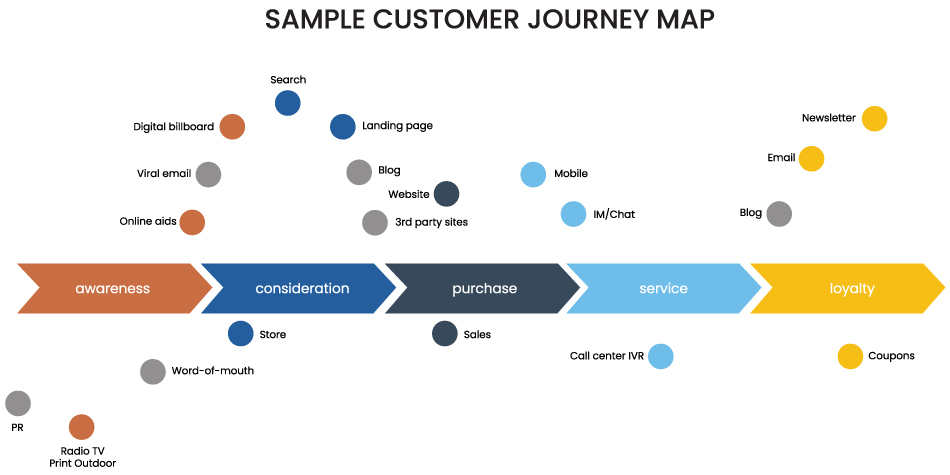
      • Start by understanding who your ideal customer persona is and what their needs are. When organizations understand their target persona they can leverage the needs of these personas to drive best-in-class messaging, content, and campaigns.
      • Once marketing understands these personas in-depth, the next step is to identify all the touch-points customers have with your brand. This is the journey a customer, prospect, or ex-customer takes with your service, brand, or product. Imagine these touch points as a visual storyline of every engagement with the brand. For example, a journey map may include how the customer first heard of you through social media or brand advertising, interactions with the product in a store, their behavior on the website, sales interactions, after-sales support over a period of time, and so on.

      Outlining your current steps, touchpoints or processes helps to visualize what the customer is experiencing in real-time and may unveil common pain points that need to be addressed. The ability to establish empathy for your customers and identify how they’re feeling at every turn is what makes customer journey mapping powerful.

      Through this exercise, you’ll also be able to connect with new buyers, existing customers, and past ones. Marketers can engage with all of them at every stage with the relevant messaging to reduce friction and provide relevant and personalized content. This not only improves customer experience, but it also helps move more customers or prospects down the funnel to sales, repeat sales, and advocacy.

    2. Build Trust with a Robust Content Strategy

      Once the journey is mapped, marketers need to build a thorough and deliberate content strategy that addresses all the good and bad points across the journey. This strategy should be persona and touch point specific, not a one size fits all.

      Start with a content strategy that is grounded in the very purpose of content marketing – creating and adding value to customers. Don’t hard sell. Rather provide a solution to a problem or offer value in the form of information. If you put out the most relevant content for your new, current and past customers depending on the persona and the touch points, it builds relevance and trust. This trust then creates repeat visits, be it in-store or online. This triggers repeat purchases and loyalty.

    3. Double Down on Your Biggest Asset: Social Media

      Social Media is an interesting channel that functions as a marketing platform and a customer service medium. But, social media accounts are owned by marketing in most companies. So why cannot CX become part of marketing’s ownership?

      When marketers own CX on social media, they can enhance the customer experience by responding quickly to questions and starting the conversation. They can use it promote content, communicate service enhancements, new products or product features, and loyalty rewards to eligible users. When done right your customers become defacto promotors who rave about your brand. This success then gets noticed by your prospects and is likely to increase your overall customer base.

      Marketers can also run integrated campaigns between email, search, and social. These can be designed in such a way that markets layout a series of personalized connects with each persona and their specific journey touch points. Using this approach marketers can share the right content and engage with the right prospects on the right channel at the right time. This strategy is a great way to move prospects and customers down the funnel to closure.

    Wrapping up

    When marketers own the CX, they have an opportunity to create a new customer base, increase stickiness with current customers – moving them towards loyalty and advocacy.

    With the connected digital ecosystem, there’s no better time than now for CMOs and their marketing teams to own customer experience. This is the golden era where marketing can own the end-to-end customer journey, from acquisition to repeat customer to a loyal advocate.

  • Marketers Can Manage Churn to Show Growth

    This article is a continuation of the one I wrote on how CMOs and their marketing team can drive organizational growth.

    As Marketing takes charge of growth, an important aspect of the business to understand and manage is your client churn.

    A common question here is: why should marketers care about churn, isn’t it customer service or leadership’s responsibility? – Wrong!

    Don’t Keep Filling a Leaky Bucket

    Lost customers impact business sustainability, and result in multifold cost incurred to get new ones. While this increases marketing budget, just covering the gap is not growth.

    Thus, it is only fair that when Marketing is tasked with bringing in new customers, they should have a say in retention too. At the very least, Marketing should influence retention along with other groups such as customer-facing teams and Sales.

    Types of Churn

    Generally, churn can be of two types- customer churn and revenue churn.

    Assume you have two customers: Customer A generates $1,000/mo. revenue and Customer B produces $5,000/mo. Your total revenue is $6,000/mo. Assume you lose Customer A. Your customer churn is high at 50%. But if you look at the dollar/revenue churn, you are at 17%, a fairly small number. You still have $5k MRR (monthly recurring revenue) from Customer B. Congratulations!

    Now, if you lose Customer B, your customer churn is still 50%, but the dollar churn is 83%. This number is big enough to give you sleepless nights.

    Imagine if you did lose Customer A (at $1k/mo. revenue), but you grew Customer B by $2,000/mo. – the total revenue now is $7k/mo. In this scenario, the revenue churn is actually negative. This is good news.

    Negative Churn Formula

    Negative churn is a powerful metric to measure your success despite the loss. A negative churn is a positive thing, and for this to happen, your additional revenue from any existing customer should be greater than the revenue lost from churn.

    Expansion

    Marketing can Control Churn

    Marketing has a lot of control over churn reduction and on expanding revenue from current customers. In fact, Marketing can help the customer-facing team and the leadership reduces churn. What is required is a deliberate strategy.

    Appropriate short and long-term nurture strategies such as content marketing and ABM (Account-Based Marketing) can help reduce churn. Marketing teams can plan and implement custom programs to the key accounts and promote the benefits of the products/services they signed up for – in a way influence why they should stay with you. Marketing can promote product features and how the product is different from competition to attract new customers. Assets such as case studies, white papers, product videos, testimonials from current customers, and other thought leadership content can help build a positive image with your current and future customers. Who does not want to be associated with a company that is making other firms in their industry successful, right?

    Other strategic initiatives could include webinars, social media, Q&As, blogs, meet-the-expert events, etc. In the post-pandemic business world, all these can be executed virtually with lower costs than large scale off-line events. You can now spending your marketing budget on customer retention and revenue growth effectively.

    Conclusion

    Your customers want to know that they have made the right decision in hiring you to help them grow. Marketing as the growth driver and one with customer insights have all the ammunition to manage churn. Thus, marketing should contribute towards and run churn management programs in conjunction with other teams such as Customer Care, Sales, and Account Management. The collective customer insights from all these teams are priceless and can help build a robust churn management strategy.

  • Chief Marketing Officers, You Own Organizational Growth

    According to Mckinsey, 83% of Global CEOs say that marketing can be a significant growth driver in their organization. This is great news for the Chief Marketing Officers (CMOs).

    But don’t pop the champagne bottle just yet! Only 23% of CEOs feel that marketing is delivering on that plan. Ouch!

    Like it or not, the responsibility to fix this is squarely on us marketers.

    So how do marketers drive growth?

    It starts by (1) recognizing that the role of marketing has indeed changed and (2) taking on accountability for the entire customer journey.

    Let’s deep dive into these two areas.

    Consumers Have Redefined Marketers’ Role

    During the pandemic, offline interactions and transactions moved to digital touchpoints at a shocking pace. And there are no signs of this abating.

    As a result, we are in the midst of a new era of consumer expectations. To cater to this demand, large and small companies have already moved, or are fast-moving, to digital experiences for their customers.

    This change is forced upon us by consumer behavior. Given marketing’s close proximity to the consumer, the impact on it is also most widely felt. As a result, the role of Chief Marketing Officers (CMOs) and their teams is changing fast.

    80% of respondents to the 2021 CMO Spend Survey by Gartner indicated that they are solely responsible or play a leading role in their company’s digital business transformation strategy. According to another report from Capgemini Research Institute, CMOs’ responsibilities are shifting. Approximately 76% are now responsible for contributing to business growth and 74% for data and technology.

    These new-age demands of a CMO and her team are a far cry from the traditional roles. A CMO needs to get into the driver’s seat and orchestrate the change, many times with the risk of ruffling feathers of other C-suite leaders.

    Additionally, to deliver to the consumer expectations in an always-connected world, marketers need to own the end-to-end consumer journey, from the first touch to loyalty and advocacy. Thus, CMO and her teams’ concerns need to shift from just marketing to the challenges of orchestrating customer-centric complex journeys.

    This brings me to my second point about what marketing needs to own and is accountable for.

    Accountability: Kill “Lead-Gratification”

    To be successful, CMOs need to go to the heart of the organization to expand the role marketing plays. To do so, they need to free the organization and the marketing department of what I call the “lead-gratification” culture.

    In this culture, marketing thrives on the lead volume from in-bound and out-bound tactics. Marketing hits its lead targets based on some qualifying criteria like industry type, title, or some other parameters. From here on out sales chases these leads. The CRM systems get updated regularly with the lead or contact status.

    On the surface, the performance looks great. But a look under the hood will show that despite the hefty marketing spends and the volume of leads, there isn’t enough revenue coming in to keep the business afloat in the long run, i.e. the lead-to-customer rates are not optimal.

    Unfortunately, this culture not only plagues the marketing and sales teams, but also the leadership. When the growth conversations about revenue, profits, customer satisfaction, and retention are missing in the leadership meetings or in the boardroom, it is an organizational issue. This culture has to change.

    Why Should CMO’s be Accountable for this Cultural Change?

    In the digital ecosystem that consumers now buy-in, marketing has become less about empowering sales with leads and some collateral to chase these leads. Marketing, now more than ever, is about working together with sales, product, finance, customer success, and offline teams to define the consumer journey touchpoints and tackle real customer pain points. Marketing can now own and demonstrate success to help educate, guide, and navigate the consumer through the entire buying process.

    To be the growth drivers, the CMO and her team need to go beyond just marketing-related metrics such as branding, engagement and leads. Marketing needs to own business metrics that offer insights into the company’s performance and marketing’s impact on the overall business. All KPIs—such as customer experience, churn, customer lifetime value, recurring revenue, and customer retention—need to be the metrics that marketing owns. This is the only way marketers can meet the demands of the CEO and become the growth drivers.

    Conclusion:

    The pandemic-driven behaviors changed customers’ engagement with brands. This forced firms to relook at how each function added value to the customer and the organization. Marketing was no exception.

    To adapt to the new reality and be agile, CEOs and the rest of the C-suite need to accept that the scope of marketing has already expanded. Marketing can no longer be a cost center but needs to be treated as a growth driver.

    These times offer great opportunities to CMOs and marketers to grab the reins and drive organizational growth. This is not going to be easy as it starts with changing the core culture within the firm and the marketing teams. It is incumbent upon marketers to ensure that the growth conversations keep happening in the leadership meetings and the boardroom and it is marketing that leads from the front.

    1. https://www.mckinsey.com/business-functions/marketing-and-sales/our-insights/marketings-moment-is-now-the-c-suite-partnership-to-deliver-on-growth

    2. https://marketingtechnews.net/news/2021/oct/12/three-quarters-of-cmos-are-contributing-to-business-growth/

  • How Can Links Strengthen Your SEO Strategy?

    “Link” is one of the most important terms used to refer to a relationship. A link simply means “something that connects”; a connection between two things or events, especially one that influences the other. The meaning itself makes links an integral part of anything that needs to be connected.

    When it comes to SEO, there is a lot to think about: content, keywords, rankings, analytics, links and much more. In this article, we will focus on the importance of links, and we’ll look at both internal links and external links.

    Internal Links

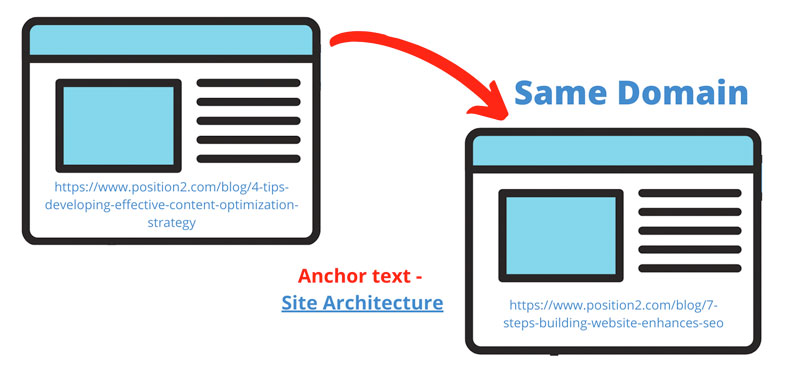
    A website is a collection of web pages that are connected. An internal link is a link on a web page to another page or resource on that same website or domain. The connection of two pages via an internal link provides search engines with details about the structure and hierarchy of a website.

    Internal links help search engines with the context to understand what the page is all about, how it is related to other pages and it’s prominence on the website. Hence, internal linking is an essential element to keep in mind when creating your SEO strategy.

    Google (and users) will not find pages on the website unless they are linked or connected. Google uses internal links to find new content on the website. The main motive of an internal link is to aid navigation.

    Passing Link Authority

    Apart from being a connector, internal links help in passing link authority between pages and improve rankings. When one page links to another, it passes a bit of its credibility to that page, increasing the possibility of the second page to rank. This credibility is frequently referred to as “link equity” or “link juice”.

    Page authority is significant since it relates to the success of the individual page. The home page will often have the most authority in comparison to other web pages. So it is critical to link strategically from the home page to important pages that need some link juice to improve their authority. Add internal links wherever they will benefit your readers. Internal linking requires a user-centric approach to add value and information.

    Google considers internal links as an integral part of a webpage. According to John Mueller, Google checks the click-depth of pages to find the most important pages on a website. Pages that are closer to the home page are more important than other web pages. A good internal linking strategy makes sure that the important pages are closer to the home page. At the same time, Google claims that using too many internal links on the same page can dilute their value. Hence, web pages must be linked strategically and resemble the website structure.

    Internal linking strategy is one of the most underrated SEO strategies that work wonders when planned and executed well. Maximize the power of your internal links to improve user experience and expedite crawling process.

    Effective Internal Linking Strategies Image – Internal Link

    Effective Internal Linking Strategies

    We recommend three internal linking strategies:

    • Create a lot of content – Internal linking is a powerful SEO strategy that is much easier to do if you have a lot of content. So, get busy creating a full content calendar, starting with blog articles.
    • Create content clusters – Content clusters are when you “cluster” related content around a central pillar page and internally link your cluster pages back to the pillar page. Content clusters are great for increasing search visibility and building authority and influence for your business in the eyes of search engines and visitors. They use a topic cluster model that focuses on topics rather than keywords which is considerably more valuable in the long run.
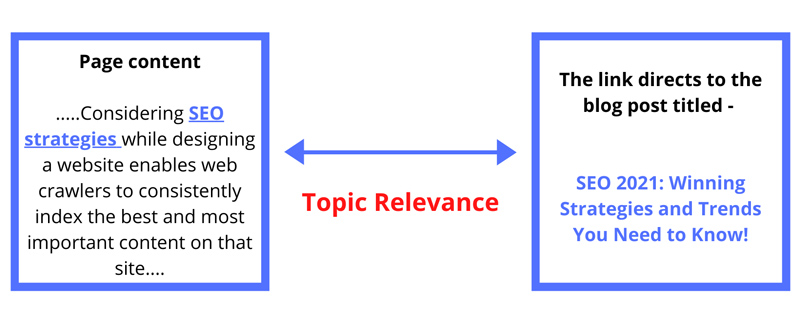
    • Use relevant anchor text – The term “anchor text” refers to the clickable text that is used to link web pages. Anchor text are words/text that you click to navigate from one web page to another. They are the hyperlinks that are usually blue in colour. Google uses anchor text to determine the context of a link. Anchor text should be relevant to the web page it is linked to.
    Use relevant anchor text

    There are various types of anchor texts that you can use. The most popular ones are:

    1. 1. Branded – Branded anchor text is a straightforward use of the brand name. They can be a combination of the brand name and relevant keywords.
    2. 2. Generic – Generic anchor texts are irrelevant terms that are generic in nature. Example – Click here, Know More, Read More etc,
    3. 3. Exact Match – The anchor text is considered “exact match” if it contains a keyword that corresponds to the page to which it is linked.
    4. 4. Related – Related anchor text is a variation of the primary keyword. They are similar to partial match anchor texts. They are a mix of relevant keywords and generic terms. For example, Enhance your SEO strategy
    5. 5. URL or Naked – A website URL in the form of an anchor text is known as a naked anchor text.
    6. 6. Article or blog post name – Hyperlinks that are the same as the article or blog post it links to.
    7. 7. Image – Clickable images are known as image anchor texts and are not recommended.

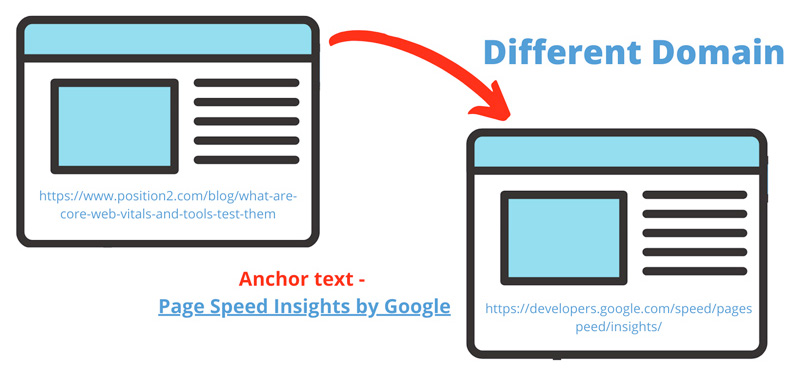
    External Links – External links are links that direct to a page on another domain. External links are an important ranking factor because they are considered as third-party votes. External links are a source of additional information that navigates the user to another domain. External links are more powerful than internal links as they pass the link equity from other websites and help in improving domain authority. Popularity and relevance are the two most important factors when it comes to linking to an external source.

    External Links Image – External Link

    Conclusion

    Internal links are crucial for SEO as they:

    • Help to speed up the crawling process for search engine bots
    • Ensure that users have a seamless navigation

    External links are pivotal, because they:

    • Extend link credibility from other sites
    • Help improve domain authority
  • Are Google’s Zero-Click Searches a Threat for Marketers?

    Are Google’s Zero-Click Searches a Threat for Marketers?

    Many marketers, especially SEOs, see zero-click searches, (searches that do not end up with people clicking on anything in the search results) as problematic.

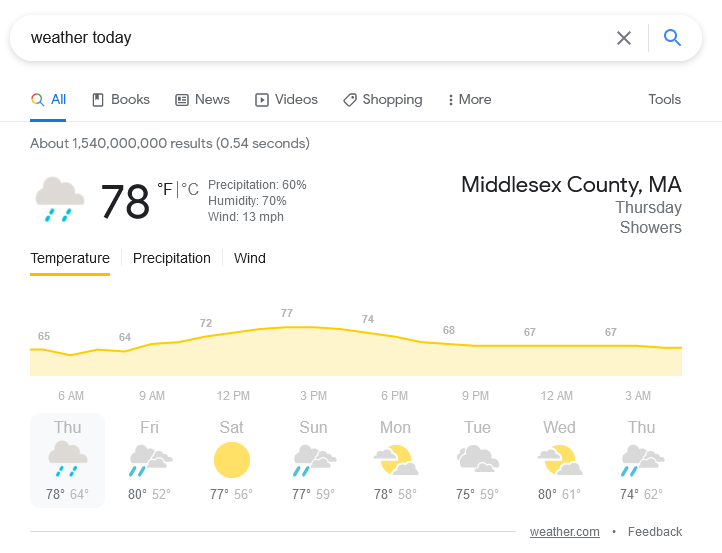
    Searching Google for information about the weather, election results, my dental office’s contact numbers, the answers are right in front of my eyes -meaning that I don’t need to scan through the snippets, click a result, or check through the content to find the answer.

    Zero click searches in google
    Zero click search weather results

    While this is definitely a handy development for users, SEOs are concerned, because SEO is all about getting traffic to the website/webpages from Google or another search engine.

    What Is the Controversy About Zero-Click Search?

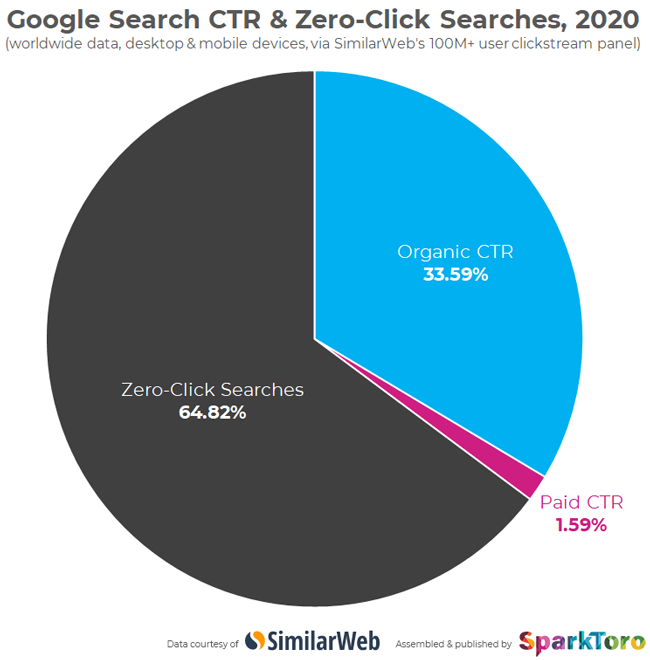
    SparkToro, in its recent blog post, said that, when SimilarWeb analyzed 5.1 trillion Google searches in 2020, they found that only 34% of the searches resulted in clicks. But Google contested these findings, saying that its search engine has increased visits to websites every year.

    Zero click search analysis by sparktoro

    For example, SparkToro said that fewer clicks are going to websites. But Google claims that its search engine has increased visits to websites every year.

    Here are some details from the SparkToro study:

    • SimilarWeb analyzed ~5.1 trillion Google searches in 2020
    • These searches took place on the 100M+ panel of mobile and desktop devices from which SimilarWeb collects clickstream data.
    • Of those 5.1 trillion searches, 33.59% resulted in clicks on organic search results.
    • 1.59% resulted in clicks on paid search results.
    • The remaining 64.82% completed a search without a direct; follow-up click to another web property.
    • Searches resulting in a click are much higher on desktop devices (50.75% organic CTR, 2.78% paid CTR).
    • Zero-click searches are much higher on mobile devices (77.22%).

    Twitter exploded right after this, and relatively several discussions happened. Followed by this, Google released a blog post claiming that the study wasn’t reliable for the following reasons:

    • People reformulate their queries.
      • People don’t always know how to word their queries when they begin searching. They might start with a broad search, like “sneakers,” and, after reviewing results, realize that they actually wanted to find “black sneakers.”
    • People look for quick facts.
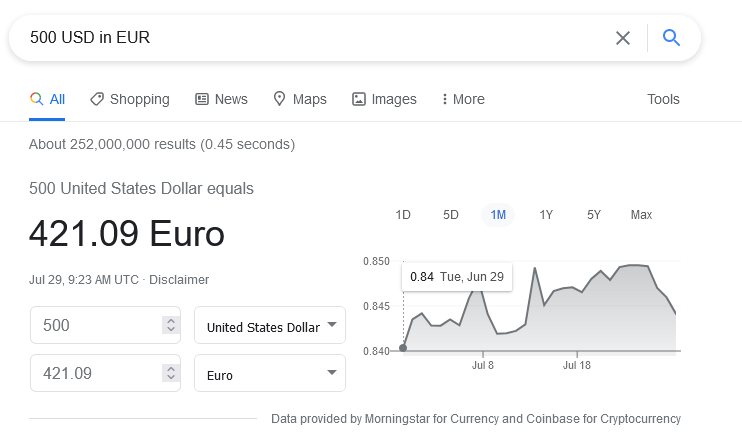
      • People look for quick, factual information, like weather forecasts, sports scores, and currency conversions.
    • People connect with a business directly.
      • People might search for business hours, then drive to the store after confirming a location is open. Or they find restaurants on Google and call for information or place an order, using listed phone numbers.
    • People navigate directly to apps.
      • If you search for a TV show, you’ll see links to various streaming providers like Netflix or Hulu. If you have that streaming app on your phone, these links will take you directly to the app.

    All of this suggests that more information is being distributed in relevant zero-click answers.

    Where does Google obtain the answers in its SERPs that deliver users the information they need, so they do not need to click further (i.e., the search ends up with zero click-throughs)? The answer is straightforward – website content and content marketing.

    So How Can Websites Benefit from Google’s New “Zero-Click Search”?

    Start with Website Content

    Examine the content of your website. Make sure it is relevant, unique, and of editorial quality. Does it answer the critical question of “Why would I choose this business?” Does it address all the crucial questions and concerns of your customer segments? Do you have detailed descriptions of your services and products?

    Frequently Asked Questions (FAQs)

    FAQs are components of the website content that have earned importance in the era of mobile search and voice assistants. Prospective customers appreciate the valuable information they can find in FAQs. It allows them to find a quick, well-formulated answer to questions they might have.

    Schema Markup

    Schema markup helps search engines understand websites’ content and intent, especially dynamic content elements such as events and happenings pages, special offers, opening hours, star ratings, FAQs, and videos.

    Accelerated Mobile Pages (AMP)

    Do you publish blogs/content assets very frequently? Are you running a news portal? Is your business getting a lot of visitors via mobile devices? – If your answers are “YES,” AMP is the feature for you. AMP increases visibility and creates an extra access point to improve mobile visitors and bookings/actions and provide another chance to outperform the competition.

    SEO KPIs and Zero-Click Searches

    Okay, we have seen enough about what a zero-click search is. How can you leverage it? How can you optimize for zero-click searches?

    If you’re trying to optimize for zero-click searches, do traditional SEO KPIs make sense? The answer is a big NO. You will want to modify your SEO KPIs to align with zero-click searches.So, what should SEOs care about? What KPIs to track and monitor while optimizing for zero-click searches?

    If you are aiming for a “featured snippet,” your KPI should be tied to impression share.

    1. Track search impressions from GSC for the LPs that you optimize for zero-click searches.

    1. a. Look at LPs that rank high (typically position 1) and drive many impressions but don’t have enough clicks.
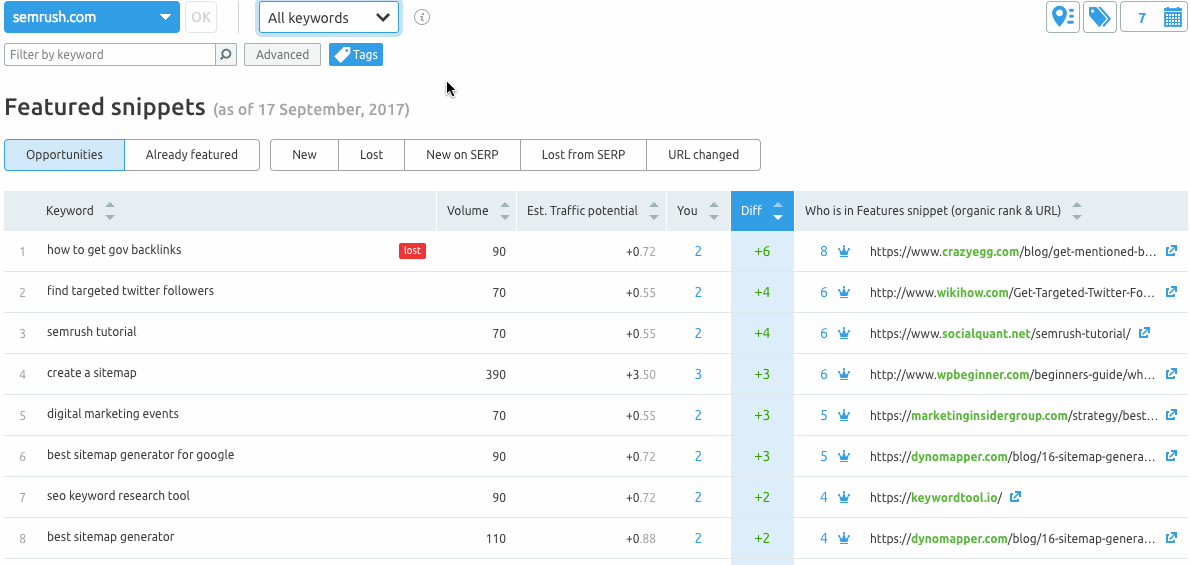
    2. b. Use tools like Semrush to track keyword position for the specific LPs. Their position tracking tool comes in handy for tracking featured snippets.
    Featured snippets tracking in semrush

    2. If you’re into local SEO, the zero-click search behavior can be overwhelming. Here are the three significant segments where the zero-click search can happen:

    • Direction-oriented searches: These are searches for places, locations, and businesses. These are almost always local and often carry tags like “near me” or “open now.”
    • Database-oriented searches: These are searches for dates, times, currency, math, or any other small snippet of information that Google can quickly answer.
    • Dictionary-oriented searches: These are searches for names, places, things, or anything that can be answered by a dictionary, thesaurus, or encyclopedia.
      1. a. Using dynamically changing phone numbers for specific channels with call tracking services, you can have precise data on how many people call your business. Most providers give full-funnel data like how many called your business, how many are existing customers, how many are new customers, and how many have made an appointment/action.
      2. b. Are you a small business owner and do not have the budget to invest in call- tracking services? Google My Business is adding a call history module that is currently in BETA for logging recent calls from searchers. Here is the extract from the GMB help page.

    “You can use call history to keep track of phone calls from your customers on Google Search and Maps. Your needs are all in one place to help you respond to missed calls and stay engaged with your customers.

    These calls may make it easier for you to find and do business with customers who found your business through Google. Any calls you get from your Business Profile will start with a short message that lets you know it’s from Google.”

    Conclusion

    By becoming creative and adding more in-depth value to the content you create, you can place your website in a strong position. SEO is all about adaptability. Google is sure to focus on its users’ stickiness as you care for your visitors’ stickiness on your website. Let the smart play game begin!

  • Personas Vs Personalization

    Personas Vs Personalization

    Getting the Most Out of Personas and Personalization

    As marketers, why do we love buyer personas? Because we believe they will help us get more sales. We understand that personas are one of the first things we need to pay attention to when we’re creating a campaign. We know that aligning personalized content with our personas can make a big difference.

    Because of the digital revolution, personas don’t provide marketers with as many benefits as they used to. In this article, we will explore how to get the most out of personas and how to use them to create top-quality personalized content.

    The Ins and Outs of Personas

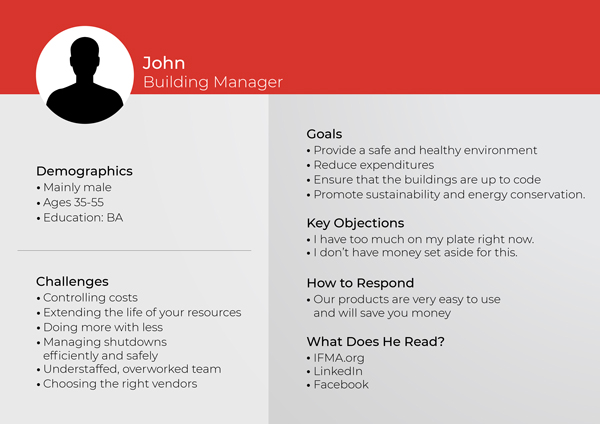
    Personas give you a theoretical look at who your target audiences might be. They help create a lens through which you can view products or services from the perspective of real people. They help you build empathy and customer centricity. They personify needs and requirements.

    Many people ask whether personas are the same as segmentation. The answer is that they are related. SAILTHRU says that “Market segmentation identifies pieces of your audience based on broad commonalities like geography, profession, or marital status, while personas are highly specific representations of particular individuals within segments.” They say that segmentation is appropriate for high-level planning, while personas are appropriate for more tactical campaigns. For the purposes of this piece, we will stick to personas.

    Let’s look at two examples. First, let’s look at an industrial fan company. This company would be likely to identify three personas: facilities managers, architects and business managers. The brand would come up with archetypal characteristics, including age, gender, job title, type of company they work for, education, hobbies and watering holes (where people go to get information) to help their content marketing and design teams provide a good customer experience for these audiences.
    Core Web Vitals

    For a second example, let’s look at a software-as-a-service (SaaS) company. A SaaS company might use these personas: users, managers/decision-makers and CFOs. Again, they would identify characteristics associated with each of these audiences.

    Creating personas is a valuable practice from the perspective of understanding your target customers. Here are a few things to look out for to make sure your personas are as helpful to you as possible:

    • While demographics like age and hobbies are helpful, they typically don’t align with how a person chooses to buy. As a marketer, it’s much more important to focus content and design on behavior than on demographics. Devote more attention to what people do (or don’t do), not to who they are.
    • Avoid using persona-based marketing as an excuse to dump a bunch of content on your target audience. You want to engage with your audience, responding to their needs, rather than just one-directionally assuming their needs.
    • Use data you collect to strengthen your personas. Having a good marketing automation solution is necessary to do this.

    The Ins and Outs of Personalization

    Today’s customers are demanding more from companies. They expect:

    • Products, services and information that address their needs and desires
    • Engaging website experiences that cater to them as individuals

    They want to feel remembered, understood and in control.

    These customer demands clearly point to the need to deliver personalized experiences.

    So how do you go about delivering personalized experiences? You start by recognizing that personalization starts with data. Using an AI-driven strategy, you can predict what someone will view or buy based on what they interact with over time. Especially when you leverage AI in e-commerce, you can easily predict what someone will view or buy based on their past interactions.

    The closer you come to a 360-degree understanding of your customer, the better. This means integrating big data coming from the web, mobile, social media, email and in-person channels.

    Once you analyze your data, you have a better understanding of how your ideal customer engages and shops for your products throughout the buyer journey. With the right data, marketers can understand what resonates and drives behaviors.

    When devising a personalization strategy, it’s important to think about the customer first, not about your products and services. Only then can you create tailored, value-added messages and incentives targeting your audience seamlessly across channels.

    Why Is Personalization So Valuable for Your Target Audience and You?

    Personalization enables your target audience to see the products, services and information that they care about in a personalized way that feels close to a one-on-one experience.

    Personalization lets you target the proper audiences, generate brand loyalty and increase engagement and conversions.

    Using Personalization to Take Your Marketing to a New Level

    You will start by developing detailed personas and then use these to move on to personalization, where you target your customers with one-to-one, actionable campaigns.

    When you treat people like individuals, they will feel the difference and be more responsive to your marketing campaigns, giving you better sales and loyalty.

    A Day (or Week or Month) in the Life

    Start with Functional Attributes: In the beginning, as is the case with most relationships, you know very little about the person (or target audience) you’re dealing with. The attributes you want to focus first on are the functional attributes of the person, including their role, their title, their position on an organizational chart, the business unit they are a part of, and a few firmographic details about the company such as company revenue, number of employees and locations.

    Follow This Up with Emotive Attributes. These include the initiatives the person is working on, their greatest challenges and their most important needs. It’s also important to understand their lexicon. For example, if you’re talking about managing student careers, will talking about an ambassador program have any meaning for your target audience?

    Next, Look at Decision Process Attributes. The buyer role, the level of engagement and the decision drivers (financial, operational, strategic) are key.

    Finally, Look at Behavior Attributes. Here, you’re looking at engagement with different types of assets, interaction-type preferences (reading vs. video vs. webinar) and favorite watering holes.

    You’ll provide email addresses to an augmentation application such as LeanData or ZoomInfo, who will then provide you with much of this data.

    Once you have the data from the augmentation application, you will put it in your automation platform. You will then segment it to qualify different personas. For example, you might clump all of the CIOs together. Your next step will be to build messaging for this target audience and determine which content types will work best. Once you have campaigns, you will use automation to build multiple levels of personalization (e.g., using their name, talking about the type of company they are working for and answering the emotive attributes in a way that addresses their needs and challenges) in a language that is well suited to them.

    If you would like to discuss how Position2 can help you out with personas and personalization, please reach out to us at personalization@position2.com. Thanks.

  • What Are Core Web Vitals and the Tools to Test Them

    What Are Core Web Vitals and the Tools to Test Them

    With Google announcing the inclusion of Core Web Vitals as part of ranking factors for search, it is essential to understand what they are and how Core Web Vital elements determine the speed, responsiveness, and elements on a page that contribute to the user’s experience.

    What Are Core Web Vitals?

    Having a website optimized for a seamless user experience is always crucial for anyone concerned about the optimum functioning of the website. Any business would want its customers to get the best experience when they visit their website.

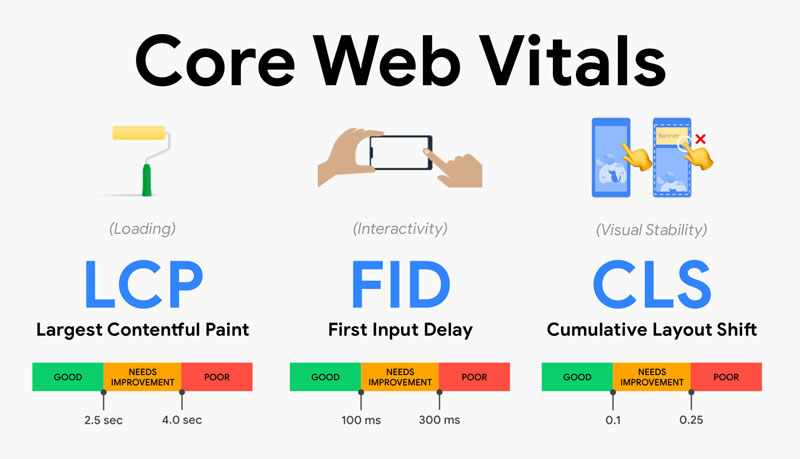
    Core Web Vitals are distinct factors in the user experience journey. They include loading speed, page interaction, and visual stability and are measurable with the help of the below metrics:

    – Largest Contentful Paint – Loading Speed
    – First Input Delay – Page Interaction
    – Cumulative Layout Shift – Visual Stability

    Core Web Vitals

    Courtesy: Akshay Ranganatha’s Blog

    1. Largest Contentful Paint

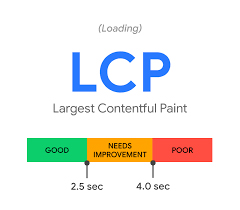
    One of the first factors that determines a user experience on a page is how long it takes for a user to see any content rendered to the screen. Largest Contentful Paint primarily measures the loading speed of the page by measuring the time it takes for a page’s main content to load. The threshold for a good LCP is considered to be 2.5 seconds. Anything faster than that is ideal.

    Largest Contentful Paint

    2. First Input Delay

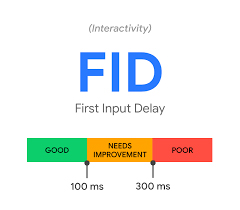
    FID measures the time it takes for a page to be interactive or the time it takes for the first interactive element on a page to become active for the user to interact with. This element can be a clickable button or a link. In order to provide a good user experience, sites should aim at achieving an ideal FID measurement of less than 100 milliseconds.

    First Input Delay

    3. Cumulative Layout Shift

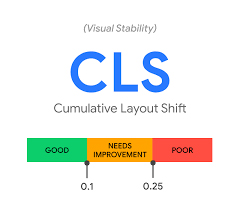
    CLS measures the shift that occurs whenever there is a visible element changing its position from one frame to the next throughout the session of a page. These shifts happen when existing visual elements change their position on the page. A good CLS score for a website is 0.1 or less.

    The calculation of the layout shift shift score consists of two essential elements, namely, impact fraction and distance fraction. Below given is how the score is calculated:

    Layout Shift Score = Impact Fraction x Distance Fraction

    Impact Fraction: The impact fraction of a frame is the fraction of the viewport that is occupied by the impact region.

    Distance Fraction: Distance fraction is the measurement of movement by in-frame elements, relative to the viewport.

    However, recently, Google has found out flaws in the way the score was calculated. Pages that were open for a longer time achieved a lower score. These changes however will not impact the scores in an unpleasant way.

    According to Google, around 55% of web pages will not see a change in their cumulative layout shift scores followed by 42% pages that will see a marginal increase in their current scores. The remaining 3% web pages that are slow to interact, will show up as ‘good’.

    Cumulative Layout Shift

    Core Web Vitals – Tools and Reports

    There are two kinds of tools available online to get insights about your site’s Core Web Vitals scores. It is essential to understand what the differences are between these two types:

    – Field Testing Tools
    – Lab Testing Tools

    Field Testing Tools

    Field testing tools always measure the Core Web Vitals elements by involving user experience. The insights or the report that you see using field testing tools allow you to precisely see the Core Web Vitals metrics for your website. Note that First Input Delay (FID) can only be measured through an on-field testing tool, not through lab testing tools. Here are two good fields testing tools:

    Page Speed Insights by Google
    Web Vitals

    Lab Testing Tools

    Lab testing tools are mainly used when a page is under development. These tools provide a set of standards and thresholds that allow one to understand the best possible options for the page. You can also figure out the time for which your website was blocked and didn’t allow user interaction. Two of the most popular lab testing tools are:

    Lighthouse
    Chrome DevTools

    Conclusion

    Core Web Vitals are evolving, as Google continues to emphasize the importance of giving the user the best experience. The quality of experience is certainly going to be a crucial factor that will determine the ranking amongst competitors. Site owners, therefore, need to check and analyze their websites to understand opportunities to optimize their pages for Core Web Vitals for a better and seamless user experience.

  • 4 Tips for Developing an Effective Content Optimization Strategy

    4 Tips for Developing an Effective Content Optimization Strategy

    “Content is king.” We’ve heard this many times. Why is content so important? Content is the most powerful catalyst for strengthening a brand’s digital presence and positioning. High-quality content helps build brand reputation and relationships with customers.

    Creating great content adds value to your business in a number of ways. So, it is an extremely important aspect of marketing. But will your best piece of content reach your target audience? To make sure that the content reaches the largest possible target audience, we need to optimize it.

    Content Optimization is the process of making your content as effective as possible. Optimization ensures that your content is crawlable by search engine bots and formatted for user consumption. It is about making sure that search engines understand what your business is all about and your content is shown to the users who are looking for it. Content is critical for SEO because, without it, search engines will not have enough information to index your pages and help you rank on SERPs.

    Let’s see how to optimize content that will help drive traffic to your website and inevitably lead to conversions.

    1. Create content that will add value to your audience

    Google prioritizes context over content. Matching the user’s intent is one of the cornerstones of content creation. Therefore, writing content that a user is looking for is more important than writing on a specific topic to start with. Follow these four steps to help you build content that is SEO friendly.

    • Shortlist relevant business keywords and create a buyer persona that will help in writing the content as per the searcher’s intent.
    • Map the shortlisted keywords to your buyer persona.
    • Understanding ambiguous intent, informational queries, local queries, transactional queries, navigational queries etc. will make it easier to have a proper content structure in place.
    • Start adding supporting content revolving around the topic clusters.

    The key is to create content that your target audience would want to consume. Write content that resonates with their wants, needs, and pain points. Providing tangible value to your audience that will help them benefit or solve something is an effective style of writing.

    2. Maximize your keyword footprint

    Optimizing content for keywords does not mean adding as many keywords as possible. Have a proper keyword strategy in place and work out variations of the seed keyword/primary keywords. Recognize that:

    • Primary keywords mostly consist of one or two words. Build your content around the seed/primary keyword and then optimize it for related keywords.
    • Related/secondary keywords are terms closely related to the seed keyword. They elucidate the content in a way that cause search engines to better understand, categorize and rank. They help in giving signals to Google regarding the context of the webpage.
    • Prioritize adding one or two long-tail keywords that match the intent of your reader. Long-tail keywords are longer queries that focus more on a niche, are less competitive and have a higher conversion value.

    In this way, perfectly optimized content is built with a combination of primary, secondary and long-tail keywords that are thoughtfully spread across the page.

    3. Craft compelling and relevant heading tags

    Add value to the content by organizing it in a systematic way. The look and feel of the webpage will contribute towards good user experience. Header tags indicate hierarchical levels of information and are typically chosen by Google for featured snippet ranking. A web page may have multiple headings. Add relevant heading tags to divide subtopics that give meaning and provide structure to your content. By adding header tags, you are informing users and search engines about the various segments of content and what each segment is about. The header tags are the first thing people usually read as they scan through the page before reading the content. When considering ranking for variations of keywords on a specific subject, they play an important role in ranking long-tail keywords.

    How to optimize the header tags

    • Follow the hierarchical structure of tags, starting from H1 (heading 1).
    • Maintain the seniority level of each header tag and make sure that each page has only one first-level heading (H1).
    • Each header provides valuable information about the page to users and search engine bots.
    • Heading level two through six should ideally follow the first level heading and should be placed in a sequential order that describes the main topic of the content.
    • Include the primary keyword in H1 as it also acts as the title of the page.
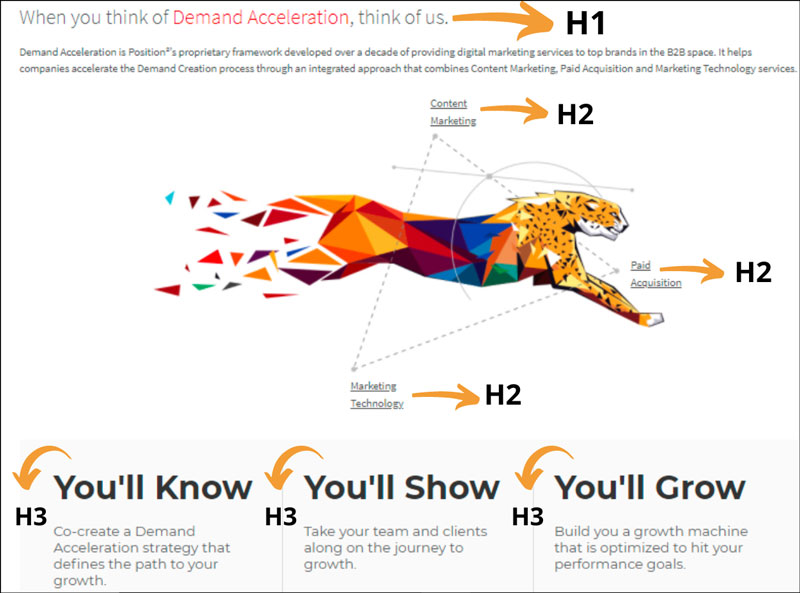
    Heading Tag Example Screenshot

    Image Source – https://www.position2.com/demand-acceleration

    See the above image from Position2 website for best usage of keywords in the heading tags.
    Primary Keyword – Demand Acceleration is in Heading 1
    Related/secondary keywords – Content Marketing, Paid Acquisition and Marketing
    Technology are Heading 2 tags
    Creative catchy terms are placed as Heading 3 tags.

    4. Get your linking strategy right

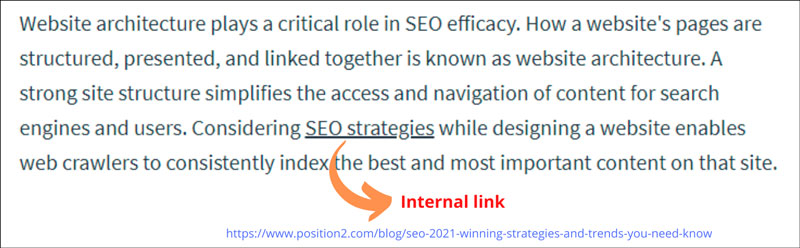
    A linking strategy is a plan that you devise and put into action to help you organize, optimize and track your links. Internal linking is the process of linking your relevant pages or blog posts using relevant descriptive contextual anchor text. Anchor text gives hints to users about the content to which it is linked to.

    Search engines use anchor text to determine the context of the linked page and then index and rank it. Internal linking not only helps in connecting your webpages, it also gives Google an idea of the website structure. Internal links are very effective in defining the site architecture and spreading link equity.

    Internal Link Example Screenshot

    Image Source – https://www.position2.com/blog/7-steps-for-building-a-website-that-enhances-seo/

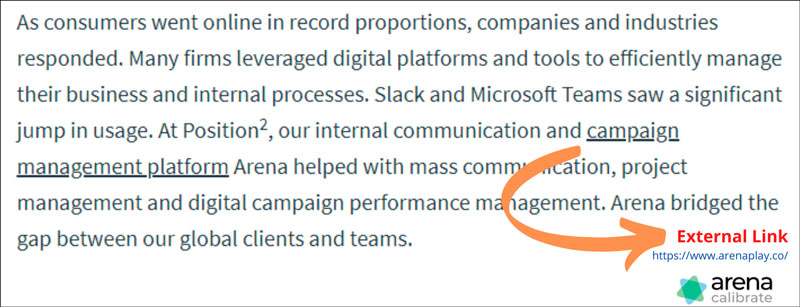
    An external link is a hyperlink that takes the reader to a reliable page on another website. Linking to credible content makes you appear to be an authority and will help Google determine what your content is about. The quantity and quality of the external links are important, so include links from trustworthy, informative and high-quality websites. External links are more valuable if they point to relevant websites that are popular, highly ranked and related to the content on your website.

    External Link Example Screenshot

    Image Source – https://www.position2.com/blog/marketing-2021-three-trends-that-will-define-the-year/

    The value of your content is determined by the quality of what you offer. You need to give your audience content that they can relate to. It takes time and effort to achieve organic search visibility, rankings, and traffic but that can be achieved by creating a strong content optimization strategy. Make your website pages more appealing to search engines and users by optimizing its content. The key to ranking higher is to create incredible optimized content that gets linked naturally and enables you to still say that “Content is king.”

  • Mobile-First Indexing – All Your Questions Answered

    Google has been shifting towards a mobile-only approach for indexing the content, ranking the indexed content, etc. This exercise started right before 2018. According to Google, 70% of the websites have already shifted into mobile-first indexing.

    Mobile-first indexing was supposed to happen in September 2020. Considering the uncertainty the world has faced, the algorithm update is rolling out this month, meaning it’s time to ensure your website is mobile optimized and not just mobile-friendly.

    Semrush has published a recent study on how mobile and desktop trends have taken shape in recent years. Here are some key findings:

    • In 2020, 66% of all site visits came from mobile devices.
    • Only 17% of websites retained their positions across both mobile and desktop SERPs.
    • 37% of URLs dropped out of the top 10 when the search query was made from mobile.

    What are the implications of these trends? How does mobile-first indexing impact your go-to-market strategy?

    What Is Mobile-First Indexing?

    Let’s start by making sure we’re all on the same page. Google historically looked into the website’s desktop version to index content and rank it for relevant search queries from users. After the mobile-first indexing algorithm rolls out, Google will ONLY consider your website’s mobile version to index and rank content. They will ignore the desktop version of both existing and new websites.

    In the meantime, Google has also started moving sites to mobile-first indexing when their systems recognize that they’re ready. Many of you are realizing that Smartphone crawlers have become the default crawler for your site. This can be verified by looking into your Google Search Console/website log files.

    How Can I Prepare for Mobile-First Indexing?

    Are you running separate websites for desktop and mobile?

    https://example.com/ – Desktop Version
    https://m.example.com/ – Mobile Version
    https://example.mobi/ – Mobile Version

    If you follow website structures like above, wait no further! Make a responsive website that enables web pages to render well on a variety of devices, windows, and screen sizes. Having a separate desktop version is not going to help, at least with Google.

    Are Your Mobile and Desktop Version Identical?

    It is a reason to rejoice! You are not duplicating it; this is what Google recommends websites do. Identical is not just about the content, it also includes navigational links, structured data, metadata, OG tags, XML sitemaps, resources (JS, Video, Images, etc.). Removing one small element (e.g., email opt-in) might not have any significant impacts. However, removing large chunks of content or features, believing it will reduce long mobile layouts and scrolls, may negatively affect your site.

    Is It Enough to Have a Responsive Site that Is Identical on Desktop and Mobile?

    Not really. Especially when you want to improve performance further. Focus on page speed. Build/improve a website that loads faster and provides a better experience for users and bots. Think of AMP if you have a content-focused website (blog/news portal, etc..). Anticipating Core Web Vital being added to Google’s algorithm this Spring, don’t forget about the website UX factors!

    I Don’t Have a Mobile Version of My Desktop Website. What Now?

    Google will still index content from the desktop websites if you do not have a mobile version. However, you aren’t likely to compete with mobile-friendly websites, which will negatively impact your organic growth.

    How Can I See if My Website Is Ready for Mobile-First Indexing?

    Using Parito, a free, thorough mobile-first index validator, you can evaluate a single URL or multiple URLs for mobile vs. desktop HTML, word count, and JS gap.

    Wrap Up

    Hopefully, your website is already on mobile-first indexing and has nothing to worry about with the next update. If not, you may want to evaluate and fix things while you still have time. Mobile is the new normal, and it’s here to stay! Require expert opinion? Reach out, and let’s speak. Have questions/additional thoughts? Feel free to jump into the comments section. Let’s discuss/debate.!