Blog

  • What is local SEO and how to do it… well

    Local SEO: Why does it matter

    Businesses with multiple locations face unique challenges when it comes to acquiring customers through organic marketing (SEO). Each location may have the same business name, but also needs to appear in local search results as separate businesses.

    Before we dive into how to do it, let’s define local SEO.

    Local SEO is the process of optimizing a business, product, or service for location-specific keywords on Google. If you were searching for something like ‘dentist in Nashua’ on Google, you may get the below result.

    The first 3 results that show up in location-specific searches are called the “local 3 pack.” Google detects that your intent is local and serves the results accordingly. The information available on the local 3 pack, like business name, contact number, location of the business, ratings, and reviews, helps you decide and reach the business you are looking for.

    How do you target your audience based on location for a multi-location business? The answer is localized SEO.

    How local SEO works

    What are the benefits of local SEO?

    Why should businesses focus on local SEO for their multi-location storefronts/offices? Here are a few of the benefits:

    • Helps improve their local presence
    • Improves local customer acquisition
    • It boosts leads, conversions, and revenue

    How to optimize multiple locations for local SEO

    Creating a local Google My Business (GMB) listing for each of your locations can further boost your localized performance. Your business also needs a GMB listing to get featured in the local pack – a group of three local business listings that appears in response to search queries for products or services provided by local businesses.

    Here is an example of a Google My Business listing:

    Build and showcase reviews

    Reviews are an important factor to consider when you’re optimizing to rank for local results. The total number of reviews and your company’s response to both positive and negative reviews can also help improve your rankings.

    It’s a good idea to ask your customers to give a review on your Google My Business listing. These ratings and reviews can also be showcased on the location pages. A good number of positive reviews can help improve customer trust.

    Create local listings for each location

    When you’re trying to rank for location-specific keywords, your efforts don’t stop after creating a local page and GMB listing. It’s a good idea to create local citations on websites that influence the local market.

    When creating citations for your location, it’s very important to make sure you’re consistent in the type of details (name, address, phone number, etc.) for all locations. You can also make use of third-party tools like Bright Local or Synup to manage your local citations if you have a large number of locations.

    Build backlinks for each location page

    Businesses need a solid backlinking strategy to improve their local performance. Backlinks are simply links on other websites (other than your own) that link back to a page on your website. Acquiring high authority backlinks, for example from a highly visited website, can boost your performance even if your business is new.

    You need backlinks for each of the SEO location pages to improve the ranking of each page. The more backlinks you earn the more likely you boost your rankings.

    Backlinks can be built from local blogs, participating in events in the community, and other efforts that get your business featured on local websites. Networking with journalists can also get you involved in events and get published on local websites.

    Maintain NAP Consistency on all citations

    Name, Address, Phone Number (NAP) consistency means your business is consistently listed across all websites. NAP consistency is important because it can improve your search rankings. When search engines crawl the website and find an inconsistency in your NAP, it can hurt the confidence and the rankings.

    NAP consistency can easily be maintained by making sure that the details on all websites/directories are the same. You can check this by a Google search of the business name with your city. There are also online tools like Bright Local that can help you with this.

    How to measure your SEO performance for multiple locations
    The first step in tracking the performance is to identify your goals and KPIs. Although goals may differ from business to business, these are some of the important metrics which can be tracked to measure performance.

    Keywords and ranking

    The number of keywords that the local pages are ranking for is a good metric to measure the overall performance of those pages. The more keywords, the more organic traffic.

    The number of keywords for which the GMB is ranking is an important metric that can help measure the performance of the listing.

    You can measure your keyword performance on tools like Semrush or Ahrefs.

    Traffic to the local pages and conversions

    Organic traffic brings in users who are looking for a specific service in a location – it’s an effective indicator of your SEO strategy. An increase in organic traffic on your local page means your visibility has increased.

    Conversions are the number of these users who have completed a goal on your local page, like filling out a form or making a purchase. These conversions/interactions can be easily tracked with Google Analytics.

    Impressions and phone calls from GMB

    GMB impressions are the number of times your GMB appeared on searches. An increase in this number means your listing is getting more visibility and your optimization is working.

    One of the main metrics to track on GMB is the number of phone calls generated from GMB. Other metrics which can be tracked on GMB are Google direction actions and Website visit actions by the users.

    Both of those metrics can be tracked on the Insights report on GMB.

    Website health

    The health of your website affects the overall SEO of your website. An unhealthy website won’t perform well on search engines and will bring down the performance of your location pages.

    Semrush and Google Search Console are both tools that can measure your website’s health and gives you recommendations to improve your site’s performance.

    Conclusion

    Multi-location SEO is not a quick hit tactic, it’ll take some time and effort for both setup and maintenance. Once it’s in place it’ll boost your local presence and awareness.

    To get the best out of your local SEO, multi-location businesses can create pages for each location, optimize them, and create GMB and local listings to boost local awareness. Maintaining NAP consistency and generating positive reviews can also help boost performance.

    Do you have any questions on multi-location SEO or any strategy to share? Let us know in the comments below!

    FAQs on Local SEO

    What is multi location SEO?

    Multi-location SEO is a strategy to optimize a website to rank in search results for different geographical locations. Used by businesses with branches in multiple locations, it involves creating location-specific pages, maintaining consistent Name, Address, and Phone Number (NAP) information, and optimizing Google My Business listings for each location, aiming to increase local visibility and attract targeted customers.

    How do I optimize local SEO for multiple locations?

    To optimize local SEO for multiple locations, create unique location-specific pages on your website, ensuring consistent Name, Address, and Phone Number (NAP) across platforms. Set up and optimize Google My Business listings for each location, integrating local keywords in your content, and build local backlinks by engaging with local communities and businesses. The aim is to provide search engines clear information about your business locations.

    How do online reviews influence local SEO?

    Online reviews greatly impact local SEO. Search engines consider them in determining rankings, with positive reviews signaling reliability and value. The quantity and diversity of reviews, as well as business responses to negative reviews, also play a role. Additionally, reviews can incorporate local keywords, further enhancing local SEO.

    What are the common mistakes businesses make in local SEO?

    Common local SEO mistakes businesses make include: inconsistent Name, Address, and Phone Number (NAP) details across platforms, neglecting their Google My Business listing, ignoring customer reviews, not creating local content, failing to build local backlinks, not optimizing their website for mobile, and overusing keywords, also known as keyword stuffing. Each of these missteps can negatively impact local search engine rankings.

    How can backlinks influence my local SEO ranking?

    Backlinks significantly influence local SEO ranking. They act as indicators of your site’s value and trustworthiness to search engines, with local backlinks suggesting a strong community connection. However, quality of backlinks matters more than quantity, as high-quality, relevant backlinks can lead to higher rankings in local search results.

    How to track my local SEO success?

    To track local SEO success, use Google Analytics for monitoring organic traffic and keyword performance. Google Search Console helps understand how Google views your site. Track your site’s local keyword rankings using SEO tools like SEMrush or Ahrefs. Monitor insights from your Google My Business listing and keep an eye on online reviews and ratings. Lastly, check the quantity and quality of backlinks with a backlink checker.


  • Content Marketing Best Practices

    What Is Content Marketing

    Content marketing is a strategy focused on creating and distributing valuable, consistent content designed to attract and retain your target audience. This content can take various forms – blog posts, videos, infographics, e-books, etc. The key to success lies in delivering high-quality content that caters to your audience’s needs while aligning with your business objectives. Doing so can build credibility, generate leads, and raise brand awareness.

    The Value of Content Marketing

    Content marketing has become a pivotal part of contemporary business strategy and for good reasons. Here are some key advantages of content marketing:

    It helps build brand awareness

    Creating and distributing valuable content can increase your brand’s visibility and reach a wider audience.

    It establishes trust and credibility

    Creating and disseminating valuable content can increase your brand’s visibility and reach a broader audience.

    It generates leads

    By offering valuable content in exchange for contact information, you can capture leads and nurture them into paying customers over time.

    It drives traffic to your website

    Sharing your content on social media or other channels can drive traffic back to your website, increasing the likelihood of conversions.

    Overall, content marketing offers a cost-effective way to attract and retain customers while building a solid brand reputation.

    Content Marketing Statistics

    • Demand Metric reports that 91% of B2B marketers employ content marketing to reach customers, while 72% of marketers confirm that content marketing boosts engagement and leads.
    • According to HubSpot, companies that publish 16 or more blog posts monthly receive almost 3.5 times more traffic than those publishing four or fewer posts.
    • Demand Metric notes that content marketing costs 62% less than traditional marketing but generates about three times as many leads.

    Top 12 Content Marketing Strategies for 2023

    Content marketing is an ever-evolving field, and staying on top of the latest trends is crucial for success in 2023 and beyond. Here are some tips to help you stay ahead of the curve

    Your goal with content marketing is to create content that showcases your subject matter expertise and helps your prospects and customers see what makes you unique. How do you do that?

    Here are 12 best practices that will make a big difference in helping prospects and customers move through the buying cycle.

    1. Know your audience

    If you’re an email marketing company and operate under the assumption that every single company is a potential customer because every company uses email, you’re missing the boat. You’re talking so highly that nobody can relate to you. You need to define your persona(s) much more precisely. Perhaps one of your targets is chain restaurants that need to promote their brand and their individual locations.

    2. Focus on key messages

    Know precisely what you want your reader to take away from your piece. Is this a new product story? Are you addressing a customer pain point? A competitive comparison? Have you chosen a good keyword?

    3. Determine the next steps

    What do you want your reader to do next? Have a clear plan and put it clearly and enticingly in your call to action (CTA).

    4. Remember that a picture is worth a thousand words

    The primitive brain plays a huge role in customer engagement, particularly during the early stages of the sales funnel. Pictures are essential, as are relatable stories.

    Remember that a picture is worth a thousand words

    5. Pay attention to readability

    After you’ve written your piece, read it as if you’re the audience and ask yourself, “Would I read through to the end? Would this engage me?” Assuming it’s a topic that would interest the audience if you answered no to these questions, it’s time to look at the piece’s readability. Do you sound a bit standoffish, or do you speak in an inviting tone? Do you break the piece into titled sections and include some bullets to make it more readable? Do you include some personal information to help people get to know and trust you? Is your piece boring? Can you figure out how to take more risks and make the piece juicier?

    6. Create A Measurable Goal

    When it comes to content marketing, creating measurable goals is essential for success. A specific and measurable goal could be to increase website traffic by 20% within the next six months through targeted content creation and promotion. To achieve this, regular blog posts, social media updates, and email newsletters can be implemented.

    Regular tracking and analysis of website traffic using tools like Google Analytics will help determine if the goal is being met and allow adjustments to be made if necessary. Businesses can achieve their content marketing objectives and drive growth by setting a clear, measurable goal and implementing an effective strategy.

    7. Understand Your Buyer’s Journey.

    Understanding your buyer’s journey is crucial for successful content marketing. It involves identifying the different stages a potential customer goes through before making a purchase and tailoring your content to address their needs at each stage.

    By creating targeted content that speaks directly to your audience’s pain points and interests, you can build trust and establish your brand as a thought leader in your industry. This, in turn, can lead to increased conversions, higher customer retention rates, and ultimately, more significant ROI for your content marketing efforts.

    8. Pillar Cluster Content Model

    The Pillar Cluster Content Model is a best practice in content marketing. It involves creating a pillar or main piece of content, such as an in-depth article or video, and then creating multiple smaller pieces of supporting content around it.

    This approach helps to establish authority and thought leadership on a particular topic and can also improve search engine rankings by providing a comprehensive resource for users. By organizing content this way, brands can create a cohesive and effective content strategy that resonates with their target audience.

    9. Track Content Marketing Performance

    To track content marketing performance, it is essential to establish clear goals and KPIs before launching any campaigns. This will help you measure the success of your efforts and identify areas for improvement. Regularly reviewing and analyzing your metrics can provide valuable insights into audience engagement, content effectiveness, and overall ROI.

    Key metrics include website traffic, social media engagement, email open rates, and lead generation. By implementing these best practices, you can ensure that your content marketing efforts deliver measurable results and drive business growth.

    10. Provide Content For Present And Future Actions

    Content marketing best practices involve creating content that speaks to your audience and provides value and relevance. It’s essential to align your content with your business objectives and use data to inform your strategy.

    Additionally, you should focus on creating evergreen content that can be updated and repurposed for future use.

    11. Strengthen Stats Skills

    Strengthening your stats skills can significantly enhance your ability to make data-driven decisions and improve your overall job performance. Whether you work in marketing, finance, or any other field that requires data analysis, having a solid foundation in statistics is essential.

    By taking courses, attending workshops, or even just practicing with real-world data sets, you can sharpen your stats skills and become more confident in interpreting and communicating complex data. This not only benefits you and your career but also helps to drive better outcomes for your organization.

    12. Keep importance to writing styles

    In content marketing, the writing style is of utmost importance. It plays a critical role in engaging and retaining the audience’s attention while effectively conveying the intended message.

    A consistent and coherent writing style can help build brand recognition, establish credibility, and strengthen brand identity. Therefore, investing time and resources is essential to develop a clear and distinctive writing style that aligns with the brand’s values and target audience.

    Before and After Applying the Best Practices

    Before

    At Acme Manufacturing, we make the best refrigeration systems in the world. Our systems feature forced air circulation for uniform temperature at all shelf levels, heat-free defrost for maximum uniformity, and solid doors.

    After

    As a food warehouse manager, you are focused on storing and preserving your food safely, with the fewest interruptions. At Acme Manufacturing, we are committed to providing safe storage with minimal interruptions.

    Content Marketing Trends for 2023

    To improve your content marketing efforts in 2023, consider implementing these content marketing tips: creating high-quality and relevant content, leveraging new technologies such as AI and AR, prioritizing customer experience, utilizing social media platforms, and measuring the ROI of your content marketing efforts.

    1. Short-Form Video Content

    Short-form video content has become an essential part of content marketing best practices. With attention spans decreasing, short-form videos provide a quick and engaging way to communicate your message to your audience. They are easily shareable on social media platforms and can help increase brand awareness and engagement.

    2. AI and Automation

    AI and automation are revolutionizing businesses’ operations, from streamlining processes to enhancing customer experiences. By leveraging the power of AI and automation, companies can increase efficiency, reduce costs, and gain a competitive edge in today’s fast-paced digital landscape.

    To stay ahead of the curve, businesses must understand how these technologies can benefit their operations and implement them effectively.

    3. Content Consistency Is Key

    Content consistency is a fundamental aspect of successful content marketing. It helps to establish brand identity, build trust with your audience, and improve SEO rankings. A consistent content strategy ensures that your messaging is clear and on-brand across all channels and platforms, leading to greater engagement and increased conversions.

    4. User experience

    User experience (UX) is critical in content marketing best practices, as it determines how users interact with and perceive your brand. Creating a seamless and enjoyable user experience can increase engagement, build brand loyalty, and ultimately drive conversions.

    5. Human-Centered Content

    Human-centered content is a crucial aspect of content marketing best practices. By focusing on the needs and preferences of your target audience, you can create content that resonates with them on a deeper level. This means taking the time to understand their pain points, interests, and motivations and using this information to inform your content strategy.

    Whether you’re creating blog posts, social media content, or video content, the key is to put your audience first and create content that speaks directly to them. Doing so can build stronger relationships with your customers and drive tremendous success for your business.

    6. Rely On original content

    As the digital landscape becomes increasingly crowded with content, relying on original content to stand out is more important than ever. Creating original content sets you apart from others in your industry and helps you establish your brand identity and build trust with your audience.

    Original content can take many forms, including blog posts, videos, infographics, and social media posts. By consistently producing high-quality original content that resonates with your target audience, you can position yourself as a thought leader and attract new customers or clients.

    So if you want to stay ahead of the game and make a lasting impact in today’s fast-paced digital world, prioritize original content in your marketing strategy.

    Types of Content Marketing Strategy

    Content marketing best practices for businesses include using various strategies to reach their audience. Blog content establishes a brand’s expertise, videos create engaging content, social media connects on a personal level, email marketing provides direct communication with subscribers, and infographics convey complex information quickly. The choice of strategy will depend on the business’s goals and target audience.

    Infographics

    Content marketing is a vital part of any successful digital marketing strategy. One popular approach is to use infographics, visual representations of data or information that are easy to digest and share on social media. Infographics can attract attention to your brand and increase engagement with your audience.

    Blog content

    Another effective content marketing strategy is blog content. By creating high-quality blog posts that address the needs and interests of your target audience, you can establish yourself as an authority in your industry while also driving traffic to your website.

    Podcasts

    Podcasts have also become a popular way to reach audiences in recent years. By creating engaging audio content that listeners can tune into anytime, anywhere, you can build a loyal following and position yourself as a thought leader in your field.

    Videos

    Videos are another effective way to engage with your audience. Whether through product demos, educational tutorials, or entertaining content, videos can help humanize your brand and build trust with your target audience.

    Social media

    Finally, social media has become essential to any content marketing strategy. By sharing relevant content on platforms like Twitter, Facebook, and LinkedIn, you can increase your brand’s visibility while building relationships with customers and prospects. Regardless of your chosen approach, a strong content marketing strategy can help grow your business and achieve long-term success.

    Wrap Up

    Effective content marketing is crucial for businesses looking to boost their online presence and engage with their target audience. By following best practices such as creating high-quality content, leveraging social media, and measuring performance, businesses can achieve their content marketing goals and drive success. At Position2, we specialize in helping businesses develop and execute effective content marketing strategies. If you’re interested in learning more about how our expert team can help your business succeed, please don’t hesitate to reach out. We look forward to partnering with you to achieve your content marketing goals.

    FAQs on Content Marketing

    How do I identify my target audience for content marketing?

    Identify your target audience for content marketing by researching their demographics, interests, behaviors, and pain points.

    How do I measure the success of my content marketing efforts?

    Measure the success of your content marketing efforts by tracking key performance indicators such as website traffic, engagement, leads, conversions, and ROI.

    What are some common mistakes to avoid in content marketing?

    Common mistakes to avoid in content marketing include ignoring your audience’s needs, being too promotional, producing low-quality content, and not measuring the results.

    How do I distribute my content for maximum impact?

    Distribute your content for maximum impact by using a multi-channel approach, leveraging social media, email, influencers, SEO, paid advertising, and other tactics that fit your audience and goals.

  • Why UI and UX are crucial for SEO?

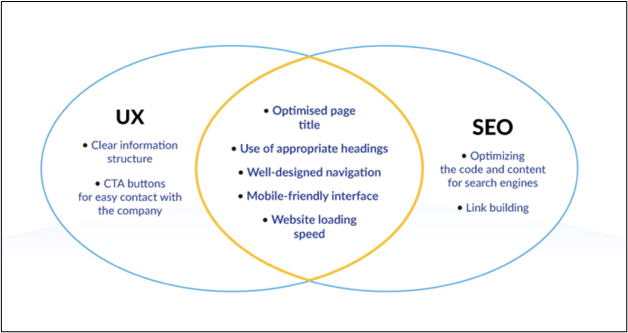
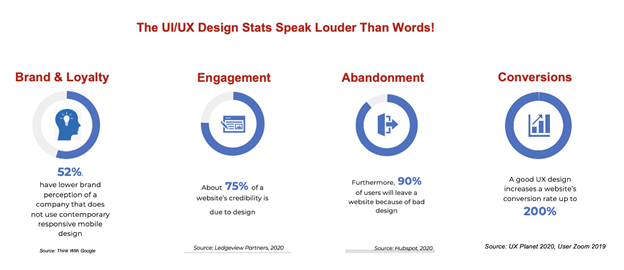
    UI (User Interface) and UX (User Experience) play crucial roles in SEO (Search Engine Optimization) because they directly impact user engagement, website performance, and overall user satisfaction. A website with a well-designed UI is visually appealing, easy to navigate, and provides a seamless browsing experience. This encourages visitors to stay longer on the site, explore its content, and engage with it, which signals to search engines that the website is valuable and relevant.

    Beyond Content & Links

    Search Marketers are right when they say content is ‘King’ regarding Search Engine Optimization (SEO). While we are busy generating quality content for our target audience, there is another aspect that we tend to overlook completely.

    You must have guessed it by now. It is the aspect of how content is presented to the readers. We are referring to UI/UX (User Interface/User Experience), an integral aspect of promoting content on the web.

    With the inclusion of recent updates like Hummingbird, Panda, Penguin, Pigeon, and hundreds of other Google algorithms that are being tweaked regularly, it becomes critical to know how users react to the website User Interface. The experience that the visitors go through definitely counts regarding how we perform on Search Engines, with special emphasis on Google!

    As a webmaster/marketer, it is essential to understand how users react to your website. Are visitors spending ample time on the website? Are they finding relevant information with minimal clicks? Are they taking desirable actions? Why are they bouncing off the website? Can the website drive visitors to the right content/sections and encourage them to take action after that? – While there are many questions to ponder, the simplicity behind having a great website is to have helpful content and enhanced UX with a well-laid-out UI.

    SEO

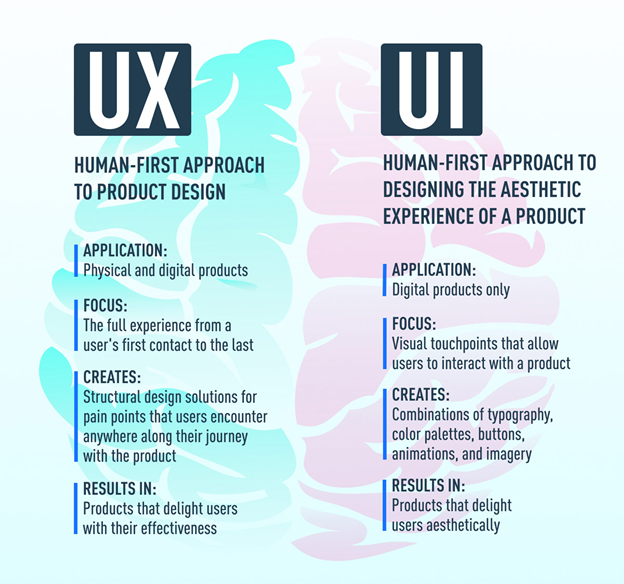
    What are UI and UX

    What are UI and UX

    User Interface (UI)

    UI refers to a website’s visual and interactive elements, including buttons, menus, and other graphical elements that users interact with. The UI creates an intuitive and user-friendly interface that allows users to navigate and interact with a website easily.

    User Experience (UX)

    UX, on the other hand, refers to a user’s overall experience when interacting with a website. This includes factors such as site speed, ease of navigation, and the quality and relevance of the content. A good UX design aims to create a positive and engaging user experience, which can lead to longer session durations, lower bounce rates, and higher conversion rates.

    In short, UI and UX are important aspects of web design that create a positive user experience.

    Impact of UI UX on SEO

    Impact of UI UX on SEO

    UI UX both have a significant impact on SEO. A website with good UI and UX design can increase SEO rankings, traffic, and user engagement.

    A good UI design can improve a website’s SEO by making it more user-friendly and easy to navigate. This can lead to longer session durations, lower bounce rates, and higher click-through rates, all important factors that search engines consider when determining rankings.

    Similarly, a good UX design can improve a website’s SEO by creating a positive and engaging user experience. This can lead to more social shares, backlinks, and other signals that search engines use to determine the relevance and authority of a website.

    1. Teamwork: SEO + UI/UX

    SEO is the medium to drive traffic, while UX/UI creates the first impression. Both work in tandem to ultimately serve the user’s intent and hence conversions on the website. It is that bit of Creative effort which aids in boosting conversions.

    matts cutts

    “…If you don’t have search engine optimization, it’s harder to be found. If you don’t have end-user optimization, you don’t get conversions… you need to have both…Try to see them in tandem (i.e., Search Engines and End Users) …Your users’ interests and the search engine’s interests are always aligned….Hence you need to view them as one unit. .”

    SEO and UI/UX play a significant role in where the path (SEO) leads to the destination (UI/UX). What happens on the web page is our real goal or concern (conversions).

    We should know that SEO exists due to dynamic Search Engine algorithms, and hence fundamentally, it plays the role of a latent follower when optimizing a website for search.

    Google Hummingbird, Panda, and Penguin updates are now meticulously weeding out sites that don’t meet the basic content standards, design (UI/UX), utility, relevance, and speed.

    SEO and UI/UX are more like unified partners that marketers/businesses must respect since one cannot work without the other.

    2. Graphics makes your website more Attractive

    While most marketers are concerned with the content that drives traffic to the website, the other aspect that we miss is the aesthetics part. This concerns how the content is more impressive and informative to visitors.

    The image and graphics support and content make visitors interact more on the website and react positively to the information provided.

    Using the right mix of graphics, images, and text is a simple and effective idea. Using image alt tags, Meta information, and SEO-friendly URLs further helps to attain more SEO benefits.

    3. Visibility: Above and below the fold

    Don’t make your website a newspaper. The above-the-fold actions came from newspapers and were later adopted as a norm for websites. You need to evaluate the website’s objective to serve the target audience.

    With the changes in user behavior and assimilation of information available on the websites, visitors have learned to scan and scroll the webpages below the fold too. The folding concept remains important, but the judgment of how to attract visitors with content, images, and graphics that make visitors look for more cannot be ignored.

    4. Responsive Website: Facilitate improved User Experience

    As more people choose to use mobiles, smartphones, and tablets, having a responsive website that allows users to search for required information on any device becomes all the more imperative.

    In 2014, 4.22 billion people worldwide are expected to use smartphones. 49% of mobile users will go online via mobile browsers or apps. By 2015, the global mobile phone Internet audience is anticipated to cross well over the 50% mark. Hence, the importance of focusing on the responsiveness of a website that provides users with what they want, i.e., uninterrupted and high-quality User Experience (UX) on any device used for search. Read more on the importance of mobile SEO optimization.

    Responsive Website

    5. Call-to-Actions on your website pages

    The call-to-action (CTA) emphasizes what a user is expected or anticipated to do. Additionally, the Call to Action helps visitors find what they need. CTAs open the website and assist users in consuming the content they are searching for by making it easy to access, increasing engagement, and improving the probability of conversions.

    call to action

    6. Blog post-level Social Sharing

    While social signals are not a direct ranking factor, they can indirectly impact a website’s search ranking in several ways. For example, if a website’s content is widely shared on social media, it can lead to more backlinks to the site, which is a direct ranking factor. In addition, social signals can also increase the visibility and reach of a website’s content, which can lead to more organic traffic and engagement on the site. This can lead to longer session durations, lower bounce rates, and higher click-through rates, all of which are important factors that search engines consider when determining search rankings.

    Social sharing

    Furthermore, areas where UI and UX impact SEO

    1. Site Speed

    Site speed (page speed) is important for SEO. Search engines like Google prioritize providing users with the best possible search results; a fast-loading website is key. Websites that load quickly are more likely to rank higher in search results

    In addition, site speed is also important for mobile SEO. With more and more users accessing the internet on mobile devices, search engines like Google prioritize mobile-friendly websites.

    2. Bounce Rate

    Bounce rate refers to the percentage of users who visit a website and leave without interacting with the site beyond the first page they land on. A high bounce rate can indicate to search engines that the website does not provide a good user experience, which can negatively impact search rankings.

    3. Linkability

    It refers to how easily other websites can link to a website. Having a high number of high-quality external links pointing to a website is a key factor in improving its search ranking.

    Example of UI and UX elements that impact SEO

    • Instagram has become extremely popular. Users can easily move through the never-ending stream of visual content for lengthy periods of time without feeling overburdened because of its layout. There is something genuinely great about Instagram’s visual harmony and order, even though most users couldn’t quite put their finger on it.
    • Uber is a prime example of a product with a nearly evenly split UX design.
    • Disney+ has generated a lot of buzz since it first entered the streaming media. The user experience has been enhanced even if the UX design had a rocky beginning.
    • Telegram is less well-known than Whatsapp, its main competitor. Its UX design does, however, offer a thoughtful, attention-to-detail experience, which is a feature of a strong UX design example.
    • Nike’s website recognizes that proximity and visual cues significantly impact the user experience. This is a lesson that every design team should remember: proximity and hierarchy can promote sales. Nike’s various product pages are excellent examples of effective UX design.
    • Without mentioning Pinterest’s recognizable user interface, what kind of blog post about UI design inspiration would it be? As true innovators in card design, Pinterest combines card design with a waterfall flow to provide users with an extremely seamless and user-friendly interface.

    Conclusion

    User intent should be measured as a probable treasure trove for content marketers. Great content, amplified attention to SEO aspects of your website, and equal prominence to the User interface (including Call-to-Actions) are all critical for making a website add value to your business.

    UI and UX is a critical part of the online purchase cycle of a product or service, and having an optimal balance of all the aspects puts you ahead of the competition.

    Frequently Asked Questions

    How can I measure the impact of UI/UX on SEO?

    You can measure the impact of UI/UX on SEO by tracking metrics such as bounce rate, session duration, and click-through rate using tools like Google Analytics. Additionally, conducting user surveys and analyzing user behavior can provide insights into how UI/UX impacts search rankings.

    Is UX/UI part of SEO?

    UX (User Experience) and UI (User Interface) are not directly part of SEO (Search Engine Optimization). However, they can indirectly impact SEO by affecting user behavior on a website. A website with a good UX/UI design is likelier to have lower bounce rates, longer session durations, and higher click-through rates, all factors that Google considers when determining search engine rankings.

    Why is user experience the most important factor for SEO in 2023?

    User experience (UX) is one of the most important factors for SEO (Search Engine Optimization) because it directly affects user behavior on a website. Search engines like Google prioritize providing their users with the best search results; a positive user experience is key. Websites that provide a good user experience, with fast loading times, mobile experience, easy navigation, and engaging content, are more likely to rank higher in search engine results.

    How do poor UI and UX affect a website’s SEO?

    A poor UI (User Interface) and UX (User Experience) can have negative impacts on a website’s SEO (Search Engine Optimization). A website’s poor UI/UX design can lead to high bounce rates, low session durations, and low click-through rates. These factors can signal to search engines that the website is not providing a good user experience, resulting in lower search rankings.

    How is SEO connected to UI and UX?

    SEO (Search Engine Optimization) and UI/UX (User Interface/User Experience) are connected because a good UI/UX design can positively impact a website’s SEO. Search engines like Google prioritize providing their users with the best search results; a positive user experience is key.

  • How do you protect identities and privileges for cloud infrastructure?

    The average data breach costs an organization $5MM—a potentially fatal blow to any cybersec firm. In response, businesses are adopting cloud infrastructure at an unprecedented rate. This “done fast is better than done right” mentality often results in high-risk identity and access management, and here’s why:

    1. COVID-19’s ripple effect continues. The pandemic forced immediate WFH policies, and businesses often granted global access and excessive privileges as a Band-Aid solution.
    2. Traditional solutions became a trap. As the digital economy grows and WFH becomes the standard, on-prem and geofencing solutions just don’t work.
    3. Managing access to cloud-based infrastructure got complicated. 87% of senior business leaders are prioritizing digital transformation in the upcoming year. To match these priorities, cloud infrastructure adoption is spiking. However, a spike in adoption produces equal risk, especially when it happens too fast.

    1 cyberattack occurs every 39 seconds—which means that delaying digital transformation is no longer an option.

    Cloud infrastructure stakes have never been higher

    90% of all cloud security failures are the result of a customer not adopting a proper cloud security posture. That posture is heavily reliant on a robust identity and access management strategy—and the tools, team, and infrastructure to support it. Without this strategy, executive leaders may experience million-dollar losses, reduced revenue, a tarnished reputation, and lost customer trust.

    Given the stakes, inaction makes no sense. But the numbers say otherwise: 49% of executives cite complexity as the biggest roadblock to an effective security organization.

    According to Akash Agarwal, Chief Business Officer at Procyon, “Before the proliferation of cloud, there were only a handful of privileged users … fast-forward to today, with the rapid [adoption] of cloud and with CI/CD, you can argue that every developer is a privileged user. Now, you need a frictionless PAM system to manage access without compromising security and productivity.”

    The payoff is too good to ignore—organizations with the most mature cloud security practices (which includes a robust identity and access management strategy) outperform their peers by 2x.

    What steps can I implement towards a robust approach to identity and access management?

    Avoid the temptation to forge a new path without assessing your organization’s history. What decisions, automations, and strategies produced your current IAM situation? Take the time to ask the following questions in order to structure a plan for the future.

    Has my organization identified and reduced excess privileges?

    The digital economy can pivot in seconds. In this volatile environment, many organizations react by granting global access or excessive privileges, ‘just for now.’ Start by assessing what resources are being regularly accessed by each department, team, and individual. If someone isn’t accessing a resource regularly, the privilege to do so will be revoked.

    Of course, take the time to host conversations to ensure you’re aware of your team’s needs. You don’t want to cut access and later realize the ability to process payroll, for instance, was tied to your hasty decision.

    Has my organization identified cloud misconfigurations connected to excessive privileges?

    Misconfigured privileges come with profound consequences. If an attacker gains access to an environment with misconfigured privileges, they can escalate quickly. Think of it this way: if an attacker can access an account, they can open all the doors that the approved user could under normal circumstances. When you limit the number of doors that each user has the keys to, you reduce unnecessary risk and exposure.

    According to Akash Agarwal, Chief Business Officer at Procyon, “…82% of data breaches involve a human element … increasing the impetus for companies to build towards a zero-trust security posture.” That’s why it is important to invest in automated tools. These tools can seamlessly detect misconfigurations and excess privileges. Then, remediation can occur once these issues are detected. (Automations aren’t a silver bullet, either. Absolute security is a goal, not an actual destination—and any service that promises otherwise is selling a myth.)

    What are your top three priorities when it comes to remediating privileges/misconfigurations that present the biggest security risks?

    Let’s recap.

    1. Start by prioritizing identity-based access threats to cloud storage buckets. This will serve as a strong preventative measure to combat the risk of data breaches.
    2. Monitoring for configuration errors through excessive or default permissions should also be prioritized.
    3. Invest in automated tools to detect misconfigurations/excessive privileges and take steps to remediate once detected.

    What happens next? You’ve put in the hard work of protecting identities and privileges for cloud infrastructure, which includes investing in new tools, educating your internal teams, and building a long-term strategy. However, it’s crucial to showcase your IAM strategy to new users or customers, too—we can help.

    Why you should shift security left

    A robust identity and access management strategy supports easy, secure access to government benefits and services, resilient communication networks, and fresh opportunities for contracts and payment. systems.

    To achieve a future supported by such a strategy, it’s critical to shift security left. What does this mean? When your organization is designing products and services, security must be an integral piece of design, instead of being treated like an afterthought. The future of cloud security relies on this paradigm shift—moving from security-minded development to developer-minded security.

    If you enjoyed this article, add a comment below or continue the conversation on LinkedIn. Learn more about what Akash and his Procyon team are working on here.

    Is your agency delivering the right return on your marketing investment? We combine strategy, execution, and knowledge into award-winning marketing solutions. Contact us today and find out how Position2 can help you grow.

  • How do you develop an IAM strategy for cloud infrastructure?

    63% of all internal data breaches within organizations are a result of compromised usernames and passwords—the indicators of a flawed security foundation that cybersec firms can ill afford. Without a robust identity access management strategy for your cloud infrastructure, your consumer data, confidential information, and trade secrets may be protected with nothing more than “password123”. However, the issue is even bigger than that.

    A holistic cloud infrastructure security plan includes the following pillars:

    • Security-first culture
    • Zero trust
    • Well-equipped team
    • Risk-based approach
    • Strong identity access management strategy

    All the usual cloud security concerns persist within IAM: losing millions of dollars in remediation and revenue, a tarnished professional reputation, and losing customer trust. When it comes to identity and access management, though, the stakes are infinitely higher.

    In this blog, we’ll cover actionable risks, your top priorities when developing a strategy, and 3 steps towards a robust approach to identity and access management.

    300 million victims were impacted by data breaches in 2021.

    Government regulations mandate that companies handle consumers’ personal information in a secure, ethical fashion. In situations where ethical behavior comes into question, executive leaders that didn’t invest in IAM strategy and prioritize transparency may face legal repercussions. (For instance, a federal jury recently convicted Joe Sullivan, former CISO of Uber, for charges related to covering up a data breach.)

    To address the stakes, focus on actionable risks, such as:

    1. Unauthorized access

    2. Data breaches, leakage, and loss

    3. Consumer identity theft

    4. Account hijacking

    With millions of data breach victims in any given year, developing an IAM strategy for your organization has never been more crucial.

    The top 3 priorities when developing an IAM strategy

    Historically, IAM was viewed as a tedious compliance process. Organizations can’t afford to treat IAM like a necessary evil anymore. To progress, IAM must be centered as a primary pillar of a holistic cloud security strategy. Fighting outdated perceptions of identity and access management slows you down—that’s why it’s important to show your work to demonstrate value and increases your chances of long-term adoption.

    Your end users or customers often represent a challenge, too. For maximum safety, it may be tempting to force users through multiple identity verification steps … which makes users feel frustrated, not protected!

    With such a nuanced landscape, it’s important to focus on your top three priorities when you develop an IAM strategy: increased visibility, improved security, and improved compliance with data regulations.

    What steps can I implement toward a robust approach to identity and access management?

    A measured approach to IAM strategy relies on three priorities: business, people, and process.

    1. Take care of your business

    Start by assessing the internal and external factors that drive your business. In your industry—and your organization—what outcomes indicate success? Your IAM strategy must work with, not against, business goals. Once you’ve identified your destination, it’s time to audit your current digital strategy. What is your organization’s current state of governance, risk, and compliance?

    2. Support your people

    The human element of your IAM strategy is crucial. Often, organizations run into trouble when they don’t support the headcount (or education needed) to actually implement their initiatives.

    Talk to your current security and IT team. Does the current structure and headcount match your organization’s needs? Even if you have enough people, they may not be properly trained. Or they may need access to different tools to support your vision. According to Akash Agarwal, Chief Business Officer at Procyon, “…there are multiple tools on the market that are helping customers eliminate passwords. Technologies like Trusted Platform Module encrypt your password in the hardware chip of the device … or [solutions] that cryptographically encrypt your credentials, eliminating the need for passwords.” Providing the tech your team needs is a critical investment.

    3. Assess your process

    When users or customers engage with your organization, what does that experience look like? Plot out their experience from start to finish, accounting for every single touchpoint they deal with as new, current, or recurring customers.

    Then, identify what your IAM process currently looks like, and compare it to the current customer experience. When conducting this audit, identify chances for automation to replace current manual processes. 95% of data breaches are a result of human error, not technical failures. Giving automation a chance to do what they do best – play by the rules – is a great first layer of defense for your organization.

    Where do I go from here?

    When you build an IAM strategy, remember the end goal: an innovative, equitable, safe digital economy. That’s what we are all striving for, an ecosystem where organizations, developers, users, and consumers can interact safely and efficiently in a forward-thinking digital ecosystem.

    A successful IAM strategy prioritizes security, privacy, and consent: the three tenets of well-structured digital identity solutions within the cloud infrastructure. When these steps are properly implemented, IAM strategies should serve as a tool to perpetuate inclusion and equity.

    If you enjoyed this article, add a comment below or continue the conversation on LinkedIn. Learn more about what Akash and his Procyon team are working on here.

    Is your agency delivering the right return on your marketing investment? We combine strategy, execution, and knowledge into award-winning marketing solutions. Contact us today and find out how Position2 can help you grow.

  • FedNow -The Evolution of Real-Time Payments and the Consumer Experience

    In today’s world, the busy highway of traditional payment methods can cause a slew of roadblocks for businesses and their customers including including slow transfer times, high transaction fees, and inadequate data security. These challenges can significantly impact customer service scores and compromise a company’s credibility and bottom line.

    FedNow, the Federal Reserve’s anticipated answer to inefficient financial transactions, boasts lightning-fast processing, enhanced security measures, and additional features that may have the power to revolutionize the way businesses and consumers exchange money forever.

    Join us as we explore this new frontier in instant payments and uncover the advantages that FedNow offers over other payment methods, potential implementation and safety concerns, and ways to leverage the payment system to improve both business operations and consumer experience.

    What is FedNow?

    FedNow is a new real-time payment system in development by the Federal Reserve Banks. While some Bank to Bank transfers can take up to three days or longer, the FedNow Service will allow for near-instantaneous transfers of funds between financial institutions 24 hours a day, seven days a week, 365 days a year, all while working to create a safe, efficient, and modern payment infrastructure.

    Here’s a brief timeline of FedNow’s development:

    • August 2018: The Federal Reserve announces its intention to build a new real-time payment service called FedNow.
    • September 2020: The Federal Reserve Board approves the development of the FedNow Service.
    • January 2021: The Federal Reserve begins a pilot program for the FedNow Service, which grows into 120 participating financial institutions.
    • August 2022: The Federal Reserve Bank narrows launch timing to mid-year 2023.
    • March 2023: The Federal Reserve announces its most specific launch date yet; the FedNow Service will start operating in July 2023.

    As the nation prepares for the anticipated launch of FedNow, it’s essential that businesses familiarize themselves with the system and prepare for its implementation.

    How does FedNow differ from other payment systems?

    Compared to the current standard for electronic payments, the Automated Clearing House (ACH) system, FedNow provides faster, near-instantaneous transfers between financial institutions. Additionally, FedNow is available 24/7/365 with higher transaction limits, setting it apart from ACH.

    Unlike credit card transactions, which can take several days to process and come with high transaction fees, FedNow again gains the upper hand with faster processing times and lower fees. In the same way, FedNow offers quicker and more cost-effective transactions compared to digital wallets like PayPal and Venmo, which can also take several days to transfer funds to a bank account unless the sender pays a higher fee.

    3 Benefits of Real-Time Payments for Businesses

    Businesses of all sizes and industries can benefit from FedNow’s real-time payments system. Here are three reasons why.

    1. Faster payment processing times

    FedNow enables near-instantaneous transfers of funds, which means businesses can receive payments and make disbursements more quickly than with traditional payment systems.

    2. Improved cash flow management

    With faster access to their funds, businesses can improve their financial planning. With a better plan in hand, a business is less likely to rely on loans and can avoid late payments and any resulting fees.

    3. Reduced transaction costs

    While FedNow’s fees haven’t been released in detail yet, they’re expected to be lower than credit card fees and competitive with ACH fees, making it a more cost-effective payment option for businesses. Additionally, since the FedNow Service will operate 24/7/365, businesses can avoid expedited or overnight payment costs.

    FedNow benefits extend beyond business

    FedNow’s benefits extend beyond a business’s doors; consumers can also reap the rewards of a virtually instant payment system.

    For example, FedNow’s enhanced security measures can reduce cybersecurity threats that put consumer data at risk. Additionally, real-time payments can help fintech companies offer swift payment solutions for customers needing quick fund transfers.

    FedNow can benefit consumers beyond convenience and security, especially in the healthcare industry. According to recent data, 17% of Americans pay medical bills with credit cards. By switching to FedNow, healthcare providers can reduce their transaction fees and pass these savings on to patients.

    Overall, FedNow offers significant advantages to businesses and consumers alike, changing the digital payment landscape indefinitely.

    Addressing the Potential Challenges of FedNow

    While FedNow’s real-time payments system offers many advantages, there are also some potential concerns that businesses should be aware of, including:

    • Integration challenges: FedNow integration requires significant time and resources, including upgrades to existing technology and collaboration with third-party providers.
    • Cost considerations: While FedNow’s transaction fees are expected to be lower than credit card fees, businesses must still consider the potential implementation and maintenance costs.
    • Customer reaction: Businesses must explain the advantages of FedNow to customers and address any concerns they may have regarding the security and dependability of a new payment system.

    Will FedNow be a requirement?

    The Federal Reserve has not announced any plans to make FedNow mandatory. However, with its potential to improve day-to-day operations and enhance the customer experience, it’s likely to become an increasingly popular payment option in the coming years that businesses may need to offer to stay competitive, even if not legal.

    Overcoming potential FedNow hurdles

    To ensure a smooth implementation process for businesses interested in experiencing the benefits of FedNow, it’s crucial to address potential challenges proactively. Here are a few tips for companies preparing to adopt FedNow as a payment option:

    • Boost internal security protocols and training programs to protect against fraud and cyber-attacks.
    • Partner with payment processors with experience integrating new payment systems to streamline the process and minimize disruption.
    • Communicate the benefits of FedNow to patients and address any concerns they may have about the security and reliability of the system.

    Using FedNow for Customer Satisfaction: 4 Marketing Strategies

    FedNow offers many potential benefits for businesses but can also be a powerful marketing tool. Here are some tips on how marketing directors can leverage FedNow to enhance their marketing strategies and improve customer relationships.

    1. Offer real-time incentives

    FedNow allows for real-time incoming and outgoing transfers. Marketing directors can use this feature to offer real-time incentives to customers, such as cash-back rewards. Research shows that 80% of consumers are more likely to shop with a brand for the first time if given a cash-back offer. By providing this form of instant gratification, businesses can draw in new target audiences and increase loyalty with existing customers.

    2. Gather better data and insights

    Companies that use big data solutions increase profits by an average of 8%. FedNow can provide businesses access to better data and insights into customer behavior.

    For instance, when a consumer uses FedNow to make a payment, a business can view that payment right away in their account and gather data about it, such as the time and location of the transaction. This information can help companies identify patterns and trends in customer behavior, such as popular purchase times and locations.

    Marketing directors can use this data to better understand their customers’ needs and preferences and create personalized content that connects on a deeper level.

    3. Educate customers to create trust

    Research shows that 33% of customers credit trust as the reason they will pay a premium for a service or product. Similarly, over 90% of customers say they would buy from a company that worked to gain their trust.

    To maximize the benefits of FedNow, businesses should start planning education-based marketing strategies about the new payment system, explaining the benefits of FedNow to customers and how to use it. This can help customers feel more comfortable and confident using the new system and increase adoption rates.

    4. Make it a selling point

    More small businesses have lost a sale as a result of limited payment choices than as a result of negative customer feedback. By marketing FedNow as a convenient payment option in their marketing materials, businesses can attract new customers and differentiate themselves from competitors.

    FedNow: Revolutionizing the Payment Industry

    FedNow represents a significant shift in the payment industry, with real-time payments offering numerous advantages for businesses and consumers alike. While there may be some concerns around integration, cybersecurity risks, and costs, companies can mitigate these with the right approach and preparation.

    For businesses, it’s crucial to start preparing for FedNow now and exploring how to leverage its advantages for customer satisfaction and loyalty. Ultimately, companies that embrace FedNow and adapt to the changing payment landscape will be best positioned for success in the future.

    Is your agency delivering the right return on your marketing investment? We combine strategy, execution, and knowledge into award-winning marketing solutions. Contact us today and find out how Position2 can help you grow. Contact us today to learn more.

  • Server-Side Rendering (SSR) vs. Client-Side Rendering (CSR)

    As more and more websites are built using JavaScript frameworks, it’s vital to understand the rendering method’s impact on search engine optimization.

    Pages that load in under 2 seconds see a bounce rate of 9%, while pages that take 5 seconds or more to load witness a bounce rate of 38%. Understanding both CSR and SSR regarding SEO is essential to know the best choice for your website.

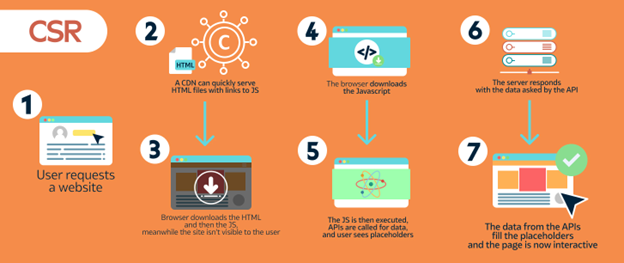
    Client-Side Rendering:

    CSR (Client-Side Rendering) refers to rendering a web page on the client side (Client device), typically using JavaScript.

    The client’s web browser receives the HTML, CSS, and JavaScript from the server, and then the JavaScript is executed to render the page dynamically.

    CSR Image

    Source: Growth Rocket

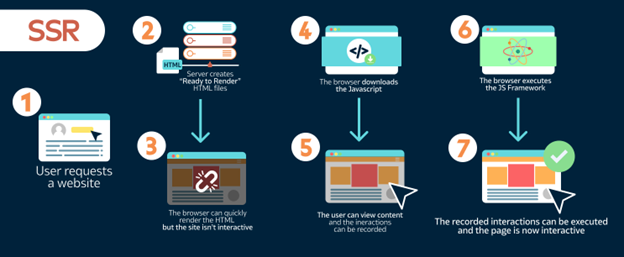
    Server-Side Rendering:

    SSR (Server-Side Rendering) refers to rendering a web page on the server side and then sending the fully rendered HTML to the client’s web browser.

    SSR allows for a faster initial load time, as the browser does not need to wait for JavaScript to execute before displaying the page.

    CSR Image

    Source: Growth Rocket

    Use cases for Client-Side Rendering (CSR)

    Here are the primary use cases where CSR is the best for development practices.

    Dynamic interactions:

    Provide a more seamless and responsive user experience for dynamic interactions, such as form submissions, real-time updates, or user-specific content.

    Single-page application:

    Faster and more efficient user experience for single-page applications (SPA) by avoiding full-page reloads.

    Large amounts of JavaScript:

    Handling a lot of complex scripting – it allows the JavaScript to be executed on the client side, reducing the load on the server.

    User-specific content:

    Display user-specific content, such as personalized recommendations. The client’s browser requests and display the content without involving the server.

    Flexibility:

    Enable developers to use the latest JavaScript libraries and frameworks, giving them the flexibility to build complex and interactive web applications.

    Use cases for Server-Side Rendering

    Here are the primary use cases where SSR is the best for development practices.

    Search engine optimization (SEO):

    Send fully rendered HTML to the search engine crawler, making it easier to index the content.

    Performance:

    Provide a fast initial load time by sending fully rendered HTML to the client’s browser, allowing it to display the content without waiting for JavaScript to execute.

    Static content:

    Reduce the load on the client’s browser and allow for faster content rendering which is excellent for static content such as blogs or news websites.

    Accessibility:

    Support users with slow internet connections or devices with limited processing power. SSR reduces the amount of JavaScript that needs execution on the client side.

    Server-side logic:

    Reduce load on the client’s browser for user authentication or data processing. Handling these tasks on the server side also increases security.

    Advantages of Client-Side Rendering for SEO

    Overall loading time:

    Users can navigate between your pages without making a roundtrip to the server. Fewer HTTP requests are made to the server since the same assets don’t have to be downloaded again for each page load.

    Improved user experience:

    Allow for a more dynamic and interactive user experience, which can improve user engagement and time on the site.

    Better indexing by search engines:

    Search engines can better index dynamic content generated by JavaScript, improving the chances of appearing in search results.

    Easier to implement dynamic content:

    Implementing is easier for dynamic content, such as user-generated content, product listings, or custom content for different user segments.

    Disadvantages of Client-Side Rendering for SEO

    Slower initial loading time:

    Initial loading time can be slow if the JavaScript is significant. The browser needs to download and execute it before rendering the content. The initial page of the website will take time to load.

    Dependence on JavaScript:

    Reliance on JavaScript, which may not be supported or enabled on all devices, leads to a degraded or broken user experience for some visitors.

    Poor crawlability:

    Search engines may need help to crawl and index dynamic content generated by JavaScript, reducing visibility in search results.

    Increased complexity:

    Requires a more complex development process, including optimization techniques, to ensure that the content is accessible and crawlable by search engines.

    Reduced accessibility:

    Reduce the accessibility of the site, especially for users with disabilities who rely on assistive technologies that may not be able to interpret the dynamically generated content.

    Advantages of Server-Side Rendering for SEO

    Initial loading time:

    Generates a complete webpage on the server, which is then sent to the client, leading to a faster loading time for the user.

    Better crawlability:

    Easily crawl and index the HTML generated on the server, leading to improved visibility in search results.

    Improved accessibility:

    More accessible, especially for users with disabilities who rely on assistive technologies that may not be able to interpret dynamic content generated by JavaScript.

    Simplified development process:

    Simpler development process, with less focus on optimization techniques, as the HTML is generated on the server and delivered to the client.

    Better support for old devices:

    Does not rely on JavaScript, making it more compatible with older devices and browsers that may not support modern JavaScript features.

    Disadvantages of Server-Side Rendering for SEO:

    Slower overall loading time:

    Complex applications may lead to a slower overall loading time for the user, as the server generates the HTML for each request.

    Increased server load:

    Heavier load on the server, as it generates/delivers the HTML for each request, which isn’t feasible for large-scale applications with multiple users.

    Lack of dynamic and interactive features:

    Doesn’t offer dynamic/interactive features, like real-time updates, user-generated content, or custom content for different user segments.

    More complex deployment:

    Requires a more complex deployment process. The server must be configured to handle the HTML generation and delivery, which may not be feasible for small-scale or low-budget projects.

    Reduced scalability:

    Less scalable than client-side rendering since the server generates/delivers the HTML for each request, which can lead to performance impact as the number of users grows.

    Overall, it’s important to weigh the pros and cons of server-side rendering and to choose the appropriate approach based on specific requirements.

    Tabular comparison for CSR and SSR in terms of SEO:

    SEO Metric CSR SSR
    Initial Loading Time Good Poor
    Overall Loading Time Poor Good
    User Experience (UX) Good Poor
    Dynamic Features Good Poor
    Interactive Features Good Poor
    Scalability Good Poor
    Server Deployment Simple Complex
    Load on Server Less More
    Accessibility to Search Engines Poor Good
    Crawlability Poor Good
    Supporting all Devices Poor Good
    Development Process Complex Simple

    Overall comparison between CSR and SSR

    Feature CSR (Client-side Rendering) SSR (Server-side Rendering)
    SEO Poor Good
    Performance Fast Slow
    Development, Complexity Simple Complex
    JavaScript Support Required Not required

    SEO:

    SSR is the better approach for SEO as search engines can crawl the HTML content of the page more quickly.

    Performance:

    CSR is generally faster since JavaScript is executed on the client’s browser.

    Development complexity:

    SSR is generally more complex to implement and maintain.

    JavaScript support:

    CSR requires JavaScript to be enabled on the client’s browser. SSR does not have this requirement.

    In conclusion, there are pros and cons with either one. It really depends on what you’re trying to achieve with your website – factoring in the needs of your end users, your position on accessibility and your SEO strategy. As you develop your website you need to account for those and select the rendering that meets those needs and requirements.

  • ChatGPT for SEO: Maximize Your SEO Strategy

    Microsoft has added an additional $10 billion in funding (added to the initial $1BN investment) for OpenAI. That investment, in the words of Satya Nadella (Chairman and CEO, Microsoft) was because of a shared ambition to responsibly advance cutting-edge AI research – while democratizing AI as a new technology platform. AI-powered ChatGPT can improve SEO by generating high-quality, relevant content, keyword strategy, and analyzing user intent.

    Our team is experimenting with some of the ChatGPT chrome extensions, here’s what we found.

    How To Use ChatGPT For SEO

    By now, many of you have tried ChatGPT or you’re familiar with how it work. OpenAI has released several updates to serve improved results for user queries. Notable releases include daily limit, general performance (speed of returns), conversation history, etc.

    Let’s dive deeper, and review the use cases of ChatGPT in real time.

    There are several ways you can use ChatGPT for digital marketing. Utilizing ChatGPT For SEO can save time and effort… and SEO automation. The chatbot plays a vital role in repetitive digital marketing activities. SEO and AI are quickly becoming unseparable, and are laying the path for future SEO success.

    “According to Neil Patel, AI is transforming the search industry. Machine learning and natural language processing will improve relevance and deliver personalized results. In the future, searches will become even more personalized.”

    How to use ChatGPT for maximum impact in your SEO efforts

    ChatGPT is only available only on the desktop version, and many of the applications available on the Play store are not legitimate. Integrate ChatGPT in your digital marketing by tying it to conversational interfaces for improved customer engagement and personalized experiences.

    Improving ChatGPT responses with examples

    You get the most from ChatGPT in real time with prebuilt SEO prompts – these prompts help to ensure the accuracy of results. It’s not a guarantee that it generates entirely original results. As you know, these AI-generated results based on learning models, you’ll need to review and edit those results to get the most of out of them.

    Let’s discuss two of the Chrome extensions for ChatGPT.

    They are AIPRM for SEO and WebChatGPT – let’s dive in and look at a couple of examples:

    AIPRM ChatGPT for SEO

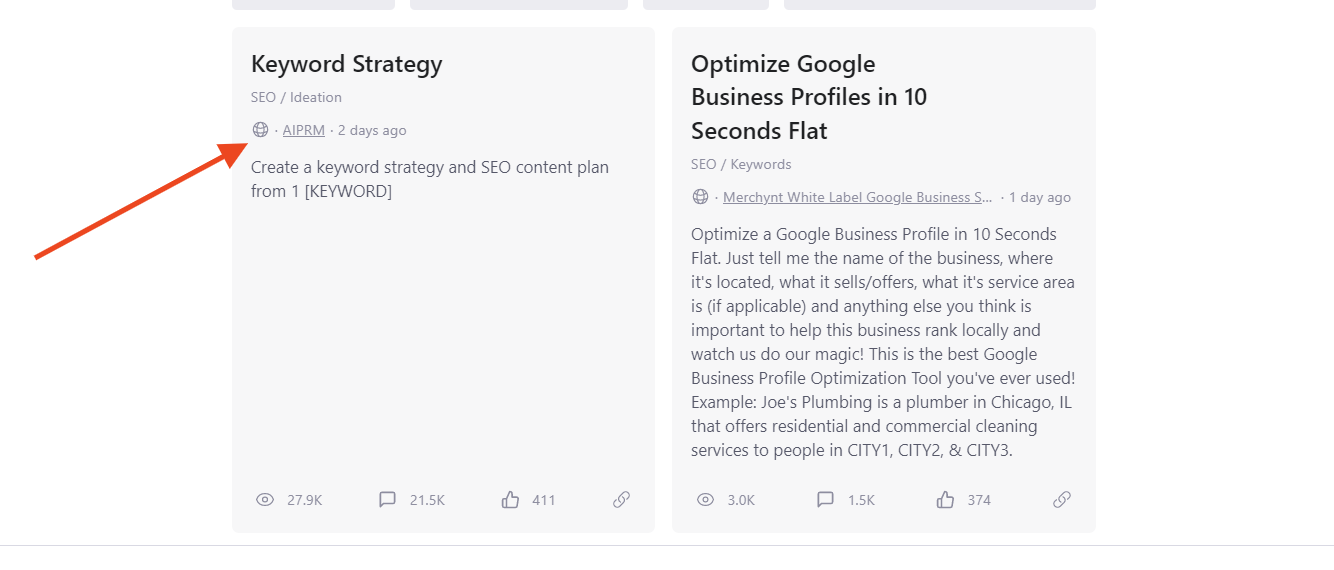
    AIPRM ChatGPT Chrome extension (multi-community version) has a list of curated prompt templates for SEO, SaaS, and more. If you’re looking to increase your organic traffic and attain a higher Google ranking through ChatGPT, this is the extension for you.

    Let’s start with keyword research. This is one of the most powerful features in AIPRM.

    Public Prompts is basically a list of predefined SEO prompts with categories like ideation, marketing, and writing. If you need something different, choose Own prompts to create your own template for recurring tasks based on your needs and requirements.

    The expectation for the Public prompt

    Let’s prepare a content strategy for one of the client businesses in the healthcare industry. Start with the keyword strategy to generate the right strategy for the blog post.

    Pro Tip:

    You can expect the desired results if you choose the SEO prompt from AIPRM. Check out the screenshot for reference.

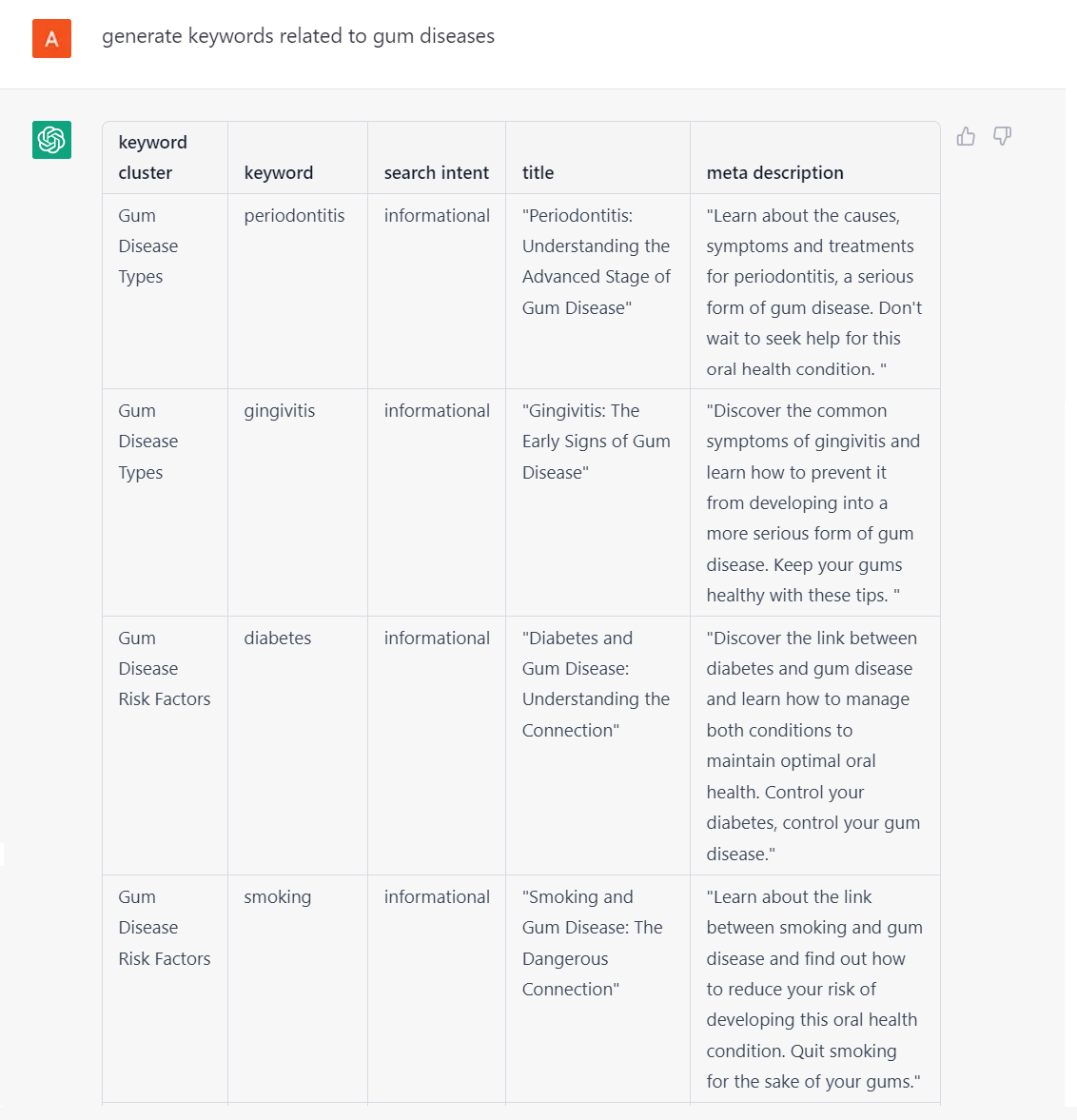
    Keyword strategy

    Your Input: Generate keywords related to gum diseases. You can find numerous results including keyword clusters, keywords, search intent, titles, and meta descriptions. Keyword research is made easier with the assistance of this SEO tool.

    Next step, pick one keyword from the list of suggested keywords and will ask to generate blog post ideas for the same keywords.

    Blog Post Ideas

    Your Input: Generate 3 blog post ideas for the keyword ‘gum disease risk factors’ (example below).

    Title and Meta Description

    Your Input: Generate a page title (maximum 70 characters) and meta description (maximum 160 characters) for the blog post: “The link between gum disease and overall health”, (example below).

    … in conclusion

    Your Input: Generate the conclusion for the blog post: The link between gum disease and overall health. This SEO prompt can assist you in finding content ideas. AI-generated content may not be 100% accurate, so we recommend proofreading the output, (example below).

    Generate FAQs Related to Content

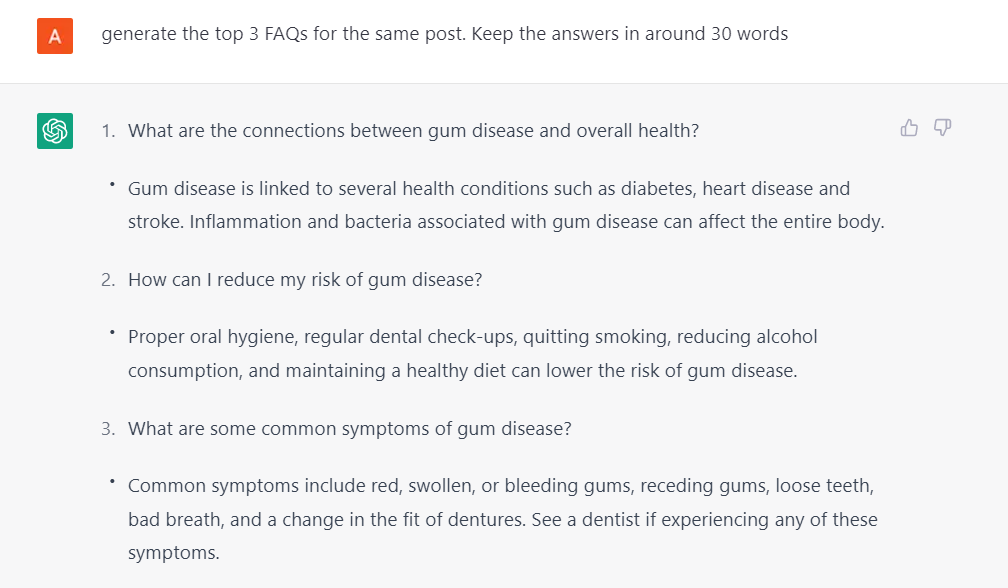
    Your Input: Generate the top 3 FAQs for the same post, keeping the answers in around 30 words, (example below).

    Generate FAQ Schema Markup

    Your Input: Generate FAQ schema tags for the current FAQs, (example below).

    Translation

    Your Input: Translate the schema tags in French.

    Outrank Article

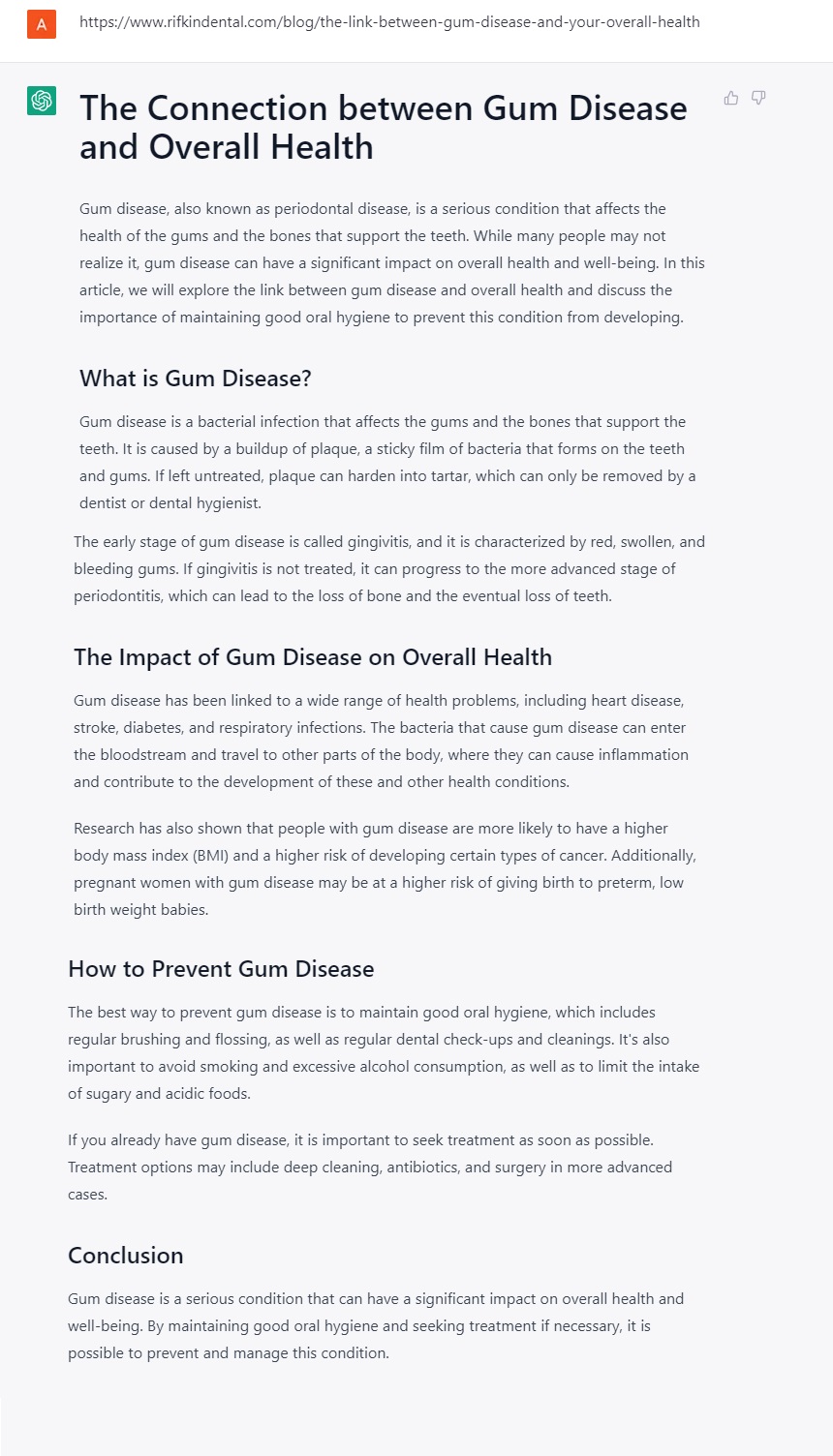
    Your Input: Type the competitor URL into the prompt. It’ll generate blog content similar to your competitor who may already rank at the top of the search engine return page (SERP), (see below).

    Note: This is a recommended practice for writing content. AI-generated answers may need to be corrected to meet search engine guidelines.

    The expectation for ‘own prompt’

    One of the coolest features under AIPRM is that you can create your own prompt based on your needs and requirements – like SILO structure, keyword strategy, translation by creating a tabular column for comparison, (see below).

    Pro Tip: You can also share the prompt template publicly with other users.

    WebChatGPT For SEO

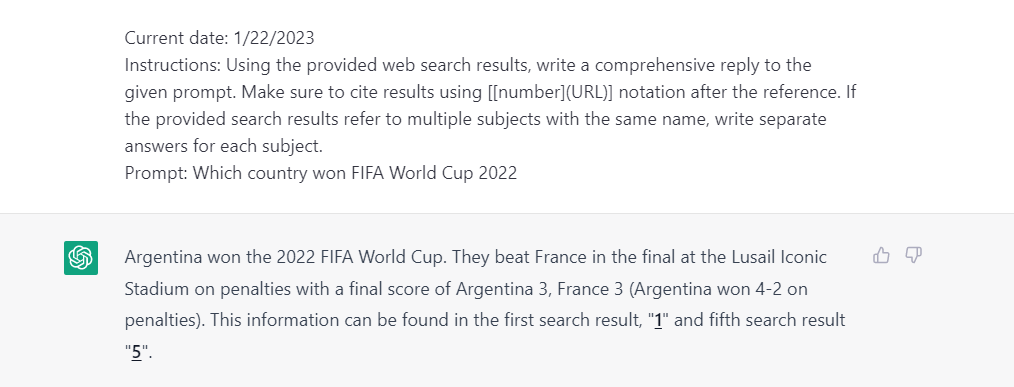
    We all know that ChatGPT has a few limitations and limited knowledge of the world after 2021. The WebChatGPT chrome extension is open-source code – anyone can review and contribute to the project.

    With the help of WebChatGPT, you can overcome the downside of ChatGPT, in real time. You can get relevant returns with up-to-date information on recent content through your prompts.

    Real-time answer

    Your Input: Which country won FIFA World Cup 2022

    Top Useful SEO Prompts in 2023

    Stay up-to-date on the latest SEO strategies in 2023 with our comprehensive guide. Learn the best practices for optimizing your website and improving your search engine rankings, ensuring your website is ready to rank on the SERP in a constantly-evolving digital landscape.

    On-page SEO Prompts

    An AI chatbot designed for conversation – streamlines the process of On-page SEO by making it more efficient, quick, and precise.

    • Suggest keywords with high search volume and low competition
    • Write an SEO optimized title on the topic, under 60 characters
    • Write a meta description, not more than 160 characters
    • Cluster the keywords based on the category
    • Generate the best image alt text for your images
    • Create a no-follow link
    • Create a self canonical tag
    • Find opportunities for internal linking for existing article
    • Provide the best strategies for SEO to an international audience

    Example for SEO keyword research

    Your Input: Suggest keywords with a high search volume for gum disease

    Off-page SEO Prompts

    ChatGPT can also assist with off-page SEO prompts by providing insights and strategies for improving your website’s off-page signals.

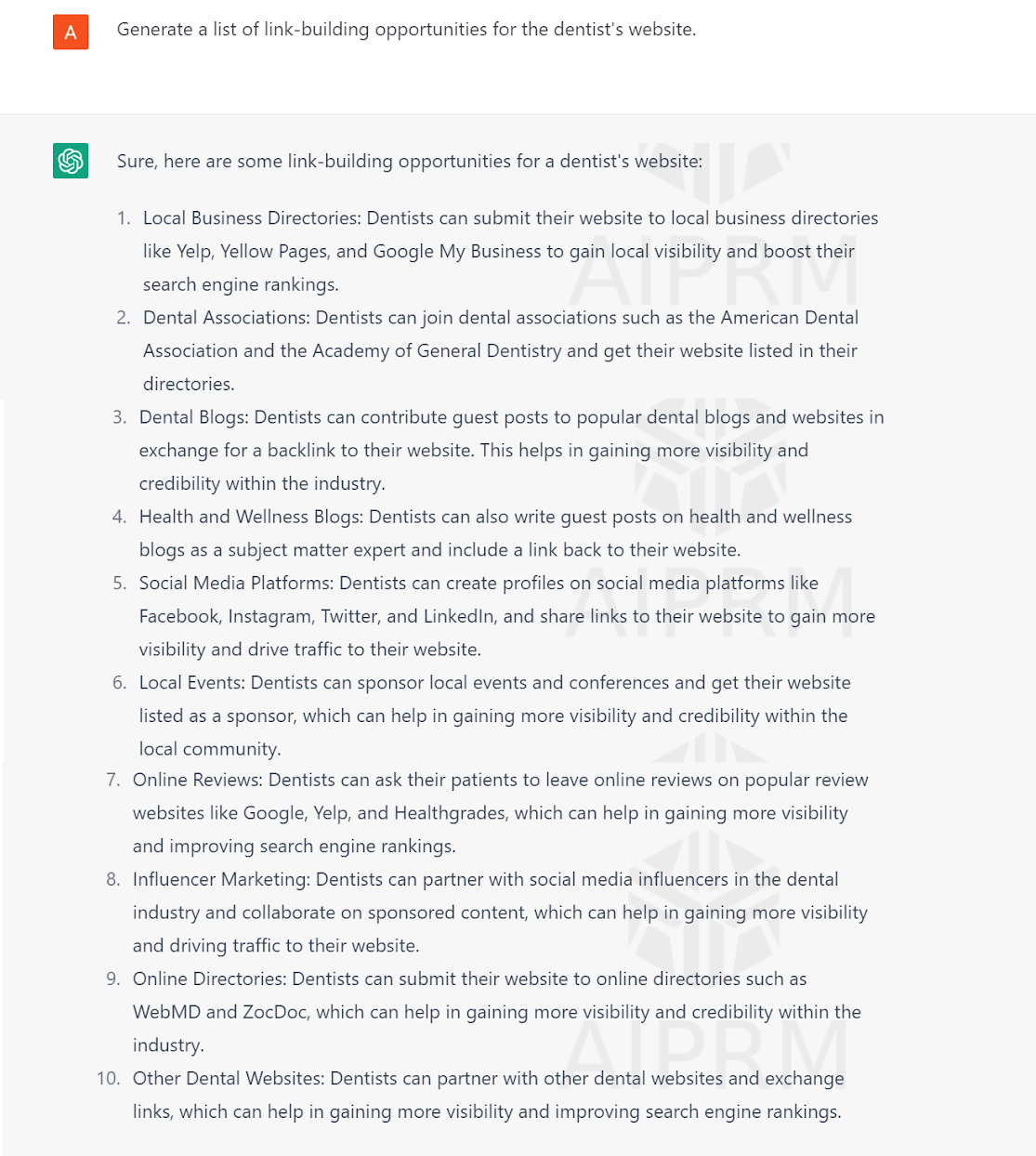
    • Generate a list of link-building opportunities
    • Create a list of potential affiliate marketing opportunities
    • Provide a list of 10 relevant websites (listing out their URLs) that talk about “off-page SEO”.
    • Create a list of guest blogging opportunities

    Example for offpage (link building)

    Your Input: Generate a list of link-building opportunities for the dentist’s website.

    Content Creation Prompts

    Create engaging and informative content with SEO prompts to attract and retain audiences. Use data-driven strategies and high-quality writing to establish your brand as a subject matter expert in your industry.

    • List out the top 10 ranking blogs
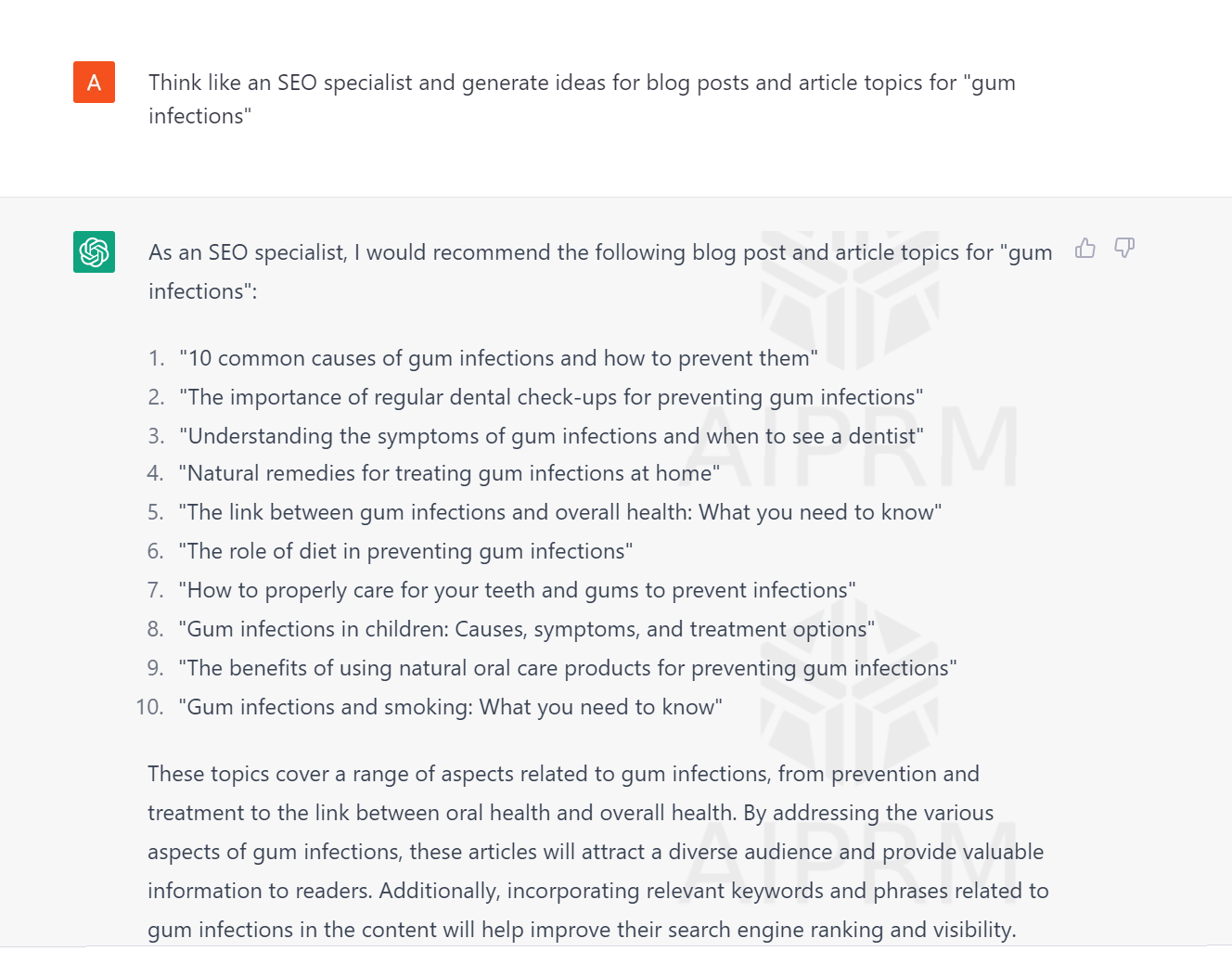
    • Think like an SEO specialist and generate ideas for blog posts and article topics
    • Write an introduction with stats and facts for the blog post
    • As a Content Marketer, create a content calendar for a specific topic for next 30 days
    • Provide the target audience for a keyword
    • Proofread the page description
    • Generate the list of FAQs for the blog post
    • Suggest the SEO-friendly URL structure for a blog
    • Create a list of LSI keywords
    • Create a list of people who also ask about a topic

    Example for content creation

    Your Input: Think like an SEO specialist and generate ideas for blog posts and article topics for “gum infections”

    Interesting Facts About ChatGPT

    • According to the source, ChatGPT just crossed 1 million users; it’s been a few weeks since launch.
    • ChatGPT comes at no cost
    • One of the dominant viral AI chatbots
    • Microsoft has announced a significant investment, in billions of dollars in OpenAI, the organization behind the creation of the ChatGPT language model.
    • Reports have indicated that users of ChatGPT will have a monthly cost of $42 for “professional” access – no official announcement has been made.

    AI Statistics

    1. 35% of companies use AI in business, and 42% want to explore it. As AI adoption grows steadily, ticking up 4 points from 2021 – it’s a fast-growing trend for businesses.
    2. Slow AI adoption is driven by the lack of a cohesive strategy of applying the AI capabilities to business goals. Smaller companies lag behind larger ones in having a holistic AI strategy – 41% of those companies are developing one.
    3. 53% of IT professionals have quickened their AI rollout in the last 24 months, a higher rate than in 2021 when only 43% accelerated AI amid the COVID-19 response.
    4. The industry has advanced beyond chatbots, with 29% of companies using or considering natural language programming (NLP) solutions.
    5. 54% of organizations report cost savings & efficiencies with AI-automated IT/business/network processes. 53% see improved performance, and 48% report better customer experiences.

    Source: IMB

    FAQs on ChatGPT For SEO In Real Time

    When was ChatGPT launched?

    ChatGPT was launched on November 30, 2022. Samuel H. Altman, CEO of Open AI.

    What are the top ChatGPT chrome extensions for?

    Due to the popularity of ChatGPT, there are a number of chrome extensions released in the market. Fortunately, finding the right extension is easy, two of favorites are AIPRM for SEO & WebChatGPT.

    Is ChatGPT a competitor to Google?

    Absolutely not. Though ChatGPT and Google have some similarities in language models, ChatGPT is just a pre-trained language model.

    Do search engines, including Google, support AI-generated content?

    Search engines, including Google, support AI-generated content as long as it has been reviewed and enhances the user experience.

    Conclusion

    To summarize, ChatGPT is a viral AI-generated content tool for SEO that provides real-time, relevant, and high-quality content for user-relevant queries called AI for SEO success. ChatGPT for SEO with chrome extensions can improve website visibility and search rankings, leading to increased traffic and potential customers.

    Give it a try to ChatGPT today.

  • What the launch of Google’s ‘Apprentice Bard’ reminds us and how to fix it.

    It’s been more than a few weeks since Google’s Bard returned an incorrect output during a demonstration of its capabilities. That doesn’t mean that tools like this have no place being integrated into society – it means there is still some work to be done to realize its potential.

    These systems are classified as weak (or narrow) AI. They work as well as the data input or learning model. What we are seeing with some of these tools is that if the data isn’t updated or exists – these tools return incorrect answers.

    When you look at the FAQs for Microsoft’s AI-driven search engine Bing, Microsoft clearly acknowledges this – they state “Use your own judgment and double check the facts before making decisions or taking action based on Bing’s responses.” Recently, Microsoft’s AI-powered search has had its own issues where the AI took on a personality that was somewhat alarming to users of the system. Microsoft responded by limiting the number of queries that can happen in a day.

    As Big Tech embraces and integrates AI-powered search, we think of the famous quote ‘with great power, comes great responsibility.’ Google and other search providers are where they are today because of the ease of use, level of accuracy, and relevance of results. So we know accuracy and relevance matter.

    That’s not to say that the big search engines are pillars of accuracy, but it’s one thing to search and find the wrong results – it’s another for an AI to generate and provide incorrect information in order to always have an answer.

    We won’t go into a detailed technical discussion on how ChatGPT and Bard are built, but we can say that ChatGPT and the large language model it was based on, GPT3.5, is different than Bard and its associated large language model roots, LaMDA. ChatGPT is a pre-trained model versus Bard which is a supervised learning model. The difference is that Bard’s responses are more human-like and ChatGPT’s knowledge base goes back to 2021 as they state on their website.

    Some of the challenges with these models are:

    • Data issues: Preprocessing, missing values, data not available
    • Issues with testing – not selecting a wider representation of data in testing
    • Issues with the model – underfitting or overfitting a model
    • Lack of governance

    These challenges are not insurmountable, but it’s up to the team developing these models to have a structure that addresses some of these potential challenges and issues.

    This technology is ever-evolving, and Google and Microsoft will continue to innovate, update and improve on current offerings – it’s in their business interests. These companies are investing heavily in conversational AI, and as a result, users can expect more conversational responses from search engines – instead of just straightforward search results. Google’s CEO, Sundar Pichai, stated that these models will be available in the coming weeks or months and serve as a “companion to search.”
    Conversational AIs aren’t exactly new, we’ve been using them for years… don’t believe us? When was the last time you asked Siri, Alexa, or Google Assistant to change a song or answer a question?

    In conclusion, these conversational AIs are here (to stay), and they have the potential to make a huge impact on existing technology, processes, and user activities that will improve results and provide a more ‘human’ experience. We are excited to see what the future holds.

  • The Psychology of UX – Decode the ‘X’

    We hear a lot about UX, DX, CX, and PX … It’s all about the ‘X’, which stands for ‘Experience’. User experience drives web and app behavior. The bigger question is: How can we address user experience variables and factor in the underlying rules of the psychology of UX to driving user behavior toward predicted outcomes? UX developers are focused on creating viewer interest and an engaging digital experience – resulting in improved user interactions and conversions.

    Design Stats Speak

    The Role Of Human Emotions

    Human reflexes instinctively connect vision with emotion. This happens in milliseconds, especially with impulse-based B2C eCommerce. Evidence-based information, reasoning, and evaluation are the next step for collective or larger decisions. Social identity, community, and convenience aspects kick in to make the final interaction decision.

    Role of Human Emotions

    Human experience resides subconsciously in the reptilian brain.

    Reference: DrawingTutorials101

    A Fun-Fact:

    “Gamification” evolved out of the synergy between online interaction and the psychologically addictive journey to ‘win’ or ‘achieve an end goal’.

    UX Goals

    User experience is essential for driving conversions. Design psychology is critical for mobile app designers, web designers, and graphic designers who create the marketing assets tap into to achieve the following goals:

    1. Create simplicity
    2. Designing for the user
    3. Focus on engagement

    We’ll explore some psychological principles that can be used to achieve these goals for browsers and apps.

    1. Create simplicity

      Psychological Principles:

      • Mental models – Although our brains can process complex information, design shouldn’t make the user ‘think too hard’. Focusing on the tried and true processes or standard UI/UX approaches helps engagement and conversions. Incorporate widely recognized icons for certain functions – don’t get overly clever with your design. Keep the number of options limited to empower decision-making – limit distractions. Cognitive overload can lead to confusion and abandoned conversions. For e-commerce sites and apps – always include search filters to deliver what your users are looking for.Here are examples of universal icons:
        Universal Icons

        Reference: Icon Library

      • Avoid content blindness – The brain cannot register quick minuscule changes – cues are missed and go unseen. The design and content need to be processed by the brain. If you’re using motion as a way to transition between components – focus on the user – don’t add it for the sake of something cool. Don’t use motion to highlight a change in state. From an ADA perspective – flashy or jarring motion is not compliant with current standards. In the example below, the team is highlighted and motion indicates changes in the images of people in the mosaic:
        Cross Link Capital

        Reference: Crosslink Capital website – Created by Position2

      • Dual Coding Theory – Memory has two systems (a) verbal and (b) non-verbal. The interplay of both is important to engrain into the users’ memory for retention and brand recall. Some of the best examples of this theory are intuitive, non-verbal brand recognition:
        Dual Coding Theory

        Reference: App Logos Another example of how the visuals capture the emotion of the moment to convey care and curriculum:

        New Story Schools

        Reference: New Story Schools, a special education school website developed by Position2

        The use of images to convey content (or emotion) is critically important. The average attention span has gone down significantly over the last 20 years. People will often glance through a page – imagery that tells a story is critical to grab the attention of the user. When you use images to support content – it’s equally important to use ALT text to describe that imagery that people with a vision disability may not get as they access digital media.


        Below, is an example of a visual that conveyed a humorous message.

        Creative Lenovo Logo

        Reference: Position2 developed this creative for Lenovo

    2. Make a good first impression

      Psychological Principles used:

      • Gestalt Theory – Visceral Reactions to visual
        design elements that make it more appealing (ref diagram).

        Gestalt Theory

        Reference:https://uxcam.com/blog/8-gestalt-principles-design-infographic/

      • Occam’s Razor – Simplest solutions keep users razor-focused, and have the highest engagement/conversion. The classic example of the simplicity is Occam’s Razor is the Google screen – it’s clean – focusing the user to interact in only one way (i.e. enter your search topic):
        Occams Razor

        Reference: Google

      • Hick’s Law – Too many options can delay a decision. Minimize the choices to reduce friction and retain users with only relevant information and UI elements.A user was recently shopping for reading glasses and chose one pair after researching options. They were offered a “You might also like” list of glasses with potential options similar to what the user had chosen. In this case, the ‘you might also like’ didn’t add value – it distracted the user and resulted in no purchase.
        Hicks Law

        Reference: Foster Grant website

    3. Increase Engagement

      The UX psychological principles that work to achieve this are:

        • Variable Ratio Schedule – To encourage adoption, vary the number of times a person displays a certain behavior (not every time), then phase out the reward once that behavior is established.


      • Psychological Resource Model – Some people are more prone to repetitive behaviors related to their purchasing profile. For example, Amazon saves users’ searches and based on their repeat searches serves them ‘similar types’ of products they have repeatedly purchased based on their history.
        Psychological Resource Model

        Reference: Amazon

      • Emotional Contagion – Humans are subconsciously drawn into personal stories and take on the emotions and behaviors of other people, thereby becoming a part of the emotional and social tapestry.In the example below: Salesforce has compiled a large amount of personal stories of trailblazers in their ecosystem. The page highlights their personal journey to success. These stories are inspiring “Every Trailblazer has blazed their own trail through Salesforce”. This visual is interactive and humanizes the experience, making it more engaging.
        Emotional Contagion

        Reference: https://trailhead.salesforce.com/trailblazers

    Position2 has dozens of successful websites and creative assets that combine these psychological aspects, best practices, and the science of design. In addition, we combine information architecture, heuristic analysis, user flow, design strategy, and deep research on industry practices to bring engaging digital experiences to life.

     Position2 Creative

    Reference: Position2 creative

    Repetition and habit-forming cues can result in intuitive and predictive interactions. Simplicity with the ease-of-use principle of least effort to drive conversions. All this sounds like a lot but once you follow the basic human psychological principles, it’s a breeze.

    Conclusion

    Mobile app designers, web designers, UX designers, and graphic designers have to understand and apply the principles of UX design psychology to achieve their goals to drive engagement. ‘X’ is not an unknown. Decode X easily.

    Connect with us, and we can provide the best digital marketing experience for your target audience.