Blog

  • The Myth of Perfect Marketing Dashboards

    With marketing going digital, it’s becoming increasingly important to measure results. There are 5000+ data sources, and the challenge of tracking and making sense of all this data is getting harder.

    So what metrics should a marketer’s dashboard contain? If your answer includes only activity-based metrics such as impressions, clicks, and form fills, please read further.

    We recommend looking at the data across two dimensions: depth and breadth.

    On the depth side, the data can be organized into four layers:

    1. Assets – The most granular level is assets, which are typically landing pages (LPs) and email templates. The objective here is to determine which landing pages have high conversion rates and which emails have better open rates or click-through rates.

    2. Programs and Campaigns – Programs and campaigns are groups of ads, emails, and LPs that have a specific objective. The objective could be lead generation or conversion of leads from the top of the funnel to further down the funnel.

    3. Leads – At the lead level, the analytics you’ll be most interested in are the volume of new leads generated and the funnel view of the leads.

    4. Pipeline – The dollar value of the pipeline generated or influenced by marketing and the value of revenue closed are the most important data points. Setting up well-integrated marketing systems will enable you to determine the economic contribution of channels and campaigns.

    On the breadth side, the measurement spans across these areas:

    1. Lead Acquisition – Web traffic, campaigns, and events that offer top-of-funnel metrics

    2. Lead Management and Nurturing – The volume of the marketable database, the volume of leads, the movement of leads from one stage to another (conversion rate), email campaign performance metrics such as open rates, and click-to-open rates

    3. CRM – To arrive at the pipeline and ROI metrics, it’s important to map the leads that came in via multiple sources to their end journey, either opportunity generated or deal closed.

    While you’ll start with basic cuts of the data (by time, industry/vertical, and acquisition channel), over time you’ll likely want to add more customized dimensions, including BUs, geos, products, and services.

    Also, you’ll want to convert the measurements into key performance indicators (KPIs), which are typically ratios, to determine efficiencies. Best practices include comparing against goals or past performance to determine corrective actions.

    Perfect marketing dashboards are not the ones that contain real-time data on siloed metrics but the ones that can give you a comprehensive view of marketing performance across the breadth and depth of marketing activities. We are confident that Arena Calibrate provides an easy to set up and use dashboard. Give it a try and see how it can make your life easier. Once you start using it, we would love to hear your ideas on how we can make it better and more useful for marketers.
  • Optimizing advertising spend across multiple locations

    Optimizing paid acquisition efforts for a company that has many locations is difficult. Nailing multi-location marketing is important for many businesses, including franchises, manufacturing firms with dealer locations, and chains of service providers. In this post, we examine some best practices for multi-location advertising for an illustrative Doggie Daycare company. You will learn the shortcomings of traditional approaches and be introduced to the DOCS framework for optimizing spend across locations.

    Meet Mary, the Director of Marketing at a regional Doggie Daycare brand with 50 locations. Paid acquisition efforts — like search engine marketing and paid social ads — are an important source of lead acquisition for her company. In this post, we consider how Mary should optimize her paid acquisition budget across 50 Doggie Daycare locations. How much budget should she assign to each location? What local marketing factors should she consider when creating the per location budget? How often should that budget split be revisited?

    ‘Even Stevens’: Why an equal marketing budget split across locations is probably not the right answer

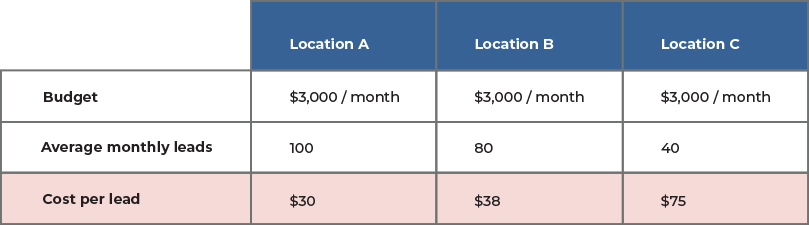
    Mary wants to be fair, so her first instinct is to split the budget equally across all locations. After a couple of months of doing this, however, she notices that some locations are driving far more leads. To investigate why, she takes a look at the leads per location (See Table 1), and notices that the cost per lead is significantly better in Location A ($30), than Location B ($38) and especially Location C ($75). Location A & B are both in locations with relatively less competition, whereas Location C is in downtown — where there are a lot of possible customers but a lot of competitors too.

    (Note: When doing this in real life, you also may notice certain locations would struggle to meet their monthly spending targets because there aren’t enough people searching for relevant keywords in those areas.)

    Table 1: Search Engine Marketing (SEM) Budget & Leads per Location

    SEM Budget & Leads per Location

    Does that mean she should assign all her budget to Location A to get the most customers at the lowest price? Probably not. To keep staff happy at each location, she likely needs some level of minimum spend. She also has to consider the fact that as you try to spend more at each location, the cost per lead will go up.

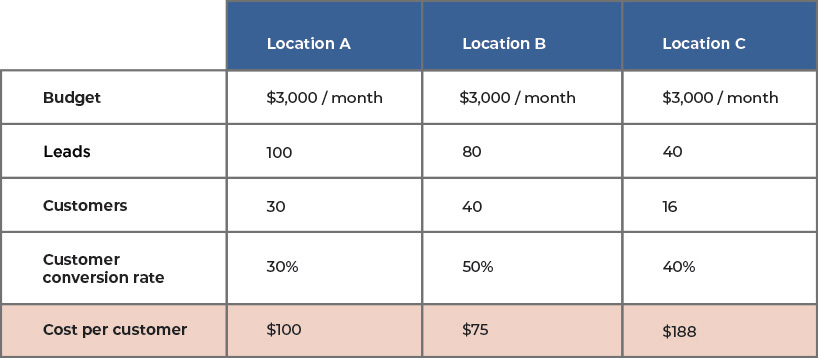
    But the cost per lead is only half the story — what Mary really wants to know is the cost per new customer. Because she has worked with a marketing agency to set up proper call tracking and marketing analytics, Mary is able to calculate cost per customer (See Table 2).

    Table 2: Digital Marketing Cost Per Customer

    Digital Marketing Cost Per Customer

    What factors to consider: Demographics, Operational efficiency, Capacity, and Service mix

    After working with dozens of multi-location companies and franchisor/franchisees, Position2 has developed a framework called “DOCS” to consider when optimizing advertising spend across locations:

    • Demographics: Consider the demographics of the neighborhood. Some locations will be in more prosperous areas, near areas with a concentration of a particular type of customer (e.g., College towns) or areas with more or less foot traffic. All of these factors should be considered along with the company’s product or service to arrive at a hypothesis of how many leads that location could bring in.
    • Operational Efficiency: Some locations — especially in service businesses — will be more or less efficient at converting leads to customers. This could be because of the quality of the reception staff, the hours of operation, or the quality of the service provider (e.g., an established service provider with a great reputation).
    • Capacity: In the service sector, a company’s capacity to serve demand will vary on a weekly or even daily basis. In this example, Mary would want to develop a system to collect prospective information on how many open spots she has in each doggie daycare pack on a regular basis. She would want to spend less money on those locations that have fewer slots open. This dynamic also exists, albeit to a lesser extent, in retail stores, as the amount of product the store has on a shelf will vary.
    • Service Mix: All the stores may not offer the same services. Mary may have some locations that offer training, grooming, or boarding, whereas others only offer doggie daycare. Mary should only spend on relevant keywords for each location, or have a good system for cross-referrals.

    From Theory to Practice: Putting a dynamic optimization system in place

    Putting the DOCS framework into place requires the proper setup. Here are some things to consider:

    • Don’t do this just once: Once you decide how much budget to allocate to each location, ensure you have a system in place to revisit this regularly. Each location’s operational efficiency and capacity will fluctuate regularly, and over time even the demographics and service may shift over time. With many of our clients, we revisit these budget allocations on a monthly or quarterly basis.
    • Use prospective information: Using historical data to predict the future is a necessary input. Where possible, however, try to augment historical data with prospective information (i.e., things you know about the future). For example, a location’s capacity may be low when you look at the past month, but you may be hiring an extra staff member or two in the next two months. You should change your budget allocation in advance to make the most of your location’s budget.
    • Create tiers: It may be difficult to report and digest information on each location. To facilitate ease of reporting to executives, and to ensure the system is easy to sanity check, we often set up “tiers of performance” with our clients. The top tier usually consists of those locations deserving of the most budget based on a balance of DOCS framework considerations. The next tier has the next highest average budget, and so on and so forth. With a tiered system, it is easier to report to executives about how each tier is doing.

    Optimizing budget allocation across multiple locations is tricky, but if you do it well, you will have a big jump on your competitors — and well on your way to getting the most bang for your buck out of your Google, Bing, and Facebook ad dollars. Consider demographics, operational efficiency, capacity, and service mix, and you will be well on your way to a sophisticated approach that gets the most out of each dollar of your marketing budget.

  • Adopting Local Store Marketing in your multi-location marketing strategy| Position2

    Managing local marketing strategies for multiple-location companies can be challenging, even for experienced marketers. Let’s say you’re running a 30-location grocery store on the West Coast of the United States. Your store managers are begging you to do a better job of marketing to their local audiences. Here are just a sampling of their complaints:

    • A manager of the flower department at one store feels like she can’t compete with the truly local florist who gets intimately involved with the high school at prom time and works with the local card store for Mother’s Day.
    • A manager of the produce department at another store doesn’t like the fact that their Asian produce isn’t getting promoted to their substantial Asian population.
    • A manager of the pharmacy department at a senior-rich store feels like he’s not effectively promoting senior-friendly products to his local market.

    How do you solve these problems? By adopting local store marketing (LSM).

    Local store marketing (LSM) is all of the marketing activities you do to help your business be locally relevant to customers within a 1- to 5-mile radius. LSM requires a lot of effort, but the payoff can be great. It’s all about building relationships, giving back to the community and serving the needs of local customers.

    Nine Steps to Take for Local Store Marketing

    1) Develop Location-based Buyer Personas

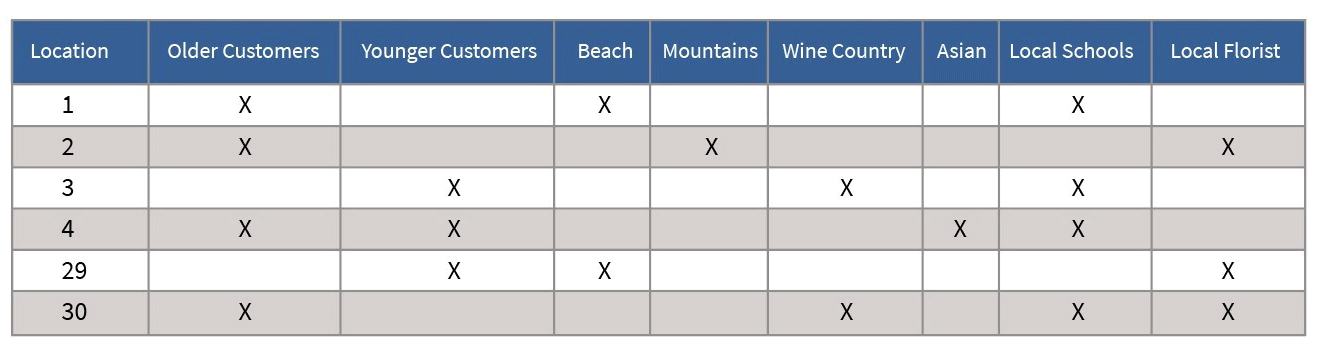
    Think about the unique characteristics of each of your locations. Essentially you want to come up with a location-based buyer persona (or multiple) for each of your stores. Here is an example to help you get started.

    Adopting Local Store Marketing in your multi-location marketing strategy| Position2

    2) Create a Location-specific Database

    Having a location-specific database and good engagement platform will make LSM much easier and more efficient. If you have a store-wide database, you can’t promote Asian produce selectively to your Asian audience.

    3) Leverage Google My Business (GMB) for Each Location

    Assuming you’ve set up Google My Business (GMB) for all of your locations1:

    • Create posts that are particular to each location-based buyer persona. For example, promote sunscreen products for the beach stores, meal kits and other senior-friendly products for the elderly stores, Asian fare for the Asian stores, and to-die-for flower offerings for the stores with local florists.
    • Highlight a local employee each month, letting people know that if they come to the store that month and find the promoted employee, they will receive a special gift. This is all about making your local store feel like a living, breathing entity who cares for them and is worthy of being cared for. Think about how you feel about most corporations. They’re big. They’re unfeeling. They only care about their bottom line. Creating relationships locally goes a long way in building loyalty and trust.
    • Promote a local school and/or a local vendor. Again, the local relationship is huge. A big corporation isn’t going to take the time to care about a local school. But your local store cares deeply.
    • Sponsor a local activity, ideally with other local companies. Perhaps you will support a Little League team or a concert at one of the local wineries. And of course, as part of the sponsorship, include some of your favorite products that you are eager to sell more heavily.

    4) Further Localize Your Digital Marketing Presence Across Multiple Locations

    Create location-specific web pages (company name/location) and social media personas to further help connect local customers with a specific site.

    5) Use Customized Emails

    Use email marketing to reach out to each location-based persona. Ideally, have the local emails signed by the local store manager.

    6) Text Messages Are Even Better

    With smart phones all the rage, text messages are even more effective than emails for connecting with local community members, especially if you’re encouraging people to visit the store. Consider using an automated system to make texting even easier. Invite your customers back, thank them for coming in, send birthday messages and much more. Offer your customers a treat and give them 7 days to come in to redeem it.

    7) Personalize Assets with Location Information

    At a minimum, replace the corporate address information with the local address information. You can do this for online assets as well as for physical assets.

    8) Practice Geotargeting for Multi-Location Marketing

    When you use geotargeting in your online communications, not only do you make local customers feel warm and fuzzy by highlighting favorite watering holes (e.g., popular restaurants, bars, companies and shops), but you also influence the owners of those favorite places to think about partnering with you. This gives you the opportunity down the road to do some joint marketing, which can be very powerful.

    9) Manage Reviews Locally

    We all love great reviews. But we know that with great reviews come some not-so-great reviews. Truth be told, the bad reviews aren’t the end of the world. People trust companies much more when they don’t look absolutely perfect. For example, let’s say you’re looking for an area rug on Overstock, and you see that they have some bad reviews. But when you dig deeper, you notice that most of the bad reviews were due to the wrong product being sent, and the reviewers said that the company handled the mistakes smoothly.

    Whether the reviews are bad or good, it’s important for the store manager to respond to all of them (the local person is key here). Corporate should write up positive and negative templates that they use on behalf of their store managers (making sure their store managers see everything) or their store managers use.

    We hope this article has given you good ideas for how to adopt LSM if you are marketing for a company or franchise with multiple locations.

    Happy Local Store Marketing!

    1Please visit to learn how to do bulk verification in GMB.

  • Post Event Video Marketing for Virtual Events

    This article is a quick snapshot of how to re-use virtual event videos produced in your post-event marketing efforts. Take me to the template.

    Today virtual events are experiencing a corona virus-related boom. It’s accessibility, flexibility, a time-saving benefit for the audience, cost-effectiveness, and most important of all – the social distancing compliance element of it all, is making them the new marketing normal! The very obvious channel of presenting a virtual event is through live streaming or on-demand video through the various tools/resources available today. What’s a less known fact is that videos created at these virtual events have great content that can also be rehashed and used again as an intriguing video asset to continue the conversation with your clients, prospects, or even new logos! While ‘video marketing’ is a trend that is considered essential to the marketing mix, effective re-application of the videos has been an effort that’s yet to be deployed effectively. So, how do we go about it?

    The typical challenges that we commonly hear are;

    1. Is there any content that was produced during the event which can be used again?

    2. We are out of assets. It was all used during the event… Now we need more for post-event promotions

    3. Can we create some snackable assets from the content used at the event?

    Solution:

    Below is a 6 step process on how this can be done.

    STEP 1: AVOID THE PLAN THAT STARTS 2 WEEKS BEFORE THE EVENT

    Start well-in-advance. Based on the event agenda, understand the kind of videos that can be captured. Make a listicle of type of videos. A sample set of videos could be:

    1. Testimonial videos

    2. 2-way interview videos

    3. Break out room session videos

    4. Recap videos (quick recap of the event with or without a moderator talking into the camera), otherwise called Sizzle Reel videos

    While we understand that filming and editing such videos well-in-advance could be an uphill battle, there are easier ways around it. Take a look.!

    STEP 2: BE CLEAR ON THE FORMAT OF THE VIDEOS

    A) Pen down the description of each of the video types so that we (advertiser/marketer) and our clients are on the same page as to what each one of them means. Some examples:

    Demo Video – Product/offering/service showcase video

    Recap Videos – Host talking into the camera on the recap or it could be:

    a. Host and a prominent speaker/guest together summarizing the video

    b. Collage of snapshots from the event – with a VO (will need to be edited)

    B) Be clear on the length of the video. This will be important while planning the usage of the same.

    STEP 3: PIN DOWN THE AUDIENCE ITS MEANT FOR

    It’s important to be clear on the audience it’s meant for. This will help further plan out the possible channels we will use it in, to reach a specific audience. It may also impact the format of the video.

    For example:
    Demo Videos – IT Architects, Developers, Data Scientists

    STEP 4: SLOT THE STAGE OF THE JOURNEY WHERE THE VIDEO FITS INTO

    Split the videos into the different stages of the customer journey. Basically slotting it into stages of the journey where you believe the content would work best. It could go right across from Discover, Early Learn, Late Learn, Try, Buy and so on…

    For example:
    Fireside chat video – where a moderator having a discussion with an expert / Senior leader could be something used in the Discover or Early Learn stage.

    STEP 5: DECIDE THE INTENT

    Now it’s time to decide the ‘intent’ that can be met with the video. Basically, what is the intended action expected from the audience you are targeting when they see this video? Answering this question will also drive a stronger orientation of the content planned for the same.

    For example:
    A Demo – could be used to encourage a trial

    STEP 6: DECIDING THE MARKETING CONDUIT

    Last, but not least, we are to decide which channels would work best for the video we intent to produce.

    For example:
    POV video on existing trends of technology – could be used in:

    • Within articles/blogs written on publisher channels
    • Landing Pages
    • Within Webinars
    • LinkedIn
    Deciding the Marketing Conduit

    Some pre-requisites are essential during this process:

    1. Sign off on the ‘video chart (see template)’ planned from client

    2. Sign off on the plan for future use of the video from the client (which is part of the template)

    3. Assignment of spocs from the client’s end to aid – in video usage post-event56t
    a. Get talent/rights forms signed off- so that they can be used across channels

    4. Detailed list at least a week before the event – of possible clients who would be attending the virtual event and whom we intend to have audience/video interviews.
    a. Get the questions in place for the interviews with approvals from the client’s internal marketing teams and if required client’s client and legal teams
    b. Get as many of videos pre-recorded

    5. Specify the need for a distinguished moderator during the interview if required

    6. Sign off on editing time (If required for uploads in real-time).

    7. Buying and testing with tools to make the videos interactive

    8. Good audio equipment in place for effective audio/videos recordings to be done

    9. Sign off on budgets for appropriate PO releases to be done

    While shifting lead gen from traditional to digital, why don’t you take a look at how Position2 can you put your marketing to work.

    Happy Video-ing! And plan ahead in time. To get you started off, here is a template you can download.

  • Protecting Data Privacy During the Turbulent 2020 COVID-19 Pandemic

    With the invasion of the coronavirus pandemic, the world has changed. Businesses across the globe while practicing social distancing are dependent on the internet more than ever before. Almost all trade shows, conferences, and offline marketing initiatives are canceled. This has dramatically increased the demand for digital marketing. While it is important to stay at home and stay safe to fight the COVID virus, it is also equally important to keep businesses running and help the economy grow during these dire times. Digital usage will be the deciding factor for business continuity and profitability. While companies use new digital strategies, it is important that they adhere to the general data protection laws that have been put in place.

    Governments across different countries are coming up with different data protection regulations and guidelines to safeguard user data. Thus it becomes increasingly important for digital marketers to follow these regulations or face huge penalties. All of the current reforms like GDPR and CCPA aim at helping the customers gain better control over their data by offering more transparency through data collection and usage processes. This doesn’t put an end to how digital marketers can market their products. They just have to modify their ways of collecting and using the data of consumers.

    Here are some tips that a digital marketing agency or any firm involved in digital marketing can use to adhere to data protection laws prevailing across the globe.

    1. Standardize the Policy for All Regions

    It is advisable to maintain a standard all-encompassing policy across all target market regions. Slowly and steadily, all countries are aiming for the protection of their consumer data. These privacy laws which are applicable in one region will soon be implemented in other regions. Most countries follow their predecessors, creating policies that are quite similar to the ones already in place. This means that you don’t have to worry about your campaigns when a new policy takes effect in a different region, because ultimately most of the privacy and cybersecurity laws are more or less similar and you have already accommodated those in your standardized approach.

    2. Risk Management

    Organizations should create new risk management policies that are to be strictly followed by each division of the company. Here are some of the steps that should be included:

    • Catalog your organization’s assets, including server, computers, data, routers, software and email.
    • Determine what threats each asset may face from humans (hackers, competitors, human error), technical (crashes, overloads) and environment (floods, earthquakes).
    • Consider the loss of confidentiality, breach of trust and lawsuit issues that may occur in case of occurrence of a threat.
    • Identify ways to mitigate the risk and protect privacy and data. For example, risks associated with unauthorized access and modification of data can be prevented by an appropriate firewall and updated antivirus.
    • After implementation, educate all stakeholders on new controls, policies, and procedures to follow in order to mitigate the risk.

    3. Website Audit

    Your business is still liable and can face heavy penalties for the collection and improper use of data by third-party platforms. It’s essential for your business to audit its website in order to understand the platforms loading across different pages of your site. This may include tags and pixels that you may not be implementing directly but are piggybacked on your platforms. You need to put checks and balances in place to identify others collecting data from your website.

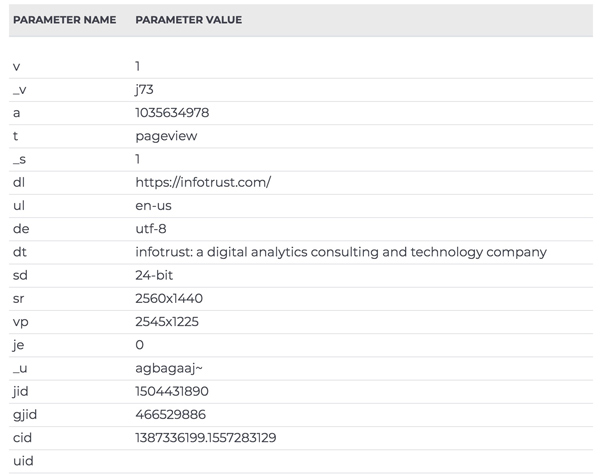
    This data can be obtained using a tag audit and tag inspector. Follow these steps:

    1) Identify the platforms loading on your website.

    2) Understand the data collected by them by looking at the network requests they are sending from your business site to the respective server of each platform. The type of data collected by these third-party platforms should be identified. This can be done by looking at the network requests they are sending from your website to their own respective servers.

    3) By using Tag Inspector, you can collect these at scale across all pages of your site and get simpler outputs to aggregate and understand the same data.

    website-audit-image-1-parameter-name-and-parameter-value

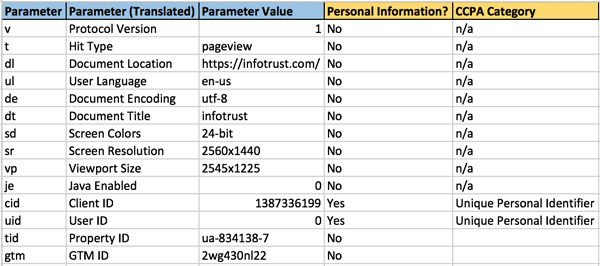
    4) After identifying the data points of each platform, analyze if any data is considered personal information. Mapping of data can be done in this format for ease of understanding.

    Emojis in Advertising: Do’s and Don’ts

    In case personal information is collected/shared/sold, you need to include this in your privacy notice and disclosures to consumers.

    4. Obtaining User Consent

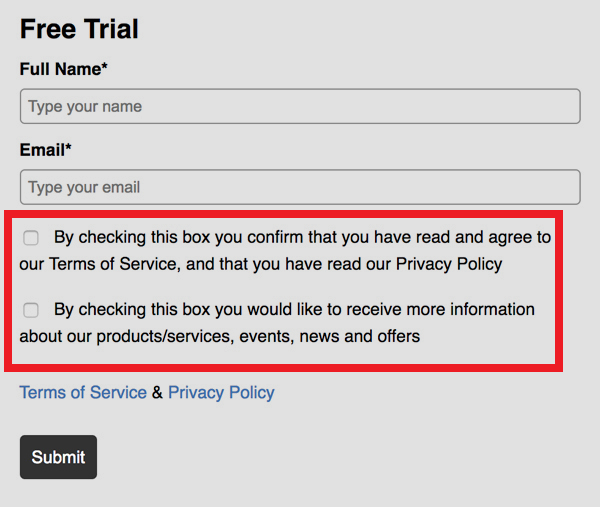
    Terms and consent on your emails, campaigns and websites should be clear and not stuffed with complex language that can confuse users. The user consent should be obtained to collect information as well as to send future information.

    Emojis in Advertising: Do’s and Don’ts

    5. Ownership in Case of Data Breach

    Data breaches are not a matter of “if they happen” but rather “when they happen”. In spite of having a very secure system, always be prepared for the worst. In case of a data breach, Marketing and IT will work together as the first line of defense in complying with legal notification requirements. The appropriate point of contact should be in place in case an unthinkable data breach situation arises.

    6. Immediate Breach Notification

    If a security breach occurs, you should report the data breach to both your customers and data controllers. Failure to report would lead to fines and strict action against the company by data protection authorities.

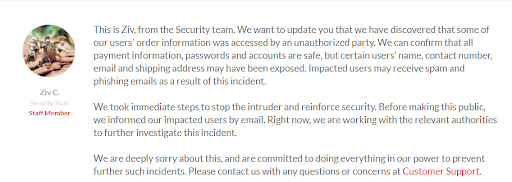
    Every individual in the company is entitled to report a data security breach as soon as they discover it. Recently, Oneplus informed its customers that an unauthorized party was able to access order information from the online store of Oneplus. They also pointed out what information was accessed. Here is the screenshot for the actual notice by Oneplus.

    Emojis in Advertising: Do’s and Don’ts

    7. Providing Data Access Rights to Users

    Under certain legal basis, users have the privilege to access their data that has been collected. The company should be able to provide the user with a free detailed electronic copy of the data that was collected about them. It would be good practice to share a report that includes various ways in which the user data is intended to be used.

    8. Right to Be Forgotten

    Customers have the right to ask for data deletion. They can make a request verbally or in writing. Additionally, companies can erase customer data after it has been used for the purpose per their consent. Every company has the right to refuse data deletion if collected for the following purposes:

    • For providing services or goods requested by the consumer
    • Data pertaining to detection of security incidents and prevention against malicious, fraudulent or illegal activity
    • For engaging in scientific, historical or statistical research in the public interest
    • Used only for internal purposes that are reasonably aligned with the expectations of the consumer
    • Data that is required to comply with a legal obligation or lawful basis

    9. Data Portability

    Data portability laws give the users rights to their own data. This information should be in a usable format that allows easy transmission without hindrance. Companies like Google and Facebook now allow users to download their own data, generally in a machine-readable format that can be used to transmit their data to another service.

    Conclusion

    It’s essential that you only collect relevant data. Collecting unnecessary data just because you think that it would be useful in the future can make your present data processing and management difficult. Ultimately you need to really think whether you require the data you are collecting or not, because the older way of collecting as much data as possible will make things more difficult for you. Data minimization and relevancy should be the goal while storing the data While it may seem that CCPA and GDPR principles will terminate digital marketing, that is far from the truth. These eprivacy directives will, in fact, help companies come out ahead, especially those companies that embrace it. They will help build a good relationship with customers by fostering trust and being open about what data is being collected from customers and why. Giving consumers a choice will help create a mutual benefit — and exchange of data for more personalized and relevant experience.

    This is a smart marketing strategy in the long run. It will help in business continuity in the current COVID-19 times when traditional marketing strategies cannot be implemented due to social distancing and restrictions to fight the global pandemic. As businesses embark on their new digital journey, it is important to adhere to data protection laws. This will benefit both your business and your customers. Stay safe, and keep others safe.

  • Top digital marketing trends for 2020

    2020 is here – the start of a new year and a new decade. Over the course of the last decade, digital marketing grew from sea level to the mountains and emerged as an essential part of any business. With the beginning of a new decade, several marketing experts have predicted how the innovations in digital media, platforms, and technology will shape marketing in 2020.

    In this article, let’s take a look at the digital marketing trends that the experts believe will be the most beneficial to your business.

    Treat personalized marketing as the key to success

    This is undoubtedly the most exciting digital marketing trend. Studies have shown that customers feel more attracted to a certain brand when they get personalized marketing messages from them. Brands should look for ways to make every customer feel special, and this should be more than just typing the first name into an email greeting. They should dig deep into the customer’s mind and find out about their liking and what they look for when buying online. Getting personalized messages,offers and alerts on a certain product that your customer may have been looking for can make them buy it instantly. But keep in mind that users do not want to be bombarded with content, especially if it isn’t relevant, so keep your content concise and easily understandable.

    Use interactive emails to engage your customers

    No matter how much we move forward with technology, the undeniable fact is that Content is still King. Several reports from 2019 suggest that most B2B content is educational, with the intent of fostering leads and building audience trust, two things that are essential for inbound marketing. The latest digital marketing trends show a downfall in text emails and newsletters, and digital marketers are looking to replace these with emails that look and function like web pages, designed with clickable buttons and other interactions. These gleaming designs are doing much more than just creating impressions. They are improving conversions.

    Utilize creatives as a serious performance driver

    Platforms like Google and Facebook are now capable of understanding which ad images and ad copies will drive the best traction and the best click-through and conversion rates. Given these new capabilities, you should make your creative emerge as a performance driver,carrying equal weight to other key drivers such as audience targeting and placement selection.

    Implement product tags to increase eCommerce sales

    A few years back, businesses were struggling to direct their social media traffic to their e-commerce stores. But thankfully, they have found an answer to this issue. With social commerce, buying a product directly from social media posts and ads is now possible, and this can be done without even leaving the app or the site. The shoppable posts may not be exactly new but, since the launch of Instagram’s checkout option, this digital marketing trend has become very popular. By giving customers a hassle-free shopping experience directly on social media, you can increase the chances of successful sales conversion.

    Update your old content with new keywords

    Your site may have old articles that have previously ranked well and have attracted backlinks, but search traffic for those old write-ups may presently not be high. So to maintain your SEO rank, you need to update your old content with new keywords, which will help you to hold your rank. This is one of the most inexpensive and effective digital marketing trends that you should consider.

    Invest in a video blog (vlog) and influencers

    With the growing success of YouTube, Instagram and Snapchat, the popularity of video blogs has skyrocketed. Findingmicro-influencers who have a targeted group of followers and are popular enough to be influential can be very beneficial.They will promote your product with video blogs and help you easily reach more potential customers within your vicinity. Small- and medium-sized businesses are opting to work with small- and medium-sized influencers instead of competing with globally-leading organizations for the top-tier influencers.

    We can see that the upcoming trends in digital marketing ask for both more of a human touch and better utilization of technologies. The emphasis is on giving a more personal relationship with extra targeted niches and making better connections using new technologies. The objective still remains the same – getting people everything they want at the same place – with technology making it easier to reach there.

  • Need More Traffic? Learn How to Optimize Google’s Featured Snippets

    The goal of all content is to attract new audiences, generate more traffic and reach the business’s overall goals. With Google’s algorithms and practices constantly evolving, it pays to adapt to the changes coming your way. One such new development in recent years is the use of featured snippets on the search results page. If you succeed in optimizing your content for Google’s featured snippets, you can increase the traffic to your site and even become recognized as a trusted source on the subject in question.

    To help you do this, here are four infallible ideas to optimize your content for Google’s featured snippets.

    What Exactly Are Google’s Featured Snippets?

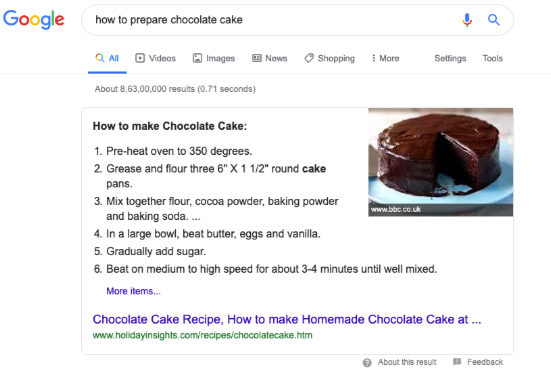
    Also known informally as answer boxes, Google’s featured snippets are exactly what they sound like – they’re featured pieces of content that appear in a distinct box right at the top of the search-results page. They precede the organic search results and come in second only to advertisements. Here’s an example of a featured snippet.

    You see that recipe in the box? That’s a featured snippet. Featured snippets are generally in the form of paragraphs, lists, or tables, and typically show up when people search for specific things like questions, recipes, statistics, and lists.

    How to Optimize Your Content for These Snippets?

    Optimizing your content for Google’s featured snippets may seem daunting until you do it. Following are a few pointers to get you started with the best practices to hop on to the featured snippets bandwagon:

    1. Research Your Keywords Thoroughly

    Keyword research forms the basis of creating content that shows up as a featured snippet. Why you ask? Because Google’s featured snippets are most often triggered by long-tail keywords. Begin by using trusted research tools to identify keywords which contain question words in them, such as “what,” “where,” “when,” and “how.” Google’s Keyword Planner can help you pick and use the right keywords to get your content noticed. Serpstat is another tool that helps with both keyword research as well as featured snippet research.

    2. Create Content That Answers the Right Questions

    Your content needs to be useful and informative. Only then can it qualify for the searches that trigger Google’s featured snippets. So, identify the topic you want to write about, and find a unique angle that people are actually interested in. Use public forums or social media to find out what people are asking and create content that’s relevant to what’s in demand. Or better yet, create a poll and ask your followers what they’d like to read about, or what they’d like to know the answer to. These tips can help you write about things that people want to read.

    3. Structure Your Content Well

    Once you’ve zeroed in on the right keywords, you need to ensure that you create content that’s easily scannable. For instance, if your content can be done up in the “how-to” format, it’s best to opt for this style. You could also opt for long-form content that’s at least 1,500 to 2,000 words wherever possible. It’s no secret that Google rewards long and informative posts, but don’t just stop with the word count. Mix it up by adding relevant images, infographics, and videos. Also, remember to make your titles descriptive and to format your title tags well.

    Learn How to Optimize Google's Featured Snippets

    4. SEO – An Important Piece of The Puzzle

    No matter what you hear, SEO is not going away anytime soon. It’s always relevant. This is why you need to keep your SEO game on point if you want to make it into the big leagues and have your content featured in a snippet. If you’re new to SEO, here are some of the best practices you need to focus on.

    • Easy-to-read content
    • Meta descriptions and keywords
    • Title tags
    • Link-building
    • Elimination of duplicate content

    A Final Word of Advice: Build on Your Strengths

    Here’s a quick tip before you get started: Get better at what you’re good at. Identify the topics where you already rank high on search results and build on the dimensions of those subjects. For instance, if you rank high on search results for “best ways to lose weight,” optimize the relevant content pieces for the answer boxes. This way, your chances to have your content show up as a featured snippet get improved.

  • What I Learned by Teaching at Universities

    I had the opportunity and privilege of teaching three classes at two universities. The first of these was at the Santa Clara University on October 2nd – a group of young students considering various career options – including digital marketing.

    The second and third were at the University of Chicago Booth School of Business, on Oct 18 and 19. The students in these classes ranged from working professionals looking to familiarize themselves with online marketing to students learning digital marketing to be future marketers themselves.

    After over two decades as a professional marketer, the opportunity to teach came as both a refreshing change and an opportunity to learn. I was supposed to be the teacher in these classes. However, I believe I walked away with as much learning – if not more – as the students. Here are a few of my take-aways from revisiting a vocation that’s close to my heart – one that I believe is the highest of all – teaching.

    What I Learned by Teaching at Universities

    1. Taking nothing for granted:
      As I started preparing for my classes, one of the first things I realized is do not take things for granted. Working in the online marketing industry, we tend to take at least a basic familiarity of various channels of marketing for granted. With clients and colleagues alike, we interact with these assumptions in place. While preparing to address students I had to be extra careful to not assume the students know what terms like SEO or PPC mean.
      At the same time, I couldn’t let the class be so basic that the savvier among the students did not takeaway some new insight, learning or perspective. Striking a balance between the two was arguably more pressure than a demanding client or a problematic marketing situation.
    2. Revisiting the basics:
      I had to revisit the very basics, and I was surprised at how much research it required. As I re-familiarized myself, I realized how little the basics of search engine optimization, paid advertising, email marketing, etc., have changed. I actually found possible solutions to a few complex situations for a few of our clients. The best solutions are usually quite simple and may lie in what we often dismiss as being too basic or simple. Sometimes we have to step back and remember what we were first taught before we can solve complex problems and this experience was a good reminder of that.
    3. Stepping away from jargon:
      Another trap many professionals get into is the use of jargon. In some cases, it just becomes part of the language – like WHO, UN, FBI, etc. It is also possible that some feel that not using jargon may make them come across as less informed. That speaking in simple terms may be perceived as being less knowledgeable. But when you are interacting with someone who may not be familiar with terminology we take for granted, you can unintentionally make them feel ignorant. Language can break barriers but can just as easily create a wall and close the doors of communication. Taking extra pains to ensure a jargon-free class taught me the value of simplicity and how it can break communication barriers.
    4. Storytelling:
      I sprinkled a few experiences from my career in each of my classes. These were what seemed to make the best connection, got the most reaction, and even provoked questions. We often forget the power of story-telling in everyday professional life. And yet, everyone — from students to colleagues and clients — humans react to personal experiences, and the three classes reconfirmed for me the value and power of a story.
    5. The pressure:
      I would be lying if I said I didn’t feel nervous walking into each class. The responsibility of influencing students and the unknown variables of how they would react to me would have been pressure enough. I also had the pressure of being on unfamiliar ground. Speaking at conferences, participating in meetings with clients and making professional presentations aren’t new to me, but addressing a class of students was. Truth be told, I was petrified walking into each of the classes, and I have no idea whether I managed to hide the fears well enough or not.
    6. Being surprised:
      I had told myself to be ready for a few surprises – I was prepared to be challenged, to deal with questions ranging from the elementary to the outlandish, and not to be fazed by bored expressions. Still, I was surprised at how similar the groups of students were to clients and colleagues. Their questions were sharp, well thought out, and refreshingly curious. I found myself responding to the infectious energy and curiosity in each of the classes. I walked away surprised at how much I felt like the student while I was supposed to have been teaching.
    7. The protégé effect:
      In hindsight, I shouldn’t have been surprised. I had read about the protĂ©gĂ© effect where you learn when you teach. The learning started when I started preparing for the classes and continued even while I was teaching. It’s as humbling an experience as it is enriching.
    8. Communication:
      Teaching is an excellent opportunity to test out your communication skills. It is said that if you cannot explain your subject to a six-year-old, you do not know your subject well enough. While I was teaching university students and not six-year-olds, it taught me to consider every word I used in class, every slide I created, and every question I answered. I believe teaching is a great way to continually improve your communication skills because only when you can communicate effectively with someone who may have no idea about a topic can you claim to communicate well.
    9. Humility:
      Last, but perhaps the biggest takeaway for me was that I left the classes humbled. Everything about the experience was humbling – from the wide-eyed curiosity of students, the open interactions and debates, the discussions, questions and reactions to my answers, and of course, to the new connections and acquaintances made.
      At the end of the day, a teacher is a reflection of what the students take away. In that, I would feel accomplished if even just one of the students from these classes chose online marketing as a career and if the class I taught had a role to play in the decision.
      As I was returning home from the last class, I realized how many of these learnings apply to my everyday life as a marketer working with peers, juniors, clients, and other professionals in the industry.
      Finally, I also realized just how much there is to learn – not only in online marketing but also about various aspects of learning, human nature, simplicity, and more. I do believe teaching is a great way to educate yourself and I hope to carry my learnings in my everyday life and interactions.
  • Evolution of B2B Marketing Strategies

    Marketing strategies are ever-evolving, year after year, with 2019 being no different. Trends like live videos and video ads will continue to grow strong because of the instant visual appeal to the audience and with more than 80% of the internet users who indulge in watching these videos. Similarly, chatbots continue to trend this year by becoming widespread and pretty ‘normal’ for brands. The novelty factor has reduced, and they have become quite common.

    Here are some of the B2B strategies that aren’t new but continue to stay in the market:

    Longtail SEO: In the B2B space, the only way to compete with the big players with deep pockets is not to outspend them but to outsmart them. Smaller players should take advantage of the longtail keywords in their industry that have lower search volumes but more qualified searchers. Fewer websites compete for longtail SEO keywords. Hence, it’s comparatively easier to rank for them.

    Longform Content: We all know that the attention span of the consumer is very short. However, for B2B marketers, long-form content may just turn out to be more beneficial this year. The reason is that Google has started giving more weight to content that has authoritative information. It’s not just about keywords anymore.

    Also, from a lead-generation point of view, the prospects who dig deeper during the Awareness stage, even if just a small number, are the most profitable leads to take to the consideration stage.

    It’s clear that solid, detailed and in-depth information for the right leads at the right time improves the chances that the prospect will engage further and consider the brand.

    Micro-influencers: We all know that having big industry influencers advocate for our brands can ensure a large exposure based on their social media reach and engagement. This, of course, would require you to spend a pretty penny. On the other hand, we have “micro-influencers” who are smaller players in the industry but may have a more engaging follower list.

    The number of followers and, hence the social media reach, maybe smaller for the “micro-influencers”, but the engagement with the followers could be so much more powerful. It’s a new approach to not burn a hole in your pocket, but still, be able to reach out to your audiences effectively through an influencer. It’s just the right amount of smartly targeted PR within an optimal budget.

    Account-based marketing (ABM): ABM is a B2B strategy that focuses on sales and marketing resources on target accounts within a specific market. It’s a strategy that aligns sales and marketing efforts and takes advantage of available data, analytics, and technology.

    Though ABM has been growing through the years, personalizing the customer experience has started to catch on even faster than ever. With the help of CRM, marketing automation tools and digital marketing, marketers need to invest in a well chalked-out strategy that is going to support multimedia, multi-channel and multi-device targeting.

    With the growing competition, B2B marketers with limited budgets need to get smarter and need to build strategies based on these old but evolving trends that are here to stay.

  • Why Should You Invest in Long-term SEO?

    “Why Should You Invest in Long-term SEO?” is one of the most common and repeated questions around the Search Engine Optimization industry.

    Over the last ten years, Google has increased its focus on user experience and search intent, making this a hot topic. Google’s rollout of RankBrain several years ago made this topic even hotter. But the big question is whether an investment in SEO is worthwhile. In this article, we’ll share with you the benefits of making a long-term investment in SEO. We have included a number of items such as SERP (Search Engine Results Page) features and voice searches that you might not even realize fall under SEO.

    Evolving Search Algorithms
    According to John Muller, Google’s Webmaster Trends Analyst, its search engine algorithm gets refreshed throughout the year. If we take the unconfirmed algorithm updates from Google into consideration, we would see a pattern of an everyday refresh. Truth be told, webmasters around the world report fluctuations in ranking almost every day. The below screenshot shows the rank fluctuations from one of the SEO tools for the last 30 days.

    The message is pretty clear that the Google algorithm is evolving every day, and your effective SEO strategy should be revised to accommodate the changes. Additionally, adhering to the Search Engine’s guidelines will help your website visits grow naturally.

    Evolving SERP Features
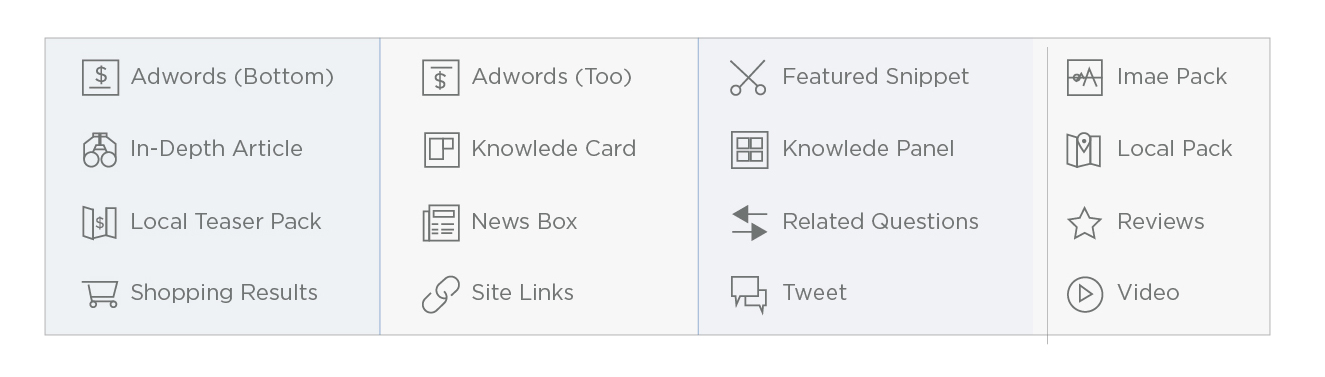
    Google keeps introducing new SERP features to deliver users what they are looking for. These changes are most visible in search results, which make every organic marketer optimize the website/content for the new feature. Every time search engines, especially Google, introduce a new SERP feature, it altogether changes the definition of “how to do SEO.” Below is a sample set of SERP features that dominate the search results.

    Emojis in Advertising: Do’s and Don’ts

    So what does this mean for you? A long-term SEO strategy is critical for making sure you perform well on SERPs.

    Evolving Search Intent
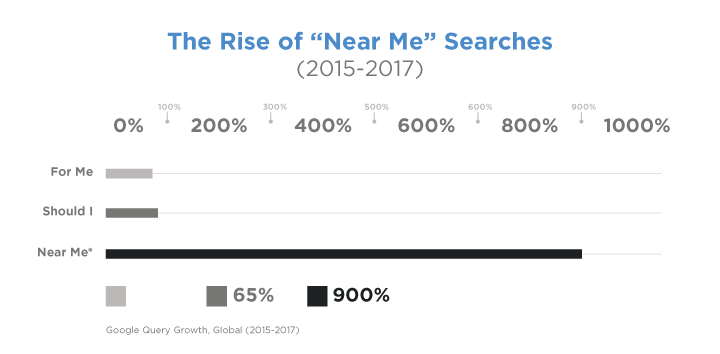
    With greater penetration of mobile devices, the search intent is evolving, as well. Currently, Local and Voice are changing the game plan. Small businesses should capitalize on local SEO to get maximum visibility. In the past two years, “Near me” organic searches have witnessed exponential growth. From 2013 to 2017, there was a 900% increase in “near me” searches.

    Emojis in Advertising: Do’s and Don’ts

    Voice search is growing exponentially YoY and is becoming popular with all age groups, especially the younger generation. If you are in the B2C market, voice search optimization should be an integral part of your marketing strategy. The following few points will clearly say where it is leading and why you should capture this:

    • The global market for voice search devices grew by 187% in Q2 2018.
    • Apple, Google, Xiaomi, Amazon, and other manufacturers collectively shipped 16.8 million units in Q1 of 2018.
    • Google sold 5.4 Million Google Home models so far in 2018.
    • Amazon had sold 4.1 Million Echo devices by Q2 2018.

    Courtesy

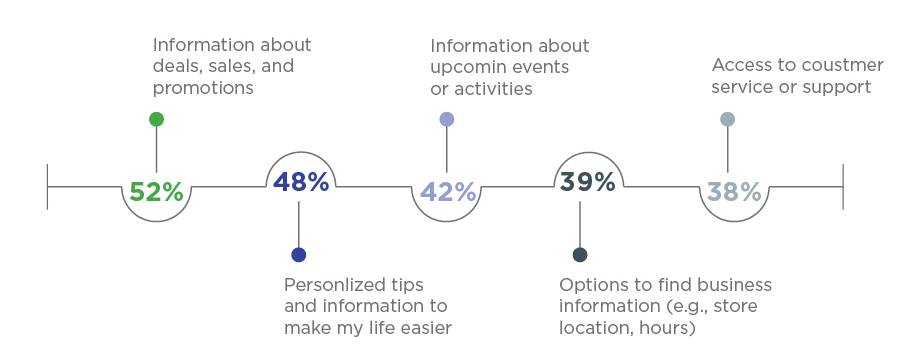
    One in five searches on a mobile device is now a voice search. According to Google, 39% of people use voice search to find business, store, etc.

    Emojis in Advertising: Do’s and Don’ts

    Clearly, optimizing your website content for voice is critical.

    Your website content should use natural language to make sure your users understand the content with ease. To optimize your content for voice searches, use long-tail keywords and focus on natural language. Keep in mind that most long-tail keywords in voice searches are in the form of questions. Having a Q&A or a FAQ section could be the right place to start.

    Competitors are Evolving
    Every business competes for better online presence. So, when it comes to online marketing, you face new competitors every day. These aren’t just your direct business competitors but also other websites like Wikipedia, Twitter, etc. These information-focused websites dominate the SERP pages for your business terms across all search engines. The bottom line is that you need to outrank your business competitors as well as the general information-based websites. Regular competitor gap analysis will help you sharpen your sword and get yourself in front of your battlefield.

    Brand Building (Economically)
    Long term SEO helps economically build your brand by growing your online presence. Remember, an established brand usually stays at the forefront of a person’s mind even after the sale or service is over. Brand building and SEO work toward the same goals with an additional benefit of getting better traffic, targeted audiences, improved conversion rate and profitable ROI.

    Hidden Benefits
    When you focus on delivering high-quality content based on what your users are looking for, you can considerably reduce your customer-care and sales costs. Here are two recommendations for accomplishing this:

    • Focus on common questions of your users/customers in a FAQ section
    • Provide tutorials/guides to help customers understand your products and services

    Final thoughts:
    The bottom line is that if you have a marketing budget, investing in long-term organic SEO should not be a second thought. Long-term investment in SEO is one of the best marketing choices you can make for your business growth. This form of digital marketing will help your potential customers find your website with ease, which will result in targeted organic traffic, higher sales and better ROI.

    Interested in learning more about the growing organic trends, reach out to us!