As marketers, we pride ourselves on developing unique solutions for business challenges. Creativity is the key to our success. Our inspiration comes from a variety of sources. These quotes we have assembled apply to marketers in almost all industry segments. May you find them as inspiring as we have.
“People shop and learn in a whole new way compared to just a few years ago, so marketers need to adapt or risk extinction.” Brian Halligan, HubSpot (TWEET THIS!)
“Measurement is like laundry. It piles up the longer you wait to do it.” Amber Naslund, Sysomos (TWEET THIS!)
“Good marketing makes the company look smart. Great marketing makes the customer feel smart.” Joe Chernov, HubSpot (TWEET THIS!)
“As you go about creating new customer engagement programs and direct marketing packages for your brand, look for opportunities to give rather than to get. Whoever makes the first kind gesture, as studies show, tends to gain the most.” Jeanette McMurtry (TWEET THIS!)
We want to know what consumers are looking for, what their values are, and how can we meet their needs. It’s not just about Big Data; it’s about translating that into the truth.” Gayle Fuguitt, The ARF (TWEET THIS!)
“We must move from numbers keeping score to numbers that drive better actions.” David Walmsley, Marks & Spencer Digital (TWEET THIS!)
“The best marketing doesn’t feel like marketing.” Tom Fishburne, Marketoon Studios (TWEET THIS!)
“Content is anything that adds value to the reader’s life.” Avinash Kaushik, Market Motive (TWEET THIS!)
“There are three objectives for content marketing: reach engagement conversion. Define key metrics for each.” Michael Brenner (TWEET THIS!)
“SEO is a marketing function for sure, but it needs to be baked into a product, not slapped on like icing after the cake is baked.” Duane Forrester (TWEET THIS!)
“In 2004, good SEO made you remarkable on the web. In 2014, good SEO is a result of being remarkable on the web.” Rand Fishkin, Moz (TWEET THIS!)
“Sometimes when you innovate, you make mistakes. It is best to admit them quickly, and get on with improving your other innovations.” Steve Jobs (TWEET THIS!)
“Without actionable data and clear metrics driven strategy, the marketing organization is being paid to guess.” Team Position2 (TWEET THIS!)
We hope you enjoyed this selection of quotes. Kindly use the comment box below to share your favorite digital marketing quote.
To generate buzz and initiate conversation companies target platforms such as Facebook, Twitter, YouTube and Pinterest, building them into their marketing strategies and budgets. All too often they overlook leveraging the untapped potential of SlideShare, thinking of it as just a place to upload presentations and webinars. Big mistake, that. SlideShare is a content marketing social site and a perfect place to generate leads. Early adopters find they don’t compete for eyeballs they way they do on other social platforms, so it can be used as one of the more effective marketing tools.
Here’s how to turn SlideShare into an effective marketing platform.
SlideShare Account Optimization
The steps you take to optimize the SlideShare channel for higher organic search rankings will also appeal to Google’s search algorithm.
Include a link to your website when completing the profile info. Include the most important SEO keywords in the company bio.
For Profile Picture use the business logo. Dimensions: 96 X 96 px (max size is 500KB)
Include the Phone Number & Location
Select the Category/Type most-relevant to the business
To best reflect the company in the Description of the Business/Organization, use copy from the company LinkedIn page or press release
Include the links to other social media profiles on SlideShare to help search engines make connections with your digital assets. You can connect your personal LinkedIn, Facebook and Google+ accounts to SlideShare. Pages or groups you administer on LinkedIn or Facebook can not be linked to a SlideShare account at this time.
SlideShare Asset Optimization
Include easy-to-read title, tags, and description. Keywords play a significant role in the visibility of the asset. Use them with care.
Select the most appropriate Category for your presentation to make it searchable by topic. It is important in terms of SlideShare’s internal SEO and the site’s own search function.
Your filename becomes your URL, so be attentive to keywords, the company’s name, the topic that the asset focuses on, etc.
Follow standard SEO guidelines for your Presentation Title. Exact keyword phrase should be used for best results. Titles should be shorter than 70 characters – anything longer will be truncated and your title will not display properly.
Include an engaging description of the asset. It makes it more appealing to the reader, and increases its SEO. If you use relevant terms within the description your Views will increase. As the meta description of your presentation it should be kept short, around 160 characters.
You are limited to 20 tags per presentation. Any more and they won’t be included.
SlideShare transcribes the text in the presentation so that search engines know what’s in it. Make sure that the presentation itself includes a keyword-rich text.
Share SlideShare files across social platforms such as LinkedIn, Facebook, Twitter, Google+, and Pinterest.
Additional Insights
Views on SlideShare asset
SlideShare counts as a view each time a page loads. By visiting the URL for a SlideShare and clicking on the Statistics Tab, you see how many times a file has been viewed. For deeper analysis click the Analytics button in the account dropdown menu. If the SlideShare is embedded on another website, it will be counted as a view and listed on the Total Views count every time the third-party page loads.
Note: SlideShare doesn’t count Facebook, Twitter and LinkedIn views in the SlideView page analytics.
Integration of Video
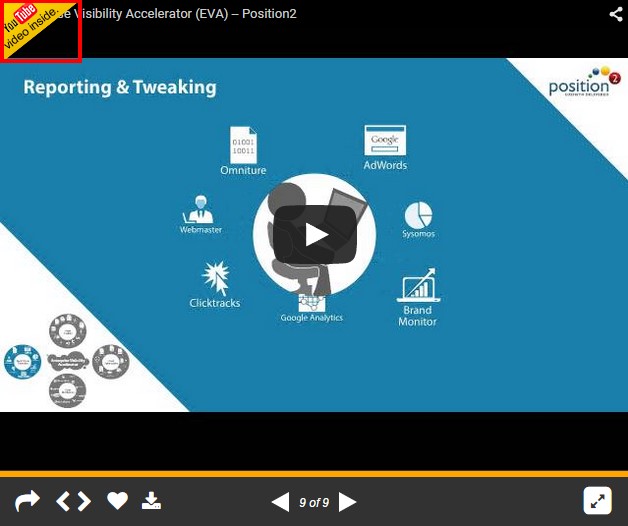
Video can be easily placed inside a slide.
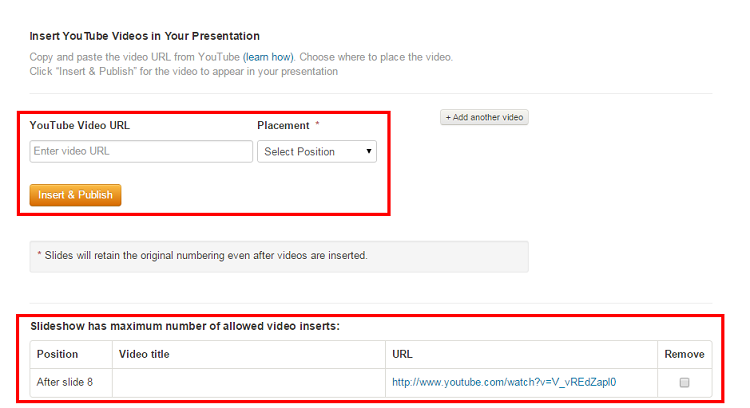
To add a YouTube video to the SlideShare presentation:
Go to My Uploads and click Edit > Settings > Edit YouTube video.
Type or paste the YouTube video URL into the box.
Select the position and click Insert & Publish.
Note: You aren’t allowed to upload copyrighted videos, TV shows, movies, music albums or videos of a personal nature. Also, you can only include the video in a presentation, not a PDF.
Format
To be sure that SlideShare displays your presentation at the highest resolution with custom fonts, images, and layouts all intact use PDF. The maximum upload file size limit is 300 MB (Video is 500 MB). If you have a recent version you can save a PowerPoint deck as a picture presentation. With images, there’s never any conflict with fonts and how they display on SlideShare. PowerPoint formats are supported on mobile, but not PDF, documents and infographics.
Note: For video insertion, retain the asset in the presentation format.
So, from next presentation onwards, implement these tricks and see how SlideShare works wonders for your marketing campaigns.
The 2015–16 report, Ovum Decision Matrix: Selecting a Digital Marketing Platform, 2015–16, has crowned Adobe the King of Digital Marketing Platforms. IBM, Oracle and Salesforce rounded out the top four.
According to Gartner, “Digital marketing platforms are designed to support an extensible set of requirements within a single neighborhood or two. A digital marketing platform exposes key elements as standardized services via a programmatic application programming interface for building custom applications, extensions and integrations with other custom and commercial applications and data sources.”
A Word Of Caution
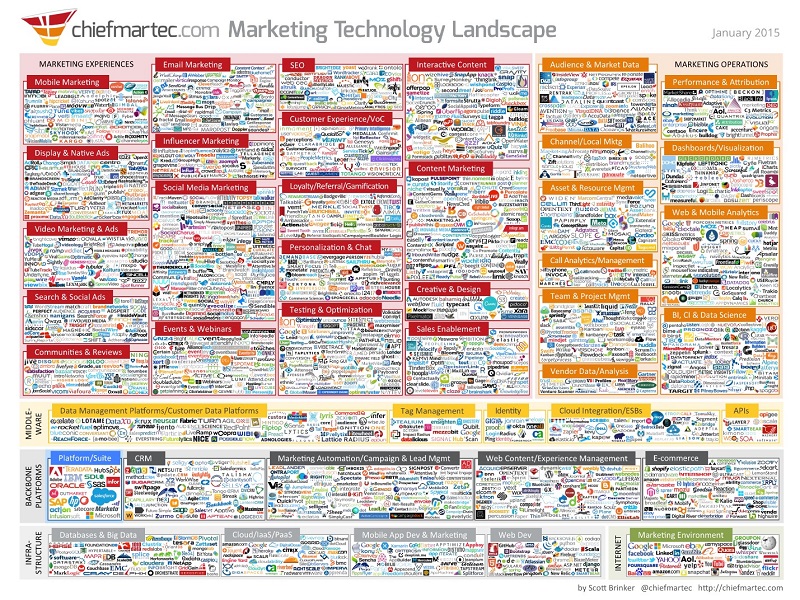
When it comes to marketing technology or tools, there’s an abundance of choices. According to this chart, those choices doubled in the last year from 947 in Jan 2014 to 1846 in Jan 2015.
Understand your requirements and evaluate multiple value propositions. Some providers may have inflated their value propositions by claiming to be a “digital marketing platform” or a “marketing cloud” when in fact they aren’t. Inflated claims may lead to loss and disappointment in terms of your dollars spent, your time wasted and your expectations not met.
Digital marketing platforms are complex inter-disciplinary systems, and work best when the CMO and CIO have a unified technology strategy to guide the organization’s digital marketing transformation.
Unicorns are awesome – but we have not yet found one. Have realistic expectations of the tools and technology you choose to implement. Your expectations will be met if and only if the tools are used by people who leverage the correct processes to extract value from your marketing technology stack.
There are a lot of tools and software that can help make a digital marketer’s job a success. The trick is to choose the right tools and technology that cater to your specific needs at any given point of time.
Let us know if marketing technology has increased the efficiency and responsiveness of your marketing organization?
Tens months have passed since Google’s last Panda update. Now it’s time for a refresh, again. Here comes Google Panda 4.2 — though, as Google points out, it will take several months for the complete roll-out.
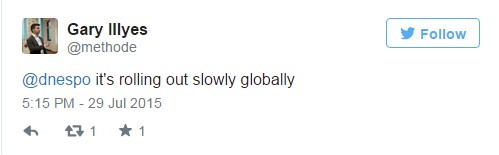
Here’s a quick Google Panda recap: The first update was announced by Google in Feb 2011. There have been four in 2015, including Mobilegeddon in April. Google’s apparent purpose is to promote quality content and reduce web spam. Panda 4.2 is the 28th iteration of Panda updates, and was announced by Google’s John Mueller and Gary Illyes on July 18. According to Search Engine Land, 2-3% of search queries are affected by this refresh, and it may take months to see the results of any changes. Gary Illyes also confirms on Twitter that the rollout will be on a global scale:
What does this mean to websites?
Sites that were hit by Panda 4.1 and have since taken remedial measures now have a chance to regain rankings. Since the rollover effect is still to be witnessed in detail, many webmasters are not really feeling the heat.
Quality content will continue, in part, to determine SEO and search ranking. Websites with good quality and original content achieve greater significance in the eyes of the search giant.
Our thoughts and recommendations haven’t changed from what we said about Google Panda 4.1. This new iteration is a refresh. We continue to recommend that our clients develop unique and original content on their sites and avoid thin content. Overall content placement should be aimed at users and should provide quality information in a way that is easy for a user to understand.
Let us know your thoughts about this update in the comments section below.
The numbers are in. The verdict has been delivered. The paradigm shift is official. According to new research from Standard Media Index, digital media siphoned off more than $1 billion in advertising revenue from the US TV market, with 87% of those dollars drained out of the Big Four networks – NBC, ABC, CBS and Fox. SMI tracked agency investments over a nine-month period spanning October 2014 to June 2015, an interval that corresponds with the broadcast calendar.
New segments like the digital video market are growing at a blistering rate. With spend on pace, it is poised to hit $7.77 billion by year’s end which is a little over 10% of the $70.6 billion TV market.
Not Convinced? Let Facebook Be Your Guide…
Three years after Facebook started running ads on its mobile properties, mobile advertising accounted for 76% of Facebook’s $3.8 billion in second-quarter advertising revenue, which was up 43% year-over-year.
Facebook’s mobile user base saw even steeper growth, with mobile monthly active users up 22% and mobile daily active users up 29%
In the second quarter, the average price of an ad on Facebook rose by 220% while the number of ad impressions Facebook served dropped by 55%.
Is your business strategy in line with the digital and mobility revolution? Use the comment box to share your thoughts.
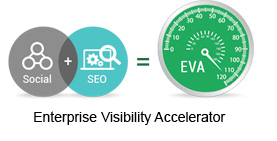
Today’s traditional SEO is inadequate: Ignite your search results by accelerating visibility in more places than ever before.Download this White Paper and learn:
SEO, why the way we know it is not enough
Introducing and implementing Enterprise Visibility Accelerator (EVA)
Using multi-channel tracking tools for effective monitoring
I’m a regular at my neighborhood café, so every morning Jinny the barista greets me with a smile and a hot ‘Skinny Cappuccino’. She knows exactly what I am looking for. And she knows much the same for a couple of dozen other regulars. It’s called personalized service. It makes me feel good, and I keep coming back. So think about the last time you opened your web browser and went to Amazon.com to buy a book. You may have had one title in mind, but you came across a few more recommendations from Amazon, all suited to your taste. Again, it’s called personalized service and it gets your attention. Amazon is doing the same thing Jinny does, but for 76.2 million users per month.
Personalization comes in many shapes
Offline Personalization
Motorola could have rolled out the Moto X customization experience – or personalization experience – in a conventional way, but instead published the world’s first interactive print ad in WIRED.
Offline Personalization
How to attract a millennial audience? Try using bright shiny things with many, many moving parts. Forever 21 and Breakfast teamed up to bring Instagram pictures to life using a giant, digitally synced adjustable billboard, a contraption that includes some 200,000 parts.
The machine renders versions of Instagram photos hashtagged ‘#F21ThreadScreen’ and cameras stream the process live at f21threadscreen.com—and send users auto-edited clips of their photos being rendered.
Online Personalization: Emails
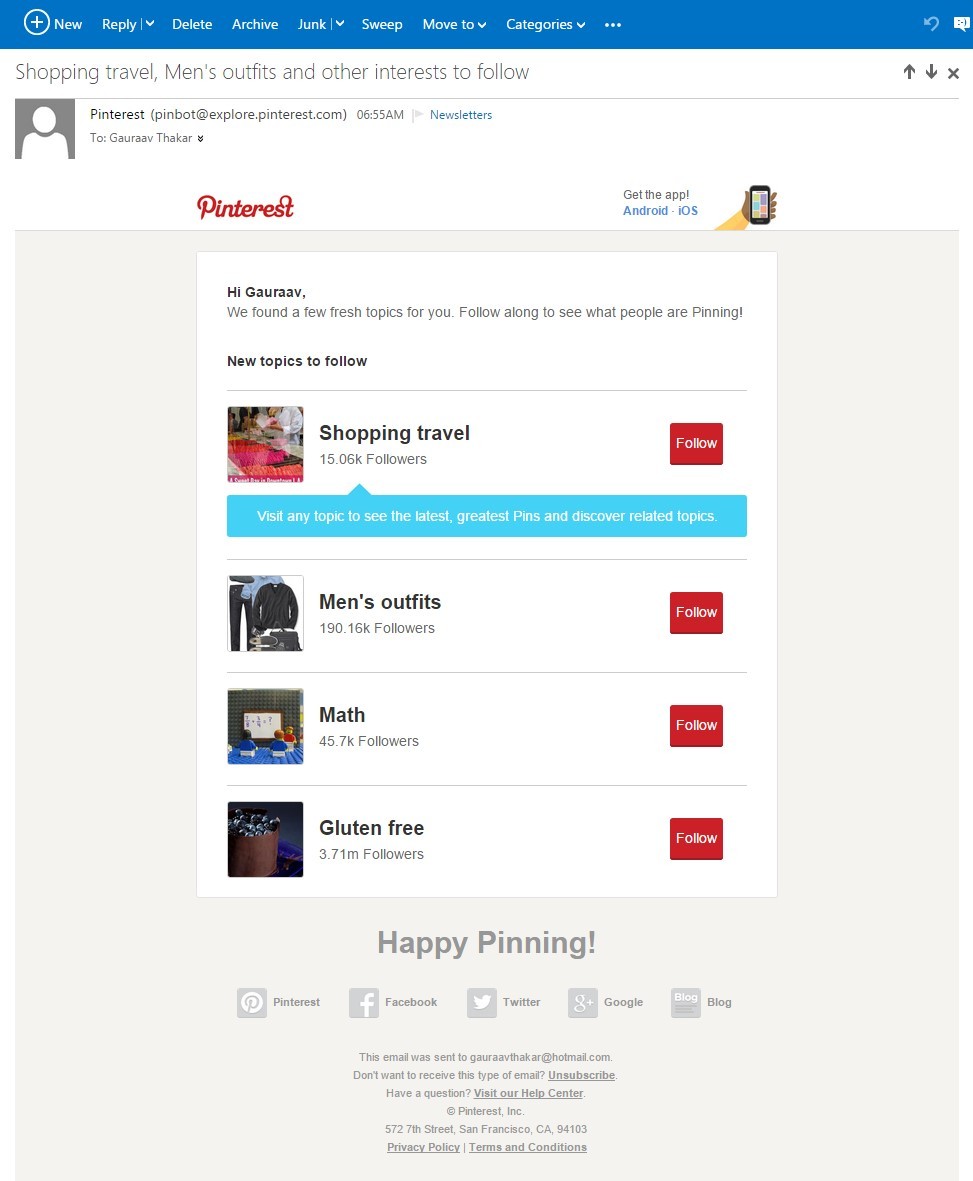
Pinterest, Twitter, Facebook and other social media networks suggest Friends, Posts and Interest Groups to ‘Pin’, ‘Tweet’, ‘Follow’ or ‘Post’, as the case may be. The vast volumes of data gathered in the process epitomizes what’s personal.
Online Personalization: Website
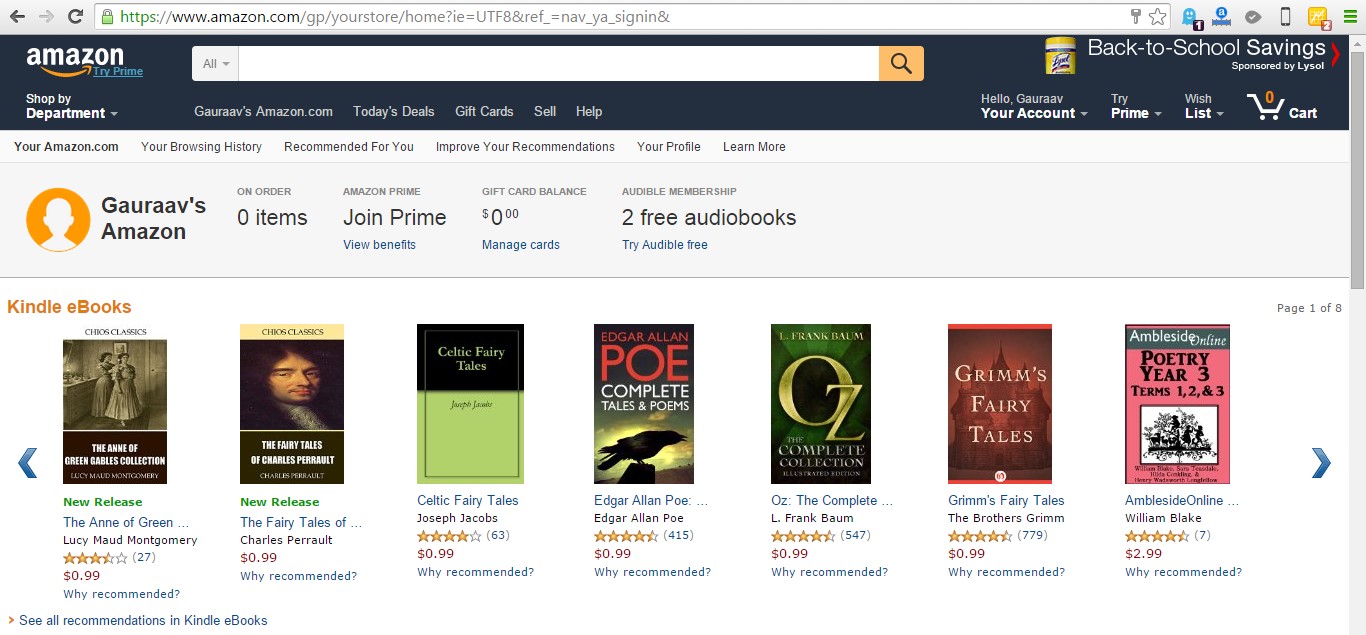
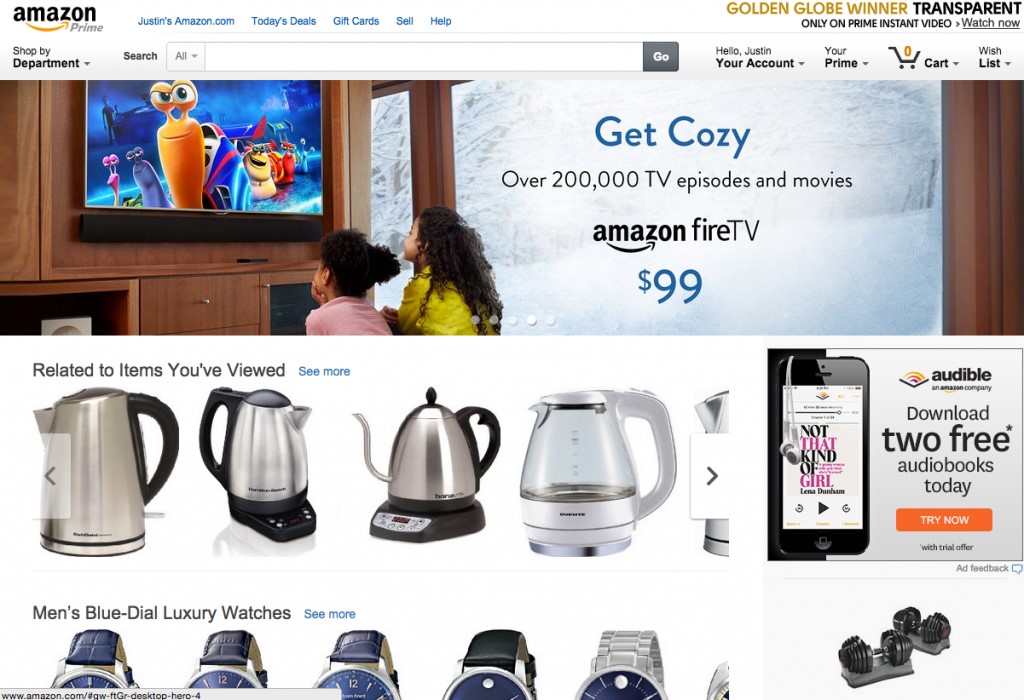
Amazon USA offers 200 million products in 35 categories. How to find what you want? Amazon simplifies the process with website personalization. By analyzing your previous behavior Amazon promotes products and makes informed suggestions according to what it “thinks” you may want.
Online Personalization: Social Media Networks
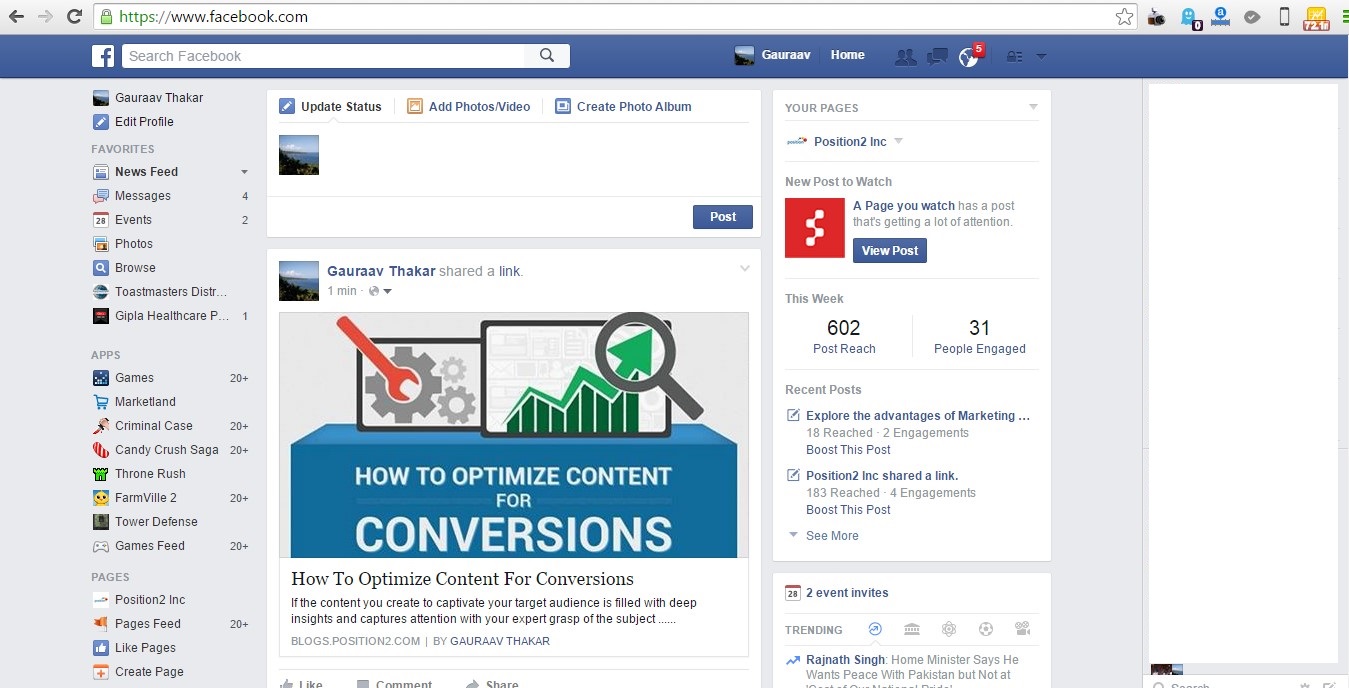
We’re all on Facebook all the time. It gives us a personalized newsfeed of what’s happening with our friends and groups. At the same time we are generating data that gives shape and meaning to out digital personality. LinkedIn does much the same while giving us personalized updates from our professional network.
Online Personalization: Retargeted Advertisements
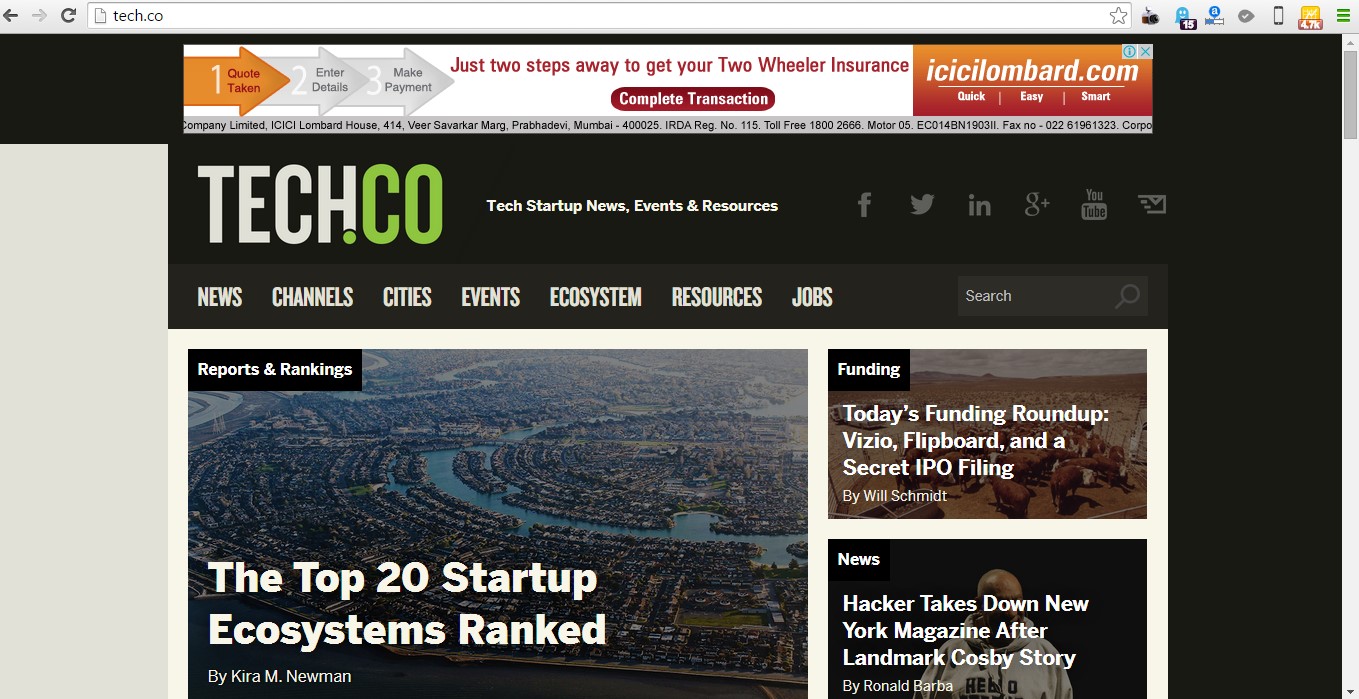
Here’s an example of an ad for a motorcycle insurance company, ICICI Lombard. I had recently been on their site, but this is the Tech Cocktail website. As you can see I have been re-targeted with an ad for ICICI Lombard’s policy.
Given all that, you would think that personalization and marketing would be a natural fit. But it has yet to work out that way.
Personalized marketing is a sadly underutilized strategy even though it’s highly effective.
Businesses that personalize web experiences see an average 19% increase in sales. (MarketingProfs)
71% of companies fail to personalize their websites. (Dynamic Yield)
Personalized marketing emails receive 29% higher open rates and 41% higher click-through rates. (Experian)
70% of companies don’t personalize marketing emails. (Experian)
So much to do, so little time… budget…?
Mobile, of course, has brought with it a greater push for personalization and marketers are responding, particularly with real-time efforts. April 2015 polling by Researchscape for Evergage found that 58% of marketers worldwide used real-time personalization—defined as data-driven personalization completed in less than 1 second. Among the 42% not using it, nearly eight in 10 intended to do so within the next year.
Personalization – Tips and Tricks
Personalization versus privacy
Each geography, market and target audience is different. Be mindful that what resonates in one market might not be received the same way in another.
Language and Culture
Think globally but act locally. Campaign messages and content assets must be translated and localized. Message tone, brand positioning and even colours (oops, I mean colors) must be appropriate to the language and culture of the market.
Audience Data
To execute large scale personalization identify the relevant data. A combination of explicit (demographic and/or firmagraphic) and implicit (activity-based) data sourced from multiple systems may need to be reconciled or integrated.
Data Audit
Once the relevant data for personalization is identified, it needs to be synthesized in the primary marketing database and analyzed for hygiene and completeness. Complex personalization is executed through data-driven rules that cannot function at an impactful level without a high degree of standardization and completeness at the database field level.
Technology
Evaluate the marketing technologies needed to support the level of personalization that programs or tactics require. Marketing automation platforms (MAPs) contain features such as field merges and the ability to render modular content based on data-driven rules to produce email and landing page personalization at scale. Additionally, programmatic site retargeting, social and mobile retargeting, reverse-IP and cookie lookup, and third-party data vendors provide options for rendering a personalized experience based on explicit and implicit data points that can exist outside the marketing database. Web conversion optimization tools can execute rules-based personalization on an organization’s Web properties to engage and qualify site visitors with a more relevant browsing experience. Finally, automated contextual call guides for tele prospecting teams can deliver personalized interactions during the tele qualification phase of the marketing and sales process.
Testing
Make a culture of testing operational in any modern marketing organization. It’s critical. Don’t assume that personalization is making content, assets, and messaging resonate better with audience microsegments. Personalization initiatives should be tempered with an organization’s ability to plan and conduct meaningful testing to verify personalization’s contribution to a measurable increase in awareness, engagement and response.
What’s your favorite example of personalization that you use on a daily basis? Drop it in the comments. Would love to hear from you.
Marketers will be able to leverage real-time strategies to reach people engaged with major live events by using Twitter’s new event targeting feature. With this three-stage tool at the ready, brands and marketers can more accurately map new event-based campaigns
Think real-time events and trends like Super Bowl, Grammys, the FIFA World Cup, or Wimbledon. Marketers have relied on manual efforts and guesswork to figure out hashtags, keywords and accounts. With event targeting you can now activate around live moments. It’s quick and easy.
We’ll help you discover and plan for these highlighted moments, learn more about the participating audiences through valuable insights and, with one click, create a campaign that delivers the right message to just the right users as the event unfolds.
How It Works?
Event Calendar
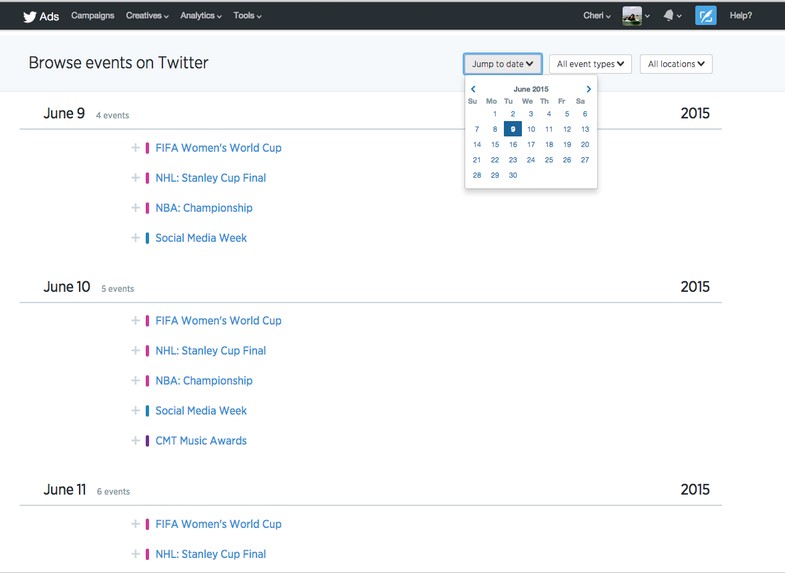
Visit ads.twitter.com and navigate to the Tools tab. Select “Event calendar” from the dropdown menu. Choose the live events that match your brand’s marketing strategy and goals. For help drilling down to the right selection you’ll find filters by location, date or type of event. Marketers can explore all events months in advance.
Event Insights
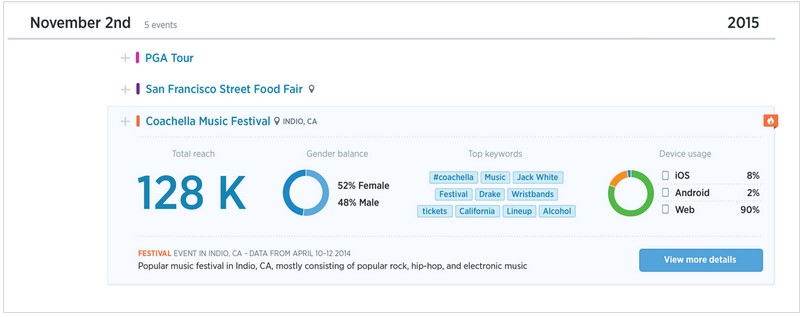
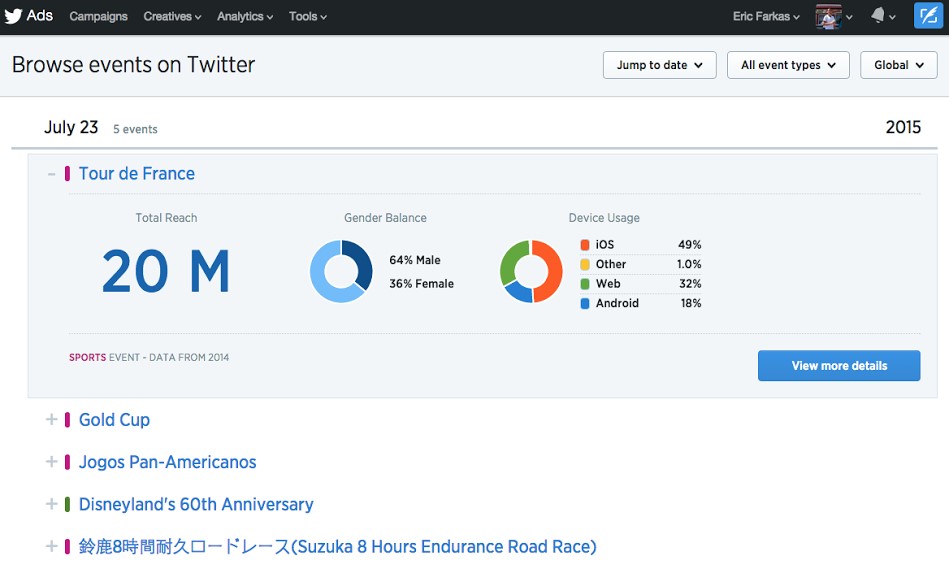
To see more information about an event, click on the event and select View More Details.
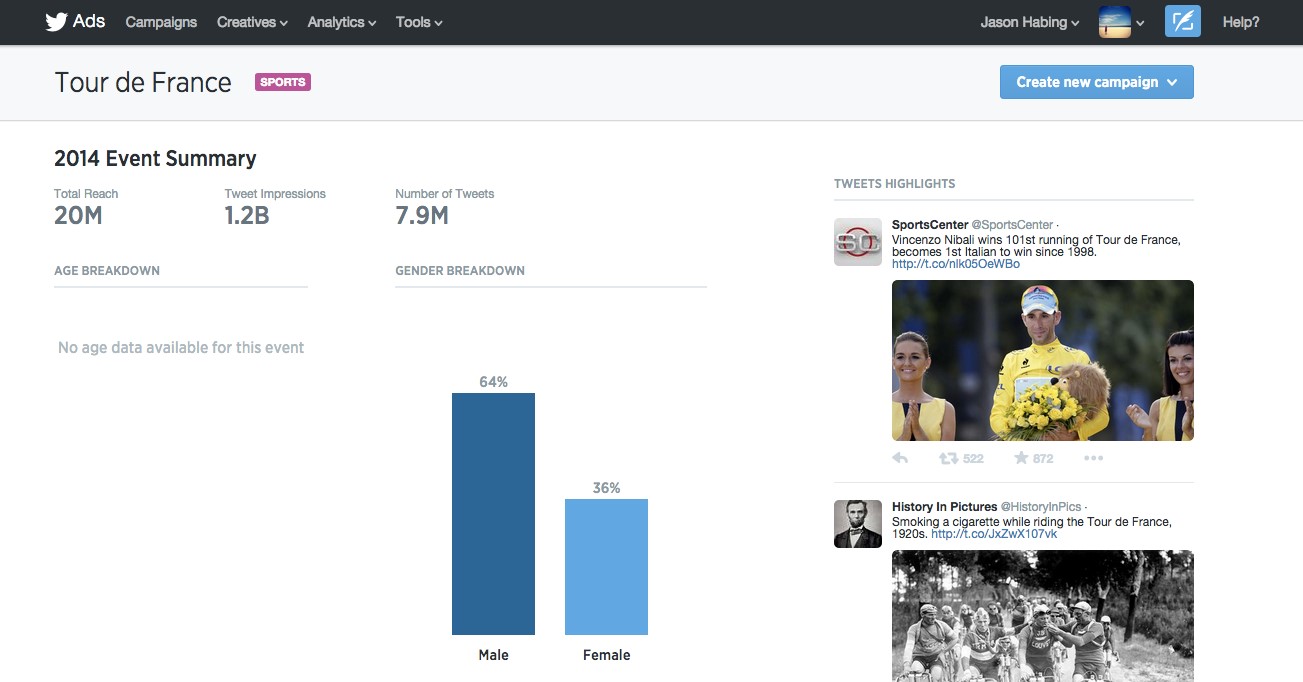
After identifying events to target, drill down into each event and learn more about the audience based on the previous year’s data — total audience reach, device breakdown, gender. You can also view the highest engaging Tweets from the previous year to get a sense of how the event conversation played out on Twitter.
Event Activation
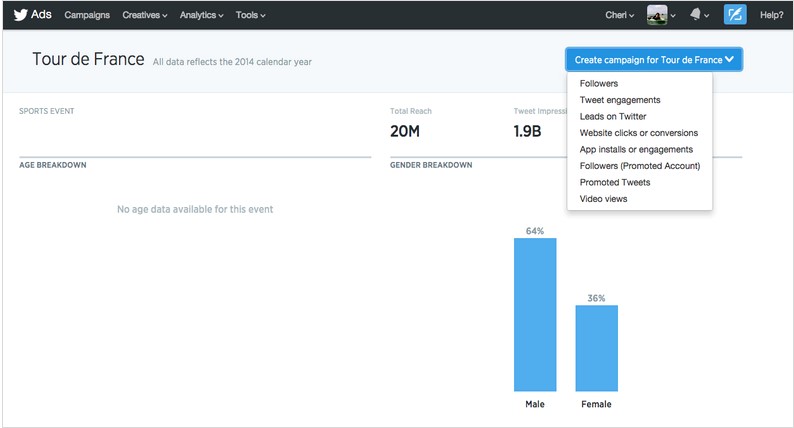
Click on the Create Campaign link to choose a campaign-based objective and launch a campaign that targets the event.
Target events of your choice with one click campaign creation. Event Targeting may be combined with other key targeting types like gender, language and device so you can reach the right segment of an event audience.
Let us know how you plan to leverage Twitter’s Event Targeting as a part of your marketing strategy?
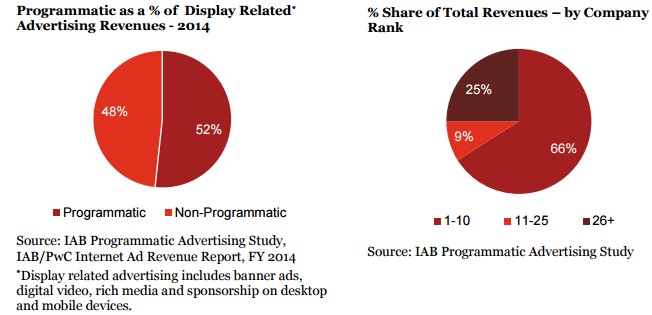
The Interactive Advertising Bureau (IAB) recently issued its first revenue report on programmatic display ad revenues in the US. The bottom line: Programmatic buying and selling accounted for more than half of the display advertising revenues generated in 2014.
Highlights of the Report
Online programmatic display with $10.1 billion in revenues in the US in 2014 accounted for a little over 20% of overall ad revenues of $49.5 billion and 52 percent of the $19.6 billion display market
Banner ads generated roughly 80 percent of the display programmatic revenues
2015 will see more inventory and spends for mobile and video formats
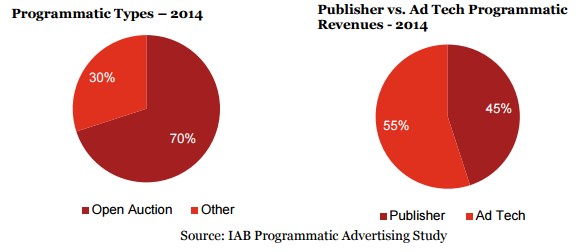
70 percent of the programmatic revenue came through open auctions
Ad tech firms and publishers took in programmatic revenues in a 55-45 percentage split
“Sizing the programmatic market has proven both challenging and illuminating, as we learned more about how that sector moves ads and money. Once we garner deeper understanding of how things work and where standard definitions and best practices are needed, we will also gain insights into where greater opportunities exist for publishers and advertisers to capitalize on programmatic channels.”
Standardization and adoption of programmatic definitions for a robust sizing of programmatic revenues
Increased dollar transparency to justify stronger overall revenues from programmatic as compared to traditional direct sales
Increase quality of premium inventory
Striking a balance between cross device and cross platform targeting and addressing concerns around user privacy and data collection
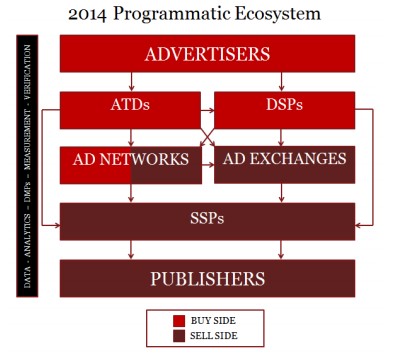
Standardization of viewability metrics, greater control over brand safety, ad verification and performance measurement solutions to build advertiser trust in the programmatic eco-system
Are you part of this fast evolving programmatic eco-system? Let us know the challenges you face and the benefits you receive using programmatic over traditional direct sales model.