Blog

  • Drupal vs WordPress

    Drupal vs WordPress

    Drupal and WordPress are two of the most widely used Content Management Systems. Both servers as open – source and user – friendly solutions to your CMS needs. But picking the right CMS for your business depends on your long – term and short – term goals.
    dupalwordpress

    What Is Drupal ?

    Drupal is a free and open – source enterprise – level CMS that helps you build complex websites and web applications. Drupal provides features like reliable performance, strong security, and reliable customizability. Drupal supports content management, collaborative authoring, podcasts, image galleries, p2p networking, and much more. It is easier to handle for professionals who are fluent in coding and web technology.

    Drupal has a huge open source community with more than one million dedicated developers, designers, trainers, strategists, editors, and sponsors worldwide. In addition, it has regional groups and meetups taking place in different parts of the world. In addition, DrupalCon events are organized where users can take skill training and level up their skills.

    Some examples of Drupal sites: the University of Colorado, The Economist, Dallas Cowboys, and Nasa.gov

    What Is WordPress ?

    WordPress has been on the market for more than a decade now and it has grown into the most popular content management system. It is an easy and user – friendly platform that comes with a one – click installation. Once WordPress is up and running, you will get to work with the most intuitive interface called a dashboard, which helps you maintain your website with ease. You can easily add content, delete, and customize your website’ s pages with simple and easy options. WordPress has become the best asset for bloggers around the world.

    Some examples of WordPress sites: Whitehouse.gov, Sony Mobile, University of Washington, Mercedes Benz, TechCrunch, and The New Yorker

    Why WordPress and Drupal Are Both Great

    1. Both Drupal and WordPress are open – source solutions, which means they are free to use and develop further. This makes them both affordable and customizable to meet your specific needs.
    2. Both platforms are popular and therefore widely known and used throughout the web development world. If you have an issue or don’ t know how to do something, you’ ve got access to a community of developers and users who can help you find the best solution.
    3. While both Drupal and WordPress are considered user – friendly platforms, some may argue whether they’ re equally user – friendly. In comparison to proprietary solutions, they’ re both considered to be easy to use.

    Drupal vs WordPress Comparison

    User – Friendly: WordPress is more user – friendly than Drupal.

    Search Engine Optimization Links: WordPress and Drupal both were constructed to create search – engine – friendly sites and it provides many SEO modules / plugins to enhance the site traffic. Native caching is supported by Drupal out of the box, whereas WordPress needs additional plugins for caching. Page caching leads to faster load times and a very useful metrics to boost your page rank.

    Flexibility: While WordPress is highly adaptable, Drupal has a reputation
    for developing much more robust websites.

    Customization: Blog and website customization are really crucial. Both Drupal and WordPress allow for customization. Drupal gives you many more options but is more difficult to use.

    Managing Multi – Site: To manage multiple sites, WordPress requires you to download WordPress MU. With Drupal, you can manage multiple websites straight from Drupal.

    Security: The security of WordPress is not as good as the security of Drupal. WordPress gets hacked without any difficulty but in Drupal,if any bug or danger is seen, it is scanned and fixed on the spot.

    Community: Community impact plays a vital role and is a big difference. WordPress has more than 100, 000 followers on Twitter and more than 250, 000 fans on Facebook, while Drupal has only 21, 000 followers on Twitter and approximately 20, 000 fans on Facebook.

    Final Words

    WordPress is highly affordable and allows for customizability down the road. If you’ re not sure what the future will bring, WordPress is a great place to start.

    Q: Looking for the Fastest Set Up ?

    A :Regardless of your web development expertise, WordPress will typically allow for the fastest set – up time, as long as you’ re not building anything too complex.

    Q: Looking for a Robust Solution ?

    A : If you know your needs are complex and that your website will require robust functionality, it’ s worthwhile to invest in Drupal from the start. It may take longer to develop, but it will be worth the time and cost.

    Q: Looking for more security ?

    A : Drupal does not power as many websites as WordPress, but when it comes to security Drupal is a clear winner. Security is a significant feature of Drupal.

    Q: Looking for more Themes and Plugins ?

    A : WordPress offers tons of themes and plugins to boost the functionality of your site. Even those who are non – technical can install and use the extensions. There are heaps of free themes that you can use for your website with amazing functionality.

    Q: Looking for Faster CMS ?

    A : When it comes to speed, Drupal has an advantage and it can generate high – speed websites in no time. Since the Drupal CMS isn’ t very resource – intensive it can help to produce very high performing and fast loading websites. The options like website caching can improve performance even further. This makes Drupal better equipped to handle websites that have thousands of pages.


  • Emojis in Advertising: Do’s and Don’ts

    With World Emoji Day coming in just around the corner on July 17th, let’s take a look at one of the most pressing questions in advertising – Should brands use emojis as part of their marketing strategy? The short answer would be “yes.” The longer answer needs more details.

    Here Are 4 Reasons Brands Should Use Emojis in Advertising

    1. Emojis Scale Past Language Barriers
    It’s no secret that emojis are universally understood by people everywhere in the world. So, if your brand is interested in expanding into a new state or country, using emojis as part of the initial marketing strategy could be a great way to gain the attention of the local folks.

    2. They Improve the Rate of Engagement
    Text can quickly get boring. And given the volume of wordy advertising campaigns being churned out every day, using emojis can be a refreshing change for the end user. In fact, using emojis can improve engagement by nearly 48% on platforms like Instagram.

    3. They’re Easily Processed by The Human Brain
    The human brain processes visuals several times faster than text. Scientists from MIT have found that we can process entire images in as few as 13 milliseconds. Brands can use this to their advantage and convey a lot more with a single emoji than they could with a string of words.

    4. Emojis Offer Opportunity for Innovation
    Unlike text, which can only be manipulated to a certain extent, emojis offer greater scope for creativity and innovation. There are around 3,000 emojis in use today, and brands can even create their own emojis to convey their unique message to the end users and consumers. The possibilities are endless.

    Emojis in Advertising: Do’s and Don’ts

    Practical Tips for Using Emojis in Your Marketing Campaign
    The next important question is – How do you go about using emojis in your advertising strategy? While there aren’t any rules set in stone, you can benefit a great deal from these three practical tips we’ve listed here.

    1. Know How Much Is Too Much
    Don’t make the mistake of being too lavish with your emojis. Often, brands tend to err on the side of generosity and use too many emojis when just one would have sufficed. For instance, using a simple party emoticon when you’re announcing a sale or a discount on Twitter can get the message across more effectively than using multiple emojis.

    2. Stay Loyal to Your Brand
    Many marketing heads worry that using emojis can dampen the seriousness of their brand. While that’s not entirely true, the nature of your brand certainly influences the kind of emojis you can use. For instance, if your company offers financial consultation services, it’s best to stay loyal to your core theme and use smiley faces, the applauding emojis, and the thumbs-up icon.

    3. Use Emojis in Multiple Channels of Communication
    Most brands tend to limit the use of emojis to social media channels like Instagram, Twitter, and Facebook. Given the informal nature of these platforms, this trend is quite understandable. But did you know that you could also use these little visuals in the subject of an email? Using the right smileys around Valentine’s Day, Christmas, and St. Patrick’s Day improves the open rate for emails.

    The Bottomline – to Emoji or not to Emoji?
    As is the answer to most questions, it’s best to emoji with moderation. Using them too much can make the novelty wear off, while not using them at all can make your message come across as stoic and unfriendly. The trick is to use emojis sparsely, in the right places, and in the right manner.

  • Brand Building with SEO Why it is important and 10 actionable tips to get it right!

    Google (and any other search engine) always give a better and favored treatment for bigger brands. More prominent brands rank for competitive terms with fewer links. For base and long tail keywords, brands rank quickly in SERPs. Whereas, the smaller brands need more than twice the link of bigger brands to get ranked for similar terms in SERP.

    Brand building and SEO work toward the same goal. Get better traffic, targeted traffic, improved conversion, profitable ROI. Like, every bigger brand small and mid-sized businesses too should focus on spreading the brand image with their users in mind.

    Remember, an established brand usually stays in the forefront of a person’s mind even after the sale or service is over.

    Google SERPs changes and updates just as frequently as each algorithm update. Most recently, SERPs consist of sitelinks, Local Pack, Knowledge Graph, Featured Snippets, People Also Ask, Images, Videos, Product Listings, and Reviews.

    According to Google’s guidelines to their quality raters (real people who assess web pages and grade scores against the predefined set of perimeters) EAT principle is predominantly used. E-A-T stands for Expertise, Authority, and Trustworthiness.

    While Google has not mentioned in their document about the brands against the EAT principle specifically, it is quite evidently important that brands fulfill all these standards by default.

    According to Google, high-quality pages own the following characteristics:

    • The content should be good enough to please the needs of a user for a page’s unique topic and purpose
    • The website also holds enough secondary information, for example, “About us,” “Contact us”, etc.
    • The website speaks about the supplementary content (SC) that improves the user’s experience of a web page
    • The page is structured and designed in a way that users locate the content easily and quickly.
    • The website is maintained and edited regularly

    Here are some brand building tips to ensure your SEO strategy supports your efforts:

    • Create fresh and unique content that addresses your users/audience pain points with blog posts, in-depth articles, videos, and podcasts.
    • Add value to the existing content to make them linkable content assets
    • Build authority via content
      • Create a blog section on your website and start adding your expert opinion
      • Be a contributor or guest blogger in niche forums/portals to have a share of voice to increase your brand image
      • Publish press releases about your brand and its activities
      • Acquire quality links via natural content-driven link building activities
      • Maintain a quality backlink profile
      • Optimize your content for your consumers by using targeted and long-tail keywords that THEY will resonate with organically. However, do not focus on keyword phrases for search engine crawlers
    • Be active on social media channels
      • Repurpose your content across various social media channels
      • Make your employees your brand advocates in social channels
      • Cross-promote the content via social channels
      • Have influencers talk about your business for reputation management and increase social shares
    • Leverage universal search (Images, Videos, etc)
    • Have a consistent NAP (Name, Address, Phone Number) across the internet. These local SEO factors for crucial for ranking if you are running a location-specific business.
    • If not backlinks, create brand identity via brand mentions from related websites
    • Have your website search engine optimization compliant
      • Audit your website against technical SEO compliance and fix the errors. Make use of Google’s free Search Console to get quick error reports on your website.
      • Leverage SEO on-page optimization and incorporate the crucial SEO elements
      • Follow white-hat SEO best practices and adhere to Google’s guidelines to stay on the track.
      • Consistent use of on-page optimization and off-page SEO while building a brand
    • Claim your Business on Google My Business to get visibility in Google Knowledge Panel.
      • Do not forget Yahoo Maps, Bing Maps
      • Data Aggregators helps you build your brand across the world wide web.
    • Build your marketing strategy focusing the local publications. Google and Bing will reward your business with a boost in local and blended search rank when you get a mention/link from local publications.

    As a business, you don’t just want people to identify you with jus t your logo. You should want your target audience and need them to find you and connect with you. Appearing for relevant search keyword phrases and search terms found by the target audience is the key to any brand image building strategy. SEO helps with both.

    Share your thoughts on the comments. Are you looking for consultation on how to build your brand image, increase your online presence, and get visibility for your brand? Let’s connect!

  • Tips for Successful Video Marketing Campaigns

    “I am so poor … I cannot pay attention!” Yup, this is a popular comedic one-liner. Not any more. The tables have turned. In a world evolving through all things digital and networking through social media, it is time to create rich videos that grab and hold attention. ‘Attention’ is a precious commodity, and brand marketers are vying for it. In the Game of Consumer Acquisition, the mother of all battles takes place in the visual domain.

    It is a well-known fact that in today’s world of digital saturation, human attention span is getting shorter. A Microsoft study estimated that between the years 2000 and 2016, the human attention span shortened from roughly 20 seconds to eight seconds on average. Therefore, it is paramount to front-load the first few seconds of your video with the most engaging content, hook in the target audience and continue to keep them glued through the rest of your video. The most creative and engaging videos have the most likely to go viral on social media – whether it is a video ad or informational video asset – earning you brand visibility, earning links and growing your authority for better SEO performance.

    Video content supports many business objectives such as customer acquisition, education, retention, extended loyalty and further growth through consumer advocacy. The overarching goal of the video is to promote a narrative, product, service or brand awareness, and recall.

    The overarching goal of the video is to promote a narrative, product, service or brand awareness. It is no wonder then that video is becoming an integral part of an effective content marketing strategy.

    Here are 10 tips to create a successful video marketing campaign:

    • Simplify – Avoid complex and heavy content as it causes cognitive overload.
    • Visuals – Use relatable visuals to convey your message and tell your story.
    • Storytelling – Informational videos are better recalled through storytelling.
    • Duration – Assess the right duration for the video without unnecessarily stretching it out. Shorter videos are consumed more readily. Less than 30 seconds is ideal for a video ad, up to 3 minutes ideal for ungated videos featured in your blog or resources section. Gated video asset can be much longer, and the length is determined by the topics covered.
    • Use Subtitles or Captions – This is a good way to accommodate people watching in a noisy environment who may not be able to hear the audio on mobile devices.
    • Front-load Content – It is important to hook people in during the first few seconds of the video with impactful content to increase engagement and make it more viral.
    • Live Video – If you have an audience list via email marketing or other digital marketing campaigns, inform them and try to broadcast live during webinars and events as people are more drawn to real-time content.
    • Variations – Experimentation can be a learning methodology to truly understand your audience. Try different captions, messages, duration, copy, platform and colors to hone-in on your ideal video. You could also try an animated video. This can be particularly effective if you want to create a brand association with a mascot or visual element.
    • Share – Make your video share-friendly to encourage sharing to extend the viral reach through social media platforms. Syndication on relevant video sites and platforms can also increase video views, brand visibility and recall.
    • Analytics – It’s critical to measure ROI as well as to leverage any information you garner for future video campaigns.

    This is how a marketer can augment visual consumption in an attention economy. Videos that are consumed the most are fun and entertaining, thoroughly engaging via visual storytelling, and innately inspiring to connect with the deeper human emotions. For effective use of video, you don’t always need specialist video marketers. Ideas for a creative video can come from within your marketing team.

    Maximize the SEO and Inbound Marketing Potential of Your Video

    Take your video marketing strategy one step further. While the tips above can improve the quality of your video and the engagement it gets, optimizing your video for search engines can and take the returns from your marketing efforts to the next level.

    • Enable embedding on your video. This will allow others to share it and possibly grow your inbound links.
    • Implement video sitemaps and submit them for indexing through Google Search Console and Bing Webmaster Tools.
    • Use enticing descriptions to encourage clicks and also to help Google understand what your video is about.
    • Add a caption that summarizes what the video contains to set the context for visitors and tell search engines what the video is about.
    • Add a video transcript where possible to add relevant content to the page. This helps visitors who prefer to read vs. watch or listen, and also provides indexable content to search engines that can help the video get more views.
    • Use relevant keywords in the title and description.

    These are just a few of SEO best practices for optimizing a video. By sharing your video on your own domain before sharing on social media and implementing these tips, can help search engines find your video, send the right traffic, increase the chances of click-through rates, and overall conversions.

    Video Marketing Trends

    It is also a known fact that we are all tuned in to the world of instantaneous satisfaction with binge-watching, where you get to eliminate the long anxious gaps between episodes. According to a Deloitte survey, nearly 73% of Americans binge watch. This goes to prove that if the audience can relate to the content or likes the content, they do pay attention and watch.

    Although short attention spans and binge watching are two ends of the spectrum, it is clear that a fun engaging video has risen to the top of the effective marketing campaign tool list.

    Hubspot surveys validate the rising effectiveness of videos:

    • Nearly 50% of internet users look for videos related to a product or service before visiting a store1.
    • 97% of marketers say video has helped users gain a better understanding of their products and services2.
    • 52% of marketers say video is the type of content with the best ROI3.
    • Adding video to your emails can increase click rates by 300%4.
    • 85% of consumers want to see more video content from brands2.

    LinkedIn recommends inserting a simple form fill for lead generation about 1/3 of the way into the video-watching experience. While there’s a risk that the form fill could cause somebody to stop watching the video, LinkedIn says that if lead generation is an important goal, a form fill is needed.

    It is recommended that you replace your video with a newer optimized version that incorporates learnings from audience engagement analytics such as what percent of the video was watched and where did the audience drop off.

    It does not matter if you are B2B or B2C, your potential customers and target audience are watching a video of some sort, work related or otherwise. This opens up a huge opportunity for you to engage your audience with videos that increase engagement, reviews, ratings, and comments. Videos can lead to rich user-generated content, in the form of reviews, ratings, comments, and feedback. This can help you build authority and increase ROI from your online marketing strategy. Bottom line is, create a video that will get a tweet, a share, and engagement.

    Video Is Here to Stay, Let Your Story Play

    I’d love to hear your stories about how you’ve used video content marketing strategy to grow your business.

    References
    1 https://www.hubspot.com/marketing-statistics
    2 https://blog.hubspot.com/marketing/state-of-video-marketing-new-data
    3 https://blog.hubspot.com/marketing/video-marketing
    4 https://blog.hubspot.com/sales/subject-line-stats-open-rates-slideshare

  • Position2 Academy Launched

    Position2 Academy is an open-learning initiative that aims to provide learning and career advancement opportunities for young digital-marketing aspirants. Our training programs are offered as instructor-led online training, web-based training, and private classroom training. Apart from the topic specific to the program, we also provide Microsoft Office and soft-skills training, which are fundamental to any profession.

    As an award-winning demand-acceleration agency with a global footprint, we are committed to delivering consistent results for our clients’ all-round progress. We carry the same attitude and commitment to our training program. To deliver the best for our clients, we are looking to strengthen our team with the best kick-starters in the digital industry; ones who would be pioneers of the next generation of integrative and innovative digital marketers.

    We are a driven, progressive, fast-paced, and successful agency first and a training academy second. The training offered by us is not to give you just a certificate but a career foundation that is second to none. We are here to build your digital career.

    Why Position2 Academy?

    • The courses are designed in a way that you are not only aware of the current best practices but become equipped to quickly adapt to any changes that come in the future.
    • Our trainers are domain experts for our agency who help multiple clients achieve accelerated success results.
    • Our focus is to enhance every individual’s natural skill set and inclination for mapping a successful career in digital marketing.
    • As the training progresses, you will be able to work on live projects to test your learning and enhance your experience.
    • You directly get hired by Position2 at the end of your training, if you qualify in the assessment.
    • The focus is on building your career in digital marketing, which means in addition to the knowledge of digital marketing, you would get trained in Excel, Communication skills and more.
    • In addition to knowing the strategic nuances of digital marketing, the faculty at Position2 is approachable and communicative. You are encouraged to ask questions, as many and as often as you like.

    Call us at 080 42416040 or mail to training@position2.com for more details.

  • Top 10 PPC Lessons I Learned from Bruce Springsteen

    I’m a huge Springsteen fan who has seen him in concert 10 times since 1992 (and I’ve spent countless hours listening to his albums and bootlegs online). Bruce has shared extraordinary personal insights through his music, but few know that Bruce’s insights could be applied to Paid Search (even though Paid Search didn’t exist until around the time he released “The Rising” album). So, without further ado, here’s what Bruce has taught me.

    You Can Look But You Better Not Touch”:
    Never discount the value of impression based marketing. Through the GDN or YouTube, a client can get large number of valuable views of their ad or their video for very low CPM rates. In a funnel-based marketing system, views can sew the seeds of future clicks and conversions.

    Jungleland”:
    Paid Search is a very skilled undertaking, especially in the B2B space. So many large companies waste quite a bit of money with suboptimal strategies and tactics. Partnering with a trusted agency with relevant experience will generate an excellent ROI.

    Does This Bus Stop At 82nd Street”:
    Many paid search efforts will benefit significantly from localization. Looking at the data, one will likely find significant performance differences between different geos, and bidding can and should be adjusted to take advantage of this performance delta.

    Growin’ Up”:
    We work with many businesses that are in early growth stage. They have big dreams for the future but have a long path to travel in order to fulfill what they wish to accomplish. We create a paid search strategy for them that will help their current situation but is also scalable for their future growth.

    Highway Patrolman”:
    Having positive relationships with Google is a solid value ad for our clients. Google has offered many of our clients invaluable assistance in growing their business or helping them solve problems. However, advice given by Google needs to be taken with a very critical eye, for not all of it will be of benefit. We can separate the Google Wheat from the Google Chaff.

    Top 10 PPC Lessons

    Roll Of The Dice”:
    Part of our job is to caution clients against making costly mistakes. For example, many clients want to bid aggressively on competitor brands. However, 99.9% of the time, this is a failed strategy with terrible ROI, so we caution our clients to stay away.

    Open All Night”:
    Paid search is a 24/7 enterprise. The concept of “Business Hours” doesn’t exist, and people will be doing research and making business decisions while you’re fast asleep. Make sure you have enough budget for all 24 hours of the day.

    57 Channels (And Nothing On)”:
    Google quietly started to show a low volume of ads on “Connected” TV devices. As more and more people “cut the cord”, this segment will increase exponentially in size, and the forward-thinking agencies and clients will begin to strategize specifically for this segment.

    Human Touch”:
    Over the years, Google’s automation has become significantly better. Today, it’s not a question of whether to use it…it’s how best to use it. Experienced paid search marketers are extremely valuable for guiding clients through choosing, implementing, and monitoring Google’s automated strategies.

    Mansion On The Hill”:
    What can be purchased with the revenue earned from a professionally managed AdWords campaign.

    Hopefully, my little reminiscence will cause you to both examine your current PPC Strategy…and listen to your favorite Springsteen.

  • B2B Facebook Event Targeting

    Are you a B2B company that’s exhibiting at a convention/conference? Facebook Event Targeting, coupled with Facebook ads, is a tactic that will go a long way towards helping your company increase the ROI at your trade show—and will only add a very small sum to your exhibition budget.

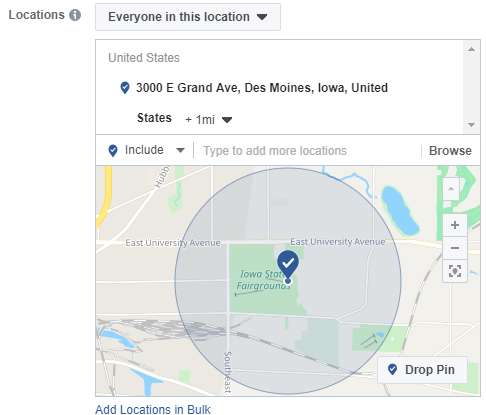
    The most important aspect of the ad setup is the definition of the geographical radius. Facebook allows “radius targeting” by address in mile increments. In all likelihood, a one-mile radius using the conference site address as the target will allow you to target the entire conference site plus a small surrounding area (since people will go offsite to transact business), which is completely adequate for the purposes of this exercise.

    Here’s a screenshot from a campaign I set up recently targeting the Iowa State Fairgrounds:

    B2B Facebook Event Targeting

    If your convention site is located in a dense urban area, this tactic will be somewhat less effective, since your mile radius will include plenty of people not involved in the targeted conference. This will require you to be more careful with managing your spend.

    Now, we need to hook people with the ad. Don’t run your “normal” Facebook ads for conference attendees (for someone quickly scrolling through Facebook on their phone isn’t going to connect your regular ad with your conference exhibit). Instead, do something creative that’s only going to be meaningful to conference attendees:

    We are going to get a fair number of clicks to the website from this ad, which is good (and generate some incidental leads). However, our objective is to directly call out people at the convention site to stop by the booth. We’ve given them an incentive to stop by (good beer). Such a tactic will generate more conversations at the booth, bringing more leads into the top of the funnel and helping to validate the tradeshow exhibition tactic.

    A logical question that I’ve been asked is whether you should layer additional interest targeting on top of the geographical targeting. I don’t recommend it as when I’ve tested it, I’ve made the audience reach too small. By virtue of being at the conference, people have self-selected as a relevant audience no matter what their previous Facebook behavior says about their interests and likes, and any restriction to this audience would be a mistake.

    How much does this cost? I’ve targeted Dreamforce at Moscone Center, San Francisco for $100 a day…and while I could have likely spent more than this, I couldn’t spend too much more while geographically restricting the campaign to just the conference site. You might not think that people would be on Facebook while attending a B2B conference, but I have plenty of data that says otherwise. This tactic has provided amazing results for my clients and no matter how much I talk about it, I feel confident that it will remain effective and inexpensive for the foreseeable future.

    B2B Facebook Event Targeting

  • Crawl Budget Optimization – a Crucial SEO Factor

    Are you a business owner with a website with multiple pages and many new URLs that are auto-generated every day? If this is your website, then Google might not crawl all of these pages effectively. The most important point is to prioritize what and when and how much to crawl.

    In simple terms, according to Google, a” define crawl budget as the number of URLs Googlebot can and wants to crawl.” Both the crawl rate limit and the crawl demand make up the crawl budget. While crawling a website, the number of requests made by Googlebot per second is considered the crawl rate. The crawl demand is where Googlebot determines how popular new and old pages are and the prevention of URLs becoming stale in the index. The more pages are crawled by search engine bots; the more will be indexed for search results.

    Most often than not, the crawl budget is overlooked when optimizing a website. Many do not realize that it is a significant SEO factor that can bring traffic to your website.

    Crawl Budget Optimization – a Crucial SEO Factor

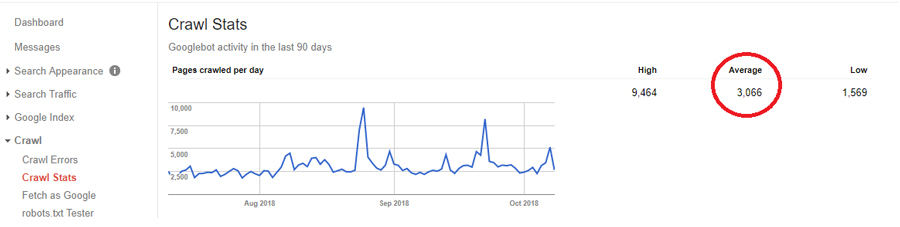
    The above screenshot is from Google search console (Google Webmaster Tools). It tells us that Google crawls 3,066 pages per day for the verified website. From that, we can figure it out that the monthly crawl budget for this site is ~3,066*30=~91,980.

    Fact check:
    A healthy crawl rate will help your websites get indexed effectively and quickly. But don’t jump to the conclusion that a higher crawl rate will help improve your organic ranking.

    Factors that affect the crawl budget

    • Duplicate Content
    • Thin Content
    • 404 Pages
    • Redirect Chains
    • Robots.txt
    • XLM Sitemaps
    • Website Architecture
    • Website Speed

    Duplicate Content

    Irrespective of the source of the content, duplicate content can negatively impact your SEO efforts, and wastes crawl budget to a significant level. Duplicate content can happen in many ways.

    Internal content duplication

    Internal content duplication may occur when different URLs point to a single page.

    • www.example.com/page1
    • example.com/page1
    • example.com/page1/
    • example.com/Page1
    • example.com/page1/index.php

    Duplication with URL parameters

    Base URLs added with parameters would create N-number of duplicate pages

    • www.example.com?id=1
    • www.example.com?id=abcd

    E-commerce duplication

    Sorting and filter options will create unintentional internal duplication

    • www.example.com/cat1/sub-cat1/product-listing
    • www.example.com/products/cat1/sub-cat1?product_list_order=name&product_list_limit=15

    The similar problem occurs with websites that offer calendars to save certain events/webinars etc.

    Thin Content

    Pages created via tags, and authors sections create thin / low-value content. This occurs mostly within the blog post section. These pages are planned for users and search engine bots to find relevant pages and improve internal navigation.

    404 pages and soft 404 pages

    If a website has a huge number of 404 and soft 404 errors, these need to be fixed. Since Googlebot tend to revisit the pages to validate if they are still non-indexable. Keeping an eye on pages that return 404 status code is key to keep things on track.

    Redirect chains

    If your site has an unreasonable number of redirect chains, bots will stop following the directions, and the destination URL may not get the bots’ attention. Each redirection is a waste of one unit in your allocated crawl budget.

    Robots.txt

    Robots.txt file instructs bots what to crawl and what not to crawl. Thus, not using it properly might consume a considerable amount of crawl budget units.

    Improper XML sitemaps

    An XML sitemap is the most important section of your website which helps proper crawling and indexing. Knockout the errors in the XML sitemaps (404s, non-canonical, redirected URLs, URLs blocked by robots and meta tag) and validate it frequently.

    Improper website architecture

    Bots will find it difficult to find fresh content and pages if the site structure is not developed properly. Having proper silo structure and internal linking structure will help improve the crawling and indexing.

    • www.example.com/product1 (Flat structure)

    Website site speed

    The faster the page loads and the response time the better for your users and search bots. The faster a web page loads not only keeps the user on the website, but it also ensures web crawlers are keen to re-crawl your website. So, if your website load time is slow, it negatively affects the crawling. Google’s page speed insights can be the first place for anyone to work around the improvement.

    Where to look for crawl data?

    To have a more detailed breakdown of the crawl stats by individual pages, we need to analyze the spiders’ footprints in the server logs. Often raw log files are hard to read and analyze, to help make the job easier, tools available in the market.

    Does crawl optimization improve ROI?

    Crawl optimization will help you get rid of inactive pages that are not useful from your website and help you build more useful and active pages. This will gradually and positively impact the indexation and internal popularity of the website and mainly for the most focused pages for your business.

    In short, Crawl budget helps you bring positive ROI with much fewer pages but are very active and important pages.

    Takeaways

    • Crawl budget is considered an important factor for SEO for websites large and small.
    • Very low crawl budget means Googlebot doesn’t like your web pages/content.
    • Very high crawl budget doesn’t guarantee a high ranking. Additionally, a very high crawl budget will overload your server.
    • Tweaks in crawl budget settling will not help. Instead, optimize your website to have an effective and efficient crawl budget by implementing the factors discussed above.

    Crawl budget is not as popular and talked about when referring to ‘quality content’ or ‘authoritative links.’ However, it is very much an important factor for larger e-commerce sites and content portals. When you spend time analyzing your server logs and optimize your crawl budget, it not only gives a cleaner site but will improve your site’s performance in organic search.

    Are you a business owner and still not sure where to start crawl budget optimization for your website? Let our experts do it for you. Let’s talk about it!

  • Meet us at SEMpdx Engage Conference on March 7th and 8th, 2019

    Join us March 8th from 11:40-12:30 PT as our head of Organic Marketing, Tushar Prabhu, speaks about creating and optimizing content with our proprietary Predictive Content methodology at the SEMpdx Engage Conference, a digital marketing conference in Portland. The Engage Conference is a two-day digital marketing conference with panel sessions of expert insights, strategies and the latest advancements in digital marketing, SEO, content, advertising, and paid media.

    Over the last couple of years, Tushar has been working with our content and organic marketing teams, developing Predictive Content, a methodology that has been transforming organic marketing for our clients.

    Participate in this packed 50-minute discussion with your questions as Tushar teams up with Kane Jamison, CEO of Content Harmony, covering concepts around content strategies, user intent, the latest in content marketing and how to get your content to rank in organic search. Do not miss out as this could jump-start your content marketing strategy.

    Come say hello to us at the Engage Conference, on March 7th and 8th at our booth at the Sentinel Hotel – Portland. We are excited to see you there!

  • Automation of Google Ad Campaigns: What It Means to Agencies

    Google is bringing their ‘Ads Experts’ to manage campaigns. “We’ll focus on your campaigns, so you can focus on your business,” says the email Google sent to some advertisers in the last week of January.

    Before we start getting paranoid about AI and machine learning taking over the advertising agencies, let’s understand more about this new feature and how it may change the advertising ecosystem.

    1. The Opt-out Option
      Although advertisers are auto opted-in to the program, Google will give them the option to opt-out and be in full control of their ads. This feature is useful as agencies are better integrated with their clients and therefore more in tune with their needs.
    2. The Multi-channel and Cross-channel Marketing
      Apart from Google Ads Campaigns, agencies manage multiple other channels for their clients like Facebook, LinkedIn and programmatic ads, to name a few. So, agencies need a broader view of how their clients’ ads are performing across channels. The integrated reports from multiple channels allow advertisers to gauge the overall performance and decide whether to pause, activate or increase the exposure of these ads.
    3. Siloed Approach
      Companies relying solely on Google’s recommendations will have a siloed approach to digital marketing. And as Google has carefully mentioned, “advertisers are still responsible for the results of their campaigns.” Agencies are far better equipped to control the performance of the ads as they work closely with their clients and have access to their entire marketing portfolio.
    4. Less Grunt Work, More Strategic Thinking
      Google indicated that their experts will help identify the structural changes to ad groups and modify the keywords to adjust bids and ad text for greater impact, without touching the budgets. This means the agency’s roles will evolve into focusing more on strategy and less on time spent on day-to-day repetitive tasks.
      If Google’s words are anything to go by, they have clearly stated that they do not “guarantee or promise any particular results from implementing these changes”, so agencies still have complete ownership of the campaign and its results and while the recommendations from Google will be helpful, they should not place complete faith in the optimization efforts.
    5. The announcement might have given a bit of a shock to agencies initially, and the changes could potentially lead to some organizational restructuring at their end, but the future is clearly a lot more worry-free, strategic, and impact-oriented for them.