Blog

  • 2018 Digital Marketing Trends

    Welcome to 2018, a new year where only the strongest fads and marketing techniques will survive. Many successful marketing techniques of the past year have proven their usefulness and will continue to grow and be implemented in 2018. As we enter this new year, let’s take a look at the fads that are here to stay.

    1. Targeted Ads and Personalization

    A long-standing marketing technique, targeted ads have gotten even more advanced and more focused. With new ways to break down your target market and find new potential customers, speaking to each individual audience has never been easier. Personalization in all aspects of your campaigns will lead to building greater personal connections with your prospects. The array of target ads and personalization options with specified messaging in marketing campaigns is endless. For example, you can target teachers, healthcare professionals, and IT administrators, all within the same campaign.

    2. Video Marketing

    On-demand and live webinars are paving the way for curated content when it comes to video marketing. These webinars often have experts presenting hot topics within their industries, which is a very enticing viewing opportunity. The way in which information can be presented and explained in these formats is quite unique – if you are hosting a live webinar, direct interaction with your viewers is a positive for you and the viewer. The data collected from these activities is top-notch.

    3. Continuously Engage Throughout the Customer Journey

    Taking the above into account, connecting with customers during one or two specific stages of the customer journey is not enough anymore. Picking the right content and right channel to engage with your customer depends heavily on your knowledge of the customer’s buying stage. This opens more doors to connect and engage with your customers, which in turn will provide more leads and data for your team.

    By incorporating these key digital marketing trends into your marketing activities this year, you are sure to see some vast improvements in lead quality, engagement, and data collected. Using these trends and improvements gives you an advantage over your competition and will help your business be more successful.

    Reference Material

    How Digital Marketing Will Change In 2018: 15 Top Trends. (2017, December 18)

    Click here

    10 Marketing Trends to act on in 2018. (2018, January 03)

    Click here

  • Account-Based Marketing In 2018

    Account-Based Marketing, or ABM, is when you approach B2B marketing strategically to reach out to potential customers. Also known as key account marketing, it is based on customer account awareness. Here, the organization considers both individual prospects and customer accounts as one market and communicates accordingly.

    ABM in 2018

    ABM was one of the top trending stories in marketing in 2017 and is likely to grow significantly in the B2B marketing domain in 2018. However, 2018 may see a shift in the focus and implementation of ABM strategies.

    Most companies are using highly customized one-on-one program with a few existing accounts, and others are also using segmented and less personalized one-to-many programs. These programs focus on acquiring new logos with broadly targeted prospective accounts.

    Both these approaches have individual merits; however, the industry is yet to use a blended approach to ABM. This blended approach will be the focus in 2018 as companies scale their approach.

    Here’s what the experts are saying:

    “My prediction for ABM in 2018 is that it will be on its way to becoming the dominant B2B demand creation strategy, and those who don’t get on board will be increasingly left behind. More and more companies are using technology, data and account insights to make smarter choices about the best path to growth,” said Megan Heuer, Vice President, Research at SiriusDecisions.

    Trish Bertuzzi, President and Chief Strategist of The Bridge Group, said, “My advice for people to succeed in ABM in 2018 is to stop thinking ABM M=Marketing and start thinking ABR R=Revenue. Any successful strategy is about one thing and the one thing is the cha-ching. A great account-based strategy isn’t just about Marketing doing something differently. It also requires that Sales and Sales Development change the way they interact with buyers. When the entire organization aligns their activities around ABR it brings it all together.”

    Jon Miller, CEO and Co-founder of Engagio, said, “My prediction is that in 2018, companies will recognize that just buying targeted ads does not represent an ABM strategy. You’re not going to get a senior executive at a large company to engage with you just by showing them an ad. Good ABM isn’t about waiting around to see if someone clicks an ad; it’s about crafting relevant, personalized messages and reaching out to the right personas at the right companies proactively.”

    5 useful tips to run a successful ABM campaign in 2018:

    Here are some useful tips to run effective ABM campaigns in 2018:

    #1 Use Marketing Automation Selectively and Effectively: Avoid misusing or overusing marketing automation when implementing ABM strategy.

    #2 Create your “List” Judiciously: When strategizing for ABM, focus on a list of a small, selective group of prospects that will fit your customer profile perfectly.

    #3 Recycle and Reutilize Your Success Stories: Check what worked well in your previous accounts and reuse those strategies in the current account if it fits.

    #4 Get your Data Correct: Ensure that your ABM strategies are based on solid data. Remember, the more you work on gathering relevant data, the more chance of success your strategy has.

    #5 Be Disruptive: This might be easier said than done. Your ABM strategy should be designed in a way that it will shake up your prospective client and give them food for thought.

    So, we can conclude by saying that ABM is currently the most talked-about digital marketing strategy to reach out to your potential prospects, educate them, and turn them into customers. However, as a smart marketer, you need to avoid any pitfalls and strategize well to make it work for you. Come up with a data-driven plan for your 2018 ABM campaign effort that will give you an edge in this competitive business marketing world where competitors are vying for every inch of customer’s attention.

    References:

    Leavitt, R. (2017, December 20). The Best of ABM: Resources for 2018 Planning – ITSMA. Retrieved January 16, 2018, from Click Here

    Redlinger, B. (n.d.). Prophets of Profit 2018: ABM Experts Give Their Predictions & Advice – Part 1. Retrieved January 16, 2018, from Click Here

    Schmukler, M. (n.d.). How to Use Account-Based Marketing Wisely in 2018. Retrieved January 16, 2018, from Click Here

    Scientist, M. L. (2017, November 29). 2018 Planning Tips: Getting Account-Based Marketing (ABM) Results Ramped Up. Retrieved January 16, 2018, from Click Here

  • Why Preventive Website Maintenance is Better than Reactive Maintenance

    At the crux of a technological revolution, “good” is no longer good enough. In addition to nurturing success by the book, businesses today use “street smarts” to stay at the forefront of the industry and provide optimal products and services to their customers. Now more than ever, a company’s online presence plays a key role in delivering the brand experience to its customers and acts as a salesman for the company. Therefore, a business cannot afford to have its website down for a single minute.

    What can effective website maintenance do for you and your business? The website is a company’s first point of interface with a new prospect. Prospects can find the site through various touchpoints, such as social media, mobile, desktop, email, Google search, or through website referrals. It is your job to guarantee a seamless user experience by building a clear path for prospects to follow in order to find the relevant pages that serve their business needs.

    Reinforcing trust in your customers’ minds

    Ten years ago, customers were reluctant to transact online, and for good reason – web technologies were in an evolutionary phase then. The reliability of e-commerce was uncertain, and everyone was skeptical about threats to customer security.

    Fast forward to today, and e-commerce has now become an integral part of our society – customers utilize e-commerce platforms everyday to stay updated on company offerings and make quick, convenient purchases from the comfort of their homes. Take the retail industry, for example. Online retail chains that use innovative technologies and sophisticated e-commerce channels are able to establish a sense of trust and security in their customers and can increase sales through opening up new channels for purchase.

    Increasing your business footprint

    Digital marketing plays a key role in promoting your business, and you always have to be on the lookout for opportunities to reach your target audience. A well-maintained website that integrates the latest technologies will likely elicit the best digital marketing campaign results. No matter what platform you use to promote content (drip marketing, Facebook, Twitter, Google, or email), you need to ensure your content stays updated and relevant at all times and that the links from these platforms to your website are not broken.

    Say goodbye to website downtime

    A website that faces the embarrassment of a “downtime” online not only loses business, but also compromises the trust of its customers. From the perspective of the customer, website downtimes are often frustrating because the customer is prevented from learning more about the company. At the same time, there is a constant stream of technology upgrades that are being brought to light, and it is extremely difficult for companies to integrate all these programs into your website efficiently. Preventive maintenance ensures you remain on top of the game all the time and never have to worry about a downtime again. Such proactive maintenance keeps your customers engaged and helps accelerate demand for your products.

    How do I solve this?

    Professional website maintenance providers are crucial in ensuring all potential sources of trouble are nipped in the bud. Deploying proactive monitoring techniques to ensure your website remains updated from both a content and technology perspective is essential to always stay on top of your game. Be on the lookout for software upgrades and security patches to ensure your website remains on and ready.

  • R.E.M. – Why Mobile is Essential

    The first and second blog in this series discussed the importance of relevance and engagement when it comes to your paid acquisition landing page. The third key to success is mobile experience. An increasingly large audience use Mobile devices to search, access their Facebook feed, read content, interact with businesses, and make purchases. However, many companies haven’t optimized their sites for mobile yet. As a result, they suffer from slow load times, which in turn increases user abandonment and impacts SEO and Adwords ranking.

    Here are a few critical elements to keep in mind:

    1. As a marketer, you need to make sure your landing page loads quickly once a user clicks on your ad.
      A mobile friendly site is essential for making sure your site’s visitors complete their objective. Therefore, the mobile site has to be optimized, keeping in mind the ‘Mobile Customers’ and their interactions on the site.
    2. With restricted real estate, mobile and the on-the-go consumer mind-set, you want to make sure your prospects or customers quickly find what they need. So prioritize the content and keep the most important one above the fold.
    3. It is perfectly fine if you have a long scroll page, but make sure your offer has enticing information as users scroll up and down. Keep the most important information up top, evaluate how your form fits in the small space on mobile, and do not force fit your form. Use a sticky CTA – i.e. one that scrolls up and down with the user. This way your CTA is always in front of the user.

    In the digital marketing world, the user is in control. So give them the information they seek, and let them make a decision. Forcing your objectives on to users will result not only in page abandonment, but also in potential brand abandonment.

  • R.E.M. – Keeping Your Audience Engaged

    In yesterday’s blog, R.E.M – The 3 Must Haves for Paid Acquisition Landing Pages, I mentioned the three core requirements for any paid acquisition landing page – Relevance, Engagement, and Mobile (R.E.M.). Here are some great tips on “E” – keeping your audience engaged with your brand and increasing brand recall:

    1. Conventional wisdom of Paid Ads tells us that we should have dedicated landing pages. This has worked for many years and for many marketers. We support this approach and recommend it to our clients. With that said, there are still valid benefits to sending users to site pages too. For example, if you are an e-commerce player, site pages can offer a depth of product information that dedicated landing pages cannot, especially if the search term is generic like ‘digital cameras’. If you are B2B or a business looking to capture leads, and you need to share a lot of information to assist decision making, you have two main options:
      1. You can build a dedicated page with all the information you want to share. You can also create a single or multi-tab page. Users landing on this page will either do what you want them to do, or will leave because dedicated pages do not typically have links to the main site.
      2. You can also send them to a relevant site page. If they like what they see, they will do what you want them do (fill a form etc.), or they will navigate to other parts of the site. This strategy increases time spent and pages visited — it increases the engagement with your brand and can lead to better brand recall in the future.

      The decision to go with a dedicated page or a site page is very important. It has to be planned well with thorough data analysis and should be driven by objectives. Pick your final strategy after doing statistically significant A/B testing. Our recommendations for which landing pages our clients use typically depend on the client goals, data, and larger Demand Acceleration objectives.

    2. When users are about to leave the landing page, engage them one last time by offering them content similar to what they were consuming. You can also try and collect an e-mail to nurture them in the future.
    3. Often times marketers forget the all too critical component of marketing- “build trust and entice customers to take an action.” How do you do this? Share a video testimonial from your customers or show them a series of text testimonials on the site or share case studies. The more you have others vouch for you the better. No better way to win additional business than from referrals.

    The final blog in this series will be posted next week and focuses on the last component of successful paid acquisition Landing Pages, “M” – optimizing your site for mobile.

  • R.E.M – The 3 Must Haves for Paid Acquisition Landing Pages

    R.E.M stands for Relevance, Engagement, and Mobile – the 3 core requirements for any landing page experience and an important concept for every marketer to know. This blog will discuss the “R” – the importance of relevancy in your landing pages.

    Relevance:

    As a seasoned marketer, you’ve probably heard that landing page relevance is critical for digital marketing success. But what does that really mean? Here are some ways to ensure your landing page remains relevant:

    1. For starters, make sure that the landing page is centered around the keyword or the ad your prospect clicked on. For example, if the keyword was about the “iPhone 8”, the landing page should be about the iPhone 8 and not the iPhoneX.

    This might seem like a no-brainer, so why even talk about it? At Position², we see such mistakes often. We highly recommend that you double and triple check your landing pages, especially if you have a large inventory of pages.

    2. If the searcher is looking for generic products, DO NOT send them to a product specific page. For example, if the user is searching for “digital cameras”, don’t send them to a “Canon Digital Camera” page.

    At first, the user is mainly interested in learning more about all the products you have to offer. After exploring the products and offerings, they might want to pick the best camera for themselves. Instead of focusing on a specific brand, use this opportunity to tell the user more about your business and the general products you offer.

    So, what is the best way to do this? First, tell them about the different types of digital cameras – give information about DSLRs, Point and Shoot Cameras, etc. Then, tell the users why your site is unique and what cameras you offer. Finally, entice them to buy from you through offers, discounts, and sales.

    If you are B2B company, you can offer your audience a relevant Whitepaper, E-book or video about your products. The key is to give the user all the information needed to make a decision and buy from you.

    3. Create transparency by giving your business details, phone number, and address. Explain what your business does.

    If you are in the financial, medical, or a related industry, you might need to explain your products and services. Include information about your approvals, accreditations, and ratings. If you ask for user information through a form fill, tell them why you need their information and what you will do with it.

    Check back tomorrow as we delve into the details of “E” – how to keep your audience engaged.

  • Simple SEO Tips to Increase Traffic

    “I optimized my website and did the best I could, but I could not find that one robust tactic that gives me a high return on investment.”

    SEO is always evolving. While some strategies in the past have proved to be profitable, they may not be as effective today. However, there are still some optimization strategies and tactics that are still important today and should not be ignored.

    Here are the four simple things to help your overall SEO results:

    1. Revise Low-Traffic/Low Quality Pages

    Depending on how large your site is, there is a limit on pages crawled by search engines. The main target should be to let search engines crawl the most valuable/quality pages of your website. Pages that have low quality or low traffic should be removed to let search engines crawl the most important pages.

    To do this, check if your site has following things:

    – Pages that are old and are no longer relevant to your business

    – Blog posts that are outdated

    – Pages with thin content (pages will less content or having little or no original content)

    – Multiple pages that can be merged and grouped under a single theme or topic

    – Pages that mostly contain low search volume keywords

    Keeping all such pages aside will pave a way for search engines to reach your higher-quality pages and are likely to appear on search results, thereby improving the overall quality of your website.

    However, be careful when removing those pages because you could lose link equity and website authority you have built. It is recommended to set up a permanent 301 redirect to ensure search engines and users are sent to the most relevant pages.

    2. Optimize URL Architecture and Structure

    URL architecture and its structure plays a significant role in modern website optimization. A wise approach in URL structure revision and optimization is to get rid of URL structure and set a hierarchy instead. A hierarchical URL architecture allows search engines to better understand what your website content is about.

    One simple way to do this is to create nested buckets under each of the individual pages within your website. Your home page will have the largest bucket since it is about the core theme of your content. Then, there will be second level-pages, under which you will create third level pages or blog posts that are related to the second level pages. When you create deeper page levels, make sure they all fit within the same theme as the second level page.

    In the same way, other second level pages should follow the same hierarchy bucketing as all related content under it. The benefit of this is creating a meaningful flow of your website content, not just throwing your various website topics randomly. Such URL folder structure allows link equity passed on to the main themes under each hierarchy and improve the authority. Search engines will weigh the content groups and are likely to churn better ranking positions.

    3. Improve Page Load Time

    Page speed is another simple SEO effort yet often discarded. The fact that page speed is a ranking factor denotes how important it for website optimization.

    You can check your website speed using Google’s speed test tools such as PageSpeed Insights and Test my site which will bring out your website speed status and areas that need improvement.

    To boost website speed, use a reputable web host that can give you secure hosting and offers overall page speed improvement. You may also want to check on the number of plugins you have and reduce them because each plugin requires processing effort for each page to load. The same approach applies to CSS, JavaScript, images, and videos.

    4. Optimize Internal Linking Structure

    This is another area most people overlook in their optimization strategy. Internal links can add valuable SEO benefits when done correctly and are important due to technical and user experience.

    Internal links help search engines discover more pages that are important and relevant to the page it crawled. They also help improve user experience as it helps users find more related content they are looking for.

    Building an internal linking structure is simple but should be done by taking into account technical and user experience impacts. Avoid too many internal links as it may confuse search engine crawlers with numerous content and distract users.

    Remember to include internal links from any relevant pages to all your important pages – solutions, products, or services. In the linking text, try to use keywords related to the page you want to link to. This will ensure optimization of relevant keywords while improving internal linking structure. At the same time, check all the internal links to make sure they are only relevant links and that there are no crawl errors.

    There are many other simple SEO tactics that can be easily employed to improve rankings and traffic and these are few of them. If you are looking for deeper optimization tips, here is what you can look up to: 4 Tips to Take Your SEO Effort to the Next Level
  • 4 Tips to Take Your SEO Effort to the Next Level

    The days when you could fool the search engines with coding and other black hat SEO stuff are gone. Search engines are being continually updated and upgraded with the latest intelligence and ability, increasing the need for improved SEO tactics and strategies.

    Having said this, there are several factors that make an SEO strategy successful: on-page activities, off-page activities, technical SEO, and non-technical SEO. These are the age-old factors that will always play a role in SEO success. Apart from these, here are few more points to remember to take your SEO efforts to the next level:

    1. Technical SEO roles and optimization effort

    Most of the organizations today have a separate technical team that maintains their website’s technical space. This team may include web developers, content marketers, link building strategists, and an IT technical team to manage security and data storage.

    Many times, the coordination between these teams are overlooked and may affect the overall SEO effort. The ideal optimization strategy is to have a constant coordination across all teams for a clear understanding of the impact one team might have on the other. It is critical to include technical SEO in the optimization planning process, and this should be incorporated at an early stage of planning. A well-coordinated team internally will ensure smooth implementation of technical SEO recommendations, optimization, site structure enhancement, etc.

    2. On-page and off-page activities balance

    On-page and off-page elements are both equally important to scale up optimization effort. There should be a good balance between the on-page and off-page SEO activities. Consider the following activities to create a balance between the two:

    On-page SEO efforts:

    1. Website architecture and folder structure
    2. Sitemap and website navigation
    3. Meta tags optimization (using a thorough keyword research and mapping)
    4. Fixing technical errors
    5. Crawlability and indexability
    6. Content updates: refresh and addition
    7. Site security
    8. Main website and sub-domain inter-connection
    9. Internal linking structure
    10. Site speed (desktop and mobile) and mobile-friendliness

    Off-page SEO Efforts:

    1. Social visibility and engagement
    2. Articles, news and blog post generation
    3. Content sharing

    3. Segregate on-page and off-page SEO responsibilities

    While there are tasks that are evident on its own, whether they belong to technical or non-technical SEO, there are some that can be missed out on both areas. Such elements can have a destructive effect on the website, user experience, rankings and traffic, and finally the overall sales.

    One of the things that is powerful in content strategy is the combined effort of the on-page, off-page, technical and non-technical SEO to set the organic traffic flow right. This may require different combinations of efforts amongst all the factors – website restructure (whether to use sub-domain or not) and revamp, content that is user driver (informative) and supported by off-page activities, and research form external partners.

    4. Create an SEO content system

    Content generation in any form requires some alignment that will direct all the SEO optimization towards one single goal. Content created from various baselines will not only disregard the intent of other content, but also dilute the optimization efforts altogether.

    To ensure that content is in line with the optimization goal, create a system that will help you get a quick reference for content creators. This will answer multiple questions, like what images are to be used and how should it be optimized, what should the meta tags be, what to use as headers and how should it be optimized, what is the intent of the content, and who is the target audience.

    Lastly, to stay on top of the competition, you need to build a connection between technical and non-technical SEO effort, on-page, and off-page activities balance. Good coordination across teams will not only help you stride towards your SEO goals, but will also find you new opportunities to stay ahead of the competition.

  • 5 Things Every CMO Must Know About Conversion Rate Optimization (CRO)

    Look before you leap! We learnt this lesson from childhood. Unfortunately, many of us forget this as we dabble with our hyper competitive and fast paced work regimes. Marketers are no exception and neither are their Conversion Rate Optimization (CRO) projects because results are expected quickly – too quickly!

    In recent years, CRO has gained significant traction. Many senior marketers want to start CRO projects. Their aim is to increase the conversion rates of people visiting their website. This, of course, is not a bad objective, but many times, it is their “only” objective.

    So, what do marketers need to focus on as they embark on their CRO journey? Here is a list of the top 5 items:

    1. CRO is not A/B Testing

    CRO is about deploying measurable techniques that can be used to improve customer experience and consequently website or landing page(s) performance, which adds to the company’s bottom line. A/B testing is exactly what it is – you test two variants of the same experience. This is a small component of CRO. In many instances, A/B testing may not be needed in a CRO project.

    For example, before you start a CRO project, you need to thoroughly analyze your site’s analytics data. If data indicates glaring problems that can be fixed immediately, you should fix them – don’t A/B test! Examples of problems include page load times, issues with Mobile load, or UI. Look for ways to improve customer experience immediately and great performance will follow.

    2. Conversion Rate is Not Important

    Yes, it’s contrary to what many marketers believe what a CRO’s end goal should be. However, conversion rate should not be the ultimate KPI. What really matters is business KPIs such as Number of Customer Wins and Monthly Recurring Revenue. These objectives are harder to measure and take longer to report.

    Ultimately, a CRO project needs to measure the bottom line impact in any business.

    3. CRO is Multidisciplinary – Put the Right Team in Place

    CRO can get complicated. It is a methodology that taps into skills from Business consulting to UI/UX to Content to Analytics.

    Here’s how these critical digital disciplines interconnect on a CRO project:

    • Business consulting helps you position your solution.
    • Marketing tells you if you have the right offer for the persona at the right time.
    • Analytics helps you identify the baseline performance and gives you regular data segmented by source, device etc.
    • Copy teams tell you if your content is persuasive and if your value proposition is clear.
    • Design teams will help identify and resolve the UI/UX challenges.
    • Content teams guide you with the right keyword strategy and SEO.
    • Developers and peers who are tech savvy help bring the technical solutions to solve a problem.
    • Marketing Automation and CRM teams inform you of the much-needed history on consumer behavior, sales cycle, type of content that has worked, and how best to retain customers/prospects – a.k.a offers intelligence around loyalty and customer advocacy.

    There is no CRO without these multifaceted teams integrated together.

    4. Statistical Significance is a Crucial Factor

    Here’s a good reality check – analyze your home page traffic (specifically unique visitors/month) and existing website conversion rate. Next, use a test duration calculator (from VWO or Optimizely). Finally, make some reasonable assumptions on the number of variations and minimum improvement to expect.

    You might get surprised to see the recommended test duration with statistical significance, especially if you are a B2B marketer or in a niche business. This kind of check helps you plan realistic goals and time frame for CRO.

    Once you start the CRO project, resist the urge to end tests quickly. Look for the best-case statistical significance you can live with – we recommend 90% +. Some marketers make changes on 75%, but just know that higher statistical significance means better chances of making the winning variation do well in the long run.

    5. Focus on the Strategy

    Focusing on individual LPs or certain website CTAs alone cannot drive significant business impact from CRO.

    Instead, focus on a larger content strategy based on target personas and corporate or product messaging. For example, ask questions: who is the target audience for a whitepaper? What they already know and how this whitepaper will impact them in a positive way? What will be the next logical action for that persona? Questions like these will help you build the right long term strategy and pool the right resources together for success.

    Conclusion:

    Even though CRO has gained significant interest among digital marketers, a lot of them don’t know what to expect, how to read results, or how to differentiate between tactics and strategy. Coincidently, according to an HBR article from 2012, marketers depend on data for 11% of their decisions, while a majority struggle with statistics, and a few who use data don’t do it the right way. Given the way marketing data has exploded in the last few years, we believe the proportion of people in the last category has increased. We hope the tips in this article help you navigate the complex CRO landscape with more planning and caution.

  • Critical SEO Factors for 2017: Key Elements from The Periodic Table of SEO

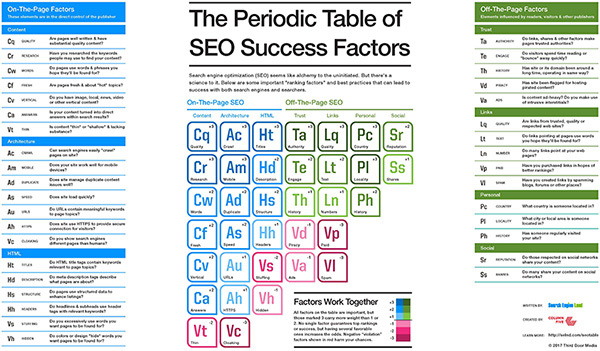
    The 2017 edition of the periodic table of SEO success factors is interesting not because new elements were added, but because it holds a few surprises on what are not that important any more.

    AdWords Optimization

    For advanced and amature SEO’s, this blog can serve as a quick reference for what to defocus from and what to focus on. I have kept the exhaustive details out, but, if you need those details and are curious about how the scores are derived, feel free to read the original article.

    The 2017 edition is the 4th installment of the Periodic Table. Notable changes from the 2015 version are:

    • Mobile, Direct Answers & Site Speed have gained greater value
    • Search history has decreased its importance
    • Site Identity and Social Sharing have been dropped

    Factors with increased value:

    Mobile – Mobile is more important than ever. It’s score increased to +3 from +2 in 2015. With 50% of Google searches on mobile devices, there is undoubtedly a need for mobile-friendly content. Plus, by the end of 2018, Google will use a “Mobile First Index” even for the desktop users.

    Speed – Google continues to push for faster sites, thus emphasizing “speed” as an important ranking factor. Implementing the AMP (Accelerated Mobile Pages) is widely backed by Google. The value of speed has increased from +1 to +2 in 2015.

    We expect speed to continue to play an important role in the long term as more and more people move to mobile and the number of consumers craving for speed increases.

    Direct Answers – This factor was added in 2015 with +1 value but now has gained a higher value of +2. With Google and Bing increasingly showing direct answers culled from webpages above regular listings (featured snippets in Google), it is a critical component for ranking.

    Given these results are directly proportional to searcher’s intent and fits right in Google’s mantra of “relevent content,” we expect this to continue to gain more importance in the future. Therefore, companies should start looking at their sites as content publishing platforms that cater to the needs of the target audience.

    Factors with drop in value:

    Site History – The value of site history dropped to + 1 (from +2 in 2015 edition), as Google seems to have downplayed the importance of a site’s age or history.

    Personal Search History – This dropped to + 2 as compared to +3 in the 2015 edition. This is an interesting twist, and it will only benefit the consumer who keeps looking for new and relevant sites that cater to their needs.

    Factors dropped:

    Identity – This factor dropped from the table as Google has blocked authorship entirely in June 2016 (a way to link content you create with a Google+ profile).

    Social – Google+’s impact on Google search has decreased. Therefore, this factor was dropped from the table.

    In Conclusion:

    The Periodic Table is an interesting way to view citical SEO parameters. I have personally used it for training and it sits really well with aspiring SEO geeks.

    The periodic table by no means should be the sole guiding force for your SEO efforts. It should be a guidance for information on factors that are most or least important.

    Do not forget, your main objective with SEO is to continue to focus on the searcher and personas you want to target. So developing quality and relevant content is most important, followed by the right site architechure. Ranking and traffic will follow as long as you do not spam or use black hat techniques.

    Leave your comments below or write to us. Feel free to give us your details and we will get in touch with you if you need SEO help.