Category: SEO

  • SEO 2021: Winning Strategies and Trends You Need to Know!

    Every marketer working with SEO keeps a diligent eye on Google’s algorithm changes and the new features and opportunities they introduce. Optimization techniques that worked two years ago don’t work anymore. For example, Citations used to be a significant ranking factor for local SEO, but recent studies show that this is no longer the case. In this blog, we walk through how you can leverage SEO to make it more impactful in 2021 and beyond.

    Google Now Ranks Web Pages Based on Passages

    Google addressed all their latest updates in a blog post published in October 2020. In a bid to enhance search results, Google is expanding natural language processing to “passage indexing,” ranking individual sentences or phrases within a page. This is one more reason why content should be optimized for long-tail searches, articles, how-to guides, and long-form content, which are all likely to benefit from this enhancement.

    Until now, an FAQ page with 15 frequently asked questions might have trouble hitting the top spot in Google as bots have a hard time understanding the page’s intent. With passage indexing, Google can match a page’s specific section to users’ search queries and rank it.

    E-A-T Principle: Should You Consider It or Not?

    Are we giving too much importance to E-A-T as it is coming straight from Google’s Quality Rater Guidelines? While Google confirmed that E-A-T (Expertise, Authority, Trust) doesn’t directly influence ranking, YMYL ( “your money or your life”) websites can’t rank without some level of expertise, authority and trust.

    In a nutshell, E-A-T is not something that every site owner needs to focus heavily on. However, if your websites fall under finance, health, law, or e-commerce, concentrating on E-A-T will add value and yield results.

    The benefits of increasing E-A-T extend beyond just SEO. E-A-T updates can enhance user experience as users feel more convinced that they can trust your website, authors, and brand.

    User Experience Is a Ranking Factor

    User experience (UX) is vital for any site’s success and has traditionally been a subjective measure. To quantify UX, Google introduced Core Web Vitals, a program to give integrated guidance for quality signals specific to user experience. Since user experience will be a ranking factor in 2021, it is important for SEOs to integrate UX as a part of their strategy.

    The Core Web Vitals report will show you three metrics we briefly discussed under “Focus on Mobile.” You can assess your site’s performance and derive a page-by-page breakdown of issues using the Core Web Vitals report in Google Search Console. This report shows you how your page performs based on real-world usage data or field data. Here are some of the key metrics you’ll find:

    • Largest Contentful Paint (LCP) – How fast a page loads
    • First Input Delay (FID) – How quickly a page interacts
    • Cumulative Layout Shifts (CLS) – How fast a page gets visually stable

    You can easily use this number to benchmark and work towards a better UX experience.

    Focus on Mobile Should Be Your Priority

    Mobile-first indexing will be enabled for all websites starting July 2021. Core Web Vitals are going to be the ranking factor for mobile search queries in May 2021.

    Mobile-first indexing will become the default for all websites, beginning in July 2021. Ensuring all content you serve is also available on mobile is critical.

    Page experience will be another ranking factor from May 2021, where mobile-friendliness and core web vitals are part of this. Safe-browsing, HTTPS-security, and intrusive interstitial are other signals that determine the “Page Experience.” Core web vital factors (LCP, FID, CLS) will be considered for mobile devices when they become an inclusive ranking factor in the algorithm.

    Search Intent More Critical than Keywords

    Google is excellent at isolating relevant content based on a person’s search intent. From an SEO perspective, this means concentrating on top-of-the-funnel, and short-tail keywords alone will no longer work.

    As Google points out, search intent is redefining the marketing funnel and content creation altogether. Here’s an excerpt from Think With Google: “Stop marketing to the average: Be useful. People respond to brands that understand their needs. So, it’s important to optimize your media for both relevance to the consumer and lifetime value for the brand.”

    Content creation should start with a clear understanding of the audience’s intent and how it might satisfy that need. Exploring top keywords you want to rank for as a brand or that your target audience tends to use isn’t good enough. Instead, dig deeper into the needs of your audience. Do people want to buy from you? Find your contact information? Get pricing information or a quote? Is there a particular question that people think you can answer? Start with a close examination of those typical customer journeys to understand that no two journeys are the same.

    From there, we recommend that you:

    • Create content that supports your target audience’s intent
    • Write content around natural search queries (question-based)
    • Examine the types of content (Q&A, guides, how-tos) your users want

    Brand Optimization: Knowledge Panels, Entities and Beyond

    Optimizing your brand’s entire digital presence will be critical in 2021. Brands with a higher presence organically get greater visibility. Claiming your knowledge panel and creating/optimizing entities will be vital in 2021. The Google Knowledge Graph is one way Google tries to recognize searcher intent and the connection between real-world entities and this process revolutionized search forever—for searchers, brands, and businesses.

    Trust also plays a key role in brand optimization. It is becoming one of the most essential and underlying optimization factors for SEO.

    We predict that entities might replace backlinks when Google collects enough data around them. We also see entities as a more real-world model than backlinks to connect a business/person. This model will tell Google which companies are trustworthy, which authors are experts, and what content truly deserves to be ranked higher.

    You can start by:

    • Implementing a complete and accurate organizational schema markup
    • Creating a presence in relevant knowledge bases such as Wikidata/Wikipedia
    • Claiming your knowledge panel to use posts by Google features
    • Setting up your Google My Business profile for physical businesses

    Don’t ignore opportunities like Video SEO (YouTube SEO), Image SEO, Amazon SEO, and like avenues to organically reach a wider audience.

    Conclusion

    Search algorithms are evolving, and users’ search adoption is changing. SEO is not as simple as it used to be. Start with great content first and then employ SEO to make sure that Google takes notice. As we advance, SEO will grow increasingly complex, particularly since rich elements are becoming more common in SERP (Search Engine Results Pages), and it becomes more about being featured than being ranked.

    Are you ready for 2021? At Position2, we can help you understand SEO trends and techniques to meet complex SEO requirements. Contact us today to learn how we can help you take your SEO strategy to the next level.
  • Why Should You Invest in Long-term SEO?

    “Why Should You Invest in Long-term SEO?” is one of the most common and repeated questions around the Search Engine Optimization industry.

    Over the last ten years, Google has increased its focus on user experience and search intent, making this a hot topic. Google’s rollout of RankBrain several years ago made this topic even hotter. But the big question is whether an investment in SEO is worthwhile. In this article, we’ll share with you the benefits of making a long-term investment in SEO. We have included a number of items such as SERP (Search Engine Results Page) features and voice searches that you might not even realize fall under SEO.

    Evolving Search Algorithms
    According to John Muller, Google’s Webmaster Trends Analyst, its search engine algorithm gets refreshed throughout the year. If we take the unconfirmed algorithm updates from Google into consideration, we would see a pattern of an everyday refresh. Truth be told, webmasters around the world report fluctuations in ranking almost every day. The below screenshot shows the rank fluctuations from one of the SEO tools for the last 30 days.

    The message is pretty clear that the Google algorithm is evolving every day, and your effective SEO strategy should be revised to accommodate the changes. Additionally, adhering to the Search Engine’s guidelines will help your website visits grow naturally.

    Evolving SERP Features
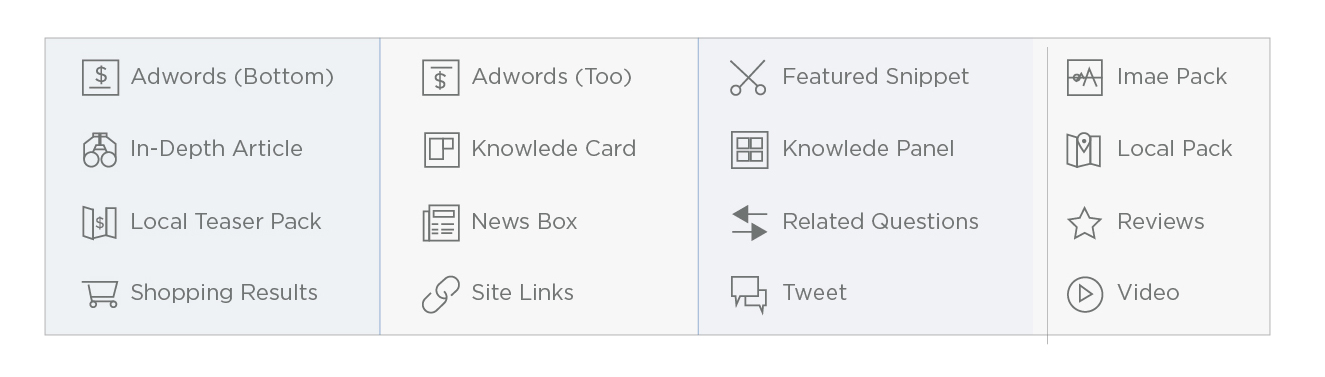
    Google keeps introducing new SERP features to deliver users what they are looking for. These changes are most visible in search results, which make every organic marketer optimize the website/content for the new feature. Every time search engines, especially Google, introduce a new SERP feature, it altogether changes the definition of “how to do SEO.” Below is a sample set of SERP features that dominate the search results.

    Emojis in Advertising: Do’s and Don’ts

    So what does this mean for you? A long-term SEO strategy is critical for making sure you perform well on SERPs.

    Evolving Search Intent
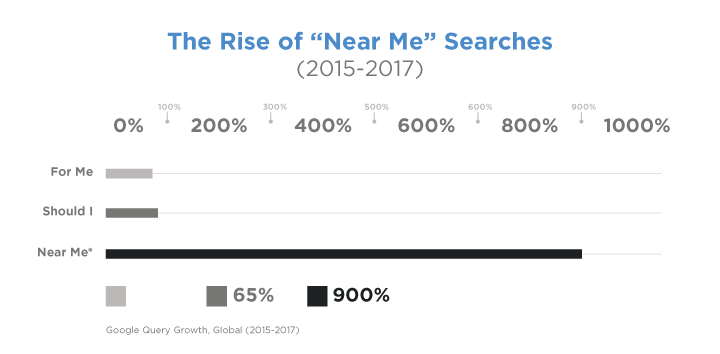
    With greater penetration of mobile devices, the search intent is evolving, as well. Currently, Local and Voice are changing the game plan. Small businesses should capitalize on local SEO to get maximum visibility. In the past two years, “Near me” organic searches have witnessed exponential growth. From 2013 to 2017, there was a 900% increase in “near me” searches.

    Emojis in Advertising: Do’s and Don’ts

    Voice search is growing exponentially YoY and is becoming popular with all age groups, especially the younger generation. If you are in the B2C market, voice search optimization should be an integral part of your marketing strategy. The following few points will clearly say where it is leading and why you should capture this:

    • The global market for voice search devices grew by 187% in Q2 2018.
    • Apple, Google, Xiaomi, Amazon, and other manufacturers collectively shipped 16.8 million units in Q1 of 2018.
    • Google sold 5.4 Million Google Home models so far in 2018.
    • Amazon had sold 4.1 Million Echo devices by Q2 2018.

    Courtesy

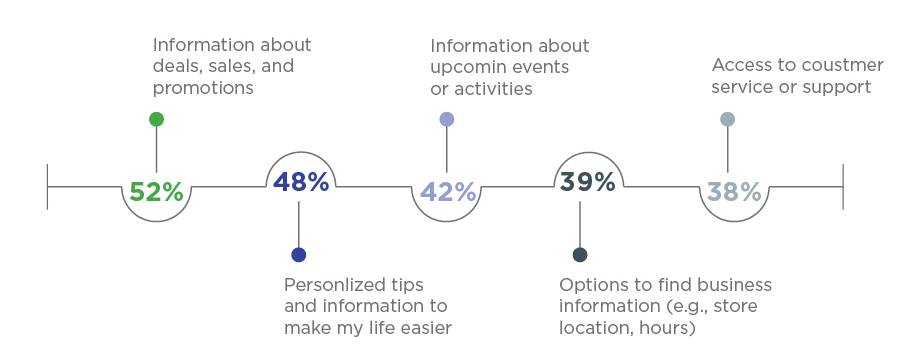
    One in five searches on a mobile device is now a voice search. According to Google, 39% of people use voice search to find business, store, etc.

    Emojis in Advertising: Do’s and Don’ts

    Clearly, optimizing your website content for voice is critical.

    Your website content should use natural language to make sure your users understand the content with ease. To optimize your content for voice searches, use long-tail keywords and focus on natural language. Keep in mind that most long-tail keywords in voice searches are in the form of questions. Having a Q&A or a FAQ section could be the right place to start.

    Competitors are Evolving
    Every business competes for better online presence. So, when it comes to online marketing, you face new competitors every day. These aren’t just your direct business competitors but also other websites like Wikipedia, Twitter, etc. These information-focused websites dominate the SERP pages for your business terms across all search engines. The bottom line is that you need to outrank your business competitors as well as the general information-based websites. Regular competitor gap analysis will help you sharpen your sword and get yourself in front of your battlefield.

    Brand Building (Economically)
    Long term SEO helps economically build your brand by growing your online presence. Remember, an established brand usually stays at the forefront of a person’s mind even after the sale or service is over. Brand building and SEO work toward the same goals with an additional benefit of getting better traffic, targeted audiences, improved conversion rate and profitable ROI.

    Hidden Benefits
    When you focus on delivering high-quality content based on what your users are looking for, you can considerably reduce your customer-care and sales costs. Here are two recommendations for accomplishing this:

    • Focus on common questions of your users/customers in a FAQ section
    • Provide tutorials/guides to help customers understand your products and services

    Final thoughts:
    The bottom line is that if you have a marketing budget, investing in long-term organic SEO should not be a second thought. Long-term investment in SEO is one of the best marketing choices you can make for your business growth. This form of digital marketing will help your potential customers find your website with ease, which will result in targeted organic traffic, higher sales and better ROI.

    Interested in learning more about the growing organic trends, reach out to us!

  • Brand Building with SEO Why it is important and 10 actionable tips to get it right!

    Google (and any other search engine) always give a better and favored treatment for bigger brands. More prominent brands rank for competitive terms with fewer links. For base and long tail keywords, brands rank quickly in SERPs. Whereas, the smaller brands need more than twice the link of bigger brands to get ranked for similar terms in SERP.

    Brand building and SEO work toward the same goal. Get better traffic, targeted traffic, improved conversion, profitable ROI. Like, every bigger brand small and mid-sized businesses too should focus on spreading the brand image with their users in mind.

    Remember, an established brand usually stays in the forefront of a person’s mind even after the sale or service is over.

    Google SERPs changes and updates just as frequently as each algorithm update. Most recently, SERPs consist of sitelinks, Local Pack, Knowledge Graph, Featured Snippets, People Also Ask, Images, Videos, Product Listings, and Reviews.

    According to Google’s guidelines to their quality raters (real people who assess web pages and grade scores against the predefined set of perimeters) EAT principle is predominantly used. E-A-T stands for Expertise, Authority, and Trustworthiness.

    While Google has not mentioned in their document about the brands against the EAT principle specifically, it is quite evidently important that brands fulfill all these standards by default.

    According to Google, high-quality pages own the following characteristics:

    • The content should be good enough to please the needs of a user for a page’s unique topic and purpose
    • The website also holds enough secondary information, for example, “About us,” “Contact us”, etc.
    • The website speaks about the supplementary content (SC) that improves the user’s experience of a web page
    • The page is structured and designed in a way that users locate the content easily and quickly.
    • The website is maintained and edited regularly

    Here are some brand building tips to ensure your SEO strategy supports your efforts:

    • Create fresh and unique content that addresses your users/audience pain points with blog posts, in-depth articles, videos, and podcasts.
    • Add value to the existing content to make them linkable content assets
    • Build authority via content
      • Create a blog section on your website and start adding your expert opinion
      • Be a contributor or guest blogger in niche forums/portals to have a share of voice to increase your brand image
      • Publish press releases about your brand and its activities
      • Acquire quality links via natural content-driven link building activities
      • Maintain a quality backlink profile
      • Optimize your content for your consumers by using targeted and long-tail keywords that THEY will resonate with organically. However, do not focus on keyword phrases for search engine crawlers
    • Be active on social media channels
      • Repurpose your content across various social media channels
      • Make your employees your brand advocates in social channels
      • Cross-promote the content via social channels
      • Have influencers talk about your business for reputation management and increase social shares
    • Leverage universal search (Images, Videos, etc)
    • Have a consistent NAP (Name, Address, Phone Number) across the internet. These local SEO factors for crucial for ranking if you are running a location-specific business.
    • If not backlinks, create brand identity via brand mentions from related websites
    • Have your website search engine optimization compliant
      • Audit your website against technical SEO compliance and fix the errors. Make use of Google’s free Search Console to get quick error reports on your website.
      • Leverage SEO on-page optimization and incorporate the crucial SEO elements
      • Follow white-hat SEO best practices and adhere to Google’s guidelines to stay on the track.
      • Consistent use of on-page optimization and off-page SEO while building a brand
    • Claim your Business on Google My Business to get visibility in Google Knowledge Panel.
      • Do not forget Yahoo Maps, Bing Maps
      • Data Aggregators helps you build your brand across the world wide web.
    • Build your marketing strategy focusing the local publications. Google and Bing will reward your business with a boost in local and blended search rank when you get a mention/link from local publications.

    As a business, you don’t just want people to identify you with jus t your logo. You should want your target audience and need them to find you and connect with you. Appearing for relevant search keyword phrases and search terms found by the target audience is the key to any brand image building strategy. SEO helps with both.

    Share your thoughts on the comments. Are you looking for consultation on how to build your brand image, increase your online presence, and get visibility for your brand? Let’s connect!

  • Crawl Budget Optimization – a Crucial SEO Factor

    Are you a business owner with a website with multiple pages and many new URLs that are auto-generated every day? If this is your website, then Google might not crawl all of these pages effectively. The most important point is to prioritize what and when and how much to crawl.

    In simple terms, according to Google, a” define crawl budget as the number of URLs Googlebot can and wants to crawl.” Both the crawl rate limit and the crawl demand make up the crawl budget. While crawling a website, the number of requests made by Googlebot per second is considered the crawl rate. The crawl demand is where Googlebot determines how popular new and old pages are and the prevention of URLs becoming stale in the index. The more pages are crawled by search engine bots; the more will be indexed for search results.

    Most often than not, the crawl budget is overlooked when optimizing a website. Many do not realize that it is a significant SEO factor that can bring traffic to your website.

    Crawl Budget Optimization – a Crucial SEO Factor

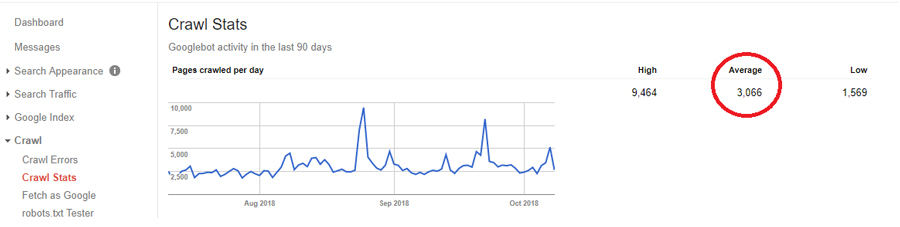
    The above screenshot is from Google search console (Google Webmaster Tools). It tells us that Google crawls 3,066 pages per day for the verified website. From that, we can figure it out that the monthly crawl budget for this site is ~3,066*30=~91,980.

    Fact check:
    A healthy crawl rate will help your websites get indexed effectively and quickly. But don’t jump to the conclusion that a higher crawl rate will help improve your organic ranking.

    Factors that affect the crawl budget

    • Duplicate Content
    • Thin Content
    • 404 Pages
    • Redirect Chains
    • Robots.txt
    • XLM Sitemaps
    • Website Architecture
    • Website Speed

    Duplicate Content

    Irrespective of the source of the content, duplicate content can negatively impact your SEO efforts, and wastes crawl budget to a significant level. Duplicate content can happen in many ways.

    Internal content duplication

    Internal content duplication may occur when different URLs point to a single page.

    • www.example.com/page1
    • example.com/page1
    • example.com/page1/
    • example.com/Page1
    • example.com/page1/index.php

    Duplication with URL parameters

    Base URLs added with parameters would create N-number of duplicate pages

    • www.example.com?id=1
    • www.example.com?id=abcd

    E-commerce duplication

    Sorting and filter options will create unintentional internal duplication

    • www.example.com/cat1/sub-cat1/product-listing
    • www.example.com/products/cat1/sub-cat1?product_list_order=name&product_list_limit=15

    The similar problem occurs with websites that offer calendars to save certain events/webinars etc.

    Thin Content

    Pages created via tags, and authors sections create thin / low-value content. This occurs mostly within the blog post section. These pages are planned for users and search engine bots to find relevant pages and improve internal navigation.

    404 pages and soft 404 pages

    If a website has a huge number of 404 and soft 404 errors, these need to be fixed. Since Googlebot tend to revisit the pages to validate if they are still non-indexable. Keeping an eye on pages that return 404 status code is key to keep things on track.

    Redirect chains

    If your site has an unreasonable number of redirect chains, bots will stop following the directions, and the destination URL may not get the bots’ attention. Each redirection is a waste of one unit in your allocated crawl budget.

    Robots.txt

    Robots.txt file instructs bots what to crawl and what not to crawl. Thus, not using it properly might consume a considerable amount of crawl budget units.

    Improper XML sitemaps

    An XML sitemap is the most important section of your website which helps proper crawling and indexing. Knockout the errors in the XML sitemaps (404s, non-canonical, redirected URLs, URLs blocked by robots and meta tag) and validate it frequently.

    Improper website architecture

    Bots will find it difficult to find fresh content and pages if the site structure is not developed properly. Having proper silo structure and internal linking structure will help improve the crawling and indexing.

    • www.example.com/product1 (Flat structure)

    Website site speed

    The faster the page loads and the response time the better for your users and search bots. The faster a web page loads not only keeps the user on the website, but it also ensures web crawlers are keen to re-crawl your website. So, if your website load time is slow, it negatively affects the crawling. Google’s page speed insights can be the first place for anyone to work around the improvement.

    Where to look for crawl data?

    To have a more detailed breakdown of the crawl stats by individual pages, we need to analyze the spiders’ footprints in the server logs. Often raw log files are hard to read and analyze, to help make the job easier, tools available in the market.

    Does crawl optimization improve ROI?

    Crawl optimization will help you get rid of inactive pages that are not useful from your website and help you build more useful and active pages. This will gradually and positively impact the indexation and internal popularity of the website and mainly for the most focused pages for your business.

    In short, Crawl budget helps you bring positive ROI with much fewer pages but are very active and important pages.

    Takeaways

    • Crawl budget is considered an important factor for SEO for websites large and small.
    • Very low crawl budget means Googlebot doesn’t like your web pages/content.
    • Very high crawl budget doesn’t guarantee a high ranking. Additionally, a very high crawl budget will overload your server.
    • Tweaks in crawl budget settling will not help. Instead, optimize your website to have an effective and efficient crawl budget by implementing the factors discussed above.

    Crawl budget is not as popular and talked about when referring to ‘quality content’ or ‘authoritative links.’ However, it is very much an important factor for larger e-commerce sites and content portals. When you spend time analyzing your server logs and optimize your crawl budget, it not only gives a cleaner site but will improve your site’s performance in organic search.

    Are you a business owner and still not sure where to start crawl budget optimization for your website? Let our experts do it for you. Let’s talk about it!

  • Simple SEO Tips to Increase Traffic

    “I optimized my website and did the best I could, but I could not find that one robust tactic that gives me a high return on investment.”

    SEO is always evolving. While some strategies in the past have proved to be profitable, they may not be as effective today. However, there are still some optimization strategies and tactics that are still important today and should not be ignored.

    Here are the four simple things to help your overall SEO results:

    1. Revise Low-Traffic/Low Quality Pages

    Depending on how large your site is, there is a limit on pages crawled by search engines. The main target should be to let search engines crawl the most valuable/quality pages of your website. Pages that have low quality or low traffic should be removed to let search engines crawl the most important pages.

    To do this, check if your site has following things:

    – Pages that are old and are no longer relevant to your business

    – Blog posts that are outdated

    – Pages with thin content (pages will less content or having little or no original content)

    – Multiple pages that can be merged and grouped under a single theme or topic

    – Pages that mostly contain low search volume keywords

    Keeping all such pages aside will pave a way for search engines to reach your higher-quality pages and are likely to appear on search results, thereby improving the overall quality of your website.

    However, be careful when removing those pages because you could lose link equity and website authority you have built. It is recommended to set up a permanent 301 redirect to ensure search engines and users are sent to the most relevant pages.

    2. Optimize URL Architecture and Structure

    URL architecture and its structure plays a significant role in modern website optimization. A wise approach in URL structure revision and optimization is to get rid of URL structure and set a hierarchy instead. A hierarchical URL architecture allows search engines to better understand what your website content is about.

    One simple way to do this is to create nested buckets under each of the individual pages within your website. Your home page will have the largest bucket since it is about the core theme of your content. Then, there will be second level-pages, under which you will create third level pages or blog posts that are related to the second level pages. When you create deeper page levels, make sure they all fit within the same theme as the second level page.

    In the same way, other second level pages should follow the same hierarchy bucketing as all related content under it. The benefit of this is creating a meaningful flow of your website content, not just throwing your various website topics randomly. Such URL folder structure allows link equity passed on to the main themes under each hierarchy and improve the authority. Search engines will weigh the content groups and are likely to churn better ranking positions.

    3. Improve Page Load Time

    Page speed is another simple SEO effort yet often discarded. The fact that page speed is a ranking factor denotes how important it for website optimization.

    You can check your website speed using Google’s speed test tools such as PageSpeed Insights and Test my site which will bring out your website speed status and areas that need improvement.

    To boost website speed, use a reputable web host that can give you secure hosting and offers overall page speed improvement. You may also want to check on the number of plugins you have and reduce them because each plugin requires processing effort for each page to load. The same approach applies to CSS, JavaScript, images, and videos.

    4. Optimize Internal Linking Structure

    This is another area most people overlook in their optimization strategy. Internal links can add valuable SEO benefits when done correctly and are important due to technical and user experience.

    Internal links help search engines discover more pages that are important and relevant to the page it crawled. They also help improve user experience as it helps users find more related content they are looking for.

    Building an internal linking structure is simple but should be done by taking into account technical and user experience impacts. Avoid too many internal links as it may confuse search engine crawlers with numerous content and distract users.

    Remember to include internal links from any relevant pages to all your important pages – solutions, products, or services. In the linking text, try to use keywords related to the page you want to link to. This will ensure optimization of relevant keywords while improving internal linking structure. At the same time, check all the internal links to make sure they are only relevant links and that there are no crawl errors.

    There are many other simple SEO tactics that can be easily employed to improve rankings and traffic and these are few of them. If you are looking for deeper optimization tips, here is what you can look up to: 4 Tips to Take Your SEO Effort to the Next Level

  • 4 Tips to Take Your SEO Effort to the Next Level

    The days when you could fool the search engines with coding and other black hat SEO stuff are gone. Search engines are being continually updated and upgraded with the latest intelligence and ability, increasing the need for improved SEO tactics and strategies.

    Having said this, there are several factors that make an SEO strategy successful: on-page activities, off-page activities, technical SEO, and non-technical SEO. These are the age-old factors that will always play a role in SEO success. Apart from these, here are few more points to remember to take your SEO efforts to the next level:

    1. Technical SEO roles and optimization effort

    Most of the organizations today have a separate technical team that maintains their website’s technical space. This team may include web developers, content marketers, link building strategists, and an IT technical team to manage security and data storage.

    Many times, the coordination between these teams are overlooked and may affect the overall SEO effort. The ideal optimization strategy is to have a constant coordination across all teams for a clear understanding of the impact one team might have on the other. It is critical to include technical SEO in the optimization planning process, and this should be incorporated at an early stage of planning. A well-coordinated team internally will ensure smooth implementation of technical SEO recommendations, optimization, site structure enhancement, etc.

    2. On-page and off-page activities balance

    On-page and off-page elements are both equally important to scale up optimization effort. There should be a good balance between the on-page and off-page SEO activities. Consider the following activities to create a balance between the two:

    On-page SEO efforts:

    1. Website architecture and folder structure
    2. Sitemap and website navigation
    3. Meta tags optimization (using a thorough keyword research and mapping)
    4. Fixing technical errors
    5. Crawlability and indexability
    6. Content updates: refresh and addition
    7. Site security
    8. Main website and sub-domain inter-connection
    9. Internal linking structure
    10. Site speed (desktop and mobile) and mobile-friendliness

    Off-page SEO Efforts:

    1. Social visibility and engagement
    2. Articles, news and blog post generation
    3. Content sharing

    3. Segregate on-page and off-page SEO responsibilities

    While there are tasks that are evident on its own, whether they belong to technical or non-technical SEO, there are some that can be missed out on both areas. Such elements can have a destructive effect on the website, user experience, rankings and traffic, and finally the overall sales.

    One of the things that is powerful in content strategy is the combined effort of the on-page, off-page, technical and non-technical SEO to set the organic traffic flow right. This may require different combinations of efforts amongst all the factors – website restructure (whether to use sub-domain or not) and revamp, content that is user driver (informative) and supported by off-page activities, and research form external partners.

    4. Create an SEO content system

    Content generation in any form requires some alignment that will direct all the SEO optimization towards one single goal. Content created from various baselines will not only disregard the intent of other content, but also dilute the optimization efforts altogether.

    To ensure that content is in line with the optimization goal, create a system that will help you get a quick reference for content creators. This will answer multiple questions, like what images are to be used and how should it be optimized, what should the meta tags be, what to use as headers and how should it be optimized, what is the intent of the content, and who is the target audience.

    Lastly, to stay on top of the competition, you need to build a connection between technical and non-technical SEO effort, on-page, and off-page activities balance. Good coordination across teams will not only help you stride towards your SEO goals, but will also find you new opportunities to stay ahead of the competition.

  • Critical SEO Factors for 2017: Key Elements from The Periodic Table of SEO

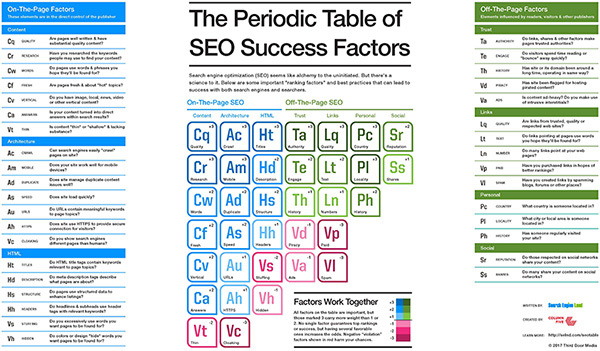
    The 2017 edition of the periodic table of SEO success factors is interesting not because new elements were added, but because it holds a few surprises on what are not that important any more.

    AdWords Optimization

    For advanced and amature SEO’s, this blog can serve as a quick reference for what to defocus from and what to focus on. I have kept the exhaustive details out, but, if you need those details and are curious about how the scores are derived, feel free to read the original article.

    The 2017 edition is the 4th installment of the Periodic Table. Notable changes from the 2015 version are:

    • Mobile, Direct Answers & Site Speed have gained greater value
    • Search history has decreased its importance
    • Site Identity and Social Sharing have been dropped

    Factors with increased value:

    Mobile – Mobile is more important than ever. It’s score increased to +3 from +2 in 2015. With 50% of Google searches on mobile devices, there is undoubtedly a need for mobile-friendly content. Plus, by the end of 2018, Google will use a “Mobile First Index” even for the desktop users.

    Speed – Google continues to push for faster sites, thus emphasizing “speed” as an important ranking factor. Implementing the AMP (Accelerated Mobile Pages) is widely backed by Google. The value of speed has increased from +1 to +2 in 2015.

    We expect speed to continue to play an important role in the long term as more and more people move to mobile and the number of consumers craving for speed increases.

    Direct Answers – This factor was added in 2015 with +1 value but now has gained a higher value of +2. With Google and Bing increasingly showing direct answers culled from webpages above regular listings (featured snippets in Google), it is a critical component for ranking.

    Given these results are directly proportional to searcher’s intent and fits right in Google’s mantra of “relevent content,” we expect this to continue to gain more importance in the future. Therefore, companies should start looking at their sites as content publishing platforms that cater to the needs of the target audience.

    Factors with drop in value:

    Site History – The value of site history dropped to + 1 (from +2 in 2015 edition), as Google seems to have downplayed the importance of a site’s age or history.

    Personal Search History – This dropped to + 2 as compared to +3 in the 2015 edition. This is an interesting twist, and it will only benefit the consumer who keeps looking for new and relevant sites that cater to their needs.

    Factors dropped:

    Identity – This factor dropped from the table as Google has blocked authorship entirely in June 2016 (a way to link content you create with a Google+ profile).

    Social – Google+’s impact on Google search has decreased. Therefore, this factor was dropped from the table.

    In Conclusion:

    The Periodic Table is an interesting way to view citical SEO parameters. I have personally used it for training and it sits really well with aspiring SEO geeks.

    The periodic table by no means should be the sole guiding force for your SEO efforts. It should be a guidance for information on factors that are most or least important.

    Do not forget, your main objective with SEO is to continue to focus on the searcher and personas you want to target. So developing quality and relevant content is most important, followed by the right site architechure. Ranking and traffic will follow as long as you do not spam or use black hat techniques.

    Leave your comments below or write to us. Feel free to give us your details and we will get in touch with you if you need SEO help.

  • Here’s What You Need to Know About the Google ‘Fred’ Update

    Google released an unconfirmed update on March 8th, 2017 which is being called the “Fred.” As per initial reports, the sites affected by this update saw up to 90% drop in organic traffic.

    What is the Google Fred algorithm update?

    While it remains vague as to what this update is specifically targeting, Fred is believed to be one of those updates which go by unnoticed until you start seeing changes in your website rankings or traffic. The chatter in the SEO community suggest that the Fred update affects these kinds of sites:

      1. Sites with low quality and thin content – Research findings from Barry Schwartz suggested that most sites that lost the most in terms of search engine rankings and organic traffic were those that have “SEO content” – content that is created solely for improving ranks in search engines and not around the user’s search intent. This is a clear indication that Google is keeping true to its goal of serving quality content that focuses on customer needs.
      2. Sites with low quality backlinks, i.e., where a number of the sites that link back to your site are low in domain authority.
      3. Sites with ads that have low or no relevance to the content on the site.
      4. Revenue or lead generation sites with lots of ads and not enough content created around the target audience’s search intent.

    5 things you can do to safeguard against the Google Fred update

    1. Build quality content – Quality content is not entirely about high word count or keyword density. Make sure that your content — even if it is low on word count — is relevant, provides unique value to the reader, addresses the needs of your audience and appeals to them.

    1. Use a website auditing tool to analyze what kind of content is ranking and driving traffic to your website by keeping a watch on key metrics such as bounce rate and time spent on page. This will help you understand what is and isn’t working to make the necessary content changes.
    2. Focus on creating unique content that clearly answers relevant queries — content that people want to read, not what you want them to read.

    2. Monitor website traffic – Keeping an eye on website analytics will help you understand how these updates are affecting your site ranking and traffic. When you begin to see unusual changes in your ranks or traffic, check the dates of the changes against the dates of the algorithm updates.

    3. Audit the ads on your site – To avoid being penalized by Google:

    1. Get rid of deceptive ads which can be deemed to be black hat SEO and harm high-quality content.
    2. Ads placed within articles and videos that auto-play when the user lands on the page affect user experience and in turn increase the chances of attracting a penalty.
    3. Ads with a dofollow link can be deemed to be black hat. Make sure all ads on your website have a nofollow attribute. Similarly, make sure all your ads on other websites have a nofollow attribute.

    4. Quality backlinks – If you find that a site irrelevant to yours has linked to you, reach out to them and ask them to remove your link or use Google’s Disavow Tool to disavow these links. Doing so will allow you to avoid a manual penalty from Google. If you have any affiliate links, make sure all the affiliate links have a nofollow attribute on them

    Use a link audit software to keep check of backlinks from other sites. Here are some Backlink analysis tools you can make use of:

    1. Ahrefs
    2. Moz Open Site Explorer
    3. Linkody
    4. Majestic SEO

    In addition to these, there are multiple tools out there that can help analyze the quality of your backlinks.

    5. Improve user experience – Focus on keeping your site user-friendly by optimizing for all platforms, eliminate unnecessary UX barriers and make the site easy to navigate, use schema markups to create well-presented search results and overall create a good site architecture.

    Focus on content quality and SEO compliance

    There is no doubt that Google is rolling out updates on a regular basis, and you may not get confirmation on every update. The best thing you can do to avoid being a victim of penalization through these updates is to constantly make sure that you are always serving quality content to your users which are not centered around search engine algorithms or created only for revenue generation.

    In addition, keep close watch for Google algorithm updates so that you can reduce the chance of being caught unprepared.

    Sources:

  • Glocalization Helps Small Businesses Compete

    Often, smaller businesses are wary of competing with a reputed brand, assuming that the bigger enterprises are more resourceful with an added advantage of an established brand value and reputation in the market. However, that’s not always how it works in the ‘www’ world. In fact, as a local business, you know more about your customers and their requirements than a bigger brand. So, you should always leverage this knowledge to become a local expert on the industry. This brings me to the concept of glocalization, the practice of conducting business according to both local and global considerations.

    Glocalization is the adaptation of globally marketed products and services to local markets. “Think globally, act locally,” is one of the most effective “mantras” for small and medium-sized business who are ‘all set’ to compete with a big brand in your domain.

    With the current digital-growth explosion, where people are connected online 24×7, you can thrive in the market with a well optimized website and an effective content marketing strategy. In fact, “content” is a key buzzword in the online space. According to WordStream, while the catchphrase “content is king” has been used plenty in the past couple of years, we shouldn’t expect it to go away any time soon. “Content is key, having a content strategy is essential, you need quality content if you want to succeed in today’s digital marketing landscape.”

    In addition to having strong content, we recommend following these simple glocalization steps:

    • Get listed on Google Places to gain visibility in the local market. People tend to trust someone from their own area, so this is a great opportunity to build on that trust factor.
    • Add images, videos, and customer testimonials on your website to make your business appear more genuine and trustworthy to potential customers.
    • Use tools to add “review ratings” that show up on the organic search results.
    • Add some resource links on your website to provide good content to your customers. After all, Google appreciates sites with authentic, useful information.
    • Provide local and relevant content on your website that your potential customers can easily relate to.
    • Know your customers’ likes and interests and provide content that they will feel compelled to share with others.
    • Connect well with your customers and get “personal,” making them feel that you are speaking with them. It is widely accepted that people connect with and trust other people more than they connect with trusted brands. Become the face of your business to forge a tie with your customers, foster a lasting relationship, and eventually turn them into loyal advocates of your business.

    Yahoo! is an example of a company that practices glocalization. It markets a portal that is viewed worldwide and offers different versions of its website (and related services) for different users.

    Therefore, the biggest weapons to win the online game are “Local-focused” content and personalization. Make sure you follow glocalization guidelines on an ongoing basis to stall a competitor from becoming a threat!

    Sources:

    1. https://en.wikipedia.org/wiki/Glocalization
    2. http://www.wordstream.com/blog/ws/2015/02/23/marketing-buzzwords
    3. http://www.investopedia.com/terms/g/glocalization.asp
  • SEO is Going Mobile. Is Your Business Ready?

    If you’re looking for information about optimizing your site for search, the web is bursting with examples. In the past, when people spoke about website optimization, the first thing that came to mind would be optimization for a desktop.

    But times are changing.

    Yes, in today’s digital era, optimizing for the desktop is critical. But additionally, we now have to recognize that people are using mobile devices for many more tasks than they used to. If you ignore these mobile users, you could miss critical opportunities and capture an ever smaller segment of the market.

    Mobile Optimization Cannot be Ignored

    When you’re optimizing your website, it makes sense to tackle desktop first. But when you review your analytics, you’ll realize how many people search on mobile platforms. Research and reports have shown that the percentage of mobile users browsing the web is increasing by the day. Google has even made mobile friendliness a factor that can boost your search ranking.

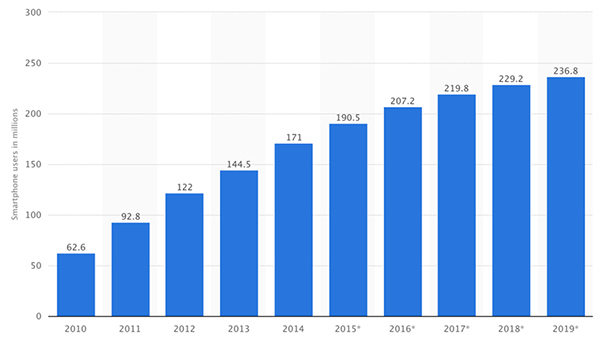
    According to research, the number of smartphone users will continue to rise in the coming years. And with the digital explosion meeting the Internet of Things (IoT), people are now more mobile than ever. The graph shown below depicts the growth of mobile users in United States, and the predicted figures for the next three years.

    If you don’t want to lose a large chunk of traffic, you need to cater for these mobile users today. Checking mobile-readability is simple: use this tool provided by Google.

    Looking Ahead to Further Optimization

    OK. Now you know how friendly your website is for mobile users. Google’s tool shows you a range of factors: mobile friendliness, mobile speed, and even the desktop speed. Page load time – or page speed – is an important factor that needs attention. But while the Google tool gives you a lot of great information, it can’t tell you what to do next.

    Getting a website optimized properly requires a lot of work behind the scenes. From the on-page optimization to off-page activities, online visibility establishment to technical checks, all of these factors are hidden – until you know what to look for. Only an expert provider has the experience and agility to tackle mobile and desktop at the same time.

    Here at Position², we take care of optimization for businesses, and help them to leverage their online presence on an ongoing basis. Now, with our content marketing service, we can handle every aspect of your optimization project. We’ll create content as often as it’s needed, optimize the content for search, build online visibility and optimize the structure and usability of content. Our dedicated SEO service complements this, by ensuring the whole website is optimized fully for desktop and mobile searches.

    Contact Position² today, to optimize your website for mobile and desktop search.

    Contributed by:
    John Bosco
    Link to G+: https://plus.google.com/u/0/114994015003691371841/posts