Category: SEO

  • Google Panda 4.0 and Payday Loan 2.0 Algorithms– Implications for SEO

    Google Panda 4.0

    Recently Matt Cutts announced on Twitter that Google had released its Google Panda 4.0 algorithm. This is a major algorithm update and not just a data refresh, which means that Google has probably made significant changes to how Panda identifies websites from now on.

    Google Panda 4.0

    Google Panda History

    Google Panda had been designed to prevent sites with poor quality content from showing up on Google’s top search results and provide searchers with the best results possible.

    The last confirmed Panda update was on January 22, 2013 and had affected about 1.2% of English queries. This time it is affecting approximately 7.5% of English queries and different languages to varying extents.

    Panda 4.0 is considered to be a softer, gentler algorithm change that worked well for only some sites. Google plans to lay the groundwork for future changes in this direction.

    Matts Cutts twitter

    Sites that have been affected by this update

    A study of this list by Search metrics reveals that one of the biggest casualties was eBay, which lost a huge amount of traffic from Google. Another was Ask.com.

    In a recent blog, Barry Schwartz said that even press release sites like PRweb, Newswire, Business Wire and PRLog seem to have lost significant ranking through Google.
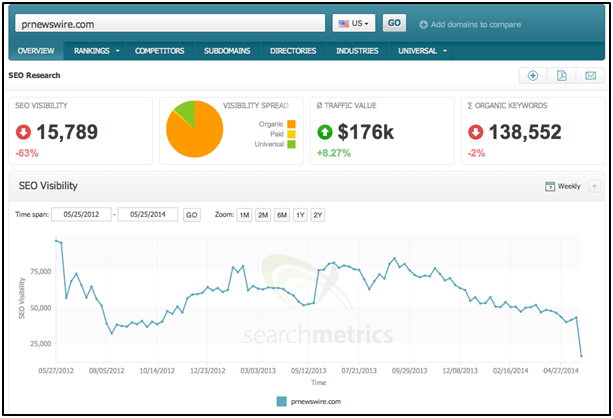
    Drop in traffic for PRweb

    From the above image, we see that PRweb had a significant drop in traffic: 71%.

    The winners’ list shows that small business sites have found favor with Google after the Panda update, and many of them have seen an incredible increase in traffic to their websites. Sites that had lost their footing in rankings despite having good quality content because of the Panda 3.0 update benefitted from Panda 4.0.

    How does this affect SEO?

    Until now, we have observed evident changes like:

    • Rank difference: There would be a considerable difference in the rankings on Google.
    • Loss/gain of traffic to the site: Some of the sites lost almost 50%-75% traffic overnight while some gained substantially.

    How to overcome the Google Panda 4.0 effect

    Listed below are some solutions to counter the impact of Google Panda 4.0:

    • Have unique and fresh content on your website. Keep in mind that content needs to be generated for users and not search engines.
    • Exclude keyword hoarding. Do not target all the keywords to one page. Use a combination of long tail/conversational and generic keywords.
    • Remove duplicate content.
    • Do not use keyword stuffed title tags. Keep it natural.
    • Do not overuse keyword rich internal links and keyword rich footer links.
    • Removing doorway pages and cloaking.
    • Avoid risky affiliate marketing setups

    Please remember recovery can take awhile if you have been hit.

    Google Payday Loan Algorithm 2.0

    Along with the Panda update, Google rolled out its Payday Loan algorithm 2.0 that targets ‘very spammy queries’. This is the second version of the Payday Loan algorithm, which is used to combat specific search queries like payday loans that tend to have a high number of extremely spammy results. This algorithm is not related to the Google Panda or Penguin updates.

    Payday Loan algorithm 2.0 is a continuation of Google’s quest to clean up search queries. The algorithm was rolled out worldwide, affecting different languages to different degrees. It has affected 0.2% of English queries. An advantage is that general queries are likely to receive better search results while preventing the appearance of low quality sites.

    Recently, spam results started to reappear in payday loans’ Google SERP’s:
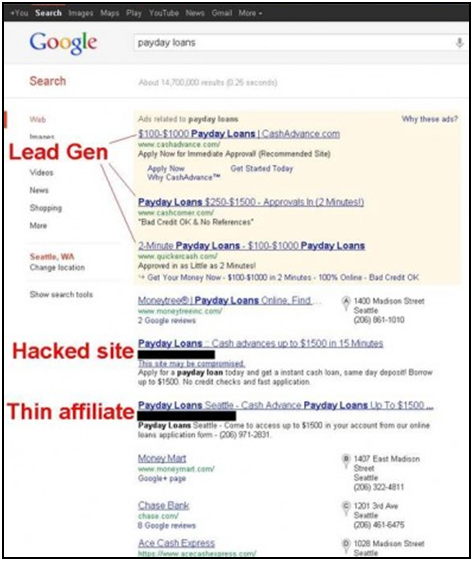
    Spam results on payday loans' Google SERP

    Google Payday Loan Algorithm 3.0

    Google Payday Loan algorithm 3.0 was released on June 12, 2014. At SMX Advanced Matt Cutts announced that this would target terms like [payday loans], [casinos] and other forms of highly spammy queries. Payday Loan algorithm 2.0, had been rolled out a week earlier targeted spammy sites.

    However, Matt did not shed much light on the difference between spammy sites and spammy queries.

    Payday Loan History

    The search engine’s original Payday Loan algorithm was first released on June 11, 2013. It impacted roughly 0.3% of US queries and around 4% of Turkish queries, where the volume of webspam is said to be higher.

    Last year, it was noticed that for the search term ‘Payday loans’, a completely different set of results were appearing on the SERPs each day. The Payday loan companies were using domains that consisted of slightly outdated specific search queries. These queries were likely to have a high number of extremely spammy results. In order to keep the best Payday loan companies on top of the SERPs, Google released the Payday Loan algorithm.

    How does this affect SEO?

    • Removal of the sites from Google SERPs that have spammy content on their site
    • Loss of rankings on Google SERPs
    • Decrease in traffic to the website

    How to overcome the Payday Loan effect

    • Avoid optimizing for any terms that would be considered ‘spammy queries’
    • Do not use spammy methods – like cloaking, hacked sites/hacked content, leveraging Google+ accounts and leveraging expired domains – to promote your website
    • Have original, quality content on the website
    • Do not stuff keywords during optimization. Target 2-3 Keywords for a page. You can use conversational or long tail keywords.
    • Keep the title and description as natural as possible.

    Have anything to add to this? Post your comments below.

    Contributed by Susanna Varghese, Junior SEO Analyst

  • How to Improve Organic CTR – does your SEO take care of this?

    What is the best ROI that you can get through SEO campaigns? How do you know the end results that can be derived from SEO?

    Is it engagement, traffic, brand building and reputation management? Or is it simply lead generation?

    How do you know the end results that can be derived from SEO?                                                                                                                                                                                                 

    You need to keep some best practices in mind while generating higher ROI vs. KPIs with SEO.

    Search engines are vital in fulfilling the ‘intent’ of finding information. SEO efforts cannot be directly tied to the final purchase of products and services like paid media/advertising. Constant and dynamic updates are made every day by search engines, making it more difficult for marketers to understand it.

    The basic rules are simple and straight: stick to the ‘intent of doing good for users’.

    Users come first and then the search engines. In fact, the very foundation of success of search engines is users. Search engines want to serve the best information to their audience. The concept of optimizing content for a visitor plays a very vital role for the marketers.

    Boost Organic CTR

    Here are few tips on how you can boost organic CTR for your website and also within the internal web pages:

    1. Focus on people and consider the latest technology as support

    People are our ultimate target audience. Users/searchers use technology to attain their goals.

    Online marketers should not forget that technology is user-driven. Focus on people and consider the latest technology as support

    Tips:

    • We need to think and adapt to what the users want and need and not the search engines.
    • Get to know your audience – conduct offline and online market research. Their feedback will be useful for your success.
    • Develop strategies around human beings (target audience) and deploy them to balance both target audience and search engines.                                 Image source

    2. Keyword Research and Mapping

    Let’s start with the basics. It is important that we have all the right keywords mapped to the right content.

    Keyword research and mapping                                                                                                                                                                                     Image source

    In other words, keywords should develop out of content and not otherwise. Combine long tail keywords and conversational keywords for balanced conversions. This increases conversions on the website with better targeted content.

    Tips:

    • With the keyword level data vanishing from Google Analytics (‘not provided’), you need to benchmark page level metrics such as KPIs for your success (page level: traffic, engagement, bounce rate, new visits, etc.).
    • With unique keywords mapped to each page, track performance of the page level traffic to mark success.
    • Have a content strategy around conversational keyword targeting (with natural language understanding) that includes blogs, forums, etc.

    3. Search Engine Results Page (SERP) Ranking

    Your SERP Ranking is an indicator of a certain level of success of your SEO efforts. But it is not the complete picture. Your SERP ranking is an indicator of a certain level of success of your SEO efforts

    We need to remember that organic rankings on Page 1 are just indicators of doing the right optimization. You need an SEO strategy that is defined better to consider these as success parameters.

    However, when your audience is finding information on search engines, it is important that you hit the sweet spot on the first page of Google. In short, ranking between 1st and 10th on Google Page 1 does matter. However, rankings above the fold (the part of the screen visible without scroll; usually rankings 1-4) have more visibility; have higher CTR and direct more traffic to the website.

    In other words, higher the rankings on search engines, higher the probability of directing relevant traffic to the website and hence conversions.  Image source

    Tips:

    • Make sure your basic SEO and technical parameters are in place.
    • Move inch by inch. Have a detailed plan to test out your SEO strategies, both short and long-term. Create content accordingly.
    • Remember to create content for your target audience and not search engines. Analyze your audience’s wants and needs.

    4. Title Tag

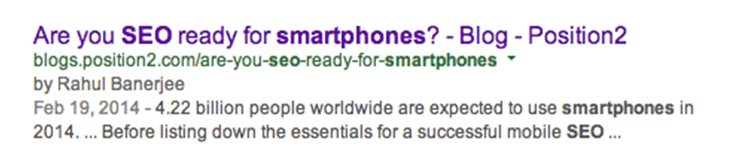
    The title tag describes the theme page in short and appears as a blue link on SERPs. These appear when a searcher types in a query to find information on search engines.

    A page title catches attention and influences the searchers to click on the link to your page. A well-defined page title has higher CTR on SERPs.

    Are you SEO ready for smartphonesTips:

    • Make your page title as natural, relevant and attractive as possible so that the target audience is compelled to click.
    • Include your target keywords to impact organic rankings.
    • Keep the title within 65 characters.

    Make it simple, short, interesting and natural to increase search inquest.

    5. Meta Description

    While the meta title gives an idea about the page users see on SERPs, meta descriptions help the audience understand what the web page content is about before they actually reach it. While search engines consider meta descriptions as ranking factors, when constructed well, they also influence searchers to click. You need to briefly describe what the page is offering.

    Tips:

    • Use it tactically. Have an objective for defining your webpage.
    • Keep it natural and understandable for your target audience. Include keywords that snag users’ attention and lead to chances of higher CTR.
    • Maintain the optimal character limits for the descriptions. It should be around 150-160 characters with spaces. Write what markets the unique content of the page. Include USPs, value adds, discounts and offers.
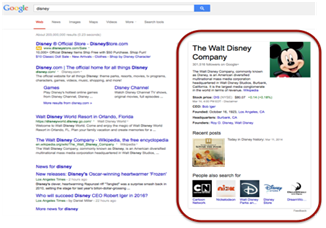
    • Meta descriptions are indicative of the page theme and may not show in the SERPs. Google also uses other publicly available sources of authority like Wikipedia to show relevant results. So, have a content marketing plan along with website optimization.

    6. URL Optimization

    The best approach is to frame URLs for people that are crisp, easy to read and remember.

    Clear and concise URLs on SERPs reassure readers that a page will deliver on their search and enable better CTRs.

    URL optimization

    7. Rich Snippets (Structured Data Markup)

    a) On-page markup using Schema

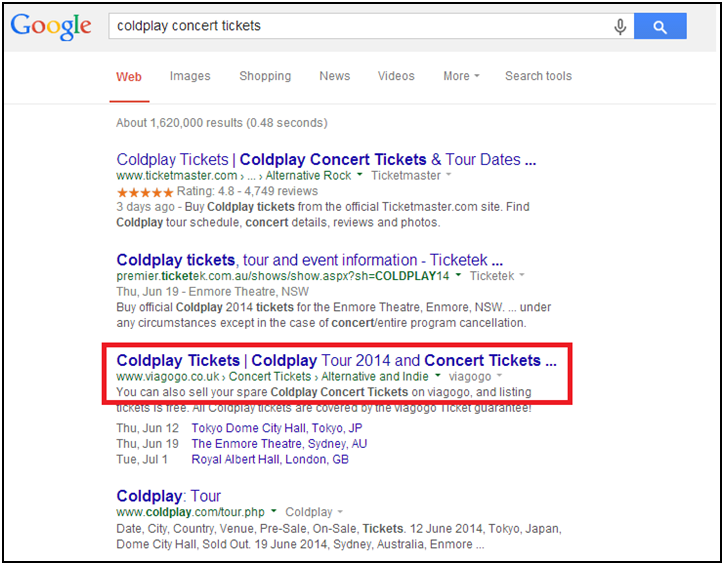
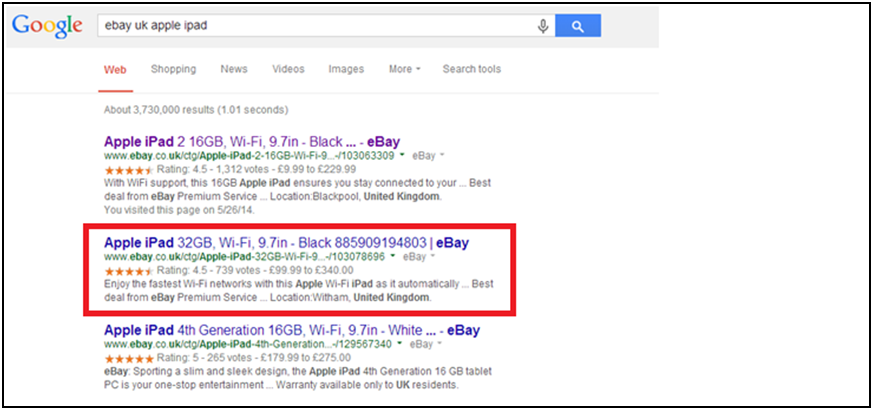
    Inclusion of Schema markup enables search engines to understand and categorize unstructured data on web pages. This helps provide richer search results and makes it easier for users to find relevant information on the SERPs thereby driving better CTRs.

    On-page markup using schema

    Customer rating markup on a product page: Improves credibility of the product leading to better CTRs.

    b) Google Authorship markup

    Linking the content of the author with his/her Google+ profile enables a headshot of the author to appear next to the search listing. This leads to better CTRs for blog posts and articles from SERPs.

    Google authorship markup

    8. Call-to-Action (CTA) – Visibility

    Apart from techniques to increase CTR through search, the final touch should be well-judged placements of CTAs on the website. This would increase the probability of CTRs and hence, conversions on the website. Call to action

    As mentioned earlier, it is necessary to rank above to fold in search engines and have CTAs (buttons, forms, etc.) above the fold.

    Call to action

    Call to action     Tips:

    • Test the important pages of the website, the home page, products and solutions pages with Heat Map. Monitor your audience’s movements on your website pages. Then place the CTAs accordingly.
    • Competitive analysis tells you how your competition is doing. Draw inputs through the comparison.
    • Work on your website design based on your budget and look to improve user experience.

    Contributed by Rahul Banerjee – Head SEO, Position2

  • Google Panda 4.0 and Payday Loan Algorithm 2.0 Launched

    Google has released its latest version of the Panda update and the second payday loan algorithm update. The announcement of the Panda 4.0 update was made by Google’s Webspam team head, Matt Cutts. The rollout has begun May 20.

    Google said at the SMX Advanced conference sometime back that Panda updates are rolled out monthly over a 10-day period. So these updates were known to be implemented regularly. The highlighting of this Panda 4.0 update signals that this is a considerably major change.

    As we know, the Panda update affects websites with low quality content, while boosting sites with top quality content. The payday loan algorithm is targeted at highly spammy queries.

    Search results are now being affected by Panda 4.0 and the payday loan algorithm 2.0 update. Though the payday algorithm update is not related to the Panda or Penguin updates, it is a little tough for SEOs to pinpoint the impact of these updates now. Websites may get affected by both the updates or by one of them.

    Google has now changed the way Panda identifies websites and is laying the foundation for future updates. The Panda 4.0 update impacts every language differently. Google has said that 7.5% of English language queries will be affected to an extent users will notice.

    Coming days will give us a better idea of the impact of Panda 4.0 and the payday loan algorithm 2.0 updates. Keep an eye on this space for more insights…

    Meanwhile, let us know what you think about these two updates.

  • Position² @ SMX West, San Jose, March 2014

    Position2 was at the SMX West event in San Jose last month represented by our Head of SEO, Rahul Banerjee.

    We think SMX West lived up to its expectations this year, especially from a SEO point of view. A look into the future of SEO was most intriguing. SMX shed light on a few key future trends to watch for:

    If you need additional information, feel free to reach out to us.

    • Conversational Search: Advancement is seen both in complexity and nature because of changing user behavior. Now, there is increased emphasis on conversational and voice search. An example of this is the Hummingbird update which emphasizes semantic search methodology (for example, Google Auto Complete option) and Natural Language Understanding (NLU) by looking at the relevance and meaning behind the query.

    Position2 shares an example of conversational search.

    Our content strategies are aligned with user experience and the optimization of search engines also powers better search results. For example, the use of blogs, forums, the Google authorship program, social media optimization etc. helps reach out to the target more with the natural language parameter of users.

    • Knowledge Graph: It is a system that understands facts about people, places and objects and the interconnectivity between them.With the implementation of the Knowledge Graph, companies will now need to make more efforts to build their brand online. Google will include results about reputed brands of authority who are trusted. Online brand building efforts need to be an ongoing activity.

    Position2 shares an example of knowledge graph.

    However, Google is also testing ads on the Knowledge Graph and carousel.

    Position2 shares an example of knowledge graph ads.

    • Structure Data Markup: It helps Google understand the content architecture of a website better and facilitates faster and more relevant results.We recommend our clients implement structure data markup (eg. Schema.org) on their websites.

    Position2 shares an example of schema markup.

    Here are some more key relevant points for organic SEO:

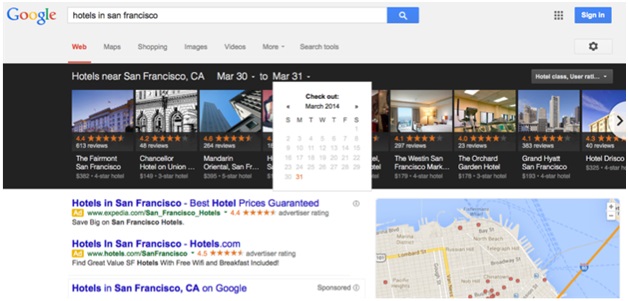
    • High competition: With Google testing out paid ads on search results, organic search results have less shelf space and are needed to compete more to be visible. For example, if you type “Hotels in San Francisco” in Google, the top scroll of the Google SERP includes only paid ads pushing the organic results lower.
    • Mobile will soon dominate: Google mobile queries are set to surpass PC search this year.


    Image Source: Google

    Mobile is another factor that is altering the nature of search. Mobile capabilities differ from device to device, which in turn impacts the content development, communication, engagement and measurement.

    Implementing and embracing personalization will make for better search experience.

    • Apps: There is a global opportunity to develop and market through apps. However, app stores must also be localized.
    • Social presence: Google may not able to read social signals completely from other channels like Facebook and Twitter yet. But, this is going to change soon, which is why we maintain a social presence for our clients and help them build the right influencer network. Google has already said that users who use their Google logins will experience better search results. Google will roll out a full fledged algorithm soon.
    • Natural link building: ‘The best links are not asked for’. Work on natural link building. Do not use shortcuts or indulge in explicit link sales. Let the target audience refer, like, comment and build links for you.

    If you have original content that is useful for people, you can ask for recommendations/references. But your intentions will matter. Google is constantly penalizing websites with vested interest towards link building as an activity.

    • Devalued content: Press releases, articles and guest blogging are now devalued content due to over optimization techniques used by most of the SEO experts. Content that offers value should be created for the target audience and not for search engines.
    • Build recognition, reputation and trust through well-devised content marketing plans. Authority plays a vital role for Google to rank a website. Consumers also look for brand reputation and trust levels before making online purchase decisions.
    • Google Panda updates: It is likely that Panda will be updated more frequently. Expect one soon. Google is constantly testing out search parameters to provide the best results to users.
    • World does not stop at ‘Not Provided’: Post the ‘Not Provided’ update, Google changed the way it harvests data from search to protect users’ privacy. First, all logged-in users were switched to “https” from “http”, where the referral data relating to that search is hidden. But, as already indicated, that refers now to the whole universe.

    Position2 recommends analyzing success with page-level metrics like page-level traffic, bounce rate, percentage of new visitors etc. to have an edge and understand user engagement metrics.

    • Generic Top Level Domains (gTLDs): These do not impact rankings. For example, a domain like www.buymycar.com need not be ranked for car related keywords if it does not have content related to buying cars.

    Share your thoughts on the event insights with us in the comments below.

    More to follow from Position2

    … keep in touch!

  • Improve SEO Effectiveness with Google Trends

    Good SEO needs more than an understanding of the technical aspects of search and client’s requirements. It also needs a thorough knowledge of search trends relevant to your line of business.

    Google Trends is a great tool to stay updated on these trends. Yes, it will also give you information on keywords that are not specific to your brand, but that’s how people search. It’s not enough to just optimize your website for brand search terms. You also need to include relevant non-brand related keywords.

    Just think about it. Your target audience may not necessarily be looking for information using your brand name. They may be using search terms related to your industry. Having a wide spread of relevant keywords, though more expensive, can give you a competitive edge.

    Using data from Google Trends will help beef up your SEO efforts as it will help you understand consumer behavior better.

    Google has been emphasizing the fact that, in the future, SEO will be driven to cater to consumer needs. Google is now evolving from being a search engine to an interface which helps users get what they exactly want.

    The settings in Google Trends offer different categories of data:

    • Web, Image, News, Product and YouTube search
    • Worldwide or region-wise search
    • Time ranges (extremely important to know how a keyword evolved)
    • Data is further available by interest categories such as, Arts and Entertainment, Autos and Vehicles etc.

    You can compare up to five terms or even groups of terms at one time with up to 25 terms in each grouping, such as:

    • Social + Icons + networking
    • Analysis + web + tools + spend
    • ROI + campaign

    As with regular search, the + sign here tells Google that you want to cover searches that include ROI and campaign both. Using ‘Hot Searches’ and ‘Top Charts’, you can also find out about the top searches for the day and by popular categories. It is small things like this that can give you a vital edge or insight that makes a huge difference in the effectiveness of your campaign.

    Avenues to Use Google Trends

    Assistance in keyword research

    Google Trends shows popularity of search terms over a period of time with a graph that indicates interest ‘levels’. While it gives you an idea of the trend for those words, it does not provide exact numbers that search marketers can use. However by using Google Trends with the AdWords Keyword Planner, you can check the interest levels for the keywords for a particular campaign. This helps weed out relevant but unpopular keywords you may have picked.

    Worldwide Keyword Popularity

    The above screenshot shows the interest levels for terms ‘social media’ and ‘social networking’. The graphical representation clearly indicates that people have searched using ‘social media’ more than ‘social networking’. For example, if you are promoting a webinar related to social media skills through Google AdWords, you would do better using the phrase ‘social media’ in the title rather than ‘social networking’.

    In geo-targeting for campaigns

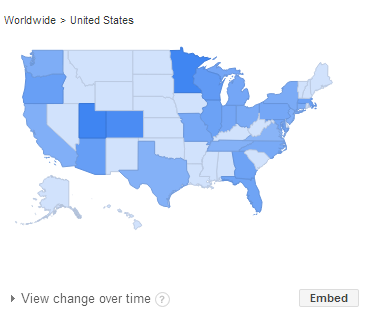
    You can access region-wise data on Google Trends and learn about the regions that exhibit the most interest in your keywords.

    Regional Keyword Popularity

    This depiction shows the maximum traction to be coming from Utah and Minnesota. You can even get data on the cities that top in these searches.

    Support in content marketing

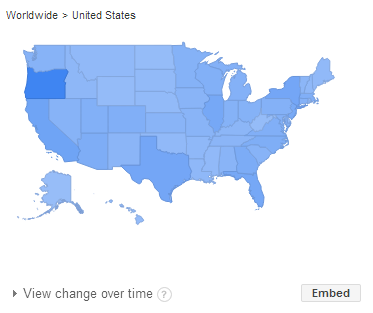
    You can use ‘Hot Searches’ and ‘Top Charts’ to learn about trending topics in your industry. Do a quick survey among your clients and find out their real-time problems. Post blogs that answer those problems and build your reputation as an industry thought leader. Let’s pick Google among the social platforms and see the region where the interest has spiked.

    Region wise Brand Popularity

    So, if you are planning on promoting an eBook on best practices for Google search optimization, Oregon should be a top contender in your list.

    Video content generation

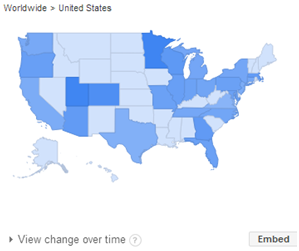
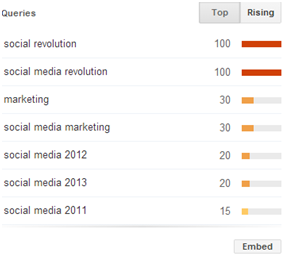
    A YouTube search for ‘social media’ and ‘social networking’ reveals that again Minnesota ranks highest again with ‘social revolution’ being the topmost key phrase.

    Maybe, you can convert your webinar on social media into a video or a series on how a brand can kick start a social revolution for itself by making the right moves. You can ensure your video features in YouTube search using these terms in your video title and description.

    Region wise Keyword Popularity on YoutubeTop Ranking Keywords on Youtube

    Another advantage of using Google Trends lies in estimating budgets to be allocated for paid campaigns. Data from Google Trends can be used to bid smartly on key search terms which users are actually using. This would help reach out to a larger section of the audience.

    Can you think of any other ways in which Google Trends can be used to boost SEO efforts? Tell us!

    Images Source: Google Trends

  • Online display vs. TV advertising, Social media impact on B2B buying process and much more…| Best of the Week

    This week’s hot news, events and videos from the online marketing and social media world.
    Despite Strong Growth, Share of Online Display Advertising Spend Well Behind TV
    From the Position² Blog This Week:
    Despite Strong Growth, Share of Online Display Advertising Spend Well Behind TV
    Online display advertising is a highly sought after form of online advertising and its growing at a strong rate. However, it is still not much compared to the growth of TV, a traditional media form. Read this article to know more.
    Top Stories this Week: Social Media
    Top Stories this Week: SEO, PPC and Digital Media
    Best of the Week Video Best of the Week Video
    Do you make your content simple or scientific?
    Google’s Matt Cutts answers a question on whether keeping your content simpler or including more scientific jargon in it makes a difference to your ranking. Check out this video to know Matt’s take on this.
    White Paper: Increase Visibility for Your Content by 4x
    Today’s traditional SEO is inadequate: Ignite your search results by accelerating visibility in more places than ever before.Download this White Paper and learn:

    • SEO, why the way we know it is not enough
    • Introducing and implementing Enterprise Visibility Accelerator (EVA)
    • Using multi-channel tracking tools for effective monitoring
    • How EVA benefits businesses.

    Download the complimentary EVA White Paper now

    Know more about Enterprise Visibilty Accelerator(EVA)
    If you are reading this blog post via a RSS reader, please click here to subscribe.
  • Google Buys SlickLogin, LinkedIn Opens up Publishing and Yahoo! Gets Started on ‘Contextual Search’

    Google

    Google Acquires SlickLogin

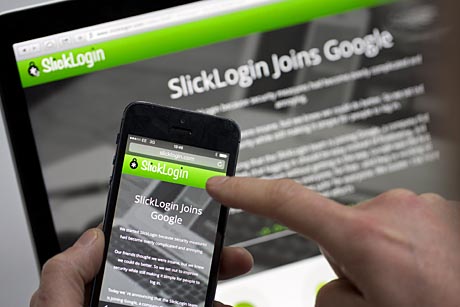
    Five month old start-up SlickLogin has been acquired by Google for their work on sound-based verification capabilities. Post its debut at TechCrunch Disrupt, September 2013, Israel-based SlickLogin released its product in closed Beta.

    How it works

    Users need to have the SlickLogin app installed on their smart phone. Adding five lines of code to an existing app will enable the app. When users want to login to a website enabled by SlickLogin, they need to click the login button and hold their phone in front of the computer.

    SlickLogin will then verify the phone’s position using technology such as, Wi-Fi, Bluetooth, Near Field Communication (NFC) or Global Positioning System (GPS). The website would then play a unique sound generated, through the computer’s speakers, which is picked up and analyzed by the phone’s app. A signal is then sent to the site’s server confirming the user’s identity.

    User Security Concerns

    SlickLogin seems to have its finger on the pulse. Each uniquely generated sound is tied to that moment. No one can record a signal and play it later to hack into an account. The phone would not have the required login credentials and these details are not embedded into the sound also. If anyone tries any of this, they may only be logging that user into their own account!

    This acquisition will help Google strengthen its login security beyond the current two-step process.

    LinkedIn

    LinkedIn Influencers

    The social network has opened its publishing platform, LinkedIn Influencer to more members.

    Now, the posts published by LinkedIn users will be made a part of their professional profile, shared with their professional network and can spread out to a large group of professionals. Users can now not only follow other members who are not in their network, but can also build their own follower group.

    The opening up of LinkedIn Influencer gives professionals a great chance to:

    • Share their experiences with others (whether they are experienced or new)
    • Expand their brand influence
    • Add to their reputation as thought leaders in their respective industries

    LinkedIn has added more influencers to the existing list and will also be monitoring them to maintain high quality levels and engagement. The capability has been extended to 25,000 LinkedIn members currently and will be expanded to include all members in multiple languages in time.

    There will be more of user-generated content on LinkedIn henceforth, which can draw more people to consume content on the site. LinkedIn can soon be a major hub for quality content by professionals. Brands can now begin to turn to LinkedIn with more focus for their content marketing strategy due to a surge in high quality content generated. If your brand’s executive is a LinkedIn Influencer, it means better brand reputation and more exposure.

    Yahoo!

    Yahoo Contextual Search

    In case you had read about it, we recently wrote about Yahoo!’s ambitions for developing better ‘contextual search’.

    Appears to be true, seeing the $10 million given to Carnegie Mellon University.

    Yahoo! does not mention the term ‘contextual search’ explicitly. But, a read of the company statement gives a sure signal of an improved version of contextual search being built.

    Though Google is already a player in the game, the possibility and consequences of a better contextual search by Yahoo! is an interesting development for the search world.

    What is your take on these updates?

    Images Courtesy: The Sydney Morning Herald, LinkedIn, Mashable

  • Are you SEO Ready for Smartphones?

    Mobile SEO Essentials

    4.22 billion people worldwide are expected to use smartphones in 2014.

    But, most marketers still don’t understand how powerful smartphones are when it comes to influencing online product/service purchase decisions. Here are some stats that are sure to raise a few eyebrows and can compel marketers to include mobile in their planning in 2014 and beyond.

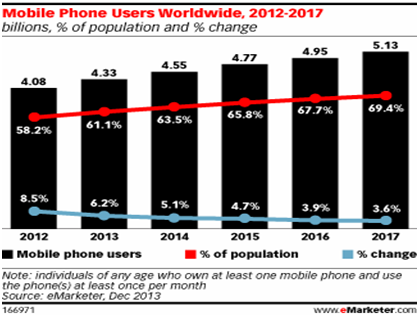
    Mobile Phone Users Worldwide (2012-2017)

    According to a report in eMarketer, mobile phone adoption worldwide, seems to be slowing down. As western nations reach a saturation point, new users from developing regions such as Asia-Pacific, Middle East and Africa will continue to drive growth. Between 2014 and 2017, mobile phone penetration will rise from 63.5% to 69.4% of the worldwide population.

    Mobile Phone Users Worldwide

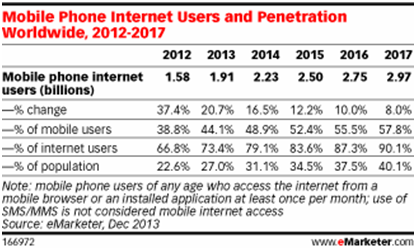
    Mobile Phone Internet Users Worldwide (2012-2017)

    It is expected that in 2014, 49% of the world’s mobile users will go online via mobile browsers or apps monthly. By 2015, it is anticipated that the global mobile phone internet audience will cross well over the 50% mark.

    Mobile Phone Internet Users and Penetration Worldwide

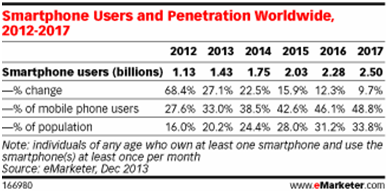
    Smartphone Users and Penetration Worldwide (2012-2017)

    Smartphone users surpassed the 1 billion mark globally in 2012 and this is projected to total 1.75 billion in 2014. A recent study by eMarketer reveals that 38.5% of mobile phone users will use a smartphone in 2014 and the usage is expected to reach one out of two mobile users by 2017. As devices become cheaper, users are quickly switching over to smartphones with 3G and 4G networks.

    Smartphone Users and Penetration Worldwide

    Mobile User Behavior

    How exactly can you leverage the information we just provided?

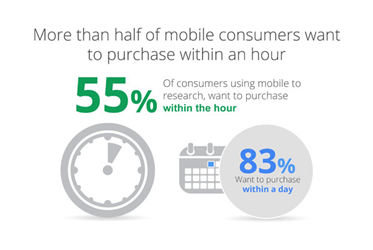
    Recently, Google certified Nielsen to conduct a study on the online purchase behavior of mobile users. The study revealed that 74% of mobile consumers use a search engine during the purchase process and 83% of mobile users intend to make a purchase within a day’s time.

    Mobile Research

    With all these indications on how mobile phone usage is going to dominate online businesses, marketers need to channelize their SEO strategy to meet these expectations.

    Before listing down the essentials for a successful mobile SEO strategy, we would like to point out that any mobile strategy that is developed should be directed to provide a better user experience and improve engagement on the website. It is important to remember the following points:

    1. Mobile Friendly Site
      With the steep rise in online mobile traffic, a mobile friendly website is imperative in 2014 for a successful mobile SEO strategy. Companies need to invest in creating either a responsive or a dedicated mobile website. Once the website is created, marketers need to form a consolidated mobile SEO strategy along with desktop SEO, which remains as important.
    2. Mobile User Experience
      User experience is the key to SEO. Over the last few years, search engines have been working to enhance user experience with mobile and provide improved results. Conversational and voice search are instances to look out for.
    3. Page Load Speed
      Although this may seem to be intuitive, it is astonishing to see a number of companies give up on page load speed for an aesthetically pleasing image or video. Page load time immensely adds to the user experience, keeps user engagement high and improves conversions for the online business.
    4. Website Design – Focus on Usability
      Usability of a website increases the probability to engage and convert users. Usability is important for mobile users as they have a small screen to view all the information. Essential elements like Call to Actions (CTAs) and relevant content should be built in for easy access to engage users and convert them on the website.
    5. Mobile User Intent
      Google’s Hummingbird algorithm update in 2013 has said it all. The SEO community is still trying to understand the effects and how to deal with the update in real time.When a user searches for something on a desktop, the intent of that user may be very different from when he looks for similar information on his mobile device. There is a sense of urgency and more likely than not, an intent to purchase.According to the Google-Nielsen study:

      • 55% of mobile users have an intention to purchase online within one hour
      • 69% expect businesses to be present within 5 miles of their location

      Hence, a smartphone user more often looks for local businesses near them and could have very high purchase intent.

    6. Conversational and Voice Search
      Improve your local SEO with specific Keywords strategy for mobile users.Marketers need to understand the mobile users’ behavior pattern. Mentions of location with the target keyword will not be of any use when mobile users opt for voice search.For example, if a mobile user performs a voice search through their smartphone for a pizza joint or restaurant, they will probably ask “nearest restaurant location” rather than typing “restaurant + location”. Hence, including conversational search as a part of the SEO strategy will help in surpassing the competition.
    7. Fully Engage with Social Media – Social Integration
      Mobile and social go hand in hand. Marketers should consider integrating both the channels – share social media buttons on mobile sites, create presence on social channels like Google+, Facebook, etc.Consumers utilize all mediums (devices) available to them to find information on products and services. A thoroughly formulated SEO strategy that will allow users to access information on product and services through all mediums will play a crucial role for success in 2014. So gear up EARLY! 2014 is set to be the year of Mobile Marketing!

    Contributed by Rahul Banerjee, Head – SEO, Position² Inc.

    Sources:

  • Matt Cutts Declares the Downfall of Guest Blogging for SEO

    Matt Cutts on Guest Blogging

    Image Courtesy: WebProNews

    Do a lot of bloggers want to write for your site? The phenomenon of guest blogging has caught web writers’ fancy and how!

    The benefits cut both ways…

    It was considered an honor to be a sought after guest blogger or a website so big that many credible guest bloggers wrote to you asking you to consider their articles.

    Guest blogging owes this popularity to bloggers and brands alike. Both were lured, in part, by the SEO benefits it offered. Some of the benefits of having a guest blogger are:

    Link building tactic

    For the guest blogger, it is a matter of pride to have posts on a reputed website. He also benefits from the back links to his blog. The website too benefits from the traffic arising via the back links of the guest author’s blog.

    Increasing engagement

    Guest bloggers offer different perspectives that may lead to their posts being liked, shared or commented on, all of which improve reader engagement and the blogger/website reputation.

    A way of content generation for websites

    Having guest bloggers write for them helped websites in reducing the pressure on their content development teams. It also gave them the chance to offer readers variety in their content by featuring different writers.

    Helps build a reputation for thought leadership

    Guest blogging aided websites and guest bloggers build their individual reputations as thought leaders in their industries.

    End of Guest Blogging for SEO

    The enormous benefits of guest blogging eventually led it to being overexploited to the point of becoming spam. Many websites and bloggers began hosting and writing guest posts to gain links without focusing on quality. So much so that, this practice led Google to make a move to end the practice of blogging for SEO.

    Matt Cutts, the head of Google’s Webspam team recently announced on his blog that guest blogging exclusively for its SEO benefits, must end. So if you were in the habit of accepting guest posts only to build links, you should stop doing that. Or, if you are a guest blogger writing for websites regardless of their credibility, you would be hurting your own reputation.

    Matt Cutts has called an immediate stop to the practice of accepting guest blogs that only serve the purpose of SEO. He gives the example of an email he received that actually hinted at offering links, which would pass PageRank! These kinds of practices would definitely not endear you to Google.

    So, unless you want to attract Google’s wrath and be penalized, stop guest blogging purely for SEO and do it for all the other benefits that it offers.

    Looking At the New Scenario

    Guest blogging for SEO is not going to work!

    So, what should guest bloggers and websites who accept guest posts do?

    Do you stop guest blogging altogether? Or, should you continue it by following certain rules?

    Of course you should continue. It is, after all, only the misuse of guest blogging that is under the scanner and not the practice itself.

    Here are some rules that you can follow when it comes to blogging for your website:

    • Look at guest bloggers as a means of generating great content variety and not from an SEO perspective.
    • Continue accepting guest blogs only if you can vouch for the reputation of the guest blogger. Be selective.
    • Sift through the blog requests for unique, good quality content.
    • Use guest blogging as a tool to bolster your content generation efforts. Don’t be so dependent on it that you rely only to fulfill content sourcing requirements.
    • If you are a guest blogger, be selective about sites you partner with. Don’t let your great content be undermined by poor quality websites.

    What are your thoughts on the current scenario in guest blogging and Google’s stand?

  • Search is Changing – Real-time Updates in SERPs

    SERPsThe world around us is moving at a swift pace today, so much so that often information absorption has to be literally (read, virtually) instantaneous. Web platforms have made it so easy to share information that people use these channels to announce important events and updates rather than wait for the slow dissemination of information by traditional media.

    Speed of Information Diffusion

    According to the now obsolete Hypodermic Needle Model theory, traditional media has an “immediate” effect on the masses. The theory stated that people were passive receivers of information and that they were immediately influenced by it.

    This theory was developed in the days when only traditional media existed and its meaning of the word ‘immediate’ is vastly different from today’s adrenaline driven, turbo charged world of social media and online communities.

    Immediate today means ‘immediate’!

    Earlier, it took at least a few hours for news to be updated through traditional media (as it does sometimes even today). But today, by that time, crucial updates would have already broken out on forums and social channels.

    In today’s highly interconnected world, it’s very important today to know about key events as soon as possible. This necessity invariably prompts people to look towards information sources that are more real-time oriented.

    For instance, the ongoing crisis in Syria captured headlines world over, especially on the web. People took to online communities and social sites like Twitter and Instagram to protest and express their anguish. A brand crisis like defective brakes in a new car model too can prompt widespread searches. Tyson’s chicken scare recently triggered a few frantic searches.

    Real-time Updates in Search Engines

    Search EnginesSearch engines are mostly regarded as a treasure trove of data by netizens. Innumerable people gravitate towards search engines when they are looking to learn about the latest events. However, a developing trend is where web users are turning to online forums and social sites like Twitter, Pinterest, Instagram and the like for real-time updates.

    Let’s do a quick inspection of the most popular multi-lingual search engines and understand their current position in terms of availability of real-time updates:

    Google

    Arguably the most popular search engine, Google has not missed this trick. They have been covering Twitter and FriendFeed updates to which they added Google+ updates also recently.

    Bing

    Microsoft’s search engine is also up-to-date offering Twitter and Facebook updates on its SERPs.

    Yahoo!

    They entered the game a little late after both Google and Bing but Yahoo! also started offering real time information on the search categories available at search.yahoo.com.

    There are also unmistakable signs of search engines opening up to search result components of different natures when compared to results that appeared on SERPs traditionally. For example, Google has begun integrating Google+ updates and it recently allowed more in-depth articles in its search results. According to Google, many users’ requests for information were for broader topics, to cater to which, the search giant incorporated more detailed posts in SERPs.

    YouTube videos have also been included in search results from a long time.

    Effect on Businesses

    All of this asks the question, ‘Can brands take advantage of people’s interest in real-time information?’ One way of doing this is in the manner mentioned above; of quickly reaching out to consumers at a time of a product crisis.

    Another way to positively leverage this opportunity is by aligning promotions with significant events. Tweeting congratulations to Golden Globe winners as the awards are announced or building a quick info newsbyte around significant events will help the brand get featured in the search results.

    How else can brands leverage people’s search for real-time information? Tell us!

    Image Sources: Bizness Quest, Real Traffic Productions