Category: Paid Search

  • The Importance of Persona-based Lead Scoring

    Importance of Persona-based lead scoring

    According to Aberdeen research, companies that get lead scoring right have a 192% higher average lead qualification rate than those that do not.

    A lot is being said and done about lead scoring. Every week, we receive an alert on a white paper (sometimes well researched, sometimes not) that is solely based on the concept of lead scoring.

    But another concept is picking up steam now and that is, persona-based lead scoring. Check out this excerpt from our white paper on persona-based lead scoring, that will be released soon:

    “Marketing has always been an extension of the dialogue between buyers and sellers. Enter the information age. The marketer faces challenges of identifying preferences, content and geo market-centric personalization, which would complete this dialogue. Implementing a persona-based lead scoring system will help you classify leads based on their behavior and demographic details.

    Based on their buying influences, different prospects have different approaches. Here is an example: prospect A visits your website’s home page, but prospect B goes to your product page directly and fills a form. Prospect B has displayed more interest by checking out your product. With persona-based lead scoring, depending on the persona prospect B belongs to, you score prospect B higher.”

    Persona-based lead scoring is especially important because it will help in personalizing your lead scoring system thereby helping in better lead targeting, nurturing and conversions.

    Interested in knowing more?

    We will be releasing our white paper on the ‘Importance of Persona-based Lead Scoring’ soon. Watch this space for more!

    Image source: mintigo

  • Google Panda 4.0 and Payday Loan Algorithm 2.0 Launched

    Google has released its latest version of the Panda update and the second payday loan algorithm update. The announcement of the Panda 4.0 update was made by Google’s Webspam team head, Matt Cutts. The rollout has begun May 20.

    Google said at the SMX Advanced conference sometime back that Panda updates are rolled out monthly over a 10-day period. So these updates were known to be implemented regularly. The highlighting of this Panda 4.0 update signals that this is a considerably major change.

    As we know, the Panda update affects websites with low quality content, while boosting sites with top quality content. The payday loan algorithm is targeted at highly spammy queries.

    Search results are now being affected by Panda 4.0 and the payday loan algorithm 2.0 update. Though the payday algorithm update is not related to the Panda or Penguin updates, it is a little tough for SEOs to pinpoint the impact of these updates now. Websites may get affected by both the updates or by one of them.

    Google has now changed the way Panda identifies websites and is laying the foundation for future updates. The Panda 4.0 update impacts every language differently. Google has said that 7.5% of English language queries will be affected to an extent users will notice.

    Coming days will give us a better idea of the impact of Panda 4.0 and the payday loan algorithm 2.0 updates. Keep an eye on this space for more insights…

    Meanwhile, let us know what you think about these two updates.

  • How do B2B Companies Survive in Tough Times?

    “The survival of the fittest.”

    Well, that’s something B2B companies need to know a thing or two about. In their world too, only those who adapt best to changing environments survive.

    B2B companies need to batten down the hatches to weather stormy market conditions, but there will be always be marketing expenses they cannot cut down on.

    So, how do they make necessary expenses and still stay afloat?

    Here are some tactics B2B companies can use to handle difficult business environments:

    • Acclimatize to the new scenario
      A bad environment isn’t going to go away overnight. So, it’s important to move quickly without panic. Quickly assess the situation and revise your sales and revenue targets accordingly, so that you know how much you can afford to spend and what the required ROI is.
    • Prioritize budget allocation
      After you adjust your business plan to current market conditions, reallocate your overall budget based on the results. Focus on the most important short term goals for now. However, some businesses stick to long term goals even during bad conditions so that they are ready when the market turns around.
    • Revisit all your offerings
      B2B companies are in a tight spot with their product portfolio during hard times. Maintaining the entire product range may be expensive, but one needs to balance that with a realistic call of what the profitability is and who is buying them.B2B companies often have long standing relationships with their customers and pulling back a product during lean times can hurt their customers’ interests and consequently the relationship. It’s a tough call, but depending on the situation may be necessary.
    • Organic social media marketing
      Tough times often requires tightening of company budgets. You will have less spending money than usual, which makes it important to spend it judiciously. Focus your money on campaigns that are imperative and drive daily posts through organic efforts.In difficult market conditions, concentrate on retaining existing customers through relationship marketing. Engage your fan base with new economical offers that will persuade them in sustained investment in your brand.Acquiring new B2B customers may be a process with a long gestation period. You may not have the resources to focus on this. Depending on the prospects’ stage in the acquisition lifecycle, companies may choose to pursue them or divert their resources to get the most from existing customers.
    • Continue email marketing efforts
      It would stand you in good stead to continue your email marketing campaigns by focusing on nurturing your current database. You will not only save money otherwise spent on buying lists, you can also build on relations with current prospects and customers. Promote your social media offers through your email campaigns too.
    • Participate in industry events
      We’re not talking sponsorship or paid advertising in any form.Send company representatives with strong networking skills to industry events. Participation in industry events achieves a three-pronged purpose: knowledge gain, strengthening customer relationships and interaction with new prospects. All it takes are a few passes to enter as participants and you can let your team do the rest of the work at the event.
    • Increase focus on risk management
      When the foreseeable future is bleak, companies will be more interested in understanding how your product/service will help combat the risks of the current market trend. There’s an opportunity for your company if you can effectively tweak your brand communication to emphasize on risk management and deliver the same through products. When a prospect/customer reads your content, they should feel that your company can help them tide over this crisis.
    • Understand the impact on brand value and position
      Making changes to your business plan and goals might have an impact on your brand’s value and position in your industry. Keep this possibility in mind while preparing for an impending industry crisis and also during the situation. Don’t make drastic changes that take a wide detour from your brand’s vision and mission. For example:

      • Cutting costs by a large margin might diminish the perception of product quality. Offering too many discounts can undermine your brand’s value.
      • Changing your tone of voice in brand communication too much can pose a threat to your connection with customers.

    The way you keep your value, customer value and revenue prospects in focus during times of crisis is what will define your brand.

    Can you think of any other way B2B companies can keep themselves above the line of risk in troubled times?

    Image source: Brand stories

  • The Effect of Facebook’s App Links

    The social networking site wants to standardize the way traffic is routed between mobile apps with the introduction of App Links.

    Twitter has already invested in mobile deep app linking.

    Facebook’s App Links will result in standard cross-platform linking between apps and contribute significantly to Facebook’s advertising revenue.

    So, how does App Links work?

    App Links helps app developers understand how they can send users who are clicking on a link within an app to the app that corresponds to the link. Facebook has launched Software Development Kits (SDKs) for the use of developers on all major platforms.

    For example, you click on a link to a Flickr photo album on an email in the Mailbox app. The Mailbox app will check if the Flickr website header has App Links tags showing deep links for the Flickr iOS, Android or Windows phone apps.

    Mailbox then sends the user to the deep links found in the App Links header tags on Flickr’s website for your device. If you have installed the Flickr app, Mailbox will send you to the correct deep link and if you haven’t installed the app, you will be directed to the Flickr website.

    Advantages of App Links Adoption for Facebook and Marketers

    The adoption of App Links will provide Facebook with data from App Links tags and the Facebook App Links Hosting API in its App Links API. Armed with this data, Facebook can understand how web links map to deep links in iOS, Android and Windows apps.

    It will offer marketers the ability to create one campaign that can run across different channels: desktop web, mobile websites and mobile apps. If the App Links adoption takes root, Facebook can do this by leveraging its App Links Index.

    You will then be able to add a web link and an image into the Facebook Ad Editor for a re-engagement campaign. You only need to add App Links tags to your website for users to be directed to your website after clicking your ad. If a user clicks on your ad from the Facebook mobile app, Facebook can check its App Links Index for App Links tags on the destination and direct the user to the app page.

    With this new introduction, Facebook can start persuading its desktop marketers to launch re-engagement campaigns on mobile with no account changes. Facebook can also convert all ad campaigns to web and desktop cross platform campaigns like Google’s Enhanced Campaigns in 2013.

    The App Links adoption will also spur Facebook’s recently launched in-app mobile ad network, Audience Network. When your app publishes an ad, Facebook can read the App Link tags of the destination URL or look at its App Links Index, to know what deep link needs to be launched if the user has installed the associated app.

    Roadblocks to App Links Adoption

    • Both the referrer and the destination apps must support the App Links standard if the user is to be sent to the destination app.
    • Facebook will have to garner support from developers and major players like Google and Yahoo to support App Links so that when links are clicked in Gmail, Yahoo Mail or any popular app, the App Links standard is leveraged.
    • App Links helps with app to app linking. It does not support web to app linking.

    Are you open to adopting App Links? Do you think it will help marketers and increase Facebook’s overall ad profits?

    Image Source: altasproject

  • Google Brings “Magazine-style” Text Ads to Display Ad Units

    Google has launched “magazine-style” text ads that brings standard text ads to websites that would normally run only display ads. These ads will consist of text only, but will adhere to a design aesthetic, suitable to display.

    Google will not add any images to these ads but will only take the text and re-format it into a larger ad unit. Look at the image below for an instance.

    The new ad type will appear when a text ad outbids a display ad. Google launches magazine style ads

    Impact on marketers and publishers

    Running these ads helps marketers align their advertising strategy with Google’s recommendations better by allowing them to run both text and display ads that increases their revenue potential.

    For example, if you wanted to run a text ad on a top website that runs only display ads, this is your opportunity. If you felt that visuals would distract the viewer from your ad’s main message, this new format can come to your rescue. It presents only text on ads, but in a more aesthetically appealing look.

    What do you think about this new ad format by Google?

  • Measuring cross channel ROI, strategic conversion optimization for B2B websites and much more…| Best of the Week

    This week’s hot news, events and videos from the online marketing and social media world.
    Measuring ROI in Cross-Channel Marketing
    From the Position² Blog This Week:
    Measuring ROI in Cross-Channel Marketing
    Active consumers on different channels have necessitated running cross channel marketing campaigns. Read this blog to know how you can measure these campaigns and allocate your budget to the best performing channels.
    Top Stories this Week: Social Media
    Top Stories this Week: SEO, PPC and Digital Media
    Best of the Week Video Best of the Week Video
    Use ‘Content Grouping’ feature in Google Analytics to group pages and content into a logical structure that mirrors how you think about your website.
    White Paper: Increase Visibility for Your Content by 4x
    Today’s traditional SEO is inadequate: Ignite your search results by accelerating visibility in more places than ever before.Download this White Paper and learn:

    • SEO, why the way we know it is not enough
    • Introducing and implementing Enterprise Visibility Accelerator (EVA)
    • Using multi-channel tracking tools for effective monitoring
    • How EVA benefits businesses.

    Download the complimentary EVA White Paper now

    Know more about Enterprise Visibilty Accelerator(EVA)
    If you are reading this blog post via a RSS reader, please click here to subscribe.
  • New Google PLA Format Based on Reviews and Ratings

    Google testing new PLA formatGoogle is testing a new form of its Product Listing Ad (PLA).

    In this new format, a search for “best anti-virus software solution” will display software products in the order of a numerical ranking system that seems to be taking both, quality and quantity into consideration for each item’s ratings.

    For example, even if Norton* has higher number of reviews, it will come second to McAfee* due to a difference in their star rating where McAfee’s star rating is higher. As a marketer, you need to focus on both, number of reviews and star ratings to take advantage of the new PLA.

    If there are two result items with the same star rating, then their number of reviews will determine their ranking. The item with more reviews will be ranked higher.

    Continue watching this space. We will keep you updated on any further developments.

    *These examples have been used only for demonstration purposes. Position² has no stake and hence does not promote any of the companies, whatsoever.

  • Twitter Launches Multi Language Targeting and Facebook Unveils Audience Insights

    Twitter

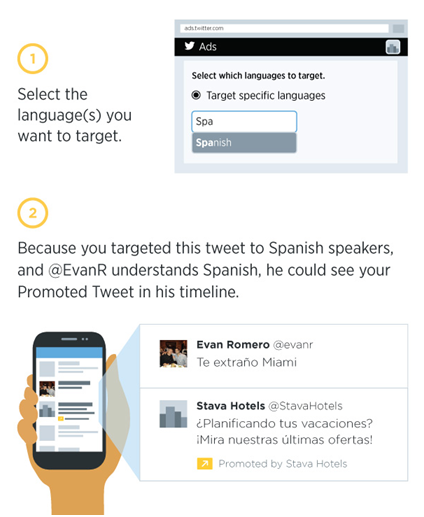
    Marketers can now target users with their preferred language through Promoted Tweets and Promoted Accounts. Users will now be seeing more relevant ads in their language.

    Multi language targeting covers 20 languages and will be rolled out globally and through Twitter’s Ads API.

    You can also use this targeting feature along with other targeting options based on interest, keyword, gender, geo and tailored audience segments. Multi language targeting helps target users from countries where people speak different languages and also in targeting a global audience with language-specific messaging.

    Twitter studies a user’s selected language in their profile settings and also the languages used on the user’s account to determine a user’s language.

    For example, if you want to target French speakers in the US, you can use geo-targeting, travel-category interest targeting and French language targeting to connect with your audience more effectively.

    Even if your audience is very comfortable with English, if their native tongue is another language, they will warm up towards their native tongue more. Using this feature will help you gain entry into a customer’s psyche with more ease. It will also be beneficial in penetrating markets where English is spoken very less or not at all.

    Facebook

    Marketers are being loaded with more customer data through Facebook newest feature, the Audience Insights tool. Using this tool, you can garner information on:

    • Demographics: user age, gender, lifestyle, job role, relationship status, education and household size
    • Location and language: the geographical location of users and the language/s they speak
    • Usage: the frequency of your target audience logins into Facebook and the device used to login
    • Purchase activity: past purchase behavior (what category do they shop most in?) and methods (in-store or online shopping)

    You can access the above information for 3 different groups of people:

    • People on Facebook (the general Facebook audience)
    • People connected to your Page or event
    • People in Custom Audiences you have already created

    Audience Insights is different from Page Insights since it studies trends about potential customers across Facebook. Page Insights looks at Page interactions.

    Audience Insights displays information users have already shared on Facebook with information from third-party providers like Acxiom through Facebook partner categories. The data about groups of people can be shown without identifying individual people in the groups. This keeps both users and marketers happy. The privacy of users is protected while supplying marketers with aggregate and anonymous data.

    Using data from the Audience Insights tool, marketers can target customer segments with campaigns that are more customized. If one of your custom audience groups is heading towards your disaster recovery solution more, you can target them with exclusive offers for that. You can target users associated with a summit you are sponsoring with special passes and contests for the event.

    The rollout of Audience Insights has begun within Ads Manager for US marketers. The global launch will happen in future months.

    You can click here to get started.

    Do you think these updates will be beneficial? Let us know.

    Image Source: Twitter

  • Mobile browsers vs. Apps, 4 ways to help buyers choose you and much more…| Best of the Week

    This week’s hot news, events and videos from the online marketing and social media world.
    Mobile Browsers vs. Apps
    From the Position² Blog This Week:
    Mobile Browsers vs. Apps
    What’s it going to be? Mobile websites or apps? The choice is not easy. Both concepts have their pros and cons. What are they? What are the best practices for mobile website and app development? Read this blog to know more.
    Top Stories this Week: Social Media
    Top Stories this Week: SEO, PPC and Digital Media
    Best of the Week Video Best of the Week Video
    Looking for ways to make your email marketing click?
    Watch this video to know what steps you need to take to achieve success in email marketing campaigns.
    White Paper: Increase Visibility for Your Content by 4x
    Today’s traditional SEO is inadequate: Ignite your search results by accelerating visibility in more places than ever before.Download this White Paper and learn:

    • SEO, why the way we know it is not enough
    • Introducing and implementing Enterprise Visibility Accelerator (EVA)
    • Using multi-channel tracking tools for effective monitoring
    • How EVA benefits businesses.

    Download the complimentary EVA White Paper now

    Know more about Enterprise Visibilty Accelerator(EVA)
    If you are reading this blog post via a RSS reader, please click here to subscribe.
  • Mobile Browsers vs. Apps

    Mobile devices are a part of every marketer’s digital strategy. Marketers are going all out in creating mobile websites, working on their SEO and building engaging apps.

    How do mobile websites and apps differ?

    A mobile website is a site that is meant to be accessed on mobile devices and which adapts to varying screen sizes. It is a basic version of a desktop site with better usability, re-organization of content to fit smaller screens etc.

    A mobile app is software that operates on specific mobile device operating systems and is designed to perform specific functions. Many apps are exclusive to iPhones/iPads/Android-based devices.


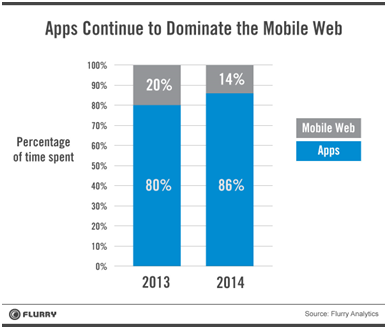
    Statistics from the Q1, 2014 study by Flurry reveal that mobile apps win in the contest with mobile browsers.

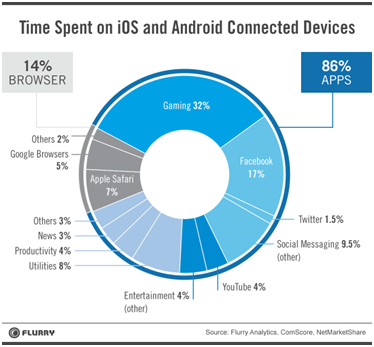
    Of the 2 hours and 42 minutes people spend on their mobile devices, 2 hours and 20 minutes (86% of their time) is spent on mobile apps! Only the rest of the 22 minutes are spent browsing mobile websites.

    People prefer to access information through apps rather than go to mobile websites on browsers. A major factor responsible for the popularity of apps is games. But people are also using social media apps to keep in touch with their digital lives. Among various mobile operating systems, predictably, Android and iOS are at the top:

    But before you pick apps just because they are more popular, check out the following sections that examine important features of both mobile apps and websites:

    Some Advantages of Mobile Apps

    • Apps provide brand access to more targeted audience groups
    • ROI is higher due to improved targeting
    • Remarkable user engagement and experiences
    • Striking visuals due to effects and animations
    • Can be developed for different operating systems and devices using native codes
    • Easy for users to download and install on their mobile devices
    • Apps can be used even without an internet connection
    • Can be easily found on app stores through a search
    • Brands can easily charge for their apps on app marketplaces, if they want to

    The Advantages of Mobile Websites

    • Mobile websites can be accessed easily with a mobile browser
    • It is easy to develop with standard development tools. The current best practice is to use HTML5 and CSS3.
    • They are generally less expensive compared to app development
    • Available to users immediately after publishing. It does not require any submission approval process from app marketplaces.
    • It does not need any installation since it is web-based.
    • Can be easily found with a standard search

    Choosing Between Mobile Apps and Websites: Aspects to Consider

    • What is your main purpose – do you want to provide information to your mobile audience or do you want to promote downloads for a specific product that will need frequent updates?
      Depending on your purpose, you need to decide between a mobile website and an app. A mobile website can help you answer all generic user queries. An app can help in achieving very specific goals like promoting a specific product.
    • Do you want to build engagement with your audience?
      Apps are a great way of building engagement with your audience. If you can identify a hook by which you can get your audience to download and use your app frequently, it will do wonders for your brand. If you just have information updates, then most would prefer to check your mobile site.
    • How interactive and graphics-driven is your content?
      Loading a mobile site with a lot of graphics will slow its load time but apps support graphics well.
    • What is your budget?
      Apps are more expensive and complex to develop since they require resubmissions on app stores when updated and require developers to have a much varied skill set. On the contrary, mobile websites are usually not as expensive.
      What is your pick? Which suits your business better – mobile apps or mobile websites?