Category: Paid Search

  • Tips & tricks for location-based paid search – one marketer’s perspective

    I’ve managed all types of paid search campaigns (Google Ads)… from eCommerce to Consumer Lead Gen, but I had never managed a campaign for a multi-location business before I joined Position2.

    Over the last few years, multi-location PPC has quickly become one of our “in-house specialties” that we offer our clients.

    In this post, I’ll share some tips and tricks that I’ve learned over the last few years that’ll benefit those who are managing marketing efforts in a multi-location business.

    Hours of Operation

    Save your budget for when you have staff to answer the phone – be mindful and turn your campaigns off when your office is closed.

    Call Tracking

    Third-party call tracking is mandatory to measure results from phone calls. CallRail is one of our favorite providers of choice. It’s incredibly powerful, reasonably priced, and user-friendly in both setup/execution.

    You’ll be tracking two types of calls: People who call your extensions right from the search results page and people who visit your site and then call from there. We recommend your business set up full source-to-close tracking where all inbound calls (and all form fills, if relevant) get recorded in your CRM and are tied to a unique GCLID tag.

    These “leads” will be tracked through the funnel and data from each stage gets pushed back into Google Ads. When the leads “close”, those closes will also be pushed into Google. When your CRM shares data with Google, it trains the algorithm to find prospects that are more likely to become leads and closed sales.

    We know that not every business is set up to do full source to close tracking, however, if your company can at least track all inbound leads and tie them to paid search it will generate an accurate cost per lead and the investment in a call-tracking solution will be justified.

    Performance Max / Smart Campaigns

    For each office location, we typically run unique Branded and Non-Branded Search Campaigns along with an office-specific Performance Max Campaign. We don’t recommend creating Performance Max Campaigns to cover multiple offices because it can lead to an increased likelihood of showing an inaccurate office location to a prospect. Office ads overlapping each other can happen but that is fairly normal and not a negative.

    Display Campaigns

    Although generating direct lead volume is never guaranteed, Google Display Network Traffic is affordable and if targeted aggressively within a small local area you can attain great brand recognition that will help generate interest from other marketing channels. We recommend that you allocate between 5-10% of each locale’s marketing budget for Google Ads on the Google Display Network.

    Response time

    During business hours, your prospective customers expect quick responses to their inquiries (or within a reasonable time during off-hours). Not responding promptly, could drive those prospects to choose a competitor. We’re recommending you set and commit to a service level agreement (SLA) for all inquiries – and ensure it’s executed in every communication/engagement. It will help prevent a loss of down-funnel revenue.

    We hope you found these tips useful, we think Google Ads is an essential tool for keeping your multi-location businesses visible and profitable. Following these steps, will help your business will get more business.
  • Automation of Google Ad Campaigns: What It Means to Agencies

    Google is bringing their ‘Ads Experts’ to manage campaigns. “We’ll focus on your campaigns, so you can focus on your business,” says the email Google sent to some advertisers in the last week of January.

    Before we start getting paranoid about AI and machine learning taking over the advertising agencies, let’s understand more about this new feature and how it may change the advertising ecosystem.

    1. The Opt-out Option
      Although advertisers are auto opted-in to the program, Google will give them the option to opt-out and be in full control of their ads. This feature is useful as agencies are better integrated with their clients and therefore more in tune with their needs.
    2. The Multi-channel and Cross-channel Marketing
      Apart from Google Ads Campaigns, agencies manage multiple other channels for their clients like Facebook, LinkedIn and programmatic ads, to name a few. So, agencies need a broader view of how their clients’ ads are performing across channels. The integrated reports from multiple channels allow advertisers to gauge the overall performance and decide whether to pause, activate or increase the exposure of these ads.
    3. Siloed Approach
      Companies relying solely on Google’s recommendations will have a siloed approach to digital marketing. And as Google has carefully mentioned, “advertisers are still responsible for the results of their campaigns.” Agencies are far better equipped to control the performance of the ads as they work closely with their clients and have access to their entire marketing portfolio.
    4. Less Grunt Work, More Strategic Thinking
      Google indicated that their experts will help identify the structural changes to ad groups and modify the keywords to adjust bids and ad text for greater impact, without touching the budgets. This means the agency’s roles will evolve into focusing more on strategy and less on time spent on day-to-day repetitive tasks.
      If Google’s words are anything to go by, they have clearly stated that they do not “guarantee or promise any particular results from implementing these changes”, so agencies still have complete ownership of the campaign and its results and while the recommendations from Google will be helpful, they should not place complete faith in the optimization efforts.
    5. The announcement might have given a bit of a shock to agencies initially, and the changes could potentially lead to some organizational restructuring at their end, but the future is clearly a lot more worry-free, strategic, and impact-oriented for them.
  • Bursting the Blockchain Bubble

    Blockchain, cryptocurrency, bitcoin, and ethereum are a few terms we often come across while flipping over a tech magazine or surfing the Internet when looking for the latest technology trends. However, blockchain isn’t the new kid on the block — it’s been around for a decade. The global market worth for blockchain was $708 million in 2017, which is now anticipated to reach $60.7 billion in 2024*.

    First off, what exactly is blockchain?

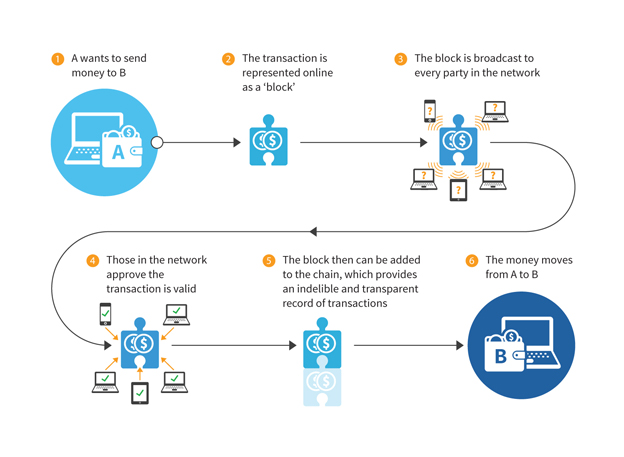
    Blockchain is a secure chain of blocks that plays the role of a ledger recording every transaction between two parties.

    Here’s a visual representation of how blockchain works.

    According to Bill Tai, venture capitalist, entrepreneur, and co-creator of the Blockchain Summit, blockchain is defined as “A distributed ledger where the recording of all those transactions isn’t just happening in one place. It’s written in thousands and thousands and thousands of places. It can’t go down, and it’s always transparent. You can always look it up. So it’s hard to hack because to try to replace or erase and change the information, you’d essentially either have to take over every single one of those computers around the world, writing it down at the same time, or you’d have to double the whole network all at once, which [is] really kind of impossible at the scale it is today.”

    So how will adapting blockchain technology be profitable for your business?

    Blockchain is set to change the way brands interact with customers. This standardization of data will not only give customers transparency of data but also motivate brands to come up with ideas that enhance their interaction with customers.

    Here are some areas where blockchain will improve business:

    1. Security
      Digital marketing has enabled interaction between the customers and brands, giving customers the power to choose what they want to do with a particular brand. This freedom, in turn, makes security a considerable concern for both marketers and customers. Data breaches are rising every second. With GDPR stepping in, marketers are in a tough spot. As if building confidence with customers wasn’t enough, but now, marketers have to do it at the cost of a security issue. If you’re a marketer looking for a solution that abides by the laws and keeps the data secure, make way for blockchain encryption. Blockchain’s security takes the trophy due to its decentralized data storage structure, meaning you can finally say goodbye to the middlemen and their fees. To hack into the data, one would have to break into each and every block the data has been stored in. Voila! There you have it — enhanced cybersecurity with blockchain.
    2. Innovations
      Remember when there were ledgers to store all business data until cloud services took over? Many of us avoided using cloud platforms for a long time, but now it’s something that we cannot imagine our businesses without. The same kind of innovation is happening with blockchain technology. Technology giants like Microsoft, IBM, and Amazon are already ahead of the curve by taking up ‘Blockchain as a Service’(BaaS). Imagine what more can evolve!
    3. Seamless Payment
      Did you know that retailers can create their own blockchain currency for their customers? They can even have the same currency for multiple retailers to build up loyalty programs. Therefore, every time you shop from a particular brand, you will be rewarded with points that you can cash at other retail stores that have the same points as their currency. This will not only increase customer participation but also be an added benefit to the customer while allowing a seamless payment process.
    4. Better Results
      Blockchain will help digital marketers measure the results better than before. Blockchain can serve as a record to solve how many people are actually looking at your content — one of the most significant grey areas in marketing. With Blockchain, a brand can verify if the ad was delivered and viewed by a real person. This will give accurate results and optimize the frequency of ads to ensure a brand does not deliver more than what is required.
    5. One-to-one Personalization
      How often have you come across targeting a whole segment whereas only a niche of that segment actually responded to your ad? Think about all the capital spent on targeting products/services to those who were not even interested in it the first place. With blockchain technology, marketers can utilize the details of each and every customer for a personalized one-to-one marketing experience, delivering exactly what customers want.
    6. Verification
      No more dealing with bots — blockchain technology will improve the verification process of social media accounts, followers, influencers, as well as email deliverability. Combining the decentralized principle of blockchain with identity verification, a digital ID can be produced that would act as a digital watermark for every online transaction. This can help organizations eliminate fraud by checking identity on every transaction in real time. Blockchain technology will also improve the verification process of social media accounts, followers, influencers, and email deliverability. BlockVerify, Guardtime, and ShoCard are a few companies that are leveraging blockchain technology to provide identification and authentication services.

    Believe it or not, blockchain is here to stay. We’re excited and are already looking for our thinking hats to transform our business with blockchain. Are you ready?

    *https://marketreportscenter.com/

    Research Material:

    https://marketreportscenter.com/

    https://www.inc.com/alisa-cohn/blockchain-is-here-to-stay-here-are-3-ways-you-can-use-it-in-your-business.html

    https://citrusbits.com/blockchain-stay-bitcoin-might-not-glimpse-future-decentralized-apps/

  • Affiliate Location Extensions: Google Launches a New Service in AdWords

    Three quarters of the people who do a ‘near me’ search on their phones visit the store within a day.

    Google introduced Location Extension in 2009 to help advertisers drive more footfalls into their stores. This year Google is testing a new beta ad extension called ‘Affiliate Location Extension’ (officially announced on Google+ on Oct 20, 2016) for some AdWords accounts.

    What is an Affiliate Location Extension?

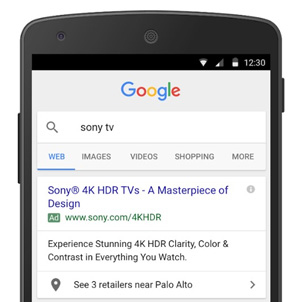
    The purpose of launching this ad extension is to help manufacturers drive traffic to third-party US retail locations that sell their products. For example, if you are a TV manufacturer, you can use this extension to help someone searching for a TV to find the nearest retail chain where he or she can buy the product.

    Some AdWords accounts have been enabled with Affiliate Location Extension, in the coming weeks this will be rolled out to other accounts.

    Google Affiliate Location Extensions

    How will Affiliate Location Extension Help

    As per Google, CTR tends to improve when ad extensions are included in an ad copy. Having an affiliate location extension will help manufacturers drive customers to the locations near them where they can buy the product they are looking for.

    Setting Up Affiliate Location Extension in AdWords

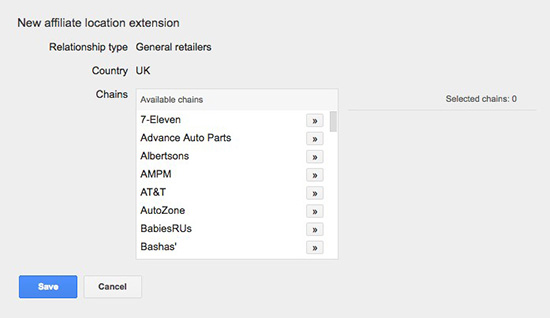
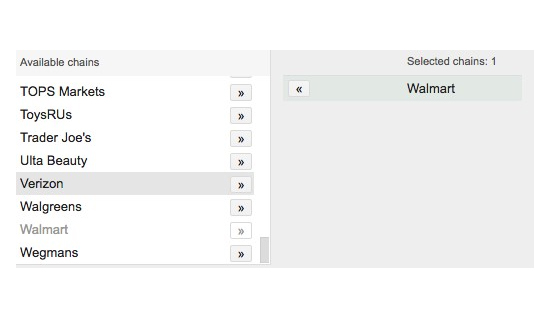
    You can easily select Affiliate Location Extension in the Ad Extensions Tab. Simply add the new extension and select the 3 categories: ‘Relationship type,’ ‘Country’ and ‘Chains.’ The ‘Relationship type’ states the type of retailer. ‘Chains’ lets you choose the retail chains where the manufacturer sells his/her products (Refer to the images below). In contrast to standard location extensions, Affiliate Location Extensions do not require you to link to a Google My Business account.

    Affiliate Location option in AdWords Account

    Affiliate Location Extension Settings

    How Affiliate Location Extension Works

    1. The User searches for a product on Google
    2. Your ad shows up with Affiliate Location Extension
    3. The user sees the nearest retail store that sells your product, either as an address or on a map
    4. On mobile, the user can tap on the extension to get directions to the store
    5. The user heads right to the nearest store and buys your product

    Conclusion

    By promoting retail location on search ads, the ads get more functional and give customers relevant information to drive store sales and visits. Since the end goal of a manufacturer is to drive more sales, Affiliate Location Extension enables manufacturers to reach their goal. Additionally, Google says that using this extension may enable some manufacturers to be eligible for ‘Store Visits Data’ in AdWords Currently, Affiliate Location Extension has been rolled out in the US only. We will learn over time how this extension actually works and how successful it is in driving product sales.

    Sources:

  • The Latest On AdWords Is What You Need To Know!

    ‘Change is the name of the game’ and who can advocate this more than Google? They have played a major role in the rapidly evolving world of online marketing and advertising with their regular innovations and strategic thought leadership.

    Google has earned the majority of the global market share [72.48%] by constantly updating and innovating their solutions and services.

    As a continuation of this process of constant evolution, Google rolled out new AdWords updates that are likely to impact your advertising ROI in a positive manner:

    1. Expanded Ad Format
    2. Bidding Metrics – Conversions and Converted Clicks

    1. Expanded Ad Format

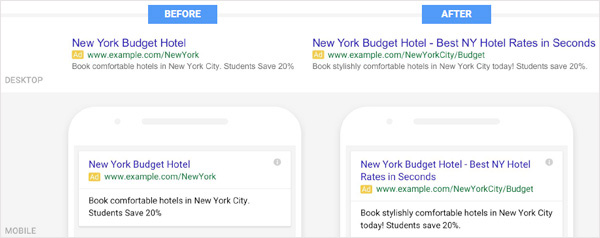
    This next generation text ad is devised to help advertisers reach out to the current mobile-savvy users in an efficient and effective manner. Two times bigger than the standard ad, this new format provides advertisers with a bigger headline and longer description, giving them an opportunity to improve their ad performance and presence across devices.

    The best part of this new format is that these ads will wrap automatically based on the device size. Additionally, the expanded text ads are available on Google Search Network as well as Google Display Network.

    This is one of the biggest changes in the ad format since AdWords was launched. Here are some of the significant features:

    • Two fields for headline with a character count of 30 characters each
    • Description field is expanded up to 80 characters
    • Ability to use final URL’s domain in the display URL
    • Display URL of the ad can use two optional path fields of 15 characters each

    Google Adwords Expanded Text Ads

    Make the changes now as you’ll no longer be able to create or edit standard text ads after October 26th, 2016

    2. Conversions and Converted Clicks

    Google AdWords uses the basic bidding metrics to measure your ad conversions. Converted clicks is a metric that counts the number of clicks leading to one or more conversions. For example, if one customer clicks on your ad and then completes two conversions, converted clicks will consider it as one click.

    On the other hand, conversions are the recommended metric for bidding and reporting, as this gives you a clearer picture of how many conversions you have from AdWords. With this bid metric, you have the option to include cross-device conversions and factor them into your automated bid strategy.

    Starting in September, Google will remove converted clicks as a conversion bid metric and later will remove this from reporting as well. So, all accounts need to change their bid metrics to conversions and if you have not done it yet, you will find it automatically migrated to conversions.

    Here’s a comparison of the metrics that will give you more clarity on the impending change.

    Features Conversions Converted Clicks
    Select which conversion actions to include Yes No
    Segment by conversion name or conversion category Yes No
    Count multiple conversions generated from a click Yes No
    Select an attribution model Yes No
    Specify a value for conversions Yes No

    With so many swift changes in the online advertising world, you need to be updated to beat the competition and win the game. Stay tuned to get the latest from the digital marketing world!

    References:

    1. https://support.google.com/adwords/answer/6372468?hl=en&authuser=0
    2. https://support.google.com/adwords/answer/7048854?hl=en
    3. https://adwords.googleblog.com/2016/07/adwords-editor-expanded-text-ads-mobile-app-engagement.html
  • The Benefits Of Facebook’s Custom Audience Remarketing

    Using Facebook’s Custom Audiences from your website, you can create an audience representing any group of customers or prospective customers that express interest in your product on your website. Later, you can reach these people with targeted Facebook Ads. For example, you could run a campaign to reach out to those who visited your site and viewed a product page, but have not made a purchase.

    Now you can deliver highly relevant ads based on the interest that visitors had in your products. This allows you to target current customers who have viewed a particular product or service page, potential customers who have not yet registered, or re-engage with recent website visitors by delivering highly relevant messages to them.

    Custom Audience from your website can be used to:

    • Remarket to people using your website
    • Make your existing ads more efficient by excluding audiences of people who have already converted
    • Create lookalike audiences of people who look like the people browsing your website

    Why should you track your customers?

    By tracking how each potential customer progresses along the buyer’s journey (e.g., which checkpoints a customer has completed), advertisers can more effectively influence people who have expressed interest in their products. For example, using the Facebook pixel, an advertiser could capture intent based on the activity of people who are viewing pages about a loyalty program, browsing a particular product page, or filling out a preferences form. Later, the advertiser could serve relevant ads to these people to encourage them to convert.

    How to set up Custom Audiences

    Custom Audiences from your website requires use of the Facebook pixel, which is a small piece of JavaScript code placed on every page of your website. The Facebook pixel is used to capture intent information about how people are using your website, and it sends back reports containing general information about the browsing session, a hashed version of the Facebook ID, and the URL being viewed.

    Advertisers can also send Custom Data back to Facebook that contains additional information about the browsing session. For example, when a viewer adds a product into her wish list, an advertiser can optionally send Custom Data to Facebook about this event, including information about the product. This product information then becomes available for use in Audience rules via the Facebook API.

    Now that you have those tracking pixels on your website, you’ll begin capturing your visitors so that you’re able to remarket to them at your leisure. This means that your ads will appear in their Facebook News Feed after they’ve visited your site.

    Using Custom Audience can lead to heightened brand recall, greater engagement, and a higher conversion rate.

  • An Introduction to the Position² Demand Acceleration Framework

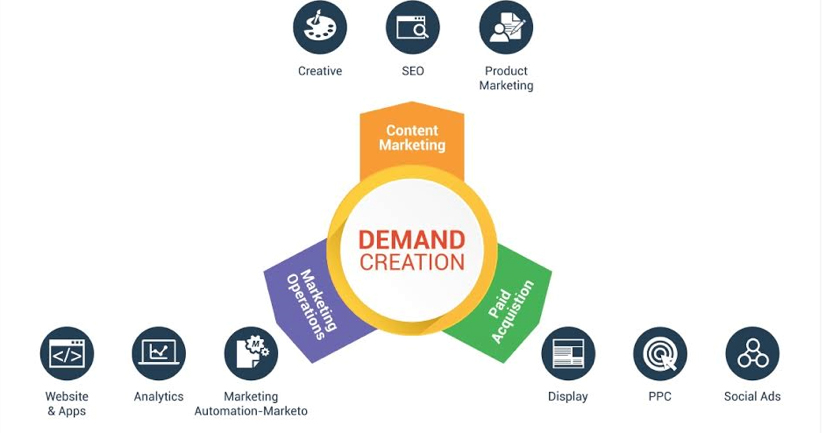
    Position2 is a full service digital marketing agency that has been working with top brands in the B2B space for over a decade. Our Demand Acceleration (DA) framework is the result of years of experience in serving a diverse range of clients of every size and type. It is an integrated approach that combines the key enablers—Content Marketing, Paid Acquisition, and Marketing Technology—to deliver significant results across the Awareness, Engagement, and Purchase stages in B2B sales.

    Over the past two years, Position2 has been engaged with SiriusDecisions, the thought leaders in B2B marketing frameworks—to adopt best practices in our services and processes.

    THE DEMAND CREATION ECOSYSTEM

    Demand Creation is a concept laid out by Sirius Decisions that provides a highly detailed model to plan, manage, and optimize the B2B marketing process.The DC ecosystem revolves around the interactions that buyers have with the marketer. B2B buying behaviour is different from B2C, the key differences being longer sales cycles and multiple buyers. Let’s look at some of the key players and concepts in this ecosystem.

    Demand Waterfall

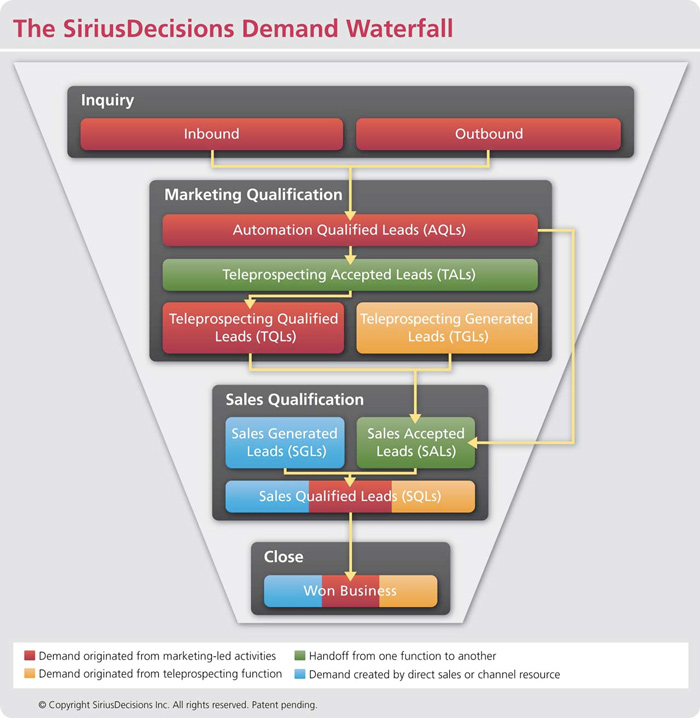
    The Demand Waterfall, originated by Sirius Decisions, illustrates the flow of buyers across different stages of the B2B buying process. The key elements in the waterfall are the different stages that leads pass through before they convert to a sale or become a customer.


    demand-waterfallBuyer

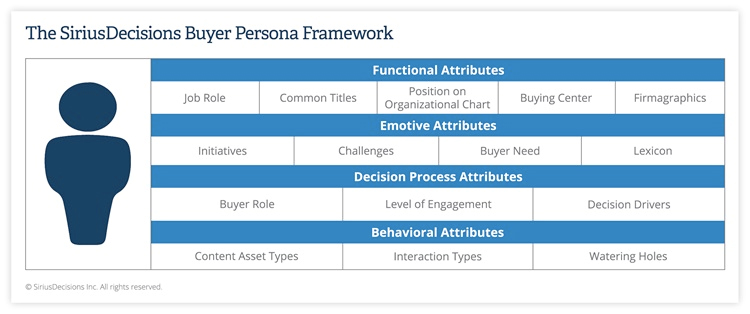
    The buyer is defined as the entity that consumes the product or service. Buyers are further classified based on their role in the buying process, as well as in the consumption of the product and service. Important concepts that are considered in relation to the buyer are personas, buying types and lead lifecycles.

    Buyer Framework

    Product/ Service

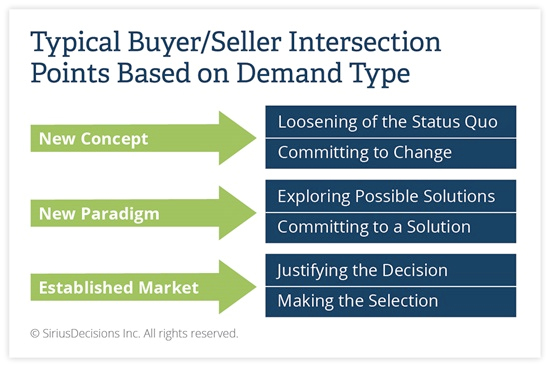
    The product or service that is being sold forms the other element in the Demand Creation process. The key concept related to the product or service is Demand Type.

    demand-type-points

    This helps marketers design programs that are best suited to their product or service.

    The Buyer’s Journey

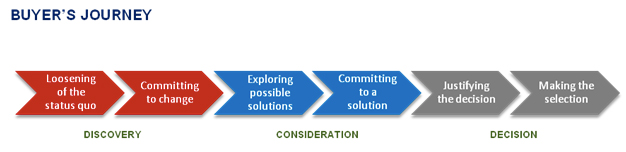
    Position2’s Demand Acceleration framework looks at the buyer as being at the core of the process. The aim is to move the buyer from an initial stage of non-awareness to the final desired stage of purchase. The DA framework leverages the key enablers—Content, Technology, and Campaigns to accelerate the buyer’s journey, thus providing more and faster sales for the company.

    buyers-journey

    THE ENABLERS

    enablers

    Content Marketing

    Content Marketing covers all the activities and planning required to develop content that drives interactions between marketer and buyer. Various types of content need to be developed based on buyer persona and stage in the buyer’s journey. These could be in the form of short video clips, whitepapers, case studies and infographics, to name a few. The Position2 DA framework incorporates a detailed template-driven process across four key stages—Audit, Creation, Curation, and Measurement.

    Marketing Technology

    Marketing Technology functions both independently, as a channel (e.g., Marketing Automation, Website and Email) as well as an enabler for Content Marketing and Paid Acquisition. Given the rapid pace of development, this is the area that draws a lot of attention and effort. In the DA framework, we clearly distinguish between technology as an enabler and technology as a channel by focusing on the core functionality of the process, rather than the process itself. This allows our framework to adapt and evolve with the latest technologies.

    Paid Acquisition

    While the other two enablers are primarily infrastructure-related, Paid Acquisition is more outward and tactical. It essentially operates as a feeder to the other two enablers. This is also the area which sees the most amount of optimization and scalability, and has the potential to help significantly scale up growth for our clients. Paid acquisition covers all the key channels—Search, Social, Display, as well as newer strategies such as content syndication and sponsorships.

    Position2’s Demand Acceleration framework brings together a calibrated combination of Content Marketing, Marketing Technology, and Paid Acquisition services to produce the best results for our clients in today’s competitive digital marketing arena.

    Contact us if you would like to learn more.

  • Mobile Marketing Trends in 2016

    Mobile marketing has evolved to become an integral part of our digital lifestyle. Smartphones are now used by two-thirds of the US population, and they are increasingly being used for email and social media, photos, navigation, financial transactions, ordering meals, entertainment, and more.

    Mobile’s growth over the past few years has been well documented, and it continues to cross major milestones that illustrate its immense popularity. In 2015, app usage surpassed desktop usage to account for half of all US digital media consumption. In March 2016, the number of mobile-only adult internet users exceeded the number of desktop-only internet users for the first time. This milestone shows just how far mobile has come in overtaking desktop’s longstanding dominance as the primary gateway to the internet.

    Just a year ago, desktop-only internet users accounted for 19.1 percent of all users, while mobile-only users comprised 10.8 percent of the total. This year, the share of mobile-only users has climbed to 11.3 percent, while the desktop-only population has drastically declined to just 10.6 percent. Of course, these numbers also tell us that the vast majority of the digital population is multi-platform and goes online using desktop as well as mobile platforms. Even then, this mobile-only milestone is meaningful because it signifies how smartphones and tablets (particularly the former) are becoming—or rather, have already become—our primary access point to the internet.

    There’s no doubt that desktop computers are highly practical and efficient when it comes to accomplishing complex and information-heavy tasks, which makes them crucial for workforce productivity. They still play an important role in our digital lives, and won’t be phased out anytime soon. Let’s not overlook the fact that consumers still prefer desktops when shopping online, with 87 percent of total digital commerce coming from the platform, despite mobile accounting for 60 percent of total time spent shopping online.

    All signs indicate that the desktop computer is here to stay for the foreseeable future, and that mobile usage will continue to grow. With more mobile-only internet users than desktop-only users today, it’s safe to assume that digital marketing will continue to evolve towards a “mobile first” approach.

  • How To Improve Your Google AdWords Quality Scores

    Quality Score (QS) is easily the most mysterious metric in Google AdWords. PPC gurus have passionately spoken about its importance. As digital marketers, we’re constantly working towards improving the QS of our keywords. Let’s take a look at how we worked on improving QS for a client who we’ve been servicing for three years.

    The client’s selected keywords were of medium priority in terms of conversions, but had relatively low QS. The only way to get the best possible results from them was to improve their QS and lower CPCs.

    How did we achieve this? The effort was twofold. The first and most important step was to ensure relevance between our ad copies, keywords, and LPs. We tested using the keyword in headlines and display URLs, and tailored landing pages to include the keywords.

    The second step was to ensure that we were giving the keywords a chance to see a good CTR through a better average position. This was done by increasing bids for a few days.

    One of our key phrases was “quick business funds.” The ad copy running at that time looked like this:

     Business Funding

    Get The Capital You Need Now.

    Fast & Easy. Sign Up Online!

    Xyz.com

     As you can see, the messaging was generic. We then introduced ad copy that included the key phrase:

    Quick business funds

    Get The Capital You Need Now.

    Fast & Easy. Sign Up Online!

    Xyz.com

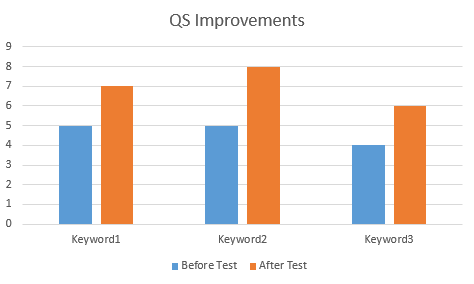
    Did we notice an instant change in QS? No, but our patience and investments in CPC paid off. After a couple of months, we found that 11 out of 23 keywords had score improvements. The table below highlights the improvements in three of the tested keywords:

    QSThe improvements in QS had a positive impact on Average Positions, CTR, and Average CPC as you can see below. It’s important to mention that the bid prices for these keywords remained the same.

    QS 2

    A combination of ad copy testing and bids brought about the improvements we were chasing. In due course of time, we found our average CPC dropping, marginally at first, but significantly in the case of expensive keywords.

    The basis for such a strategy was to insert the keyword into the ad copy in a clever way. You’re often confronted by keywords that don’t directly speak to your product or service. But if these keywords can be highlighted with a unique perspective, there is a lot you can gain as a pay per click advertiser. For example, you’re offering just headphones for sale. Though you don’t offer earphones, keywords around that theme could be crucial for you. If you were to target a user with messaging such as “Why go for Earphones? Get more with Headphones”, you could possibly strike gold on Google. Your Quality Score is bound to increase for such keywords, provided your landing page offers the right experience.

    In addition to this strategy, never underestimate the importance of Ad Extensions catered to the keyword. Google offers advertisers an array of ways to connect with a user, given that there is only so much one can do with 130 characters worth of ad copy. Using Sitelinks, Callouts, Snippets, and other extensions, there are many ways to achieve improved  performance. Tailoring your extensions to a particular campaign, ad group, or even a keyword can help you boost Quality Score in unimaginable ways. The more relevance you earn, the more value you can obtain.

  • What We Learned at HIMMS 2016 in Las Vegas

    Position2 attended this year’s HIMSS Annual Conference and Exhibition, which was held in Las Vegas in early March. The conference attracts more than 40,000 people each year, with 1,300 vendors exhibiting. Through the course of the event, attendees have the chance to take in keynote speeches from thought leaders in healthcare IT, and take part in discussions, webinars and workshops to drive innovation in this space.

    HIMMS is an important event, and it showcases myriad products and solutions in cutting edge healthcare markets. It also provides a snapshot of the market as it is today, and showcases new opportunities that IT providers can exploit. Our team came away with fresh insights into the opportunities this unique market presents, as well as a new understanding of the importance of our work in delivering engaging content to patients and businesses.

    Key Takeaways from HIMMS 2016

    At Position2, we came away from the event with four valuable takeaways that describe the state of healthcare IT right now. Across all of the products that were exhibited, these principles stood out.

    1. A Need for Efficiency

    Users engaged with healthcare IT are increasingly looking for efficiency in the solutions they select. And it’s not just the healthcare providers that are seeking cost and resource savings. Increasingly, we’re seeing consumers looking for healthcare IT solutions, and they are also likely to be interested in cost-effective answers to their questions. We’re seeing both B2B and B2C products growing in parallel, which presents an interesting evolution of the market compared with traditional medical companies.

    2. Patients Are the Focus

    As the market has evolved, we’re seeing more service users engaging with the IT solutions that provide healthcare information. This is particularly prevalent in the US, where it’s the patient that engages directly with the care provider in many cases. Patients are the focus of the work we do at Position2, and it’s important to maintain this focus.

    3. Mobile is a Growth Area

    Right now, figures suggest that 70 per cent of patients are using mobile devices to log on to service portals. This is an increase on last year, and it ties in with the opportunities of mobile retargeting, which can be used to reengage consumers on their journey. At HIMMS 2016, we saw a strong interest in video ads that are clear, digestible and engaging.

    4. Position2 is excited to be part of this industry

    Position2 had a prominent spot in one of the key vendor’s booth at HIMMS 2016, both on the posters and the video screens displayed to delegates. We continue to support and inspire healthcare companies in delivering effective solutions, contributing to their ongoing growth. As the market continues to boom, Position2 will continue to deliver value to the most important people: a community of patients worldwide.

    The Future of Healthcare IT

    Again and again, IT proves itself as a transformational force. Healthcare is no different. As patients become more in tune with their own care, they will be more interested in using mobile technology to quickly access the services they need. Position2 is at the forefront of this rapidly evolving market. Get in touch to find out more.