Category: Paid Search

  • Yahoo Prime View – Changing the Way CPMs Are Bought

    Yahoo releases Yahoo Prime View

    Being committed to providing advertisers their investments’ worth in display ads, Yahoo is introducing Yahoo Prime View.

    This new vCPM product will allow brands to run display ad campaigns at a 100% viewability rate. vCPM ensures that you pay only for viewable impressions enabling better campaign performance.

    Currently, Yahoo Prime View has been introduced for display ads on Yahoo, only in the US. However, the company has plans for a global rollout, with no certain time frame.

    You can now increase ad exposure without modifying your workflow – reporting or creative. Yahoo Prime View employs IAB’s SafeFrame, which is a managed API-enabled iframe that opens up a line of communication between the publisher’s page content and iframe contained external content such as ads.

    For marketers who opt for CPM campaigns for branding and visibility purposes, Yahoo Prime View will help in increasing marketer confidence in CPM campaigns and thereby, brand investment.

    What are your views on Yahoo Prime View?

  • Implementing Cross-Channel Personalization

    How to implement cross channel personalization

    Personalization is the name of the game.

    Whether it’s for your email campaigns or your website, personalization is an essential ingredient. Now that cross-channel campaigns are gaining popularity, it’s logical that one applies personalization across channels.

    Revisiting cross-channel marketing

    Cross-channel marketing refers to the practice of integrating marketing campaigns that are being run across different channels. This means making sure your website, email and social campaigns are talking to the same person in the same way.

    Getting down to business…

    The Need for Personalization in Cross-channel Marketing

    As you would have noticed in our blog posts, we’ve been talking about how consumer attention today is getting divided between multiple media. This is necessitating marketing communication to be sent through different platforms. Every channel has unique characteristics and lends itself to a specific style of messaging. This often leads to inconsistent messaging in terms of tone and manner and occasionally messaging that seems irrelevant.

    It is not easy to tailor your messages to suit each platform’s conditions and still capture audience attention. This is where personalization can come to your rescue. By personalizing cross-channel marketing, you tend to catch your prospects attention because the message is developed keeping in mind his interests, habits and other data you have picked up about him. It’s more relevant and therefore, more likely to strike home. Also, when you personalize your marketing, you stay with the prospect all through the communication cycle, otherwise the same brand may sound inconsistent or disconnected while talking to the same person at different stages of communication.

    Important Factors for Implementation of Cross-channel Personalization

    Identify available data

    Personalization is dependent on data. Brands have different types of data about customers stored in different sections of the company. Create a culture of company-wide appreciation of the importance of data. Collate all data into a single database, which can help build an integrated view of the customer and enable creation of personalization strategies. You will be well prepared for more possible scenarios and can build a robust analytics strategy for your cross-channel personalization efforts.

    Unify data sets

    Brands typically have different data sets about the same customer. There is often disconnect between offline and online data sets. Consolidating all the data against one customer ID helps get an integrated image of the customer. As the database gets richer in terms of data, different user personalities emerge, each with a set of homogenous customers. This enables segregation of customers into different segments from your core audience to less prominent yet important segments.

    Develop a connected profile across the customer journey

    Customer touch points are many: onsite behavior, email campaign offers & responses, display ads, search terms used, customer support conversations and social media interactions. You will also have data from on-site customer behavior, the transactions they conduct and data from references:

    • Device related factors – IP address, device type, browser details etc.
    • Onsite behavioral factors – Time spent on site, site paths followed, product interests etc.
    • Offline factors – CRM system used, brand loyalty, data from third parties etc.
    • Time related factors – Time of day during site visit/engagement, day of the week, frequency of visits etc.
    • Reference related factors – PPC ads, natural search, referring domain etc.

    All the above touch points are a part of the customer’s journey. Joining these dots will give you the big picture about the customer segment and specific cues about individuals’ profile.

    Stay consistent across channels

    Share the available profile data across all the channels that are a part of your cross channel personalization strategy. All your channels should carry the same message since they would be talking to the same customer depending on the channel the customer has chosen. If customers approach you through two different channels and see different offers, it will lead to confusion and indecision.

    Build engagement rules

    Establish rules that define engagement. Decide how you are going to engage customer profiles on different platforms. Have a plan in place that outlines your strategy after each customer engagement action on every platform. Base these campaign tactics on unique customer profiles.

    Implement personalization across touch points

    Provide personalized experiences for customers across various touch points. Coordinate these experiences by leveraging customer profiles and recommendations.

    Reporting and Analysis

    Generating reports and analyzing data will enable you to meet customer requirements better by optimizing your cross channel experiences. However, reporting and analysis can get complex due to the involvement of multiple channels. Knowing the end requirement from every channel can help you channelize the sub-points under every channel to drive towards that end need.

    Do you run cross-channel campaigns? What have you learned?

  • Animated GIFs, now on Twitter!

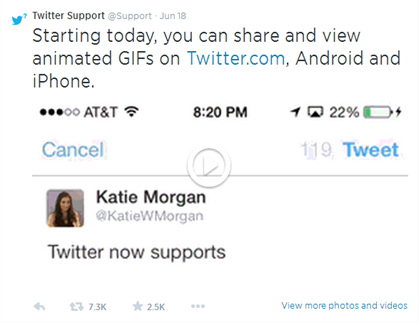
    The social media platform recently announced that users will now be able to share and view animated GIFs on the Twitter desktop site and on its Android and iOS apps.

    This move saves users from the round trip they had to take until now, uploading the image on third-party sites like Imgur and then sharing the link on Twitter. Users can now share GIFs directly on the site.

    However, GIFs will not automatically play on Twitter. Each GIF will have a white play button on it, which the user has to click to play the GIF. Share animated GIFs on Twitter

    Changes for Marketers

    Enabling of animated GIFs provides content marketers with more creative avenues for their content marketing efforts.

    GIFs capture attention and engage users more easily. They also help deliver brand messages to customers better through animated visuals. With a 140 character tweet limit, it sometimes would be tough for marketers to convey emotions behind messages. Adding a GIF now makes it easier.

    Let us know if you have anything to add to this…

  • Key Takeaways from the Digital Now Conference in Association with Google

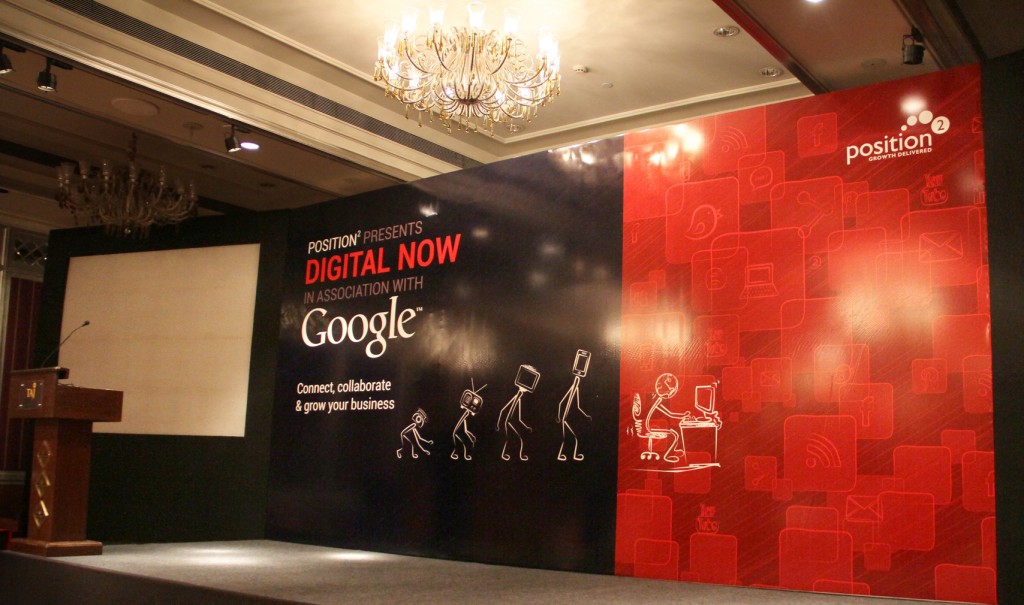
    The Bangalore chapter of Digital Now conference, in association with Google, concluded on June 12. The event was a great success, both for the participants and speakers.

    Position2 presents Digital Now in association with Google

    If you could not attend the event or if you want a second look at the insights shared, here are the key takeaways:

    Reach of Digital in India by Google’s Akshay Sonthalia

    Google’s Strategic Partnership Manager, Akshay Sonthalia, delivered the keynote address on the reach of digital in India. Akshay shared several popular videos with the audience, that highlighted one key factor – digital marketing is capable of touching the hearts of millions. It Connects.

    Check out the key takeaways from his session:

    • Think digital, with Google – Engage with people’s emotions, logic and sense of awe. Digital helps move people when it matters the most
    • Video views are exploding in India with YouTube having 60 million unique users. If you have not completely embraced video marketing, you need to start now to stay ahead of your competitors
    • Timeliness, reach and impact can act as cost effective ways to reach out to millions of people
    • Increase reach by embracing personalization. In fact, digital ads have more scope to get creative as compared to traditional media, where you are bound by a set of guidelines
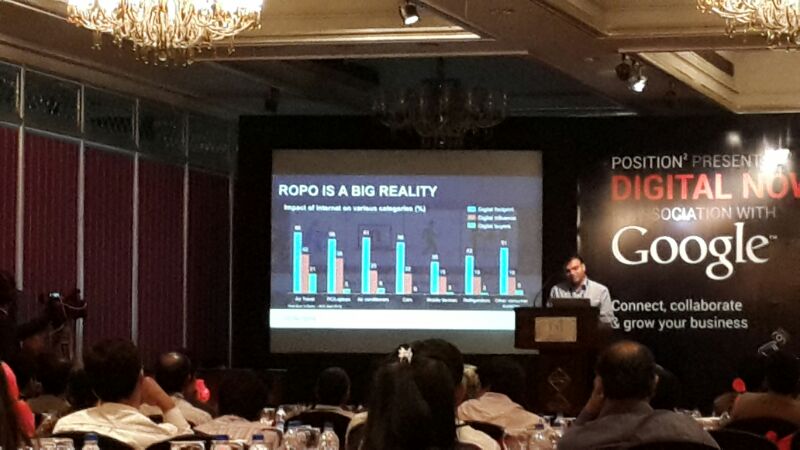
    • Indians are transacting online more. Here is what we found – Digital buyers in India are expected to reach 41.8 million by 2016 (eMarketer)Research online purchase offline
    • Research Online Purchase Offline (ROPO) is today’s reality – consideration happens in digital even if purchase doesn’t. Leverage it.
    • 3 pillars of capturing demand: Personalize, build for mobile and data usage
    • Good customers are great to have, they say awesome things about you. However, you should not ignore disgruntled customers. In fact, you should be wary of them, since they can ruin your credibility with even a single bad experience, thanks to digital media. Invest in reputation management systems.
    • Consumers can create and consume content. Keep consumers engaged to make them your brand advocates

     Infrastructure for going digital, by Position2’s CEO Rajiv Parikh and MD 74 Nambiar

    After watching some wonderful, moving videos, it was time for the audience to tighten their seat belts. Next up were our CEO Rajiv Parikh and MD 74 Nambiar for the session on ‘What you need to go digital’. Here are the key insights from this session:

    • Customer journey varies in B2C and B2B sectors. Position2 took the audience through the journey of a consumer, until she/he reaches a purchase decision.
    • Content in multiple formats is in demand
    • Mobile is big, so you have to make your landing pages mobile-friendly
    • You need a three layered framework to go digital:
      • Content layer
      • Interaction layer (for instance, blogs, social channels, landing pages etc.)
      • Marketing layer (paid search, media, email etc.)
    • We also emphasized on the need for user centric SEO, as compared to search engine centric. The consumer is king and while creating an SEO strategy, companies need to focus on conversational keywords, user experience and content authority. If you are still focusing on keywords, content quantity and frequency, its time to realign your marketing priorities.

    Insights from the panel discussion

    The following are the important points that cropped up during the panel discussion that followed:

    • Move from traditional to digital marketing
    • Monitor the journey of a customer through digital
    • Consumer behavior drive social media marketing

    Hope this was a good refresher!

    To the 100+ people who attended the event, thank you! If you did not get to the event, we hope you see you next time.

    Drop your comments in the section below!

  • Google My Business Launch and Facebook Plans to Sell Web Browsing Data

    Google My Business launch and Facebook plans to sell web browsing data

    Google

    Based on brands’ feedback that it’s tough to find their loyal customers, Google is making it easier for businesses to connect with the latter.

    Here comes ‘Google My Business’…a free and easy way for brands to connect with customers wherever they are.

    With Google My Business, you can:

    • Update business information on Google Search, Maps and Google+ from one place making it easy for customers to connect with you. This also helps in making sure you provide consistent information to customers across platforms.
    • Add pictures of your business and provide customers with a virtual tour of your business, giving them a glimpse of your company
    • Connect with your customers on Google+ by sharing updates about events and important news
    • Monitor and respond to Google reviews
    • Gain insights and integration with AdWords Express and understand how people find and interact with you
    • Manage your brand’s information even when you are on the move with the Google My Business Android app and the soon-to-be launched iOS app

    Google will be moving brands using Places for Business and the Google+ Dashboard onto Google My Business along with adding new businesses.

    Facebook

    User browsing data and information about the apps they have downloaded will now be provided to advertisers by Facebook.

    Announcing this through a blog post, Facebook said this move was to help users see more personalized ads. The rollout will be limited to US based users initially.

    However, users can opt out of this feature by clicking on this link and selecting the companies they want to opt out from. Users can also opt out from Facebook’s iOS and Android apps.

    Implications

    With Google’s update, brands can now:

    • Connect with customers better and also when they are on the move
    • Manage consistent brand messaging
    • Keep an eye on customer reviews more easily and respond

    Until now, Facebook could target users with ads based on their behavior on the social network only. You can now target users based on their extended web activities. For example, if a user wants to buy a subscription for a PPC service and is searching for it, you can show him/her ads about PPC services using this data. With users choosing to research online increasingly before making purchases, brands can benefit immensely from this data.

  • The rise of transient competitive advantage, best practices for B2B websites and much more…Best of the Week

    This week’s hot news, events and videos from the online marketing and social media world.
    The Rise of Transient Competitive Advantage
    From the Position² Blog This Week:
    The Rise of Transient Competitive Advantage There is a new concept on the block, transient competitive advantage, where companies continually innovate. Check out this blog to know more about this concept and how it can help in volatile business environments.
    Top Stories this Week: Social Media
    Top Stories this Week: SEO, PPC and Digital Media
    Best of the Week Video Best of the Week Video Mobile devices and apps are hot areas for marketers. Check out this video to know how you can use both platforms to engage with customers and also generate brand value and revenue.
    White Paper: Increase Visibility for Your Content by 4x
    Today’s traditional SEO is inadequate: Ignite your search results by accelerating visibility in more places than ever before.Download this White Paper and learn:


    • SEO, why the way we know it is not enough
    • Introducing and implementing Enterprise Visibility Accelerator (EVA)
    • Using multi-channel tracking tools for effective monitoring
    • How EVA benefits businesses.

    Download the complimentary EVA White Paper now

    Know more about Enterprise Visibilty Accelerator(EVA)
    If you are reading this blog post via a RSS reader, please click here to subscribe.
  • The Rise of Transient Competitive Advantage

    It’s been a long standing belief that a company must have a sustainable competitive advantage to excel. But, lately, there has been an upsurge of popularity for a different but related concept, ‘transient competitive advantage’.

    What is the difference between transient and sustainable competitive advantage?

    Transient competitive advantage refers to the practice of taking up new strategic initiatives based on short term or transient advantages. This is novel because the norm has always been to build a business around something that is lasting and will provide an enduring competitive advantage.

    A sustainable competitive advantage is the practice of finding a profitable opportunity that can deliver an advantage that competition cannot match for many years. This advantage can take the form of differentiation, new business model, entry barriers, ownership of critical resources, etc. anything that blocks competition for a long time. For example, SouthWest Airlines’ business model of flying short hauls between small city airports gave it an advantage that competition could not match for years. Dell’s strategy of mass-customization gave it an advantage that lasted many years.

    A Shift in Thinking

    Changing times have propelled a move towards the concept of transient competitive advantage. At a time when scenarios shift dramatically in a short period of time, executives are recognizing the merit of looking at the short term rather than the long term.

    What’s led to This Shift in Thinking?

    The digital revolution and globalization are the two main factors that have increased the pace of change and shortened the durability of most concepts. Companies can innovate or imitate faster now than ever before. With faster information flow and quicker research – nothing remains a secret for long and no product remains unique for long. Entry barriers have become meaningless in many industries due to outsourcing. Businesses have a shorter window for success and so it makes sense for them to run with opportunities that deliver a short term competitive advantage.

    Important Considerations for Transient Competitive Advantage

    With volatile business environments, companies continue with strategies from stable times. A business plan put together during good times can comfortably draw from resources. Continuing with such a plan in difficult times can leave you with depleting resources and increasing costs. And soon, the advantage will run out of steam and your company will be left in the lurch.

    An example of this scenario is Kodak, from the photography industry. In 1973, the Hunt brothers, oil and gas billionaires, decided to increase their stock of silver and prices of this commodity shot through the roof. Kodak was one of the major consumers of silver and tried to break away from this stranglehold by inventing the digital camera. This was a great example of a transient competitive strategy. However, what they didn’t do was capitalize on this advantage. They remained dependent on a film-based model for far too long.

    Companies should consider transient competitive advantages to survive in today’s competition intensive and barrier-free environment. They need to look at developing transitory business strategies that consider the crucial market and company variables from that time. These strategies should evolve as soon as there is a change in the important variables.

    A culture of constant innovation lies at the heart of transient competitive strategy. Innovations earn profits only if they take current market conditions into consideration. The importance of innovation was stressed by GE CMO Beth Comstock during the recently concluded Marketo summit.

    Structure of Transient Competitive Advantage

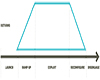
    The lifecycle of any transient competitive advantage typically looks like this:
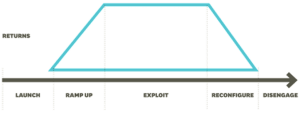
    The growth of transient competitive advantage

    A transient competitive advantage kicks off with a launch procedure during which the company identifies an opportunity and organizes resources required to utilize the opportunity. In this first phase, you need employees who are willing to embrace new ideas and structures. It takes an open mind to understand changing contingencies and create strategies accordingly.

    In the second phase, ramp up, the idea is scaled up. This stage requires employees who have good organizational and planning skills. The required resources with the right quality levels have to be collated at the right time for the idea to materialize into reality.

    The third phase of exploit is where it can be possible for you to gain profits and market share and compel competitors to answer. You need employees who are good at mergers and acquisitions, analytical decision making and are efficient.

    If your competitors do answer your product move in kind, it so happens that the competition you spawned dilutes your advantage. So, you will need to re-configure your advantage to maintain the uniqueness. This stage needs employees who aren’t afraid to juggle the box a little and revisit strategies or resources.

    Examples of Companies Who Adopted Transient Competitive Advantage

    More and more companies are realizing the necessity of transient competitive advantage. Here are a few companies who have adopted the concept:

    • Milliken & Company, a textiles and chemicals company
    • Cognizant, an IT services company
    • Brambles, a logistics company

    The photography business provides us with another example:

    There was another company from the photography industry at the time of the Kodak episode. Fuji, the other player, was also affected by the control of silver of the Hunt brothers. However, what set Fuji apart from Kodak was that it recognized that depending on chemicals whose cost they couldn’t control would always make their business vulnerable. Fuji started investigating opportunities for photography to be less dependent on chemistry.

    Today, Fuji is a leading company in the photography industry with revenue of about $560 billion for fiscal year 2014.

    What are your thoughts on transient competitive advantage? Do tell us in the comments below.

    Image source: Strategy capstone
  • LinkedIn Powers up Search and Google Launches Premium Programmatic Video Marketplace

    LinkedIn updates and Google launches Apps Marketplace

    LinkedIn

    LinkedIn’s burgeoning user base – more than 300 million registered users – has made its search methodology insufficient. LinkedIn’s current search feature that allowed people to search for jobs, groups and other criteria was not catering to its user base.

    As a solution, a new search feature, Galene, was developed by LinkedIn.

    With Galene’s introduction, search will be twice as fast. New aspects with the updated search structure include instant results and suggestions that offer clues when users type in. For example, if you type ‘C++’, LinkedIn will ask you if you are looking for jobs in C++ programming.

    This feature will be rolled out to all users over the next few months.

    Google

    Google is unveiling its programmatic video marketplace, Google Partner Select, with a group of select partners, whose names are yet to be revealed.

    Google Partner Select will connect premium publishers and brands through direct buying. According to Neal Mohan, Google’s VP of display and video advertising products, “This new premium programmatic marketplace will connect a select set of publishers investing in top-quality video with the brands that want to buy against it.”

    Neal also said that this venture will help brands and publishers in leveraging programmatic video buying. Brands want to take advantage of premium video content but are having trouble finding high quality videos. On the other hand, publishers want to exercise control over programmatic.

    Google Partner Select will build a bridge over these troubled waters, meeting the needs of both brands and publishers by bringing together “the best of brand with the best of programmatic.”

    What do these changes mean for marketers?

    Better and quicker LinkedIn search can mean easier content searches for users, especially with the recent boost for LinkedIn Influencers. If content is easy to find, the reader will engage more, which can lead to better conversion rates. This will also help you expand your reach by bringing relevant groups and forums closer to you.

    Google Partner Select will close the gap between brands and publishers in programmatic video buying. Brands can get access to high quality videos while publishers will be getting some control over the process.

  • The Concept of Smart Segmentation

    What is smart segmentation

    You have a large database of leads? That’s great!

    It takes a lot of effort to build one. But worth it since a business’s future is built on leads. A database is only as good as what you do with it. So you need to use it carefully.

    Large disorganized databases are messy to handle. Organizing them would be a good first step.

    Smart segmentation is a system of classifying and categorizing leads based on certain pre-determined stipulations.

    Key Considerations

    Your segments must be:

    • Practical: Not too many, not too few. A rule of thumb suggests 8 is ideal because this tends to be a manageable number.
    • Distinct: Make sure that each segment is markedly different so that you can tailor your messages/ actions for maximum effectiveness.
    • Adaptable to different campaigns: Segment creation should be such that they can be used for varied campaigns.
    • Open to adjustments: Be prepared to make edits to segments based on results and feedback.

    Base Factors

    Customer segmentation needs to be based on certain tangible parameters:

    • Identity
      Know the identity of your customers, they expect it. Maintain a basic profile about your customers with demographical information such as their age, gender, occupation details etc. These factors help you classify leads into appropriate segments.
    • Attitudes & Behavioral Cues
      The different kinds of attitude and behavior that prospects demonstrate gives important cues on how you need to engage with and convert them. Tracking your prospects’ engagement activities will give you valuable inputs for your campaigns.
      Who is opening your emails and who isn’t? Are they looking at your discount offers and moving away without buying? Is discount the only incentive that makes them buy? All these questions give you an idea on handling prospects in different segments.
    • Channels of Engagement
      Know the channels through which customers prefer to hear from you. Successful marketing communication depends on delivering the message through a channel the prospect prefers. Knowledge of customer preference of channels helps develop and target content right with the most impact.
      For example, millennials may prefer being contacted through social media channels but baby boomers may be more partial towards emails. Similarly, younger customers might engage with your brand through apps more but older customers may show preference for your desktop site.
    • Timing
      Sending marketing communication when the prospect is not available or is uninterested is of no use. It’s important to know the best time to approach prospects. Gain understanding of their browsing habits so that you can connect with them when their interest is at the optimum – the time at which they check emails, do product research, shop etc.
    • Current and Future Value of Customers
      Factor in the value customers are adding to your company now and project the value they might add in the future while establishing segments. Knowing the expected value of customers will help in approaching a segment.
      For example it’s one thing to approach a prospect as a one-time buyer of a $100 product and it’s another thing to see the customer as a potential $10,000 business possibility based on the prospect buying a $100 product once a month for the next 10 years.

    Smart segmentation based on measurable factors helps in:

    • The ability to create exclusive campaigns for specific segments
    • Executing more precision-targeted campaigns
    • Customized and more intelligent marketing communication

    Have you implemented ‘smart’ segmentation? What do the results say? Tell us in your comments below…

    Image source

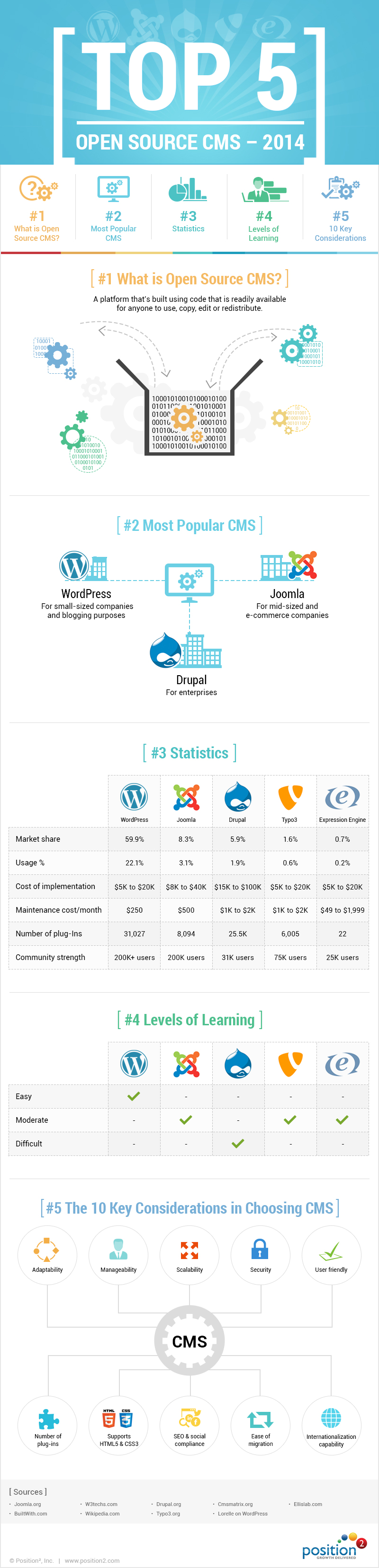
  • [Infographic] Top 5 Open Source CMS of 2014

    Top 5 open source CMS of 2014

    The right Content Management System (CMS) is a crucial business choice any company will make. There are numerous CMSs available. How do you pick the one best for you? How do you know it is the best choice for you? Check out this infographic that studies the top 5 CMSs.