Category: Paid Search

  • Google Tests Capability to Trace Consumers from Mobile Browsers to Apps

    Google Tests Capability to Trace Consumers from Mobile Browsers to Apps

    Google is looking to close the gap between mobile browser and app users in ad targeting.

    Till now, advertisers were treating the same consumers as two separate individuals depending on whether they were using mobile browsers or apps owing to disconnect between the two tracking technologies. Google is going to start testing a means of targeting tablet and smart phone users by connecting the separate tracking mechanisms for mobile browsers and apps. Google is using the cookie in a mobile browser and connecting it to a mobile app’s equivalent of a cookie.

    Once this connection is established, Google can show the same ads to consumers irrespective of whether they are using mobile browsers or apps. Google can also track consumers who saw an ad in a mobile browser and show a follow-up ad on a mobile app.

    This test will help advertisers to run consistent ad campaigns across mobile browsers and apps by using current anonymous identifiers while users can still keep a finger on their privacy controls on Android and iOS. With this capability, advertisers can treat their target audiences as unified groups instead of treating them as separate entities and setting up unconnected ad campaigns. An added advantage is that the capability to trace consumers from mobile browsers to apps makes use of Google’s 2 million+ strong third-party site network and mobile app ad network, AdMob, which can track users and post ads across hundreds of thousands of Android and iOS apps.

    Being able to track consumers as one will help marketers target them with more relevant ads and avoid repetition. Often, it so happens that consumers would have seen a brand’s ad while browsing the web on their mobile device and later when they use an app, they end up seeing the same ad. While repetition sometimes helps in better brand retention, it can also annoy consumers.

    Google’s ability to show follow-up ads can contribute to more conversions since these follow-up ads are not only new for the consumer, they also prompt them to actually take action after introducing the product to them in the previous ad.

    We would like to know your thoughts on this Google move…leave your comments in the box below.

  • The ROI of Constant Innovation

    The ROI of Constant Innovation

    Think of the world of business as a treadmill that’s operating at high speed. If you stand still, you will be flung off!

    Innovation is how you stay on the treadmill. It’s the way to keep moving to survive and thrive in today’s competitive environment.

    Turbulent business times require companies to innovate constantly to maintain their edge in the market. The direction of many business organizations’ thinking is leaning towards the concept of transient competitive advantage. This concept says that a business needs to continuously innovate to stay afloat in the market.

    However, there is a catch here…

    Innovation always entails certain risks. Well, that’s to be expected, isn’t it? After all, innovation involves betting on something that’s hitherto untried and untested…

    But, what do you need to consider before plunging into innovation?

    Can you afford to invest in innovation? Where will the money come from? What can constant innovation cost your company? Who will manage it?

    Often, investment in innovation comes out of funds that would otherwise go into the company reserves strengthening the organization or be distributed as profits/dividends thereby making investors happy. Investing in innovation has an opportunity cost that needs to be quantified to see what ROI justifies the investment. However, not all aspects of this decision can be quantified.

    You should invest in exploring innovative ideas only if you can provide the necessary resources and hold out until your idea turns profitable. There is no point in kicking off ambitious innovative projects only to slacken the pace midway due to financial constraints. All business ventures, especially innovative concepts have a gestation period. It takes considerable time to:

    • Educate your audience about the features
    • Convince them that the product works and delivers what it promises
    • Penetrate the market and get sales going

    There are also other important factors that affect the success of an innovative business venture:

    • Market conditions – how conducive are current market conditions to make space for an innovative product like yours?
    • Latent need in the market for such a product – do you sense a strong need in the market for your innovation?
    • Can you consistently own a lion’s share of the market for your innovation?
    • Premium: It’s likely that you are going to find others copying your innovation and maybe even improving on it in the months to come. Can you charge a premium for the innovation while you are still the first in the market so that you can quickly recoup some of the investment made in the innovation?
    • Competitors’ position – Often innovation is a tool to create a buzz and a favorable image. It’s worth thinking about how your innovation will affect competition and use market intelligence to understand if your competitors are working on something similar that can counter or nullify your innovation.
    • Your marketing strategy – how aggressive and sensitive is your marketing strategy? Is it inclusive of all the above factors?

    Funding Innovation

    Investing in an innovative idea is often worth its while. Creating a separate fund out of your profits, for exploring and supporting innovative ideas is a great way to ensure continued investment in innovation. If you do this, you wouldn’t need to dip into your profits every time someone in your organization comes up with an idea worth checking out. You can just use your ‘innovation fund’.

    The Innovation Manager

    An important factor that you need to consider is the employee in charge of innovation. The best person to manage innovation is someone interested in trying out new ideas and one who is not demotivated by the losses to the division that are inevitable till profits start rolling in.

    Ideally, whoever is handling innovation should be remunerated so that he doesn’t pay the price for the long gestation yet is incentivized if the innovation is successful. Willingness to invest resources and absorb losses is imperative for success in innovation.

    Let’s take a look at two examples of innovative products and their later modifications:

    • The Apple iPhone was a revolutionary innovation. However, the later versions of the iPhone are not innovations in themselves. They are extensions of the original innovation, the iPhone.
    • Another example is the luggage case, which was the innovation idea. The trolleys that are so common today are a modification of this innovative idea.

    What is your opinion about innovation? Are there any other steps a business can take to ensure continued exploration of innovative ideas?

    Image Source

  • Pinterest Builds on Content Curation with Icebergs Acquisition

    Pinterest acquires Icebergs

    Pinterest is strengthening its content curation abilities with its latest acquisition, Barcelona-based startup Icebergs.

    Icebergs is a company that provides a private online space for users to find, organize and collaborate on projects in the form of images, videos and other types of digital content.

    Icebergs’ two co-founders, César Isern and Albert Pereta will join Pinterest’s team in San Francisco. Icebergs’ online service will be shut down and its current users will be asked to migrate their projects by September 1, 2014.

    Though Pinterest is not adding Icebergs’ technology to its platform, this acquisition will add more users to Pinterest’s user base and help Pinterest in improving its content curation offering. Pinterest will be relying on Icebergs co-founders to build technology for the discovery and organization of content on the site.

    Known for its appealing visual content and content curation possibilities, this talent acquisition can help Pinterest in becoming a better content curation platform for marketers. Marketers will then be able to conceptualize and launch great creative projects in richer formats like videos on Pinterest. With more content curation, marketers can collate content from their fans, which effectively ensures that they are using content people are actually interested in.

    Until now, Pinterest was a curation point mostly for images, which can change with the acquisition of Icebergs. Marketers can aim for higher engagement rates with more relevant and interesting content if Pinterest applies Icebergs’ co-founders on a path to bolster its content curation abilities.

    Image Source

  • LinkedIn to Launch New Sales Tool

    Arguably one of the most reputed professional networking sites, LinkedIn, is aiming to befriend sales executives.

    LinkedIn is going to start offering a new tool this week, Sales Navigator, which it says will make the lives of sales people easier and happier.

    Costing $1200 per year, Sales Navigator allows sales people to efficiently look up potential customers who would be more inclined to meet due to shared personal connections. LinkedIn has tested this tool with companies like PayPal and Autodesk and claims to have gained good results.

    LinkedIn says that sales people can turn out better results and be more productive since Sales Navigator lets them contact prospects through known people. Sales Navigator allows you to import existing contacts from Salesforce.com or Microsoft Dynamics. Using this imported data, LinkedIn can bring up more information about those contacts. With the ability to draw more information about contacts imported from other tools like Salesforce, sales people can improve their productivity for prospects arising from platforms other than LinkedIn also

    LinkedIn can also scan contacts’ social data for additional insights that will tell you if people are warm prospects or cold calls. Insight into contacts’ social behavior can enrich and make sales executives’ approach more relevant when contacting prospects.

    LinkedIn will also allow whole companies to pool their sales executives’ connections. This can help sales people to connect with a prospect through another sales person’s connections even if they don’t know the prospect personally.

    However, LinkedIn is also conscious of the effect this feature can have on users. To prevent people from being deluged by mails from sales people, LinkedIn is restricting Sales Navigator users to only 25 targeted InMails every month.

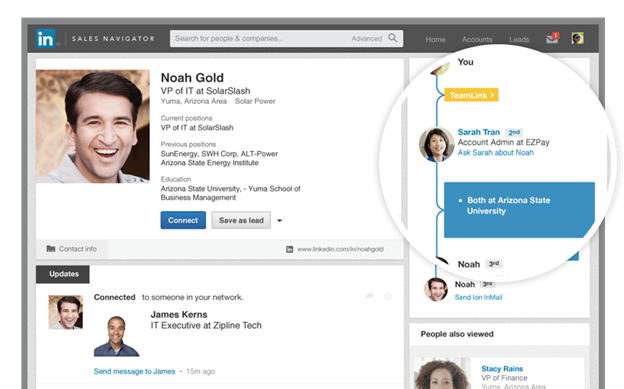
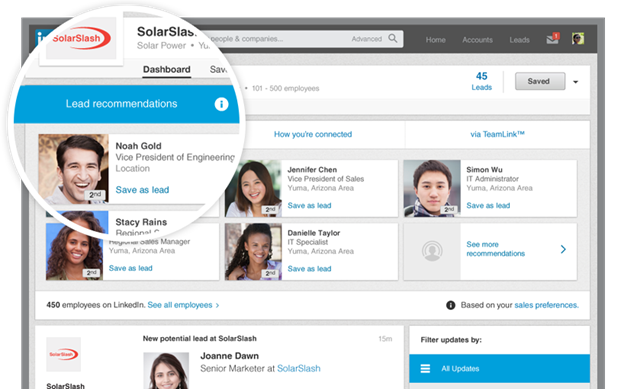
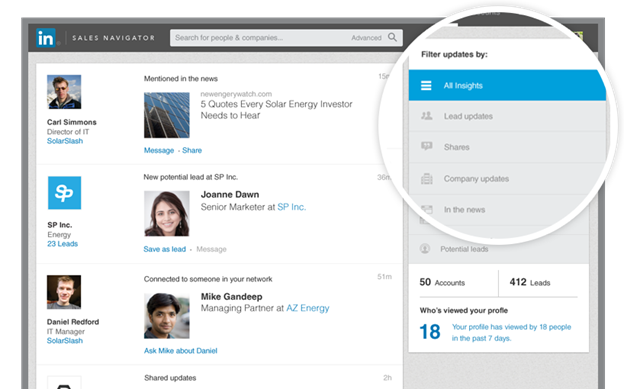
    Check out these screenshots of the Sales Navigator tool:

    LinkedIn's new sales tool


    LinkedIn's new sales tool


    LinkedIn's new sales tool

    Image source: Mashable

    Do you think LinkedIn’s Sales Navigator will benefit sales executives? And, will it be accepted well by users?

  • Geo-targeting, B2B content marketing and much more…| Best of the Week

    This week’s hot news, events and videos from the online marketing and social media world.
    Geo-targeting – 7 Tips to Consider
    From the Position² Blog This Week:
    User targeting is becoming more precise and its importance is increasing in the digital marketing world. Precise and relevant user targeting is essential to ensure better campaign success and geo-targeting is one way of doing it. Read this blog to know more about geo-targeting.
    Top Stories this Week: Social Media
    Top Stories this Week: SEO, PPC and Digital Media
    Best of the Week Video Best of the Week Video
    Check out this video where John Rampton talks to Bob Rains about negative SEO practices prevalent in the industry and how to stop such practices.
    White Paper: Increase Visibility for Your Content by 4x
    Today’s traditional SEO is inadequate: Ignite your search results by accelerating visibility in more places than ever before.Download this White Paper and learn:

    • SEO, why the way we know it is not enough
    • Introducing and implementing Enterprise Visibility Accelerator (EVA)
    • Using multi-channel tracking tools for effective monitoring
    • How EVA benefits businesses.

    Download the complimentary EVA White Paper now

    Know more about Enterprise Visibilty Accelerator(EVA)
    If you are reading this blog post via a RSS reader, please click here to subscribe.
  • Geo-targeting – 7 Tips to Consider

    It’s a common scenario today for brands to have customers in many countries. But, targeting these customers and engaging them is a challenge, owing to their varying preferences and requirements.

    This is where geo-targeting steps in…

    Targeting customers by location is called Geo-targeting. It’s an important aspect of online marketing especially for brands targeting customers in different geographical locations.

    Geo-targeting helps brands address customers using their preferred language and target them with region-specific offers. This increases customers’ brand affinity, engagement and conversions. Google AdWords provides a variety of options and features for geo-targeting.

    However, there are certain important factors you need to consider while planning geo-targeting campaigns:

    1. Your site’s domain

    Some brands have Top Level Domains (TLD) specific to the country they want to provide information for. A ‘.co.uk’ site is specific to the UK and ‘.co.jp’ is specific to Japan. Country specific TLDs make it easy for Google to understand who you are targeting with your information and lets it rank your website appropriately in location specific search results.

    However, with a generic TLD like .com or .org, your website may not appear correctly in search results because Google doesn’t know which location you are targeting. If no information has been entered in the Webmaster tools, Google will look at multiple signals like the IP address, location information on your page, links to your page and any other relevant information from Google Places and pick your website’s country domain. These may not yield you the best results. With generic TLDs, it’s best to give Google the requisite information to improve search ranking for specific locations.

    2. Choose the right geographical areas

    This sounds like a no-brainer, but it’s surprising how often this is missed. Select geographical areas for your campaigns based on your product availability. If your product is available in certain regions of a country, picking those areas will increase the chances of better ad ROI. With Google AdWords, you can achieve precision targeting by postal code targeting.

    3. Optimize By Exclusion

    Optimize your effectiveness by leaving out areas that are delivering low responses. You can get back to these areas with a revised strategy. After the first run of your campaign, you may notice that your ads have low ROI in certain areas or your products may not have a market in some regions due to geographical factors. You can optimize your ROI by cutting out non-performing areas. Concentrate more on the areas that are generating the highest number of clicks. You can also try bidding less on the areas that have low traction.

    4. Include mobile devices

    If most of your target audience is on their mobile devices for considerable amounts of time, you should geo-target your mobile audience also. If you are using Google AdWords call extensions and tracing a significant part of your conversions through calls, geo-targeting on mobile devices will be even more beneficial for your business.

    People use mobile devices when they are on the go and would be looking for deals that are nearby. Geo-targeting mobile users is highly beneficial because, you can then target them with not only offers in establishments they are close to, you can also roll out geo-specific offers.

    5. Use the appropriate languages and currency

    Matching your web pages’ language with the main languages of the region is a major aspect of geo targeting that influences traffic and engagement. Provide content in different languages and use a drop down menu that allows users to select the language/region they are accessing the site from. This is an effective way to ensure users can consume content easily. Another way to make your site easy to use is to build it so that it reads the user’s IP address and displays content in the main language of that region.

    You also need to focus on the currencies that your site uses to process transactions. Offer the right currency depending on the geographical area the user is browsing from. You can also offer currency options and leave the choice up to customers.

    6. Offer coupons and deals

    The marketing strategy for each market is different. So, it’s important to sync your offers and deals with the visitor’s geographical area. You can either track users’ IP addresses or you can provide menus for users to select from before providing region-wise offers. Localized offers and deals are more relevant to visitors as they cater to specific market requirements and can therefore help in driving conversions.

    7. Run tests

    Everything may not go as planned so it’s best to run tests to see if your effectiveness is indeed going up or whether you need to tweak any part of your strategy. Different people react differently to changes, even minor ones and it’s best to use this as an opportunity to improvise further.

    Do you have anything to add to this? Let us know in your comments!

  • Why B2B Companies Shouldn’t Skip Video Marketing [Infographic]

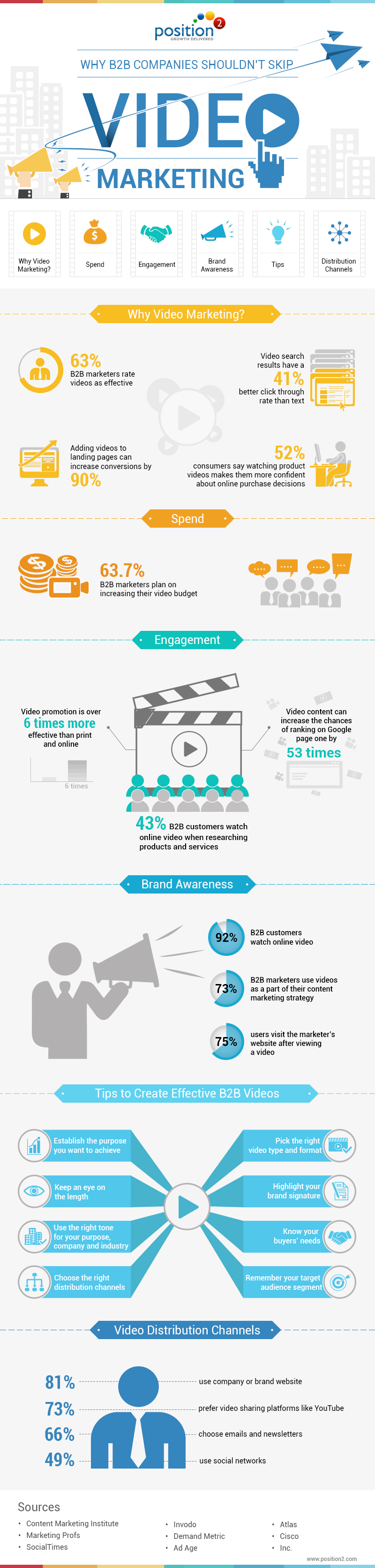
    Video is emerging as a major crucial tool for B2B marketers. Whether it is for engagement or brand awareness, marketers are adding videos as a tool in their marketing arsenal. Check out this visual representation of the world of video marketing for B2B.

    Use of video marketing in B2B space

  • LinkedIn acquires Bizo and Launches Direct Sponsored Content

    LinkedIn & Bizo

    LinkedIn has acquired B2B ad tech company Bizo in a deal costing approximately $175 million. LinkedIn acquires Bizo

    This acquisition comes after Facebook bought LiveRail and Twitter purchased TapCommerce recently. These moves by social networks are aimed at bolstering their ad reach beyond the boundaries of their websites.

    Bizo enables B2B marketers to post ads to professional target audiences across the web. Bizo is integrated with marketing automation platforms and also has a database that will help marketers target by company, industry and functional area parameters. Bizo helps marketers nurture prospects at every stage of the buying funnel through targeted content and supports precise and measurable multi-channel marketing programs.

    Bizo’s targeting capabilities coupled with LinkedIn’s large professional network can help B2B marketers improve performance of multi-channel campaigns.

    LinkedIn Direct Sponsored Content (DSC)

    LinkedIn’s acquisition of Bizo was closely followed by the launch of a new feature, Direct Sponsored Content (DSC), which will help marketers reach out to specific audiences with more personalized content.

    DSC is an extension of LinkedIn’s Sponsored Updates. DSC enables marketers to publish sponsored content to their LinkedIn homepage feed without posting it on the Company Page. DSC can be viewed by page administrators on the Company Page but it will show only for those users who fit the target criteria specified for the campaign. The launch of DSC will allow marketers to target and engage with the right members of the target audience using more personalized content.

    Earlier, with Sponsored Updates, marketers had to post content to their Company Page. If they wanted to test an ad, they had to repeatedly post ads on the Company Page to measure the audience’s reaction. It was very likely that users would get irked by this. Marketers collected a mix of organic and paid results and could not measure the performance of posts accurately.

    DSC now allows marketers to optimize content according to the preferences of specific consumers and conduct A/B tests across audience segments.

    Will LinkedIn’s acquisition of Bizo achieve the desired results? Can Direct Sponsored Content (DSC) contribute to LinkedIn targeting and personalization capabilities?

    Image Source: Bizo 

  • New Patent Enables Marketers to Tie Sales to Specific TV Ads

    New patent allows marketers to tie sales to TV ads

    AOL’s Adap.tv’s new patent allows it to tie consumer sales to specific television advertisements. This helps marketers to connect conversions with television advertising better.

    The new patent involves a system which can recognize conversions stemming from television and based on the study of those patterns, can predict the possibility of future conversions. For companies, activating this online conversion attribution capability is as simple as adding conversion tracking script on their websites.

    Sales will be measured against audiences who have been exposed to your ads and those who haven’t been. This system measures the total change among those groups and provides capabilities for real-time analytics. Being able to access real-time analytics is a huge plus compared to the earlier scenario where this data was available once in a quarter or a year.

    Using this technology, marketers can understand the capability of their TV or digital advertising in driving sales. It also helps marketers to have a more complete view of the performance of their marketing campaigns across channels. Marketers can track conversions to a specific ad and also to a particular airing time. This will be a lot of help for marketers during budget allocation for television and optimizing effective ads.

    Inability to trace conversions to their TV ad campaigns has long been a pain point for marketers. Such capabilities are steps towards addressing this concern as well as bringing together TV and online advertising.

    What do you think about this analytical capability? Let us know in your comments…

    Image source

  • Facebook is Testing ‘Buy’ Button and Twitter Acquires Payments Startup CardSpring

    Facebook

    The social behemoth is testing a new ‘Buy’ button that will let users purchase products without leaving the site. If launched, brands can use this feature to drive sales from News Feed and their Pages.

    Users can now click the ‘Buy’ CTA on ads and Page posts and purchase directly from a brand. Facebook is Testing 'Buy' Button

    Facebook assures users of privacy when using this feature. It says that it will not share with advertisers any of the credit and debit card information users share with Facebook. Users can also select whether they would like to save payment information or not.

    This test is being run with a few small and medium-sized businesses in the US. Facebook says that it will share more information after receiving feedback.

    This feature will allow for more Facebook-driven sales since users don’t have to leave the social network to make purchases. Often, the need to leave the site deters users from purchasing from social networks. If implemented, the ‘Buy’ button can increase sales for brands thereby driving better Facebook ad ROI while making it easier for users to shop on the site.

    Twitter

    The social network is in the news again, this time for the acquisition of payments infrastructure startup, CardSpring.

    This move by Twitter is being seen as an effort to strengthen its e-commerce offerings to increase revenue. CardSpring lets developers build applications for credit cards, discount coupons and other payment systems. Users can collect sales offers, sync them with credit card and collect at stores later.

    CardSpring can help Twitter boost ‘on the spur of the moment’ purchases. As soon as users spot great offers on Tweets, they can immediately purchase with CardSpring’s technology. Along with breathing life into Twitter’s revenue, this technology can also set up Twitter as a name for impulse purchases. This feature will also help users cash in on quick, on the spot deals.