Category: Digital Marketing

  • AI and the Creative Process: What the Future Holds

    Research into AI has been ongoing since the first computers were made—the idea of a computer able to think and reason fascinated and enthralled in equal measure. Multiple attempts were made over the years with varying degrees of success. We’re seeing the fruits of that research with the rapid growth of generative and conversational AI.

    The Impact of AI

    AI is already disrupting many fields such as content, design, and device management. Marketing, medical sciences, pharmacology, coding, data science, sales, logistics, defense, and more are seeing the benefits of AI. Surveys across the marketing spectrum show that attitudes toward adopting AI are increasingly positive. Eighty-eight percent of marketers believe that AI and automation are necessary for organizations to stay competitive. The question arises – can AI be creative?

    AI and the Creative Industries – Can They Work Together?

    AI combines various disciplines and methods—collecting and analyzing vast amounts of data to create relevant content. A blend of Natural Language Models, Machine Learning, Deep Learning, and other methodologies enables AIs to learn to create unique creative content with input from artists and other creatives. AI collects and analyzes information from across the web, and distills and learns from it, creating content based on specific prompts provided. It isn’t limited to words or images. It’s possible to create anything imaginable.

    • Graphics design
    • Copywriting
    • Content creation
    • Marketing
    • Art
    • Music
    • Game development

    Generative AI has many roles in every creative field that relies on human input to learn, understand, and make correlations to generate content. Although there are concerns that the disruption caused by AI might overwhelm industries, forcing layoffs and job losses – human intervention will still be needed. Seventy-seven percent of respondents to a Forbes survey believe that the next year will see significant job losses to AI.

    AI is expected to improve productivity, helping creators work faster and create more. AI applications like ChatGPT, Midjourney, and others are rapidly gaining prominence for their ease of use. They have even been used to generate assignments and work-related documents.

    This comes with potential risks. Harvard Business Review theorizes three plausible scenarios: AI-assisted Innovation, AI monopolizing creativity, and human creative works commanding a premium over AI-generated content. Here are a few creative industries where AI plays a significant role.

    Graphic Design

    AI significantly helps streamline digital design. With specific input from graphic designers, AI can remove backgrounds, selectively blur images, and erase parts of images. This reduces the time designers spend on minute details, allowing them to focus on the overarching concept. Specific AI applications using Natural Language Processing can create completed images based on concept descriptions provided by designers, writers, and content creators. AI in graphic design speeds up creation and helps develop more assets with minimal downtime.

    Copywriting

    Copywriters are an integral part of any marketing effort. With AI, copywriters can speed up content creation with specific inputs, simplify long-form content creation, and deliver quality content. Information and research are also made more accessible, thanks to AI’s connection to the broader information pool of the internet. AI-assisted copywriting can also help create social posts, plan calendars, schedule posts, and more, thanks to the power of AI.

    Content Creation

    Content is not limited to design and copywriting. There are video creators, and influencers creating content for social media, contests, blogs, and more. AI in content creation helps reduce the workload and streamlines the process. Creators armed with a clear concept can direct AI to create content tailored to specific audiences, develop games, launch websites quickly, and make videos.

    Marketing

    Marketers handle many diverse tasks during any given day. They manage social media, create calendars, interact with customers, respond to queries, conduct keyword research, optimize content, and publish blogs. AI can help marketers plan their efforts, automate regular tasks, monitor results, spot trends, identify gaps in communication strategy, track ROI, keep track of leads, and make reaching out to them more accessible. AI in marketing can reduce the time taken to find results, collate, and understand large amounts of data compared to humans.

    Art

    Artists also benefit from AI by using it to bring their imaginations to life. AI can help plan sculptures, create paintings, digital artwork, and more. We are already seeing the use of AI to create digital art, clothing, shoes, and NFTs, to name a few.

    Artists can create new designs, artwork, architecture, pottery, and kinetic art. AI-generated art is already taking the world by storm. AI Apps like MidJourney, ChatGPT, DALL-E 2, Adobe, and NVIDIA Canvas drive the art scene to new heights.

    Music

    Musical artists can use AI to make new beats, arrange musical scores, and write lyrics. The AI even helps find new platforms to self-publish music, reach out to audiences, and manage their career. AI in music has an everyday use too. Apps that help users identify tracks are increasingly common. Artists can sample tracks and combine them in new ways without track software. AI can also quickly solve copyright issues by identifying samples and finding the rights holders. AI-generated music is rising to new heights.

    Game Development

    Game development is a tedious job that requires hundreds of designers, QA testers, debuggers, storyboarders, and coders to create them. It’s a job with updates, patches, and extra content – every game at release, ships with plenty of bugs. AI can help streamline the process—identify bugs, apply fixes, write short dialogues, and shape player interactions.

    Deep learning already plays a role in gaming by helping create true-to-life lighting effects, clearer accurate audio, and control framerates for an optimal gaming experience. AI in game development helps plan paths to navigating in-game worlds and create non-player characters (NPCs) that can make decisions and react to stimuli and environmental physics.

    The Future of AI

    AI plays many significant roles today, and continued development will lead to it taking more and more functions in the future: medical, economic, sociological, law, and more. AI developments will lead to new scientific breakthroughs and exploration.

    AI will significantly impact our daily lives. It is already aiding jobs, reducing the burden on companies, and the need for extensive human resources. It has the potential to open up new job roles and alternative pursuits. It’s all speculative at this point, but AI has and will continue to have a significant role to play.

  • Large Vision Models (LVMs): The next branch on the evolutionary tree and how it can help Marketers

    “The highest education is that which does not merely give us information but makes our life in harmony with all its existence” – Tagore

    Andrew Ng gave an interview to EE Times in early September 2023, where he talked about the next AI revolution coming to images and about a future with LVMs (Large Vision Models).

    What is an LVM?

    Large Language Models (LLMs) are now well-known thanks to ChatGPT’s phenomenal success. They can analyze and comprehend vast volumes of sophisticated data, including text, images, and other types of information, making them unique. These models analyze and learn from enormous volumes of data using deep learning techniques, which enables them to spot patterns, forecast the future, and produce high-quality results. Large language models’ capacity to build natural language material that closely mimics human writing is one of their main features. These models are helpful for applications like language translation, content generation, and chatbots since they can generate logical and persuasive written passages on various subjects. Similarly, LVMs can recognize and classify images with astounding precision. They can produce in-depth descriptions of what they see and recognize items, scenes, and even emotions that are depicted in photographs. These models’ distinctive abilities have several real-world applications in areas like artificial intelligence, computer vision, and natural language processing, and they have the potential to alter how we use technology and handle data fundamentally.

    The applications of this are enormous. Imagine a computer looking into human tissues and counting the exact number of cancer cells. LVMs combined with the ever-evolving LLMs can count, classify, and predict the stage and rate of progression.

    And like LLMs, LVMs can be trained through a technique called Visual Prompting. In this technique, a user prompts the model to produce the desired output by suggesting a pattern or image that the model has been trained to recognize and respond to in a certain way.

    Here is an Example

    Cell detection

    Cell Detection Left side Img
    Cell Detection Right side Img

    On the left: We have the visual prompt showing the system a white space (long stroke) and on a cell by a dot.
    On the Right: The system has detected cells on the petri dish, ignoring the empty space.

    Some examples of LVMs are

    CLIP: Developed by OpenAI, CLIP (Contrastive Language–Image Pretraining) is a vision-language model that’s trained to understand images in conjunction with natural language.

    Google’s Vision Transformer: Also called ViT is a model for image classification that employs a Transformer-like architecture over patches of the image. An image is split into fixed-size patches, each of them is then linearly embedded, position embeddings are added, and the resulting sequence of vectors is fed to a standard Transformer encoder. This is now trained on 22 billion parameters. You can read about the latest update here.

    LandingAi: Their flagship product, LandingLens™, is designed to make computer vision accessible to everyone. It provides an intuitive platform to create a custom computer vision project in minutes. You can upload images directly into LandingLens, label objects in your images, train your model, evaluate its performance, and deploy it to the cloud or edge devices.

    What’s in it for Marketers?

    Large Visual Models (LVMs) can be beneficial in several ways. Here are a few examples:

    1. Data Analysis and Insights: LVMs can analyze large volumes of social media data, including text, images, and videos, to extract valuable insights. By applying natural language processing (NLP) and computer vision techniques, LVMs can identify trends, sentiments, topics, and key influencers in social media conversations.
    2. Social Listening and Monitoring: LVMs can help monitor social media platforms in real time to track brand mentions, customer feedback, and emerging trends. Marketers can gain a deeper understanding of customer preferences, sentiment, and engagement levels by analyzing social media data.
    3. Image and Video Analysis: LVMs excel at image and video analysis tasks, enabling marketers to analyze visual content. They can identify objects, scenes, and logos – even detecting inappropriate or harmful content.
    4. Social Media Advertising: LVMs can enhance social media advertising campaigns by analyzing user behavior, interests, and demographics. Marketers can leverage LVM-generated insights to target specific audience segments effectively and optimize ad placements for better performance.
    5. Social Media Influencer Identification: LVMs can assist in identifying relevant influencers for influencer marketing campaigns. Analyzing social media data and engagement metrics can help marketers find influencers who align with their brand values – having an authentic connection with their target audience.
    6. Customer Segmentation: Large vision models can analyze customer data and segment customers based on their behavior and preferences. This allows businesses to target specific segments with personalized marketing messages, thereby enhancing the customer experience and increasing CLV.
    7. Optimizing Marketing Spend: By identifying high-value customers, businesses can optimize their marketing spend to focus on retaining these customers and acquiring similar ones. This targeted approach can lead to a higher return on investment and increased CLV.

    To realize some of these benefits above; the LVMs will need to be used in conjunction with LLMs.

    LVMs are far from perfect and have a few issues related to hallucinations, labeling issues, biases, and privacy concerns but these current offerings will continue to evolve and find their place in the future of Marketing.

  • The way forward: AI and UX design in thoughtful synergy

    The road behind, the path ahead

    Though Artificial Intelligence (AI) as a field has origins dating back to the 1950s and user experience (UX) design first came about in the 1980s, the rise of personal computing and the demand for usability fueled advancements in AI and UX design.

    Despite AI and UX efforts gaining attention, their trajectories diverged considerably over time. While AI seeks to make machines act intelligently, UX optimizes designs for human thinking and behavior. Their motivations were linked, but their approaches were different.

    Research in AI and UX gathered pace as individual disciplines for many years, though some interactive AI research looked at usability. With AI enhancing UX design of late, their paths have converged, yet again. However, the key differences remain in their focus, which shows AI cannot fully take over UX. UX will still require those uniquely human perspectives.

    UX emphasizes on:

    • Emotions
    • Intuition
    • Social cues
    • Qualitative insights
    • Subjective creativity
    • Emotional intelligence

    AI emphasizes on:

    • Data analysis
    • Predictive modeling
    • Quantitative insights
    • Iterative testing

    Potential for AI

    AI’s immense potential awakens both awe and apprehension. The rapid advances in AI are showing us glimpses of a future that was only confined to science fiction. AI systems now match or surpass human expertise in certain areas. It automates routine tasks and augments human abilities, it is awe inspiring as we understand how AI could transform our world.

    The marvel lies in imagining how AI might evolve and what new potential could emerge from digital minds. A total of 5 new AI unicorns emerged in Q1’23 — the same rate as the previous quarter. Generative AI companies accounted for a gaining valuation of $1B or above. Because of its fast-paced adoption, AI is making waves in various industries.

    However, AI’s Black Box nature pauses can bring up feelings of apprehension. The prospect for AI seems endless, but every progress has growing pains.

    Uncovering the synergies of AI & UX design

    UX is pivotal for creating effective, enjoyable digital experiences. Meanwhile, AI presents an intriguing potential for optimizing UX. Recent research by Forbes Agency Council shows applications with excellent UX design can increase conversion rates by 400%, compared to just 200% for poor UX.

    To many, AI is the future of UX design. By leveraging data and algorithms, AI can unlock new directions for engaging users. However, thoughtfully integrating AI in UX introduces complex challenges that must maintain human-centered practices.

    While AI has demonstrated the ability to strengthen UX, human creativity and oversight remain essential. UX designers have a crucial role in guiding AI ethically and responsibly. With diligence, AI’s data-driven capabilities can synergize with UX principles to create captivating, inclusive experiences.

    While UX designers guide the user journey, and AI engineers enable the predictive brain, this fusion allows incredibly personalized and futuristic interfaces today. With AI continually learning from real-world usage data, the systems get smarter over time. The future is exciting for UX designers who are guiding AI-infused design processes.

    7 ways AI helps us in UX design

    1. Enhance user research
    AI can conduct user interviews and analyze qualitative data to uncover insights. AI tools like NLP (Natural Language Processing) analyze interviews and open-ended survey responses to find sentiment, themes, and insights faster than manual analysis giving rich qualitative data to inform designs.

    2. Visual design assistance
    AI can suggest aesthetically pleasing color schemes, font pairings, layouts, and more based on data. Some generative AI tools like Midjourney create aesthetically pleasing graphics, illustrations, and layouts. The AI rapidly generates numerous on-brand options for us to select from and refine.

    3. Powers hyper-personalization
    AI uses data like demographics, behaviors, and preferences to suggest personalized experiences. Leveraging user data with machine learning algorithms, AI can curate tailored content and product recommendations.

    75% of Netflix users select films recommended to them by the company’s machine-learning algorithms.

    4. Accessibility and inclusive design
    AI can scan interfaces and suggest changes to improve accessibility for users with disabilities. AI-powered accessibility scanners like AudioEye can be used to catch issues early in the design process. These tools flag problems like low color contrast, missing alt text, and insufficient sizing for low-vision users. Fixing these UX barriers before launch helps meet WCAG standards and improve inclusive experiences. Microsoft’s ‘People lens’ uses computer vision to describe environments for blind users audibly.

    5. Performance optimization
    AI analyzes technical elements like code, assets, and infrastructure to suggest performance improvements. Sentry.io analysis tools reduce page load times by 350+ milliseconds by crunching assets and suggesting image compression.

    6. Automates design workflows
    AI can batch process repetitive design tasks like resizing images and creating multiple variations. It helps save designers tremendous time on repetitive tasks by automatically batch editing, reformatting, and processing design system assets. It enables them to focus their creativity on high-value work like ideation and complex layout problems that only humans can tackle.

    7. Facilitates user testing
    AI can create and analyze virtual users to test interfaces. We leverage AI to generate thousands of synthetic test users with diverse behaviors to test designs at scale before launch. This technique uncovers significant issues on projects that would have impacted retention.

    What AI Can’t Do

    AI has its limitations. It lacks human judgment, intuition, and creativity. AI cannot ask intelligent follow-up questions, read between the lines, or infer underlying emotions and unspoken needs. Nor can it synthesize findings into innovative solutions. Relying solely on AI could lead to superficial insights and ineffective designs that lack empathy.

    The key is finding the right balance. While AI can provide data-driven insights, it may not be able to generate creative and innovative ideas for improving the user experience. This is something that only UX researchers can do.

    A report by user interviews confirms a fifth of researchers are currently using AI in their research; an additional 38% plan to incorporate it in the future.

    AI-infused UX design at Position2

    At Position2, we are putting what we believe into practice. We incorporate AI to enhance our understanding of users and design experiences. AI has become an inseparable team player, augmenting our designers rather than replacing them.

    We analyze and restructure the recommendations to understand why an AI made certain creative choices or user recommendations before applying them. For client projects, we are upfront about how we use AI. We provide summaries or descriptions of AI reasoning where feasible.

    We’ve had teething problems when we began our incorporating AI, but we also keep improving how we combine AI abilities with human creativity. The combination is enabling us to deliver incredibly personalized experiences for our clients. We are eager to see how much more AI can improve our work.

    The future of AI is here

    Our selective integration of AI into the UX process can benefit your organization in exciting ways. Our clients have responded enthusiastically as AI-assisted research provides rapid insights to enhance digital experiences strategically.

    AI efficiently tests innovative interface variations to help engage your users. And data-driven personalization powered by responsible AI implementation allows you to connect with diverse customer bases.

    We are already seeing promising new directions from collaborating with clients to incorporate AI capabilities thoughtfully. Together, we can brainstorm additional applications of emerging AI, like contextual reasoning and sentiment analysis, to make your interfaces highly intuitive and responsive. The positive reception from clients motivates us to continue exploring how AI can judiciously provide organizations with new tangents to elevate UX to the next level.

    If you share our passion for leveraging technology to better connect people and businesses, then we invite you to join our journey. Let’s keep growing together as AI and UX continue to transform possibilities. Contact us today to discuss how we can collaborate to create unmatched digital engagement through design.

    FAQ’s

    1. What is the difference between AI and UX design?

    AI focuses on making machines act intelligently through data analysis and algorithms. UX design optimizes the user experience and interfaces for how humans think and behave, using qualitative insights and subjective creativity.

    2. Why is AI now being used in UX design?

    Recent advances have allowed AI to analyze user data and suggest improvements to UX design. AI can quickly test variations, personalize content, and automate repetitive tasks. This frees designers to focus on creative strategy.

    3. Doesn’t AI threaten to replace UX designers?

    While AI can aid and enhance the work of UX designers, unique human skills like emotional intelligence, subjective creativity, and qualitative judgement remain essential. AI does not fully replace the need for human-centered UX oversight.

    4. How can AI make experiences more personalized?

    By studying user demographics, behaviors, and preferences, AI algorithms can tailor content and product recommendations individually for each customer. This creates highly customized experiences.

    5. What are some limitations of current AI?

    Present AI still has limitations like requiring massive training data, being prone to perpetuating biases and lacking general reasoning skills. Thoughtful human guidance is key to steering AI responsibly and overriding problematic recommendations.

    6. How can UX designers prepare for an AI-powered future?

    UX designers should focus on honing high-level creative and strategic skills. They should also stay current on AI advancements to guide integration thoughtfully. With human creativity guiding responsible AI usage, AI can unlock new potential in UX.

  • Redefining Business with AI-powered Business Processes

    It’s a known fact that businesses worldwide are on the lookout for ways to improve their bottom line and increase profits. They’re all chasing optimum efficiency to meet those ends. Artificial Intelligence (AI) and Machine Learning (ML) can help improve business processes.

    Large data firms and organizations pioneer the exploration of AI for improving business processes. The best-kept secret, however, is that even small businesses can benefit from able deployment of AI and ML in their business processes.

    How, you may ask? While artificial intelligence can redesign business processes, machine learning algorithms can streamline the existing business process automation, making businesses more profitable.

    AI for Business Process Automation

    Employing technology to automate any process while negating human intervention is called Process automation. Repetitive tasks can drive monotony in operations, impacting productivity, and these jobs beg to be automated. Automation doesn’t necessarily involve massive robots like on the industry floor. Even unassuming software can replace humans in specific tasks.

    There are plenty of examples of business process automation with AI that are readily available. NASA used several RPA (Robotic Process Automation) systems to automate payments, spending, and HR. The effortless implementation of RPA systems at NASA made Jim Walker, the leader behind these projects, quip, “So far, it’s not rocket science.

    Updating Process Reengineering

    Technology in the 90s was predominantly transactional and communications-based. It enabled efficient data capture and transfer within and across organizations. It’s the same job that AI does as well.

    However, AI trains from large datasets to make predictions or classifications, helping businesses make better operational decisions faster. It improves efficiency by producing better outcomes.

    AI implementation costs have drastically dropped in recent years. AI is now within general reach, thanks to falling computing costs, wide availability of the cloud, growth of low-cost bandwidth, and reduced cost of sensors. AI is now offered “off the shelf” for various business cases.

    Deploying AI systems into business processes has drastically brought about changes. Due to AI, there is an uptick in visual image recognition and inspection, autonomous operations, and new content generation.

    AI Drives Business Process Reengineering

    AI-driven re-engineering is now gradually replacing robotic process automation (RPA) technologies which was the hallmark of any business process. Innovative companies are embedding AI into business processes as the rationale for a new look at end-to-end processes. Harnessing AI is significantly advantageous as businesses can now decide what humans and machines will do in their operations.

    In a retail industry scenario, data directly comes from users/customers. AI can effectively unclutter big data from plain data through cognitive insight implementation. AI learns from the customer’s patterns, trends, preferences, and specifications and utilizes its gained knowledge to satisfy them.

    You might have often wondered how Amazon gets precise recommendations on what you should buy next. Amazon has the ability to collect big data about its customers and run it through machine learning algorithms.

    Key Benefits of AI-Powered Business Processes

    • Increased Efficiency: AI automates manual tasks, reduces human error, and boosts productivity, allowing employees to focus on high-value activities.
    • Enhanced Decision-Making: AI analyzes vast amounts of data, providing actionable insights that enable data-driven decision-making, leading to better outcomes.
    • Improved Customer Experience: AI enables personalized and proactive customer interactions, enhancing satisfaction and loyalty.
    • Innovation Catalyst: AI-powered processes unlock new possibilities for innovation, enabling organizations to develop novel products, services, and business models.

    Overcoming Challenges

    • Data Quality and Availability: Ensuring data accuracy, completeness, and accessibility is crucial for AI-powered processes to deliver reliable results.
    • Ethical Considerations: Addressing ethical concerns, such as data privacy, algorithmic bias, and transparency, to build trust and mitigate risks.
    • Change Management: Changes to management strategies, including employee training and stakeholder buy-in.

    Best Practices for AI-Powered business processes

    • Start with a clear strategy: Define objectives and identify processes where AI can deliver the most significant impact.
    • Data-Driven Approach: Collect and curate high-quality data, ensuring it aligns with the objectives of AI-powered processes.
    • Collaboration: Foster a culture that embraces collaboration between AI and human workers, leveraging the strengths of both.
    • Continuous Learning and Adaptation: Regularly update and refine to keep pace with changing business requirements and data patterns.

    Can AI Optimize Business Processes?

    The answer is yes. Now, more than ever, organizations are finding ways to make their business more efficient, streamlined, cost-effective, and able to better cope with the evolving market needs.

    Artificial intelligence-driven automation is the way forward, helping organizations achieve all this. AI, aided by the findings of deep learning and machine learning algorithms, has the power to optimize business processes and be effective in any scenario.

    These are how AI can help businesses.

    AI to optimize sales and marketing

    Many CRM solutions incorporate AI analytics to enable sales teams to generate valuable insights automatically. AI can be a boon for retailers in planning store layouts, organizing inventory, and predicting customer buying preferences.

    Sales and marketing businesses can entirely rely on AI to boost their transactions, so much so that it can predict which customers are most likely to generate more revenue.

    With such relevant information, salespeople can focus their time and energy on where it matters the most. Companies can depend on AI for their marketing activities by targeting ads to the exact target audience helping secure a prospective conversion.

    AI in manufacturing process

    The manufacturing sector has been pioneering in automation and robotics for a long time. Intelligent automation in manufacturing can let humans work together with robots and prevent accidents. It has given rise to “cobots,” or collaborative robots. AIs are affordable, easy to program, and fast to set up.

    AI in recruitment

    Imagine the HR department of a company peering over hundreds of job applications to zero in on the right candidate for a job. Screening them one by one would eat into resources, taking many people and too much time to do the task.

    Enter AI-powered recruitment. Algorithms perform data analytics on all job applications. It can help determine and eliminate unsuitable candidates, saving time and money and removing the subjective factor in decision-making.

    Unilever has cut down over 70,000 person-hours of interviewing and assessing candidates due to automated screening of candidates.

    AI in content generation

    AI tools can write engaging and informative copy. It can create ads, promo videos, websites, product descriptions, social media posts, white papers, flyers, etc., to improve company sales and deliver exceptional results in seconds.

    E-commerce giant Alibaba has developed an AI-CopyWriter that’s capable of generating more than 20,000 lines of copy in just one second.

    AI in Security

    Companies must go the extra mile to safeguard data privacy. AI security systems and AI models based on Deep learning methods have proven to better detect hackers and fraud attempts.

    AI in product development processes

    Generative design is a cutting-edge field that uses AI to augment the creative process. Just input your design preferences, goals, requirements and let the generative design software explore all the permutation combinations of your design.

    Quickly generate multiple designs from a single idea or prompt. This generative design software saves organizations many hours and the expense of creating prototypes that don’t deliver.

    Conclusion

    AI-powered business processes offer organizations unparalleled opportunities to optimize operations, make data-driven decisions, and drive innovation. Businesses can gain a competitive edge in today’s fast-paced digital landscape by leveraging the latest advancements in AI technologies.

    AI is now booming and pretty much an omnipresent technology. Once the buzz around AI recedes, it will become as standard as yesteryear’s ERP systems or, even as common as a spreadsheet.

    Companies and organizations will embed AI in business processes to re-engineer their current and existing processes. Businesses need AI to improve their daily routine. However, implementing AI-powered business processes requires careful planning, addressing challenges, and adhering to best practices.

    The latest statistics, facts, and credible sources provide businesses with valuable insights to embark on a successful AI journey. Organizations with a strategic approach can harness the power of AI, unlocking efficiency and innovation that propels them toward sustainable growth and success.

    Artificial Intelligence is a means to an end, not the end. Organizations that understand AI and harness it in their process engineering will get the most from AI in the long run.

  • AI marketing ethics: How marketers should ride the wave?

    Imagine this: you’re a marketer striving to boost conversions and offer exceptional customer experiences, having a smart assistant by your side, working tirelessly to analyze data, optimize your campaigns, and engage with your customers. Sounds like a dream? With Artificial Intelligence (AI), this dream can become a reality.

    The market for AI in marketing will exceed $35 billion next year, nearly tripling in size in only four years. Statisticians expect that marketers will utilize AI to a value of nearly $108 million before the end of this decade.

    From bots to brilliance: What is AI in marketing?

    AI has become one of the most impactful innovations of the modern age. Although Generative AI has been around for years – we have seen a rapid pace of creation and release of these tools – it hasn’t taken long to make an impact in the business world.

    AI is already deeply embedded into the marketing landscape too, and most industry experts integrate some form of AI technology into their marketing activities. This vast adaptation of AI in sales and marketing is no surprise considering that its benefits include the following:

    • Automation of repetitive tasks
    • Analysis of large quantities of data
    • Personalization of campaigns
    • Predicting conversion rates
    • Optimizing the timing of email marketing

    Virtually every business now has multiple AI systems and counts the implementation of AI as integral to their business strategy. Early on, it was surmised that the future of AI would involve the automation of simple redundant tasks requiring low-level decision-making. Instead, AI has quickly evolved in finesse, owing to more powerful computers and access to massive data sets.

    The emergence of AI in marketing comes with various associated ethical implications. Business leaders have a responsibility regarding the ethics of AI in marketing efforts.

    AI marketing ethics: Dilemmas mount as AI takes a bigger role

    Applications of AI are proliferating as marketing teams leverage it to hypercharge their marketing efforts in creating content that was unthinkable one year ago. Generative AI tools used carelessly or improperly can create massive problems just as fast as they resolve them. The biggest concerns of AI marketing ethics are:

    • Privacy and security concerns
    • Social and environmental well-being concerns
    • Reliability concerns

    Ethics of AI in marketing: What and why?

    Marketing involves content and data collection. These efforts have the potential to be misused, leading to privacy violations, discrimination, and manipulation. AI further complicates the situation by allowing for greater scale and precision in these activities.

    Implementing ethical frameworks, guidelines, regulatory frameworks, and policies can help mitigate these concerns. Here are some key insights for marketers and policymakers to navigate the ethics of AI in marketing and ensure the responsible use of AI in marketing practices.

    Finding the balance between privacy and personalization

    AI has the significant ability to personalize advertisements and campaigns for individual users. AI can tailor marketing messages to be more relevant and effective by analyzing customer behavior, preferences, and other demographic details.

    However, obtaining data that allows for creating this hyper-personalized content may be in contention with data privacy laws.

    Anonymity takes a back burner when consumers find value in personalized experiences. Businesses will often use this information to offer what feels like spam with targeted ads embedded in websites consumers visit. This dilemma puts forth questions- where to draw the line between personalization and privacy?

    Marketers must prioritize protecting customer data from unauthorized access, theft, or accidental disclosure. To protect against an invasion of privacy be transparent about data accumulation methods and adhere to data protective measures. It is essential to respect people’s personal data and ensure that privacy is never compromised.

    Measures such as data encryption, access controls, and up-to-date security protocols must be taken to keep customer information safe. Businesses must ensure that their employees are trained to handle sensitive data properly and that they understand the importance of data security policies.

    Ensuring that algorithms are free from bias and discrimination

    Another ethical concern of AI in marketing is the potential for bias in the algorithms that power it. AI systems can only be as unbiased as the data they are trained on. AI systems built with biases or programmed to learn from current biases will lead to prejudice and stereotyping content that does not reach its intended audience.

    Unintentionally biased AI models pose various risks to a brand’s reputation, regulatory fines and legal action, and potential loss of customers and revenue. Marketers must ensure that their AI models are free of bias and discrimination and that they are continuously monitored for any signs of discriminatory behavior.

    Test the algorithm in the way it will be utilized in the real world. A human-in-the-loop system can do what neither a human nor a computer can accomplish independently. Humans must intervene and solve a problem when a machine alone cannot solve an issue.

    Additionally, businesses can implement best practices such as diversity training, data transparency, and stakeholder involvement to battle bias and discrimination in their AI-based marketing campaigns and to ensure AI marketing ethics are in place.

    Easing job loss fears

    The biggest dilemma associated with AI relates to job obsoletion. Intelligent systems are already replacing both blue-collar and white-collar jobs. According to a study by the McKinsey Global Institute, up to 800 million jobs worldwide could be lost to automation by 2030.

    AI-powered content generators and ad-targeting tools could replace human labor in the marketing sector. The fundamental question remains; What do we expect employees to do with their lives when smart machines take over their jobs?

    Since the Industrial Revolution, automation has disrupted employment and wage structure while creating more jobs over time. While new jobs will be made due to AI, there is a risk that the transition will not be smooth for all workers.

    Those in industries that are heavily impacted by automation may struggle to find new employment opportunities, leading to increased unemployment and social unrest.

    AI in marketing will re-engineer processes, reorganize tasks, and eventually create more jobs – many of which – people have never done before. These roles will need higher-order skills and are in short supply in all parts of the globe.

    This presents an opportunity to address AI-related job loss and the skills shortage simultaneously. New skills and learning models will be required from job seekers, education providers, and business organizations from the employment ecosystem.

    Business leaders should ensure that rules / ethics are in place to create an always-on, lifelong learning culture, including job rotations and training/apprenticeships, to ensure their employees are better equipped for an AI future.

    Unlocking the copyright puzzle

    Copyrighted materials are fair game when training AI models. That’s because a law permits the use of copyrighted material under certain conditions without the owner’s permission.

    The torrent of AI-generated text, images, music, and the process used to create them, creates some complex legal questions. They are challenging the understanding of ownership, fairness, and the very nature of creativity itself.

    The data, AI tools utilize, may have been obtained unethically, using an artist’s content for learning without consent, and in some cases, AI-created art beating out human artists in competitions.

    The biggest concern about AI art is how the art used for learning was obtained. AI tools can even create realistic fake content, known as “deep fakes,” spreading misinformation.

    Marketers should implement contractual terms against those accessing or using AI-generated content that prohibit unauthorized copying and use of AI-generated content. There may be a breach of contract claim if there is no copyright claim.

    Preparing for the scale and sophistication of cybercrime

    Cybercriminals have always been early adopters of the latest technologies, and AI is no different. AI is already leveraged by cyber attackers to improve the effectiveness of conventional cyberattacks. Many applications focus on bypassing the automated defenses that secure IT systems.

    AI is used to craft malicious emails that can bypass spam filters, find weak spots in the software’s malware detection algorithm, and deceive human users into clicking malicious links or sharing sensitive information.

    The use of AI by cybercriminals is forecasted to increase as the technology becomes more widely available. Experts predict this will enable them to launch cyberattacks at a far greater scale than is possible.

    According to Gartner, 30% of all AI cyberattacks will leverage training-data poisoning, AI model theft, or adversarial samples to attack AI-powered systems.

    Protecting against AI-powered cybercrime will require responses at the individual, organizational, and society-wide levels. Employees must be trained to identify new threats, such as deep fakes. In addition, organizations must employ AI tools to match the scale and sophistication of future threats.

    Understanding the AI identity threat in the workplace

    AI is ushering in a new age where humans are working in collaboration with smart technologies. This has increased levels of anxiety and fear in the workforce. Such emotions have been attributed to loss of control, disruption of human relationships, impending job loss, and the loss of empathy.

    How do we face a situation where smart tools can potentially dictate the actions and behavior of the workforce?

    In a work environment where AI systems replace human collaboration, individuals may experience a sense of isolation and loneliness. The continuous availability and reliance on artificial intelligence systems blur the lines between work and personal life.

    Employees may find it challenging to detach from work as AI enables continuous monitoring and immediate response to work-related requirements The pressure to be constantly connected creates heightened stress, anxiety, and sleep disturbances.

    To address these issues, business leaders must prioritize the well-being of their employees. Educating on challenges associated with AI by providing resources for work-life balance, stress management, and healthy sleep habits can make a considerable difference.

    Businesses can create a hybrid work environment that capitalizes on the advantages of artificial intelligence while maintaining the necessary human connection.

    With the help of assigning responsibilities that require empathy, creativity, and complex problem-solving to humans, organizations ensure that employees have fruitful interactions and maintain a sense of purpose in their job-related roles.

    Promoting responsible and sustainable use of AI

    Generative AI also hoists concerns about the natural resources they consume, such as electricity and water, and their carbon emissions. AI and the broader internet are being rigorously criticized for using exorbitant amounts of energy.

    The supercomputers that run advanced AI programs are powered by the public electricity grid and diesel-powered backup generators. Training a single AI system can emit over 250,000 pounds of carbon dioxide.

    Recent studies have shed light on the water footprint of AI models, highlighting the significant amounts of water required to maintain data centers and train these models.

    According to recent research, a conversation with an AI chatbot such as ChatGPT can consume up to 500ml of water for 20-50 questions and answers, which may not seem like much until you consider that ChatGPT has more than 100 million active users who engage in multiple conversations.

    To address these negative environmental impacts of AI, it is necessary to establish enforceable regulations for developing, using, and disposing of AI models. These standards should consider AI’s environmental impacts and promote sustainable practices.

    Educating the public about the potential impacts of AI and promoting responsible and sustainable use is essential. The public will play a significant role in shaping the development and use of AI technologies by making informed decisions and advocating for sustainable practices.

    The future of AI in marketing calls for ethical practices

    Like any other industry, marketing has been on a decades-long journey of change driven by constant technological advancements. Today’s shifts in marketing revolve around the clear truth that consumers have raised the bar by controlling their relationship with brands and determining their own levels of engagement. Every business thrives based on its command of the customer experience, making AI a basic imperative in modern-day marketing.

    There is no denying that AI tools augment efficiency. Marketers must balance leveraging the benefits of AI-powered personalization while protecting customers’ privacy and avoiding unethical practices. Trust is key to building long-term customer relationships. Companies must prioritize ethical considerations regarding AI marketing strategies.

    FAQs

    1. How will AI artificial intelligence influence digital marketing?

    AI introduces new opportunities, revolutionizing how marketers analyze data, automate processes, engage with customers, and plan campaigns. Marketers can gain a competitive edge in the digital landscape by embracing AI technologies.

    2. What ethical considerations should marketers consider while implementing AI?

    Some of the most pressing concerns include privacy, bias, censorship, environmental accountability, etc. These ethical concerns need to be considered when using AI in digital marketing. It is important to have open and transparent discussions about these concerns to develop ethical guidelines for using AI.

    3. What is AI marketing ethics?

    AI ethics in marketing is about making sure that the use of AI in marketing efforts is ethical and doesn’t cause any harm to your business or your audience.

    4. How to create more ethical AI?

    Creating more ethical AI requires the evaluation of policy, education, and technology. Regulatory frameworks can make sure that technologies benefit society rather than harm it. Globally, businesses should deal with legal issues if bias or other harm arises.

  • Diverse Website Tactics For B2B Online Lead Generation

    As the digital world keeps growing, it’s super important to have different types of content on a B2B website to attract potential customers. Cool blog posts, eye-catching videos, and interesting podcasts are just a few ways we can grab the attention of different people, get them thinking, and influence their decisions.

    Businesses must understand how important this mix is to connect with customers along the buying journey. The goal is to deliver content so appealing that, in the words of the musician Gil-Scott Heron, “You will not be able to stay home, brother. You will not be able to plug in, turn on, and cop out.”

    Companies don’t want their prospects to just get information; they want to get them thinking, feeling and inspired enough to want to learn more about them. Even when facing obstacles in creating content, they should see fresh content as an opportunity to improve, grow, and surprise their audience with something new and exciting. In this blog post, we’ll outline the different types of website content for lead generation and share some guidance on which audience members will likely be drawn to (or pushed away) from it.

    Blog Posts and Thought Leadership

    Imagine potential consumers stumbling upon your blog while browsing for answers or strategies to address their dilemmas. Reading your blog, they unravel valuable perspectives, eventually arriving at your offer, which might read, “Contact us and learn more” or “Book a complimentary consultation”. Intrigued by your enlightening content, they click on it, offering their contact information, thus transforming into promising leads.

    Positives: Erecting barriers on blog content enables you to collect data from curious parties willing to exchange their personal details for the value your content provides.

    Drawbacks: Generally, blogs remain freely accessible, thus placing restrictions could dissuade potential visitors, diminishing the influx of readers, and consequently denting your optimization strategies.

    Works best with: Prospects just beginning their buying voyage, probing for information or strategies about your field or service offerings.

    Works worst with: Individuals who have journeyed further in their purchase exploration, craving detailed, specific knowledge or a direct interaction with a salesperson.

    For consumers already journeying within the funnel, blog posts serve as platforms to present comprehensive perspectives on your field or service offerings, thereby cementing your professional acumen. These posts could spotlight unique benefits offered, countering prevalent apprehensions or hurdles hindering a consumer’s progression down the purchasing path.

    Case Studies

    Exhibit your successes through detailed case studies. These narratives present potential consumers with tangible evidence of your service’s efficacy. Case studies with compelling attributes usually feature a client reminiscent of the prospective consumer.

    Imagine a potential consumer seeking specific validation of your professional competencies. They peruse a case study demonstrating how your service propelled a similar enterprise toward success. Impressed by the account, they complete the request form for additional details, converting into a promising lead.

    Positives: These case studies constitute invaluable content pieces, exemplifying your firm’s capabilities. Restricting access to such content can usher in quality leads since those ready to share their information often find themselves further along the buying cycle.

    Drawbacks: Erecting barriers around case studies can curtail the population of potential consumers viewing these successful narratives. Certain potential leads might feel reluctant to divulge their information merely to peruse your case studies.

    Works best with: Individuals considering your services, desiring to witness examples of your work and its consequential impact.

    Works worst with: Individuals not yet prepared to make commitments, or those beginning to understand their challenges.

    Case studies prove your service’s efficacy, documenting successful engagements with prior clients. They sketch a possible scenario that potential consumers could encounter, hence alleviating uncertainty and enabling potential consumers to feel comfortable progressing to the subsequent stage.

    E-books and White Papers

    Propose comprehensive guides or research narratives pertinent to your profession to engage leads. For this high-value content, seek visitors’ contact details, effectively converting curiosity into prospective collaboration.

    Visualize an engaged consumer yearning for deeper knowledge about an industry-related subject. This individual stumbles upon your e-book or whitepaper, entering their contact details to facilitate a download. This exchange transforms a casual visitor into a potential lead.

    Positives: E-books and whitepapers, owing to their detail-oriented and invaluable nature, frequently serve as gated content designed to engage lead generation. Individuals usually exhibit a greater willingness to share their contact details in exchange for such high-value content.

    Drawbacks: Some visitors might find the extra step of entering their details off-putting, limiting the reach of your resourceful content.

    Works best with: Individuals hunting for exhaustive information about an industry-related topic. These individuals could be anywhere in their purchase journey but are ready to invest time in comprehending their predicament or your resolution.

    Works worst with: Individuals seeking concise, digestible information or those not ready to share their contact information to access the offered content.

    These resources offer detailed information about complex subjects pertinent to your profession or service offerings. For individuals within the funnel, these resources further enlighten them, fortifying their trust in your venture, and prompting serious contemplation about your services.

    Webinars or Podcasts

    Webinars or audio broadcasts offer an engaging platform to demonstrate proficiency, fostering personal connections, and permitting interactivity through query-response sessions.

    Visualize an individual hunting for expert insights stumbling upon your webinar or audio broadcast. This individual commits to a live session or subscribes to your channel, offering their email. This interaction transforms casual engagement into a potential business lead.

    Positives: Webinars and audio broadcasts, replete with information, demand a significant time commitment. Providing access to them in exchange for contact details can lead to acquiring high-quality business leads.

    Drawbacks: Restricting access might diminish the audience base for your webinars or audio broadcasts. Some individuals might show reluctance in sharing contact information, for uncertain content quality.

    Works best with: Individuals seeking an understanding of business-related topics, preferring an interactive, engaging format. They might be traversing deeper into their buying journey.

    Works worst with: Individuals who prefer digesting content at their leisure or those hesitant to invest considerable time in a webinar or audio broadcast.

    Utilize these platforms to explore subjects of interest to your prospects. This could encompass demonstrations of your product or service, expert discourse, query-response sessions, or conversations on industry evolutions. Such formats aid in cultivating relationships with prospects, underscoring your proficiency, and adding a personal touch to your brand.

    Newsletters

    Periodic communiqués keep your audience abreast of recent developments within your enterprise, shifts in industry trends, or additional services being offered. Urge visitors to sign up, promising exclusive perspectives or discounts.

    Consider a potential client browsing your digital platform, noticing your sign-up form promising industry perspectives or exclusive offers. They subscribe, effectively transforming into a business lead.

    Positives: Inherently, newsletters are exclusive content because they necessitate an email for transmission. This can assist you in establishing a regular, engaged audience.

    Drawbacks: The obligation to enroll might dissuade some visitors. Moreover, if your content doesn’t offer continual value, subscribers might opt out, potentially impacting your relationship with your email provider.

    Works best with: Captivated consumers, those interested in your brand or industry, who find value in regular insights.

    Works worst with: Prospects chiefly pursuing information exhibit less interest, eschewing consistent updates.

    Videos

    A well-constructed video elucidates your services in a captivating and engaging style. Content can range from instructional pieces, behind-the-scenes glimpses of your enterprise, testimonials from satisfied customers, or demonstrations of your service.

    Picture a prospective client engaging with your visual presentation on your digital platform, exploring your services, client testimonials, or industry insights. They perceive high value and decide to probe further, offering their contact details through a form attached in the presentation description or embedded on the website.

    Positives: High-definition, instructive presentations might justify exclusivity, particularly if they extend expert advice, thorough tutorials, or detailed service demonstrations. Visitors willing to part with their information for access are very likely intrigued, yielding high-quality leads.

    Drawbacks: Presentations often augment brand awareness and visibility; hence exclusivity might impede their reach. Furthermore, many users anticipate visual content to be openly accessible.

    Works best with: Prospects who relish visual and auditory content, desiring a more captivating medium to comprehend your services. They could be at any phase of the decision-making journey.

    Works worst with: Prospects who favor text-based content that they can absorb at their leisure.

    In conclusion

    Having a mix of different content on your website is critical for creating connections with potential customers. It’s like having a party with various types of entertainment – some guests might enjoy music, some might like magic tricks, and others might prefer a good conversation. It’s all about making sure there’s something for everyone. This concept reminds us of something the musician Tom Waits once said:

    “I like beautiful melodies telling me terrible things.” In other words, it’s not just about making something; it’s about creating a feeling, sparking a thought, or starting a discussion. By continuously working on content and aiming to keep things fresh and interesting, you hope to build a lively, involved community around your brand.

  • Future-Ready Agencies Must Embrace AI and Human Collaboration

    Change is the only constant in business, and technology has always been a change driver. The impact of generative AI-led tech will be unlike anything we have experienced. AI tools have the potential to revolutionize how digital marketing agencies price their services, organize their teams, operate, and continue to be profitable.

    If your agency or marketing team still needs to adopt the Gen AI capabilities, you may already be missing out. Why? Because your competition is not waiting, nor is the AI tech advancement.

    It can be overwhelming, instead of focusing on every new tool or application – focus on a few marketing areas where generative AI significantly impacts your business or your industry. Explore potential applications and strategic implications for marketers. Learn how humans and machines can work collaboratively and how human involvement will remain indispensable.

    As businesses strive to create engaging and personalized customer experiences, generative AI presents a transformative opportunity for marketing agencies to achieve unparalleled creativity, efficiency, and customer engagement.

    Here are some of the applications and implications of this technology:

    Transforming Creativity

    Today’s AI platforms produce original and innovative content and design, challenging traditional notions of creativity. Digital marketing agencies can use these algorithms to generate compelling visuals, ad copy, and immersive storytelling experiences.

    Platforms such as Dall-E, for example, allow us to combine human creativity with the limitless possibilities of AI. Agencies can unlock new realms of imagination and deliver truly unique and captivating campaigns.

    While AI can provide inspiration and streamline certain creative tasks, it cannot replicate the true depth of human creativity. The human touch adds emotion, intuition, and an understanding of brand and cultural nuances, enabling marketers to craft unique and compelling works of art.

    Automated Multichannel Campaigns

    AI can automatically adapt and optimize marketing materials for various channels, including social media, email, websites, and mobile apps. Sophisticated algorithms ensure consistent messaging and design across multiple platforms, reaching customers at the right time and through the most effective channels.

    Chat GPT can help with basic content that prompts can generate. The more detailed your prompts, the more accurate the output. Jasper can help with SEO and email content. Generate extensive prompts that help with email and other short and long-form content in seconds. Copy.ai can help with social posts and more in seconds.

    This level of automation frees up agency resources, allowing everyone to focus on strategic planning and creative imagination. Marketers can conduct detailed and deep research on the target markets, geographies, and personas. This can feed into the AI platforms that will then offer insights, content, and ideas that can speed up campaign launches and go-to-market.

    Dynamic Optimization

    With generative AI, digital marketing agencies can optimize real-time content based on audience response and feedback. The algorithms can dynamically analyze user engagement metrics, sentiment analysis, and conversion rates to adjust and optimize campaigns.

    LLM-based platforms create AI applications rapidly to create custom data optimization models that can be used for SMBs and Enterprises alike.

    This enables agencies to fine-tune content, ROI targets, budget allocations, and ad elements such as headlines, visuals, and calls to action. Ensuring that marketing messages resonate with target audiences and maximize desired outcomes.

    Streamlined Customer Journey Mapping

    Generative AI can revolutionize how to map and optimize customer journeys. By analyzing vast amounts of customer data, AI platforms, such as Upshot.ai, can identify key touchpoints, pain points, and opportunities for engagement.

    This knowledge allows agencies to create seamless, personalized customer journeys that guide individuals from initial awareness to conversion. AI-powered customer journey mapping ensures that marketing efforts are aligned with customer needs and preferences, leading to improved customer satisfaction and higher conversion rates.

    However, it is crucial to remember that AI is a tool that augments human decision-making rather than replacing it. Marketers must interpret the insights generated by AI systems, apply their strategic thinking, and make informed decisions based on their deep industry knowledge and expertise.

    Hyper-Personalization at scale

    Generative AI enables digital marketers to achieve hyper-personalization at an unprecedented scale. These algorithms can analyze individual preferences, behaviors, and interactions by leveraging vast customer data to create highly personalized marketing materials.

    From tailored product recommendations to customized email content, generative AI empowers agencies to connect with customers on a deeply individual level, fostering long-term loyalty and increasing customer lifetime value.

    Opportunities for agencies

    The Evolution of Roles and Skillsets

    The advent of Generative AI is not a threat to human jobs in the digital marketing industry. On the contrary, it allows marketers to evolve and embrace new skill sets. AI should be a technology that takes over repetitive and time-consuming tasks. Marketers can focus on activities that demand creativity, strategy, and critical thinking.

    Professionals in the field must adapt and upskill, gaining proficiency in AI implementation, data analysis, and decision-making. Human intuition, empathy, and understanding of complex consumer behavior remain invaluable assets that AI cannot replace.

    Ethical Considerations and Human Oversight

    As digital marketing agencies embrace generative AI, ethical considerations continue to emerge. Agencies need to ensure transparency, fairness, and responsible use of AI.

    Human oversight becomes crucial to guarantee that AI-generated content aligns with brand values, trademark regulations, legal guidelines, and ethical standards.

    A balance between automation and human judgment is required to maintain unbiased output and mitigate potential risks associated with AI-generated content.

    In conclusion, generative AI applications are here to stay and will continue to influence marketing and design for the foreseeable future. The future of digital marketing agencies lies in harnessing the power of generative AI to deliver unparalleled creativity, personalization, and efficiency.

    Balance must be maintained between AI-driven automation and human oversight, ensuring ethical use and preserving brand authenticity. The true potential of Generative AI lies not in fearing it or in keeping it at bay but in collaboration where humans and machines work hand in hand to bring ideas to life.

  • Using ChatGPT To Write Google Ad Copy

    Over the last couple of months, we’ve seen people utilizing ChatGPT for all types of marketing functions – keyword research, SEO, copywriting… etc.

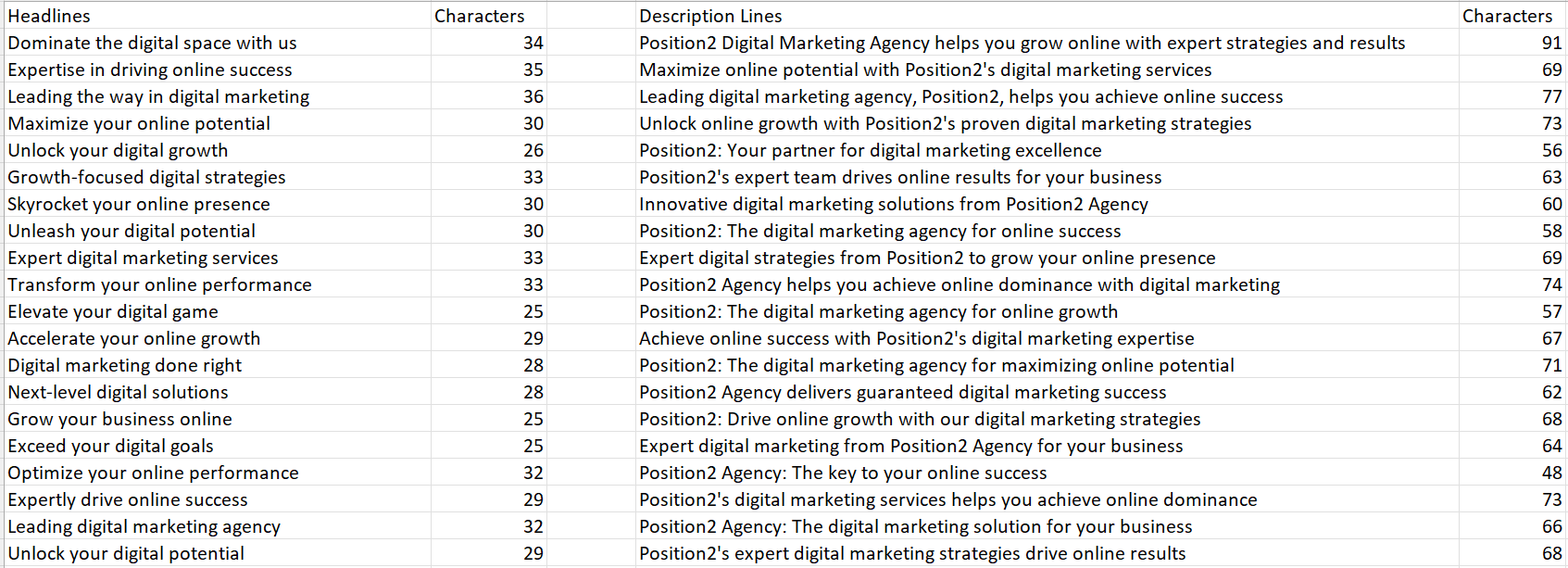
    I asked ChatGPT to write ad copy, advertising Position2, with headlines of 30 characters (or less) and descriptions of 90 characters (or less).

    Here’s what I got back:

    ChatGPT Results

    Now, there are a few immediate problems that are quick to spot:

    • Character limits aren’t always followed (I specifically asked ChatGPT not to use our Brand in the headlines because I couldn’t get any ads under 30 characters). Because I believe that our Brand would be mandatory in the first headline, I would have to create that Headline 1 (H1) manually and pin it, leaving the ChatGPT input for Headlines 2 & 3 (H2 and H3).
    • A few awkward constructs exist (e.g. Position2 Agency) that need to be fixed.
    • The range of descriptors is narrow (digital, business, marketing, strategies, success, growth, results, expertise etc.)

    Overall, these ads don’t suck. They’re better than many copy writers I’ve worked with. Even more important, I can bring all this ad text up to an acceptable standard in less than 10 minutes.

    Of the 20 ad headlines, forgetting about the character limit issue that needs to be addressed, the only headline that seems awkward is “Expertly Drive Online Success”…and this is easily fixed by removing “Expertly”.

    While many of the ad description lines are average (as currently constructed), all of them are workable with some simple and quick editing. For example, I modified the example below:

    From ChatGPT: Expert digital marketing from Position2 Agency for your business

    After my edit: Position2: Digital Marketing Expertise For Your Business

    What ChatGPT does very well here is staying within its “lanes” of knowledge. It’s clear that it only knows Position2 at a very superficial level, but it doesn’t stray from its limited knowledge of us. The challenge of ad copy is to present the same type of information in enough different ways to populate the maximum number of allowable ad copy variants for Responsive Search Ads (15 headlines, 4 description lines).

    Google Ads offers ad copy suggestions when setting up certain campaigns that are generally on point and usable. What Google doesn’t currently do is take their ad copy suggestions and roll out multiple variants of them which should be easy to do given the ease with which ChatGPT can. I suspect that Google will move in this direction by allowing “external factors” to be brought into its ad copy creation algorithm.

    When I write ad copy for clients, my first step is to scan the relevant pages for content that is easily adaptable to the Google Ads medium. I will sometimes copy and paste the content from the website and sometimes, but I’ll have to tweak it a bit. I’ll then take what I’ve culled from the website and manually create multiple textual variants.

    These secondary “ad riffs” are what ChatGPT does really well. Their entire ad output shown here are just variations on a singular theme and we would want our Paid Search Ads to aggressively hit on that theme.

    With a little bit of human oversight, ChatGPT can contribute to any ad copy creation scenario, though it’s a long way from being a singular solution.

  • Migrating your website – you need this SEO checklist

    There are multiple reasons for a website migration – switching content management systems, design limitations, enhancing functionality or performance, etc. A full website migration is no easy feat – even in optimal conditions – one thing you need to prioritize is your site’s search engine optimization to prevent traffic loss.

    Not focusing on SEO has the potential to significantly affect the search visibility of your site. Our website migration checklist is intended to help you better plan and manage a website migration, reducing the impact on organic rankings and traffic.

    Project Stage 1: Planning and Scoping Checklist

    It all starts with planning – ensuring that the site’s SEO needs are factored into the broader plan

    Project Stage 2: Pre-Migration Checklist

    Pre-migration activities identify all the requirements needed for the migration.

    Project Stage 3: Migration Day Checklist

    Migration day is very crucial. You have to check and ensure multiple parameters are as expected to ensure the migration is successful.

    Project Stage 4: Post-migration Checklist

    In the post-migration phase, you track and check if the migration was planned and executed effectively and make any changes if necessary.

    What is a website migration?

    It’s a broad term used by digital marketers and web development teams to describe any substantial changes the website is undergoing. The change could be the website’s structure, platform, content, design, technology, etc.

    The different types of website migration

    Protocol change

    A change from HTTP to HTTPS to provide better security to your users. This is a simpler site migration.

    Subfolder/Subdomain change

    This is a very common change to the website where a subfolder is moved to a sub-domain or vice versa. A common example is moving the blogs from blog.website.com to website.com/blog.

    Change in domain name

    Change in the domain name is when the entire content of the website is moved to a different domain.

    Website structure changes

    This is when the architecture of the website is changed. This often includes URL structure changes and internal linking changes.

    Change in platform

    When a brand decides to move the website to a different CMS or technology platform due to a specific feature or functionality of the platform. An example is moving an e-commerce website from WordPress + WooCommerce to Magento.

    Redesign

    Redesigning the website is required every few years to give it a fresh look. Website redesign includes significant media, code, and copy changes.

    Website merger

    Sometimes, merging 2 or more websites could be a strategic business decision. Ensuring that the organic traffic of both websites is retained can be tricky.

    Hybrid migration

    Migration types can be combined in any way possible, depending on the business needs. The more changes are made at the same time, the complexity and risks are higher. But making more changes simultaneously is justified considering the cost-effectiveness, provided the migration is planned and executed well.

    Why consider SEO while migrating your website?

    Site migration can have a significant impact on your SEO and the organic traffic to your website if it’s not executed effectively. Recovering from the impacts of a poorly managed migration could take weeks to months.

    After a website migration, Google needs to crawl and re-index the pages of the website. If the migration is not completed properly, Google could miss many important pages on the website, and you could lose significant traffic.

    This website migration checklist (links below to the checklist) helps you ensure the migration is completed smoothly with minimal drop in traffic.

    How long does an migration take?

    It really depends on the type and complexity of the migration. With a small site with a simple design, the process can be completed in a few days. If you are migrating a larger website with a complex structure and design, the process can take weeks to months.

    That’s why it’s important to have a plan in place to ensure enough resources are allocated to each step in the process. A poorly planned migration can result in lost data (or content), broken links, de-indexed pages, etc.

    What can go wrong during migration?

    Depending on the complexity and breadth of the migration there are multiple things that can go wrong, these are some of the most common.

    Poor strategy

    Before you even start the work of migration – it can go off the rails. Approach the migration focused on your goal (or what you’re trying to solve). Is it to update functionality, and usability (for internal and external users) or whether you’re bringing in a new CMS – this should be at the forefront of your strategy.

    Poor planning

    A detailed project plan is a necessity for any website SEO migration. Project plans will help you capture all activities and avoid delays in migrations.Even with your best-laid plans, not everything will go as planned, so factor in delays.

    We recommend avoiding planning a migration during seasonal activity peaks (end-of-year holidays etc). If anything goes wrong, there’s no room for error. Plan the migration during an off-season period.

    Lack of SEO involvement

    Website migration can impact your SEO efforts and organic traffic significantly. You’ll need search engines to re-index your site, post-migration. You want to make that your SEO team or vendor is involved in the migration process to ensure you don’t miss critical SEO optimization techniques that could have a negative impact on traffic/volume.

    Lack of testing

    Testing your website during all stages of migration is critical to success. There are many moving parts to migration – and you should factor in testing to limit factors that can go wrong during a migration.

    Not addressing bugs and defects

    As you test, you will find the occasional bug or defect – these have to be categorized and addressed based on impact and severity.

    Example of a successful site migration

    Writing a guide to help factor in SEO in your website migration isn’t just theory. We put it into practice.

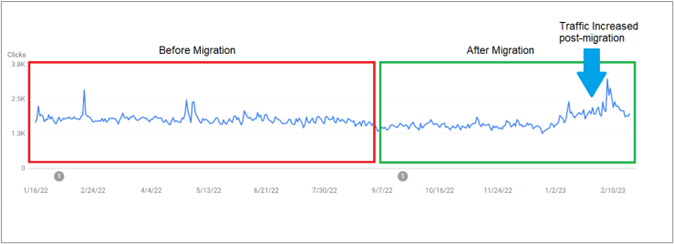
    We wanted to share what we actually delivered for one of our clients post-migration. We executed what we discuss here and helped deliver substantial growth for our client. As you can see from the graph below – we helped prevent a drop in traffic – eventually delivering more traffic compared to pre-migration.

    Example of a successful site migration

    Website Migration Checklist

    Following these steps will help reduce any drop in traffic (and revenue) post-migration.

    Stage 1: Planning and Scoping Checklist

    Define the objective of the migration

    You need to be very clear about the objectives of the migration. Whether it’s a design overhaul of the website or changing the CMS, the objective of the migration will differ. It’s important to be clear about the objective and set the right expectations.

    The site migration is also a good opportunity to fix any critical issues on the website, as the resources required for fixing these issues post-launch will be significantly higher.

    Identifying the best time for migration

    When you migrate your current site is just as important. If it fits with your marketing and business strategy – choosing an off-peak time is preferred.

    Create a project plan

    Planning is always important – identifying the objectives and laying out a detailed plan to tackle those objectives will be critical for success. A complex project with multiple phases and stakeholders needs the structure of a project plan. All dependencies should be identified and included in the project plan so that every task owner is aware of the dependencies.

    Identify task owners

    In order to keep your migration on track – identify the task owners – those responsible for the execution of specific tasks within the migration plan. Once identified, task owners should know what’s needed, the timelines, and the dependencies.

    Stage 2: Pre-migration Checklist

    Backup the website

    Seems obvious, but backing up the site is a best practice. Consider creating a dev (and staging) environment. A dev environment allows the development to go unimpeded – adding a staging environment gives you the ability to test new functionality and be able to quickly revert if need be.

    Block access to the new website

    After your site is migrated, it needs to be crawled and indexed by search engines to ensure your SEO efforts don’t miss a beat. Blocking access to the site as the migration is in full swing will reduce the potential for content duplication issues. Learn how to add a ‘noindex’ tag to your site here

    Check the backlink profile and health of the new domain

    It’s important to check the backlink profile of the new domain, especially if it was recently purchased. The backlink profile can be checked using a tool like Semrush. Always good to double-check that the domain didn’t receive a manual penalty (this can be checked in the Manual Actions Report on Google Search Console).

    Crawl the old website

    Crawl the old website using a tool like ScreamingFrog and keep a copy of all SEO parameters like URLs, page titles, descriptions, redirections, etc. Keep a copy of this crawl even after the site launch, just in case you need the old data.

    Identify the URLs to be redirected

    If the structure of the new website is different, it’s important to identify those pages which require a redirect. Consider creating a redirect document to track all pages requiring it.

    Implement 301 redirects

    HTTP code 301 identifies content or a page that has been permanently moved. It’s important to redirect the old URLs to the updated ones. Not doing this, will negatively impact your site ranking and traffic.

    Update internal Links

    If there are URL changes involved, update the site’s internal links so that they don’t trigger internal redirects. These internal redirects could add latency to the crawl and impact the crawl budget.

    Create a Custom 404

    During the migration, some of the pages may be deleted. A custom 404 page allows users to easily navigate to other pages if the page they are looking for is unavailable.

    Update GMB and Bing Places

    Update the new URLs on Google My Business and Bing Places. Not updating the URL could result in traffic loss from these listings.

    XML sitemap

    We recommend creating 2 sets of XML sitemaps, one for the older website and another for the new website. The sitemap for the new website will inform Google of the new URLs, and the sitemap of the old URLs will help Google be aware of the 301 redirections.

    This will ensure the authority of the old URLs is passed on to the new ones.

    Make sure the new website is mobile-friendly

    Mobile-friendly websites increase traffic and revenue by providing easy access to users on mobile devices. Make sure the new website is mobile-friendly. Google’s mobile-friendly test is a great way to test your site.

    Add schema

    Add schema to the new website. Bringing schema from the old website to the new site will help improve optimization.

    Update the robots.txt file

    Not updating the robots.txt file during a site migration is an easily missed opportunity. Ensure you update the file for the new website before the launch so the new site is easily accessible to search engines.

    Update your backlinks

    Update the backlinks of the website with the new URLs. Reach out to the referring websites and request they update the backlinks. Also don’t forget to change the URLs on all social media profiles and any other directories.

    Conduct a pre-migration SEO audit

    A pre-migration audit will help find and fix SEO issues before launch. This will ensure that the website is well-optimized. Tools like Semrush and Screaming Frog can be used to conduct an SEO audit.

    Benchmark pre-migration performance and compare it with the post-migration performance

    During migration, the primary SEO objective is to ensure that traffic (and revenue) don’t drop off. Capturing a pre-migration benchmark of business-critical metrics will help you measure the new website’s performance after the launch.

    Update the GA code on your new website

    Make sure your GA code is added on the staging website so that the website’s performance can be measured right after the launch.

    Stage 3: Migration Day Checklist

    Check the load performance of the new site

    Immediately after the launch, check the load performance of the website and make sure site loading is optimized. A slow-loading site could impact the organic performance of the website since it’s an important factor SEO ranking factor.

    Technical Checks

    Here are some of the technical checks to do immediately after the website launch. This will ensure the website performs well after the launch.

    • Validate site redirects
    • Validate robots.txt
    • Validate sitemap.xml
    • Check canonical tags
    • Check noindex/nofollow tags

    Search Console Checks

    Here are the Google Search Console (GSC) checks that help make sure Google can crawl and index the pages on the new website properly.

    • Test and upload XML sitemap
    • Submit new and old sitemap to GSC
    • Check international targeting
    • Upload disavow files
    • Use the change of address tool

    Check server performance

    After the new website is launched, Google will have to crawl and re-index the website. If the server response time is high, the process of re-indexation will be slow. So, it’s important to make sure the server response is quick.

    Stage 4: Post-migration Checklist

    Check if Google can access all the pages on the new website

    Check the crawl stats available on the Google Search Console to check if Google is crawling the new website. If you can’t see a spike in crawls after the launch, there could be something wrong with the crawling.

    Conduct a post-migration SEO audit

    Conduct a post-migration audit to make sure all the SEO parameters are in place, and nothing is missed out during the launch of the new website. Any errors identified during the audit must be fixed immediately to avoid impacting search performance.

    Add annotation on Google Analytics

    There could be a drop in organic metrics after the launch. Adding an annotation on Google Analytics will help make a note of this drop in the future.

    Track the performance of the new website

    Track the performance and compare it with the pre-migration benchmark numbers. This will help identify the efficiency of the migration and check if there is any major drop in metrics.

    Keep control of the old domain

    We’re recommending you maintain control over the old domain (unless you are planning on selling the old domain). If you’re keeping the old domain – redirect it to the new domain, page by page, to ensure the authority is passed on to the new URLs. If you don’t retain control over the old domain, the authority earned by the old domain will be lost, and you won’t be able to redirect them to the new domain and pages.

    In conclusion, website migrations are complex and have many moving parts to them – a bad migration can result in a hit to your Brand’s reputation, a dropoff in traffic, and a potential loss of revenue.

    If you’re planning a site migration, please use this website migration checklist to ensure you’re tracking and accounting for the critical tasks that are needed to maintain your site’s performance post-migration.

  • How to use ChatGPT for Digital marketing?

    One of the latest entries in AI-powered tech is ChatGPT (Chat Generative Pre-trained Transformer), a prototype released late last year. As you can imagine, the reaction to it was both positive and negative – as more and more AI-driven tech is being released, there will be a conversation on how to utilize these tools to enhance our daily lives while reducing a negative impact on humans.

    We feel that ChatGPT has great potential to impact our homes and workplaces positively. It has become widely popular barely a month into its release – so you’re probably thinking ‘ok, so what does it do?’

    What is ChatGPT?

    Before you start, it can help you research an industry silo before you build out your first marketing campaign.

    Use it to quickly understand your client’s business without getting bogged down in online research. It has the potential to be a huge timesaver as you ramp up for new clients/customers.

    Let’s say we are looking to build new creative for a CyberSec client on threat deception, but your team has questions. If we use ChatGPT and type in threat deception, we get information as shown in the screenshot below.

    Threat Deception Chatgpt

    Let us see what we get from a Google search. Hint, many links may or may not have the information we need.

    Threat Deception Question Chatgpt

    When we needed to understand different methods of threat deception, we edited the query for ChatGPT and got much more detailed results.

    Different Methods of Threat Deception Chatgpt

    Google provides more options for keywords, but ChatGPT helps us find the root keywords.

    Chatgpt Takes Root Keywords

    Chatgpt To Write SEO Descriptions

    Limitations of ChatGPT

    GTP is a language model trained to produce text. It is prepared on vast amounts of data on the internet, created by humans. So it has many limitations you must be aware of before using it. Many have criticized it for the lack of accuracy of the answers. ChatGPT is restricted in specific parameters, and we have listed them here for your leisurely reading.

    Lack of common sense

    ChatGPT is incapable of understanding the world as humans do, and as a result, it may make mistakes or produce meaningless responses.

    Difficulty handling long-term dependencies

    Difficulty handling long-term dependencies

    ChatGPT is trained to generate text based on the input it receives, but it may struggle with tasks that require a deeper understanding of the context or long-term dependencies.

    Data bias

    ChatGPT is only as good as the data it was trained on, which means it may be impacted by the biases present in that data.

    Limited flexibility:

    ChatGPT is trained to generate text based on a specific task or objective, and it may struggle with tasks that are outside of its scope or that require a high degree of flexibility.

    AI Training Cutoff in 2021

    Since it’s not connected to the internet, it can occasionally produce incorrect answers. The learning model has limited knowledge of the world and events after 2021 – which can result in incorrect instructions or biased content.

    Facts about ChatGPT

    As per Exxactcorp, ChatGPT has released several versions of GPT, such as GPT-2 and GPT-3. While GPT-2 is a smaller version of the model with 1.5 billion parameters, the GPT-3 is a much larger version with 175 billion parameters. GPT-3 is a powerful language processing tool that can perform various language tasks, such as translation, summarization, and answering questions. A recent article published in the New York Times states that GPT-4 will be launched in 2023.

    Is ChatGPT better than Google?

    It is not a search engine like Google, so it is not intended to be used for the same purposes. Google is a powerful search engine that can find information online by searching keywords or phrases. It is designed to help users find the most relevant and valuable results for their search queries based on a wide range of factors.

    What are the uses of GPT?

    Chat GPT can be used to build chatbots that can hold natural conversations with humans. It can be used in various applications, including customer service, e-commerce, and entertainment.

    Is ChatGPT for content and SEO?

    In SEO, GPT can be used to generate meta titles and descriptions for web pages. It can also suggest keywords and other tags that may help a website rank higher in search engine results. However, it’s important to note that using GPT or other AI tools to generate content or optimize a website is not a guarantee of success.

    Is ChatGPT Free To Use?

    It is a language model developed by OpenAI that is freely available for use.

    Wrapping up

    GPT can be used in chatbots and other applications where it is important to generate human-like text. It can be fine-tuned for specific tasks and has been used to generate news articles, write stories, and even create code.

    As a digital marketer, imagine ChatGPT connected to google ads, generating automatic titles and descriptions based on predefined instructions for those ads – optimizing those that aren’t performing well.

    ChatGPT is a powerful tool – if and when it becomes connected to the internet (for real-time results), it will significantly impact multiple disciplines.

    We’ll keep an eye on this space, and so should you.