Category: Digital Marketing

  • Account-Based Marketing In 2018

    Account-Based Marketing, or ABM, is when you approach B2B marketing strategically to reach out to potential customers. Also known as key account marketing, it is based on customer account awareness. Here, the organization considers both individual prospects and customer accounts as one market and communicates accordingly.

    ABM in 2018

    ABM was one of the top trending stories in marketing in 2017 and is likely to grow significantly in the B2B marketing domain in 2018. However, 2018 may see a shift in the focus and implementation of ABM strategies.

    Most companies are using highly customized one-on-one program with a few existing accounts, and others are also using segmented and less personalized one-to-many programs. These programs focus on acquiring new logos with broadly targeted prospective accounts.

    Both these approaches have individual merits; however, the industry is yet to use a blended approach to ABM. This blended approach will be the focus in 2018 as companies scale their approach.

    Here’s what the experts are saying:

    “My prediction for ABM in 2018 is that it will be on its way to becoming the dominant B2B demand creation strategy, and those who don’t get on board will be increasingly left behind. More and more companies are using technology, data and account insights to make smarter choices about the best path to growth,” said Megan Heuer, Vice President, Research at SiriusDecisions.

    Trish Bertuzzi, President and Chief Strategist of The Bridge Group, said, “My advice for people to succeed in ABM in 2018 is to stop thinking ABM M=Marketing and start thinking ABR R=Revenue. Any successful strategy is about one thing and the one thing is the cha-ching. A great account-based strategy isn’t just about Marketing doing something differently. It also requires that Sales and Sales Development change the way they interact with buyers. When the entire organization aligns their activities around ABR it brings it all together.”

    Jon Miller, CEO and Co-founder of Engagio, said, “My prediction is that in 2018, companies will recognize that just buying targeted ads does not represent an ABM strategy. You’re not going to get a senior executive at a large company to engage with you just by showing them an ad. Good ABM isn’t about waiting around to see if someone clicks an ad; it’s about crafting relevant, personalized messages and reaching out to the right personas at the right companies proactively.”

    5 useful tips to run a successful ABM campaign in 2018:

    Here are some useful tips to run effective ABM campaigns in 2018:

    #1 Use Marketing Automation Selectively and Effectively: Avoid misusing or overusing marketing automation when implementing ABM strategy.

    #2 Create your “List” Judiciously: When strategizing for ABM, focus on a list of a small, selective group of prospects that will fit your customer profile perfectly.

    #3 Recycle and Reutilize Your Success Stories: Check what worked well in your previous accounts and reuse those strategies in the current account if it fits.

    #4 Get your Data Correct: Ensure that your ABM strategies are based on solid data. Remember, the more you work on gathering relevant data, the more chance of success your strategy has.

    #5 Be Disruptive: This might be easier said than done. Your ABM strategy should be designed in a way that it will shake up your prospective client and give them food for thought.

    So, we can conclude by saying that ABM is currently the most talked-about digital marketing strategy to reach out to your potential prospects, educate them, and turn them into customers. However, as a smart marketer, you need to avoid any pitfalls and strategize well to make it work for you. Come up with a data-driven plan for your 2018 ABM campaign effort that will give you an edge in this competitive business marketing world where competitors are vying for every inch of customer’s attention.

    References:

    Leavitt, R. (2017, December 20). The Best of ABM: Resources for 2018 Planning – ITSMA. Retrieved January 16, 2018, from Click Here

    Redlinger, B. (n.d.). Prophets of Profit 2018: ABM Experts Give Their Predictions & Advice – Part 1. Retrieved January 16, 2018, from Click Here

    Schmukler, M. (n.d.). How to Use Account-Based Marketing Wisely in 2018. Retrieved January 16, 2018, from Click Here

    Scientist, M. L. (2017, November 29). 2018 Planning Tips: Getting Account-Based Marketing (ABM) Results Ramped Up. Retrieved January 16, 2018, from Click Here
  • The Year Ahead: Top Trends That Will Shape Digital Marketing in 2017

    The past 12 months have certainly been eventful in the digital world, with a number of developments that are expected to play a significant role in shaping marketing for years to come. The key takeaways we should remember from 2016 are:

    • Online advertising spend has overtaken TV. For the first time, global ad spend on the internet has totaled more than television advertising. Online video advertising has now doubled since 2013 to £5 billion.
    • Mobile is on the march. The percentage of web visits on desktop and laptops has dropped by nine points to 56 percent while browsing on mobile phones has soared by 21 percent, significantly closing the gap on PCs to stand at 39 percent of all web hits.
    • Live video stream has arrived. The importance of online video has been growing for the past couple of years, and in 2016 it accounted for half of all mobile web traffic. That has been given a significant boost by the rapid emergence of live video streaming, first by specialist services like Periscope and Meerkat, and now brought into the social mainstream by the arrival of Facebook Live.
    • Social has diversified. Whether it is e-commerce on Facebook or Twitter or advertising on Snapchat and Instagram, social platforms have entered the marketing mainstream with nearly all leading services now providing a suite of business services. Spend on social has increased to 14 percent of total marketing spend and can be expected to keep rising.

    What to Expect in 2017

    Some of the trends that dominated 2016 will continue to shape digital marketing through the coming year. What we can expect is the use of increasingly sophisticated technologies which will add value to the interaction between brand and customer.

    From Live to Immersive

    Live video streaming announced itself in 2016 and should be a priority for marketers seeking to keep up with consumer trends in 2017. Faster connection speeds will iron out glitches in delivering smooth streams to mobile devices, while brands will be keen to explore advertising options in this new and exciting space.

    But that will not be the end of video innovation in 2017. Shoppable film is a natural evolution in content marketing, marrying high-quality films packaged as entertainment with e-commerce – viewers can simultaneously purchase as they watch. The idea was a high profile success for Ted Baker in its spy-themed collaboration with Guy Ritchie.

    Another hot trend in video could be the development of immersive content. With virtual reality headsets becoming increasingly popular, the development of 360o video offers a new dimension for brands to engage their audiences.

    Native Advertising

    Native advertising is nothing new, but its importance to digital marketers could be on the rise. Although online took the largest share of total advertising spend for the first time in 2016, the click-through rate for display advertising was 0.6 percent, with more than half of the internet users saying that they will not click an ad because they don’t trust them.

    Given those statistics, marketers have to be creative in how they present advertising online. Native advertising is about effectively hiding the fact that it is an advertisement at all, blurring the lines with content.

    Augmented Reality (AR)

    AR exploded into public consciousness in the summer of 2016 with the overnight success of the Pokémon Go app. With 650 million downloads within 80 days of launch, the game has brought to notice the potential AR has to engage audiences, especially on mobile. Digital marketers will be keen to cash in on this potential with imaginative branded AR offerings.

    Artificial Intelligence (AI)

    The rise of Virtual Assistants like Apple’s Siri, Microsoft’s Cortana and Amazon’s Alexa means AI is now part of the mainstream when it comes to accessing the internet. For marketers, this demands fresh thinking in areas like SEO and ensuring websites are optimized for the way people search and browse online using their voice.

    AI also presents brands with new opportunities for interacting with customers. Chatbots are growing in popularity for providing one-to-one interaction with their customers, and as AI develops, those dialogues can become more and more personalized and responsive.

    The Future is Near

    We can expect some real technological innovations in 2017. With futuristic technologies like Augmented Reality and Artificial Intelligence ready to go mainstream, brands can now add a certain depth to their brand experiences in a way that was never possible before.

    The evolution of video will lead to brands fully embracing the interactive opportunities of live streaming and immersive content to capture audience imagination the way television and film have for half a century. Let’s stay tuned for 2017!

    For further updates on the latest digital marketing trends, subscribe to our blog here.

    Sources:

  • Key Steps for Improving Your Brand

    According to businessdictionary.com, brand is defined as “Unique design, sign, symbol, words, or a combination of these, employed in creating an image that identifies a product and differentiates it from its competitors. Over time, this image becomes associated with a level of credibility, quality, and satisfaction in the consumer’s mind. Thus, brands help harried consumers in crowded and complex marketplace, by standing for certain benefits and value.”

    Having a good brand is at the heart of having a successful business. So, how do you create and protect your brand? Here are four steps to help you do that.

    1. Have a Recognizable, Compelling Look and Feel

    For the last 30 or so years, when you see a swirl, you know Nike is nearby. When you read the words “Just Do It,” you also know Nike is involved. Nike has one of the most recognizable, compelling brands around. While they’ve changed some of their messaging to align with changing times, they’ve stayed true to their singular look and feel.

    Beyond the look and feel, key messaging should be honored in a similar fashion. For example, if you want your storage solution to be known for “working equally well in data centers and branch offices,” you always need to say those exact words.

    2. Know Your Customers

    Personas are the name of the game these days. You want to use market research and data to create personas for your different customers, and you want to include as much detail as possible. Why? When you are able to talk to people in a personal way, addressing some of heir hottest issues, you build a lot of trust in your brand.

    3. Don’t Keep Yourself a Secret

    People like to get their information in different ways and from different sources. So make sure you are easily found and accessible. Get your word out everywhere – web, social media, YouTube, emails, webinars and more – and then track where you’re having the most success.

    4. Be Authentic

    Your business is made up of wonderful people like you. Be sure to capture this in your voice. Sound like real people who care deeply about their customers’ success. Engage in conversations with your customers. Recognize that your engagement with them helps them move more speedily through the buyer’s journey.

    Now, that you know what to do; know your Brand and be seen!

  • The Impending Digital Era

    In 2011, Peter Drucker said that “the aim of marketing is to know and understand the customer so well, the product or service fits him, and sells itself.” Traditional marketing with a push strategy was never able to reach this objective, but digital marketing with a pull strategy – and client focus – has realized this aim.

    PwC’s 15th annual report reveals that TV advertising generated $173.7 billion worldwide in 2014 and will grow to $214.7 billion by 2018. During the same period, internet advertising will grow from $133 billion to $194.5 billion. Research indicates a 5.5 percent compound annual growth rate for TV advertising compared with 10.7 percent for the internet, suggesting the latter will pass the former by the end of the decade. (Source PWC)

    In the constantly changing world of digital marketing, it is hard to predict what the future has in store for us, whether as a marketer or a consumer. Just like technology, consumer behavior will evolve exponentially and unpredictably. To anticipate upcoming developments in digital, we have to look at it from both the consumer’s and the marketer’s perspective.

    As a Consumer: The consumer will be at the epicenter of all strategic decisions. Most marketing and branding content will soon come from consumers. Social media has already empowered consumers to influence the branding and marketing strategies of multi-billion dollar companies by simply writing reviews and providing feedback. On one hand, a single review, comment or tweet can spread like wildfire and have a catastrophic effect on a brand. On the other hand, positive reviews and feedback can take a brand to new heights, and have the same impact as a multi-million dollar advertising campaign. Consumers will not only influence strategic decisions, but will have the power to make these decisions for brands. User generated content will be increasingly prevalent, and brands will have to be authentic to stay relevant. Popular culture will only gain importance in the years to come. Brands that change in accordance with culture will reign supreme and brands that do not give culture the required attention will eventually cease to exist.

    Being a Marketer: Noah Brier (the co-founder of Percolate) said that “the complexity of modern marketing is only going to keep increasing.” Being a marketer will become much more different and challenging in the years to come. Marketers will soon have vast amounts of data on consumer behavior, available at the click of a button. They will have the power to know exactly why a product or service is more successful, and which factors influence a buying decision. Organizations will have enough data to attribute a specific set of strategies to various stages of the buyer’s journey, ultimately leading to a conversion. Marketers constantly learn what to do; that will not change. What will change is that the marketers will have the resources and technology to know what not to do, and this could save a brand millions of dollars in expenditure which otherwise would have been in vain.

    The Funeral of the ‘Funnel’

    It is getting harder to predict consumer behavior in a constantly changing digital environment. As no two consumers are the same, the steps they take to convert into a client will also differ. The traditional funnel will no longer be relevant as consumers become more aware, and enhancements in technology will enable consumers to skip or add a few steps in the journey towards conversion.

    Mobility of Things

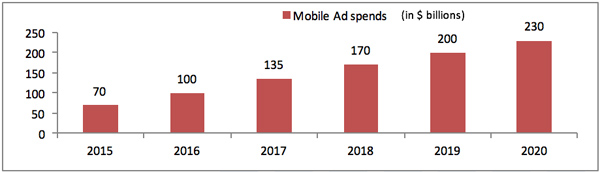
    Mobile devices and the Internet of Things (IoT) will lead the way to a much more user-friendly future. The majority of digital spends are going to be on mobile internet by decade’s end. Mobile marketing reach will be nearing 60 percent penetration, which will propel the digital advertising share to about 40 percent of all advertising spends by the end of the decade.

    Total Advertising Internet Mobile
    CAGR 4.4 % 10.7 % 21.5 %

    The Underdogs

    Developing countries will power the future of digital marketing. Markets such as China, India, Brazil, Russia, Mexico, South Africa, Turkey, Argentina, and Indonesia are collectively forecast to account for more than 25 percent of all global entertainment and media revenue by the end of the decade.

    More than a decade ago, C.K. Prahalad said that the “Fortune is at the bottom of the pyramid.” Developing countries of the world constitute the bottom of the pyramid, which holds the most potential, and soon every organization will want a piece of this pie. These countries are the potential gold mines of the future. As far as digital marketing is concerned, the term ‘population’ will soon be replaced by ‘economies of scale’.

    Organizations, marketers and agencies who master synthesis, community and creativity will be the winners, but the biggest winner of all, without a speck of doubt, will be the ‘consumer’. The consumer will be on the highest podium, around which the Internet of Things is going to revolve.

    With over a decade of expertise, Position2 is a digital marketing agency that accelerates demand for fast growing technology companies. ROI-driven solutions integrate paid acquisition, content marketing and marketing technology.

    By Divyansh Sharma

  • Key Takeaways From SiriusDecisions Summit 2016

    We took the excitement and enthusiasm of Marketo Marketing Nation Summit and made our way to SiriusDecisions for some more stimulating sessions and inspiring keynotes at Nashville. We have to say, SiriusDecisions Summit not only lived up to the excitement but took it up a notch. The event was bursting with – pioneering research, networking opportunities and over 50 analyst sessions and 100 practitioner case studies.

    We learned, ‘Adopt’, ‘Operationalize’ and ‘Optimize’- 3 key steps that lead us to a future where Art and Science come together to transform the way businesses should and will be done in the future.

    Most talked about topics at the Summit:

    • The Art and Science of Intelligent Growth – blending the art of innovative story telling with the science focused on new models and methods to support it
    • The Position2 case study with a global wi-fi infrastructure leader demonstrated how efficient tracking enabled us to perform Deep Funnel Optimization with great results
    • Personalization is crucial to marketers
    • Account-Based Marketing – one size doesn’t fit all, today’s technology has come a long way in terms of supporting Account-Based Marketing
    • The key to the future: Predictive Technologies

    Consistent with this year’s theme – The Art and Science of Intelligent Growth, one of the crucial topics discussed was art and science melding together today, more than ever before. And on the same note Position2, proud platinum sponsors for SiriusDecisions, presented a case study on the success of Deep Funnel Optimization. A three-prong approach that involves the blending of AdTech, MarTech and Tracking & Optimization.

    To learn more about Deep Funnel Optimization, reach out to us or drop by our office in the heart of Silicon Valley, California.