Author: Team Position Squared

  • New Google PLA Format Based on Reviews and Ratings

    Google testing new PLA formatGoogle is testing a new form of its Product Listing Ad (PLA).

    In this new format, a search for “best anti-virus software solution” will display software products in the order of a numerical ranking system that seems to be taking both, quality and quantity into consideration for each item’s ratings.

    For example, even if Norton* has higher number of reviews, it will come second to McAfee* due to a difference in their star rating where McAfee’s star rating is higher. As a marketer, you need to focus on both, number of reviews and star ratings to take advantage of the new PLA.

    If there are two result items with the same star rating, then their number of reviews will determine their ranking. The item with more reviews will be ranked higher.

    Continue watching this space. We will keep you updated on any further developments.

    *These examples have been used only for demonstration purposes. Position² has no stake and hence does not promote any of the companies, whatsoever.

  • Twitter Launches Multi Language Targeting and Facebook Unveils Audience Insights

    Twitter

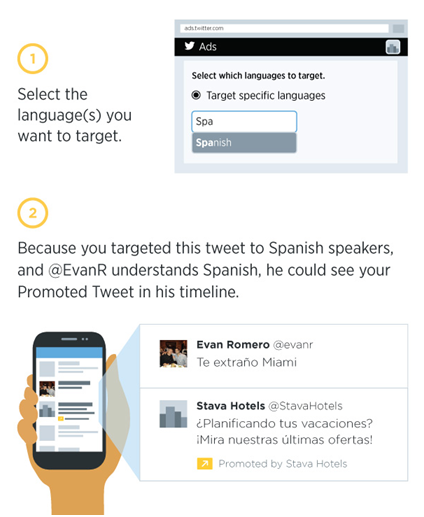
    Marketers can now target users with their preferred language through Promoted Tweets and Promoted Accounts. Users will now be seeing more relevant ads in their language.

    Multi language targeting covers 20 languages and will be rolled out globally and through Twitter’s Ads API.

    You can also use this targeting feature along with other targeting options based on interest, keyword, gender, geo and tailored audience segments. Multi language targeting helps target users from countries where people speak different languages and also in targeting a global audience with language-specific messaging.

    Twitter studies a user’s selected language in their profile settings and also the languages used on the user’s account to determine a user’s language.

    For example, if you want to target French speakers in the US, you can use geo-targeting, travel-category interest targeting and French language targeting to connect with your audience more effectively.

    Even if your audience is very comfortable with English, if their native tongue is another language, they will warm up towards their native tongue more. Using this feature will help you gain entry into a customer’s psyche with more ease. It will also be beneficial in penetrating markets where English is spoken very less or not at all.

    Facebook

    Marketers are being loaded with more customer data through Facebook newest feature, the Audience Insights tool. Using this tool, you can garner information on:

    • Demographics: user age, gender, lifestyle, job role, relationship status, education and household size
    • Location and language: the geographical location of users and the language/s they speak
    • Usage: the frequency of your target audience logins into Facebook and the device used to login
    • Purchase activity: past purchase behavior (what category do they shop most in?) and methods (in-store or online shopping)

    You can access the above information for 3 different groups of people:

    • People on Facebook (the general Facebook audience)
    • People connected to your Page or event
    • People in Custom Audiences you have already created

    Audience Insights is different from Page Insights since it studies trends about potential customers across Facebook. Page Insights looks at Page interactions.

    Audience Insights displays information users have already shared on Facebook with information from third-party providers like Acxiom through Facebook partner categories. The data about groups of people can be shown without identifying individual people in the groups. This keeps both users and marketers happy. The privacy of users is protected while supplying marketers with aggregate and anonymous data.

    Using data from the Audience Insights tool, marketers can target customer segments with campaigns that are more customized. If one of your custom audience groups is heading towards your disaster recovery solution more, you can target them with exclusive offers for that. You can target users associated with a summit you are sponsoring with special passes and contests for the event.

    The rollout of Audience Insights has begun within Ads Manager for US marketers. The global launch will happen in future months.

    You can click here to get started.

    Do you think these updates will be beneficial? Let us know.

    Image Source: Twitter

  • Mobile browsers vs. Apps, 4 ways to help buyers choose you and much more…| Best of the Week

    This week’s hot news, events and videos from the online marketing and social media world.
    Mobile Browsers vs. Apps
    From the Position² Blog This Week:
    Mobile Browsers vs. Apps
    What’s it going to be? Mobile websites or apps? The choice is not easy. Both concepts have their pros and cons. What are they? What are the best practices for mobile website and app development? Read this blog to know more.
    Top Stories this Week: Social Media
    Top Stories this Week: SEO, PPC and Digital Media
    Best of the Week Video Best of the Week Video
    Looking for ways to make your email marketing click?
    Watch this video to know what steps you need to take to achieve success in email marketing campaigns.
    White Paper: Increase Visibility for Your Content by 4x
    Today’s traditional SEO is inadequate: Ignite your search results by accelerating visibility in more places than ever before.Download this White Paper and learn:

    • SEO, why the way we know it is not enough
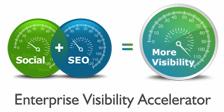
    • Introducing and implementing Enterprise Visibility Accelerator (EVA)
    • Using multi-channel tracking tools for effective monitoring
    • How EVA benefits businesses.

    Download the complimentary EVA White Paper now

    Know more about Enterprise Visibilty Accelerator(EVA)
    If you are reading this blog post via a RSS reader, please click here to subscribe.
  • Mobile Browsers vs. Apps

    Mobile devices are a part of every marketer’s digital strategy. Marketers are going all out in creating mobile websites, working on their SEO and building engaging apps.

    How do mobile websites and apps differ?

    A mobile website is a site that is meant to be accessed on mobile devices and which adapts to varying screen sizes. It is a basic version of a desktop site with better usability, re-organization of content to fit smaller screens etc.

    A mobile app is software that operates on specific mobile device operating systems and is designed to perform specific functions. Many apps are exclusive to iPhones/iPads/Android-based devices.


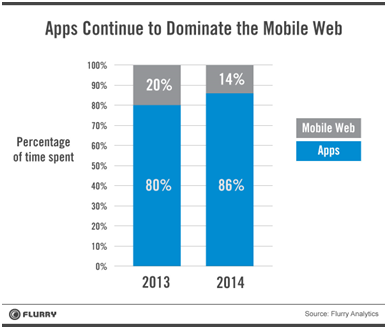
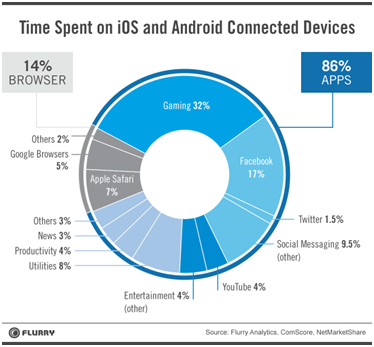
    Statistics from the Q1, 2014 study by Flurry reveal that mobile apps win in the contest with mobile browsers.

    Of the 2 hours and 42 minutes people spend on their mobile devices, 2 hours and 20 minutes (86% of their time) is spent on mobile apps! Only the rest of the 22 minutes are spent browsing mobile websites.

    People prefer to access information through apps rather than go to mobile websites on browsers. A major factor responsible for the popularity of apps is games. But people are also using social media apps to keep in touch with their digital lives. Among various mobile operating systems, predictably, Android and iOS are at the top:

    But before you pick apps just because they are more popular, check out the following sections that examine important features of both mobile apps and websites:

    Some Advantages of Mobile Apps

    • Apps provide brand access to more targeted audience groups
    • ROI is higher due to improved targeting
    • Remarkable user engagement and experiences
    • Striking visuals due to effects and animations
    • Can be developed for different operating systems and devices using native codes
    • Easy for users to download and install on their mobile devices
    • Apps can be used even without an internet connection
    • Can be easily found on app stores through a search
    • Brands can easily charge for their apps on app marketplaces, if they want to

    The Advantages of Mobile Websites

    • Mobile websites can be accessed easily with a mobile browser
    • It is easy to develop with standard development tools. The current best practice is to use HTML5 and CSS3.
    • They are generally less expensive compared to app development
    • Available to users immediately after publishing. It does not require any submission approval process from app marketplaces.
    • It does not need any installation since it is web-based.
    • Can be easily found with a standard search

    Choosing Between Mobile Apps and Websites: Aspects to Consider

    • What is your main purpose – do you want to provide information to your mobile audience or do you want to promote downloads for a specific product that will need frequent updates?
      Depending on your purpose, you need to decide between a mobile website and an app. A mobile website can help you answer all generic user queries. An app can help in achieving very specific goals like promoting a specific product.
    • Do you want to build engagement with your audience?
      Apps are a great way of building engagement with your audience. If you can identify a hook by which you can get your audience to download and use your app frequently, it will do wonders for your brand. If you just have information updates, then most would prefer to check your mobile site.
    • How interactive and graphics-driven is your content?
      Loading a mobile site with a lot of graphics will slow its load time but apps support graphics well.
    • What is your budget?
      Apps are more expensive and complex to develop since they require resubmissions on app stores when updated and require developers to have a much varied skill set. On the contrary, mobile websites are usually not as expensive.
      What is your pick? Which suits your business better – mobile apps or mobile websites?
  • More Updates from Facebook’s f8 Developers Conference…

    Image Source: Facebook

    The latest edition of the f8 boasts of a series of updates that impacted users, marketers and developers.

    However, for the intents and purposes of our discussion here, we’ll continue to focus on updates that affect marketers in particular.

    Among other things, with the launch of its mobile ad network, Audience Network, Facebook is also focusing on integrating its website better with lead nurturing efforts of brands through enhancements to Mobile App Install Ads.

    Brands can now send news feed messages to users if they:

    • Completed an action
    • Are inactive
    • Need more nurturing

    You can now nudge along users who are at different stages on your Facebook strategy by messaging them on their news feed. With all the latest changes to the news feed that has made it more visual, Facebook users are focused on the news feed a lot. This increases the chances of your message reaching the user on their news feed.

    Facebook is now enabling messaging from apps or external events in order to help brands reach users through their news feed. Mobile app install ads also have calls to actions added to them in order to help drive the user actions you want.

    For more information on this and other f8 updates, check out this page.

    Adds more thrust to your Facebook strategy? Tell us in the comments section below.

  • Being a Hit on Social Media and Facebook Updates for the Week

    Image Source: ilfoglio

    Social Media Content

    Every brand (almost) has a social media presence.

    And, all these brands post content on their social media accounts (we think it’s safe to assume all do).

    End result?

    • A totally cluttered social platform, which gets even more crowded when you factor in individual user posts.
    • If your content quality isn’t top notch, it will fall flat on its face when faced with top quality content.
    • If you are heavily reliant on organic content, social networks are adding filters to it in a bid to promote brand paid promotions (for example, Facebook’s recent changes due to which brands are now reaching a lesser percentage of their audience).

    You can blame Facebook and other social networks for making changes that are quashing organic content reach while filling their coffers through promotion of paid content posts.

    However, it is also true that be it for organic or paid promotion, brand content has to be of very high quality.

    Getting back to the point…

    Creating great content

    Do you follow a calendar or do you simply go with the creative flow?

    Social media content is different from blog posts, white papers and other long content forms. Social content has to be short and preferably written on the spur of the moment. This helps maintain the essence of the news. Remember, it is very important for social content to work in real-time.

    Posting frequency

    You need to post once every day on Facebook and four times on Twitter. Added to this are your blogging responsibilities. So, how do you create great content (particularly if you are short on resources)?

    Check this plan:

    • A short news update every day
    • A well thought out post once a week
    • Close the week with a collation of all the important happenings from that week

    Do you want to simply churn out content or do you want to make sure it is great content but posted less frequently?

    Take a call…

    If you want great content that interests your audience, cut down on your frequency and focus on quality.

    Facebook Finally Releases its Mobile Ad Network and Makes Changes to Login Systems

    After all the noise created by rumors, Facebook finally released its ad network, Audience Network, during the f8 developers conference recently.

    Changes to Login Systems

    Trying to solve users’ concerns about sharing information with apps, Facebook announced:

    • Anonymous login: You can use an app without sharing any personal information.
    • Facebook login: You can choose the information apps will gain.
    • Redesigned app control panel: You can see and manage the apps you use.

    For more information about new developments in login systems, click here.

    Tell us what you think about this post…

  • Four types of social analytical tools, the state of B2B marketing data and much more… | Best of the Week

    This week’s hot news, events and videos from the online marketing and social media world.
    Four Types of Social Media Analytical Tools You Need
    From the Position² Blog This Week:
    Four Types of Social Media Analytical Tools You Need
    Effective and efficient social media management, especially when you are operating on a large scale, is tough without the support of analytical tools. Refer to this blog post to learn about the types of social media analytical tools you need.
    Top Stories this Week: Social Media
    Top Stories this Week: SEO, PPC and Digital Media
    Best of the Week Video Best of the Week Video
    Check out this video in which Cyrus Shepard, a senior content astronaut at Moz, talks about good and bad SEO practices and how Google traces your moves on the web.
    White Paper: Increase Visibility for Your Content by 4x
    Today’s traditional SEO is inadequate: Ignite your search results by accelerating visibility in more places than ever before.Download this White Paper and learn:

    • SEO, why the way we know it is not enough
    • Introducing and implementing Enterprise Visibility Accelerator (EVA)
    • Using multi-channel tracking tools for effective monitoring
    • How EVA benefits businesses.

    Download the complimentary EVA White Paper now

    Know more about Enterprise Visibilty Accelerator(EVA)
    If you are reading this blog post via a RSS reader, please click here to subscribe.
  • Social Media: Which One Is For You

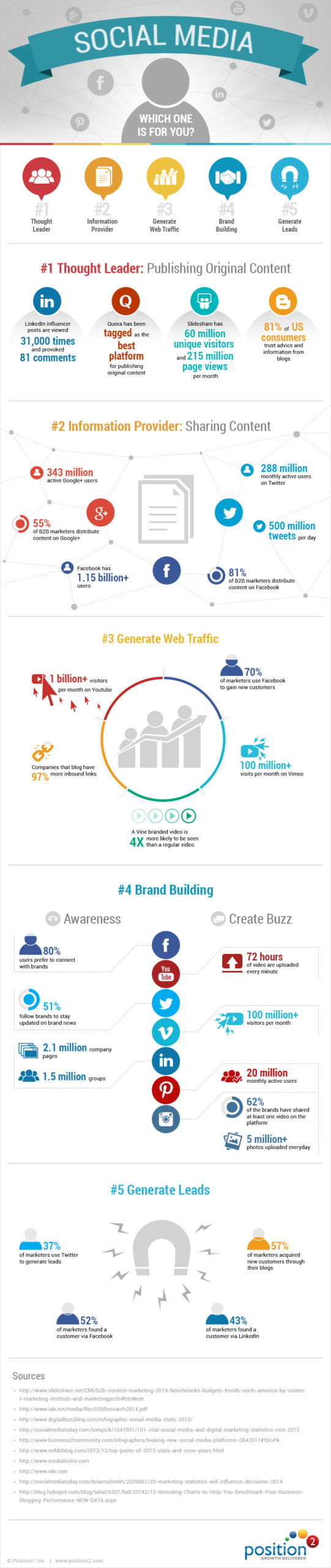
    Every social media platform is unique. The necessities in your social media marketing arsenal need to accomodate the requirements of every social platform. Check out this infographic which highlights the best social media platforms for your brand goals.

    InfoG final

  • Four Types of Social Media Analytical Tools You Need

    Image Source: Greenbookblog

    Social media has become a deeply entrenched aspect of our digital lives. We use it as a guide on what to do and to tell us what others are doing. Social media has become an integral aspect of brands’ digital lives too. Companies continue to invest significantly in social media because of its importance to consumers. According to a recent study, 58% B2B marketers are increasing their social media spend in 2014. As brands get more ambitious and expand the scope of their social media campaigns, the volume of social interaction between brands and consumers and also between consumers about the brand, increases. Brands obviously will want to get the most from their investment in social media and mining this data can give them rich insights for further marketing campaigns. Social media analytical tools can help marketers do just this. Following are four kinds of social analytical tools that can help you learn more about your consumers, reach out and engage better:

    1. Listening Tools

    A brand cannot afford to be ignorant about what’s being said about it on any major social platform. Social media listening tools (also known as social media monitoring tools) can be your digital eyes and ears. They sift through all the chatter and analyze it for positive and negative comments. Depending on their complexity and features, they can give you alerts on where your brand is featured or direct your attention to negative comments and potential trouble creators.

    Listening tools provide insights into social data and help formulate informed and effective social marketing strategies. These tools can help brands be proactive either in exploiting opportunities or in defusing controversies before they spiral out of control.

    2. Reach Tools

    Every brand wants to maximize its reach on social media. With the variety of social media platforms today, this is becoming an increasingly tough task. Each platform has different formats – Slideshare can carry a 100 MB presentation but Twitter restricts at 140 character messages. The growth and diversity of social media offerings makes manual posting across social media platforms tougher with each passing day.

    This is where social reach tools come in. Through an automated process they spread your brand’s content across the web, helping you target prospects, engage with existing customers and encourage word of mouth. What’s more, you can use even use these tools to identify influencers (positive and negative) for your brand. As you know, influencer marketing is a great technique to increase reach.

    3. Depth Tools

    Some products are high involvement products and choosing the right product means a lot to the buyer. It could be a camera for an amateur photographer or a financial software package for a small business owner. The stakes are high for the buyer either emotionally, financially or in terms of effort and impact.

    These prospects want in-depth information such as, third party reviews and ratings of your products before they make their purchase decision. Tools that offer social depth help your brand by building rich social content and experiences into your sites. You can even use social depth tools to facilitate comments, third party ratings and reviews on your site.

    4. Relationship Tools

    Social relationship tools are useful for publishing content on social sites. These tools offer scheduling capabilities, which ensure an enduring online presence. This helps the brand stay in touch regularly with consumers instead of making sporadic appearances.

    Additionally, relationship tools can create rich content assets like Twitter Cards and experiences like social contests and polls both of which give texture, prompt interest and involvement in the engagement. There are social CRM tools that help you respond to customer queries and build positive word of mouth amongst consumers. Each tool offers specific benefits, each of which is important to your business. You will have to choose your mix of tools based on your business objectives. These tools work best together, after all what’s the point of ‘listening’ to a problem, if you are not going to address it with your ‘reach’ tools or ‘relationship’ tools. Choose your tools carefully based on your resources and watch the effectiveness of your social media activities surge.

    Which tools work best for your business? Tell us…

  • Google Updates Call Extensions Feature

    Google Updates Call Extension Feature

    Image Source: Fonolo

    If you are an AdWords user who has been waiting for an opportunity to utilize the Google call extension feature, Google has a sweet surprise for you…

    Google call extension has added a new avenue to regular ads to reach potential customers who are willing to actively pick up a phone and place a call. In order to make this feature more useful, Google is now boosting the capabilities of call extension feature.

    Reasons for the change

    Google call extension with Google Forward Number enables tracking success of the feature. However, there were gaps with the conversion tracking where all conversion actions were grouped. This meant that you had no way to track if an action such as a purchase took place on your website by looking at the (call) count. Also, the call extension feature does not work if you have a flexible bidding strategy.

    What’s Changing?

    From the end of April 2014, a call will be split into multiple conversion actions based on call length. This change offers new options for reporting and bidding, including the ability to:

    • Create conversion names for each of your account conversion actions.

    For example, you can create a conversion action named “sale” for calls longer than 60 seconds and another named “lead” for calls longer than 30 seconds. You can then choose the conversion actions you would like to count for any ad group in your account.

    • Apply custom conversion values to each of your conversion actions
    • Edit call length settings in the Conversions page in the “Tools and Analysis” menu
    • Apply Target Return on Ad Spend (Target ROAS) bidding strategies

    However, these changes do not fill all the gaps. Minimum click threshold per ad group does continue. But, the current enhancements to the tracking will provide more comprehensive reporting on the features’ success.

    Watch this space for more updates. We will be keeping an eye on future changes Google may make.

    Position2’s POV

    Call extensions enhancement will have an impact on how success is measured for the feature with the application of custom conversion values:

    • Call extension feature can be leveraged to make actual sales because calls that last longer and typically lead to sales can be captured separately.
    • You can apply ROAS bidding strategy, which allows for call extensions to be targeted with call per conversion goals.
    • The minimum threshold for the feature to kick-in for ads continues so the feature should be reserved for best performance ads and keywords.
    • For companies that have a call center support system, the enhancement is a good way to capture incremental conversions.