| This week’s hot news, events and videos from the online marketing and social media world. | ||||
 |
||||
 |
||||
|
||||
|
||||
| If you are reading this blog post via a RSS reader, please click here to subscribe. |
Author: Team Position Squared
-
Importance of persona-based lead scoring, B2B companies using marketing automation and much more…| Best of the Week
-
[Infographic] Top 5 Open Source CMS of 2014
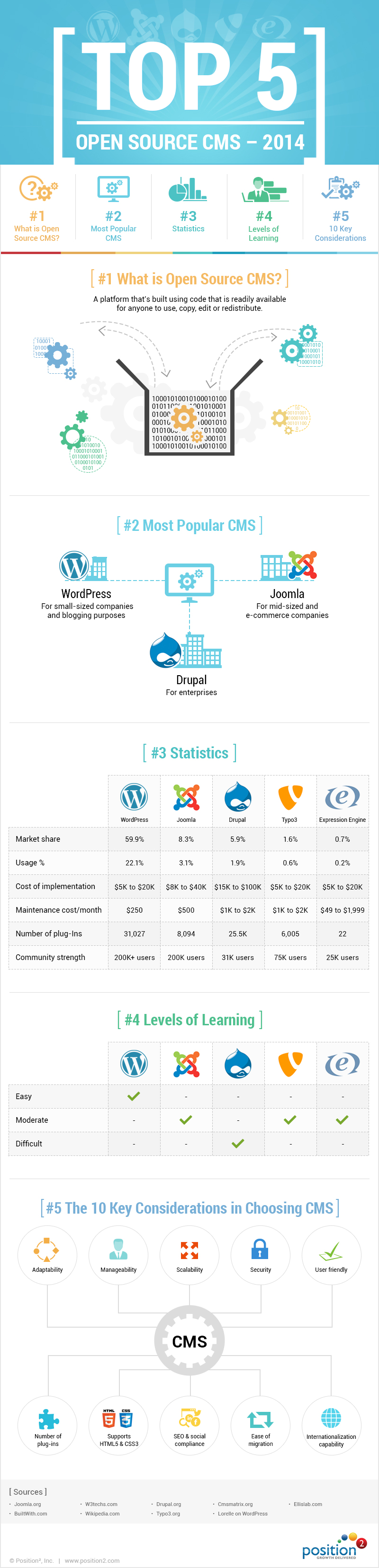
The right Content Management System (CMS) is a crucial business choice any company will make. There are numerous CMSs available. How do you pick the one best for you? How do you know it is the best choice for you? Check out this infographic that studies the top 5 CMSs.
-
The Importance of Persona-based Lead Scoring

According to Aberdeen research, companies that get lead scoring right have a 192% higher average lead qualification rate than those that do not.
A lot is being said and done about lead scoring. Every week, we receive an alert on a white paper (sometimes well researched, sometimes not) that is solely based on the concept of lead scoring.
But another concept is picking up steam now and that is, persona-based lead scoring. Check out this excerpt from our white paper on persona-based lead scoring, that will be released soon:
“Marketing has always been an extension of the dialogue between buyers and sellers. Enter the information age. The marketer faces challenges of identifying preferences, content and geo market-centric personalization, which would complete this dialogue. Implementing a persona-based lead scoring system will help you classify leads based on their behavior and demographic details.
Based on their buying influences, different prospects have different approaches. Here is an example: prospect A visits your website’s home page, but prospect B goes to your product page directly and fills a form. Prospect B has displayed more interest by checking out your product. With persona-based lead scoring, depending on the persona prospect B belongs to, you score prospect B higher.”
Persona-based lead scoring is especially important because it will help in personalizing your lead scoring system thereby helping in better lead targeting, nurturing and conversions.
Interested in knowing more?
We will be releasing our white paper on the ‘Importance of Persona-based Lead Scoring’ soon. Watch this space for more!
Image source: mintigo
-
Go Real-time with YouTube’s New App
Like most social channels and ecommerce websites, YouTube is also being swept away in the app wave of the digital marketing industry.
The video behemoth has announced that it will be launching a new app that will hand digital marketers easier access to YouTube’s creator features. This app will enable you to manage your YouTube channel easily when you are on the field.
Using YouTube’s new app will help in engaging your channel’s fans with real time content. For example, if your brand is sponsoring an industry event, you can take short videos of your activities at the event on your phone and post it on your brand’s YouTube channel, live!
Real time posting is a great way to boost fan engagement!
YouTube has also rolled out a new feature that will enable you to collect funds directly from your fans on YouTube. You no longer have to rely solely on off-YouTube fund raising.
Another new project in the pipeline is what YouTube has termed as ‘Creator Academy’. This is a collection of articles that can help you get more out of YouTube. We will know more on how it will impact marketers once YouTube rolls out the feature.
To check out the new features rolled out by YouTube, watch this video:
-
B2B companies’ survival in tough times, creating content that converts and much more…| Best of the Week
This week’s hot news, events and videos from the online marketing and social media world. 
Best of the Week Video
Check out this video that simplifies the process and gives guidelines on selecting a marketing automation partner instead of a solution only.White Paper: Increase Visibility for Your Content by 4x Today’s traditional SEO is inadequate: Ignite your search results by accelerating visibility in more places than ever before.Download this White Paper and learn: - SEO, why the way we know it is not enough
- Introducing and implementing Enterprise Visibility Accelerator (EVA)
- Using multi-channel tracking tools for effective monitoring
- How EVA benefits businesses.

If you are reading this blog post via a RSS reader, please click here to subscribe. -
Google Panda 4.0 and Payday Loan Algorithm 2.0 Launched
Google has released its latest version of the Panda update and the second payday loan algorithm update. The announcement of the Panda 4.0 update was made by Google’s Webspam team head, Matt Cutts. The rollout has begun May 20.
Google said at the SMX Advanced conference sometime back that Panda updates are rolled out monthly over a 10-day period. So these updates were known to be implemented regularly. The highlighting of this Panda 4.0 update signals that this is a considerably major change.
As we know, the Panda update affects websites with low quality content, while boosting sites with top quality content. The payday loan algorithm is targeted at highly spammy queries.
Search results are now being affected by Panda 4.0 and the payday loan algorithm 2.0 update. Though the payday algorithm update is not related to the Panda or Penguin updates, it is a little tough for SEOs to pinpoint the impact of these updates now. Websites may get affected by both the updates or by one of them.
Google has now changed the way Panda identifies websites and is laying the foundation for future updates. The Panda 4.0 update impacts every language differently. Google has said that 7.5% of English language queries will be affected to an extent users will notice.
Coming days will give us a better idea of the impact of Panda 4.0 and the payday loan algorithm 2.0 updates. Keep an eye on this space for more insights…
Meanwhile, let us know what you think about these two updates.
-
How do B2B Companies Survive in Tough Times?
“The survival of the fittest.”
Well, that’s something B2B companies need to know a thing or two about. In their world too, only those who adapt best to changing environments survive.
B2B companies need to batten down the hatches to weather stormy market conditions, but there will be always be marketing expenses they cannot cut down on.
So, how do they make necessary expenses and still stay afloat?
Here are some tactics B2B companies can use to handle difficult business environments:
- Acclimatize to the new scenario
A bad environment isn’t going to go away overnight. So, it’s important to move quickly without panic. Quickly assess the situation and revise your sales and revenue targets accordingly, so that you know how much you can afford to spend and what the required ROI is. - Prioritize budget allocation
After you adjust your business plan to current market conditions, reallocate your overall budget based on the results. Focus on the most important short term goals for now. However, some businesses stick to long term goals even during bad conditions so that they are ready when the market turns around. - Revisit all your offerings
B2B companies are in a tight spot with their product portfolio during hard times. Maintaining the entire product range may be expensive, but one needs to balance that with a realistic call of what the profitability is and who is buying them.B2B companies often have long standing relationships with their customers and pulling back a product during lean times can hurt their customers’ interests and consequently the relationship. It’s a tough call, but depending on the situation may be necessary. - Organic social media marketing
Tough times often requires tightening of company budgets. You will have less spending money than usual, which makes it important to spend it judiciously. Focus your money on campaigns that are imperative and drive daily posts through organic efforts.In difficult market conditions, concentrate on retaining existing customers through relationship marketing. Engage your fan base with new economical offers that will persuade them in sustained investment in your brand.Acquiring new B2B customers may be a process with a long gestation period. You may not have the resources to focus on this. Depending on the prospects’ stage in the acquisition lifecycle, companies may choose to pursue them or divert their resources to get the most from existing customers. - Continue email marketing efforts
It would stand you in good stead to continue your email marketing campaigns by focusing on nurturing your current database. You will not only save money otherwise spent on buying lists, you can also build on relations with current prospects and customers. Promote your social media offers through your email campaigns too. - Participate in industry events
We’re not talking sponsorship or paid advertising in any form.Send company representatives with strong networking skills to industry events. Participation in industry events achieves a three-pronged purpose: knowledge gain, strengthening customer relationships and interaction with new prospects. All it takes are a few passes to enter as participants and you can let your team do the rest of the work at the event. - Increase focus on risk management
When the foreseeable future is bleak, companies will be more interested in understanding how your product/service will help combat the risks of the current market trend. There’s an opportunity for your company if you can effectively tweak your brand communication to emphasize on risk management and deliver the same through products. When a prospect/customer reads your content, they should feel that your company can help them tide over this crisis. - Understand the impact on brand value and position
Making changes to your business plan and goals might have an impact on your brand’s value and position in your industry. Keep this possibility in mind while preparing for an impending industry crisis and also during the situation. Don’t make drastic changes that take a wide detour from your brand’s vision and mission. For example:- Cutting costs by a large margin might diminish the perception of product quality. Offering too many discounts can undermine your brand’s value.
- Changing your tone of voice in brand communication too much can pose a threat to your connection with customers.
The way you keep your value, customer value and revenue prospects in focus during times of crisis is what will define your brand.
Can you think of any other way B2B companies can keep themselves above the line of risk in troubled times?
Image source: Brand stories
- Acclimatize to the new scenario
-
The Effect of Facebook’s App Links
The social networking site wants to standardize the way traffic is routed between mobile apps with the introduction of App Links.
Twitter has already invested in mobile deep app linking.
Facebook’s App Links will result in standard cross-platform linking between apps and contribute significantly to Facebook’s advertising revenue.
So, how does App Links work?
App Links helps app developers understand how they can send users who are clicking on a link within an app to the app that corresponds to the link. Facebook has launched Software Development Kits (SDKs) for the use of developers on all major platforms.
For example, you click on a link to a Flickr photo album on an email in the Mailbox app. The Mailbox app will check if the Flickr website header has App Links tags showing deep links for the Flickr iOS, Android or Windows phone apps.
Mailbox then sends the user to the deep links found in the App Links header tags on Flickr’s website for your device. If you have installed the Flickr app, Mailbox will send you to the correct deep link and if you haven’t installed the app, you will be directed to the Flickr website.
Advantages of App Links Adoption for Facebook and Marketers
The adoption of App Links will provide Facebook with data from App Links tags and the Facebook App Links Hosting API in its App Links API. Armed with this data, Facebook can understand how web links map to deep links in iOS, Android and Windows apps.
It will offer marketers the ability to create one campaign that can run across different channels: desktop web, mobile websites and mobile apps. If the App Links adoption takes root, Facebook can do this by leveraging its App Links Index.
You will then be able to add a web link and an image into the Facebook Ad Editor for a re-engagement campaign. You only need to add App Links tags to your website for users to be directed to your website after clicking your ad. If a user clicks on your ad from the Facebook mobile app, Facebook can check its App Links Index for App Links tags on the destination and direct the user to the app page.
With this new introduction, Facebook can start persuading its desktop marketers to launch re-engagement campaigns on mobile with no account changes. Facebook can also convert all ad campaigns to web and desktop cross platform campaigns like Google’s Enhanced Campaigns in 2013.
The App Links adoption will also spur Facebook’s recently launched in-app mobile ad network, Audience Network. When your app publishes an ad, Facebook can read the App Link tags of the destination URL or look at its App Links Index, to know what deep link needs to be launched if the user has installed the associated app.
Roadblocks to App Links Adoption
- Both the referrer and the destination apps must support the App Links standard if the user is to be sent to the destination app.
- Facebook will have to garner support from developers and major players like Google and Yahoo to support App Links so that when links are clicked in Gmail, Yahoo Mail or any popular app, the App Links standard is leveraged.
- App Links helps with app to app linking. It does not support web to app linking.
Are you open to adopting App Links? Do you think it will help marketers and increase Facebook’s overall ad profits?
Image Source: altasproject
-
Google Brings “Magazine-style” Text Ads to Display Ad Units
Google has launched “magazine-style” text ads that brings standard text ads to websites that would normally run only display ads. These ads will consist of text only, but will adhere to a design aesthetic, suitable to display.
Google will not add any images to these ads but will only take the text and re-format it into a larger ad unit. Look at the image below for an instance.
The new ad type will appear when a text ad outbids a display ad.

Impact on marketers and publishers
Running these ads helps marketers align their advertising strategy with Google’s recommendations better by allowing them to run both text and display ads that increases their revenue potential.
For example, if you wanted to run a text ad on a top website that runs only display ads, this is your opportunity. If you felt that visuals would distract the viewer from your ad’s main message, this new format can come to your rescue. It presents only text on ads, but in a more aesthetically appealing look.
What do you think about this new ad format by Google?
-
Measuring cross channel ROI, strategic conversion optimization for B2B websites and much more…| Best of the Week
This week’s hot news, events and videos from the online marketing and social media world. 
From the Position² Blog This Week: Measuring ROI in Cross-Channel Marketing
Active consumers on different channels have necessitated running cross channel marketing campaigns. Read this blog to know how you can measure these campaigns and allocate your budget to the best performing channels.
Best of the Week Video
Use ‘Content Grouping’ feature in Google Analytics to group pages and content into a logical structure that mirrors how you think about your website.White Paper: Increase Visibility for Your Content by 4x Today’s traditional SEO is inadequate: Ignite your search results by accelerating visibility in more places than ever before.Download this White Paper and learn: - SEO, why the way we know it is not enough
- Introducing and implementing Enterprise Visibility Accelerator (EVA)
- Using multi-channel tracking tools for effective monitoring
- How EVA benefits businesses.
If you are reading this blog post via a RSS reader, please click here to subscribe.