Author: Team Position Squared

  • LinkedIn Launches Sponsored Updates API, Partner Programs and Facebook is Rumored to Launch Mobile Ad Network

    LinkedIn

    The networking site is adding more weight to content marketing with the launch of Sponsored Updates Partners and Content Partners.

    LinkedIn Certified Sponsored Updates

    Sponsored Updates Partners can help brands increase their campaign ROI by supplying them with campaign management tools that make it easier to handle large Sponsored Updates campaigns. They can create bulk updates across campaigns, target different audiences at scale, schedule advance updates and track performance using reporting dashboards. These partners also help brands manage paid content activities on multiple social channels with a single dashboard.

    During the pilot test, participating companies experienced an overall increase of more than 30% in engagement on their Sponsored Updates campaigns, which was higher than previous campaign results without partner services.

    If your brand does not allocate resources to manage its social media campaigns, some Sponsored Updates Partners also offer managed services, providing expert campaign strategists to supervise brand activities on behalf of your company.

    LinkedIn Certified Content Partners

    Certified Content Partners help brands who do not have enough quality content to share with their audience. They build a bridge between companies and publishers, platforms and original content producers. Content Partners provide brands access to information relevant to their audience.

    Brands who want to run large Sponsored Updates campaigns on LinkedIn can now go ahead whether they have the requisite resources or not since a few Sponsored Updates Partners offer managed services.

    It does not matter even if you do not have sufficient relevant content to share. LinkedIn’s Certified Content Partners program, which puts such brands in touch with original content providers who can provide relevant content, can help you out.

    Facebook

    Is the social giant launching a mobile ad network?

    According to a post on Re/Code, yes it is. Facebook is reportedly working on a mobile ad network that will help it post ads to publishers and developers, making it possible to monetize a large user base even when users are not connected to Facebook.

    Facebook is expected to launch this network at the F8 Facebook Developers Conference on April 30.

    As per the Re/Code post, Facebook’s mobile ad network will attempt to give Google’s AdMob mobile network, Twitter’s MoPub network and small players like Millenial Media.

    Facebook seems to be stepping up its efforts to monetize the mobile space.

    What do you think about these two developments?

    Images Source: LinkedIn

  • The Future of Native Ads

    The Future of Native Ads

    Image Source: oDesk

    Native advertising has been called ‘ads dressed as content’. It is slowly changing the face of ads in the digital space. Native advertising has not only spawned a host of new ad types, it has also captured marketers’ fancy due to its ROI capabilities.

    In this blog post, we attempt to answer the following questions with respect to native advertising:

    • Why are publishers focusing on native advertising?
    • What is influencing the growth of native advertising today?
    • What is it being used for?
    • What does the future hold for native ads?

    Native Advertising to the Rescue

    The rise of native advertising will compensate media publishers who have been hit by dwindling print ad revenues. According to eMarketer, US print ad revenues will reduce from $32.16 billion this year to $31.29 billion in 2018; digital ad spending on newspapers and magazines will increase from $7.48 billion in 2014 to $8.41 billion by 2018. This shift in ad dollars is encouraging media publishers to turn towards native advertising.

    Drivers of Growth

    Web users have become so used to seeing display ads that they overlook them very easily as soon as they identify them as ads. The increasing immunity of consumers to regular display ads has prompted advertisers to adopt native advertising to regain consumers’ lost interest. Designed in the format of the host site’s content, native ads blend in to the content and lure users into engagement.

    Social media has quickly adapted to native ads’ format (for example, Facebook’s newsfeed redesign). Understandably, native ad spending is strongly focused on social media platforms. However, native ads are also flourishing on content portals, news properties, video sharing sites and streaming services, wherever fresh content is to be found.

    As per a BIA/Kelsey research, native ad spends will continue to grow in the coming years driven by mobile devices. As more people take to mobile devices, marketers will increase their focus on mobile marketing and native advertising.

    The Usage of Native Advertising

    According to the eMarketer study mentioned above, the top 3 reasons brands are using native advertising on mobile devices are for:

    • Raising awareness
    • Branding
    • Brand affinity

    Other lead-related reasons like purchase intent and customer acquisition come later in the list of priority reasons. Brand native advertising on mobile devices is more a branding exercise than a sales initiative.

    The Road Ahead

    Despite being a relatively new concept in digital marketing, native advertising has grown considerably and is poised for further growth.

    According to the BIA/Kelsey report mentioned above, in 2014, marketers plan to spend $3.1 billion on native ads in social networks. Growth projections for native ad spending are pegged at a significant 42.4% in 2014. Native advertising offers an interesting opportunity for brands who want consumers to engage with them and they are putting money on this opportunity.

    Have you tried native ads? What is your opinion about them?

  • Twitter Offers Mobile Ads Beyond its Site and LinkedIn Shuts Polling in Groups

    Twitter’s Mobile App Install and Engagement Ads

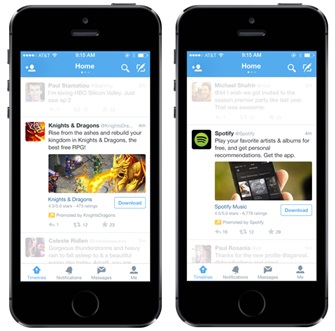
    Post its acquisition of MoPub in 2013, Twitter is expanding its reach by selling ads in mobile apps beyond Twitter. According to Twitter’s blog, “For marketers, this means a rich, native ad unit that combines the best of Twitter Cards and Promoted Tweets. Users can easily install and engage with apps, directly from the Twitter timeline.”

    Through MoPub exchange, you can purchase ads that power mobile app installs and engagement. These apps appear on Twitter as well as thousands of apps on MoPub’s network. Currently in private beta, these ads will be available for purchase in Twitter’s ad auction. You can apply other targeting parameters offered by Twitter for these ads.
    Twitter’s Mobile App Install and Engagement Ads
    You can also participate in real-time bidding to buy mobile app installs and engagement ads programmatically through MoPub within Twitter’s ad system. The ads will appear in the form of banners, interstitials, videos and also in native formats.

    A few brands like Spotify, HotelTonight, Kabam, Deezer, SeatGeek, GREE and GetTaxi have already tested this feature in beta.

    Mobile app installs and engagement ads will work on both, Android and iOS.

    MoPub reaches more than 1 billion unique devices, which is a huge bonus for advertisers in terms of reach. With Twitter being a lead source of engagement, a wide reach can help brands in enriching user experience more.

    LinkedIn Group Polling is Shutting Down

    LinkedIn is closing the Polling feature in Groups. The announcement on its Help Center claims that this update is part of LinkedIn’s bid to build a better product suite.

    As an alternative, brands can continue to engage with fans by:

    • Posting questions to get the Group’s response
    • Sharing an update or
    • Participating in conversations directly on the LinkedIn homepage

    Though this update may not interfere with brand engagement on LinkedIn Groups overtly, it does make a difference where brands will no longer be able to engage through an organized ‘questionnaire’ format that LinkedIn Polling offered.

    Do let us know your opinion on these updates…

    Image Source: Twitter

  • Position² @ SMX West, San Jose, March 2014

    Position2 was at the SMX West event in San Jose last month represented by our Head of SEO, Rahul Banerjee.

    We think SMX West lived up to its expectations this year, especially from a SEO point of view. A look into the future of SEO was most intriguing. SMX shed light on a few key future trends to watch for:

    If you need additional information, feel free to reach out to us.

    • Conversational Search: Advancement is seen both in complexity and nature because of changing user behavior. Now, there is increased emphasis on conversational and voice search. An example of this is the Hummingbird update which emphasizes semantic search methodology (for example, Google Auto Complete option) and Natural Language Understanding (NLU) by looking at the relevance and meaning behind the query.

    Position2 shares an example of conversational search.

    Our content strategies are aligned with user experience and the optimization of search engines also powers better search results. For example, the use of blogs, forums, the Google authorship program, social media optimization etc. helps reach out to the target more with the natural language parameter of users.

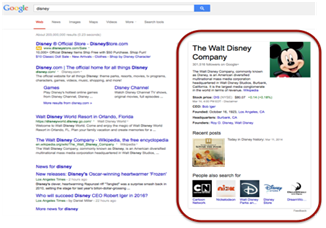
    • Knowledge Graph: It is a system that understands facts about people, places and objects and the interconnectivity between them.With the implementation of the Knowledge Graph, companies will now need to make more efforts to build their brand online. Google will include results about reputed brands of authority who are trusted. Online brand building efforts need to be an ongoing activity.

    Position2 shares an example of knowledge graph.

    However, Google is also testing ads on the Knowledge Graph and carousel.

    Position2 shares an example of knowledge graph ads.

    • Structure Data Markup: It helps Google understand the content architecture of a website better and facilitates faster and more relevant results.We recommend our clients implement structure data markup (eg. Schema.org) on their websites.

    Position2 shares an example of schema markup.

    Here are some more key relevant points for organic SEO:

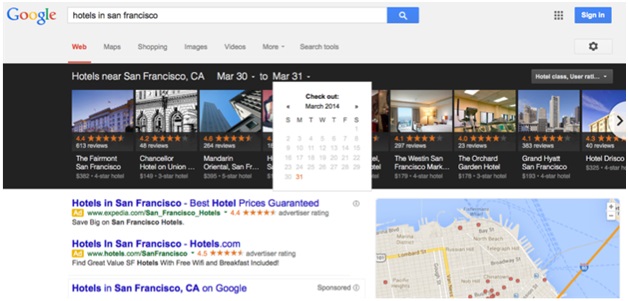
    • High competition: With Google testing out paid ads on search results, organic search results have less shelf space and are needed to compete more to be visible. For example, if you type “Hotels in San Francisco” in Google, the top scroll of the Google SERP includes only paid ads pushing the organic results lower.
    • Mobile will soon dominate: Google mobile queries are set to surpass PC search this year.


    Image Source: Google

    Mobile is another factor that is altering the nature of search. Mobile capabilities differ from device to device, which in turn impacts the content development, communication, engagement and measurement.

    Implementing and embracing personalization will make for better search experience.

    • Apps: There is a global opportunity to develop and market through apps. However, app stores must also be localized.
    • Social presence: Google may not able to read social signals completely from other channels like Facebook and Twitter yet. But, this is going to change soon, which is why we maintain a social presence for our clients and help them build the right influencer network. Google has already said that users who use their Google logins will experience better search results. Google will roll out a full fledged algorithm soon.
    • Natural link building: ‘The best links are not asked for’. Work on natural link building. Do not use shortcuts or indulge in explicit link sales. Let the target audience refer, like, comment and build links for you.

    If you have original content that is useful for people, you can ask for recommendations/references. But your intentions will matter. Google is constantly penalizing websites with vested interest towards link building as an activity.

    • Devalued content: Press releases, articles and guest blogging are now devalued content due to over optimization techniques used by most of the SEO experts. Content that offers value should be created for the target audience and not for search engines.
    • Build recognition, reputation and trust through well-devised content marketing plans. Authority plays a vital role for Google to rank a website. Consumers also look for brand reputation and trust levels before making online purchase decisions.
    • Google Panda updates: It is likely that Panda will be updated more frequently. Expect one soon. Google is constantly testing out search parameters to provide the best results to users.
    • World does not stop at ‘Not Provided’: Post the ‘Not Provided’ update, Google changed the way it harvests data from search to protect users’ privacy. First, all logged-in users were switched to “https” from “http”, where the referral data relating to that search is hidden. But, as already indicated, that refers now to the whole universe.

    Position2 recommends analyzing success with page-level metrics like page-level traffic, bounce rate, percentage of new visitors etc. to have an edge and understand user engagement metrics.

    • Generic Top Level Domains (gTLDs): These do not impact rankings. For example, a domain like www.buymycar.com need not be ranked for car related keywords if it does not have content related to buying cars.

    Share your thoughts on the event insights with us in the comments below.

    More to follow from Position2

    … keep in touch!

  • Position² @ The Marketing Nation Summit, 2014

    ‘The Marketing Nation Summit’ that concluded last week provided a world of insights, knowledge and excitement!

    Team Position2 loved the event and is already looking forward to the next one. We had a lot of fun but, as you know, we’re serious when it comes to business.

    For all you folks who couldn’t attend the summit and for those who can’t get enough, here’s a quick recap…The Marketing Nation Summit Exhibitor Sponsor

    Day 1 – April 7

    Kicked off with an early morning run. Followed by on-site Marketo certifications where users could choose from one of four tracks that included – from basic forms, landing pages, emails to advanced and multi-stream nurturing.

    The day ended with a business mixer where event participants and exhibitors got an opportunity to network and explore new technology integrations.

    Day 2 – April 8

    The excitement went up several notches on the second day with all the high-powered sessions lined up!

    Ann Handley from MarketingProfs on Content Marketing

    The morning session at 8:00 was illuminating with Ann detailing the aspects that content marketers can and can’t take from traditional publishers. She said that though there is plenty to take away, content marketers should go beyond that. Ann’s 5-point action plan:

    • Experiences matter, not just narration: Add real-life examples instead of just narrating to your customers. It makes a lot of difference. Give them a feel of using your product.
    • Talk to your customers directly: Connect with your customers by using words like ‘you’, ‘we’ and ‘us’.
    • Experiment with your content marketing channels: Figure out your ideal content marketing mix. But also invest in different channels and learn what’s best suited for you.

    sam-khandelwal

    • Have a can-do attitude: You can do a lot with even small budgets and teams.
    • Be active in real-time: Participate in conversations as they happen or kick start them yourself.

    Dayna Rothman from Marketo on Lean Content Marketing for Lead Generation

    The session covered a wide variety of topics, from ideation to customers’ buying stages to creating the best content with small teams or budgets.

    But but but…the keynote address by Marketo CEO Phil Fernandez and former Secretary of State Hillary Clinton was still waiting in the wings.

    Phil Fernandez spoke more about Innovation in the Nation, this year’s theme. Besides highlighting the fact that many strong industry players were Marketo users, Phil also provided cool insights into marketing automation and new features of the Marketo platform:

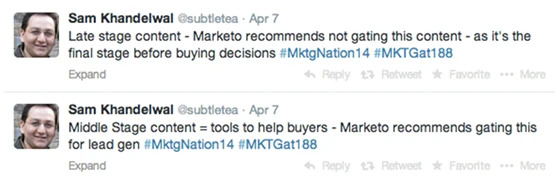
    • Real-time personalization: This allows marketers to personalize content for every member of the audience and helps succeed in creating unique, individualistic customer experiences.

    sam-khandelwal-1

    • Marketo’s new SEO capabilities & the Marketing Calendar: Marketo’s SEO capabilities will enable you to optimize your site’s SEO and work on competitor comparison. Watch out for its launch by the end of this year.
    • The Marketing Calendar will allow you to view, plan, map, adjust and trigger marketing programs in one place.
    Blog-Featured

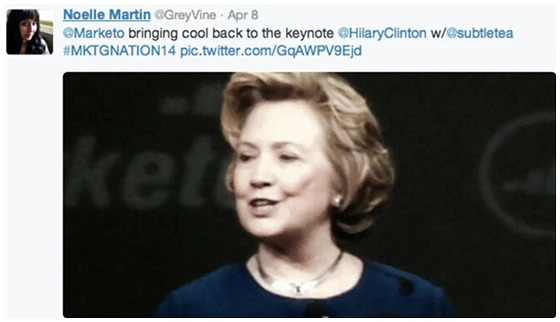
    Post Phil’s session, Hillary Clinton took to the stage. She spoke on a number of topics ranging from inclusion of women in the technology industry to the infancy of the internet and how innovation needs a certain level of risk taking.
    noelle

    Day 3 – April 9

    The last day of the Summit was not lacking in excitement. The keynote address was by Marketo CEO Phil Fernandez (again) and General Electric’s CMO, Beth Comstock.

    After Phil Fernandez announced Marketo’s Revvie winners for this year, Beth Comstock took center stage and spoke on innovation and rapid changes in marketing:

    • Practical innovation: It’s important to understand what people actually need and keep innovating to satisfy that need. Ideas don’t count unless something is done about them. The future has to be today…
    • Innovation does not end: How do you instill ambition and accountability in your company? Dream big and scale. The journey of innovation involves offering powerful outcomes.
    • Marketing is growing in power: Marketers are innovators and integrators. We need to be where the market is moving to. Marketing needs to be a vital function with a growth agenda.
    • Mind sharing: Join hands with others in your system, solve problems as a group and expand your company expertise. Marketers are incubators of new businesses.

    DJ Waldow from Marketo on Being Human

    Marketo’s Digital Marketing Evangelist, DJ Waldow emphasized the importance of the ‘human’ element in marketing communication with examples:

    • Email subject lines and copy: Make them humorous, conversational and creative.
    • Videos: Personalized videos that help establish a rapport between company and customer are great. Though they may not be scalable, you can try them for important prospects and customers.

    sam-khandelwal-3

    • Out-of-Office Replies: It helps communicate with your connections better if you’re more human.
    • Email opt-out landing pages: Instead of ultimatums, personalize landing page copy and offer unique options.

    Moz’s Cyrus Shepard on New Opportunities in SEO

    Cyrus said Google has been energizing SEO and the new changes in the field can be good opportunities:

    • Keywords to concepts: It’s the meaning behind the keyword that matters. You need to be contextually relevant to search queries.
    • Schema, markup and meta data: Google promotes sites that follow content structure, like authorship and reviews. The increase in CTR’s is beneficial and social annotations and data make searchers more attentive towards search results.
    • Web pages to awarding authority: Google is now moving away from blindly placing importance on web pages. The trend is to identify and reward experts who provide solutions through their content.
    • Links to endorsements: Google no longer cares about link building activities. Person-to-person endorsements are more important.
    • Page views to user satisfaction: Google measures bounce rate, time spent on the site, pages viewed per visit, shares, mentions etc. to understanding user satisfaction levels.
    sam-khandelwal-4

    Whew! That’s some heavy lifting! We do hope you’ve picked enough points of interest from this post…

    What was your experience at the Summit? We’d love to hear from you! Get in touch with us!

  • Getting more engagement on Twitter, LinkedIn for B2B Marketing and much more…| Best of the Week

    This week’s hot news, events and videos from the online marketing and social media world.
    Getting the Most Engagement for Your Tweets
    From the Position² Blog This Week:
    Getting the Most Engagement for Your Tweets
    Twitter is undoubtedly a major component of most brands’ social strategies. But, what are the kinds of tweets that get the most traction? Which industry is topping the engagement charts? Read this blog post to know all this and more.
    Top Stories this Week: Social Media
    Top Stories this Week: SEO, PPC and Digital Media
    Best of the Week Video Best of the Week Video
    Entrepreneur and author Eric Ries talks about how big companies today can be trumped by innovations by smaller entities but brands still measure and reward the wrong performance.
    White Paper: Increase Visibility for Your Content by 4x
    Today’s traditional SEO is inadequate: Ignite your search results by accelerating visibility in more places than ever before.Download this White Paper and learn:


    • SEO, why the way we know it is not enough
    • Introducing and implementing Enterprise Visibility Accelerator (EVA)
    • Using multi-channel tracking tools for effective monitoring
    • How EVA benefits businesses.

    Download the complimentary EVA White Paper now

    Know more about Enterprise Visibilty Accelerator(EVA)
    If you are reading this blog post via a RSS reader, please click here to subscribe.
  • Getting the Most Engagement for Your Tweets

    As a top social platform, Twitter is a strong contender for the attention of brands. A wide user base coupled with a powerful ad interface beckons with fans on Twitter. A recent study by Simply Measured showed that:

    • 92% brands covered in the study tweet at least once every day
    • Top brands scored an average of 20% growth in Twitter followers in Q4, 2013

    Judging by the amount of content posted by brands, we can gauge the current levels of engagement. A new study by Twitter identifies what drives engagement for verified accounts:

    • Photos received 35% more re-tweets
    • Videos led to a 28% boost in re-tweets
    • Quotes came third with 19% re-tweets
    • Statistics led to a 17% increase in re-tweets
    • Hashtags gathered 16% re-tweets

    Of course, these figures vary based on the industry, but as mentioned in our earlier blog posts, visuals and videos are powerful marketing tools that build engagement.

    However…there are more ways of improving engagement on Twitter.

    With the growing trend of using multiple media simultaneously, you can cross link TV with Twitter using the latter’s TV ad targeting feature. You can craft compelling stories through your tweets to get consumers interested like Google and Nike have.

    Curated content not just creates relevance, but also puts your individual stamp on it. At the end of the day, it’s all about providing great content.

    The most effective way of creating engagement may be through the simplest thing. If you want engagement, ask for it through a powerful call to action. Ask people to follow you, download your content, retweet or even ask for replies.

    To engage consumers you need to engage them on their interests, values or just capture their imagination. Sometimes that means doing the obvious and at other times, being creative. It starts by knowing your audience. Go ahead and try it – fortune favors the brave.

    What are your strategies for getting more engagement on Twitter?

    Image Source: Binkd

  • Google Applies “Not Provided” to Paid Search Ads

    Following up on its SSL encryption for signed-in searches, Google is extending the “Not Provided” arm of influence to cover paid search ads.

    In an announcement on its blog, Google declared that it is removing the query from the referrer on ad clicks stemming from SSL searches on Google.com.

    Google has assured advertisers that the latter will continue to have access to ad performance data and be able to optimize campaigns and landing pages. You will be able to draw crucial ads data from:

    • The AdWords Search Terms report, which will give you access to the search queries that generated ad clicks along with key performance data.
    • The Google Webmaster tools Search Queries report that will provide aggregate information about the first 2000 queries that generated organic clicks every day.

    If you used queries in the referrer for reporting, automated keyword generation or landing page optimization, Google has provided alternative routes:

    Position2’s POV

    Application of “Not Provided” to paid ads will not impact our optimization since we will get actual search queries using AdWords Search Query reports. This is what our Head of PPC, Sudheer Dhayanand had to say about this move by Google:

    • It will have an impact on dynamic query insertion on landing pages. But, we can insert keywords instead of search queries.
    • It may have an impact on third party analytics tools because of unavailability of search queries.
    • This will definitely impact companies who do not use AdWords tracking since they will not know which query has actually converted.