Author: Team Position Squared

  • Google Panda 4.0 and Payday Loan 2.0 Algorithms– Implications for SEO

    Google Panda 4.0

    Recently Matt Cutts announced on Twitter that Google had released its Google Panda 4.0 algorithm. This is a major algorithm update and not just a data refresh, which means that Google has probably made significant changes to how Panda identifies websites from now on.

    Google Panda 4.0

    Google Panda History

    Google Panda had been designed to prevent sites with poor quality content from showing up on Google’s top search results and provide searchers with the best results possible.

    The last confirmed Panda update was on January 22, 2013 and had affected about 1.2% of English queries. This time it is affecting approximately 7.5% of English queries and different languages to varying extents.

    Panda 4.0 is considered to be a softer, gentler algorithm change that worked well for only some sites. Google plans to lay the groundwork for future changes in this direction.

    Matts Cutts twitter

    Sites that have been affected by this update

    A study of this list by Search metrics reveals that one of the biggest casualties was eBay, which lost a huge amount of traffic from Google. Another was Ask.com.

    In a recent blog, Barry Schwartz said that even press release sites like PRweb, Newswire, Business Wire and PRLog seem to have lost significant ranking through Google.
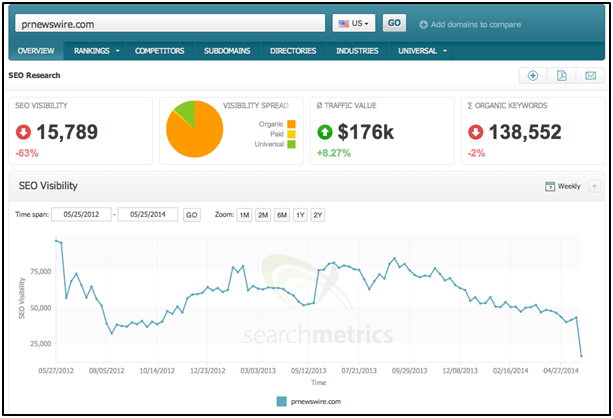
    Drop in traffic for PRweb

    From the above image, we see that PRweb had a significant drop in traffic: 71%.

    The winners’ list shows that small business sites have found favor with Google after the Panda update, and many of them have seen an incredible increase in traffic to their websites. Sites that had lost their footing in rankings despite having good quality content because of the Panda 3.0 update benefitted from Panda 4.0.

    How does this affect SEO?

    Until now, we have observed evident changes like:

    • Rank difference: There would be a considerable difference in the rankings on Google.
    • Loss/gain of traffic to the site: Some of the sites lost almost 50%-75% traffic overnight while some gained substantially.

    How to overcome the Google Panda 4.0 effect

    Listed below are some solutions to counter the impact of Google Panda 4.0:

    • Have unique and fresh content on your website. Keep in mind that content needs to be generated for users and not search engines.
    • Exclude keyword hoarding. Do not target all the keywords to one page. Use a combination of long tail/conversational and generic keywords.
    • Remove duplicate content.
    • Do not use keyword stuffed title tags. Keep it natural.
    • Do not overuse keyword rich internal links and keyword rich footer links.
    • Removing doorway pages and cloaking.
    • Avoid risky affiliate marketing setups

    Please remember recovery can take awhile if you have been hit.

    Google Payday Loan Algorithm 2.0

    Along with the Panda update, Google rolled out its Payday Loan algorithm 2.0 that targets ‘very spammy queries’. This is the second version of the Payday Loan algorithm, which is used to combat specific search queries like payday loans that tend to have a high number of extremely spammy results. This algorithm is not related to the Google Panda or Penguin updates.

    Payday Loan algorithm 2.0 is a continuation of Google’s quest to clean up search queries. The algorithm was rolled out worldwide, affecting different languages to different degrees. It has affected 0.2% of English queries. An advantage is that general queries are likely to receive better search results while preventing the appearance of low quality sites.

    Recently, spam results started to reappear in payday loans’ Google SERP’s:
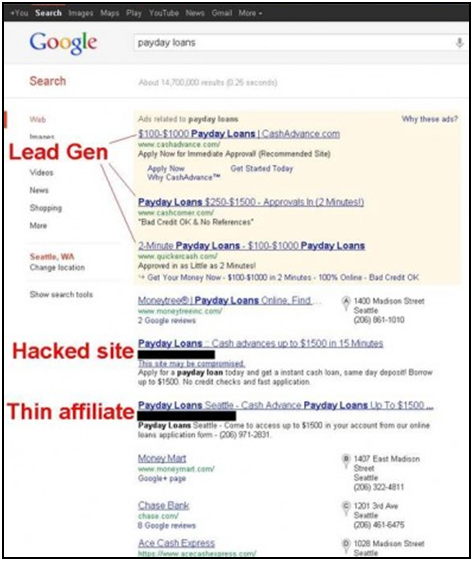
    Spam results on payday loans' Google SERP

    Google Payday Loan Algorithm 3.0

    Google Payday Loan algorithm 3.0 was released on June 12, 2014. At SMX Advanced Matt Cutts announced that this would target terms like [payday loans], [casinos] and other forms of highly spammy queries. Payday Loan algorithm 2.0, had been rolled out a week earlier targeted spammy sites.

    However, Matt did not shed much light on the difference between spammy sites and spammy queries.

    Payday Loan History

    The search engine’s original Payday Loan algorithm was first released on June 11, 2013. It impacted roughly 0.3% of US queries and around 4% of Turkish queries, where the volume of webspam is said to be higher.

    Last year, it was noticed that for the search term ‘Payday loans’, a completely different set of results were appearing on the SERPs each day. The Payday loan companies were using domains that consisted of slightly outdated specific search queries. These queries were likely to have a high number of extremely spammy results. In order to keep the best Payday loan companies on top of the SERPs, Google released the Payday Loan algorithm.

    How does this affect SEO?

    • Removal of the sites from Google SERPs that have spammy content on their site
    • Loss of rankings on Google SERPs
    • Decrease in traffic to the website

    How to overcome the Payday Loan effect

    • Avoid optimizing for any terms that would be considered ‘spammy queries’
    • Do not use spammy methods – like cloaking, hacked sites/hacked content, leveraging Google+ accounts and leveraging expired domains – to promote your website
    • Have original, quality content on the website
    • Do not stuff keywords during optimization. Target 2-3 Keywords for a page. You can use conversational or long tail keywords.
    • Keep the title and description as natural as possible.

    Have anything to add to this? Post your comments below.

    Contributed by Susanna Varghese, Junior SEO Analyst

  • How to Improve Organic CTR – does your SEO take care of this?

    What is the best ROI that you can get through SEO campaigns? How do you know the end results that can be derived from SEO?

    Is it engagement, traffic, brand building and reputation management? Or is it simply lead generation?

    How do you know the end results that can be derived from SEO?                                                                                                                                                                                                 

    You need to keep some best practices in mind while generating higher ROI vs. KPIs with SEO.

    Search engines are vital in fulfilling the ‘intent’ of finding information. SEO efforts cannot be directly tied to the final purchase of products and services like paid media/advertising. Constant and dynamic updates are made every day by search engines, making it more difficult for marketers to understand it.

    The basic rules are simple and straight: stick to the ‘intent of doing good for users’.

    Users come first and then the search engines. In fact, the very foundation of success of search engines is users. Search engines want to serve the best information to their audience. The concept of optimizing content for a visitor plays a very vital role for the marketers.

    Boost Organic CTR

    Here are few tips on how you can boost organic CTR for your website and also within the internal web pages:

    1. Focus on people and consider the latest technology as support

    People are our ultimate target audience. Users/searchers use technology to attain their goals.

    Online marketers should not forget that technology is user-driven. Focus on people and consider the latest technology as support

    Tips:

    • We need to think and adapt to what the users want and need and not the search engines.
    • Get to know your audience – conduct offline and online market research. Their feedback will be useful for your success.
    • Develop strategies around human beings (target audience) and deploy them to balance both target audience and search engines.                                 Image source

    2. Keyword Research and Mapping

    Let’s start with the basics. It is important that we have all the right keywords mapped to the right content.

    Keyword research and mapping                                                                                                                                                                                     Image source

    In other words, keywords should develop out of content and not otherwise. Combine long tail keywords and conversational keywords for balanced conversions. This increases conversions on the website with better targeted content.

    Tips:

    • With the keyword level data vanishing from Google Analytics (‘not provided’), you need to benchmark page level metrics such as KPIs for your success (page level: traffic, engagement, bounce rate, new visits, etc.).
    • With unique keywords mapped to each page, track performance of the page level traffic to mark success.
    • Have a content strategy around conversational keyword targeting (with natural language understanding) that includes blogs, forums, etc.

    3. Search Engine Results Page (SERP) Ranking

    Your SERP Ranking is an indicator of a certain level of success of your SEO efforts. But it is not the complete picture. Your SERP ranking is an indicator of a certain level of success of your SEO efforts

    We need to remember that organic rankings on Page 1 are just indicators of doing the right optimization. You need an SEO strategy that is defined better to consider these as success parameters.

    However, when your audience is finding information on search engines, it is important that you hit the sweet spot on the first page of Google. In short, ranking between 1st and 10th on Google Page 1 does matter. However, rankings above the fold (the part of the screen visible without scroll; usually rankings 1-4) have more visibility; have higher CTR and direct more traffic to the website.

    In other words, higher the rankings on search engines, higher the probability of directing relevant traffic to the website and hence conversions.  Image source

    Tips:

    • Make sure your basic SEO and technical parameters are in place.
    • Move inch by inch. Have a detailed plan to test out your SEO strategies, both short and long-term. Create content accordingly.
    • Remember to create content for your target audience and not search engines. Analyze your audience’s wants and needs.

    4. Title Tag

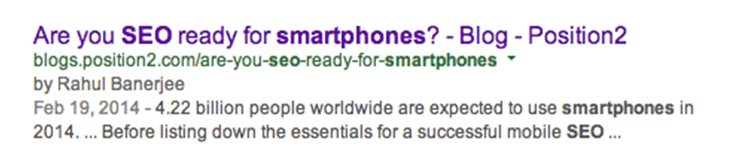
    The title tag describes the theme page in short and appears as a blue link on SERPs. These appear when a searcher types in a query to find information on search engines.

    A page title catches attention and influences the searchers to click on the link to your page. A well-defined page title has higher CTR on SERPs.

    Are you SEO ready for smartphonesTips:

    • Make your page title as natural, relevant and attractive as possible so that the target audience is compelled to click.
    • Include your target keywords to impact organic rankings.
    • Keep the title within 65 characters.

    Make it simple, short, interesting and natural to increase search inquest.

    5. Meta Description

    While the meta title gives an idea about the page users see on SERPs, meta descriptions help the audience understand what the web page content is about before they actually reach it. While search engines consider meta descriptions as ranking factors, when constructed well, they also influence searchers to click. You need to briefly describe what the page is offering.

    Tips:

    • Use it tactically. Have an objective for defining your webpage.
    • Keep it natural and understandable for your target audience. Include keywords that snag users’ attention and lead to chances of higher CTR.
    • Maintain the optimal character limits for the descriptions. It should be around 150-160 characters with spaces. Write what markets the unique content of the page. Include USPs, value adds, discounts and offers.
    • Meta descriptions are indicative of the page theme and may not show in the SERPs. Google also uses other publicly available sources of authority like Wikipedia to show relevant results. So, have a content marketing plan along with website optimization.

    6. URL Optimization

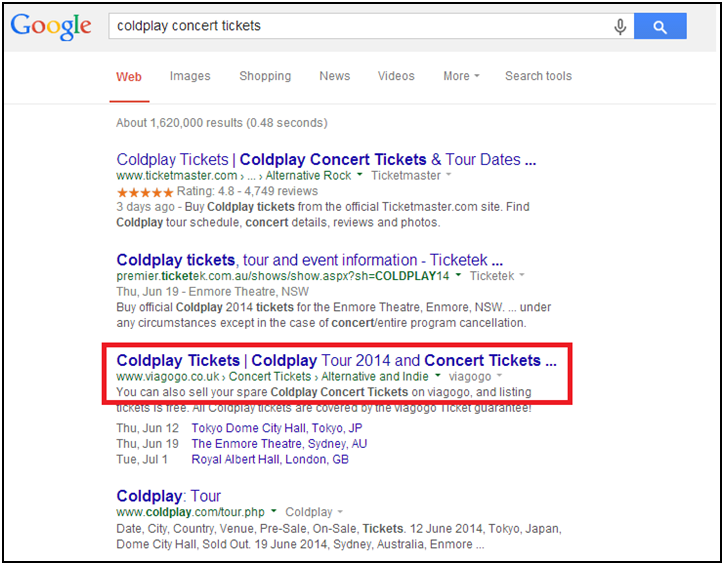
    The best approach is to frame URLs for people that are crisp, easy to read and remember.

    Clear and concise URLs on SERPs reassure readers that a page will deliver on their search and enable better CTRs.

    URL optimization

    7. Rich Snippets (Structured Data Markup)

    a) On-page markup using Schema

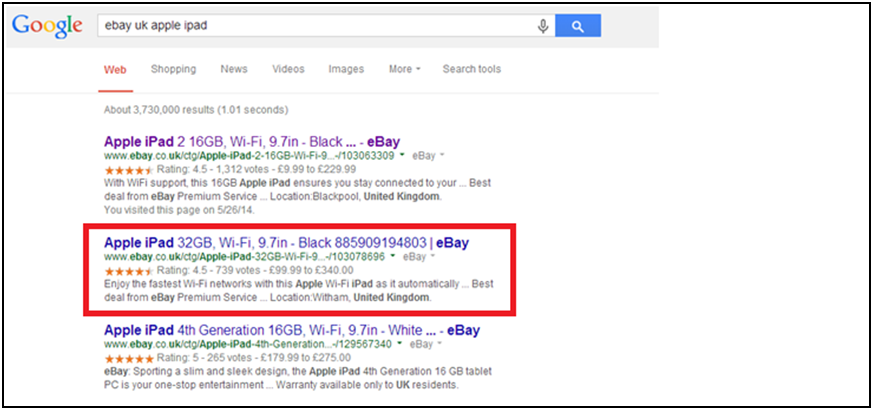
    Inclusion of Schema markup enables search engines to understand and categorize unstructured data on web pages. This helps provide richer search results and makes it easier for users to find relevant information on the SERPs thereby driving better CTRs.

    On-page markup using schema

    Customer rating markup on a product page: Improves credibility of the product leading to better CTRs.

    b) Google Authorship markup

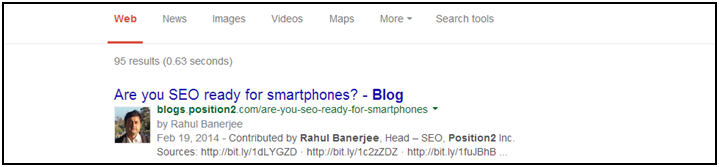
    Linking the content of the author with his/her Google+ profile enables a headshot of the author to appear next to the search listing. This leads to better CTRs for blog posts and articles from SERPs.

    Google authorship markup

    8. Call-to-Action (CTA) – Visibility

    Apart from techniques to increase CTR through search, the final touch should be well-judged placements of CTAs on the website. This would increase the probability of CTRs and hence, conversions on the website. Call to action

    As mentioned earlier, it is necessary to rank above to fold in search engines and have CTAs (buttons, forms, etc.) above the fold.

    Call to action

    Call to action     Tips:

    • Test the important pages of the website, the home page, products and solutions pages with Heat Map. Monitor your audience’s movements on your website pages. Then place the CTAs accordingly.
    • Competitive analysis tells you how your competition is doing. Draw inputs through the comparison.
    • Work on your website design based on your budget and look to improve user experience.

    Contributed by Rahul Banerjee – Head SEO, Position2

  • Key Takeaways from the Digital Now Conference in Association with Google

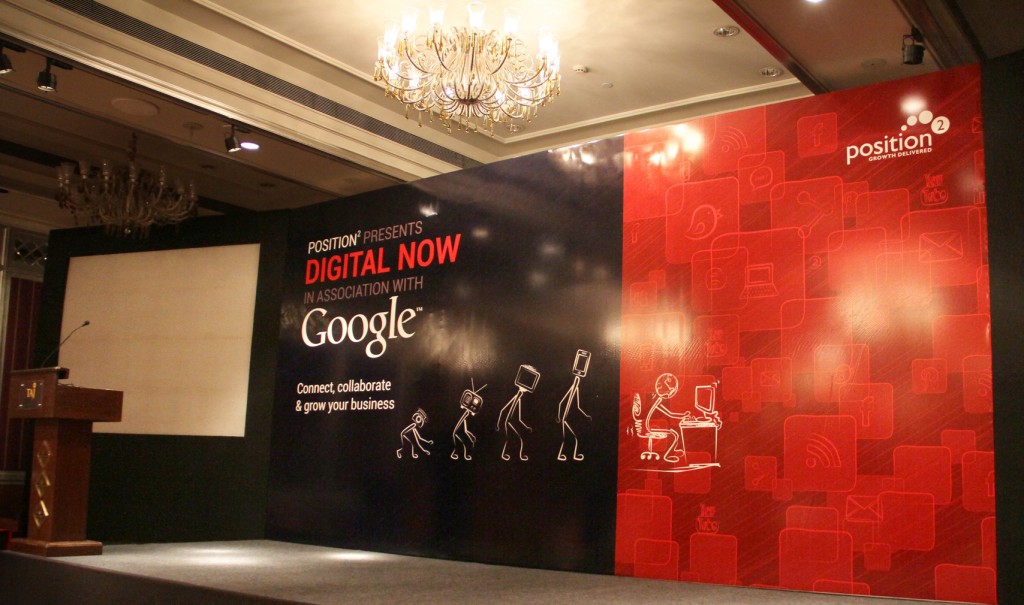
    The Bangalore chapter of Digital Now conference, in association with Google, concluded on June 12. The event was a great success, both for the participants and speakers.

    Position2 presents Digital Now in association with Google

    If you could not attend the event or if you want a second look at the insights shared, here are the key takeaways:

    Reach of Digital in India by Google’s Akshay Sonthalia

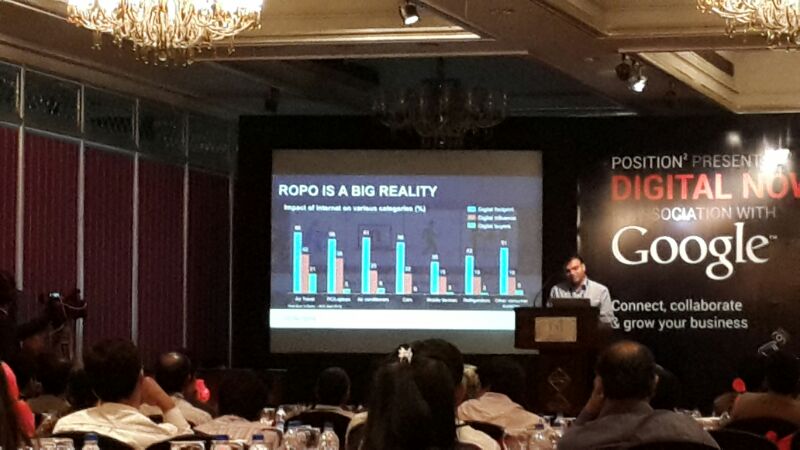
    Google’s Strategic Partnership Manager, Akshay Sonthalia, delivered the keynote address on the reach of digital in India. Akshay shared several popular videos with the audience, that highlighted one key factor – digital marketing is capable of touching the hearts of millions. It Connects.

    Check out the key takeaways from his session:

    • Think digital, with Google – Engage with people’s emotions, logic and sense of awe. Digital helps move people when it matters the most
    • Video views are exploding in India with YouTube having 60 million unique users. If you have not completely embraced video marketing, you need to start now to stay ahead of your competitors
    • Timeliness, reach and impact can act as cost effective ways to reach out to millions of people
    • Increase reach by embracing personalization. In fact, digital ads have more scope to get creative as compared to traditional media, where you are bound by a set of guidelines
    • Indians are transacting online more. Here is what we found – Digital buyers in India are expected to reach 41.8 million by 2016 (eMarketer)Research online purchase offline
    • Research Online Purchase Offline (ROPO) is today’s reality – consideration happens in digital even if purchase doesn’t. Leverage it.
    • 3 pillars of capturing demand: Personalize, build for mobile and data usage
    • Good customers are great to have, they say awesome things about you. However, you should not ignore disgruntled customers. In fact, you should be wary of them, since they can ruin your credibility with even a single bad experience, thanks to digital media. Invest in reputation management systems.
    • Consumers can create and consume content. Keep consumers engaged to make them your brand advocates

     Infrastructure for going digital, by Position2’s CEO Rajiv Parikh and MD 74 Nambiar

    After watching some wonderful, moving videos, it was time for the audience to tighten their seat belts. Next up were our CEO Rajiv Parikh and MD 74 Nambiar for the session on ‘What you need to go digital’. Here are the key insights from this session:

    • Customer journey varies in B2C and B2B sectors. Position2 took the audience through the journey of a consumer, until she/he reaches a purchase decision.
    • Content in multiple formats is in demand
    • Mobile is big, so you have to make your landing pages mobile-friendly
    • You need a three layered framework to go digital:
      • Content layer
      • Interaction layer (for instance, blogs, social channels, landing pages etc.)
      • Marketing layer (paid search, media, email etc.)
    • We also emphasized on the need for user centric SEO, as compared to search engine centric. The consumer is king and while creating an SEO strategy, companies need to focus on conversational keywords, user experience and content authority. If you are still focusing on keywords, content quantity and frequency, its time to realign your marketing priorities.

    Insights from the panel discussion

    The following are the important points that cropped up during the panel discussion that followed:

    • Move from traditional to digital marketing
    • Monitor the journey of a customer through digital
    • Consumer behavior drive social media marketing

    Hope this was a good refresher!

    To the 100+ people who attended the event, thank you! If you did not get to the event, we hope you see you next time.

    Drop your comments in the section below!

  • Google My Business Launch and Facebook Plans to Sell Web Browsing Data

    Google My Business launch and Facebook plans to sell web browsing data

    Google

    Based on brands’ feedback that it’s tough to find their loyal customers, Google is making it easier for businesses to connect with the latter.

    Here comes ‘Google My Business’…a free and easy way for brands to connect with customers wherever they are.

    With Google My Business, you can:

    • Update business information on Google Search, Maps and Google+ from one place making it easy for customers to connect with you. This also helps in making sure you provide consistent information to customers across platforms.
    • Add pictures of your business and provide customers with a virtual tour of your business, giving them a glimpse of your company
    • Connect with your customers on Google+ by sharing updates about events and important news
    • Monitor and respond to Google reviews
    • Gain insights and integration with AdWords Express and understand how people find and interact with you
    • Manage your brand’s information even when you are on the move with the Google My Business Android app and the soon-to-be launched iOS app

    Google will be moving brands using Places for Business and the Google+ Dashboard onto Google My Business along with adding new businesses.

    Facebook

    User browsing data and information about the apps they have downloaded will now be provided to advertisers by Facebook.

    Announcing this through a blog post, Facebook said this move was to help users see more personalized ads. The rollout will be limited to US based users initially.

    However, users can opt out of this feature by clicking on this link and selecting the companies they want to opt out from. Users can also opt out from Facebook’s iOS and Android apps.

    Implications

    With Google’s update, brands can now:

    • Connect with customers better and also when they are on the move
    • Manage consistent brand messaging
    • Keep an eye on customer reviews more easily and respond

    Until now, Facebook could target users with ads based on their behavior on the social network only. You can now target users based on their extended web activities. For example, if a user wants to buy a subscription for a PPC service and is searching for it, you can show him/her ads about PPC services using this data. With users choosing to research online increasingly before making purchases, brands can benefit immensely from this data.

  • The rise of transient competitive advantage, best practices for B2B websites and much more…Best of the Week

    This week’s hot news, events and videos from the online marketing and social media world.
    The Rise of Transient Competitive Advantage
    From the Position² Blog This Week:
    The Rise of Transient Competitive Advantage There is a new concept on the block, transient competitive advantage, where companies continually innovate. Check out this blog to know more about this concept and how it can help in volatile business environments.
    Top Stories this Week: Social Media
    Top Stories this Week: SEO, PPC and Digital Media
    Best of the Week Video Best of the Week Video Mobile devices and apps are hot areas for marketers. Check out this video to know how you can use both platforms to engage with customers and also generate brand value and revenue.
    White Paper: Increase Visibility for Your Content by 4x
    Today’s traditional SEO is inadequate: Ignite your search results by accelerating visibility in more places than ever before.Download this White Paper and learn:


    • SEO, why the way we know it is not enough
    • Introducing and implementing Enterprise Visibility Accelerator (EVA)
    • Using multi-channel tracking tools for effective monitoring
    • How EVA benefits businesses.

    Download the complimentary EVA White Paper now

    Know more about Enterprise Visibilty Accelerator(EVA)
    If you are reading this blog post via a RSS reader, please click here to subscribe.
  • The Rise of Transient Competitive Advantage

    It’s been a long standing belief that a company must have a sustainable competitive advantage to excel. But, lately, there has been an upsurge of popularity for a different but related concept, ‘transient competitive advantage’.

    What is the difference between transient and sustainable competitive advantage?

    Transient competitive advantage refers to the practice of taking up new strategic initiatives based on short term or transient advantages. This is novel because the norm has always been to build a business around something that is lasting and will provide an enduring competitive advantage.

    A sustainable competitive advantage is the practice of finding a profitable opportunity that can deliver an advantage that competition cannot match for many years. This advantage can take the form of differentiation, new business model, entry barriers, ownership of critical resources, etc. anything that blocks competition for a long time. For example, SouthWest Airlines’ business model of flying short hauls between small city airports gave it an advantage that competition could not match for years. Dell’s strategy of mass-customization gave it an advantage that lasted many years.

    A Shift in Thinking

    Changing times have propelled a move towards the concept of transient competitive advantage. At a time when scenarios shift dramatically in a short period of time, executives are recognizing the merit of looking at the short term rather than the long term.

    What’s led to This Shift in Thinking?

    The digital revolution and globalization are the two main factors that have increased the pace of change and shortened the durability of most concepts. Companies can innovate or imitate faster now than ever before. With faster information flow and quicker research – nothing remains a secret for long and no product remains unique for long. Entry barriers have become meaningless in many industries due to outsourcing. Businesses have a shorter window for success and so it makes sense for them to run with opportunities that deliver a short term competitive advantage.

    Important Considerations for Transient Competitive Advantage

    With volatile business environments, companies continue with strategies from stable times. A business plan put together during good times can comfortably draw from resources. Continuing with such a plan in difficult times can leave you with depleting resources and increasing costs. And soon, the advantage will run out of steam and your company will be left in the lurch.

    An example of this scenario is Kodak, from the photography industry. In 1973, the Hunt brothers, oil and gas billionaires, decided to increase their stock of silver and prices of this commodity shot through the roof. Kodak was one of the major consumers of silver and tried to break away from this stranglehold by inventing the digital camera. This was a great example of a transient competitive strategy. However, what they didn’t do was capitalize on this advantage. They remained dependent on a film-based model for far too long.

    Companies should consider transient competitive advantages to survive in today’s competition intensive and barrier-free environment. They need to look at developing transitory business strategies that consider the crucial market and company variables from that time. These strategies should evolve as soon as there is a change in the important variables.

    A culture of constant innovation lies at the heart of transient competitive strategy. Innovations earn profits only if they take current market conditions into consideration. The importance of innovation was stressed by GE CMO Beth Comstock during the recently concluded Marketo summit.

    Structure of Transient Competitive Advantage

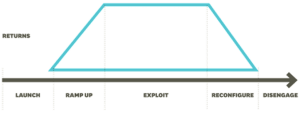
    The lifecycle of any transient competitive advantage typically looks like this:

    The growth of transient competitive advantage

    A transient competitive advantage kicks off with a launch procedure during which the company identifies an opportunity and organizes resources required to utilize the opportunity. In this first phase, you need employees who are willing to embrace new ideas and structures. It takes an open mind to understand changing contingencies and create strategies accordingly.

    In the second phase, ramp up, the idea is scaled up. This stage requires employees who have good organizational and planning skills. The required resources with the right quality levels have to be collated at the right time for the idea to materialize into reality.

    The third phase of exploit is where it can be possible for you to gain profits and market share and compel competitors to answer. You need employees who are good at mergers and acquisitions, analytical decision making and are efficient.

    If your competitors do answer your product move in kind, it so happens that the competition you spawned dilutes your advantage. So, you will need to re-configure your advantage to maintain the uniqueness. This stage needs employees who aren’t afraid to juggle the box a little and revisit strategies or resources.

    Examples of Companies Who Adopted Transient Competitive Advantage

    More and more companies are realizing the necessity of transient competitive advantage. Here are a few companies who have adopted the concept:

    • Milliken & Company, a textiles and chemicals company
    • Cognizant, an IT services company
    • Brambles, a logistics company

    The photography business provides us with another example:

    There was another company from the photography industry at the time of the Kodak episode. Fuji, the other player, was also affected by the control of silver of the Hunt brothers. However, what set Fuji apart from Kodak was that it recognized that depending on chemicals whose cost they couldn’t control would always make their business vulnerable. Fuji started investigating opportunities for photography to be less dependent on chemistry.

    Today, Fuji is a leading company in the photography industry with revenue of about $560 billion for fiscal year 2014.

    What are your thoughts on transient competitive advantage? Do tell us in the comments below.

    Image source: Strategy capstone

  • LinkedIn Powers up Search and Google Launches Premium Programmatic Video Marketplace

    LinkedIn updates and Google launches Apps Marketplace

    LinkedIn

    LinkedIn’s burgeoning user base – more than 300 million registered users – has made its search methodology insufficient. LinkedIn’s current search feature that allowed people to search for jobs, groups and other criteria was not catering to its user base.

    As a solution, a new search feature, Galene, was developed by LinkedIn.

    With Galene’s introduction, search will be twice as fast. New aspects with the updated search structure include instant results and suggestions that offer clues when users type in. For example, if you type ‘C++’, LinkedIn will ask you if you are looking for jobs in C++ programming.

    This feature will be rolled out to all users over the next few months.

    Google

    Google is unveiling its programmatic video marketplace, Google Partner Select, with a group of select partners, whose names are yet to be revealed.

    Google Partner Select will connect premium publishers and brands through direct buying. According to Neal Mohan, Google’s VP of display and video advertising products, “This new premium programmatic marketplace will connect a select set of publishers investing in top-quality video with the brands that want to buy against it.”

    Neal also said that this venture will help brands and publishers in leveraging programmatic video buying. Brands want to take advantage of premium video content but are having trouble finding high quality videos. On the other hand, publishers want to exercise control over programmatic.

    Google Partner Select will build a bridge over these troubled waters, meeting the needs of both brands and publishers by bringing together “the best of brand with the best of programmatic.”

    What do these changes mean for marketers?

    Better and quicker LinkedIn search can mean easier content searches for users, especially with the recent boost for LinkedIn Influencers. If content is easy to find, the reader will engage more, which can lead to better conversion rates. This will also help you expand your reach by bringing relevant groups and forums closer to you.

    Google Partner Select will close the gap between brands and publishers in programmatic video buying. Brands can get access to high quality videos while publishers will be getting some control over the process.

  • The Concept of Smart Segmentation

    What is smart segmentation

    You have a large database of leads? That’s great!

    It takes a lot of effort to build one. But worth it since a business’s future is built on leads. A database is only as good as what you do with it. So you need to use it carefully.

    Large disorganized databases are messy to handle. Organizing them would be a good first step.

    Smart segmentation is a system of classifying and categorizing leads based on certain pre-determined stipulations.

    Key Considerations

    Your segments must be:

    • Practical: Not too many, not too few. A rule of thumb suggests 8 is ideal because this tends to be a manageable number.
    • Distinct: Make sure that each segment is markedly different so that you can tailor your messages/ actions for maximum effectiveness.
    • Adaptable to different campaigns: Segment creation should be such that they can be used for varied campaigns.
    • Open to adjustments: Be prepared to make edits to segments based on results and feedback.

    Base Factors

    Customer segmentation needs to be based on certain tangible parameters:

    • Identity
      Know the identity of your customers, they expect it. Maintain a basic profile about your customers with demographical information such as their age, gender, occupation details etc. These factors help you classify leads into appropriate segments.
    • Attitudes & Behavioral Cues
      The different kinds of attitude and behavior that prospects demonstrate gives important cues on how you need to engage with and convert them. Tracking your prospects’ engagement activities will give you valuable inputs for your campaigns.
      Who is opening your emails and who isn’t? Are they looking at your discount offers and moving away without buying? Is discount the only incentive that makes them buy? All these questions give you an idea on handling prospects in different segments.
    • Channels of Engagement
      Know the channels through which customers prefer to hear from you. Successful marketing communication depends on delivering the message through a channel the prospect prefers. Knowledge of customer preference of channels helps develop and target content right with the most impact.
      For example, millennials may prefer being contacted through social media channels but baby boomers may be more partial towards emails. Similarly, younger customers might engage with your brand through apps more but older customers may show preference for your desktop site.
    • Timing
      Sending marketing communication when the prospect is not available or is uninterested is of no use. It’s important to know the best time to approach prospects. Gain understanding of their browsing habits so that you can connect with them when their interest is at the optimum – the time at which they check emails, do product research, shop etc.
    • Current and Future Value of Customers
      Factor in the value customers are adding to your company now and project the value they might add in the future while establishing segments. Knowing the expected value of customers will help in approaching a segment.
      For example it’s one thing to approach a prospect as a one-time buyer of a $100 product and it’s another thing to see the customer as a potential $10,000 business possibility based on the prospect buying a $100 product once a month for the next 10 years.

    Smart segmentation based on measurable factors helps in:

    • The ability to create exclusive campaigns for specific segments
    • Executing more precision-targeted campaigns
    • Customized and more intelligent marketing communication

    Have you implemented ‘smart’ segmentation? What do the results say? Tell us in your comments below…

    Image source

  • The Secret to Successful Lead Scoring

    Lead scoring is the scale against which an organization can perceive the value of its prospects. Successful lead scoring leads to increased sales efficiency and effectiveness as well as tighter marketing and sales alignment.

    There are 2 fit categories that define the success of lead scoring: Explicit and Implicit. The secret to successful lead scoring

    Here is an excerpt from our soon-to-be released white paper on persona-based lead scoring:

    “Explicit lead scoring refers to declarations about demographic data, which are indicative of one’s profile. BANT components are largely explicit in nature and are dependent on self declaration. So, they are limited to the extent of anonymity the lead wants to have…Implicit scoring signals refer to behavioral activities such as visits to product pages, thought leadership articles and others, which are generally segmented into early, mid and late stage content”.

    Interested in knowing more? Watch out for our white paper on persona-based lead scoring

    Image source: galleryhip.com

  • Importance of persona-based lead scoring, B2B companies using marketing automation and much more…| Best of the Week

    This week’s hot news, events and videos from the online marketing and social media world.
    The Importance of Persona-based Lead Scoring
    From the Position² Blog This Week:
    The Importance of Persona-based Lead Scoring
    Persona-based lead scoring is very important. But why? Read this blog that talks about the importance reserved for persona-based lead scoring.
    Top Stories this Week: Social Media
    Top Stories this Week: SEO, PPC and Digital Media
    Best of the Week Video Best of the Week Video
    How do you turn your marketing messages into continuous, relationship building conversations? Can you scale these? Get the answers to these questions in this video featuring Mike Stocker, Sr. Consumer Marketing Solution Strategist at Marketo.
    White Paper: Increase Visibility for Your Content by 4x
    Today’s traditional SEO is inadequate: Ignite your search results by accelerating visibility in more places than ever before.Download this White Paper and learn:

    • SEO, why the way we know it is not enough
    • Introducing and implementing Enterprise Visibility Accelerator (EVA)
    • Using multi-channel tracking tools for effective monitoring
    • How EVA benefits businesses.

    Download the complimentary EVA White Paper now

    Know more about Enterprise Visibilty Accelerator(EVA)
    If you are reading this blog post via a RSS reader, please click here to subscribe.