Author: Team Position Squared

  • Facebook Acquires LiveRail and Twitter Picks up TapCommerce

    Facebook acquires LiveRail

    Facebook

    The latest addition to Facebook is LiveRail, an online video advertising company that provides premium publishers the technology to sell video inventory across all devices. LiveRail connects publishers to major ad networks, Demand-Side Platforms (DSPs), trading desks and exchanges. It uses a combination of real-time bidding and proprietary market data.

    LiveRail will be functioning as a wholly owned subsidiary of Facebook and will be integrating its data with Facebook’s to improve user targeting and display better ads.

    Video ads’ increasing popularity has propelled marketers to take serious note of it. Now, social platforms are catering to marketers’ video ad requirements. Plus, industry trends are leaning towards programmatic ad buying and Facebook’s acquisition of LiveRail underlines the importance of this trend. With LiveRail’s capabilities, marketers will now be able to harness the power of videos ads and will take Facebook’s user reach and user engagement to a different level.

    Twitter

    Treading on the path of boosting its mobile ad offering, Twitter has announced that it will be acquiring TapCommerce, a leading mobile retargeting and re-engagement advertising company.

    After its acquisition of MoPub, Twitter says it has been working on improving its mobile advertising capabilities. Users are increasingly juggling different media and advertisers are spending to gain new customers. However, reviving inactive customers or retaining current customers is equally critical for good ROI.

    Marketers using Twitter can now retarget and re-engage with users using TapCommerce technology. Twitter will be able to provide better capabilities for app re-engagement, tools and managed service solutions for real-time programmatic buying paired with sophisticated measurement capabilities.

    Used with Twitter’s other ad solutions, marketers will now be able to drive ROI with mobile users both on and off Twitter.

    Social media platforms, especially Facebook and Twitter, are constantly innovating and strategically acquiring smaller, niche companies to build up their arsenal. It will be interesting to see whether marketers can keep up with the ever increasing offerings of these two platforms.

    What do you think of these acquisitions?

  • Website migration checklist, B2B email perspective and much more…| Best of the Week

    This week’s hot news, events and videos from the online marketing and social media world.
    Website Migration Blueprint – A 4 Step Checklist
    From the Position² Blog This Week:
    Website Migration Blueprint – A 4 Step Checklist
    Migrating your website from one Content Management System (CMS) to another is no mean feat. Read this blog post to know the steps you need to follow to ensure error-free and smooth website migration.
    Top Stories this Week: Social Media
    Top Stories this Week: SEO, PPC and Digital Media
    Best of the Week Video Best of the Week Video
    How can you manage search in a digital world that is changing so fast? Check out this video where Jeff Preston, Senior Manager, SEO at Disney Interactive talks about handling change in today’s business environment.
    White Paper: Increase Visibility for Your Content by 4x
    Today’s traditional SEO is inadequate: Ignite your search results by accelerating visibility in more places than ever before.Download this White Paper and learn:

    • SEO, why the way we know it is not enough
    • Introducing and implementing Enterprise Visibility Accelerator (EVA)
    • Using multi-channel tracking tools for effective monitoring
    • How EVA benefits businesses.

    Download the complimentary EVA White Paper now

    Know more about Enterprise Visibilty Accelerator(EVA)
    If you are reading this blog post via a RSS reader, please click here to subscribe.
  • Website Migration Blueprint – A 4 Step Checklist

    A Content Management System (CMS) makes life easier for organizations that have repetitive or standardized content. Nothing is constant. So, there will be a time when you realize that your CMS is not doing as much as you want it to or is not as flexible as you want it to be. Many companies begin looking for a smarter CMS than what they had started out with. Another important reason these days is the need for CMS that publishes both to web and mobile simultaneously.

    But migrating your website from one CMS to another isn’t an easy task…it requires organized planning and execution.

    Also, every CMS has its own unique features. Though they may share some common ones, each CMS will have exclusive features. For instance, you have chosen CMS ‘A’ based on a set of specific criteria. So, when you are migrating to CMS ‘B’, you need to check if all your criteria are being met and also look out for common and unique features.

    Blueprint

    You need to make sure the following tasks are completed in the process of your website’s migration:

    Step I – Content Audit

    A website’s content makes it what it is. The content audit phase is a great opportunity to take a good, hard look at the content on display. Excellent website navigation and structure should be coupled with relevant and captivating content. List out all your current pages and number them. This will give you an idea about probable website size and help in site mapping. Also, list out your URL structure and map the old URLs to the new URL structure.

    Content removal is also an integral part of a content audit. Without a second thought, unnecessary content will have to go. Bigger is not better.

    Here are some perspectives on how to examine your content:

    • Identify what has changed in your company – some product lines may have been stopped, some people may have left the organization, etc.
    • All related content can be removed.
    • There often is some content that becomes repetitive/ irrelevant with the passage of time – eliminate it.
    • Some of your content may not have garnered you any traction, whether in terms of social reach or sales – see how you can make it more engaging and effective.
    • Some websites are like mansions – there will be areas that get overlooked. Pay attention to those website areas.
    • Some content may now be deviating from your company policy/tone of voice. Use this opportunity to remove or rewrite such content

    Another reason to remove content is change in your website structure. If you decide to not have certain tabs/pages in your new website, you will not need the content on those tabs/pages.

    Step II – Customize the new CMS

    The second step would be to tailor the new CMS to fit your current requirements. Customization involves installing the plug-ins you would need and adding the content you have left from the content audit.

    Step III – Re-direct URLs

    Once your content is added, you need to add 301 re-directs from your old URLs to the new ones. 301 redirect is a HTTP response status code that mentions that the page has moved permanently. Your old URLs will then be cached.

    You need to transfer all your properties from old URLs to the new ones. While structuring your new URLs, you need to be certain that they are identical to the old ones. Your aim should be to avoid those dreaded ‘Page not found’ 401 errors.

    Proper URL re-direction also helps search engines in associating authority signals to the new URLs. The new URLs will then rank well for the same keywords as the old URLs. If you don’t re-direct URLs right, the new URLs will be treated as new pages. You will need to start trying to rank the new URLs for keywords from scratch.

    Step IV – Build theme

    The fourth step would be to build the theme for the new website design. Pick your theme design based on aspects like:

    • Your industry
    • Brand colors, fonts and visual messaging
    • Visual appeal and practicality
    • Complexity and maintenance effort required

    This checklist offers only an overview of the steps that you need to follow for successful and error free website migration. The detailed framework you need to follow is much more elaborate…

    Have you migrated your website from one CMS to another? How has your experience been?

    Image source

  • Implementing cross-channel personalization, state of B2B search marketing and much more…| Best of the Week

    This week’s hot news, events and videos from the online marketing and social media world.
    Implementing Cross-Channel Personalization
    From the Position² Blog This Week:
    Implementing Cross-Channel Personalization
    How do you apply personalization to your cross-channel campaigns? What are the crucial factors that you should consider? Read this blog post to know the answers to these questions and more…
    Top Stories this Week: Social Media
    Top Stories this Week: SEO, PPC and Digital Media
    Best of the Week Video Best of the Week Video
    Even if you have amazing content, unless you increase its visibility, it is not of much use to you. Watch this video where Ben Lloyd and Brian Rauschenbach talk about tips and tactics to amplify the reach of your content.
    White Paper: Increase Visibility for Your Content by 4x
    Today’s traditional SEO is inadequate: Ignite your search results by accelerating visibility in more places than ever before.Download this White Paper and learn:

    • SEO, why the way we know it is not enough
    • Introducing and implementing Enterprise Visibility Accelerator (EVA)
    • Using multi-channel tracking tools for effective monitoring
    • How EVA benefits businesses.

    Download the complimentary EVA White Paper now

    Know more about Enterprise Visibilty Accelerator(EVA)
    If you are reading this blog post via a RSS reader, please click here to subscribe.
  • LinkedIn Expands its Ad Network across the Web

    LinkedIn Expands its Ad Network across the Web

    Following in the footsteps of Twitter and Facebook, LinkedIn is testing advertising outside its platform.

    LinkedIn has kicked off a pilot project that lets marketers to post ads over the web using its data repository. The participants of this pilot program include GroupM’s programmatic focused agency Xaxis and marketing technology and data specialist company Dstillery.

    LinkedIn is also opening up its own ad inventory through programmatic channels. Marketers can now target specific audience groups on LinkedIn through a ‘private exchange’.

    LinkedIn’s entry into the programmatic ad buying market is new and will take some time to strengthen its hold in the domain.

    The digital marketing industry is leaning heavily towards programmatic buying lately. Being a social platform better suited for business professionals, if launched as a full time capability, LinkedIn’s expanding ad network can prove to be a blessing for marketers, B2B in particular. When targeting business professionals, LinkedIn is a top platform and if this pilot project is launched, targeting will become more precise and effective.

    Will this move help LinkedIn gain reputation as a top targeting platform and lead to increased revenues?

  • [Infographic] Kickstarting Personalization

    Kickstarting Personalization

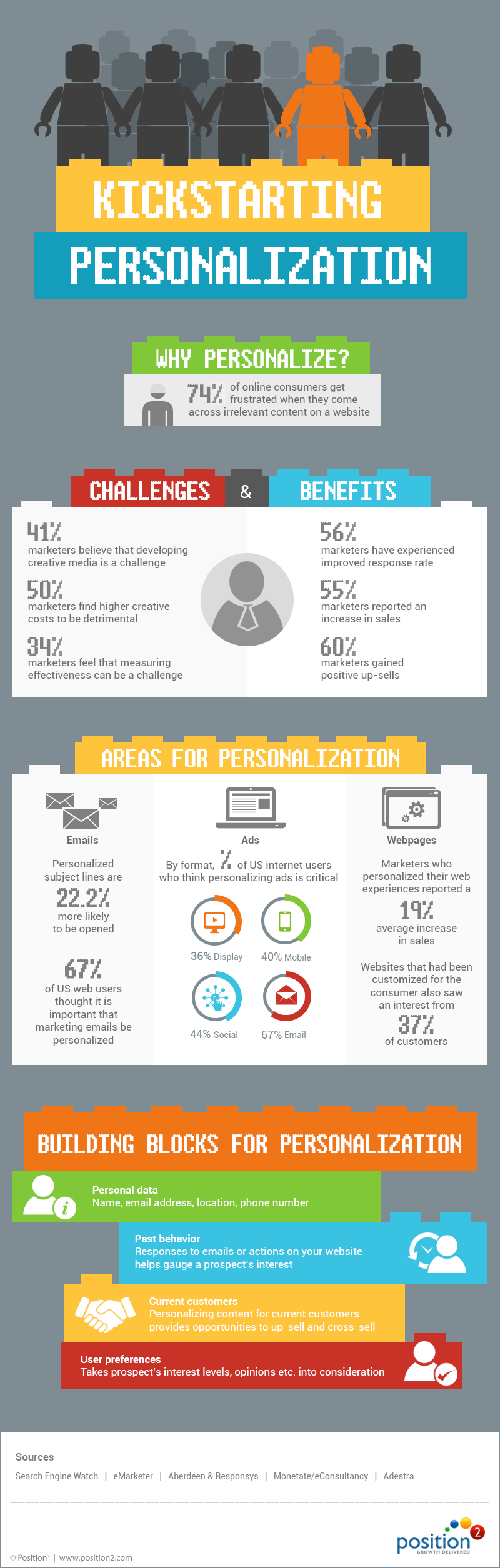
    Personalization. This word is being heard, rather a lot, in the industry. A lot of content is available on the same. This is why we came out with this infographic that talks about why you need personalization, its challenges and benefits, areas you can implement it and what you need to apply personalization. Check it out!

  • Yahoo Prime View – Changing the Way CPMs Are Bought

    Yahoo releases Yahoo Prime View

    Being committed to providing advertisers their investments’ worth in display ads, Yahoo is introducing Yahoo Prime View.

    This new vCPM product will allow brands to run display ad campaigns at a 100% viewability rate. vCPM ensures that you pay only for viewable impressions enabling better campaign performance.

    Currently, Yahoo Prime View has been introduced for display ads on Yahoo, only in the US. However, the company has plans for a global rollout, with no certain time frame.

    You can now increase ad exposure without modifying your workflow – reporting or creative. Yahoo Prime View employs IAB’s SafeFrame, which is a managed API-enabled iframe that opens up a line of communication between the publisher’s page content and iframe contained external content such as ads.

    For marketers who opt for CPM campaigns for branding and visibility purposes, Yahoo Prime View will help in increasing marketer confidence in CPM campaigns and thereby, brand investment.

    What are your views on Yahoo Prime View?

  • Implementing Cross-Channel Personalization

    How to implement cross channel personalization

    Personalization is the name of the game.

    Whether it’s for your email campaigns or your website, personalization is an essential ingredient. Now that cross-channel campaigns are gaining popularity, it’s logical that one applies personalization across channels.

    Revisiting cross-channel marketing

    Cross-channel marketing refers to the practice of integrating marketing campaigns that are being run across different channels. This means making sure your website, email and social campaigns are talking to the same person in the same way.

    Getting down to business…

    The Need for Personalization in Cross-channel Marketing

    As you would have noticed in our blog posts, we’ve been talking about how consumer attention today is getting divided between multiple media. This is necessitating marketing communication to be sent through different platforms. Every channel has unique characteristics and lends itself to a specific style of messaging. This often leads to inconsistent messaging in terms of tone and manner and occasionally messaging that seems irrelevant.

    It is not easy to tailor your messages to suit each platform’s conditions and still capture audience attention. This is where personalization can come to your rescue. By personalizing cross-channel marketing, you tend to catch your prospects attention because the message is developed keeping in mind his interests, habits and other data you have picked up about him. It’s more relevant and therefore, more likely to strike home. Also, when you personalize your marketing, you stay with the prospect all through the communication cycle, otherwise the same brand may sound inconsistent or disconnected while talking to the same person at different stages of communication.

    Important Factors for Implementation of Cross-channel Personalization

    Identify available data

    Personalization is dependent on data. Brands have different types of data about customers stored in different sections of the company. Create a culture of company-wide appreciation of the importance of data. Collate all data into a single database, which can help build an integrated view of the customer and enable creation of personalization strategies. You will be well prepared for more possible scenarios and can build a robust analytics strategy for your cross-channel personalization efforts.

    Unify data sets

    Brands typically have different data sets about the same customer. There is often disconnect between offline and online data sets. Consolidating all the data against one customer ID helps get an integrated image of the customer. As the database gets richer in terms of data, different user personalities emerge, each with a set of homogenous customers. This enables segregation of customers into different segments from your core audience to less prominent yet important segments.

    Develop a connected profile across the customer journey

    Customer touch points are many: onsite behavior, email campaign offers & responses, display ads, search terms used, customer support conversations and social media interactions. You will also have data from on-site customer behavior, the transactions they conduct and data from references:

    • Device related factors – IP address, device type, browser details etc.
    • Onsite behavioral factors – Time spent on site, site paths followed, product interests etc.
    • Offline factors – CRM system used, brand loyalty, data from third parties etc.
    • Time related factors – Time of day during site visit/engagement, day of the week, frequency of visits etc.
    • Reference related factors – PPC ads, natural search, referring domain etc.

    All the above touch points are a part of the customer’s journey. Joining these dots will give you the big picture about the customer segment and specific cues about individuals’ profile.

    Stay consistent across channels

    Share the available profile data across all the channels that are a part of your cross channel personalization strategy. All your channels should carry the same message since they would be talking to the same customer depending on the channel the customer has chosen. If customers approach you through two different channels and see different offers, it will lead to confusion and indecision.

    Build engagement rules

    Establish rules that define engagement. Decide how you are going to engage customer profiles on different platforms. Have a plan in place that outlines your strategy after each customer engagement action on every platform. Base these campaign tactics on unique customer profiles.

    Implement personalization across touch points

    Provide personalized experiences for customers across various touch points. Coordinate these experiences by leveraging customer profiles and recommendations.

    Reporting and Analysis

    Generating reports and analyzing data will enable you to meet customer requirements better by optimizing your cross channel experiences. However, reporting and analysis can get complex due to the involvement of multiple channels. Knowing the end requirement from every channel can help you channelize the sub-points under every channel to drive towards that end need.

    Do you run cross-channel campaigns? What have you learned?

  • Animated GIFs, now on Twitter!

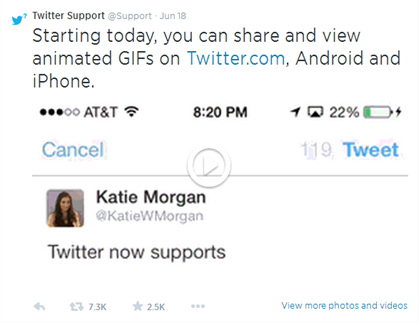
    The social media platform recently announced that users will now be able to share and view animated GIFs on the Twitter desktop site and on its Android and iOS apps.

    This move saves users from the round trip they had to take until now, uploading the image on third-party sites like Imgur and then sharing the link on Twitter. Users can now share GIFs directly on the site.

    However, GIFs will not automatically play on Twitter. Each GIF will have a white play button on it, which the user has to click to play the GIF. Share animated GIFs on Twitter

    Changes for Marketers

    Enabling of animated GIFs provides content marketers with more creative avenues for their content marketing efforts.

    GIFs capture attention and engage users more easily. They also help deliver brand messages to customers better through animated visuals. With a 140 character tweet limit, it sometimes would be tough for marketers to convey emotions behind messages. Adding a GIF now makes it easier.

    Let us know if you have anything to add to this…

  • How to improve organic CTR, personalize automated emails and much more…| Best of the Week

    This week’s hot news, events and videos from the online marketing and social media world.
    How to Improve Organic CTR – does your SEO take care of this
    From the Position² Blog This Week:
    How to Improve Organic CTR – does your SEO take care of this?
    What are the key areas you need to focus on to give your organic CTR a boost? Read this blog post to know the steps you have to take for the same.
    Top Stories this Week: Social Media
    Top Stories this Week: SEO, PPC and Digital Media
    Best of the Week Video Best of the Week Video
    Check out this webinar by Marketo that sheds light on improving your marketing automation using real-time personalization.
    White Paper: Increase Visibility for Your Content by 4x
    Today’s traditional SEO is inadequate: Ignite your search results by accelerating visibility in more places than ever before.Download this White Paper and learn:

    • SEO, why the way we know it is not enough
    • Introducing and implementing Enterprise Visibility Accelerator (EVA)
    • Using multi-channel tracking tools for effective monitoring
    • How EVA benefits businesses.

    Download the complimentary EVA White Paper now

    Know more about Enterprise Visibilty Accelerator(EVA)
    If you are reading this blog post via a RSS reader, please click here to subscribe.