Blog

  • Diverse Website Tactics For B2B Online Lead Generation

    As the digital world keeps growing, it’s super important to have different types of content on a B2B website to attract potential customers. Cool blog posts, eye-catching videos, and interesting podcasts are just a few ways we can grab the attention of different people, get them thinking, and influence their decisions.

    Businesses must understand how important this mix is to connect with customers along the buying journey. The goal is to deliver content so appealing that, in the words of the musician Gil-Scott Heron, “You will not be able to stay home, brother. You will not be able to plug in, turn on, and cop out.”

    Companies don’t want their prospects to just get information; they want to get them thinking, feeling and inspired enough to want to learn more about them. Even when facing obstacles in creating content, they should see fresh content as an opportunity to improve, grow, and surprise their audience with something new and exciting. In this blog post, we’ll outline the different types of website content for lead generation and share some guidance on which audience members will likely be drawn to (or pushed away) from it.

    Blog Posts and Thought Leadership

    Imagine potential consumers stumbling upon your blog while browsing for answers or strategies to address their dilemmas. Reading your blog, they unravel valuable perspectives, eventually arriving at your offer, which might read, “Contact us and learn more” or “Book a complimentary consultation”. Intrigued by your enlightening content, they click on it, offering their contact information, thus transforming into promising leads.

    Positives: Erecting barriers on blog content enables you to collect data from curious parties willing to exchange their personal details for the value your content provides.

    Drawbacks: Generally, blogs remain freely accessible, thus placing restrictions could dissuade potential visitors, diminishing the influx of readers, and consequently denting your optimization strategies.

    Works best with: Prospects just beginning their buying voyage, probing for information or strategies about your field or service offerings.

    Works worst with: Individuals who have journeyed further in their purchase exploration, craving detailed, specific knowledge or a direct interaction with a salesperson.

    For consumers already journeying within the funnel, blog posts serve as platforms to present comprehensive perspectives on your field or service offerings, thereby cementing your professional acumen. These posts could spotlight unique benefits offered, countering prevalent apprehensions or hurdles hindering a consumer’s progression down the purchasing path.

    Case Studies

    Exhibit your successes through detailed case studies. These narratives present potential consumers with tangible evidence of your service’s efficacy. Case studies with compelling attributes usually feature a client reminiscent of the prospective consumer.

    Imagine a potential consumer seeking specific validation of your professional competencies. They peruse a case study demonstrating how your service propelled a similar enterprise toward success. Impressed by the account, they complete the request form for additional details, converting into a promising lead.

    Positives: These case studies constitute invaluable content pieces, exemplifying your firm’s capabilities. Restricting access to such content can usher in quality leads since those ready to share their information often find themselves further along the buying cycle.

    Drawbacks: Erecting barriers around case studies can curtail the population of potential consumers viewing these successful narratives. Certain potential leads might feel reluctant to divulge their information merely to peruse your case studies.

    Works best with: Individuals considering your services, desiring to witness examples of your work and its consequential impact.

    Works worst with: Individuals not yet prepared to make commitments, or those beginning to understand their challenges.

    Case studies prove your service’s efficacy, documenting successful engagements with prior clients. They sketch a possible scenario that potential consumers could encounter, hence alleviating uncertainty and enabling potential consumers to feel comfortable progressing to the subsequent stage.

    E-books and White Papers

    Propose comprehensive guides or research narratives pertinent to your profession to engage leads. For this high-value content, seek visitors’ contact details, effectively converting curiosity into prospective collaboration.

    Visualize an engaged consumer yearning for deeper knowledge about an industry-related subject. This individual stumbles upon your e-book or whitepaper, entering their contact details to facilitate a download. This exchange transforms a casual visitor into a potential lead.

    Positives: E-books and whitepapers, owing to their detail-oriented and invaluable nature, frequently serve as gated content designed to engage lead generation. Individuals usually exhibit a greater willingness to share their contact details in exchange for such high-value content.

    Drawbacks: Some visitors might find the extra step of entering their details off-putting, limiting the reach of your resourceful content.

    Works best with: Individuals hunting for exhaustive information about an industry-related topic. These individuals could be anywhere in their purchase journey but are ready to invest time in comprehending their predicament or your resolution.

    Works worst with: Individuals seeking concise, digestible information or those not ready to share their contact information to access the offered content.

    These resources offer detailed information about complex subjects pertinent to your profession or service offerings. For individuals within the funnel, these resources further enlighten them, fortifying their trust in your venture, and prompting serious contemplation about your services.

    Webinars or Podcasts

    Webinars or audio broadcasts offer an engaging platform to demonstrate proficiency, fostering personal connections, and permitting interactivity through query-response sessions.

    Visualize an individual hunting for expert insights stumbling upon your webinar or audio broadcast. This individual commits to a live session or subscribes to your channel, offering their email. This interaction transforms casual engagement into a potential business lead.

    Positives: Webinars and audio broadcasts, replete with information, demand a significant time commitment. Providing access to them in exchange for contact details can lead to acquiring high-quality business leads.

    Drawbacks: Restricting access might diminish the audience base for your webinars or audio broadcasts. Some individuals might show reluctance in sharing contact information, for uncertain content quality.

    Works best with: Individuals seeking an understanding of business-related topics, preferring an interactive, engaging format. They might be traversing deeper into their buying journey.

    Works worst with: Individuals who prefer digesting content at their leisure or those hesitant to invest considerable time in a webinar or audio broadcast.

    Utilize these platforms to explore subjects of interest to your prospects. This could encompass demonstrations of your product or service, expert discourse, query-response sessions, or conversations on industry evolutions. Such formats aid in cultivating relationships with prospects, underscoring your proficiency, and adding a personal touch to your brand.

    Newsletters

    Periodic communiqués keep your audience abreast of recent developments within your enterprise, shifts in industry trends, or additional services being offered. Urge visitors to sign up, promising exclusive perspectives or discounts.

    Consider a potential client browsing your digital platform, noticing your sign-up form promising industry perspectives or exclusive offers. They subscribe, effectively transforming into a business lead.

    Positives: Inherently, newsletters are exclusive content because they necessitate an email for transmission. This can assist you in establishing a regular, engaged audience.

    Drawbacks: The obligation to enroll might dissuade some visitors. Moreover, if your content doesn’t offer continual value, subscribers might opt out, potentially impacting your relationship with your email provider.

    Works best with: Captivated consumers, those interested in your brand or industry, who find value in regular insights.

    Works worst with: Prospects chiefly pursuing information exhibit less interest, eschewing consistent updates.

    Videos

    A well-constructed video elucidates your services in a captivating and engaging style. Content can range from instructional pieces, behind-the-scenes glimpses of your enterprise, testimonials from satisfied customers, or demonstrations of your service.

    Picture a prospective client engaging with your visual presentation on your digital platform, exploring your services, client testimonials, or industry insights. They perceive high value and decide to probe further, offering their contact details through a form attached in the presentation description or embedded on the website.

    Positives: High-definition, instructive presentations might justify exclusivity, particularly if they extend expert advice, thorough tutorials, or detailed service demonstrations. Visitors willing to part with their information for access are very likely intrigued, yielding high-quality leads.

    Drawbacks: Presentations often augment brand awareness and visibility; hence exclusivity might impede their reach. Furthermore, many users anticipate visual content to be openly accessible.

    Works best with: Prospects who relish visual and auditory content, desiring a more captivating medium to comprehend your services. They could be at any phase of the decision-making journey.

    Works worst with: Prospects who favor text-based content that they can absorb at their leisure.

    In conclusion

    Having a mix of different content on your website is critical for creating connections with potential customers. It’s like having a party with various types of entertainment – some guests might enjoy music, some might like magic tricks, and others might prefer a good conversation. It’s all about making sure there’s something for everyone. This concept reminds us of something the musician Tom Waits once said:

    “I like beautiful melodies telling me terrible things.” In other words, it’s not just about making something; it’s about creating a feeling, sparking a thought, or starting a discussion. By continuously working on content and aiming to keep things fresh and interesting, you hope to build a lively, involved community around your brand.

  • Future-Ready Agencies Must Embrace AI and Human Collaboration

    Change is the only constant in business, and technology has always been a change driver. The impact of generative AI-led tech will be unlike anything we have experienced. AI tools have the potential to revolutionize how digital marketing agencies price their services, organize their teams, operate, and continue to be profitable.

    If your agency or marketing team still needs to adopt the Gen AI capabilities, you may already be missing out. Why? Because your competition is not waiting, nor is the AI tech advancement.

    It can be overwhelming, instead of focusing on every new tool or application – focus on a few marketing areas where generative AI significantly impacts your business or your industry. Explore potential applications and strategic implications for marketers. Learn how humans and machines can work collaboratively and how human involvement will remain indispensable.

    As businesses strive to create engaging and personalized customer experiences, generative AI presents a transformative opportunity for marketing agencies to achieve unparalleled creativity, efficiency, and customer engagement.

    Here are some of the applications and implications of this technology:

    Transforming Creativity

    Today’s AI platforms produce original and innovative content and design, challenging traditional notions of creativity. Digital marketing agencies can use these algorithms to generate compelling visuals, ad copy, and immersive storytelling experiences.

    Platforms such as Dall-E, for example, allow us to combine human creativity with the limitless possibilities of AI. Agencies can unlock new realms of imagination and deliver truly unique and captivating campaigns.

    While AI can provide inspiration and streamline certain creative tasks, it cannot replicate the true depth of human creativity. The human touch adds emotion, intuition, and an understanding of brand and cultural nuances, enabling marketers to craft unique and compelling works of art.

    Automated Multichannel Campaigns

    AI can automatically adapt and optimize marketing materials for various channels, including social media, email, websites, and mobile apps. Sophisticated algorithms ensure consistent messaging and design across multiple platforms, reaching customers at the right time and through the most effective channels.

    Chat GPT can help with basic content that prompts can generate. The more detailed your prompts, the more accurate the output. Jasper can help with SEO and email content. Generate extensive prompts that help with email and other short and long-form content in seconds. Copy.ai can help with social posts and more in seconds.

    This level of automation frees up agency resources, allowing everyone to focus on strategic planning and creative imagination. Marketers can conduct detailed and deep research on the target markets, geographies, and personas. This can feed into the AI platforms that will then offer insights, content, and ideas that can speed up campaign launches and go-to-market.

    Dynamic Optimization

    With generative AI, digital marketing agencies can optimize real-time content based on audience response and feedback. The algorithms can dynamically analyze user engagement metrics, sentiment analysis, and conversion rates to adjust and optimize campaigns.

    LLM-based platforms create AI applications rapidly to create custom data optimization models that can be used for SMBs and Enterprises alike.

    This enables agencies to fine-tune content, ROI targets, budget allocations, and ad elements such as headlines, visuals, and calls to action. Ensuring that marketing messages resonate with target audiences and maximize desired outcomes.

    Streamlined Customer Journey Mapping

    Generative AI can revolutionize how to map and optimize customer journeys. By analyzing vast amounts of customer data, AI platforms, such as Upshot.ai, can identify key touchpoints, pain points, and opportunities for engagement.

    This knowledge allows agencies to create seamless, personalized customer journeys that guide individuals from initial awareness to conversion. AI-powered customer journey mapping ensures that marketing efforts are aligned with customer needs and preferences, leading to improved customer satisfaction and higher conversion rates.

    However, it is crucial to remember that AI is a tool that augments human decision-making rather than replacing it. Marketers must interpret the insights generated by AI systems, apply their strategic thinking, and make informed decisions based on their deep industry knowledge and expertise.

    Hyper-Personalization at scale

    Generative AI enables digital marketers to achieve hyper-personalization at an unprecedented scale. These algorithms can analyze individual preferences, behaviors, and interactions by leveraging vast customer data to create highly personalized marketing materials.

    From tailored product recommendations to customized email content, generative AI empowers agencies to connect with customers on a deeply individual level, fostering long-term loyalty and increasing customer lifetime value.

    Opportunities for agencies

    The Evolution of Roles and Skillsets

    The advent of Generative AI is not a threat to human jobs in the digital marketing industry. On the contrary, it allows marketers to evolve and embrace new skill sets. AI should be a technology that takes over repetitive and time-consuming tasks. Marketers can focus on activities that demand creativity, strategy, and critical thinking.

    Professionals in the field must adapt and upskill, gaining proficiency in AI implementation, data analysis, and decision-making. Human intuition, empathy, and understanding of complex consumer behavior remain invaluable assets that AI cannot replace.

    Ethical Considerations and Human Oversight

    As digital marketing agencies embrace generative AI, ethical considerations continue to emerge. Agencies need to ensure transparency, fairness, and responsible use of AI.

    Human oversight becomes crucial to guarantee that AI-generated content aligns with brand values, trademark regulations, legal guidelines, and ethical standards.

    A balance between automation and human judgment is required to maintain unbiased output and mitigate potential risks associated with AI-generated content.

    In conclusion, generative AI applications are here to stay and will continue to influence marketing and design for the foreseeable future. The future of digital marketing agencies lies in harnessing the power of generative AI to deliver unparalleled creativity, personalization, and efficiency.

    Balance must be maintained between AI-driven automation and human oversight, ensuring ethical use and preserving brand authenticity. The true potential of Generative AI lies not in fearing it or in keeping it at bay but in collaboration where humans and machines work hand in hand to bring ideas to life.

  • Making sense of the cybersecurity landscape: is digital marketing to explode or implode based on adopting AI and machine learning?

    3 out of 4 C-Suite executives believe that if they don’t scale artificial intelligence in the next five years, they risk going out of business entirely. Artificial intelligence is the future—for legitimate organizations and threat actors alike. In 2023, malicious actors are leveraging attack vehicles that are more sophisticated than ever. For instance, malicious exploitation of vulnerable systems (such as IoT devices, cloud servers, and mobile applications) can be automated via algorithms. For every tool that saves time, boosts revenue, and protects your organization, there is a feature that allows hackers to potentially access your systems.

    In particular, digital marketing teams benefit from artificial intelligence. In fact, the “AI for digital marketers” industry is projected to increase to more than $107.5 billion in the next five years. However, without proper attention to cybersecurity practices, many digital marketing teams may engineer their own doom as they race to adopt these tools at an unsustainable pace.

    Given the cybersecurity concerns at hand, is digital marketing poised to explode or implode based on the adoption of AI and machine learning?

    AI, cybersecurity, and digital marketing

    AI and machine learning empowers digital marketing teams in a few ways. Often, teams leverage these tools to accomplish the following:

    • Sales forecasting
    • Digital ad placement
    • Predict media trends
    • Manage customer conversations
    • Generate written, image, and video content
    • Transcribe speech to text
    • Conduct predictive lead generation and personalization

    To conduct these tasks, however, AI and machine learning models must be trained. The accuracy of these tasks depends on how well this has been done, which requires massive datasets to do correctly. Once accomplished, these tools can drive programmatic buying, sales propensity models, e-commerce recommendation engines, and more.

    Unfortunately, these massive datasets equal an unprecedented attack surface for hackers to use advanced tools to spot and penetrate weaknesses. If digital marketers are to succeed, AI and cybersecurity must combine to prevent hackers from accessing and manipulating this data.

    AI for digital marketers is a long-term investment

    76% of business executives are struggling to scale AI across their organizations. Complex data sets, technologies, and IAM strategies must be implemented properly for digital marketers to proceed. However, the sheer mass of these assets exposes vulnerabilities if AI and machine learning tools, digital marketing goals, and cybersecurity protocols are not equally weighted. Pairing these elements requires a balance of trust, data security, transparency, and control.

    This incremental process is necessary when it comes to reaping the benefits of AI and machine learning for digital marketers, which include:

    • End-to-end efficiency. AI automates repetitive tasks that require time, energy, and brainpower—but no emotional intelligence.
    • Improved accuracy. Human error is responsible for 9 out of 10 data breaches. Automation is a fantastic safeguard for your organization’s cybersecurity.
    • Improved decision-making. Poor decisions often result from poor data. With infinite data available through AI, decision-making becomes easier and more accurate.
    • Intelligent offerings. What do your customers want? AI can predict the market, forecast sales trends, and produce detailed profiles of your target audience.
    • Empowered employees. Employees need access to the right tools to do their jobs. By taking away repetitive tasks that suck up time and energy, they can pour that passion into their careers.
    • Superior customer service. Top-notch customer service is a mix of data and interpersonal strengths. AI can manage the former, and human representatives can deal with the latter.

    What steps can I implement toward a robust approach to AI/machine learning in digital marketing?

    Start by leveraging AI to process copious amounts of data from various sources quickly. This produces more accurate insights into customer behavior. Now, your digital marketing team can precisely target potential customers and create tailor-made campaigns.

    As technology changes and AI capability skyrockets, it is important to monitor changes and make regular tweaks. Make sure you track how search results rank and adjust strategies accordingly.

    Remember to quantify your investments, too. Start by measuring ROI with metrics such as:

    • Customer engagement rate
    • Lead conversation rate
    • Cost per acquisition

    This highlights areas for improvement, ensures efficient resource utilization, and justifies any investments your department has made in AI.

    Without cybersecurity practices to shield all these new developments, your efforts may be wasted. It is critical to invest in cybersecurity training and solutions to offset risks that are inherent to the adoption of new technology. This includes employee training, regular vulnerability scans, intrusion detection systems, and strong authentication protocols.

    Prioritize scalable, long-term growth over unsustainable wins

    Every one of your competitors is likely leveraging AI, machine learning, and data analytics in their marketing efforts and media platforms. Adapting your strategies to remain competitive is necessary to stay relevant in your industry—and invest in your own organization’s growth journey.

    If you enjoyed this article, add a comment below or continue the conversation on LinkedIn. Learn more about what Tina is working on here.

  • Privacy and Compliance for Digital Marketers in 2023

    5.16 billion people use the Internet daily. These activities produce a trail of data that must be safely processed, handled, and stored. But after an onslaught of breaches, scandals, and lawsuits, Internet users no longer trust how organizations deal with their data.

    To combat this, users do what they can to protect themselves. This includes browsing in private mode, deploying ad blockers, or avoiding web presences they are unsure of. This is bad news for digital marketers since audience identifiers are created when people interact with ads, use public browsers, and interact with new web presences. Without these identifiers, 80% of the addressable market will quickly become unknown audiences.

    These new developments limit the information digital marketing teams have. As a result, their ability to launch high-performing paid ads, conduct accurate targeting, develop lucrative paid search strategies, or craft audience-specific content is curtailed.

    Substantial fines are associated with privacy and compliance violations

    Browser updates also represent a challenge for marketers gathering data. For instance, Apple and Mozilla implemented browser updates that enhance consumer privacy and limit third- and first-party cookies. (Google will likely follow suit in 2024.) These updates make it more challenging for digital marketers to access and gather the data they rely on. What is the reasonable solution? Start demonstrating privacy and compliance in a way that bolsters user trust.

    Of course, the stakes of privacy and compliance have never been higher. It starts with users: if they don’t trust your organization, you can expect a loss in revenue, reputation, and more. But if users have a reason for these suspicions—in other words, if there’s lawsuit material at hand—the authorities step in. For example, the EU’s General Data Protection Regulation (along with other legislative bodies) leverages substantial fines for privacy and compliance violations. Fines usually equal 20 million pounds or 4% of your firm’s worldwide annual revenue from the preceding financial year.

    The shifting state of privacy and compliance is a major challenge

    The implementation of regulations like the GDPR or CCPA protects consumers and keeps data safe. However, as different laws pass and new standards are set, organizations must navigate a maze of high-stakes, conflicting guidance. The shifting state of legislature surrounding privacy and compliance requires a nuanced, incremental approach.

    Prioritize transparency, choice, and control

    Privacy and compliance for digital marketers require a two-pronged approach: building user trust and taking practical steps to comply with legal standards. Start by disclosing and explaining how data will be used—and that information will be deleted, modified, or altered if requested. In today’s tech climate, user expectations are rising as they demand transparency, privacy, and control over how their information is used. Once users trust you, they are more likely to share data, interact with your ads, and so forth.

    Build an incremental privacy and compliance strategy

    For legal, ethical, and interpersonal reasons, it is crucial to implement a robust approach toward privacy and compliance in digital marketing. Here’s how to start.

    Minimize the collection and use of personally identifiable information by distinguishing between zero-party data and first-party data. First-party data comes from user behavior in a browsing situation that provides clues about their intent and priorities. This approach generates insights—without capturing unnecessary personal data. Instead, it relies on making the most of the technical information at your disposal. When surveying data from a browsing session, this includes:

    • Device, language, and operating system being used
    • General location
    • Time of customer interaction
    • What they were looking at
    • The path they took to arrive at a certain location or experience

    On the other hand, zero-party data comes directly from your audience. Filling out a contact form, signing up for an e-newsletter, or taking a survey all generate zero-party data since it’s offered voluntarily. This data gives marketers the opportunity to provide highly tailored messaging.

    When you do end up acquiring data, focus on transparency. Make sure consumers stay well-informed on how your organization collects, uses, and stores data. It’s also important to remember that this data is subject to deletion upon request, per regulations such as the GDPR and CCPA.

    Ensure these data collection processes are compliant with the EU’s General Data Protection Regulation. Prioritize data being stored securely, handled responsibly, and used only within the scope of consent given. Once data is responsibly stored, your organization must keep it safe—which requires an investment in robust cybersecurity measures. Start by prioritizing:

    • Intrusion detection systems
    • Strong authentication protocols
    • Regular vulnerability scans

    Minimize the acquisition of personal data

    Privacy and compliance for digital marketers in 2023 requires balance: getting what you need to inform a solid marketing strategy while minimizing your acquisition of personal data. Start by pursuing tactics that focus on patterns and trends. When you do acquire data, focus on collaborative strategies, such as data clean rooms.

    Remember to plan for conflicting imperatives from different legislative bodies. For instance, many laws require that you delete data when users request it. However, other guidelines require that you retain certain data for certain time periods. In these tricky situations, it is important to pursue legal advice, maintain flexibility, and prioritize compliance.

    From a cybersecurity perspective, it is critical to remain aware of current threats and regularly monitor your organization’s systems. Refusing to trust piecemeal protocols is necessary for your organization’s long-term investment in privacy and compliance for your digital marketing teams.

    If you enjoyed this article, add a comment below or continue the conversation on LinkedIn.

    Learn more about what Tina is working on here.

  • Not connecting with customers? Leverage analytics to up-level your customer journey map

    We get it, content is king. That said, why are so many businesses getting content wrong? It’s time we acknowledged the not-so-little elephant in the room. 57 percent of marketing executives admit they don’t know how to leverage their data to understand customers or anticipate their needs.

    We know there’s a significant upside to delivering quality content experiences. Businesses that create and share high-quality content can attract new customers, build relationships with existing customers, and boost their bottom line. However, even the best content strategy can fail if it’s not aligned with the customer journey. Here, we’ll discuss the customer journey, how to create a customer journey map, and how analytics can position your content strategy for success.

    What is the customer journey map?

    A customer journey map is a visual representation of the customer journey. It guides and influences the steps that a customer takes from the moment they first become aware of your business to the moment they make a purchase.

    Why is it so important?

    A customer journey map can help you identify the content that your customers need at each stage of the buying process. Think of it as a knowledgeable sherpa that quietly guides a customer toward a buying decision. When done well, you gain satisfied and loyal customers. Fortunately designing a customer journey map does not have to be left up to chance. To increase your chances for success, leverage analytics within your customer journey map to bolster your content strategy.

    How Analytics Improves the Customer Journey

    Analytics can improve the customer journey in several ways. For example, analytics can be used to:

    • Identify the most important touchpoints in the customer journey.
    • Measure customer satisfaction at each touchpoint.
    • Identify areas where customers are having trouble.
    • Develop strategies to improve the customer experience at each touchpoint.

    By using analytics to improve the customer journey, you can:

    • Increase customer satisfaction.
    • Reduce customer churn.
    • Increase sales.

    To create a customer journey map, you’ll need to:

    Identify your target audience:

    Who are you trying to reach with your content? What are their needs and interests?

    Map out the customer journey:

    What are the different stages that your customers go through from the moment they first become aware of your business to the moment they make a purchase?

    Identify the content that your customers need at each stage:

    What kind of content will help them learn more about your business, solve their problems, and make a purchase?

    By understanding the customer journey, you can identify the touchpoints that are most important to your customers and make sure that you are providing them with a positive experience at every stage. This will help you to increase customer satisfaction, loyalty, and revenue.

    Not sure where to start? Here are some tips for creating a positive customer journey:

    • Make it easy for customers to find information about your products or services.
    • Provide clear and concise pricing information.
    • Make it easy for customers to contact you with questions or concerns.
    • Deliver on your promises.
    • Go above and beyond to exceed customer expectations.

    Once you have created your customer journey map, use it to improve the customer experience at every stage. In doing so, you increase customer satisfaction, loyalty, and revenue.

    Bottom Line

    Standing out amongst competitors is an ever-growing challenge. The customer journey is an important concept that businesses must conceptualize. By understanding the different stages of the customer journey and the emotions that customers experience at each stage, businesses can improve the customer experience and increase customer satisfaction, loyalty, and revenue. Don’t go it alone, analytics can significantly raise your level of success. Not sure you can tackle this on your own. Find out how Position2 can help you uplevel your customer journey, taking prospective customers into loyal buyers.

  • Content’s Primary Role In The Customer Decision Journey

    Putting the Customer First

    Now, more than ever, today’s customers are more discerning and it’s not just about your competitors. They have access to a wide variety of information at their fingertips and can easily compare products and services from different businesses. With limited time, budget, and attention, businesses need to do more than just offer a good product or service. One of the most important aspects of a great customer experience is content. Content can be used to educate customers, build relationships, and drive sales. It can also be used to shape the customer journey. Failing to do so could result in lost revenue and growth. So, how do you manage to capture your audience while transforming them into your customers? You put their needs first.

    The best way for a business to position itself is to solve the needs of its customers. That said, in order to achieve optimal positioning, it’s vital for a company to effectively articulate the pain points that it solves. This is where content comes into play, as marketing efforts help or hinder brand awareness. It’s one thing to drive audiences to your content. But to convert readers into customers, that takes fine-tuning and understanding the customer journey.

    The customer journey is the path that a customer takes from first learning about your business to becoming a loyal customer. We break it into five stages: awareness, consideration, purchase, use, and advocacy.

    Leverage content at each stage of the customer journey to:

    • Attain awareness: Content can be used to introduce your business and its products or services to potential customers. This can be done through blog posts, articles, social media posts, and other forms of content.
    • Generate interest: Now that potential customers are aware of your business, use content to generate interest in your products or services. For example, highlight information about the benefits of your products or services, or by sharing customer testimonials.
    • Drive consideration: As potential customers journey through the pipeline, considering your products or services, deliver content experiences to help them make a decision. Case studies are a phenomenal method for highlighting customer challenges while positioning a business as the solution.
    • Close the sale: Once potential customers are ready to buy, it’s time to sign on the dotted line. And, content is key to getting to the finish line. Design your content to deliver clear and concise information about your business and how it can fulfill a need.
    • Nurture relationships: After the sale is closed, leverage content to nurture relationships with customers. We’re not talking about spamming them with emails, but rather sharing targeted content that speaks to their needs. For example, providing customer support, sharing educational content, or simply staying in touch with customers up-levels the customer experience.
    • Drive advocacy: Happy customers make the best evangelists. The ultimate goal of any customer journey is to drive advocacy and when customers are so happy with your business, they are willing to recommend you to their friends and colleagues. In this stage, use content to drive advocacy by sharing customer testimonials, offering referral bonuses, or simply making it easy for customers to share your content with others by adopting social media.

    Effective content strategy shapes and influences the customer journey, creating a positive experience that will lead to repeat business and referrals.

    Not sure where to start? Here are some tips for using content to shape the customer journey:

    • Be relevant. The content you create should be relevant to the interests and needs of your target audience. This will help you to capture their attention and keep them engaged.
    • Make your content easy to find. Your content should be easy to find on your website and social media channels. You can use search engine optimization (SEO) to make your content more visible in search results. Make sure you’re using best practices in website design to drive visibility on your site.
    • Promote your content. Once you have created compelling content, you need to promote it to generate viewership. Automate your content through social media, email marketing, and other channels. Let technology do the heavy lifting by highlighting your content.
    • Measure results and impact. In order to improve, It is important to measure the results of your content marketing efforts to see what is working and what is not. You can use analytics tools to track website traffic, social media engagement, and other metrics. By knowing where you’ve been and how you’ve done, you can significantly improve your roadmap for the future.

    Content has always been a mechanism for creating satisfied and repeat customers. But in order to tap into its benefits, you have to put the customer first, which starts with the customer journey. To achieve great results, the customer journey strategy has to be enveloped within your content strategy. Create targeted content campaigns for each stage of the customer journey. In doing so, content is at the helm of the customer journey shaping a positive experience that will lead to repeat business and referrals.

  • Using ChatGPT To Write Google Ad Copy

    Over the last couple of months, we’ve seen people utilizing ChatGPT for all types of marketing functions – keyword research, SEO, copywriting… etc.

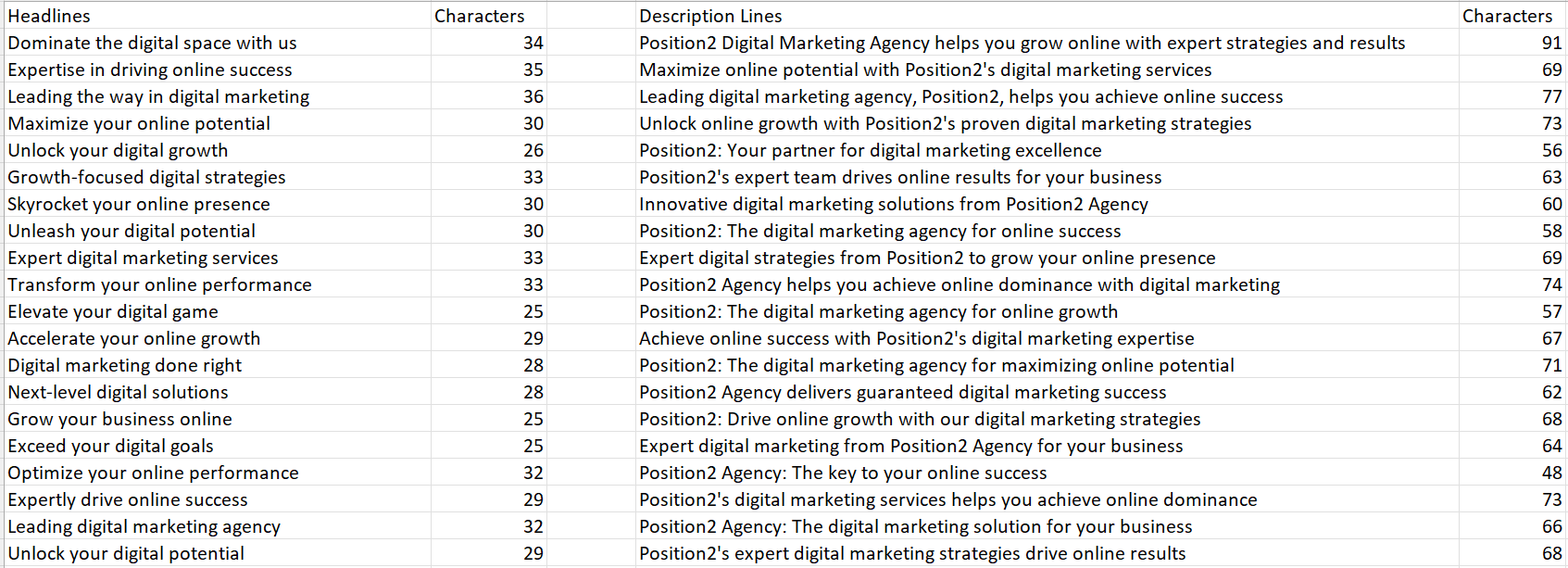
    I asked ChatGPT to write ad copy, advertising Position2, with headlines of 30 characters (or less) and descriptions of 90 characters (or less).

    Here’s what I got back:

    ChatGPT Results

    Now, there are a few immediate problems that are quick to spot:

    • Character limits aren’t always followed (I specifically asked ChatGPT not to use our Brand in the headlines because I couldn’t get any ads under 30 characters). Because I believe that our Brand would be mandatory in the first headline, I would have to create that Headline 1 (H1) manually and pin it, leaving the ChatGPT input for Headlines 2 & 3 (H2 and H3).
    • A few awkward constructs exist (e.g. Position2 Agency) that need to be fixed.
    • The range of descriptors is narrow (digital, business, marketing, strategies, success, growth, results, expertise etc.)

    Overall, these ads don’t suck. They’re better than many copy writers I’ve worked with. Even more important, I can bring all this ad text up to an acceptable standard in less than 10 minutes.

    Of the 20 ad headlines, forgetting about the character limit issue that needs to be addressed, the only headline that seems awkward is “Expertly Drive Online Success”…and this is easily fixed by removing “Expertly”.

    While many of the ad description lines are average (as currently constructed), all of them are workable with some simple and quick editing. For example, I modified the example below:

    From ChatGPT: Expert digital marketing from Position2 Agency for your business

    After my edit: Position2: Digital Marketing Expertise For Your Business

    What ChatGPT does very well here is staying within its “lanes” of knowledge. It’s clear that it only knows Position2 at a very superficial level, but it doesn’t stray from its limited knowledge of us. The challenge of ad copy is to present the same type of information in enough different ways to populate the maximum number of allowable ad copy variants for Responsive Search Ads (15 headlines, 4 description lines).

    Google Ads offers ad copy suggestions when setting up certain campaigns that are generally on point and usable. What Google doesn’t currently do is take their ad copy suggestions and roll out multiple variants of them which should be easy to do given the ease with which ChatGPT can. I suspect that Google will move in this direction by allowing “external factors” to be brought into its ad copy creation algorithm.

    When I write ad copy for clients, my first step is to scan the relevant pages for content that is easily adaptable to the Google Ads medium. I will sometimes copy and paste the content from the website and sometimes, but I’ll have to tweak it a bit. I’ll then take what I’ve culled from the website and manually create multiple textual variants.

    These secondary “ad riffs” are what ChatGPT does really well. Their entire ad output shown here are just variations on a singular theme and we would want our Paid Search Ads to aggressively hit on that theme.

    With a little bit of human oversight, ChatGPT can contribute to any ad copy creation scenario, though it’s a long way from being a singular solution.

  • Migrating your website – you need this SEO checklist

    There are multiple reasons for a website migration – switching content management systems, design limitations, enhancing functionality or performance, etc. A full website migration is no easy feat – even in optimal conditions – one thing you need to prioritize is your site’s search engine optimization to prevent traffic loss.

    Not focusing on SEO has the potential to significantly affect the search visibility of your site. Our website migration checklist is intended to help you better plan and manage a website migration, reducing the impact on organic rankings and traffic.

    Project Stage 1: Planning and Scoping Checklist

    It all starts with planning – ensuring that the site’s SEO needs are factored into the broader plan

    Project Stage 2: Pre-Migration Checklist

    Pre-migration activities identify all the requirements needed for the migration.

    Project Stage 3: Migration Day Checklist

    Migration day is very crucial. You have to check and ensure multiple parameters are as expected to ensure the migration is successful.

    Project Stage 4: Post-migration Checklist

    In the post-migration phase, you track and check if the migration was planned and executed effectively and make any changes if necessary.

    What is a website migration?

    It’s a broad term used by digital marketers and web development teams to describe any substantial changes the website is undergoing. The change could be the website’s structure, platform, content, design, technology, etc.

    The different types of website migration

    Protocol change

    A change from HTTP to HTTPS to provide better security to your users. This is a simpler site migration.

    Subfolder/Subdomain change

    This is a very common change to the website where a subfolder is moved to a sub-domain or vice versa. A common example is moving the blogs from blog.website.com to website.com/blog.

    Change in domain name

    Change in the domain name is when the entire content of the website is moved to a different domain.

    Website structure changes

    This is when the architecture of the website is changed. This often includes URL structure changes and internal linking changes.

    Change in platform

    When a brand decides to move the website to a different CMS or technology platform due to a specific feature or functionality of the platform. An example is moving an e-commerce website from WordPress + WooCommerce to Magento.

    Redesign

    Redesigning the website is required every few years to give it a fresh look. Website redesign includes significant media, code, and copy changes.

    Website merger

    Sometimes, merging 2 or more websites could be a strategic business decision. Ensuring that the organic traffic of both websites is retained can be tricky.

    Hybrid migration

    Migration types can be combined in any way possible, depending on the business needs. The more changes are made at the same time, the complexity and risks are higher. But making more changes simultaneously is justified considering the cost-effectiveness, provided the migration is planned and executed well.

    Why consider SEO while migrating your website?

    Site migration can have a significant impact on your SEO and the organic traffic to your website if it’s not executed effectively. Recovering from the impacts of a poorly managed migration could take weeks to months.

    After a website migration, Google needs to crawl and re-index the pages of the website. If the migration is not completed properly, Google could miss many important pages on the website, and you could lose significant traffic.

    This website migration checklist (links below to the checklist) helps you ensure the migration is completed smoothly with minimal drop in traffic.

    How long does an migration take?

    It really depends on the type and complexity of the migration. With a small site with a simple design, the process can be completed in a few days. If you are migrating a larger website with a complex structure and design, the process can take weeks to months.

    That’s why it’s important to have a plan in place to ensure enough resources are allocated to each step in the process. A poorly planned migration can result in lost data (or content), broken links, de-indexed pages, etc.

    What can go wrong during migration?

    Depending on the complexity and breadth of the migration there are multiple things that can go wrong, these are some of the most common.

    Poor strategy

    Before you even start the work of migration – it can go off the rails. Approach the migration focused on your goal (or what you’re trying to solve). Is it to update functionality, and usability (for internal and external users) or whether you’re bringing in a new CMS – this should be at the forefront of your strategy.

    Poor planning

    A detailed project plan is a necessity for any website SEO migration. Project plans will help you capture all activities and avoid delays in migrations.Even with your best-laid plans, not everything will go as planned, so factor in delays.

    We recommend avoiding planning a migration during seasonal activity peaks (end-of-year holidays etc). If anything goes wrong, there’s no room for error. Plan the migration during an off-season period.

    Lack of SEO involvement

    Website migration can impact your SEO efforts and organic traffic significantly. You’ll need search engines to re-index your site, post-migration. You want to make that your SEO team or vendor is involved in the migration process to ensure you don’t miss critical SEO optimization techniques that could have a negative impact on traffic/volume.

    Lack of testing

    Testing your website during all stages of migration is critical to success. There are many moving parts to migration – and you should factor in testing to limit factors that can go wrong during a migration.

    Not addressing bugs and defects

    As you test, you will find the occasional bug or defect – these have to be categorized and addressed based on impact and severity.

    Example of a successful site migration

    Writing a guide to help factor in SEO in your website migration isn’t just theory. We put it into practice.

    We wanted to share what we actually delivered for one of our clients post-migration. We executed what we discuss here and helped deliver substantial growth for our client. As you can see from the graph below – we helped prevent a drop in traffic – eventually delivering more traffic compared to pre-migration.

    Example of a successful site migration

    Website Migration Checklist

    Following these steps will help reduce any drop in traffic (and revenue) post-migration.

    Stage 1: Planning and Scoping Checklist

    Define the objective of the migration

    You need to be very clear about the objectives of the migration. Whether it’s a design overhaul of the website or changing the CMS, the objective of the migration will differ. It’s important to be clear about the objective and set the right expectations.

    The site migration is also a good opportunity to fix any critical issues on the website, as the resources required for fixing these issues post-launch will be significantly higher.

    Identifying the best time for migration

    When you migrate your current site is just as important. If it fits with your marketing and business strategy – choosing an off-peak time is preferred.

    Create a project plan

    Planning is always important – identifying the objectives and laying out a detailed plan to tackle those objectives will be critical for success. A complex project with multiple phases and stakeholders needs the structure of a project plan. All dependencies should be identified and included in the project plan so that every task owner is aware of the dependencies.

    Identify task owners

    In order to keep your migration on track – identify the task owners – those responsible for the execution of specific tasks within the migration plan. Once identified, task owners should know what’s needed, the timelines, and the dependencies.

    Stage 2: Pre-migration Checklist

    Backup the website

    Seems obvious, but backing up the site is a best practice. Consider creating a dev (and staging) environment. A dev environment allows the development to go unimpeded – adding a staging environment gives you the ability to test new functionality and be able to quickly revert if need be.

    Block access to the new website

    After your site is migrated, it needs to be crawled and indexed by search engines to ensure your SEO efforts don’t miss a beat. Blocking access to the site as the migration is in full swing will reduce the potential for content duplication issues. Learn how to add a ‘noindex’ tag to your site here

    Check the backlink profile and health of the new domain

    It’s important to check the backlink profile of the new domain, especially if it was recently purchased. The backlink profile can be checked using a tool like Semrush. Always good to double-check that the domain didn’t receive a manual penalty (this can be checked in the Manual Actions Report on Google Search Console).

    Crawl the old website

    Crawl the old website using a tool like ScreamingFrog and keep a copy of all SEO parameters like URLs, page titles, descriptions, redirections, etc. Keep a copy of this crawl even after the site launch, just in case you need the old data.

    Identify the URLs to be redirected

    If the structure of the new website is different, it’s important to identify those pages which require a redirect. Consider creating a redirect document to track all pages requiring it.

    Implement 301 redirects

    HTTP code 301 identifies content or a page that has been permanently moved. It’s important to redirect the old URLs to the updated ones. Not doing this, will negatively impact your site ranking and traffic.

    Update internal Links

    If there are URL changes involved, update the site’s internal links so that they don’t trigger internal redirects. These internal redirects could add latency to the crawl and impact the crawl budget.

    Create a Custom 404

    During the migration, some of the pages may be deleted. A custom 404 page allows users to easily navigate to other pages if the page they are looking for is unavailable.

    Update GMB and Bing Places

    Update the new URLs on Google My Business and Bing Places. Not updating the URL could result in traffic loss from these listings.

    XML sitemap

    We recommend creating 2 sets of XML sitemaps, one for the older website and another for the new website. The sitemap for the new website will inform Google of the new URLs, and the sitemap of the old URLs will help Google be aware of the 301 redirections.

    This will ensure the authority of the old URLs is passed on to the new ones.

    Make sure the new website is mobile-friendly

    Mobile-friendly websites increase traffic and revenue by providing easy access to users on mobile devices. Make sure the new website is mobile-friendly. Google’s mobile-friendly test is a great way to test your site.

    Add schema

    Add schema to the new website. Bringing schema from the old website to the new site will help improve optimization.

    Update the robots.txt file

    Not updating the robots.txt file during a site migration is an easily missed opportunity. Ensure you update the file for the new website before the launch so the new site is easily accessible to search engines.

    Update your backlinks

    Update the backlinks of the website with the new URLs. Reach out to the referring websites and request they update the backlinks. Also don’t forget to change the URLs on all social media profiles and any other directories.

    Conduct a pre-migration SEO audit

    A pre-migration audit will help find and fix SEO issues before launch. This will ensure that the website is well-optimized. Tools like Semrush and Screaming Frog can be used to conduct an SEO audit.

    Benchmark pre-migration performance and compare it with the post-migration performance

    During migration, the primary SEO objective is to ensure that traffic (and revenue) don’t drop off. Capturing a pre-migration benchmark of business-critical metrics will help you measure the new website’s performance after the launch.

    Update the GA code on your new website

    Make sure your GA code is added on the staging website so that the website’s performance can be measured right after the launch.

    Stage 3: Migration Day Checklist

    Check the load performance of the new site

    Immediately after the launch, check the load performance of the website and make sure site loading is optimized. A slow-loading site could impact the organic performance of the website since it’s an important factor SEO ranking factor.

    Technical Checks

    Here are some of the technical checks to do immediately after the website launch. This will ensure the website performs well after the launch.

    • Validate site redirects
    • Validate robots.txt
    • Validate sitemap.xml
    • Check canonical tags
    • Check noindex/nofollow tags

    Search Console Checks

    Here are the Google Search Console (GSC) checks that help make sure Google can crawl and index the pages on the new website properly.

    • Test and upload XML sitemap
    • Submit new and old sitemap to GSC
    • Check international targeting
    • Upload disavow files
    • Use the change of address tool

    Check server performance

    After the new website is launched, Google will have to crawl and re-index the website. If the server response time is high, the process of re-indexation will be slow. So, it’s important to make sure the server response is quick.

    Stage 4: Post-migration Checklist

    Check if Google can access all the pages on the new website

    Check the crawl stats available on the Google Search Console to check if Google is crawling the new website. If you can’t see a spike in crawls after the launch, there could be something wrong with the crawling.

    Conduct a post-migration SEO audit

    Conduct a post-migration audit to make sure all the SEO parameters are in place, and nothing is missed out during the launch of the new website. Any errors identified during the audit must be fixed immediately to avoid impacting search performance.

    Add annotation on Google Analytics

    There could be a drop in organic metrics after the launch. Adding an annotation on Google Analytics will help make a note of this drop in the future.

    Track the performance of the new website

    Track the performance and compare it with the pre-migration benchmark numbers. This will help identify the efficiency of the migration and check if there is any major drop in metrics.

    Keep control of the old domain

    We’re recommending you maintain control over the old domain (unless you are planning on selling the old domain). If you’re keeping the old domain – redirect it to the new domain, page by page, to ensure the authority is passed on to the new URLs. If you don’t retain control over the old domain, the authority earned by the old domain will be lost, and you won’t be able to redirect them to the new domain and pages.

    In conclusion, website migrations are complex and have many moving parts to them – a bad migration can result in a hit to your Brand’s reputation, a dropoff in traffic, and a potential loss of revenue.

    If you’re planning a site migration, please use this website migration checklist to ensure you’re tracking and accounting for the critical tasks that are needed to maintain your site’s performance post-migration.

  • Accessibility and Healthcare Websites: Ensuring Inclusivity for All

    In today’s digital age, healthcare providers must ensure that their websites are accessible to all individuals, regardless of their abilities. People with disabilities often face significant barriers to accessing healthcare information and services online, which can lead to significant health disparities. Moreover, the failure to comply with accessibility guidelines can expose healthcare organizations to potential lawsuits and legal action.

    The WAGC 3.0 accessibility guidelines are a set of standards developed by the World Wide Web Consortium (W3C) to ensure that websites are accessible to people with disabilities. Compliance with these guidelines is not only crucial for ensuring inclusivity but also for avoiding legal action.

    According to a recent article in the Wall Street Journal, lawsuits related to digital accessibility for people with disabilities are on the rise. The Americans with Disabilities Act (ADA) is the primary legal framework that governs website accessibility. In federal courts alone, over 3,200 ADA-based web accessibility lawsuits were filed in 2022, which represents a 12% year-over-year increase. The ADA requires that public accommodations, including healthcare providers, ensuring that their websites are accessible to people with disabilities.

    Failure to comply with the ADA can result in legal action and significant financial penalties. As healthcare providers increasingly rely on their websites to deliver critical information and services to patients, it’s more important than ever to ensure that their websites are accessible to all individuals.

    In a recent article in the American Bar Association’s Law Practice Magazine, attorneys Sharon D. Egan and Julia V. Launey emphasized the importance of website accessibility for healthcare providers. They note that “healthcare providers who offer services through websites or mobile applications face an increased risk of litigation under the ADA, as well as related state laws and regulations.”

    The risk of litigation is not limited to large healthcare organizations. Small and mid-sized practices are also vulnerable to lawsuits related to website accessibility (See Gomez v. Riverchase Dermatology & Plastic Surgery). As healthcare providers continue to rely on their websites to deliver services and information to patients, the importance of complying with accessibility guidelines cannot be overstated.

    In addition to the legal risks, failure to comply with accessibility guidelines can also result in significant reputational harm. Patients with disabilities may choose to seek care from providers who prioritize accessibility and inclusivity. In contrast, healthcare providers who fail to comply with accessibility guidelines may be viewed as discriminatory and may struggle to attract and retain patients.

    One of the key challenges in ensuring accessibility is that people with disabilities have diverse needs and requirements. For example, individuals with visual impairments may require alternative text descriptions of images, while those with hearing impairments may require captioning or transcripts for videos. Websites must be designed to accommodate a wide range of disabilities and ensure that everyone can access the content and services they need.

    The Doctors Company, a leading medical malpractice insurer, recommends several steps that healthcare providers can take to ensure website accessibility. These steps include conducting an accessibility audit of the website, creating an accessibility plan, training staff on accessibility, and testing for accessibility regularly.

    In addition to these steps, it is essential to follow key accessibility guidelines when designing and developing healthcare websites. Some of the critical guidelines include providing alternative text for images, ensuring proper color contrast, using clear and simple language, making sure the website is compatible with assistive technologies, and providing keyboard navigation.

    Ensuring accessibility is not just a legal requirement; it is also a moral imperative. Healthcare providers have a responsibility to ensure that their services and information are accessible to all individuals, regardless of their abilities. Compliance with accessibility guidelines can also help to improve the patient experience and enhance patient outcomes.

    In conclusion, healthcare providers must prioritize website accessibility to ensure inclusivity for all individuals. Failure to comply with accessibility guidelines can result in legal action, reputational harm, and barriers to accessing critical healthcare information and services. By following key accessibility guidelines and taking proactive steps to ensure accessibility, healthcare providers can demonstrate their commitment to inclusivity and improve the patient experience.

  • Copy Writer vs. Content Writer: Which One is Right For You?

    Content creation is the lifeblood of digital marketing.

    It’s a given that customers aren’t just going to stumble on your business while browsing the internet unless your content compels them to. Content is the soul of digital marketing and any successful digital marketing campaigns, from search engine optimization (SEO), pay-per-click (PPC) advertising, and social media marketing (SMM) – all rely on top-notch content.

    Every sentence and every paragraph of content represents your business – setting up a new opportunity for your business to connect with prospective customers. There’s a catch here – content types vary. There’s content writing, and there’s copywriting – the difference is night and day. While both are used in digital marketing strategy, campaigns, and on your website, they have different purposes.

    It’s a common misconception among businesses that content writing and copywriting are interchangeable. If you hire a copywriter instead of a content writer (or vice versa), the result is not going to meet your expectations. A copywriter or a content writer’s ultimate goal is to influence their business’s bottom line, but that’s where the similarities end – if you use digital marketing for promotional purposes – we recommend you read on.

    Table of Contents

    • What is Copywriting?
    • Examples of copywriting
    • Top Features of Copywriting
    • What Is Content Writing?
    • Content Writing Examples
    • Top Features of Content Writing
    • Difference Between Copywriter and Content Writer
    • Content Writer vs Copywriter Statistics
    • Conclusion

    What is Copywriting and What is The Role of a Copywriter?

    It involves the creation of content to persuade readers to engage with your business’s sales process. Put simply, copywriting is writing advertising copy. So, what’s effective copywriting? It’s content that immediately grabs the reader’s attention, and clearly promotes a product or idea – prompting the reader to take action (clicking a link or making a purchase).

    Copywriters write persuasive short-form copies such as headlines, taglines, scripts for commercials, sales letters, product descriptions, and other types of advertising copy.

    Copywriters work closely with marketers, creative directors, and designers to develop content that resonates with their target audience.

    Examples of copywriting:

    • PPC landing pages
    • PPC ads
    • Cost-per-mille (CPM) ads
    • Social media ads
    • Product pages or brochures
    • Website sales copy or Website funnels
    • Sales emails or Direct emails
    • Short Message Service (SMS) ads
    • Conventional forms of advertising
    • Taglines

    Top Copywriting Skills

    A good copywriter possesses the combination of skills and qualities for writing a compelling content that captures and engages the target audience. Here are some important features of a good copywriter:

    1. Persuasion Skills

    A good copywriter is persuasive and can influence the target audience to take a desired action, whether it’s making a purchase, signing up for a service, or subscribing to a newsletter.

    2. Excellent Writing Skills

    A good copywriter must have excellent writing skills along with grammar, syntax, spelling, and punctuation.

    3. Understanding of the Target Audience

    A good copywriter understands the target audience, their motivations, and their pain points. This will help in generating a copy that resonates with the target audience.

    4. Research skills

    A good copywriter is adept at researching and gathering information on the topic they are writing about. This helps them create accurate, informative, and persuasive content.

    5. Creativity

    A good copywriter is creative and can develop unique ideas and perspectives that make their content stand out.

    The sole purpose of copywriting is to persuade. They use emotion to compel the reader to action. You’ll want to hire a copywriter if you’re hoping to sell something on your website through ads, email, or direct response materials.

    The primary objective is to understand sales psychology and human behavior. Copywriters use this understanding to craft copy highlighting a product’s features to create a unique selling proposition that addresses consumer demands and needs. Copywriters thrive on brevity and use emotion-based, short-form text that grabs attention and directs consumer behavior. According to research conducted by Harvard University professor Gerald Zaltman, over 9 in 10, consumer purchases are driven by emotion.1

    Marketing copy should be concise, using a limited number of words to convey the point and convince the consumer to take the desired action, whether to click a link or make a phone call.

    What Is Content Writing and What is The Role of The Content Writer?

    Content writing involves the creation of content to inform, educate or entertain readers. It drives sales, but that’s not its only purpose. With content writing, you create high-quality content to engage and entice the reader to learn more and empower the readers to make more informed purchasing decisions.

    Content writers are specialized in creating high-quality and engaging content that appeals to the target audience, drives traffic, and achieves marketing goals.

    Content writers may collaborate with other professionals such as designers, marketers, and editors to develop and optimize content for maximum impact.

    Content Writing Examples

    For example, a computer company may have datasheets or whitepapers on their current line-up of laptops that they intend to sell – those documents are providing useful and actionable information for consumers or a channel partner. Sales are the end goal, but content writing drives sales through exposure, and building consumer trust.

    • Advertorials
    • Blogs
    • Website articles/news articles
    • Evergreen articles
    • E-books
    • Social media posts generate leads and are aimed at a targeted audience
    • Tutorials
    • Emailer newsletters
    • Case studies

    Top Content Writing Skills

    To become a good content writer you should possess some excellent writing skills, creativity, and the ability to write in a tone that resonates with the target audience.

    1. Excellent Writing Skills

    A good content writer should have excellent writing skills and should be able to write clear, precise, and engaging content. They should be proficient in grammar, punctuation, and spelling.

    2. Creativity

    A good content writer should be creative and should be able to come up with new content ideas and fresh perspectives. They should be able to present the information in a way that is interesting and engaging to the readers.

    3. Research Abilities

    Content writers should be able to conduct thorough research on the blog topic and gather relevant information to write a valuable article.

    4. SEO Knowledge

    A good content writer should have knowledge of Search Engine Optimization (SEO) which would help them in optimizing their content to improve visibility and ranking in search engines.

    5. Adaptability

    Good content writers should be adaptable and able to write for various types of content, such as blog posts, social media posts, whitepapers, and product descriptions.

    The sole purpose of content writing is to engage, inform or entertain. A content writer uses education to connect with the reader and to build trust.

    About 6 in 10 consumers2 feel more optimistic about a company/brand after reading custom content on its site. If your goal is brand awareness, establishing thought leadership, demonstrating industry expertise, or creating educational materials for your customers – you’ll need to hire a content writer.

    Content writers craft long-form content (between 500 – 2,500 words) that is optimized for search. They are usually skilled researchers and excellent writers. The best content writers are storytellers, weaving words into compelling and relatable content designed to connect on some level with the reader.

    Differences Between Copywriters and Content Writers

    Here are some key differences between copywriting and content writing:

    Copywriter Content Writer
    Purpose – To sell the target audience to the brand Purpose – Build trust and educate the users about the brand
    Goal – Persuasion is their main goal Goal – To educate readers about the brand by writing a long descriptive content
    Audience – They target the specific audience who are interested in buying the product/service Audience – They target the broader audience who may or may not be familiar with the topic
    SEO – They mainly focus on the keywords and phrases which are designed to rank well in search engines SEO – Along with keywords they focus on creating high-quality content which will be valuable for the reader

    Breakdown of Differences Between Copywriter and Content Writer

    1. Purpose

    The purpose of writing content for both copywriter and content writer is different from each other. Copywriter writes short-form catchy content which can persuade users to take action on the page.
    While a content writer writes detailed long-form content to educate and inform the user about the brand. This will help in building trust and recognition of the brand among the users.

    2. Main goals

    Both the copywriter and content writer aim to improve the bottom line of the business. The only difference is that the path chosen by both professionals is different.
    The copywriter writes the content focusing on short-term commitment. Their topmost priority is to persuade their users to take action. In other words, we can say that copywriter is majorly focused on increasing sales.
    Content writing is a long-term commitment. It takes some time to build trust and recognition of the brand among the users. For this to achieve businesses need to post regularly to entertain and educate their target audience.

    3. Audience

    The target audience for both copywriting and content writing differs. Copywriting is designed in such a way that it will target only the specific audience who are interested in buying the product or service. The language and tone of the content would be more persuasive so that the target audience would take some action.
    While for content writing the target audience would be broader as a content writer writes long-form content to inform and educate the readers who may or may not be familiar with the topic at hand. The language and tone of the content would be more informative.

    4. SEO

    Search Engine Optimization (SEO) is an important consideration for both copywriters and content writers. However, the approach to SEO is different for each.
    The copywriter often focuses on specific keywords and phrases that are designed to rank well in search engines. The goal here is to make that copy appears on the top of the results when users search for those keywords.
    The content writer also focuses on keywords along with the main focus would be on creating high-quality content that is valuable to the readers. By creating informative and engaging content the hope here will be that content will attract links and shares naturally, which will help in improving the search engine rankings.

    Content Writer vs Copywriter Statistics

    When it comes to the world of writing, there are two main types: content writers and copywriters.

    Here are some statistics that highlight the differences between the two:

    – Content writers focus on creating informative and educational content for websites, blogs, and social media. They typically earn an average salary of $50,000 per year.

    – Copywriters, on the other hand, specialize in writing persuasive and promotional content for advertisements, sales pages, and marketing campaigns. They typically earn an average salary of $61,000 per year.

    – The demand for content writers is expected to grow by 9% from 2019 to 2029, while the demand for copywriters is expected to grow by 3% during the same period.

    – Content writing jobs are more prevalent in industries such as healthcare, finance, and technology while copywriting jobs are more common in advertising agencies and marketing firms.

    – While both roles require strong writing skills, copywriters must also have a deep understanding of consumer psychology and marketing strategy.

    Overall, whether you choose to pursue a career as a content writer or a copywriter will depend on your interests and strengths as a writer.

    Dabbling in copy and content?

    Can a content writer also craft compelling copy, and can a copywriter create useful content? Absolutely. A good writer can do both – the ability to juggle content and copy expand the writer’s options for future assignments.

    Conclusion

    Content brings an audience to the website – copy converts that audience into consumers.

    In conclusion, the choice between a copywriter and a content writer ultimately depends on your specific needs. If you’re looking for persuasive writing that drives action and sales, a copywriter is your best bet. However, if you’re more interested in engaging your audience with informative and educational content, then a content writer is the way to go. Ultimately, both roles are important for any successful marketing strategy, and it’s important to find the right balance between them based on your goals and objectives.

    FAQs on Copywriter vs Content writer

    What industries hire copywriters and content writers?

    The travel industry, the Healthcare industry, Nursing homes & assisted living facilities, Education, and Staffing & Recruiting.

    How do copywriters create effective advertising messages?

    Here are some guidelines for creating memorable advertising that really sells:

    • Make sure your ads are “on strategy” with your business positioning.
    • Go to where your customers are.
    • Communicate a simple, single message.
    • Stick with a likable style.
    • Be credible.

    How do copywriters work with designers and other creatives?

    Copywriters and designers are natural collaborators. Both share a common mindset: to create beautiful, effective things that engage people and achieve results. In other words, to build stuff you believe in.

    What is the role of a content writer in SEO?

    An SEO content writer understands search engine optimization and knows how to write content that’s informative, compelling, and relevant. However, they aren’t always effective when it comes to writing content intended to drive conversions.

    How do content writers create engaging and informative content?

    • Address something your audience cares about
    • Think about the user need you’re going to fulfill
    • Make sure the headline indicates what you’re actually going to write about
    • Get your timing right
    • Understand which format fits at what time