Blog

  • Key Takeaways From SiriusDecisions Summit 2016

    This week’s hot news, events and videos from the online marketing and social media world.

    From the Position2 Blog This Week:

    Top Stories of the week

    White Paper: The Rapidly Changing World of SEO

    Get a head start in your quest for search engine optimization through this insightful white paper.

    Download this White Paper to know:

    • How important SEO is and why it should concern you
    • Various ways in which you can deploy SEO
    • How to combine Social Media with SEO
    • SEO best practices and a roadmap to getting there

    DOWNLOAD WHITE PAPER

    If you are reading this blog post via a RSS reader, please click here to subscribe.

  • Key Takeaways From SiriusDecisions Summit 2016

    We took the excitement and enthusiasm of Marketo Marketing Nation Summit and made our way to SiriusDecisions for some more stimulating sessions and inspiring keynotes at Nashville. We have to say, SiriusDecisions Summit not only lived up to the excitement but took it up a notch. The event was bursting with – pioneering research, networking opportunities and over 50 analyst sessions and 100 practitioner case studies.

    We learned, ‘Adopt’, ‘Operationalize’ and ‘Optimize’- 3 key steps that lead us to a future where Art and Science come together to transform the way businesses should and will be done in the future.

    Most talked about topics at the Summit:

    • The Art and Science of Intelligent Growth – blending the art of innovative story telling with the science focused on new models and methods to support it
    • The Position2 case study with a global wi-fi infrastructure leader demonstrated how efficient tracking enabled us to perform Deep Funnel Optimization with great results
    • Personalization is crucial to marketers
    • Account-Based Marketing – one size doesn’t fit all, today’s technology has come a long way in terms of supporting Account-Based Marketing
    • The key to the future: Predictive Technologies

    Consistent with this year’s theme – The Art and Science of Intelligent Growth, one of the crucial topics discussed was art and science melding together today, more than ever before. And on the same note Position2, proud platinum sponsors for SiriusDecisions, presented a case study on the success of Deep Funnel Optimization. A three-prong approach that involves the blending of AdTech, MarTech and Tracking & Optimization.

    To learn more about Deep Funnel Optimization, reach out to us or drop by our office in the heart of Silicon Valley, California.

  • Improve Visibility With Content Syndication

    Just as SEO has transformed over the years, Content Marketing is evolving too. Along with optimization for search, certain online activities are here to stay, even as digital marketing gradually changes.

    Let’s look at content syndication and how it can help you develop your brand reputation and online visibility.

    How will Content Syndication benefit you?

    Content syndication helps you reach a wider audience and provides exposure to another website’s audience. Exposure to a larger audience helps you build your reputation and brand recognition while boosting visibility.

    Syndicate your content to sites that have an audience that is relevant to your services or products. Another thing to note is that you should only syndicate to sites that are of higher authority than your site. A site with good authority will then reflect on your website authority too.

    Great! So do I syndicate whatever content I have?

    It is best to syndicate content that is attractive and has the potential to bring visitors to your site. You should not syndicate all of your content; else there would be no new information left for them to discover.

    First, carefully select and syndicate content that is relevant to your core business and your audience.

    Second, syndicate some of your best content to build a reputation on a higher authority site. This will help you improve visibility.

    Third, if you are just starting out your business, aggressive content syndication would be the best idea. This will help you boost your visibility and presence, and build your brand. If you are an established business, sparingly choose content that attracts your target audience.

    Content syndication, when done correctly, can actually make a huge impact on brand reputation and online visibility. It can improve search visibility, website traffic, lead generation, and eventually increase conversion and revenue.

    Ready to leverage your content marketing and optimization?

    Contact Position2 and let us help you build a reputation and online visibility with our Demand Acceleration and Content Syndication efforts.

    Contributed by:
    John Bosco
    Link to G+: https://www.position2.com/

  • Key Takeaways From Marketo Marketing Nation Summit 2016

    Marketo Marketing Nation 2016 was enthralling to say the least. The plethora of speakers was something marketers only dream of. The sessions were just amazing with meaningful insights. Exciting is just one way of describing the experience.

    As proud sponsors of Marketo Marketing Nation Summit for the past three years, we not only attended the event this year, but also had an engaging exhibitor booth!

    Marketo Marketing Nation Summit 2016

    Here are some of the key takeaways we captured at the summit:

    • Keynote speaker Will Smith emphasized the power of being authentic, “In today’s world – we are out in the open, so the best bet to succeed is be true.”
    • Jon Miller of Engagio highlighted that, “75% of marketing executives read unsolicited content if it’s relevant.”
    • Jeriad Zoghby of Accenture explained that, “Personalization is making it easier for consumers to buy and consume what they want, how/when they want.”
    • Strategy trumps creative in email marketing campaigns. Most successful campaigns spend more time on strategy.
    • Gen Z form 30% of the global population, are age 18 and younger, digital dependent and control $200B in spending annually. So your long term marketing plans need to influence this group who will soon (if not already) be your primary target audience.
    • The Facebook community – with 1.65B people on Facebook, 400M on Instagram, 1B on WhatsApp and 900M on Messenger – is turning out to be the world’s largest ecosystem. Facebook should be part of every Marketer’s digital plan.

    With stimulating sessions and inspiring keynotes, Marketo Marketing Nation Summit was abuzz with activity. A great opportunity to showcase our proprietary approach, Demand Acceleration. A three-pronged approach that leverages content marketing, paid acquisition and marketing technology to give your digital marketing endeavour a big boost. As a certified Marketo partner and the preferred agency for many high-tech B2B and B2C companies, we believe that Demand Acceleration can help resolve your immediate as well as long term revenue challenges.

    To learn more, reach out to us or better yet, come see us at our office in the heart of Silicon Valley, California.

  • The Benefits Of Facebook’s Custom Audience Remarketing

    Using Facebook’s Custom Audiences from your website, you can create an audience representing any group of customers or prospective customers that express interest in your product on your website. Later, you can reach these people with targeted Facebook Ads. For example, you could run a campaign to reach out to those who visited your site and viewed a product page, but have not made a purchase.

    Now you can deliver highly relevant ads based on the interest that visitors had in your products. This allows you to target current customers who have viewed a particular product or service page, potential customers who have not yet registered, or re-engage with recent website visitors by delivering highly relevant messages to them.

    Custom Audience from your website can be used to:

    • Remarket to people using your website
    • Make your existing ads more efficient by excluding audiences of people who have already converted
    • Create lookalike audiences of people who look like the people browsing your website

    Why should you track your customers?

    By tracking how each potential customer progresses along the buyer’s journey (e.g., which checkpoints a customer has completed), advertisers can more effectively influence people who have expressed interest in their products. For example, using the Facebook pixel, an advertiser could capture intent based on the activity of people who are viewing pages about a loyalty program, browsing a particular product page, or filling out a preferences form. Later, the advertiser could serve relevant ads to these people to encourage them to convert.

    How to set up Custom Audiences

    Custom Audiences from your website requires use of the Facebook pixel, which is a small piece of JavaScript code placed on every page of your website. The Facebook pixel is used to capture intent information about how people are using your website, and it sends back reports containing general information about the browsing session, a hashed version of the Facebook ID, and the URL being viewed.

    Advertisers can also send Custom Data back to Facebook that contains additional information about the browsing session. For example, when a viewer adds a product into her wish list, an advertiser can optionally send Custom Data to Facebook about this event, including information about the product. This product information then becomes available for use in Audience rules via the Facebook API.

    Now that you have those tracking pixels on your website, you’ll begin capturing your visitors so that you’re able to remarket to them at your leisure. This means that your ads will appear in their Facebook News Feed after they’ve visited your site.

    Using Custom Audience can lead to heightened brand recall, greater engagement, and a higher conversion rate.

  • An Introduction to the Position² Demand Acceleration Framework

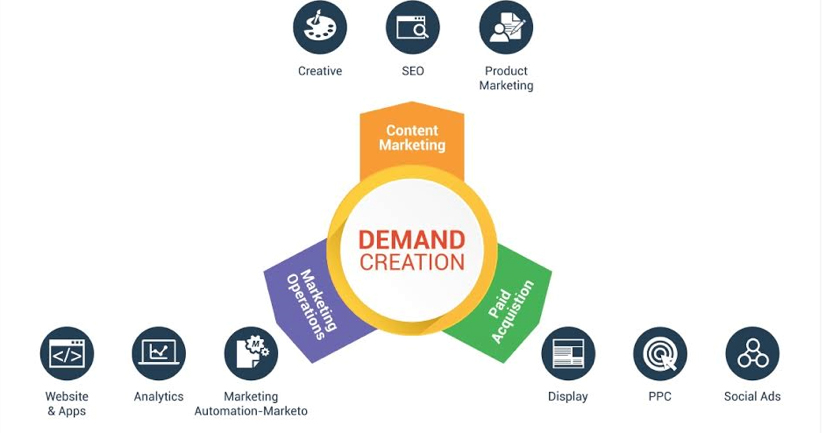
    Position2 is a full service digital marketing agency that has been working with top brands in the B2B space for over a decade. Our Demand Acceleration (DA) framework is the result of years of experience in serving a diverse range of clients of every size and type. It is an integrated approach that combines the key enablers—Content Marketing, Paid Acquisition, and Marketing Technology—to deliver significant results across the Awareness, Engagement, and Purchase stages in B2B sales.

    Over the past two years, Position2 has been engaged with SiriusDecisions, the thought leaders in B2B marketing frameworks—to adopt best practices in our services and processes.

    THE DEMAND CREATION ECOSYSTEM

    Demand Creation is a concept laid out by Sirius Decisions that provides a highly detailed model to plan, manage, and optimize the B2B marketing process.The DC ecosystem revolves around the interactions that buyers have with the marketer. B2B buying behaviour is different from B2C, the key differences being longer sales cycles and multiple buyers. Let’s look at some of the key players and concepts in this ecosystem.

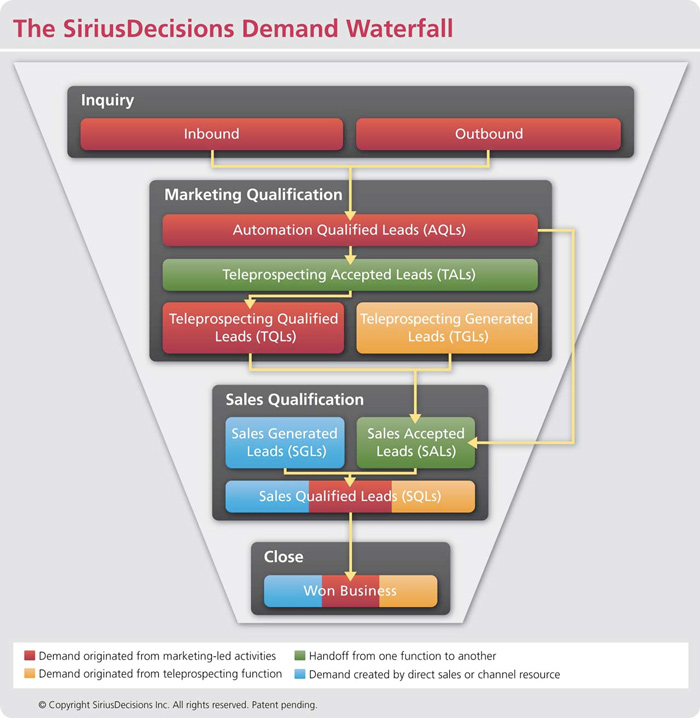
    Demand Waterfall

    The Demand Waterfall, originated by Sirius Decisions, illustrates the flow of buyers across different stages of the B2B buying process. The key elements in the waterfall are the different stages that leads pass through before they convert to a sale or become a customer.
     

    demand-waterfallBuyer

    The buyer is defined as the entity that consumes the product or service. Buyers are further classified based on their role in the buying process, as well as in the consumption of the product and service. Important concepts that are considered in relation to the buyer are personas, buying types and lead lifecycles.
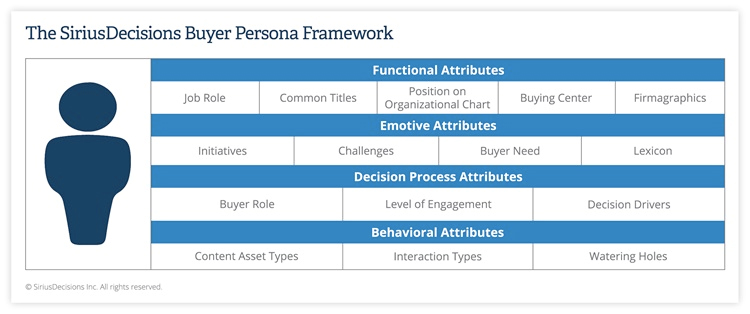
    Buyer Framework

    Product/ Service

    The product or service that is being sold forms the other element in the Demand Creation process. The key concept related to the product or service is Demand Type.
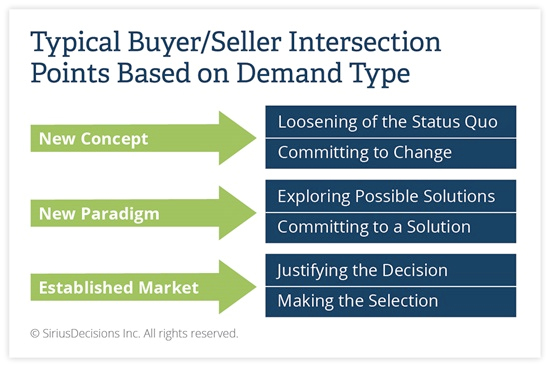
    demand-type-points

    This helps marketers design programs that are best suited to their product or service.

    The Buyer’s Journey

    Position2’s Demand Acceleration framework looks at the buyer as being at the core of the process. The aim is to move the buyer from an initial stage of non-awareness to the final desired stage of purchase. The DA framework leverages the key enablers—Content, Technology, and Campaigns to accelerate the buyer’s journey, thus providing more and faster sales for the company.
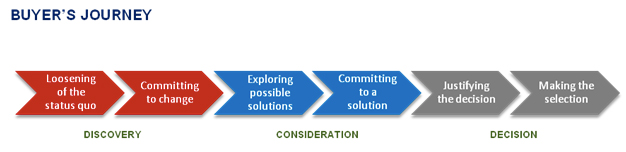
    buyers-journey

    THE ENABLERS

    enablers

    Content Marketing

    Content Marketing covers all the activities and planning required to develop content that drives interactions between marketer and buyer. Various types of content need to be developed based on buyer persona and stage in the buyer’s journey. These could be in the form of short video clips, whitepapers, case studies and infographics, to name a few. The Position2 DA framework incorporates a detailed template-driven process across four key stages—Audit, Creation, Curation, and Measurement.

    Marketing Technology

    Marketing Technology functions both independently, as a channel (e.g., Marketing Automation, Website and Email) as well as an enabler for Content Marketing and Paid Acquisition. Given the rapid pace of development, this is the area that draws a lot of attention and effort. In the DA framework, we clearly distinguish between technology as an enabler and technology as a channel by focusing on the core functionality of the process, rather than the process itself. This allows our framework to adapt and evolve with the latest technologies.

    Paid Acquisition

    While the other two enablers are primarily infrastructure-related, Paid Acquisition is more outward and tactical. It essentially operates as a feeder to the other two enablers. This is also the area which sees the most amount of optimization and scalability, and has the potential to help significantly scale up growth for our clients. Paid acquisition covers all the key channels—Search, Social, Display, as well as newer strategies such as content syndication and sponsorships.

    Position2’s Demand Acceleration framework brings together a calibrated combination of Content Marketing, Marketing Technology, and Paid Acquisition services to produce the best results for our clients in today’s competitive digital marketing arena.

    Contact us if you would like to learn more.

  • Mobile Marketing Trends in 2016

    Mobile marketing has evolved to become an integral part of our digital lifestyle. Smartphones are now used by two-thirds of the US population, and they are increasingly being used for email and social media, photos, navigation, financial transactions, ordering meals, entertainment, and more.

    Mobile’s growth over the past few years has been well documented, and it continues to cross major milestones that illustrate its immense popularity. In 2015, app usage surpassed desktop usage to account for half of all US digital media consumption. In March 2016, the number of mobile-only adult internet users exceeded the number of desktop-only internet users for the first time. This milestone shows just how far mobile has come in overtaking desktop’s longstanding dominance as the primary gateway to the internet.

    Just a year ago, desktop-only internet users accounted for 19.1 percent of all users, while mobile-only users comprised 10.8 percent of the total. This year, the share of mobile-only users has climbed to 11.3 percent, while the desktop-only population has drastically declined to just 10.6 percent. Of course, these numbers also tell us that the vast majority of the digital population is multi-platform and goes online using desktop as well as mobile platforms. Even then, this mobile-only milestone is meaningful because it signifies how smartphones and tablets (particularly the former) are becoming—or rather, have already become—our primary access point to the internet.

    There’s no doubt that desktop computers are highly practical and efficient when it comes to accomplishing complex and information-heavy tasks, which makes them crucial for workforce productivity. They still play an important role in our digital lives, and won’t be phased out anytime soon. Let’s not overlook the fact that consumers still prefer desktops when shopping online, with 87 percent of total digital commerce coming from the platform, despite mobile accounting for 60 percent of total time spent shopping online.

    All signs indicate that the desktop computer is here to stay for the foreseeable future, and that mobile usage will continue to grow. With more mobile-only internet users than desktop-only users today, it’s safe to assume that digital marketing will continue to evolve towards a “mobile first” approach.

  • How To Improve Your Google AdWords Quality Scores

    Quality Score (QS) is easily the most mysterious metric in Google AdWords. PPC gurus have passionately spoken about its importance. As digital marketers, we’re constantly working towards improving the QS of our keywords. Let’s take a look at how we worked on improving QS for a client who we’ve been servicing for three years.

    The client’s selected keywords were of medium priority in terms of conversions, but had relatively low QS. The only way to get the best possible results from them was to improve their QS and lower CPCs.

    How did we achieve this? The effort was twofold. The first and most important step was to ensure relevance between our ad copies, keywords, and LPs. We tested using the keyword in headlines and display URLs, and tailored landing pages to include the keywords.

    The second step was to ensure that we were giving the keywords a chance to see a good CTR through a better average position. This was done by increasing bids for a few days.

    One of our key phrases was “quick business funds.” The ad copy running at that time looked like this:

     Business Funding

    Get The Capital You Need Now.

    Fast & Easy. Sign Up Online!

    Xyz.com

     As you can see, the messaging was generic. We then introduced ad copy that included the key phrase:

    Quick business funds

    Get The Capital You Need Now.

    Fast & Easy. Sign Up Online!

    Xyz.com

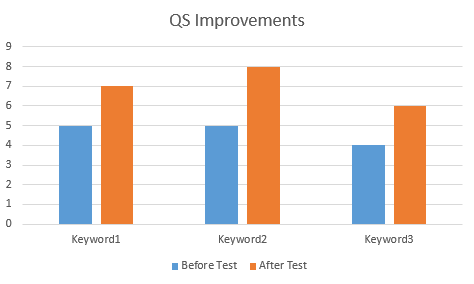
    Did we notice an instant change in QS? No, but our patience and investments in CPC paid off. After a couple of months, we found that 11 out of 23 keywords had score improvements. The table below highlights the improvements in three of the tested keywords:

    QSThe improvements in QS had a positive impact on Average Positions, CTR, and Average CPC as you can see below. It’s important to mention that the bid prices for these keywords remained the same.

    QS 2

    A combination of ad copy testing and bids brought about the improvements we were chasing. In due course of time, we found our average CPC dropping, marginally at first, but significantly in the case of expensive keywords.

    The basis for such a strategy was to insert the keyword into the ad copy in a clever way. You’re often confronted by keywords that don’t directly speak to your product or service. But if these keywords can be highlighted with a unique perspective, there is a lot you can gain as a pay per click advertiser. For example, you’re offering just headphones for sale. Though you don’t offer earphones, keywords around that theme could be crucial for you. If you were to target a user with messaging such as “Why go for Earphones? Get more with Headphones”, you could possibly strike gold on Google. Your Quality Score is bound to increase for such keywords, provided your landing page offers the right experience.

    In addition to this strategy, never underestimate the importance of Ad Extensions catered to the keyword. Google offers advertisers an array of ways to connect with a user, given that there is only so much one can do with 130 characters worth of ad copy. Using Sitelinks, Callouts, Snippets, and other extensions, there are many ways to achieve improved  performance. Tailoring your extensions to a particular campaign, ad group, or even a keyword can help you boost Quality Score in unimaginable ways. The more relevance you earn, the more value you can obtain.

  • Facebook’s New Detailed Ad Targeting Options

    Without much fanfare, Facebook has quietly introduced a new ad targeting option—detailed targeting—which combines demographics, interests, behaviors and categories. Marketers can now create extremely sophisticated, multi-layered target groups that will give them the ultimate in targeting precision.

    In essence, Facebook is bringing four different targeting options—Demographics, Behaviors, Interests and Categories—into one place. With these different targeting options, marketers can build composite targets, such as reaching parents, working in the banking industry, celebrating their wedding anniversary in the next month, for example.This will produce better results, and of course, more money spent on Facebook. It’s a win-win for everyone. It will also be especially helpful to beginner advertisers.

    Now, advertisers on Facebook will see all the targeting options in one place, without needing to explore multiple drop-downs. By making audience targeting more precise, marketers can make their ads significantly more attractive and effective.

    More precision means a smaller audience and more competition. If there are too many advertisers competing for the same niche audience, we may see greatly increased CPM and average cost per click for that audience.

    OR vs. AND Targeting

    For those using third-party tools that work with the Facebook API, you’ve probably already witnessed the power of AND targeting.

    Up until now, Facebook has been operating with OR targeting. This means that if you attempt to get your message in front of two audiences, you would hit either of them, and not the intersection of the two audiences.

    An example of this would be if you wanted to reach people interested in Soccer and Rugby in the same campaign. Facebook would show your ad to either Soccer fans OR Rugby fans. Now with AND targeting, you can reach people interested in both sports.

    You may notice that some targeting options appear to have been removed from the general Facebook ad options page—Demographics (Relationship, Education, Work, Life Events, and more) and Behaviors.

    These options can now be found in the “Detailed Targeting” section, which actually makes sense, because these were already partially using AND targeting when combined with Interests and other targeting factors.

    How Can You Get Access to Detailed Targeting?

    According to Facebook, these new targeting options are slowly being rolled out to advertisers. If you have an account manager at Facebook, ask if these new options can be enabled for you.

    The new detailed targeting options are going to make advertising on Facebook a lot easier. If you can get your message in front of the ideal audience, you have a better chance of converting. This will make advertisers happier than targeting messages at those that might only be slightly interested, and are not likely to convert. Hopefully, this should decrease CPM for narrowly targeted audiences, but only time will tell.

  • The Role of Content Curation in Content Marketing

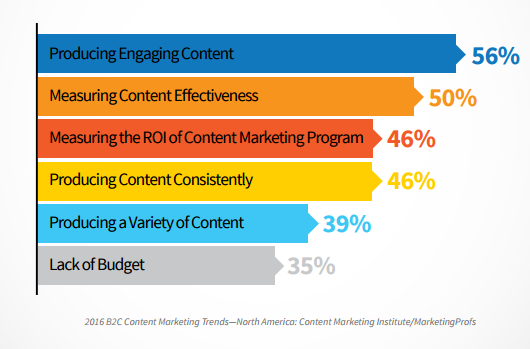
    The Content Marketing Institute (CMI) recently published its report on Content Marketing trends for 2016. It lays out some of the key challenges that marketers face today. As the graph below shows, the major hurdle for marketers lies in producing engaging content itself, according to over 55% of those polled.

    Top Challenges For B-to-C Content Marketers

    Content 1

    The poll also tells us that consistently producing a variety of content—and having the budget required to do so—are significant challenges to many marketers. Content Curation is one solution to these challenges. So what exactly is it, and how does it help marketers achieve the desired ROI? Content Curation can be defined as the process of gathering information relevant to a particular topic or area of interest.

    Key Steps In The Content Curation Process

    • Find interesting content from other people and sources
    • Use curation platforms to add descriptions and make the content more engaging
    • Add more visuals to the article
    • Elaborate on the content in about 200 words; ensure that the article is SEO-friendly
    • Publish it (but don’t forget to cite the original article or credit the author)

    Distributing Curated Content

    The task of a content marketer doesn’t end with curation. It is equally important to distribute curated content to get results. So let’s look at key aspects of how to optimize and distribute curated content.

    • Convert curated blog posts into informational e-books
    • Create emailers and newsletters with curated content
    • Use paid channels such as Medium.com for better performance
    • Create rich-media versions of curated content and syndicate on Slideshare
    • Publish on LinkedIn and other popular social channels

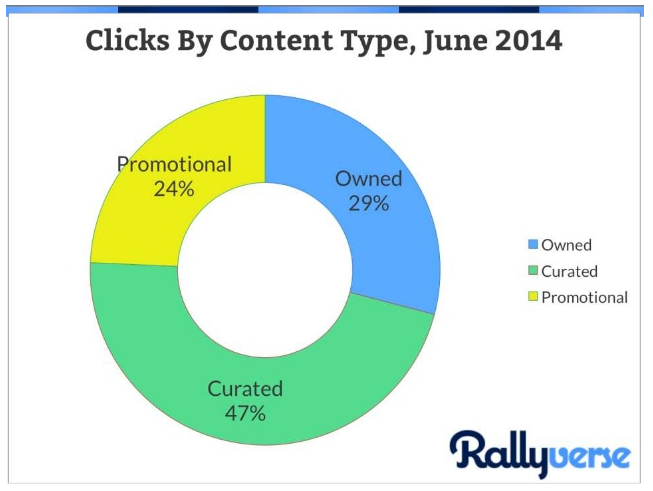
    How effective can content curation be? Here’s an example:

    Content 3Image Source 

    Position2 recommends that content marketers leverage the power of curation to meet marketing goals. We offer specialized content marketing services for businesses to accelerate demand. Get in touch with us for more information.