Category: Paid Search

  • Now Promote Your Tweets Faster

    Twitter has launched its new feature called ‘quick promote’ which is a fast and easy way to promote your tweets. It gives you the power to amplify your best performing tweets directly from the Twitter Activity Dashboard. All you need to do is follow a few simple steps and your tweet will be automatically targeted to users having similar interests to your followers. This way you can make an impact on the minds of people who are most likely to respond to your message.

    If you want to promote a new product, service or blog then Promoted Tweets can drive you measurable business results. This service is specifically targeted towards small and medium enterprises to help them get their best content in front of more viewers on Twitter.

    To promote you tweet all you need to do is

    • Go to your tweet activity dashboard
    • Click on the tweet that you want to promote
    • On the left sidebar you will have an option to promote that tweet

    Though this feature lacks advanced targeting options at present, it is a good initiative. It has been found that users who see a relevant promoted tweet are 32% more likely to visit that business. The ability to promote a tweet directly from your Twitter Activity Dashboard is hugely beneficial for all the small and medium businesses that are active on the micro-blogging site. It assists one in quickly pinpointing content that performs and then targeting people who are naturally inclined to view such content. This way you can effectively expand your audience and augment your message.

    Do share your views on Twitter’s ‘Quick Promote’ with us.

    Contact us for your brand’s integrated social media marketing!

  • Personalized Search

    A personalized search reaches beyond the user’s initial query by incorporating information gleaned from his digital history of interests. There are at least two ways in which personalized search can be delivered: modifying the search query, and re-ranking the search results.

    The search engines of yore catered to all users in the same way. Not so today. The search engine learns about the user profile from the individual’s search history. This profile is then mapped to a set of categories that the search engine accesses to make sense of the query. In effect, the search engine disambiguates keywords in order to serve up what the searcher is actually looking for. With this level of personalization, search engines provide different results for different searchers.

    Google first introduced personalized search in 2004 and began actively implementing it in 2005 in the Google search results. Various factors come into play when personalizing a user’s search results, like the location of the user, the search language and the user web history.

    Search engines today want to reach beyond what you type in the search box. They seek to understand what your intent might be in order to give you exactly what you want. Or, what they think you want. To do this they use information you have provided, either wittingly or unwittingly, to create user profiles, or personas. The search engine then utilizes the persona to target information in a way that best serves your perceived interest.

    The more often you visit a certain web page, the more Google believes that you like that page. Your behavior is duly noted and used to optimize future search results. The next time you search, a page which you have been previously visiting with regularity is likely to be shown more prominently. Herein lays both advantages and disadvantages of just such a likelihood.

    Finding new information becomes a major disadvantage of personalized search. You will be repeatedly shown the same results because that is what you always click on. It’s in your history. This naturally narrows your information exploration on the web. The problem is called ‘filter bubble’ and it means that people are letting search engines decide what the users want to see and what they don’t want to see. In the extreme case the user becomes confined to his own ‘filter bubble’ and is cordoned off from the rest of the information out there on the Internet.

    Extrapolate this to a community level, and the consequences become troubling. As certain search results are bumped up and more and more people view them, the favored results become more prominent, and the ones not so favored are removed from the listed search results. When this happens collectively the society as a whole will likely have a skewed perspective of a particular topic. It gets Orwellian without much effort. He who controls the search engine controls information.

    Google uses Google News to personalize your search. The first few results for a specific news query would likely be the same to all viewers. But as you scroll down, the results begin to differ. Google takes your past searches into account and your location and gives you local news that may matter more to you. This could be useful. But the potential disadvantage is missing what may be important news from farther afield.

    The average person’s attention span is 8 seconds, so personalized search helps to quickly sift through the blocks of data that search engines throw up. Personalization saves time and significantly improves the quality of the search. It can also help search engines display highly targeted (“personalized”) advertising — the best deals, offers and discounts, depending on an individual’s interests – the idea being that the consumer finds what he is looking for faster and with all the relevant information displayed more prominently.

    Contact us to deploy personalized advertising campaigns!

  • Google ‘Other Interests’ Closure Imminent

    The numero uno search engine will be retiring its ‘other interests’ category in the interest of serving the advertisers more effectively. This was a service that was introduced by Google in 2009 in the interest market category connecting advertisers with people across the display network based on customer interests. Using this advertisers could get a better inkling about their core target group. ‘Other interests’ was basically built on topics. But now it seems that it is limited in addressing advertisers’ extensive targeting needs and there is a lack of specificity too here.

    ‘Other interests’ was deployed by Google in order to target people based on implicit interests. This was done on the basis of types of web pages that these people visited on the Google Display Network. It was but natural that Google would pull the plug on ‘other interests’ since there was an overlap with the advanced audience solutions. But you can still access historical performance data from ‘other interest’ targeting, going forward.

    With each passing day, Google has been launching new and powerful interest-based capability tools like ‘affinity’, ‘custom affinity’ and ‘in-market audiences’. These tools offer much more flexibility and control as compared to the ‘other interests’ tool. If you have a ‘other interests’ campaign account then it will run for some time and then it will be automatically upgraded to one of the three tools viz.

    • Affinity audiences – To create brand awareness
    • Custom affinity audiences – For niche audience targeting
    • In-market audience – targeting prepped shoppers on the verge of buying

    All these above tools use very sophisticated audience signals to attract and retain very specific group of customers. It makes segregation on the basis of customers wanting to buy particular products or services and such other criteria. So when you upgrade to the new services, if the need be, Google  can help you out with campaign type recommendations based on your current performance goals and bidding preferences.

    Let us have your inputs on this imminent changes in advertising with Google! Contact us to advertise across the extensive Google Network and beyond!

  • View-through Conversions

    You are as likely to click on a website immediately on seeing a banner ad as much as you would walk immediately into a store on seeing an attractive out-of-home display ad. We are less inclined to stop what we are doing in order to respond to ads, be it online or when we are out in the city.

    In the world of search marketing, click-through conversion is all that matters. Search, by its very nature, has a pre-qualified audience based on their intent to seek out information. Clicks reign supreme because ‘Clicks’ from search ads connect your brand with a sought after need.

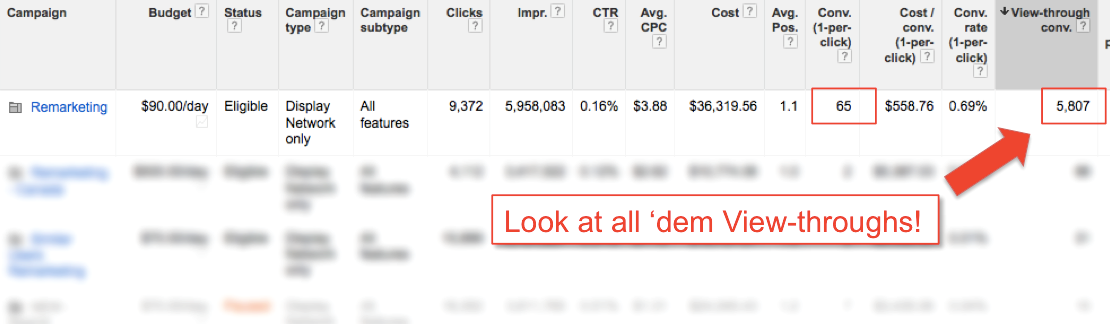
    On the other hand view-through conversions – VTCs (a.k.a post-impression conversions) happen when a person is exposed to a display advertisement, does not click, but goes on later to visit the website or search for the brand on search engines and converts. The driving force behind display advertisement is to create an influence. As a marketer we must endeavor to reach the right type of person, at the right time, at the right location and with an offer /service they simply cannot refuse. Even when all these factors are present in a precise way, a person might be inclined to click only when an impression is served and is compelled by what he sees in order to take some action. In display advertising, the ‘Impression’ still reigns supreme.

    So that brings us to some interesting questions:

    Q – Are VTCs just duplicates of the other conversions in the interface?

    View-through conversions are not able to get the rightful credit mainly due to the way people view it in DSP buying. Many DSPs will group the VTCs along with the Click-through conversions while filling leads form thus giving a distorted figure. These DSPs will then promise a CPA model to the client which can only be fulfilled with the help of duplicated view-through conversions.

    You can be on top of all such things by checking the validity of this metric:

    1. You have to run a split or A/B test campaign. For one group you need to show the banner ad and for the other show a PSA ad. You then have to find out the incremental conversions for the group that viewed the banner ads.

    A/B Testing vs a Blank Ad

    a_b testing_view-through-conversion

    Source

    1. You have to demand that the view-through conversions be shown separately from last click conversions. That way you can have the actual break down of the conversions.
    2. Based on the industry conversion duration norms, set a custom backtrack durations for view-through look ups. Do not take view-through conversions that are registered beyond the set conversion duration.

    Q – What is the view-through conversion window?

    A view-through conversion window reckons a conversion after an ad is viewed depending on the number of days that you allow for the conversion to happen. You can customize it as per your needs to only record a VTC if it happens within the window of time frame post ad view that you have selected. The shorter the ad window the more accurate is the result. A 24-hour window is very reliable since the stickiness factor will definitely influence the customer’s decision to click the ad. A 30 days ad window may or may not be so accurate which is again wholly dependent on the type of product or service that you are selling, sales cycle, industry, and other factors.

    Q – Even if I believe that VTCs are valuable, how should I value them?

    We have to get used to the fact that impressions are indeed influential. This needs a radical change in the mindset of marketers that strictly value ROI and CPA goals. Studies have shown that lift and influence are very real and give a fair amount of conversion rate improvement. If you look at the following table you will see that VTC does help.

    Influence of View-through conversion

    Influence of View-through conversion

    Even if it is just a 10% improvement it still can make a difference. It could mean ratcheting up a good ROI to a great ROI. If you closely look at users clicking on your ads or otherwise you will surely see that they might not convert immediately. They can come back to your website later and convert. This is the overwhelming underpinning validation of view-through conversions. You can now measure the success of your display ad campaigns via the view-through conversion paradigm. Search engines like Google have taken cognizance of this and provide you insights into it so you get a holistic value of your display campaigns.

    View-through conversions is a tracking metrics available in the AdWords account that can give you a clear understanding of your campaigns as it can measure assisted conversions. This happens when a user views your ad but comes back to it later, may be through another channel and converts into a customer.

    Display advertising plays an important role in improving your digital marketing returns. Taking into account view-through conversions (VTC) can get you a comprehensive understanding of your efforts. It offers you a lifting effect of display advertising which hitherto you had no idea about. VTC helps to drive conversions even though it might not produce direct clicks. A visitor might return to your site via a bookmark, an organic listing or a regular URL and convert. You can then conclude that the original display ad did make a difference.

    Now, we have a formula in order to find the efficacy of VTC that can help you reckon your digital ROI.

    Actionable items

    • Segregate you target group into two parts, 90% for brand and 10% as control group with no room for overlap.
    • Use your Branded ads in the first campaign and PSA control ads for the second
    • Run the ads for a conveniently long period to collate good amount of data

    Compare results after normalizing the data

    weighted vtc

    An Example

    Sample Data

    Impressions VTC
    Brand Ads 1,000,000 1000
    PSA 800,000 720

    We need to multiply the PSA campaign results by a factor of 1.25, to normalize the data

      Impressions VTC
    Brand Ads 1,000,000 1000
    PSA 1,000,000 900

    Weighted VTC = (1000 – 900)/1000 = 10%

    Result: One in ten VTC has indeed influenced someone to take action.

    This is a holistic view of your digital return on investment. Most digital marketers might not be initially convinced of the benefits of VTC. In today’s world, people more often than not, are multitasking. So somebody might see your display ad while visiting some website at work. Now that somebody might not click immediately on that ad or even take any action at that point of time. Your ad might not even get due appreciation by the person. But the brain can register more than the eyes can see. So you might not get an immediate conversion for your display ads but that does not mean that your ad spend is completely wasted. It does create an impression and next time that person sees your ad he can immediately relate to it. There are more chances of conversion on that pay per click ad that you are going to serve him for his specific query. But then if you give 100% of the credit to the PPC ad, then it is not completely accurate. The initial display ad did have its own impact and all we say is that we now have a robust method to measure that impression leading to conversion called as view-through conversion.

    This is a new frontier in a digital marketing world addicted to clicks and quick results. VTC is an avenue that you need to explore further in your quest for improved results for digital marketing dollars spent.

    Let us know your views on View Through Conversions!

    Contact us now to make your display ads go the extra mile for you!

  • The Super Bowl 2015 – Digital Marketers Can’t Get Enough!

    A record 111 million viewers in 2014 alone, out of which over 50% tune in just to watch the commercials! Now that is manna from heaven for any advertiser worth his salt. A 30-second TV spot is worth a staggering 4 million dollars! Now that we have your undivided attention, let’s get to the issue of how lucrative this Super bowl can be and also let you in on the secret of immensely benefiting from it if you are a digital marketer!

    Super_Bowl

    The television is the centre of the Super Bowl action. It has been so since a long time and will remain so at least in the very near future. But digital marketers need not lose hope as it is much more than just showcasing your latest creatives on TV. Some of the most aggressive brands create their digital advertising campaigns weeks in advance of the actual action. This gives them the much needed stickiness factor and it creates an atmosphere of anticipation and surprise. It has been proven that brands that promote teaser campaigns well in advance reap the benefits of broader reach and circulation. TV ads might not be everybody’s cup of tea but that need not deter you from creating an online marketing blitzkrieg!

    A well known brand like Snickers promised to release its TV ad only if its social media campaign attracted 2.5 million views before the big kickoff! All this creates a lot of positive buzz around the brand which is music to the ears of digital marketers. Today in an interconnected world it is not hard to accomplish a holistic branding exercise with synergy coming into play.

    You can create longer form, online targeted content beyond the blink-and-you-miss-it 30-second TV spot in order to ensure greater customer engagement. If your TV commercial is a runaway success then you can reap the benefit of this bonhomie in the digital world too. TV viewers that love your commercials will surely talk about it on social networking sites, search for it on their smart phones, view it again on YouTube, and most importantly share it with friends. This can give digital marketers real insights into who are the people that are interested in their brands, thus assisting in deploying targeted advertising to these people.

    It is all about getting your act together and synchronizing all your digital touch-points in order to ensure a remarkable touchdown (if we may borrow a term from the Super Bowl!).

    Do share your excitement about the Super Bowl 2015 now! Contact us to generate integrated digital marketing campaigns for your brand!

  • Digital Marketing & Behavioral Targeting

    You can’t be limiting your marketing strategies to one or two channels today, not with digital media on board. If the difficulty of marketing to potential customers on this labyrinthine playing field tweaks your pain threshold, then you need to focus on behavioral targeting.

    It is nothing new. Marketers have used behavioral targeting since analog times to get better ROI. But not necessarily in the digital age. Only 24% of digital marketers actively utilize behavioral targeting techniques, no matter how straight forward those techniques might be.

    So let’s look at some ways to implement behavioral targeting in the digital world. In its simplest form, behavioral targeting means gathering information from a user’s browsing history then using it to tailor a marketing strategy. Consumers leave behind a digital footprint when they visit a website. Customer profiles can be created from page visits, time spent, links visited, search history, etc., and can then be used to deploy behavioral targeting, like pushing highly relevant (“targeted”) advertising. Statistics demonstrate that the chances are high that a targeted advertisement will convert a user into a customer.

    When Amazon seems to follow you to any website you visit and then throws up highly relevant ads, that’s behavioral targeting used by an online ecommerce behemoth. The days of one size fits all are long gone. The Internet of the future will be an even more personalized affair. Behavioral targeting might be costly to deploy but the returns more than compensate.

    The Right Approach

    It is an interconnected world all the way around and the idea of remaining incognito while on the Internet is, well, quaint. Digital marketers can turn this quality to their advantage. With each passing day the prices of ads rise and the cost of customer acquisition follows suit. This has given rise to technology firms masquerading as ad networks that partner with tens of hundreds of websites simply to obtain information on user behavior. In other words, a whole new digital industry. These ad networks use sophisticated software tools and advanced analytics to slice and dice the raw data they gather and produce readily deployable digital marketing information..

    It is not how much information you have but what you do with that information that matters. You can target your users via “cookies”, small bits of code deposited on your users’ hard drive. From this their browsing behavior can be tracked, the websites they visit, their social networking interests. If they send a tweet or publish a post on Facebook, you can keep a tab on it, too. All this information pertaining to your users can then be organized, aggregated and distributed so you can make sense of it and target them with ads that, hopefully, make sense to them. When someone shops on an ecommerce site their shopping behavior reveals itself, in detail. And so user personas are built and targeted ads are delivered. But here’s the trick for digital marketers: whenever they tracking users, they should make sure the users have a knowledge of it. In other words, the users have to buy in. Otherwise, it’s spying. It’s invading privacy.

    If done the right way your users won’t complain about behavioral targeting. It can be a win-win situation, but not if it  becomes intrusive, a perceived breach of trust. That’s when it becomes an issue with your users. You simply cannot intrude on your users’ privacy. Everybody appreciates their needs being met, actions being anticipated before they are manifested. But no one likes their privacy hacked by advertisers. The opportunity you have is to build trust. Then you not only convert a customer, you retain a customer for life.

    What do you think of behavioral targeting and its vast benefits? Contact us to deliver personalized advertising to your target group now!

  • Yahoo Market Share Rises after Mozilla Deal!

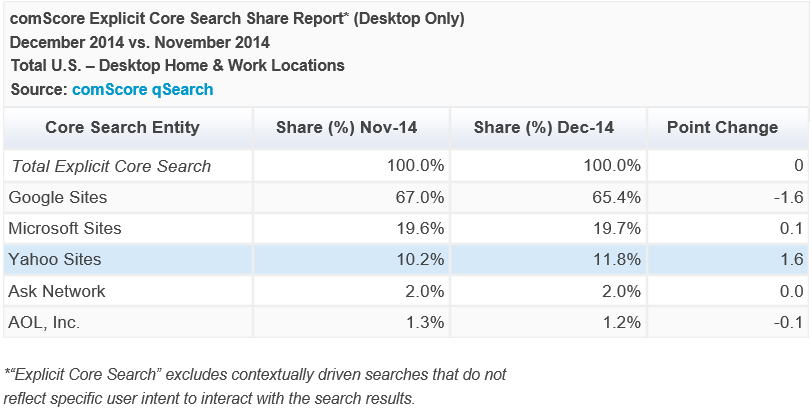
    Yahoo had got into an exclusive agreement with Mozilla in November 2014. As per this deal, Yahoo became the default search engine for Mozilla PC and mobile browsers. This was a “strategic five-year partnership” and as part of the deal, Yahoo started offering enhanced search experiences. Yahoo featured a clear, modern and immersive design with inputs from the Mozilla team.

    yahoo_market_share_rise

    Source

    This deal seems to have paid Yahoo rich dividends. This is clearly evident in the latest comScore released for US desktop search engine rankings. As per this data, Yahoo has seen an increase of 1.6% in US desktop search market for the month of December. This is the first month since the five year partnership with Mozilla came into effect. Unsurprisingly this comes at the cost of Google which saw a decline of 1.6% of its market share. Any rise of more than 1% is significant for Yahoo, considering the vice-like grip that the numero uno search engine Google has on the US online search market. This is Yahoo’s highest market share since 2009 for the United States.

    How do you view Yahoo’s ascent in the online search market share!

    Contact us for enhanced search engine optimization of your website now!

  • WhatsApp Gets a Desktop Avatar

    It is the sign of the changing times. Convergence is the way to go in the digital world. Less than a year ago, the social media giant Facebook had bought the mobile messaging service WhatsApp for around $19 billion! Now Facebook is going for a major makeover for the app. Going forward you can access WhatsApp on your desktop or laptop PCs.

    This would basically be a mirror of the app on your phone and you would still need an Internet-connected phone. All your message though will reside on your phone and the desktop would just be an interface for you to send and receive messages. This is presently available for the Google Chrome browser and there are plans to include the Apple iOS platform too.

    To get your WhatsApp messages on your desktop all you need to do is

    • Open the website https://web.whatsapp.com in your chrome browser
    • You will see a QR code which you need to scan inside of WhatsApp
    • WhatsApp web client will now be paired with WhatsApp on your phone

    Your phone always needs to be connected to the Internet for the web client to work. Make sure you have the latest version of WhatsApp installed on your phone. This latest development shows the growing influence of the mobile messaging services in the grand scheme of digital communication.

    Let us know what you think of WhatsApp on Desktop!

    Contact us to deploy your marketing messages effectively across the digital space!

  • Responsive Web Design (RWD) – What you should know?

    The use of mobile devices with differing display sizes to browse the web has all but erupted overnight, and most websites haven’t been optimized to handle the variety of screens. Enter Responsive Web Design (RWD), a technique capable of rendering the same content without disruption across devices with varying screen sizes.

    What is Responsive Web Design?

    Responsive web design is a web development approach that enables dynamic changes to the appearance of a web page, depending on the screen size and orientation of the device used. It’s a technique for building websites that works on mobile phones, tablets, TVs, game consoles and wearables as well as laptops and PCs. RWD is the best way for websites to eloquently adapt to different kinds of screens.

    How does Responsive Design work?

    With RWD web pages automatically adapt to the layout of the viewing environment using Fluid, proportions-based grids, Flexible or responsive images and Media queries.

    Fluid Grid:

    Website design initially followed in the tradition of the print media industry where a magazine or newspaper was the same fixed size, though in the case of websites the size was defined in terms of pixels. But the problem arises when website content is no longer viewed using only one fixed display size. A magazine is a magazine and the content is universally viewed in a specific fixed size. Websites can be viewed using a bigger format like a television or a smaller format like a smartphone, or a tablet or an even smaller smart watch. So, responsive web design builds websites with relative, not fixed units. The fluid grid concept calls for page element sizing to be in relative units like percentages, rather than absolute units like pixels or points.

    Flexible or Responsive Images:

    The idea of responsive images, in a nutshell: images shrink and adjust themselves within the confines of a fluid grid.
    Responsive_website_device_view

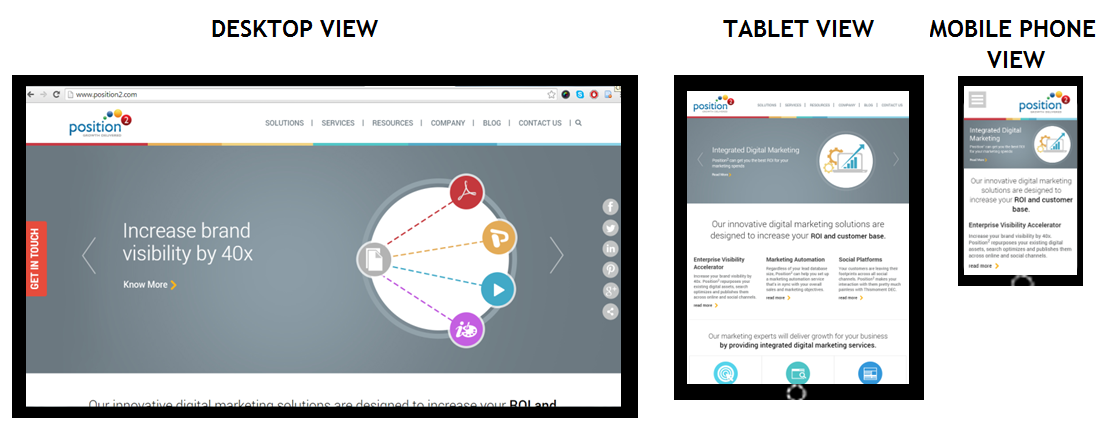
    Home page of www.position2.com viewed on various devices

    Desktop View gives maximum image size, but in the Tablet View the same image shrinks to display with full details while text content colonizes the remaining area of the screen. In Mobile Phone View, the image shrinks to display full details and text content occupies the remaining area of the screen. So, depending on the screen size, responsive images shrink or extend to display images in full details.

    RWD developers define the maximum and minimum dimensions to establish the limit of image pixilation in the CSS.

    img { max-width: 100%; }

    Media Queries:

    Websites are usually built for viewing on desktops and laptops in landscape mode. It’s challenging to take such a website and try to shrink it down to a mobile phone because mobile phones are used in portrait mode where the screen is longer than it is wide. With the website scrolling vertically, layouts several columns wide don’t work. This is where media queries come in. Media queries are a CSS technology, a core component of responsive design. Media queries allow CSS to be applied only when specific conditions are met (like when a webpage is viewed in portrait mode). When a design is too large or too small, a media query detects the site width and serves CSS that appropriately rearranges or adjusts the site’s content.

    Media queries code differs depending on the target device. Below is an example of media queries code for a smart phone in portrait mode:

    <style  type=”text/css”>

    @media (max-width: 320px) {
    #banner { width:275px; }
    #banner img { max-width:275px; max-height:83px; }
    #main { width:250px; }
    #main-content { width:250px;padding:0px;}
    #widget-container { width:250px; padding:0px; }
    .widget-content { width:250px; margin:5px;}
    .widget-text { display:none; }
    }
    </style>

    The challenge in responsive web design is to reorganize elements on larger pages to fit smaller, longer pages or vice versa. To make sure responsive design is successful, the design must be usable across an array of screen sizes (SEO experts will help the developer to define this limit based on the various devices used to access the website from Google Analytics).

    Advantages of Responsive Web Design

    A website with responsive web design gives a better user experience and the users are more likely to engage with the content.

    Cost efficient: When a website is developed using responsive web design, it basically means one website for all screen sizes and devices. You won’t have to build a separate mobile website.

    Smarter and better user experience: RWD gives users a better experience by offering the same content on a smaller device. It can be accessed from anywhere on any device at the sole discretion of the user.

    Future preparation: If you have a website built with responsive web design, then you are well prepared for the mobile future.

    Increase in conversion rate: A well-optimized website gives better user experience, encourages them to remain engaged with the site, and eventually leads them to customer conversion.

    One URL for one website: One website with a common URL can be used for different devices.

    Better user experience: Responsive websites are available to users anytime anywhere on any device.

    Bounce rate improvement: Do not underestimate the fickle nature of tablet and mobile users. They want their (same) desktop content and they want it now, otherwise they will bounce. And those bounce rates can get high. RWD enables delivery of the same content both in mobile and desktop view thus improving mobile traffic.

    Responsive web design delivers great user experience. It’s simply the best way to optimize a website for mobile devices. Visitors accustomed to viewing websites on larger screens expect the same experience on their smaller devices. If a website is not well optimized, then it annoys the user and bounce rates escalate. The solution is a responsive website with well optimized content ensuring that users see what they really want to see at first glance.

    Contact us now to deploy responsive web design & never miss another opportunity!

  • Google’s Data Platform Changes Imminent

    Google is the market leader as far as online advertising is concerned. But of late there are a few other competitors that are threatening Google’s hegemony in this space. This has obviously got the search engine giant quite perturbed and it is no mood to give away its share of the lucrative online ad business without a fight. The Facebook Atlas platform seems to be one of the toughest competitors that the Google ad network had to face since a very long time.

    Google intends to respond to such threats by restricting its ad network to data management platforms. This has naturally got digital marketers quite concerned. This move could curtail the freedom that ad tech firms enjoyed till now. But there is definitely more to this move from Google than meets the eye.

    Going forward, Google will restrict ad technology partners from gathering data while running campaigns on the Google Display Network. Now this move seems to have been timed with the launch of Facebook’s ad server and data platform, Atlas. But there are people on the other end of the spectrum who say that Google has been working on this for quite some time now.

    Whatever be the spur, Google will not allow ad networks to fire pixels on certain ads. Pixels help advertisers to keep track of user views and interactions so that the ads can be better managed. Standalone entities who do not have a hybrid model of deploying ads will be the most affected. Beginning March 2015, Google will implement its policy to restrain certain data management platforms from firing tracking pixels on the Google Display Network. The DMPs that will get the short end of the stick are the ones that do not own a demand-side platform or DSP to execute the transaction.

    But ad tech companies are afraid that in due course, Google might bring sweeping changes to the ads served on its various platforms including its DoubleClick Ad Exchange. Now that calls for a detailed discussion which we shall be covering as and when it happens. Watch this space for more.

    What is your take away from this new move from Google? Contact us now for 360° online advertising!