Category: Content Marketing

  • Google Authorship Axed but Author Rank Endures

    Google authorship

    It was heralded as a radical idea that was going to change online content marketing forever. Google patented Agent Ranking/Author Ranking way back in 2007. At that time, the idea was to give due credit to writers/authors for the content that they generated by tagging their identities to their content when it showed up in the results page. The goal was simple and if it had been successfully accomplished, online content would have had an added layer of credibility.

    Google’s enthusiasm is understandable. After all, its mission is to organize the world’s information and make it universally accessible and useful.

    But for Google things did not pan out the way they had expected. Surprisingly it offered a rather cumbersome option for authors to add their identities to their content. Latest statistics reveal that a majority of the authors made no effort to attach their names to their content. Thus, the very purpose of Author Ranking was defeated due to authors’ aversion to ‘publicity’. Ironically, while real authors didn’t use this feature, there was a proliferation of fake ‘authors’ attaching their names to content they never wrote.

    This setback did not faze Google. It’s a research based organization at heart and views failures as stepping stones to success. The company tests and evaluates every product, innovation or change. After rigorous testing anything that does not meet the company’s expectation or does not provide enough user value is ruthlessly terminated. It’s this very discipline that keeps Google at the top of its game even after so many years.

    In keeping with the company norms, Google finally had to pull the plug on Author Ranking and call it a day. But that does not mean the search engine giant will not be researching talented authors and make this a leading factor in deciding Page Ranking going forward. It has more than one ways to do it. Google Knowledge Vault is a good case in point and so is the schema markup. It keeps a tab on authors and sees to it that content from tried and tested authors is always valued better than greenhorn writers who are yet to earn their stripes.

    What it Means for Content Marketing

    Where once the content was followed by the name of the author and a picture in search engine results, the page will now look more lackluster. This doesn’t have to deter content writers and marketers since according to latest research from Google the Authorship snippets in any case offered very little value to searchers and there was no radical change in ‘click behavior’ on results page.

    The search engine will rely on Author Rank nonetheless to reward quality content. There is schema.org which is a collaboration of major players in the field of online search. Schema is a microdata that helps search engines to better parse and interpret content on the web in order to better rank it in the results page.

    Quality content deserves recognition and reward. Google Author Ranking was a wonderful initiative and something that deserved to do much better. Position2 engaged with a financial services company and recommended Author Ranking that helped them get their content a far higher ranking in the search engine results page.

    We believe that the current avatar of Author Rank will continue to help in ranking authors as per their credibility though it will remain inconspicuous to the lay user. Having recognized the need to provide search engine rankings based on author credibility, Google is unlikely to give up on this. While Google has officially pulled back this offering, it’s probably a strategic retreat for them to work on it away from the public eye.

    Giving up on a juicy research problem is just not the Google way!

     

  • Go Real-time with YouTube’s New App

    Like most social channels and ecommerce websites, YouTube is also being swept away in the app wave of the digital marketing industry.

    The video behemoth has announced that it will be launching a new app that will hand digital marketers easier access to YouTube’s creator features. This app will enable you to manage your YouTube channel easily when you are on the field.

    Using YouTube’s new app will help in engaging your channel’s fans with real time content. For example, if your brand is sponsoring an industry event, you can take short videos of your activities at the event on your phone and post it on your brand’s YouTube channel, live!

    Real time posting is a great way to boost fan engagement!

    YouTube has also rolled out a new feature that will enable you to collect funds directly from your fans on YouTube. You no longer have to rely solely on off-YouTube fund raising.

    Another new project in the pipeline is what YouTube has termed as ‘Creator Academy’. This is a collection of articles that can help you get more out of YouTube. We will know more on how it will impact marketers once YouTube rolls out the feature.

    To check out the new features rolled out by YouTube, watch this video:

  • Measuring ROI in Cross-Channel Marketing

    How to measure Cross Channel Marketing

    Mobile, TV, mobile.

    Newspaper, TV, tablet.

    The combinations vary.

    People these days aren’t just consuming digital media but juggling content across platforms. They do not want to miss out on anything while doing everything that they want to do.

    Media multi-tasking has necessitated cross channel marketing and it is here to stay.

    So, what is cross channel marketing?

    Cross channel marketing is the integration of marketing campaigns across channels.

    So, marketers now need to plan their content strategies in such a way that they can target users across different channels. However, the needs of people differ with every channel. You may be able to keep up with changing needs but:

    • How do you measure campaign performance across channels with different parameters?
    • Can you take the right decisions about budget allocations with measurement data on such different parameters?

    A recent study by CMO Club and Visual IQ has revealed that only 1 in 5 CMOs are confident about their ability to quantify the impact of one channel on another and only 1 in 4 marketers think they can quantify the impact of offline and online channels. Due to the different ways in which people engage on different channels, marketers are finding it tough to collate and manage data.

    Here are a few pointers that can aid you in measuring campaign performance across channels on different parameters:

    • It is very important to know the parameters you can compare with each other and the ones you cannot. You need to predetermine the weightage of the various measurement parameters:
      • Should Facebook likes, Google+ ‘+1’, Pinterest re-pins and Instagram likes be categorized as a measure of basic interaction only? Do they have equal weightage?
      • Are LinkedIn shares and Twitter re-tweets to be rated as a superior level of engagement?
      • Are online video ad views and TV ads comparable because they both are ads in the same format?
      • Can you compare radio ads with other mainstream ads’ performance?
    • Based on your measurement data, make adjustments to your channel-wise budget allocation.
    • Invest more on channels that are better suited for you and so, yield more ROI. Pick out the best mix for your brand, keeping in mind your industry, budget, campaign aims and so forth. As per the above mentioned study, only 6.7% marketers think that they can determine the best touch point/channel mix for their brand.

    Using attribution models helps take the right decisions about budget allocations even with measurement data on different parameters. Attribution models assign credit to each channel depending on the time the marketing communication happened. For example, if you are using the ‘First Interaction’ attribution model and TV is your first point of contact, TV is where you should focus the most. Choose the attribution model best suited for you.

    • Do you think the first touch point/channel deserves all the credit?
    • Or, is it the last channel that is most important?
    • Check out these different attribution models:
      • First Interaction – This attribution model gives all credit to the first touch point/channel that started the marketing communication sequence.
      • Last Interaction – The last touch point before the conversion gets all the credit. According to the CMO Club and Visual IQ study, 47% marketers use this attribution model.
      • Linear – This model spreads the credit equally among all the channels irrespective of their position along the path to conversion.
      • Time Decay – The channel right before the conversion gets the most credit while the first touch point gets the least. As for the touch points in between, they get lower credits as the progression moves away from the conversion to the first channel.
      • Position Based – This model gives the first and last channels equal credit. The touch point in the middle gets the lowest credit. The other touch points get more credit as they get closer to the first and last touch points.

    Do you think anything else is important when measuring ROI for cross channel marketing?

    Image Source: skylinetradeshowtips

  • Being a Hit on Social Media and Facebook Updates for the Week

    Image Source: ilfoglio

    Social Media Content

    Every brand (almost) has a social media presence.

    And, all these brands post content on their social media accounts (we think it’s safe to assume all do).

    End result?

    • A totally cluttered social platform, which gets even more crowded when you factor in individual user posts.
    • If your content quality isn’t top notch, it will fall flat on its face when faced with top quality content.
    • If you are heavily reliant on organic content, social networks are adding filters to it in a bid to promote brand paid promotions (for example, Facebook’s recent changes due to which brands are now reaching a lesser percentage of their audience).

    You can blame Facebook and other social networks for making changes that are quashing organic content reach while filling their coffers through promotion of paid content posts.

    However, it is also true that be it for organic or paid promotion, brand content has to be of very high quality.

    Getting back to the point…

    Creating great content

    Do you follow a calendar or do you simply go with the creative flow?

    Social media content is different from blog posts, white papers and other long content forms. Social content has to be short and preferably written on the spur of the moment. This helps maintain the essence of the news. Remember, it is very important for social content to work in real-time.

    Posting frequency

    You need to post once every day on Facebook and four times on Twitter. Added to this are your blogging responsibilities. So, how do you create great content (particularly if you are short on resources)?

    Check this plan:

    • A short news update every day
    • A well thought out post once a week
    • Close the week with a collation of all the important happenings from that week

    Do you want to simply churn out content or do you want to make sure it is great content but posted less frequently?

    Take a call…

    If you want great content that interests your audience, cut down on your frequency and focus on quality.

    Facebook Finally Releases its Mobile Ad Network and Makes Changes to Login Systems

    After all the noise created by rumors, Facebook finally released its ad network, Audience Network, during the f8 developers conference recently.

    Changes to Login Systems

    Trying to solve users’ concerns about sharing information with apps, Facebook announced:

    • Anonymous login: You can use an app without sharing any personal information.
    • Facebook login: You can choose the information apps will gain.
    • Redesigned app control panel: You can see and manage the apps you use.

    For more information about new developments in login systems, click here.

    Tell us what you think about this post…

  • Position² @ The Marketing Nation Summit, 2014

    ‘The Marketing Nation Summit’ that concluded last week provided a world of insights, knowledge and excitement!

    Team Position2 loved the event and is already looking forward to the next one. We had a lot of fun but, as you know, we’re serious when it comes to business.

    For all you folks who couldn’t attend the summit and for those who can’t get enough, here’s a quick recap…The Marketing Nation Summit Exhibitor Sponsor

    Day 1 – April 7

    Kicked off with an early morning run. Followed by on-site Marketo certifications where users could choose from one of four tracks that included – from basic forms, landing pages, emails to advanced and multi-stream nurturing.

    The day ended with a business mixer where event participants and exhibitors got an opportunity to network and explore new technology integrations.

    Day 2 – April 8

    The excitement went up several notches on the second day with all the high-powered sessions lined up!

    Ann Handley from MarketingProfs on Content Marketing

    The morning session at 8:00 was illuminating with Ann detailing the aspects that content marketers can and can’t take from traditional publishers. She said that though there is plenty to take away, content marketers should go beyond that. Ann’s 5-point action plan:

    • Experiences matter, not just narration: Add real-life examples instead of just narrating to your customers. It makes a lot of difference. Give them a feel of using your product.
    • Talk to your customers directly: Connect with your customers by using words like ‘you’, ‘we’ and ‘us’.
    • Experiment with your content marketing channels: Figure out your ideal content marketing mix. But also invest in different channels and learn what’s best suited for you.

    sam-khandelwal

    • Have a can-do attitude: You can do a lot with even small budgets and teams.
    • Be active in real-time: Participate in conversations as they happen or kick start them yourself.

    Dayna Rothman from Marketo on Lean Content Marketing for Lead Generation

    The session covered a wide variety of topics, from ideation to customers’ buying stages to creating the best content with small teams or budgets.

    But but but…the keynote address by Marketo CEO Phil Fernandez and former Secretary of State Hillary Clinton was still waiting in the wings.

    Phil Fernandez spoke more about Innovation in the Nation, this year’s theme. Besides highlighting the fact that many strong industry players were Marketo users, Phil also provided cool insights into marketing automation and new features of the Marketo platform:

    • Real-time personalization: This allows marketers to personalize content for every member of the audience and helps succeed in creating unique, individualistic customer experiences.

    sam-khandelwal-1

    • Marketo’s new SEO capabilities & the Marketing Calendar: Marketo’s SEO capabilities will enable you to optimize your site’s SEO and work on competitor comparison. Watch out for its launch by the end of this year.
    • The Marketing Calendar will allow you to view, plan, map, adjust and trigger marketing programs in one place.

    Blog-Featured

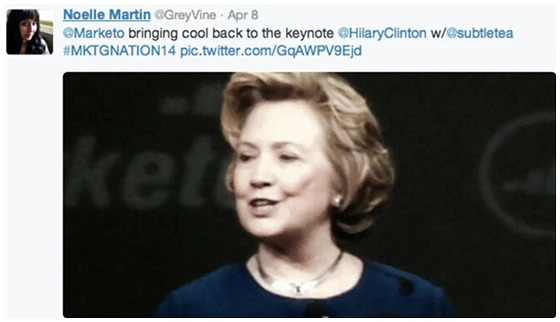
    Post Phil’s session, Hillary Clinton took to the stage. She spoke on a number of topics ranging from inclusion of women in the technology industry to the infancy of the internet and how innovation needs a certain level of risk taking.

    noelle

    Day 3 – April 9

    The last day of the Summit was not lacking in excitement. The keynote address was by Marketo CEO Phil Fernandez (again) and General Electric’s CMO, Beth Comstock.

    After Phil Fernandez announced Marketo’s Revvie winners for this year, Beth Comstock took center stage and spoke on innovation and rapid changes in marketing:

    • Practical innovation: It’s important to understand what people actually need and keep innovating to satisfy that need. Ideas don’t count unless something is done about them. The future has to be today…
    • Innovation does not end: How do you instill ambition and accountability in your company? Dream big and scale. The journey of innovation involves offering powerful outcomes.
    • Marketing is growing in power: Marketers are innovators and integrators. We need to be where the market is moving to. Marketing needs to be a vital function with a growth agenda.
    • Mind sharing: Join hands with others in your system, solve problems as a group and expand your company expertise. Marketers are incubators of new businesses.

    DJ Waldow from Marketo on Being Human

    Marketo’s Digital Marketing Evangelist, DJ Waldow emphasized the importance of the ‘human’ element in marketing communication with examples:

    • Email subject lines and copy: Make them humorous, conversational and creative.
    • Videos: Personalized videos that help establish a rapport between company and customer are great. Though they may not be scalable, you can try them for important prospects and customers.

    sam-khandelwal-3

    • Out-of-Office Replies: It helps communicate with your connections better if you’re more human.
    • Email opt-out landing pages: Instead of ultimatums, personalize landing page copy and offer unique options.

    Moz’s Cyrus Shepard on New Opportunities in SEO

    Cyrus said Google has been energizing SEO and the new changes in the field can be good opportunities:

    • Keywords to concepts: It’s the meaning behind the keyword that matters. You need to be contextually relevant to search queries.
    • Schema, markup and meta data: Google promotes sites that follow content structure, like authorship and reviews. The increase in CTR’s is beneficial and social annotations and data make searchers more attentive towards search results.
    • Web pages to awarding authority: Google is now moving away from blindly placing importance on web pages. The trend is to identify and reward experts who provide solutions through their content.
    • Links to endorsements: Google no longer cares about link building activities. Person-to-person endorsements are more important.
    • Page views to user satisfaction: Google measures bounce rate, time spent on the site, pages viewed per visit, shares, mentions etc. to understanding user satisfaction levels.

    sam-khandelwal-4

    Whew! That’s some heavy lifting! We do hope you’ve picked enough points of interest from this post…

    What was your experience at the Summit? We’d love to hear from you! Get in touch with us!

  • LinkedIn Builds On Content Marketing Ad Tools

    LinkedIn Builds On Content Marketing Ad Tools

    Image Source: Zach Zupancic via Flickr

    After its Influencers update, LinkedIn is continuing to focus on building tools that will increase its focus on content marketing.

    LinkedIn Content Marketing Score

    LinkedIn calls this tool as a ‘recommendation engine’ that measures your target audience’s engagement with your content and informs you about the extent of your impact. You can compare your performance with your competitors and see how you are doing. You can also measure your content performance across various LinkedIn platforms: Company Updates, Sponsored Updates, Groups, Influencer Posts etc.

    LinkedIn Trending Content

    You can now have your finger on the pulse of your audience’s content preferences. LinkedIn Trending Content tool will rank the topics that are popular with your audience. This will help you develop and modify content according to industry trends.

    Trending Content will display trending articles and topics that are ranked based on their engagement on LinkedIn. You can even see the particular audience segments that are sharing the most content about any topic.

    What it means for brands…

    You can target your content based on specific audience interests. While Trending Content will provide information about industry topic trends, it will also help in securing higher content reach with more shares. This is because Trending Content also shows data on audience segments that are sharing content, which will help in targeting only those segments that are most active in sharing.

    If you already have content on LinkedIn, score your current content and study the results. If you are not doing well, you can use the Trending Content tool and develop content based on trending topics.

    If you are starting out now, find out what topics are trending in your industry amongst your target audience. Build your content and strategy based on this.

    For more information on how you can bring Content Marketing Score and Trending Content together, you can download LinkedIn’s eBook.

    Tell us what you think about these two updates…

  • Online display vs. TV advertising, Social media impact on B2B buying process and much more…| Best of the Week

    This week’s hot news, events and videos from the online marketing and social media world.
    Despite Strong Growth, Share of Online Display Advertising Spend Well Behind TV
    From the Position² Blog This Week:
    Despite Strong Growth, Share of Online Display Advertising Spend Well Behind TV
    Online display advertising is a highly sought after form of online advertising and its growing at a strong rate. However, it is still not much compared to the growth of TV, a traditional media form. Read this article to know more.
    Top Stories this Week: Social Media
    Top Stories this Week: SEO, PPC and Digital Media
    Best of the Week Video Best of the Week Video
    Do you make your content simple or scientific?
    Google’s Matt Cutts answers a question on whether keeping your content simpler or including more scientific jargon in it makes a difference to your ranking. Check out this video to know Matt’s take on this.
    White Paper: Increase Visibility for Your Content by 4x
    Today’s traditional SEO is inadequate: Ignite your search results by accelerating visibility in more places than ever before.Download this White Paper and learn:

    • SEO, why the way we know it is not enough
    • Introducing and implementing Enterprise Visibility Accelerator (EVA)
    • Using multi-channel tracking tools for effective monitoring
    • How EVA benefits businesses.

    Download the complimentary EVA White Paper now

    Know more about Enterprise Visibilty Accelerator(EVA)
    If you are reading this blog post via a RSS reader, please click here to subscribe.
  • Matt Cutts Declares the Downfall of Guest Blogging for SEO

    Matt Cutts on Guest Blogging

    Image Courtesy: WebProNews

    Do a lot of bloggers want to write for your site? The phenomenon of guest blogging has caught web writers’ fancy and how!

    The benefits cut both ways…

    It was considered an honor to be a sought after guest blogger or a website so big that many credible guest bloggers wrote to you asking you to consider their articles.

    Guest blogging owes this popularity to bloggers and brands alike. Both were lured, in part, by the SEO benefits it offered. Some of the benefits of having a guest blogger are:

    Link building tactic

    For the guest blogger, it is a matter of pride to have posts on a reputed website. He also benefits from the back links to his blog. The website too benefits from the traffic arising via the back links of the guest author’s blog.

    Increasing engagement

    Guest bloggers offer different perspectives that may lead to their posts being liked, shared or commented on, all of which improve reader engagement and the blogger/website reputation.

    A way of content generation for websites

    Having guest bloggers write for them helped websites in reducing the pressure on their content development teams. It also gave them the chance to offer readers variety in their content by featuring different writers.

    Helps build a reputation for thought leadership

    Guest blogging aided websites and guest bloggers build their individual reputations as thought leaders in their industries.

    End of Guest Blogging for SEO

    The enormous benefits of guest blogging eventually led it to being overexploited to the point of becoming spam. Many websites and bloggers began hosting and writing guest posts to gain links without focusing on quality. So much so that, this practice led Google to make a move to end the practice of blogging for SEO.

    Matt Cutts, the head of Google’s Webspam team recently announced on his blog that guest blogging exclusively for its SEO benefits, must end. So if you were in the habit of accepting guest posts only to build links, you should stop doing that. Or, if you are a guest blogger writing for websites regardless of their credibility, you would be hurting your own reputation.

    Matt Cutts has called an immediate stop to the practice of accepting guest blogs that only serve the purpose of SEO. He gives the example of an email he received that actually hinted at offering links, which would pass PageRank! These kinds of practices would definitely not endear you to Google.

    So, unless you want to attract Google’s wrath and be penalized, stop guest blogging purely for SEO and do it for all the other benefits that it offers.

    Looking At the New Scenario

    Guest blogging for SEO is not going to work!

    So, what should guest bloggers and websites who accept guest posts do?

    Do you stop guest blogging altogether? Or, should you continue it by following certain rules?

    Of course you should continue. It is, after all, only the misuse of guest blogging that is under the scanner and not the practice itself.

    Here are some rules that you can follow when it comes to blogging for your website:

    • Look at guest bloggers as a means of generating great content variety and not from an SEO perspective.
    • Continue accepting guest blogs only if you can vouch for the reputation of the guest blogger. Be selective.
    • Sift through the blog requests for unique, good quality content.
    • Use guest blogging as a tool to bolster your content generation efforts. Don’t be so dependent on it that you rely only to fulfill content sourcing requirements.
    • If you are a guest blogger, be selective about sites you partner with. Don’t let your great content be undermined by poor quality websites.

    What are your thoughts on the current scenario in guest blogging and Google’s stand?

  • Overcoming the Struggles of Content Marketing

    Percentage of marketers using content marketing
    Content is a very important component of marketers’ strategies. Irrespective of the nature of campaigns being run, every marketer needs content to be a part of his store to inform, engage and convince viewers.

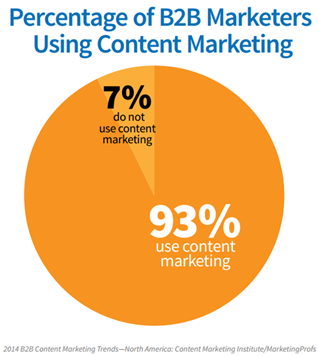
    Marketing the content that you develop is right at the top of the importance scale for marketers. Content marketing continues to shine as a priority area. This trend continues from 2013, when 91% B2B marketers said that they used content marketing to 2014 where the number of B2B marketers planning to use content marketing has inched its way up to 93%.

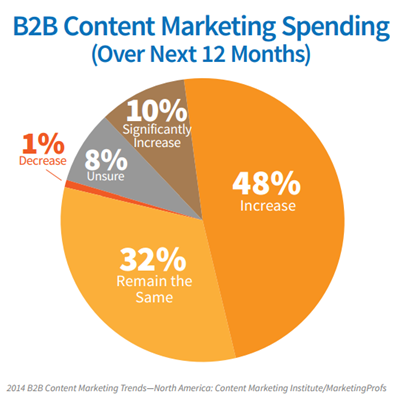
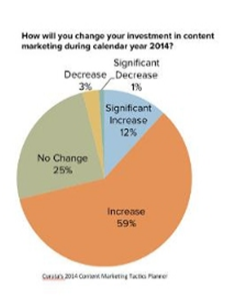
    In tandem with the increased usage, according to a recent Ad Age survey, 71% marketers are also spending more on content marketing in 2014. It’s important to note that this figure includes 58% B2B marketers.

    Despite such concentrated efforts, the above mentioned survey by Curata found that US marketers are floundering in content marketing waters. How do you counter these roadblocks in content marketing?
    B2B Content Marketing Spending Investment in content marketing

    Let’s look at some of the key issues (identified by the % of marketers facing these) and how they can be tackled.

    Contextualizing content (67%)

    Making sure the content that is developed is appropriate to the context in which it is being received is the biggest problem of marketers according to this survey.

    Solution

    • Use primary or secondary research to delve into your target audience’s minds and know what makes them tick. Also understand how and when they consume content.
    • Knowledge of audience demographics and online behavior are important factors in prepping your marketing campaigns for success.
    • Engage with customers to know them better. This will give you an idea of their deeper motivations that may not be revealed by basic research.

    Organizing content (63%)

    At 63%, organizing their content collateral is the second biggest hurdle for marketers.

    Solution

    • Organizing content is a matter of planning content flow so as to ensure that the marketing messages are being played out in a logical sequence to each audience.
    • This requires creation of a set content calendar to ensure that all campaigns go live at the designated time with the right content.
    • A clear content strategy serves as the backbone of well-organized content. A Content Marketing Institute survey found that only 44% B2B marketers have a documented content strategy!
    • 66% B2B marketers with a documented content strategy thought they experienced more success than those without (11%).

    Finding and discovering content (57%)

    According to an AOL and Nielsen study, 27,000,000 pieces of content is shared every day. That’s a really huge number! Finding and discovering content is this ocean is obviously difficult.

    Solution

    • You can use tools like blog topic generators that can line up topics suited for your business based on keywords you supply.
    • You can scout the web for trending topics from your industry and develop content that is relevant and gives you thought leader status.
    • You also can identify customer pain points that you can address through content. Even if you don’t have solutions it shows you to be thinking on the right lines. This will endear you to customers and show yours to be an empathetic brand.

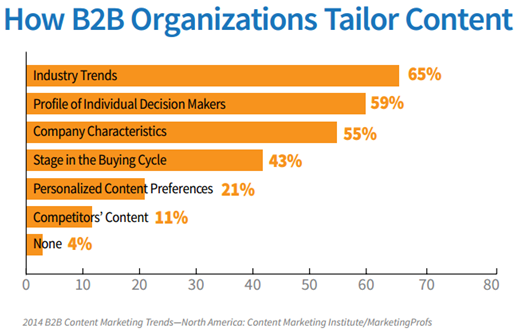
    How B2B Organizations Tailor Content

    Sharing content (52%)

    Sharing the content developed may rank as the lowest in the list of marketers’ content related problems however it is a significant issue with over 50% marketers saying so. After all, content distribution is as important as developing the right content.

    Solution

    • Identify websites that cater to interests similar to your website and share content there through tactics like white papers, webinar registrations, eBooks, best practices guides etc.
    • You can also use distribution tools like Position2’s EVA that not only distributes your content across relevant sites, but also provides the added benefit of content re-purposing.

    Are you facing any other content marketing related problems? Do you think there are any other ways to tackle the above problems?

  • Personalized Marketing – How Personal Should You Get?

    Personalized Marketing

    Personalized marketing.

    Though the name is pretty much self-explanatory, we would still like to define it because it is a significant aspect of modern marketing and deserves a definition. Simply put, personalized marketing is the breaking down of the mass marketing process to directly address the needs and interests of individual prospects.

    Why is personalized marketing so important?

    In the past, it was probably acceptable to a certain extent for marketers to send out generic communications. You would remember that personalized messages weren’t as common some years ago, as they are today. Generic communication to the entire audience suited everyone whether customers or marketing departments for no one knew or even could do any better.

    As consumers and technology changed, there was a need for marketing to become a lot more focused and cost-effective. Consumers began asking for their individual needs to be addressed and marketers had to measure up to the changing expectations.

    Increase in the amount of content

    This situation escalated with the onslaught of online content. The internet is an ocean of content and an average person receives more content today and from more sources than compared to a few years ago.

    Sifting through the entire content one receives, looking for information that is relevant, is not something that anyone looks forward to. In the midst of all this generic (and mostly irrelevant) content, people are on the lookout for communications that talks to them directly and offers to address their needs.

    Marketing is getting more personal

    According to research conducted in 2013, 74% of online customers said that they get frustrated when they encounter content irrelevant to their interests on websites.

    This goes to show that after being literally (or, should we say virtually) bombarded with generic content, consumers don’t want to be bundled with a crowd. They want personalized brand messages that are in line with their interests.

    But if you think that this mindset is restricted to brand messages, you’re wrong. Consumers want the entire marketing process to be personalized, sometimes including personalized products too. And while this is tough, marketers are figuring how to do this because it stands to deliver greater loyalty and higher sales.

    Benefits of Personalized Marketing

    Personalized marketing is also helpful in nurturing leads and retargeting campaigns. Talking to a lead about something that interests them about your brand will naturally capture their attention and result in better lead nurturing.

    With retargeting campaigns, targeting prospects with products/services they have already shown an interest in buying may prod them into actually making the purchase.

    But, but, but…how personal can you get? Doesn’t this personalization need to stop?

    Introducing personalization as early as possible and increasing it as far as possible is a great way to improve loyalty and effectiveness.

    What’s important, however, is that it should be done right.

    Do it right.

    Adopting an overly familiar tone with prospects just because you know their name or presuming that you know their requirements too early in the relationship can put them off. You definitely don’t want to get off the wrong foot like this. Nobody likes a smug presumptuous associate!

    However, as you gain more knowledge about the prospect, using this well to personalize your information, suggestion of products, etc. will help further the relationship. You can even use a marketing automation system to manage this if the volume of prospects is high. Mass personalized marketing as a concept is here to stay.

    We would love to know what your opinion is about personalized marketing. Drop your comments in the box below…