Category: Content Marketing

  • Position² Is Looking Forward To Content Marketing World 2015


    After the picnics, barbecues, games and other Labor Day celebrations, content marketers have Content Marketing World #CMWorld to look forward to, which kicks off on September 8th at Cleveland Convention Center, Ohio. Over 3500+ attendees, 225 speakers, 550+ organizations across industry verticals makes this the ‘go to’ event for content specialists all over the world.

    This mega event has something for everyone – 123+ key note sessions, hours of learning, networking and ideas exchange, insights, best practices and inside secrets.

    At Position2, we believe content is the master key for unlocking digital success. The following topics are top-of-mind for us:

    • Content creation in multiple formats – for multiple channels
    • Integrating the content marketing strategy with SEO, SEM and social media
    • Marketing automation integration
    • Capturing data and understanding the derived insights

    We are excited to hear myriad opinions, real-life examples and best practices at Content Marketing World.

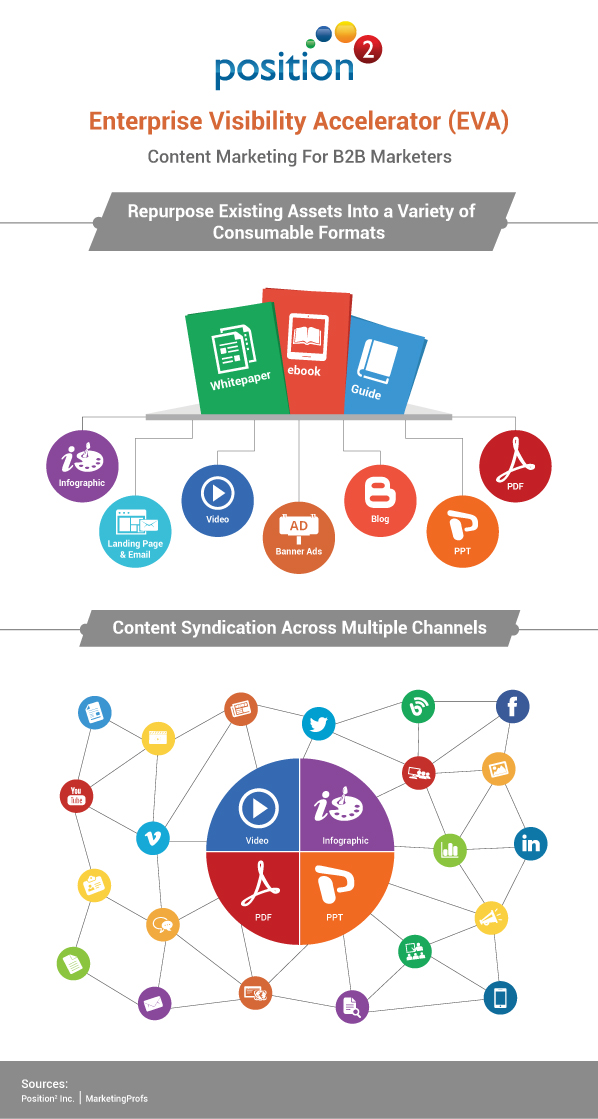
    We will be introducing our Enterprise Visibility Accelerator (EVA) solution for B2B Content Marketers. Enterprise Visibility Accelerator (EVA) is a process and framework that uses all of the company’s assets, re-purposes them into multiple formats, and then uses SEO and social media marketing to distribute them.

    EVA infographic

    Join Us At Booth: #37. Schedule A Meeting Here!

    P.S. We’ll be giving away our famous Position2 organic hoodies.

  • How To Optimize Content For Conversions

    If the content you create to captivate your target audience is filled with deep insights and captures attention with your expert grasp of the subject matter you will convert your audience to clients who willingly advocate your brand or organization by sharing your content – infographics, blogs, and social media posts. Follow the step-by-step formula in this blog to optimize your content for conversions.

    Step 1: Take a Tried and True Asset

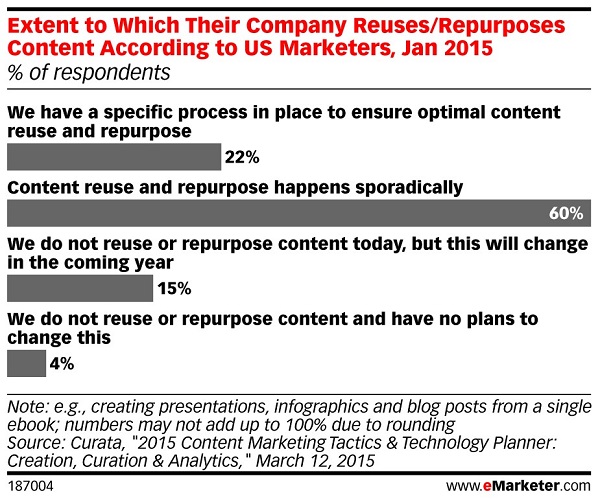
    Just 22% of US marketers have a specific process in place to reuse and repurpose their content. More often than not, marketers are sitting on a gold mine of unused content. A content inventory will help you get started. It gives you a clear picture of where existing content can be found, how well it performs, and what gaps remain unfilled.

    For example: A 20 page whitepaper created three months ago, can be repurposed into an infographic, PDF, a video with voice-over and a 10-slide powerpoint (TWEET THIS!).

    P.S. This blog is a repurposed infographic.
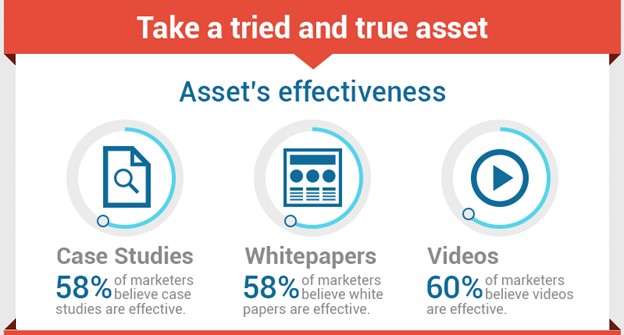
    Effectiveness of various assets

    Step 2: Create Multiple Compelling and Cool Looking Formats

    Great content can make a significant impact when repurposed across multiple delivery methods. Relevant portions from an eBook or whitepaper can be used both as blog and social media posts. Convert webinars into videos; create a blog post from the slide show.

    People respond to visual information better than plain text. A picture is worth a thousand words because everyone is naturally wired to remember images far longer than they will ever recall a clever tag line.

    Posters are one of the most effective types of visual content. Make sure to use a poster maker to create visually compelling posters that will leave a long-lasting effect on people.
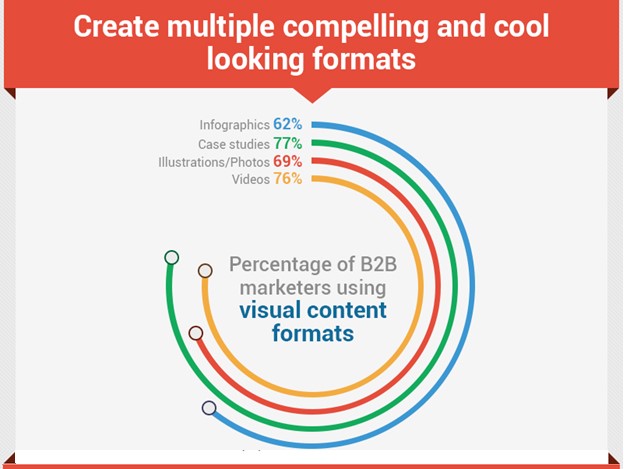
    Visual content formats used by marketers

    Step 3: Syndicate and Link Back to Your Website

    Even though you have created stellar content that is relevant to the needs of your audience, there’s so much competition and content it’s easy to get lost in the crowd. So double down. Submit your content everywhere: social media, blog directories, online PR websites, niche communities, forums and user groups for your products or solutions.

    Over a period of time you will see:

    • Increase in website traffic
    • Upward boost in sign-ups (newsletter, gated resources, contact us, etc.)
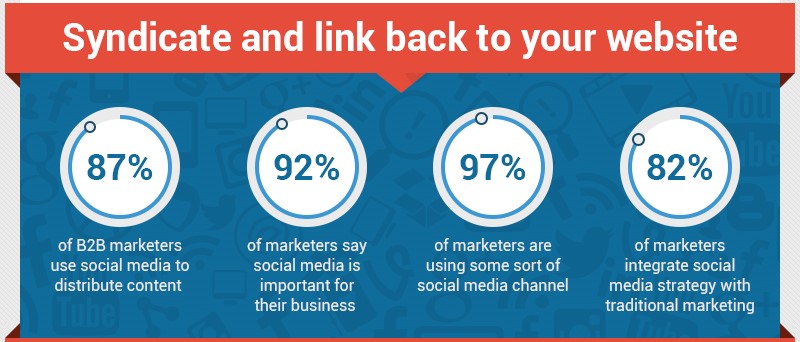
    Asset syndication platforms used by marketers

    Step 4: Build Lead Capturing Landing Pages

    Kudos! You are just over the hump and you are seeing a significant rise in your website traffic. But where is all this traffic going?

    According to MarketingSherpa’s Landing Page Handbook (2nd edition), 44% of clicks for B2B companies are directed to the business’ homepage, not a special landing page. Furthermore, of the B2B companies that are using landing pages, 62% have six or fewer total landing pages.

    MarketingSherpa cites the number one reason for landing page failure is a marketing department that doesn’t know how to set one up or a marketing department that’s too overloaded to get the job done. (TWEET THIS!).

    Ideally, every offer should have its own landing page. The user who clicks a specific post or link and gets to your landing page remains engaged with the same messaging, and that leads him to your call to action (CTA). The advantages of landing pages are multi-fold:

    • Landing pages help generate more leads
    • One offer = One Landing page: Gated offers are a crucial lead generation source in your marketing efforts
    • Capture information about your prospects and understand your audience better
    • Thank You Pages and Email Responders will help you close the loop with your leads in real-time

    Our verdict: The More Landing Pages You Have, The Merrier Your Numbers Shall Be!
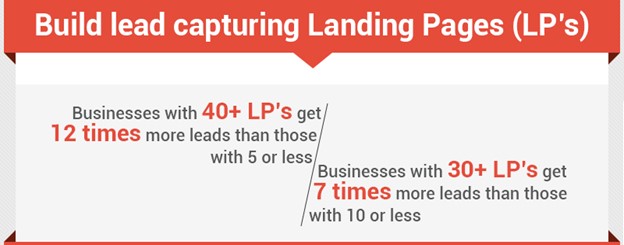
    Build lead capturing landing pages

    Step 5: Don’t Forget Your Tracking Codes

    If you cannot measure content, you cannot manage content. Decide on your KPIs and then measure all your content efforts against the baseline KPI numbers. Broad KPI areas to track for different types of content are:

    • Consumption metrics
    • Sharing metrics
    • Lead metrics
    • Sales metrics

    The process of content creation, distribution, tracking and analysis is an iterative cycle. You learn each cycle what your audience likes, and improve the process. The continual improvement results in enhanced lead quality, brand advocacy, happier prospects and loyal customers.
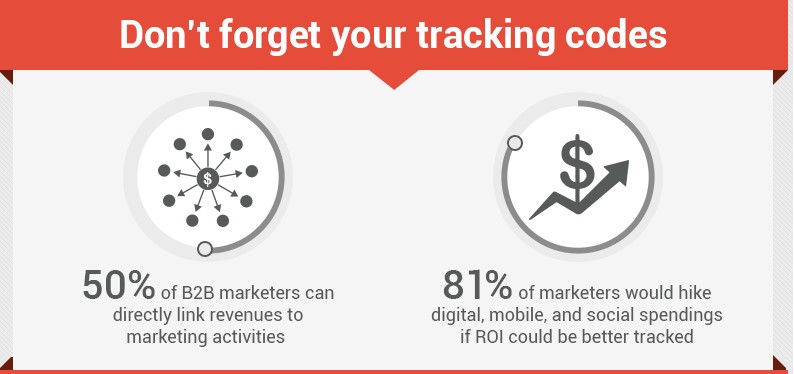
    Measure content with analytics tracking code

    Bravo, if your numbers are off the charts! If not, continue reading…

    Challenges Marketers Face

    Marketers face serious challenges when creating and implementing in-house a sustainable content marketing strategy. The 2015 B2B Content Marketing Trends—North America highlights the major challenges that B2B Marketers face:

    • Producing engaging content 54%
    • Producing content consistently 50%
    • Measuring content effectiveness 49%
    • Producing a variety of content 42%
    • Gaps in Knowledge and Skills of Internal Team, Lack of Integration Across Marketing and Budget were a few other challenges

    I Can’t Do It All – Outsource Content Marketing

    Creating a culture of capturing expertise within the organization and converting it into engaging content takes consistent time and effort. Bringing in an agency can help you fill some or all of the gaps in content strategy, content creation and distribution – right now.

    An agency partnership provides:

    • a different perspective
    • variety and diversity in skills
    • functional expertise
    • industry specific expertise

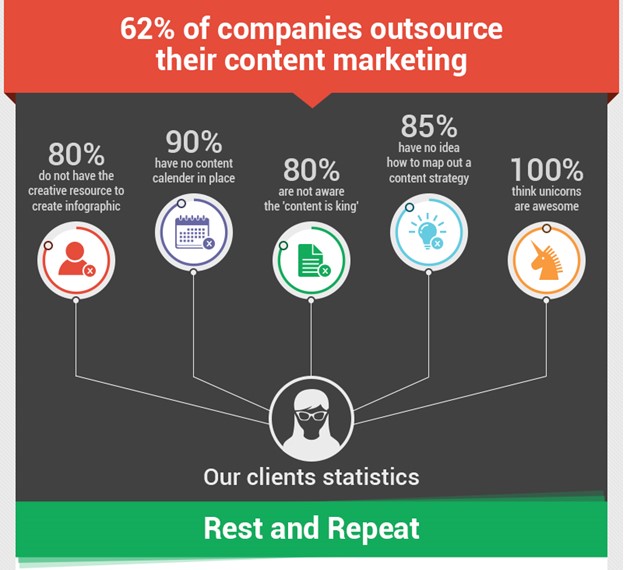
    Content marketing statistics

    “Marketing has changed more in the last two years than in the previous fifty.” – John Watton, EMEA Marketing Director, Adobe Marketing Cloud.

    Is your marketing organization equipped to take advantage of every opportunity and overcome these challenges? Let us know your thoughts on content marketing, the pain points, the best practices or how unicorns are awesome!
  • Do You Have A Content Marketing Strategy?


    You will find a good piece of content at the core of a successful email campaign. But that’s only one cog in the wheel. For an entire annual marketing plan to be a success you need a focused content strategy, something along the lines of what Michael Brenner has in mind in ‘What is Content Strategy and Why Do You Need it?’ on Forbes.com: “A content strategy flips the tables on traditional linear marketing by defining the process and then securing the right resources for producing a consistent stream of content mapped to buyer needs across all phases of the buying cycle. This is done for each buyer type or “buyer persona” that is involved in the B2B decision-making process.”

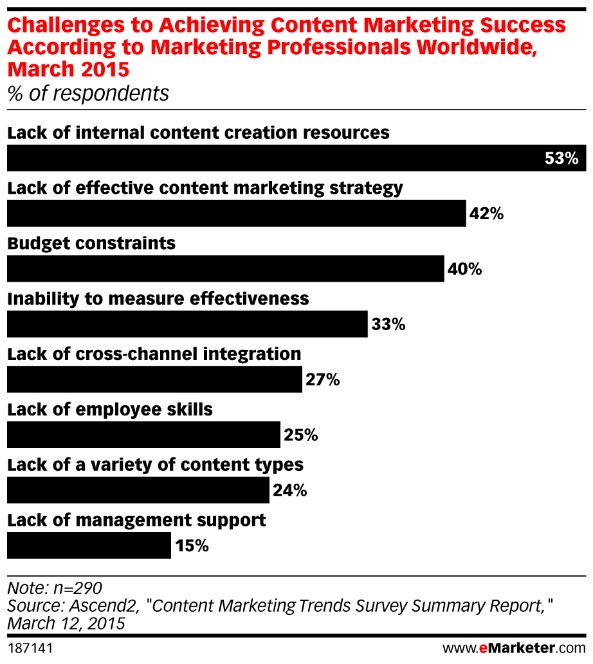
    If you think content marketing isn’t easy, you are not alone (see below). Marketers assume they face unpredictable challenges designing a sustainable content marketing strategy. And then they have to implement it. But it may not be all that daunting.

    Challenges in achieving content marketing success

    Beyond verbal: Why you need a documented content marketing strategy?

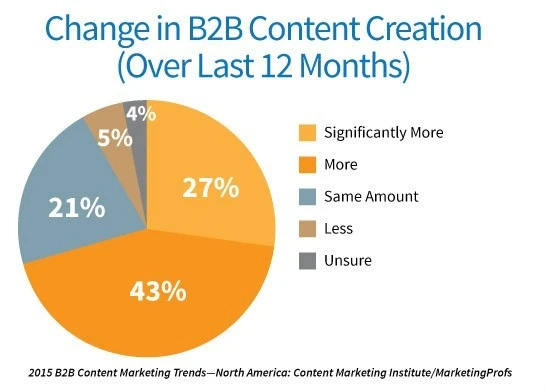
    Seventy percent of marketers say they are creating more content today than they did one year ago. That’s a quantum leap in both content creation and distribution. Marketers are learning how essential it is to have the right content, in the right channel, at the right time – every time a potential customer goes looking for an answer. Having a method to match the content creation madness helps marketers aim their energy, their money and, most crucially, their time in the right direction.

    2015 B2B Content creation trends for North America


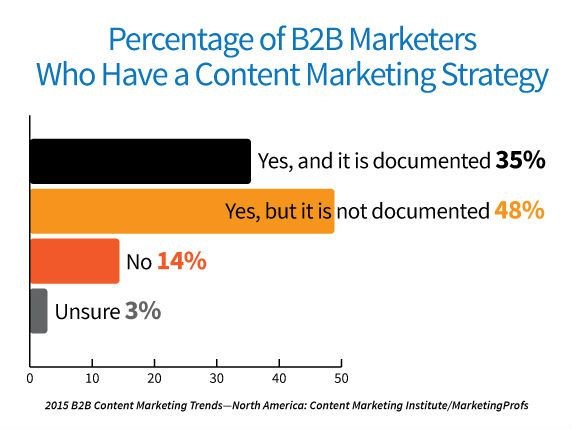
    Content Marketing Institute’s research shows that marketers with a documented content strategy:

    • Are far more likely to consider themselves effective at content marketing
    • Feel significantly less challenged with every aspect of content marketing
    • Generally consider themselves more effective in their use of all content marketing tactics and social media channels
    • Can justify spending a higher percentage of their marketing budget on content marketing

    Percentage of B2B marketers using content marketing strategy

    How to build a winning content strategy?

    You need to ask yourself a few questions before you start a deep-dive into the elements of your strategy:

    • Define your ultimate goals (traffic, sales, retention, awareness, etc.)
    • Define the target group that will help achieve your goals
    • Pinpoint where is the target group and who or what influences it
    • Establish the metric to judge the success of your efforts (links, shares, engagements, conversions, etc.)
    • Compare ROI with other marketing activities

    Once you have filled in those blanks, follow these simple steps for a well-rounded content strategy.

    Step 1: Do a content inventory

    More often than not, marketers are sitting on a gold mine of unused content. A documented content inventory gives you a clear picture of where your existing content can be found, how well it performs, and what gaps remain unfilled.

    Content reuse/repurpose trends


    Step 2: Start building a content calendar to fill identified gaps

    The content calendar helps you nail down the content type, tone, audience and publishing schedule. For example, a retail solutions firm, not only wants to produce great content for potential customers interested in, say, retail operation optimization but also for potential new employees who want to know how good a company they are to work for

    Step 3: Content is ‘King’; content promotion is ‘Queen’

    Decide how to distribute and promote your content. How long — duration — will you keep it published (limited time, indefinitely)? What’s the reusability across channels? Planning this will help you publish and promote the right content to the right channels.

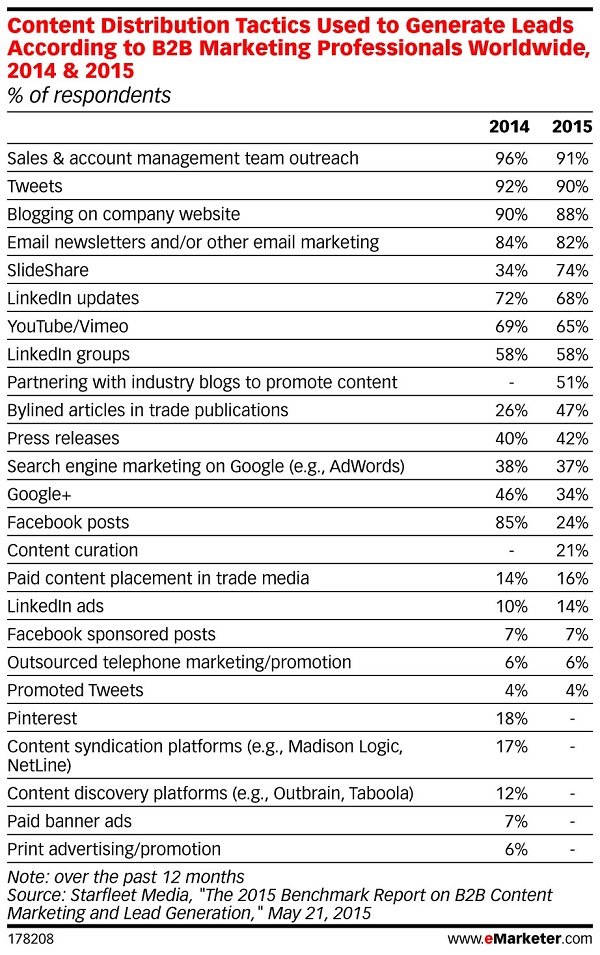
    Usage of content distribution tactics

    Step 4: Track and Tweak

    Track how your content performs across the distribution channels and which promotions pay off. Optimize your content with an analytic approach based on agreed upon metrics.

    Building and implementing a content strategy can be as easy as taking stock of existing content, filling in the gaps and then looking at the numbers coming in to tweak the content for the next round.

    We would love to hear your thoughts on content marketing strategy and execution. What are your pain points? What really works for you?

  • Crafting An Effective Call To Action


    Highly successful websites, landing pages, email campaigns and PPC ads all have an effective call to action in common. That’s a fact. It’s the CTA (call to action) button on your landing page that guides the users to goal conversion.  An effective CTA urges visitors to buy, subscribe, register, apply, download, vote, share, play and learn more.

    Here are a few best practices to help you improve on your CTA efforts.

    1. The CTA has to be aligned to the campaign objective

    Whether you are running a PPC campaign or an email marketing campaign, the CTA has to be perfectly aligned to your core objective.  Using the right text makes all the difference.

    One study showed that using first person increased conversion rates by 90%.  A simple “My free trial“ instead of “Your free trial” made all the difference.

    Use action oriented text, not the usual “Download here” or “Get Started Here”. If it’s an invitation to visit a video page, limit the CTA to Watch Now, not Learn More. If it’s a loan application, use Apply Now.

    2. It pays to tell them—clearly & loudly!

    Not every visitor to your landing page will a button presser be.  Those inclined to press the button need a clear cut call to action telling them to “just do it”.  The study quoted above found that simply adding “now” to the copy resulted in a nearly 30% improvement in conversion rates. “Now” – Buy Now. Subscribe Now.

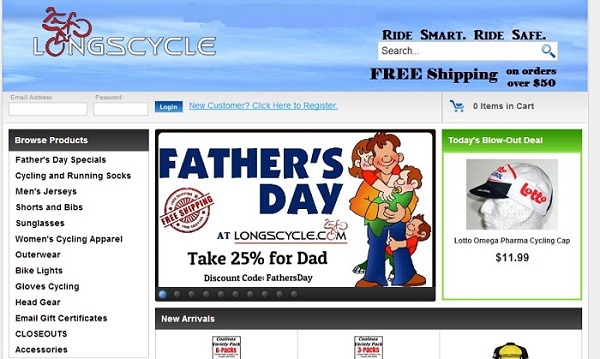
    A good example of using “Now” in the CTA:

    CTA

    3. Make choices clear

    Emailer buttons are meant to be clicked.  So it is imperative that CTAs are clear and compulsive.  Do not clutter the copy with a maze of options. Simply show the way. If there are multiple objectives and communication assets, create more than one campaign or landing page, each with its own CTA.

    The perfect example of what not to do to a customer:

    CTA2


    4. Value delivery or click triggers

    Not many visitors will click on a PPC ad or banner stating the obvious or obviously exaggerating “facts”.  A CTA like Try It Free For 7 Days will always sound more credible than You Need To Try It To Believe It.  Show value by stating facts and focusing on user benefits. A confident visitor will take immediate action, so encourage that. Additional information — called a click trigger — provided near the clickable CTA button or text can be beneficial. Click triggers include:

    • Customer testimonials
    • Product benefits
    • Recognition
    • Short term incentives

    5. Placing it right and making it visible

    Websites, landing pages and e-mailers have different ways of presenting calls to action. Many effective communication assets present CTAs above the fold where almost 80% of visitors spend time. Color and design are of equal importance.  Maximize the use of white space around the button to highlight it. Use contrast and flow to good effect.

    Good button design is imperative. “In your face design” is not to anyone’s advantage, depending on the product and target audience. Placement and prominence are the keys to high call to action conversion rates. The bottom line is engagement.

    An example of flow, design and contrast:

    CTA3

    6. The look and feel matters

    Design a call to action button that’s both interesting and inviting. It should stand out and grab the visitor’s attention. Try some relevant embellishments (like an arrow pointing to the button) or animations (CTA and click trigger on the same button). More breathing space and button text in large fonts attract attention. Never forget to place alt tags for email buttons, or convert them into complete text, so the call to action never gets missed even if the images don’t load.

    CTA4

    Last but not least, run tests to understand what works or does not.  Do A/B testing and retain what works.

    Here’s wishing that your CTAs keep converting! If you want to know how we integrate calls to action to create high converting marketing assets at Position2, drop us a line.
    And if you have any new CTA ideas, please share them here for the benefit of our readers.

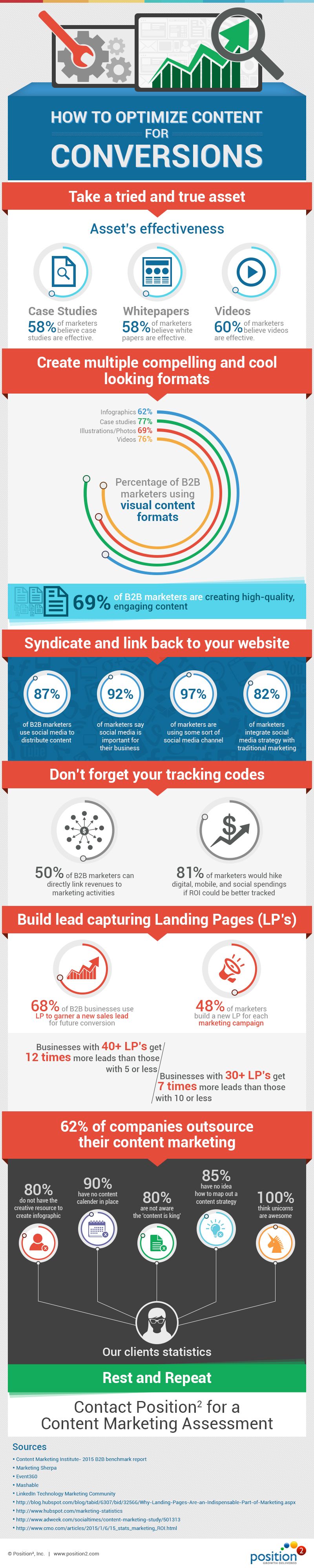
  • How to Optimize Content for Conversions [Infographic]

    Content marketing powers your online visibility and conversions. It is essential that you have your digital content across multiple channels in multiple formats. Asset creation, optimization, distribution, reporting, and tweaking are the important steps in your content marketing endeavor. Learn more in this incisive infographic now.

    How-Optimize-Content-For-Conversions-Position2-Infographic

  • Content Marketing Trends in 2015

    Over 35,000,000 distinct units of content were shared on a daily basis in 2014.  As staggering as that may seem, 2015 promises to  be even bigger. Now’s the time to look at the content trends likely to appear in 2015, and plot your marketing course accordingly.

    content-marketing-trends-2015

    Current Marketing Trend

    Social Media Marketing and Blogs on Top

    Today most marketers promote their content on social media sites, and for good reason. Clicks, shares, and views from social media sites are five times more likely to be shared.

    The Prediction: This year we’ll see content marketing efforts push beyond social media and spill over into webinars, case studies and other relevant content platforms. These efforts deliver more value, brand awareness, backlinks and discussions than just a simple social share.

    1. Businesses will finally get involved in content creation

    Nearly all marketers now factor content marketing into their overall marketing plan, and 45% of B2B marketers report having a content strategy in place. They understand how social media and content marketing line up with each other. They understand that content marketing is all about story-telling. Make this the year you generate high quality engaging  multimedia content. Customers respond to visual content and remember it better.

    For help planning a content strategy for your business, see the links below:

    1. Content marketing targets engagement and brand awareness

    According to the Content Marketing Association, brand awareness and engagement are the leading marketing goals for 2015. To build better brand awareness develop regular posting schedules, speak with a consistent voice and share the kind of content with groups that functions like free publicity.

    In 2015 expect to see a deeper focus on brand awareness and engagement as content marketing assumes a more natural approach.

    1. Get ready for the content marketing visualizations boom

    Neil Patel of Crazy Egg and KISSmetrics says that content marketers should be ready for visualizations in 2015 and move beyond basic infographics. Neil suggests that 3D infographics or animated infographics work to your advantage, adding a “wow” effect that generates more shares and likes.

    To learn more about infographics check content marketing infographics for 2015

    1. Calculating content marketing ROI

    In 2015 you’ll see content gaining more traction in terms of lead generation, and lay a new groundwork for the future of content marketing. Content marketing platforms will become fully integrated with customer records and customer relationship management.

    For tips on how to improve digital marketing ROI see tips to improve digital marketing ROI

    1. Smart marketers prefer thought leadership

    Don’t just present content. Add value. From shares and tweets to blog posts to whitepapers, have a well-defined plan to engage with the consumer. Always ask the question,”Will our clients and prospects find this content valuable?”

    1. Content marketers wake up to email marketing

    There was a time when you could offer a company newsletter via email and that was enough to build and grow your list. Email marketing has been used as a distribution channel for existing content such as blog posts, and to promote paid products and content to subscribers. All that has to change.

    In 2015 marketers need to get really smart about the kinds of email marketing content they want to produce and develop engaging ways to promote it.

    1. Conquering content on mobile

    In 2015 there is no longer any debate about mobile. Everyone will be investing in the space. So it is essential for content marketers to develop mobile-friendly content for customers. The health of their brand depends on it. It’s a problem that needs adressing. While 41% of respondents confirm that up to half of their subscribers open emails on mobile devices, only 42% of vendors admit they rarely employ a mobile-friendly design in their communications.

    There’s a big disconnect between what marketers know they need to do, and what they’re actually doing. Look for that to change in 2015 because it’s a change or die situation.

    2015 to-dos

    • Make responsive connections with your prospects
    • Build brand awareness
    • Increase commitment

    What ups and downs or trends do you predict for content marketing in 2015? Please Share your insights below!

    Contact Position² to establish a B2B content marketing strategy now! Happy Blogging!!!

  • Content Marketing 2015 [Infographic]

    Today relevant, insightful and highly useful content can no longer be sidestepped in your digital marketing campaigns. A stellar content marketing deployment will separate the men from the boys of the digital arena, come 2015. Here’s a primer of all that you need to know in order to have a successful content marketing strategy. Go through the incisive infographic now.

    content-marketing_infogra

  • Evolution of Content Marketing

    We trace the shift in the approach to marketing with higher than ever emphasis on “creating meaningful experiences” for the audience.

    Global Content Marketing

    The traditional content marketing was very limited in ways of reach and effect. Content marketers traditionally ‘push’ what they have, to potential customers rather than what potential customers demand. Majority of the websites in the past are example of this traditional content marketing where content was deployed using a single common language (usually English) for visitors across the globe.

    • A single website is developed online for the entire targeted areas to advertise or show all the available products, services and information
    • The content is created without any targeting for specific geographies or regions
    • The intent of the content is not customized to suit specific potential customers
    • The tone of the content seems like a one-way communication

    The traditional content marketing was just like a seller offering what he had, not what the buyers needed or demanded. The dissemination of information was straightforward and limited.

    Geo-based Marketing (Localization of content)

    Globalization influences the reach of content. With business expansion and scattered target audience, a single website is not the best solution to market to the whole world. Marketers realized that whatever content they marketed was to be understood by specific sets of target audience and hence had to be tailored accordingly – which is Localization of content based on the Geography.

    The whole information is translated and modified to suit each targeted consumer in terms of local preferences, languages, products and services demanded. Marketers realized that the perception of their website adversely affects the acceptance of their products in those geographies where content has not been localized and optimized.

    Coupa Software was in its rapid 120% growth stage with customers spread across 40+ countries. It had 150K+ users of its services in over 140 countries who used 20+ different languages. Coupa had no bandwidth to localize their marketing campaign to suit every specific region. But with the help of Cloudwords, a translation and content localization company, Coupa Software has managed to localize their products, thus, attaining a higher click through rate from the same audience. This audience now brings more than 50% higher conversion rate.

    Personalized Content Marketing

    Approach to content marketing has shifted from a global audience to local to a more individual level. The localization of content has been filtered further to a more accurate target. This involves real-time personalization of content.

    Personalization means identifying a person’s attributes such as potential, behavior, profile etc, and customizing their experience by presenting them with relevant content, call-to-action or visuals. Personalization can be B2B or B2C and has a unique process consisting of Who (target audience, potential, profile), What (content, case studies, videos, assets) and Where (website, email, mobile, ads).

    What personalized content marketers do is that they track the overall behavior of an individual engaging with the content. User preferences, likes, navigation history, pages navigated, sections of the content viewed and other such data is collected by the content marketer. The more the visitor frequents the website, the more personalized the content gets with every new visit due to his previous interactions. The content is generated based on the visitor’s profile like location of access, time, source, form factor, et al. This way the visitor is served when he is most interactive and engaging optimally with the website and its content.

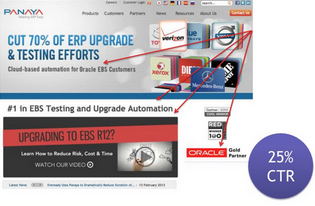
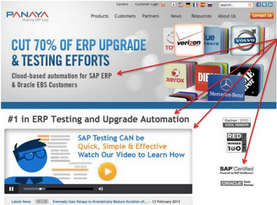
    Take for example, Panaya has a visitor from a particular IP address who browses through the content and clicks on some link. In the first visit, the user is served a normal web content that Panaya offers to all visitors.

    Position2- An example of Panaya serving users with real-time personalization of content

    Based on the pages visited and the sections of contents read by the visitor, Panaya served a different content to the visitor when he returned back to the site. This highly personalized content marketing strategy is likely to boost conversion because the visitor has been served with content that he wants from the website.

    Contact Position2 to learn more about personalized content marketing

    How does Personalization help you?

    • It creates a meaningful interaction by serving the right content
    • It educates and nurtures top-of-funnel prospects
    • It optimizes budget and lowers cost per lead
    • It improves site performance, analytics and content consumption
    • Extends marketing automation reach
    • Turns anonymous prospects into qualified leads

    Contact us to learn more about personalized content marketing.

  • Effective Ways of Measuring Your Content Marketing Efforts

    Did you know that 92% of companies that blogged multiple times a day acquired customers via their blogs this year? It is time to take full advantage of this content marketing craze by reaching out to your customers with the right content.

    The Rise of Content Marketing

    All Google updates have led to one conclusion by SEO experts:  Content is King. It all started in 2011, when the search query “content marketing” began its rising trend, and has now grown to be extremely common. Creating quality content for your business has major benefits for your search engine optimization, social media marketing, and your company’s overall branding.

    What is Content Marketing?

    Content Marketing is the new way to get higher search rankings and increased sales by creating useful, informative content that is appealing both to your target group and also to Google and other search engines. The motive is to attract, obtain and engage a clearly defined target audience in order to drive profitable customer interactions.

    By answering the most frequently asked questions with respect to your content, your company can become the most credible resource for your domain and gain new leads that convert to customers in the long term.

    About Position²

    Image Source: Iciweb

    What types of content should you create?

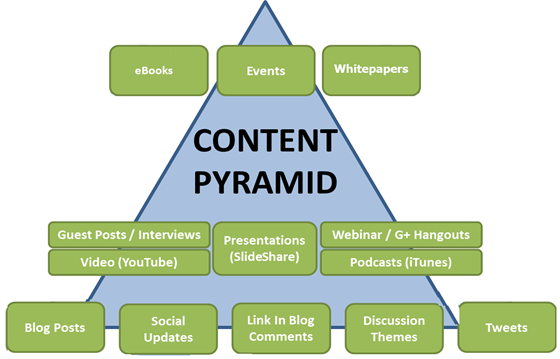
    If you are looking for opportunities to generate more results from your marketing efforts, you need to look at establishing a content marketing strategy. This Pyramid highlights a variety of different types of content that need to be taken into consideration:

    content marketing strategy pyramid


    Content Marketing: Parts as a whole

    1. Creating Valuable Content: Content needs to be created for your audience with the objective of informing and educating them, by simultaneously boosting your credibility and connections with consumers. This can be done in the form of articles, eBooks, press releases, white papers, blogs, webinars, posts, infographics, etc.
    2. Distributing that Content: This unique content needs to be then shared with users through social networking websites, blogs, through e-mail marketing and other platforms where your viewers are active, provided your content is suitable for that particular platform. Once your content strategy has been recognized, metrics need to be defined in order to accurately measure and monitor your success.

    Take a look at metrics to effectively measure the content marketing efforts:

    1. Brand Lift: “Brand lift” is the blanket term for a brand’s increase in customer or audience perception. This is a concept that has its roots in online advertising (brand advertising, to be more specific) and refers to an increased awareness of the brand (product, or contribution), attitude (view on quality, value and appeal), recall (ability to evoke), favorability (likelihood to recommend), and intent (likelihood to purchase)-all of which can be a challenge to measure.One way to measure the rise or fall in the sentiment of your brand in the long run is through social media. Once we have a plan in place, we create content that promotes your brand and conveys your expertise, distributing it over the right channels to ensure effective placement. When highly consumable content gets published in front of your target audience, you can begin to gain authority and thought leadership in your industry. Increased authority in your space not only helps to retain customers, but also generate awareness and trust in your brand. This creates an organic sales funnel that can dramatically increase conversions.Ultimately, this increased inbound traffic improves your overall branding.
    2. Social Media Success: This is a metric that allows you to better understand where the social traffic is coming from. By observing the gross amount of social media success, your business will be able to understand what type of content was well received, on what platforms and by which users. It also helps explain how these social actions are affecting your other marketing channels too.The “social media content” widget looks at how many “social actions” were taken while viewing your content. These can include:Interactions – Likes, Comments, Shares, Replies, Retweets, and so on.Reach – The percentage of fans that have seen your post from your page.Engagement Rates –A formula for quantifying a brand’s success.This is a valuable performance measure, as it displays that visitors didn’t just passively leave the web page open for an extent of time, or click through to other web pages because they were bored. It shows that they actually appreciated your content enough to share it within their network.
    3. Onsite Engagement and content effectiveness: Once traffic is driven to your website from the variety of content that has been distributed to your audiences, the hope is that this effort will drive repeat traffic to your web site. The metrics in Google Analytics helps measure whether the content you’re creating is engaging enough to draw traffic to your website from the search engines. This allows you to make two conclusions about those pieces of content that are attracting a lot of readers and giving you a lot of their time.Firstly, that content is building relationships by compelling readers to return. Secondly, that valuable content is creating an increase by facilitating repeat exposures.This is a valuable way of determining if your content marketing efforts are driving real value to your business. If your content efforts are often the most viewed part of your website, it might be safe to say that your audience is finding value and that you are educating them on a particular expertise.
    4. Google Analytics audience Widget: Google Analytics is a collection of widgets that allows you to quickly visualize your data. The audience related widgets on the Google Analytics dashboard provide information about viewers. The visitor’s pie chart gives an idea of the number of visitors that revisited the website because they found well optimized content in search engines.Some of these are:“Content behavior metrics” Helps to determine the number of new/revisiting users. Also helps to check whether the content you are creating is engaging enough to draw traffic to your website or not.“Site Content metrics effects” Shows the website’s ALL/ landing pages performance metrics which helps in determining which page content played an important role to get the visitors on the website.Lastly, “GEO metrics effects on content strategy” shows you where in the world your visitors are from. You can use this data to improve your content in all kinds of ways, such as:‘Visitor Language usehelps in optimizing multi-language websites.Location area’: helps to determine the place / nearby places of the visitor, hence it can be helpful in optimization / filtering the content related to location.By using Google Analytics we can measure the content effectiveness using real data. It is always helpful to see what is effective and to avoid what is not.
    5. Lead Generation: One of the most valuable metrics to monitor when it comes to your content marketing efforts is if lead generation efforts have increased. Lead generation is important because leads are the most likely people to convert and make your business revenue grow. This is where we start determining whether the content marketing efforts are making financial sense.When a visitor signs up on a website, he/she enters his/her contact information to have access to exclusive content created by the company about business. This visitor is a new lead who can eventually become a paying customer. It is important to measure the rate at which leads are being generated from the website content to see what type of content is working to get more traction from your web visitors.Successful content solicits a certain response from your target audience. For instance, taking advantage of a special gift or promo being offered and filling up information sheets that converts visits into leads.
    6. Conversions: Consumption is the most basic and most measurable type of metric you can use to measure content marketing success. It is straightforward and deals with real figures and statistics. It states how many people actually consumed your content. Google Analytics, Website platforms and social media insights already have these tools available for you to use and the only thing left for you to do is use them and gain better insights about your content consumption. Content marketers and conversion optimization professionals have a glorious collaboration ahead.
    7. Thought Leadership: Content marketing can describe a business as being an expert or a thought leader in an industry which can lead to many invaluable benefits. Becoming a thought leader and a trusted source of information will gradually gain more traffic, follows, and subscriptions, leads, and conversions over time. Social signals get a boost when website owners refer your work and when social media followers share the content. Take a step back and observe the media mentions of your content, if other thought leaders refer to your content, if the media is requesting for your contribution on certain topics or requests the leaders to speak at business events.Look at how your content is performing and helping you to position your company as a thought leader. By becoming an industry known expert, your content could continue to gain more traffic, follows, subscriptions, leads, and conversions over time. Overall, there are several ways to measure the performance of content marketing strategies.What metrics does your organization use to measure your content marketing? How often are you analyzing the results of your content strategy? I’d love to hear about your experience with your content marketing strategy. Share your thoughts in the comments below!

    Blog contributed by Anu Gupta, SEO Analyst, Position