Category: Content Marketing

  • Why High-Quality Content Systems Are a Game Changer for Technical B2B Companies.

    How a thoughtful content system transformed the digital experience for a materials testing company.

    For companies that provide advanced technical services such as materials testing, analytics, or engineering support, your content is more than just information. It is often the first way customers experience your expertise, helps them choose the right service, and can be the reason they decide to contact you.

    But many technical B2B companies struggle with the same challenge:

    A disorganized website, unclear messaging, and content that fails to assist users in making informed decisions.

    This was the case with the materials-testing company we collaborated with. They had useful information on their site, but it wasn’t organized in a way that would assist the different Persona types. The result? Lack of attention, poor interest, and lost conversions.

    A high-quality content system changed everything.

    First, What’s a Content System?

    A content system describes the strategic, repeatable structure for how a company develops, manages, delivers, and preserves content within its digital ecosystem.

    Rather than posting pages and blogs when needed, a content system will ensure:

    • Every page has a clear purpose.
    • Content is mapped to real customer needs.
    • The site is easy to navigate.
    • Users at different levels of expertise can find what they need.
    • Content supports the entire marketing funnel – from awareness to decision.

    For technical B2B companies, this is not optional. It’s a competitive advantage.

    The Personas That Shaped the System

    To create the right content structure, we identified three main personas. Each one has a different level of technical knowledge and different expectations.

    1. The Expert (PhD-Level Researcher)

    Highly technical; knows exactly which technique they need; wants depth and accuracy.

    2. The Informed but Uncertain Mid-Level Scientist

    Understands materials testing but requires guidance on selecting the most suitable technique.

    3. The Novice

    Knows the problem they want to solve but needs simple explanations and directional help.

    A successful content system must support all three simultaneously. That became the foundation of our redesign.

    Key Transformation #1: Intuitive Navigation

    The original website made users hunt for information.

    Our new organization of the navigation was based on a simple rule:

    The right information should be available to the user in three or fewer clicks.

    This entailed rational categorization of services, simpler labeling, and an easy route for users from novice to expert.

    Key Transformation #2: A Brand Identity That Reflects the Service

    The redesigned logo centered on electrons, forging a visual connection between the brand and its core strength: advanced analytical techniques for material testing.

    This change went beyond a mere aesthetic update, establishing a cohesive visual narrative and significantly enhancing brand perception.

    Key Transformation #3: Technique Pages That Educate and Convert

    The original technique pages were completely reconstructed, featuring clear and organized sections that covered the following key areas:

    • Definition: What the technique entails.
    • Problem Solved: The issue addressed by the technique.
    • Visuals: Images of the necessary equipment.
    • Results: Examples of the output.
    • Applications: Typical use cases.
    • Target Audience: Guidance on who should select this specific technique.
    • Comparison: How it stacks up against alternative options.

    The content should cater to three distinct audience levels:

    • Experts: To satisfy their need for in-depth information.
    • Mid-level Scientists: To help them make well-informed comparisons.
    • Novices: To clearly explain the fundamentals without causing confusion or being overwhelming.

    Key Transformation #4: Smart Content Mapping to Resources

    We transitioned from isolated pages to an interconnected content ecosystem.

    This system ensures that each technique is now linked to:

    • Relevant case studies
    • Webinars
    • Blogs
    • Application notes

    This helps users naturally transition from learning → to evaluating → to deciding, thereby improving both user experience and funnel performance.

    Key Transformation #5: Humanizing the Expertise

    The core stakeholders were categorized into three groups:

    • Executives
    • Operational Experts
    • Technical Specialists

    Showcasing the actual people behind the service is a strategic move to build confidence. This is especially vital for companies whose success hinges on precision, accuracy, and scientific integrity.

    Why This Content System Is a Game Changer

    A well-structured content system goes beyond mere aesthetics; it is crucial for enhancing performance across the entire funnel.

    Top of Funnel- Attract and Educate.

    Novices and mid-level scientists can easily and conveniently understand it clearly It leads to higher-quality traffic, more visits, and greater activity on resources.

    Mid Funnel — Influence & Compare

    Technique pages, use cases, and mapped resources help users evaluate the right options with confidence.

    This lowers bounce and improves lead quality.

    Bottom Funnel — Build Trust & Convert

    PhD-level researchers and decision-makers are assured by expert-level content, stakeholder profiles, and breakdowns of techniques.

    This shortens decision cycles and increases conversion rates.

    The Real Win: Content That Works for Everyone

    A high-quality content system not only organizes information but also directs, teaches, and helps users at different levels of expertise.

    For technical B2B companies, this is what sets leaders apart from everyone else.

    When your content system works:

    • Your website becomes a decision-making engine
    • Your users feel understood
    • Your brand stands out as a trusted expert
    • And your conversions grow naturally

    Content That Builds Trust Before the Initial Conversation

    The ongoing transformation points strongly toward a significant evolution: as you improve your customer experience, you also improve your content system.

    You turn complexity into clarity

    You turn expertise into accessible value

    And you turn your website into a place where every audience, from novices to PhD-level researchers, feels supported

    In the case of technical B2B firms, building customer confidence is at the centre of this

    It’s how you establish your brand’s voice, showcase your expertise, and build customer confidence before they even contact you.

  • Why UI and UX are crucial for SEO?

    UI (User Interface) and UX (User Experience) play crucial roles in SEO (Search Engine Optimization) because they directly impact user engagement, website performance, and overall user satisfaction. A website with a well-designed UI is visually appealing, easy to navigate, and provides a seamless browsing experience. This encourages visitors to stay longer on the site, explore its content, and engage with it, which signals to search engines that the website is valuable and relevant.

    Beyond Content & Links

    Search Marketers are right when they say content is ‘King’ regarding Search Engine Optimization (SEO). While we are busy generating quality content for our target audience, there is another aspect that we tend to overlook completely.

    You must have guessed it by now. It is the aspect of how content is presented to the readers. We are referring to UI/UX (User Interface/User Experience), an integral aspect of promoting content on the web.

    With the inclusion of recent updates like Hummingbird, Panda, Penguin, Pigeon, and hundreds of other Google algorithms that are being tweaked regularly, it becomes critical to know how users react to the website User Interface. The experience that the visitors go through definitely counts regarding how we perform on Search Engines, with special emphasis on Google!

    As a webmaster/marketer, it is essential to understand how users react to your website. Are visitors spending ample time on the website? Are they finding relevant information with minimal clicks? Are they taking desirable actions? Why are they bouncing off the website? Can the website drive visitors to the right content/sections and encourage them to take action after that? – While there are many questions to ponder, the simplicity behind having a great website is to have helpful content and enhanced UX with a well-laid-out UI.

    SEO

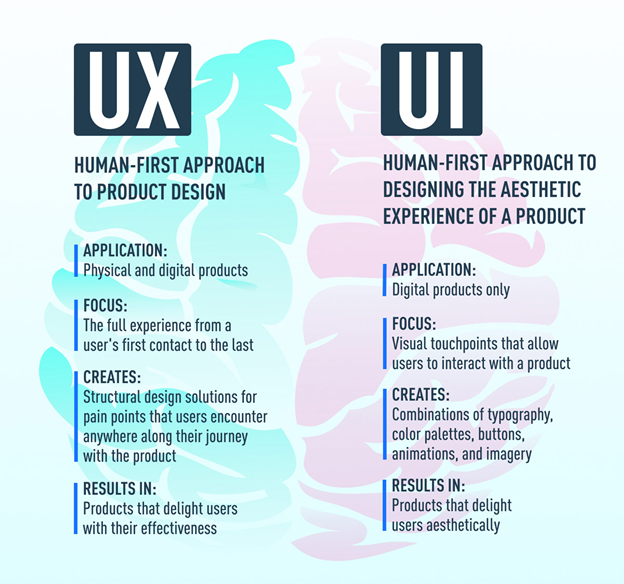
    What are UI and UX

    What are UI and UX

    User Interface (UI)

    UI refers to a website’s visual and interactive elements, including buttons, menus, and other graphical elements that users interact with. The UI creates an intuitive and user-friendly interface that allows users to navigate and interact with a website easily.

    User Experience (UX)

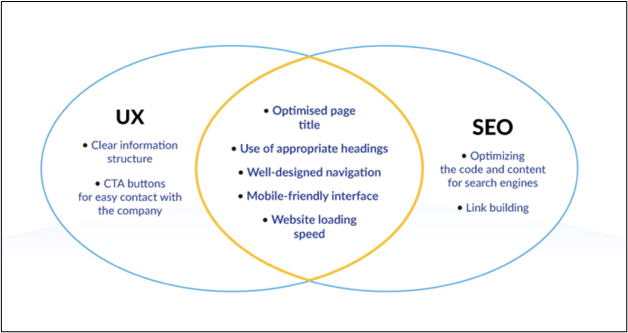
    UX, on the other hand, refers to a user’s overall experience when interacting with a website. This includes factors such as site speed, ease of navigation, and the quality and relevance of the content. A good UX design aims to create a positive and engaging user experience, which can lead to longer session durations, lower bounce rates, and higher conversion rates.

    In short, UI and UX are important aspects of web design that create a positive user experience.

    Impact of UI UX on SEO

    Impact of UI UX on SEO

    UI UX both have a significant impact on SEO. A website with good UI and UX design can increase SEO rankings, traffic, and user engagement.

    A good UI design can improve a website’s SEO by making it more user-friendly and easy to navigate. This can lead to longer session durations, lower bounce rates, and higher click-through rates, all important factors that search engines consider when determining rankings.

    Similarly, a good UX design can improve a website’s SEO by creating a positive and engaging user experience. This can lead to more social shares, backlinks, and other signals that search engines use to determine the relevance and authority of a website.

    1. Teamwork: SEO + UI/UX

    SEO is the medium to drive traffic, while UX/UI creates the first impression. Both work in tandem to ultimately serve the user’s intent and hence conversions on the website. It is that bit of Creative effort which aids in boosting conversions.

    matts cutts

    “…If you don’t have search engine optimization, it’s harder to be found. If you don’t have end-user optimization, you don’t get conversions… you need to have both…Try to see them in tandem (i.e., Search Engines and End Users) …Your users’ interests and the search engine’s interests are always aligned….Hence you need to view them as one unit. .”

    SEO and UI/UX play a significant role in where the path (SEO) leads to the destination (UI/UX). What happens on the web page is our real goal or concern (conversions).

    We should know that SEO exists due to dynamic Search Engine algorithms, and hence fundamentally, it plays the role of a latent follower when optimizing a website for search.

    Google Hummingbird, Panda, and Penguin updates are now meticulously weeding out sites that don’t meet the basic content standards, design (UI/UX), utility, relevance, and speed.

    SEO and UI/UX are more like unified partners that marketers/businesses must respect since one cannot work without the other.

    2. Graphics makes your website more Attractive

    While most marketers are concerned with the content that drives traffic to the website, the other aspect that we miss is the aesthetics part. This concerns how the content is more impressive and informative to visitors.

    The image and graphics support and content make visitors interact more on the website and react positively to the information provided.

    Using the right mix of graphics, images, and text is a simple and effective idea. Using image alt tags, Meta information, and SEO-friendly URLs further helps to attain more SEO benefits.

    3. Visibility: Above and below the fold

    Don’t make your website a newspaper. The above-the-fold actions came from newspapers and were later adopted as a norm for websites. You need to evaluate the website’s objective to serve the target audience.

    With the changes in user behavior and assimilation of information available on the websites, visitors have learned to scan and scroll the webpages below the fold too. The folding concept remains important, but the judgment of how to attract visitors with content, images, and graphics that make visitors look for more cannot be ignored.

    4. Responsive Website: Facilitate improved User Experience

    As more people choose to use mobiles, smartphones, and tablets, having a responsive website that allows users to search for required information on any device becomes all the more imperative.

    In 2014, 4.22 billion people worldwide are expected to use smartphones. 49% of mobile users will go online via mobile browsers or apps. By 2015, the global mobile phone Internet audience is anticipated to cross well over the 50% mark. Hence, the importance of focusing on the responsiveness of a website that provides users with what they want, i.e., uninterrupted and high-quality User Experience (UX) on any device used for search. Read more on the importance of mobile SEO optimization.

    Responsive Website

    5. Call-to-Actions on your website pages

    The call-to-action (CTA) emphasizes what a user is expected or anticipated to do. Additionally, the Call to Action helps visitors find what they need. CTAs open the website and assist users in consuming the content they are searching for by making it easy to access, increasing engagement, and improving the probability of conversions.

    call to action

    6. Blog post-level Social Sharing

    While social signals are not a direct ranking factor, they can indirectly impact a website’s search ranking in several ways. For example, if a website’s content is widely shared on social media, it can lead to more backlinks to the site, which is a direct ranking factor. In addition, social signals can also increase the visibility and reach of a website’s content, which can lead to more organic traffic and engagement on the site. This can lead to longer session durations, lower bounce rates, and higher click-through rates, all of which are important factors that search engines consider when determining search rankings.

    Social sharing

    Furthermore, areas where UI and UX impact SEO

    1. Site Speed

    Site speed (page speed) is important for SEO. Search engines like Google prioritize providing users with the best possible search results; a fast-loading website is key. Websites that load quickly are more likely to rank higher in search results

    In addition, site speed is also important for mobile SEO. With more and more users accessing the internet on mobile devices, search engines like Google prioritize mobile-friendly websites.

    2. Bounce Rate

    Bounce rate refers to the percentage of users who visit a website and leave without interacting with the site beyond the first page they land on. A high bounce rate can indicate to search engines that the website does not provide a good user experience, which can negatively impact search rankings.

    3. Linkability

    It refers to how easily other websites can link to a website. Having a high number of high-quality external links pointing to a website is a key factor in improving its search ranking.

    Example of UI and UX elements that impact SEO

    • Instagram has become extremely popular. Users can easily move through the never-ending stream of visual content for lengthy periods of time without feeling overburdened because of its layout. There is something genuinely great about Instagram’s visual harmony and order, even though most users couldn’t quite put their finger on it.
    • Uber is a prime example of a product with a nearly evenly split UX design.
    • Disney+ has generated a lot of buzz since it first entered the streaming media. The user experience has been enhanced even if the UX design had a rocky beginning.
    • Telegram is less well-known than Whatsapp, its main competitor. Its UX design does, however, offer a thoughtful, attention-to-detail experience, which is a feature of a strong UX design example.
    • Nike’s website recognizes that proximity and visual cues significantly impact the user experience. This is a lesson that every design team should remember: proximity and hierarchy can promote sales. Nike’s various product pages are excellent examples of effective UX design.
    • Without mentioning Pinterest’s recognizable user interface, what kind of blog post about UI design inspiration would it be? As true innovators in card design, Pinterest combines card design with a waterfall flow to provide users with an extremely seamless and user-friendly interface.

    Conclusion

    User intent should be measured as a probable treasure trove for content marketers. Great content, amplified attention to SEO aspects of your website, and equal prominence to the User interface (including Call-to-Actions) are all critical for making a website add value to your business.

    UI and UX is a critical part of the online purchase cycle of a product or service, and having an optimal balance of all the aspects puts you ahead of the competition.

    Frequently Asked Questions

    How can I measure the impact of UI/UX on SEO?

    You can measure the impact of UI/UX on SEO by tracking metrics such as bounce rate, session duration, and click-through rate using tools like Google Analytics. Additionally, conducting user surveys and analyzing user behavior can provide insights into how UI/UX impacts search rankings.

    Is UX/UI part of SEO?

    UX (User Experience) and UI (User Interface) are not directly part of SEO (Search Engine Optimization). However, they can indirectly impact SEO by affecting user behavior on a website. A website with a good UX/UI design is likelier to have lower bounce rates, longer session durations, and higher click-through rates, all factors that Google considers when determining search engine rankings.

    Why is user experience the most important factor for SEO in 2023?

    User experience (UX) is one of the most important factors for SEO (Search Engine Optimization) because it directly affects user behavior on a website. Search engines like Google prioritize providing their users with the best search results; a positive user experience is key. Websites that provide a good user experience, with fast loading times, mobile experience, easy navigation, and engaging content, are more likely to rank higher in search engine results.

    How do poor UI and UX affect a website’s SEO?

    A poor UI (User Interface) and UX (User Experience) can have negative impacts on a website’s SEO (Search Engine Optimization). A website’s poor UI/UX design can lead to high bounce rates, low session durations, and low click-through rates. These factors can signal to search engines that the website is not providing a good user experience, resulting in lower search rankings.

    How is SEO connected to UI and UX?

    SEO (Search Engine Optimization) and UI/UX (User Interface/User Experience) are connected because a good UI/UX design can positively impact a website’s SEO. Search engines like Google prioritize providing their users with the best search results; a positive user experience is key.

  • Content Marketing Best Practices

    What Is Content Marketing

    Content marketing is a strategy focused on creating and distributing valuable, consistent content designed to attract and retain your target audience. This content can take various forms – blog posts, videos, infographics, e-books, etc. The key to success lies in delivering high-quality content that caters to your audience’s needs while aligning with your business objectives. Doing so can build credibility, generate leads, and raise brand awareness.

    The Value of Content Marketing

    Content marketing has become a pivotal part of contemporary business strategy and for good reasons. Here are some key advantages of content marketing:

    It helps build brand awareness

    Creating and distributing valuable content can increase your brand’s visibility and reach a wider audience.

    It establishes trust and credibility

    Creating and disseminating valuable content can increase your brand’s visibility and reach a broader audience.

    It generates leads

    By offering valuable content in exchange for contact information, you can capture leads and nurture them into paying customers over time.

    It drives traffic to your website

    Sharing your content on social media or other channels can drive traffic back to your website, increasing the likelihood of conversions.

    Overall, content marketing offers a cost-effective way to attract and retain customers while building a solid brand reputation.

    Content Marketing Statistics

    • Demand Metric reports that 91% of B2B marketers employ content marketing to reach customers, while 72% of marketers confirm that content marketing boosts engagement and leads.
    • According to HubSpot, companies that publish 16 or more blog posts monthly receive almost 3.5 times more traffic than those publishing four or fewer posts.
    • Demand Metric notes that content marketing costs 62% less than traditional marketing but generates about three times as many leads.

    Top 12 Content Marketing Strategies for 2023

    Content marketing is an ever-evolving field, and staying on top of the latest trends is crucial for success in 2023 and beyond. Here are some tips to help you stay ahead of the curve

    Your goal with content marketing is to create content that showcases your subject matter expertise and helps your prospects and customers see what makes you unique. How do you do that?

    Here are 12 best practices that will make a big difference in helping prospects and customers move through the buying cycle.

    1. Know your audience

    If you’re an email marketing company and operate under the assumption that every single company is a potential customer because every company uses email, you’re missing the boat. You’re talking so highly that nobody can relate to you. You need to define your persona(s) much more precisely. Perhaps one of your targets is chain restaurants that need to promote their brand and their individual locations.

    2. Focus on key messages

    Know precisely what you want your reader to take away from your piece. Is this a new product story? Are you addressing a customer pain point? A competitive comparison? Have you chosen a good keyword?

    3. Determine the next steps

    What do you want your reader to do next? Have a clear plan and put it clearly and enticingly in your call to action (CTA).

    4. Remember that a picture is worth a thousand words

    The primitive brain plays a huge role in customer engagement, particularly during the early stages of the sales funnel. Pictures are essential, as are relatable stories.
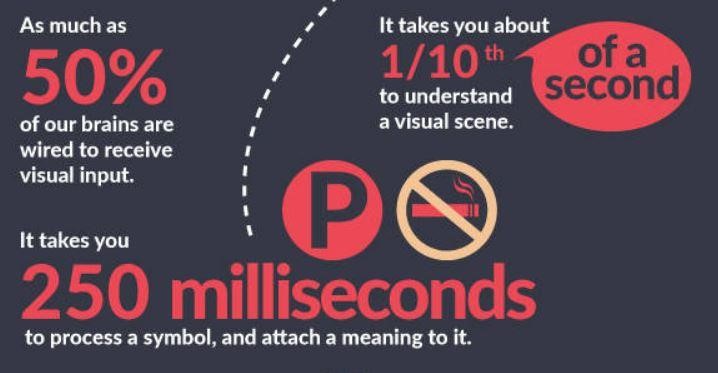
    Remember that a picture is worth a thousand words

    5. Pay attention to readability

    After you’ve written your piece, read it as if you’re the audience and ask yourself, “Would I read through to the end? Would this engage me?” Assuming it’s a topic that would interest the audience if you answered no to these questions, it’s time to look at the piece’s readability. Do you sound a bit standoffish, or do you speak in an inviting tone? Do you break the piece into titled sections and include some bullets to make it more readable? Do you include some personal information to help people get to know and trust you? Is your piece boring? Can you figure out how to take more risks and make the piece juicier?

    6. Create A Measurable Goal

    When it comes to content marketing, creating measurable goals is essential for success. A specific and measurable goal could be to increase website traffic by 20% within the next six months through targeted content creation and promotion. To achieve this, regular blog posts, social media updates, and email newsletters can be implemented.

    Regular tracking and analysis of website traffic using tools like Google Analytics will help determine if the goal is being met and allow adjustments to be made if necessary. Businesses can achieve their content marketing objectives and drive growth by setting a clear, measurable goal and implementing an effective strategy.

    7. Understand Your Buyer’s Journey.

    Understanding your buyer’s journey is crucial for successful content marketing. It involves identifying the different stages a potential customer goes through before making a purchase and tailoring your content to address their needs at each stage.

    By creating targeted content that speaks directly to your audience’s pain points and interests, you can build trust and establish your brand as a thought leader in your industry. This, in turn, can lead to increased conversions, higher customer retention rates, and ultimately, more significant ROI for your content marketing efforts.

    8. Pillar Cluster Content Model

    The Pillar Cluster Content Model is a best practice in content marketing. It involves creating a pillar or main piece of content, such as an in-depth article or video, and then creating multiple smaller pieces of supporting content around it.

    This approach helps to establish authority and thought leadership on a particular topic and can also improve search engine rankings by providing a comprehensive resource for users. By organizing content this way, brands can create a cohesive and effective content strategy that resonates with their target audience.

    9. Track Content Marketing Performance

    To track content marketing performance, it is essential to establish clear goals and KPIs before launching any campaigns. This will help you measure the success of your efforts and identify areas for improvement. Regularly reviewing and analyzing your metrics can provide valuable insights into audience engagement, content effectiveness, and overall ROI.

    Key metrics include website traffic, social media engagement, email open rates, and lead generation. By implementing these best practices, you can ensure that your content marketing efforts deliver measurable results and drive business growth.

    10. Provide Content For Present And Future Actions

    Content marketing best practices involve creating content that speaks to your audience and provides value and relevance. It’s essential to align your content with your business objectives and use data to inform your strategy.

    Additionally, you should focus on creating evergreen content that can be updated and repurposed for future use.

    11. Strengthen Stats Skills

    Strengthening your stats skills can significantly enhance your ability to make data-driven decisions and improve your overall job performance. Whether you work in marketing, finance, or any other field that requires data analysis, having a solid foundation in statistics is essential.

    By taking courses, attending workshops, or even just practicing with real-world data sets, you can sharpen your stats skills and become more confident in interpreting and communicating complex data. This not only benefits you and your career but also helps to drive better outcomes for your organization.

    12. Keep importance to writing styles

    In content marketing, the writing style is of utmost importance. It plays a critical role in engaging and retaining the audience’s attention while effectively conveying the intended message.

    A consistent and coherent writing style can help build brand recognition, establish credibility, and strengthen brand identity. Therefore, investing time and resources is essential to develop a clear and distinctive writing style that aligns with the brand’s values and target audience.

    Before and After Applying the Best Practices

    Before

    At Acme Manufacturing, we make the best refrigeration systems in the world. Our systems feature forced air circulation for uniform temperature at all shelf levels, heat-free defrost for maximum uniformity, and solid doors.

    After

    As a food warehouse manager, you are focused on storing and preserving your food safely, with the fewest interruptions. At Acme Manufacturing, we are committed to providing safe storage with minimal interruptions.

    Content Marketing Trends for 2023

    To improve your content marketing efforts in 2023, consider implementing these content marketing tips: creating high-quality and relevant content, leveraging new technologies such as AI and AR, prioritizing customer experience, utilizing social media platforms, and measuring the ROI of your content marketing efforts.

    1. Short-Form Video Content

    Short-form video content has become an essential part of content marketing best practices. With attention spans decreasing, short-form videos provide a quick and engaging way to communicate your message to your audience. They are easily shareable on social media platforms and can help increase brand awareness and engagement.

    2. AI and Automation

    AI and automation are revolutionizing businesses’ operations, from streamlining processes to enhancing customer experiences. By leveraging the power of AI and automation, companies can increase efficiency, reduce costs, and gain a competitive edge in today’s fast-paced digital landscape.

    To stay ahead of the curve, businesses must understand how these technologies can benefit their operations and implement them effectively.

    3. Content Consistency Is Key

    Content consistency is a fundamental aspect of successful content marketing. It helps to establish brand identity, build trust with your audience, and improve SEO rankings. A consistent content strategy ensures that your messaging is clear and on-brand across all channels and platforms, leading to greater engagement and increased conversions.

    4. User experience

    User experience (UX) is critical in content marketing best practices, as it determines how users interact with and perceive your brand. Creating a seamless and enjoyable user experience can increase engagement, build brand loyalty, and ultimately drive conversions.

    5. Human-Centered Content

    Human-centered content is a crucial aspect of content marketing best practices. By focusing on the needs and preferences of your target audience, you can create content that resonates with them on a deeper level. This means taking the time to understand their pain points, interests, and motivations and using this information to inform your content strategy.

    Whether you’re creating blog posts, social media content, or video content, the key is to put your audience first and create content that speaks directly to them. Doing so can build stronger relationships with your customers and drive tremendous success for your business.

    6. Rely On original content

    As the digital landscape becomes increasingly crowded with content, relying on original content to stand out is more important than ever. Creating original content sets you apart from others in your industry and helps you establish your brand identity and build trust with your audience.

    Original content can take many forms, including blog posts, videos, infographics, and social media posts. By consistently producing high-quality original content that resonates with your target audience, you can position yourself as a thought leader and attract new customers or clients.

    So if you want to stay ahead of the game and make a lasting impact in today’s fast-paced digital world, prioritize original content in your marketing strategy.

    Types of Content Marketing Strategy

    Content marketing best practices for businesses include using various strategies to reach their audience. Blog content establishes a brand’s expertise, videos create engaging content, social media connects on a personal level, email marketing provides direct communication with subscribers, and infographics convey complex information quickly. The choice of strategy will depend on the business’s goals and target audience.

    Infographics

    Content marketing is a vital part of any successful digital marketing strategy. One popular approach is to use infographics, visual representations of data or information that are easy to digest and share on social media. Infographics can attract attention to your brand and increase engagement with your audience.

    Blog content

    Another effective content marketing strategy is blog content. By creating high-quality blog posts that address the needs and interests of your target audience, you can establish yourself as an authority in your industry while also driving traffic to your website.

    Podcasts

    Podcasts have also become a popular way to reach audiences in recent years. By creating engaging audio content that listeners can tune into anytime, anywhere, you can build a loyal following and position yourself as a thought leader in your field.

    Videos

    Videos are another effective way to engage with your audience. Whether through product demos, educational tutorials, or entertaining content, videos can help humanize your brand and build trust with your target audience.

    Social media

    Finally, social media has become essential to any content marketing strategy. By sharing relevant content on platforms like Twitter, Facebook, and LinkedIn, you can increase your brand’s visibility while building relationships with customers and prospects. Regardless of your chosen approach, a strong content marketing strategy can help grow your business and achieve long-term success.

    Wrap Up

    Effective content marketing is crucial for businesses looking to boost their online presence and engage with their target audience. By following best practices such as creating high-quality content, leveraging social media, and measuring performance, businesses can achieve their content marketing goals and drive success. At Position2, we specialize in helping businesses develop and execute effective content marketing strategies. If you’re interested in learning more about how our expert team can help your business succeed, please don’t hesitate to reach out. We look forward to partnering with you to achieve your content marketing goals.

    FAQs on Content Marketing

    How do I identify my target audience for content marketing?

    Identify your target audience for content marketing by researching their demographics, interests, behaviors, and pain points.

    How do I measure the success of my content marketing efforts?

    Measure the success of your content marketing efforts by tracking key performance indicators such as website traffic, engagement, leads, conversions, and ROI.

    What are some common mistakes to avoid in content marketing?

    Common mistakes to avoid in content marketing include ignoring your audience’s needs, being too promotional, producing low-quality content, and not measuring the results.

    How do I distribute my content for maximum impact?

    Distribute your content for maximum impact by using a multi-channel approach, leveraging social media, email, influencers, SEO, paid advertising, and other tactics that fit your audience and goals.


  • Videos and brands: Like chocolate and peanut butter

    Brands thrive on awareness

    Whether it’s their products or services, their social impact, or how their customers perceive them – a brand’s values and promise and how it delivers against both can make or break a business. With so many marketing channels for a brand to spread the message – social media, web, content marketing, SEM, paid media and print advertising … it can be overwhelming for a marketing team.

    Quickly, concisely

    We all know there are a million distractions and average attention spans have dropped significantly in the last 20 years. If your message doesn’t reach the intended audience in seconds, chances are, it’ll be skipped over or outright ignored. Your marketing content needs to be presented quickly, and be easily digestible – delivered to the consumer on the channels they are on. How quickly you can turn around and deliver your content matters – but it also has to hold that consumer’s attention, it has to be entertaining and relevant.

    There’s no better format than video content to achieve this – no other format can blend visual content with storytelling and information to generate awareness.

    Show the world

    We just discussed why brand awareness is critical for any marketing efforts and in 2023 – video content is one of the best ways to achieve this. As Dr. James McQuivey of Forrester Research wrote years ago “One minute of video is worth 1.8 million words”. A brand can say and show more about itself with ten seconds of video than in any other media.

    You might think that videos may impede the success of other channels – they can actually help with SEO and better page rankings. Google is the premier search engine in the world – YouTube is ranked second in popularity, in addition to being a social platform.

    So why do videos attract so much attention? It’s psychology 101. It’s a fact that our eyes are drawn to motion.1 Whether it’s a holdover from our hunter-gatherer days, or something more, the fact remains – anything that moves catches our attention.

    Additionally, video can:

    1. Be an engagement booster

      Consumer consensus is that video content is more interesting compared to static content. When surveyed, 80% of consumers prefer to see more content from businesses.2 Over the last year alone, 82% of the total web traffic was driven by video content.3 This engagement drives brand awareness. Video is not limited to one channel either – they can be hosted on a brand’s website, on sites like YouTube (and the Google Advertising Network), or on apps like Instagram, TikTok, and Snapchat literally driving engagement from multiple platforms simultaneously. Additionally, consumers or more likely to share videos with their friends than any other content 2 – making a persuasive argument as a mechanism for customer loyalty and advocacy.

    2. Help you stay top-of-mind

      Video content is an excellent way to reach out to new customers, or remind existing ones that you’re still here. Consistent video content is a great way to keep your brand in front of your customers, updating them on what you are doing, Top-of-Mind-Awareness (TOMA).4 This is especially useful with targeted or retargeted advertising across multiple platforms – helping brands focus their content across channels – reaching a wider audience.

    3. Help build community

      Few things help drive awareness or brand recall like building a community, and it’s not just limited to social media. Brands can develop a loyal fan base on and offline. Video content lets brands build an identity that resonates with their customers, creating relevant, relatable content. Helping spread the word and get consumers to regularly interact with your content, building engagement and trust in your brand.

    4. Give sales a boost

      The direct benefit of video marketing is increased sales. 88% of consumers say that watching a brand’s video convinced them to purchase or opt-in to a product or service, with 78% of respondents claiming to have downloaded an app or software thanks to videos.5

    5. Drive organic traffic

      Video marketing is a mainstay of any marketing strategy because it’s widely helpful for driving organic traffic to sites and landing pages. Benefiting brands in so many ways – viewers don’t feel excessively targeted by advertising, and regular site visits help page rankings rise naturally (allowing for better search results). It’s proven that websites with video, experience a 157% increase in traffic, and are 53% more likely to reach Google’s front page.6 Resulting in 89% of marketers saying that videos have helped them achieve a better ROI.

    It’s a fact that video has taken brands in a new direction – increasing the number of people consuming content on the go in an engaging manner. The benefits to B2B / B2C brands (and consumers) are undeniable – and unlikely to change soon – at least until a new format comes along.

    For now, though, video content is here to stay.

  • Why is Video the Hottest Growth Hack Today?

    “The play button is the most compelling call to action on the internet.” Michael Litt, CEO and Co-Founder of Vidyard, a global video creation, hosting, and analytics platform for businesses – perfectly sums up the power of video content marketing.

    About 4.7 billion people across the globe use social media, and 227 million new users have come online within the last 12 months. Failing to adapt to the latest social media trends means neglecting a significant audience. The key to unlocking your social media potential lies in the definition itself; other media types are usually one-way, while social media is social.

    The most successful marketers deliver content consistently through multiple social media channels. Of all the content posted through these channels, it’s no surprise that visual content is 40 times more likely to be shared than text-only content. Video is no exception. It’s becoming an increasingly vital part of the promotional artillery, with 65% of businesses considering it the most engaging communication channel for their audiences.

    Video: The Swiss Army Knife of Social Media Marketing

    With online videos accounting for more than 82% of all consumer internet traffic by 2022– you need to consider your options as we advance. The question is, are you making the most of your video assets across social media? Here are just a few reasons why video is currently topping the charts as the focus for social media marketers presents a huge opportunity.

    Helps you reach a broad audience

    One of the most significant contributors to bounce rates is when someone comes to your website, and it’s unclear what product or service you’re offering. This is where the use of video can be very beneficial. Video can present information in a more interactive, visual, and enjoyable way. It is an effective tool to generate website traffic and keep visitors on your website longer. Video content marketing gives your brand a voice, authenticity, and credibility. It’s visually appealing and can be used as an essential resource, making a big difference in your marketing and sales success.

    Video content improves search optimization

    Suppose you’re looking for just one reason to recommend creating video content for your business or brand: it’s Search Engine Optimization. Videos are valuable metrics that search engines consider for ranking. Two of the most critical metrics for SEO are the time users spend on your page or website and the number of backlinks to your domain. Videos improve both numbers in most cases. The more video content you create, the more quality traffic you can drive to your page, which will enhance your overall SEO in the long run.

    A sure-fire way to boost your ROI

    Audiences are watching the video like never before, so there’s no question why social media channels like Facebook, Instagram, YouTube, and LinkedIn prioritize video so highly. Videos not only increase brand messaging and awareness, but they also help businesses worldwide generate leads and increase sales. Social media channels tend to outperform static posts, so continue to favor video by making it more visible in your feed. This allows businesses to be creative and find new ways to differentiate themselves digitally. To get you even more excited, 83% of companies say video delivers a high return on investment.

    Helps you build effective relationships and trust with customers

    Trust is the foundation of conversions and sales. Building trust with your customers makes them more likely to commit to your product or service. Trust is one of the factors that influences nearly every purchase decision a customer makes, regardless of the product. Videos are a great way to build brand loyalty. By creating videos that inspire trust and add value to your brand, you can keep growing your loyal customer base for the long term. Including some or all these videos in the client’s marketing funnel can provide a richer and more positive experience for the client’s customers, increase brand loyalty, and increase the likelihood of converting customers into brand ambassadors.

    Provides data and actionable insights

    When brands use video on social channels, they have immediate access to robust data. Enthusiastic viewers can participate in the user’s journey, driven by video viewing habits. For example, you can send your viewers targeted information or a call to action midway through your video. Viewers who have watched the entire video can be marketed accordingly, and viewers who previously quit the video can be given specific information to target them. Video allows audiences to test different narratives, tones, and styles to find the most effective communication for each target market.

    Video appeals more to mobile users

    Video and mobile phones go hand in hand. Most consumers watch videos on their mobile phones. People love to watch videos on the go, and as the number of smartphone users grows, so does the video audience. Research shows that smartphone users are twice as likely as TV viewers and 1.4 times as likely as desktop viewers to feel a personal connection with brands that display video content and ads on their devices. The growth of mobile video means brands need to pay attention to their customers’ personal experiences on smartphones.

    Wrapping Up

    In the age of YouTube, Facebook, live streams, Instagram Reels, and webinars, it’s clear that video is the number one priority. One of the revolutionary additions to your advertising toolbox. Creating a marketing video for your business requires creativity and an understanding of human psychology. These components allow you to make proper marketing miracles with minimal effort. Inspirational and creative videos go viral on the Internet in days, receiving millions of views and shares.

    Social Media Video Marketing is undoubtedly king today. It’s time to lead, not lag.

  • Qualitative Strategic Content Audit Guidelines

    When was the last time your team did a content audit on your marketing assets ?

    A qualitative assessment of your content is a best practice – it’ll help identify messaging that’s out of date, improve relevancy for new audiences as well as overall organization for your content.

    What qualifies as content?

    Everything from your website (and landing pages), blogs, social media channels/pages, posts, and third-party content/event is a good start for a content audit. Don’t stop there, there’s value in extending the audit to product briefs, whitepapers, use cases, customer success stories, ebooks, webinars, videos, and recorded live streams.

    Do you know how your content measures up against your business goals? And why is that important? If you’ve never done a content audit, it can be overwhelming to get it started, try focusing and prioritizing on what content needs action, then start identifying low-quality content to clean up or remove.

    Quick questions to ask when you’re considering an audit:

    Does your content meet your audience’s needs?

    Is your content findable?

    Is your content easy to digest?

    Is your content actionable?

    Strategic Content Assessment Factors

    Time to get started evaluating content quality and value:

    Is the content relevant? Yes or No

    What’s the purpose of the content? Is it Informative or Actionable? Does the content educate or influence the audience? Or is the content meant to move the reader to take action (fill out a form)?

    What is the value of the content? Is it critical to the goals and strategy of the business and or does it support your brand?

    How valuable is your content to your audience? In order to identify the value, you have to measure audience engagement (web visits, time on page, clicks). If you don’t measure engagement, you’re just speculating.

    What’s the tone of your content? Does it support the brand voice, persona(s), and buyer’s journey? Does it represent the voice of the company or the product team?

    How accurate is your content? Does it represent the current view of messaging or product information?

    Expertise, Authority and Trust (EAT)

    One of the more important aspects of content/content marketing that you’ll have to address is EAT. It’ll be difficult to measure in your organization but it’s important to Google – since they represent a large part of US search – it’s also critical for your business.

    Expertise in content is demonstrating that you (or your company) have the domain expertise. Being an Authority is the natural progression of that expertise. Trust, howsoever, is built over time – think of your favorite ‘trusted’ brands, they took years to build.

    There’s no quick way to build up EAT, if you haven’t started – there’s no time like now to start.

    Content Marketing checklist

    Use this list as an audit checklist and a foundation of a scoring system.

    Audience: Identify the relevant audience and match it to the right content asset. Your audiences will include customers, prospects, internal, press/media etc.

    Industry: If your content is developed for a particular industry – be sure to identify it by industry. Some of your content will have broad appeal – list it as general or multi.

    Service / Product: Your company could offer services, a product(s), or both – identify your content accordingly.

    Key topic: When reviewing content that is editorial in nature (blogs, case studies, eBooks, etc) identify each asset for its key topic for easier categorization and access

    Funnel: Is your sales and marketing content applicable to the stages of your prospect/customer journey? You’ll want to identify and categorize the content asset by TOFU, MOFU, and BOFU (top, middle, bottom of the funnel).

    Objective: What’s this content purpose/objective? Brand awareness, sales, lead generation, etc.

    Map Your Content

    Map your content to your audience persona’s buyers’ journeys. (TOFU, MOFU, BOFU)
    (use a comprehensive multi-touch attribution approach i.e. website, social, third-party)

    1. What is the current audience mindset?
    2. What do we want them to think and feel regarding our offering?
    3. What are our key message(s) and messaging frameworks?
    4. What are the appropriate content types(video, short-form, long-form?)
    5. What content is available and low effort/high effort?
    6. Determine the appropriate KPIs?
    7. Find your gaps? What is missing?
    8. Make appropriate content recommendations for net new.

    Results

    Once the audit is completed you’ll have the confidence that your content is positioned to perform, on-brand, current, and valuable to your audience.

    • Outdated content is refreshed and updated
    • The digital experience for customers and prospects is improved
    • Your brand message is clear and concise
    • Content is more relevant to the audiences it was developed for
    • Traffic and site stickiness improves
    • Redundant or outdated messaging is removed
    • You’ve de-cluttered the CMS
    • The client has actionable insights and next steps
  • Personas Vs Personalization

    Personas Vs Personalization

    Getting the Most Out of Personas and Personalization

    As marketers, why do we love buyer personas? Because we believe they will help us get more sales. We understand that personas are one of the first things we need to pay attention to when we’re creating a campaign. We know that aligning personalized content with our personas can make a big difference.

    Because of the digital revolution, personas don’t provide marketers with as many benefits as they used to. In this article, we will explore how to get the most out of personas and how to use them to create top-quality personalized content.

    The Ins and Outs of Personas

    Personas give you a theoretical look at who your target audiences might be. They help create a lens through which you can view products or services from the perspective of real people. They help you build empathy and customer centricity. They personify needs and requirements.

    Many people ask whether personas are the same as segmentation. The answer is that they are related. SAILTHRU says that “Market segmentation identifies pieces of your audience based on broad commonalities like geography, profession, or marital status, while personas are highly specific representations of particular individuals within segments.” They say that segmentation is appropriate for high-level planning, while personas are appropriate for more tactical campaigns. For the purposes of this piece, we will stick to personas.

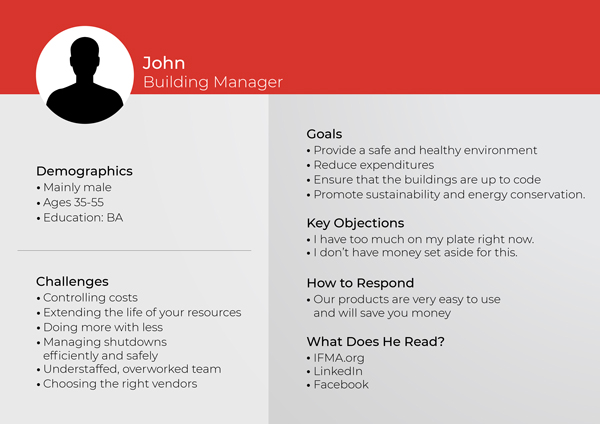
    Let’s look at two examples. First, let’s look at an industrial fan company. This company would be likely to identify three personas: facilities managers, architects and business managers. The brand would come up with archetypal characteristics, including age, gender, job title, type of company they work for, education, hobbies and watering holes (where people go to get information) to help their content marketing and design teams provide a good customer experience for these audiences.

    Core Web Vitals

    For a second example, let’s look at a software-as-a-service (SaaS) company. A SaaS company might use these personas: users, managers/decision-makers and CFOs. Again, they would identify characteristics associated with each of these audiences.

    Creating personas is a valuable practice from the perspective of understanding your target customers. Here are a few things to look out for to make sure your personas are as helpful to you as possible:

    • While demographics like age and hobbies are helpful, they typically don’t align with how a person chooses to buy. As a marketer, it’s much more important to focus content and design on behavior than on demographics. Devote more attention to what people do (or don’t do), not to who they are.
    • Avoid using persona-based marketing as an excuse to dump a bunch of content on your target audience. You want to engage with your audience, responding to their needs, rather than just one-directionally assuming their needs.
    • Use data you collect to strengthen your personas. Having a good marketing automation solution is necessary to do this.

    The Ins and Outs of Personalization

    Today’s customers are demanding more from companies. They expect:

    • Products, services and information that address their needs and desires
    • Engaging website experiences that cater to them as individuals

    They want to feel remembered, understood and in control.

    These customer demands clearly point to the need to deliver personalized experiences.

    So how do you go about delivering personalized experiences? You start by recognizing that personalization starts with data. Using an AI-driven strategy, you can predict what someone will view or buy based on what they interact with over time. Especially when you leverage AI in e-commerce, you can easily predict what someone will view or buy based on their past interactions.

    The closer you come to a 360-degree understanding of your customer, the better. This means integrating big data coming from the web, mobile, social media, email and in-person channels.

    Once you analyze your data, you have a better understanding of how your ideal customer engages and shops for your products throughout the buyer journey. With the right data, marketers can understand what resonates and drives behaviors.

    When devising a personalization strategy, it’s important to think about the customer first, not about your products and services. Only then can you create tailored, value-added messages and incentives targeting your audience seamlessly across channels.

    Why Is Personalization So Valuable for Your Target Audience and You?

    Personalization enables your target audience to see the products, services and information that they care about in a personalized way that feels close to a one-on-one experience.

    Personalization lets you target the proper audiences, generate brand loyalty and increase engagement and conversions.

    Using Personalization to Take Your Marketing to a New Level

    You will start by developing detailed personas and then use these to move on to personalization, where you target your customers with one-to-one, actionable campaigns.

    When you treat people like individuals, they will feel the difference and be more responsive to your marketing campaigns, giving you better sales and loyalty.

    A Day (or Week or Month) in the Life

    Start with Functional Attributes: In the beginning, as is the case with most relationships, you know very little about the person (or target audience) you’re dealing with. The attributes you want to focus first on are the functional attributes of the person, including their role, their title, their position on an organizational chart, the business unit they are a part of, and a few firmographic details about the company such as company revenue, number of employees and locations.

    Follow This Up with Emotive Attributes. These include the initiatives the person is working on, their greatest challenges and their most important needs. It’s also important to understand their lexicon. For example, if you’re talking about managing student careers, will talking about an ambassador program have any meaning for your target audience?

    Next, Look at Decision Process Attributes. The buyer role, the level of engagement and the decision drivers (financial, operational, strategic) are key.

    Finally, Look at Behavior Attributes. Here, you’re looking at engagement with different types of assets, interaction-type preferences (reading vs. video vs. webinar) and favorite watering holes.

    You’ll provide email addresses to an augmentation application such as LeanData or ZoomInfo, who will then provide you with much of this data.

    Once you have the data from the augmentation application, you will put it in your automation platform. You will then segment it to qualify different personas. For example, you might clump all of the CIOs together. Your next step will be to build messaging for this target audience and determine which content types will work best. Once you have campaigns, you will use automation to build multiple levels of personalization (e.g., using their name, talking about the type of company they are working for and answering the emotive attributes in a way that addresses their needs and challenges) in a language that is well suited to them.

    If you would like to discuss how Position2 can help you out with personas and personalization, please reach out to us at personalization@position2.com. Thanks.

  • 4 Tips for Developing an Effective Content Optimization Strategy

    4 Tips for Developing an Effective Content Optimization Strategy

    “Content is king.” We’ve heard this many times. Why is content so important? Content is the most powerful catalyst for strengthening a brand’s digital presence and positioning. High-quality content helps build brand reputation and relationships with customers.

    Creating great content adds value to your business in a number of ways. So, it is an extremely important aspect of marketing. But will your best piece of content reach your target audience? To make sure that the content reaches the largest possible target audience, we need to optimize it.

    Content Optimization is the process of making your content as effective as possible. Optimization ensures that your content is crawlable by search engine bots and formatted for user consumption. It is about making sure that search engines understand what your business is all about and your content is shown to the users who are looking for it. Content is critical for SEO because, without it, search engines will not have enough information to index your pages and help you rank on SERPs.

    Let’s see how to optimize content that will help drive traffic to your website and inevitably lead to conversions.

    1. Create content that will add value to your audience

    Google prioritizes context over content. Matching the user’s intent is one of the cornerstones of content creation. Therefore, writing content that a user is looking for is more important than writing on a specific topic to start with. Follow these four steps to help you build content that is SEO friendly.

    • Shortlist relevant business keywords and create a buyer persona that will help in writing the content as per the searcher’s intent.
    • Map the shortlisted keywords to your buyer persona.
    • Understanding ambiguous intent, informational queries, local queries, transactional queries, navigational queries etc. will make it easier to have a proper content structure in place.
    • Start adding supporting content revolving around the topic clusters.

    The key is to create content that your target audience would want to consume. Write content that resonates with their wants, needs, and pain points. Providing tangible value to your audience that will help them benefit or solve something is an effective style of writing.

    2. Maximize your keyword footprint

    Optimizing content for keywords does not mean adding as many keywords as possible. Have a proper keyword strategy in place and work out variations of the seed keyword/primary keywords. Recognize that:

    • Primary keywords mostly consist of one or two words. Build your content around the seed/primary keyword and then optimize it for related keywords.
    • Related/secondary keywords are terms closely related to the seed keyword. They elucidate the content in a way that cause search engines to better understand, categorize and rank. They help in giving signals to Google regarding the context of the webpage.
    • Prioritize adding one or two long-tail keywords that match the intent of your reader. Long-tail keywords are longer queries that focus more on a niche, are less competitive and have a higher conversion value.

    In this way, perfectly optimized content is built with a combination of primary, secondary and long-tail keywords that are thoughtfully spread across the page.

    3. Craft compelling and relevant heading tags

    Add value to the content by organizing it in a systematic way. The look and feel of the webpage will contribute towards good user experience. Header tags indicate hierarchical levels of information and are typically chosen by Google for featured snippet ranking. A web page may have multiple headings. Add relevant heading tags to divide subtopics that give meaning and provide structure to your content. By adding header tags, you are informing users and search engines about the various segments of content and what each segment is about. The header tags are the first thing people usually read as they scan through the page before reading the content. When considering ranking for variations of keywords on a specific subject, they play an important role in ranking long-tail keywords.

    How to optimize the header tags

    • Follow the hierarchical structure of tags, starting from H1 (heading 1).
    • Maintain the seniority level of each header tag and make sure that each page has only one first-level heading (H1).
    • Each header provides valuable information about the page to users and search engine bots.
    • Heading level two through six should ideally follow the first level heading and should be placed in a sequential order that describes the main topic of the content.
    • Include the primary keyword in H1 as it also acts as the title of the page.
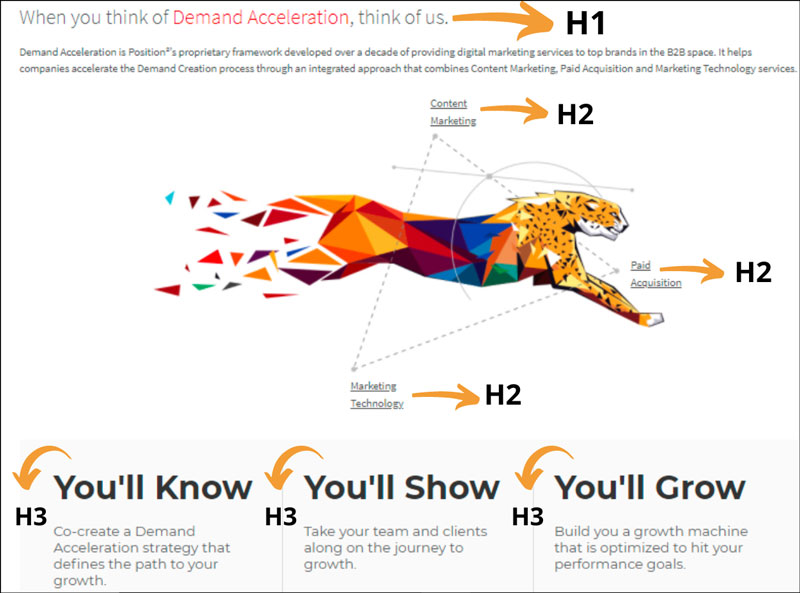
    Heading Tag Example Screenshot

    Image Source – https://live-p2-headless.pantheonsite.io/demand-acceleration

    See the above image from Position2 website for best usage of keywords in the heading tags.
    Primary Keyword – Demand Acceleration is in Heading 1
    Related/secondary keywords – Content Marketing, Paid Acquisition and Marketing
    Technology are Heading 2 tags
    Creative catchy terms are placed as Heading 3 tags.

    4. Get your linking strategy right

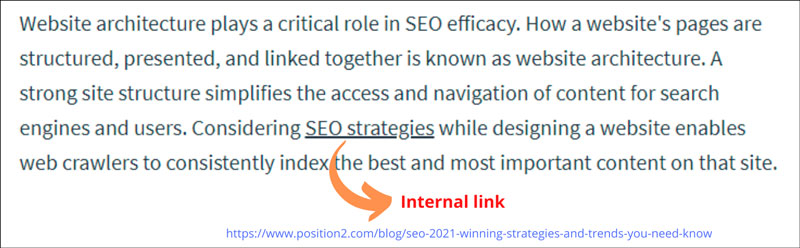
    A linking strategy is a plan that you devise and put into action to help you organize, optimize and track your links. Internal linking is the process of linking your relevant pages or blog posts using relevant descriptive contextual anchor text. Anchor text gives hints to users about the content to which it is linked to.

    Search engines use anchor text to determine the context of the linked page and then index and rank it. Internal linking not only helps in connecting your webpages, it also gives Google an idea of the website structure. Internal links are very effective in defining the site architecture and spreading link equity.

    Internal Link Example Screenshot

    Image Source – https://live-p2-headless.pantheonsite.io/blog/7-steps-for-building-a-website-that-enhances-seo/

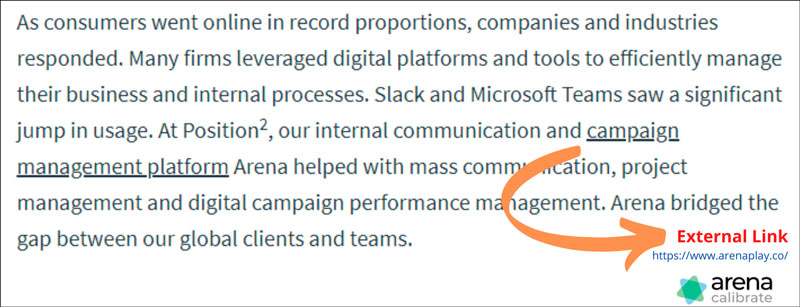
    An external link is a hyperlink that takes the reader to a reliable page on another website. Linking to credible content makes you appear to be an authority and will help Google determine what your content is about. The quantity and quality of the external links are important, so include links from trustworthy, informative and high-quality websites. External links are more valuable if they point to relevant websites that are popular, highly ranked and related to the content on your website.

    External Link Example Screenshot

    Image Source – https://live-p2-headless.pantheonsite.io/blog/marketing-2021-three-trends-that-will-define-the-year/

    The value of your content is determined by the quality of what you offer. You need to give your audience content that they can relate to. It takes time and effort to achieve organic search visibility, rankings, and traffic but that can be achieved by creating a strong content optimization strategy. Make your website pages more appealing to search engines and users by optimizing its content. The key to ranking higher is to create incredible optimized content that gets linked naturally and enables you to still say that “Content is king.”

  • What Is Personalized Content, and How Can You Use It to Drive Sales?

    When you’re on Amazon’s site, aren’t you amazed (impressed, frightened, in awe) when you see them serving up products that you did a Google search on earlier in the day? Their ability to serve up customized shopping experiences is what personalized content, or dynamic content, is all about.

    Personalized content is online content that dynamically appears based on a visitor’s past and in-session behavior and data known about the visitor.

    Personalized Content and Your CRM System

    Personalized content relies heavily on your CRM system, which might be SalesForce, Hubspot or Pardot. Using data from your CRM system, you can customize your site pages, emails and other communiques for each particular visitor. You can segment your pages to provide a different experience for leads vs. customers, for people from the United States vs. other countries, for people who appear to be further along the sales funnel, for people interested in certain product lines, and so on.

    If you’d like to use your CRM system to personalize content, you’ll first want to make sure your CRM system is collecting a mass amount of data about your customers and prospects. You’ll then define a set of rules and set up priorities for those rules to help ensure that the most important content reaches the right customers. Hubspot provides many more details on how to use your CRM system to add personalization to your content.

    Why Is Personalized Content Important?

    B2B companies spend a ton of money on content – sometimes as much as 25% of their total budget. If that content isn’t consumed, the money goes to waste. Everybody understands that SEO plays a huge role in helping your content be seen. But even if your content is seen, is it consumed, and is it compelling? All too often, it isn’t. All too often, consumers feel like the site they’re visiting is talking generically to a million people. Not a fun experience.

    Personalized content goes a long way in helping engage readers, which of course drives conversions.

    Here is a chart from Evergage’s 2018 Trends in Personalization report.

    What are the main benefits you see from personalization for your organization?

    The good news is that all of these user-experience benefits point to higher-quality content, which improves Google organic rankings and SEO.

    When Creating Personalized Content, What Are the First Steps?

    To create content that delights customers and drives sales, start by identifying who you’re creating your dynamic content for. The more detail, the better. Long gone are the days when you could successfully convert customers by using a one-size-fits-all approach to marketing. A key goal from this step is to identify your segmentation criteria and the smart rules your system will use to adapt your dynamic content to your intended audience.

    Once you identify your audience, do some research on customer intent:

    • Use Google Trends to explore search trends in your category.
    • Conduct keyword research to better understand the words that are more likely to result in conversions.

    Next, determine your default content, which is the content that will be served up to people for whom you have no information. If you manage an ecommerce website, your default content will be the website, perhaps including a “Customers also bought” section. The dynamic element would be a “You may also like” section. This would look different depending on the visitor’s age, their interests and their past buying history. For every dynamic asset on your site, you’ll need a default version for the people for whom you have no information.

    What Should Be Done Next?

    You’ll want to use dynamic content recommendations. The most widely used and most advanced general recommendation method is called ‘collaborative filtering’, which, at its core is an algorithmic approach to capture preference or taste information on many users by collecting and analyzing behavioral information on them.

    Any Other Recommendations?

    • Be Sure to Use Automatic Optimization: Dynamic content should be automatically optimized over time when search engines introduce changes to their algorithms, standards and formats that would otherwise require retroactive and sometimes work-intensive optimization.
    • Adopt a Progressively-Dynamic-Content Approach: If you have a visitor who comes in with no cookies, and you can’t figure out where they live, your system will serve up default content. If your visitor doesn’t have a cookie, but your system can figure out that they live in Texas, that visitor will be served up default content for Texas. If your visitor has a cookie, your system will look up their search and visit history and serve up the most relevant content for them.
    • Choose What You Will Personalize: Because personalization adds layers of complexity, most companies start by personalizing one or two elements per page. Keep in mind that some of your pages won’t be suitable for personalization.
    • Remember All of Your Options: It’s important to remember that, in addition to personalizing web pages, you can personalize social media, emails, landing pages and ecommerce sites.

    How Do You Measure Performance?

    Why do you personalize your content? To increase conversions? The good news is that, according to SurveyAnyplace, 91% of B2B buyers prefer to consume dynamic content over static content.

    But how do you measure the impact of using dynamic content?

    It can be difficult to track which versions of your dynamic content receive more engagement. Using a different link or a unique query string for each asset will make things easier. For your website, you’ll want to track before and after statistics to see if your dynamic site gets more visitors and if the visitors stay longer.

    If they don’t, you will need to rethink your personalization strategy and make modifications to boost your performance.

  • Meet us at SEMpdx Engage Conference on March 7th and 8th, 2019

    Join us March 8th from 11:40-12:30 PT as our head of Organic Marketing, Tushar Prabhu, speaks about creating and optimizing content with our proprietary Predictive Content methodology at the SEMpdx Engage Conference, a digital marketing conference in Portland. The Engage Conference is a two-day digital marketing conference with panel sessions of expert insights, strategies and the latest advancements in digital marketing, SEO, content, advertising, and paid media.

    Over the last couple of years, Tushar has been working with our content and organic marketing teams, developing Predictive Content, a methodology that has been transforming organic marketing for our clients.

    Participate in this packed 50-minute discussion with your questions as Tushar teams up with Kane Jamison, CEO of Content Harmony, covering concepts around content strategies, user intent, the latest in content marketing and how to get your content to rank in organic search. Do not miss out as this could jump-start your content marketing strategy.

    Come say hello to us at the Engage Conference, on March 7th and 8th at our booth at the Sentinel Hotel – Portland. We are excited to see you there!