Tag: facebook

  • Facebook Raises the Ante in Mobile Ad Space

    facebook audience network

    Facebook has officially launched its mobile ad platform called “Audience Network” which lets digital advertisers to serve ads on third party apps. Now this is just an extension of the Facebook advertising program and it even involves the same ad inventory that serves ads on Facebook’s own site and its apps. For long Facebook has been struggling to monetize its database of over a billion users without much impact. Now this launch of its mobile ad platform will give a fresh boost to Facebook’s advertising capabilities. It is a simple way to augment its advertising reach across the burgeoning mobile apps category to improve targeted advertising. This will no doubt be beneficial to advertisers but at the same time it offers value to the users and the app publishers as well.

    This Facebook platform immediately serves two purposes. Firstly, it helps Facebook to leverage its treasure trove of user information without putting more pressure on its already existing ad programs. Secondly, it gives advertisers an opportunity to display their ads to more people based on specific demographic needs. With the launch of Audience Network, Facebook will now be able to compete directly with Google AdMob, Yahoo Flurry and Twitter MoPub in the mobile advertising space. A major chunk of Facebook’s revenue today is coming from the mobile space and hence the social media giant wants to bolster its position in this arena lest the search engine giant Google permanently renders it to a distant second place.

    What it Means for Digital Marketers

    The mobile app space is growing at a torrid pace but unfortunately there aren’t many organized advertising networks that cater exclusively to this space. Facebook now is trying to bridge that gap. It will no doubt bring its deep expertise of using targeted advertising to create better campaigns in the mobile app space too. Digital marketers like you can take comfort in the fact that Facebook can now use the same targeting options that it uses to push ads on the social networking site such as age, gender, social contacts, buying habits, et al in the mobile arena too. You can now make your ads resonate with the right customer group and command more qualified leads giving you better return on investment.

    Facebook is linking its Audience Network to its existing ad network which means you cannot buy ads on Audience Network without buying ads on Facebook as well. For those of you digital marketers already running News Feed ads on Facebook using this new mobile offering from Facebook is just a click away!

    You can better meet your business objectives using Audience Network like increasing app installation and engagement. The platform supports ads in three creative formats namely banner, interstitial and native. Early tests have shown that the ads on Audience Network offer great value for money and this has got the digital marketers quite excited.

    So, will you be using Facebook Audience Network to get more digital bang for your buck?
  • Facebook “Like” Button goes Mobile

    Facebook has come up with yet another update wherein the ubiquitous “Like” button will now be available for Android and iOS mobile apps too. This has got the digital marketers quite excited since now they can analyze user engagement via mobile apps. The mobile users can directly “Like” the app’s Facebook page or any other object within the app and share it on the social networking site.

    Today more and more people are using mobile gadgets like smart phones, tablets and phablets (phone + tablet) as their primary device for browsing the Internet. In the world of mobile devices the apps rule supreme. So any marketing strategy that does not take into consideration this vital factor is doomed to fail. The Facebook “Like” button going mobile in order to garner the attention of the growing clan of app users is a well-timed update from the social media giant.

    The “Like” button works flawlessly with the user’s Facebook account no matter what device he/she is using to log into the account. This makes liking any piece of content in the native app effortless. Facebook has issued some guidelines for digital marketers in order to make the most of the Like button on mobile apps. They are as follows:

    • Research when exactly to show the Like button.
    • Position it strategically to get the best outcome.
    • Have a riveting Facebook page.

    As a digital market you have data of a whole new segment of consumers using mobile apps, at your disposal. Using the “Like” button you can find out which is the form factor that your customers are most comfortable with and how it converts into more marketing leads. This can give you an accurate picture about which platform is the most profitable. Thus you can pursue a digital marketing strategy taking cue from this new found knowledge.

    Mobile marketing will upend the digital marketing world for good. So you have to be always nimble and on the lookout for new opportunities and threats alike. You need to have a team of technologists with an intuition of future technology, business executives with an eye on the revenues working together seamlessly. Their efforts can then come to fruition using market intelligence apprising you about imminent business prospects.

    It was but imperative on the part of Facebook to bring an update like this since the majority of Facebook users are youngsters. So keeping in sync with the mobile centric demographics that Facebook has, it had to bring its desktop features and capabilities on to the mobile bandwagon thus benefiting publishers and developers on this burgeoning platform.

    So how do you think this new update from Facebook, is going to augment your digital marketing campaign going forward?

  • Facebook Launches Atlas

    Facebook has officially launched the Atlas advertising platform which is purportedly going to give the giants of the industry like Google a run for their money. Facebook calls this “people-based marketing” since the social media giant will not be utilizing cookies to track people and to learn more about their browsing habits. It will be using the login credentials of its over 1.3 billion users, the biggest database of any Internet company in the world! Hence, Facebook can track a user on mobile devices too since they are not relying on cookies here (cookies don’t work on mobile devices). It is going to be a paradigm shift as far as advertising is concerned and this has got the digital advertising agencies quite frenzied.

    Facebook can even track its users offline. If a Facebook user goes about shopping in a mall and enters an email id in the shop registry and that shop is on Facebook, then the social networking giant can map that id to the actual user. It can then easily find out whether that person saw a particular ad or not! This helps marketers to reach real people across devices, platforms and publishers. So the cross-device impediment that they used to face until now has been removed. They can now target, serve and measure the performance of their ads across devices.

    All this leads to better optimized ads that can help the digital marketers get better ROI on their media budget. When a company like Facebook has so much user information the natural proclivity is to tie that data to analytics and an ad server and start targeting users in hitherto unheard ways. “That’s Marketing Nirvana”, said one digital advertising CEO; how true! Marketers will now be able to successfully serve ads to people based on their demographic data like age, gender, socio-economic status, et al. They can even measure how effective their ad campaigns have been at targeting the right customer group. Instagram, as a publisher is already plugging into the Atlas ad server in order to examine and authenticate ad impressions, according to a Facebook Atlas Update. Looks like there is a lot to come in the days ahead.

    So, is this the start of a new era of holistic advertising?

    What do you think?

  • LinkedIn Gives Users Control Over Their Data and Facebook’s New Ad Format Gives Brands Better Visibility

    LinkedIn

    LinkedIn has decided to be more transparent when dealing with your user data. You can now request data about your account from LinkedIn and within 72 hours you will get a host of information that you can use as you deem fit. This information includes Registration information, Login history, email history, your first degree contacts, photos that you have uploaded and a lot more.

    So how will this help LinkedIn Users? It is going to be hugely beneficial for users since they can now keep a close tab on their accounts with a little help from the social networking site. You can now manage your account better and make the best of it for networking in a more professional way.

    LinkedIn has been steadily growing its user base over the years. The networking site is being used by people more for professional interactions rather than personal associations. So this tool now will immensely help professionals to keep track of their online identity. You can now get all your information, contacts, interactions, uploads and related things in one place. This feature from LinkedIn puts you in the driver’s seat.

    It also offers the users an added sense of security. You can find out anytime about all the places and terminals from where your account has been logged into. You can also remotely log out. If your password is changed you will know exactly which device and IP address initiated that change. For more security related features please visit LinkedIn Developers’ Blog.

    So how exactly do you think this new feature is going to help your LinkedIn Profile?

    Facebook

    Facebook has launched new ad formats through which users can display their events more prominently. This is particularly of interest to the marketing community who can now exploit this new feature for pushing better ad formats irrespective of the platform. Brands can display their events in both desktop and mobile news feed now.

    The social networking giant has also given a host of metrics to you as a marketers through which you can gauge the amount of attention that your event receives. You get a detailed report of the amount of people who had a passing acquaintance with your event link, the number of people who actually viewed your event and the response of the people who viewed it.

    Brands can actually leverage this events feature from Facebook to their advantage. Just creating an event can help you garner that much more eye balls. Learn more about how to get started with Facebook Events to catapult your brand online. Now if this event is an RSVP for some online tuning in for your brand showcase then you can actually capitalize on it. But it has to be used with caution since creating events for every little thing might actually work adversely against you since people do not have the time or the patience to view everything that you post.

    Though, it is a powerful conduit for your brand online without a smidgen of doubt. If you stick to a few standard tips on how to harness this feature on Facebook optimally then you can have a whole new set of customers who will be hanging on every word that you say.

    So will you be using this feature from Facebook for better brand visibility?

  • Twitter Opens Analytics to All Users and Facebook Allows Advertisers to Target Mobile Users by Bandwidth

    Twitter

    The micro-blogging site has given all users access to its analytics feature. This was initially limited to advertisers, Twitter Card publishers and verified users only.

    Twitter Analytics provides real time insights into how your tweet is performing by showing you the impressions, clicks, retweets and replies for each tweet. You can also get a report on monthly engagement and engagement rates for your account and download Tweet metrics.

    This has been an eye-opener for many users since they realized that their organic reach and engagement rates are not at par with their expectations. But, in the future, this could be a very useful tool to measure your Twitter campaigns.

    The Analytics feature is available to people who tweet primarily in English, French, Japanese and Spanish and who have had an account for at least two weeks. Twitter is looking out to extend this service to the rest of the users, though the company did not specify a time frame.

    Twitter has become very popular in recent times, for news dissemination, joining forces for a crucial cause and the like. The analytics dashboard will help you gauge the reach and engagement of every tweet. This insight is helpful in making sense of your tweet and its effectiveness amidst all the clutter.

    Better campaign measurement means better planned Twitter campaigns with an increase in ROI. The analytics dashboard can also encourage more marketers to run Twitter campaigns. Real time insight into tweet engagement rates allows you to know how your campaign is running at the moment. If you are running a campaign for a long time and you have periodic milestones during that time, you can check if users are engaging with your tweets the way you expected at those milestones.

    Have you used Twitter’s analytics? What do you think about this update?

    Facebook

    Facebook is now allowing you to target mobile users in the developing world with ads depending on their bandwidth. This way you don’t waste your company’s resources in showing a video ad to somebody who is on a 2G mobile network.

    This has huge implications for digital marketers who want to target mobile internet users. Mobile penetration today around the globe is truly phenomenal. But, this is not backed by robust mobile data network, particularly in the developing countries. Until now, advertisers had no choice but to target all mobile internet users with one strategy irrespective of their data speeds.

    For instance, with this new feature from Facebook, you can target your video ads to only those consumers who have sufficient bandwidth to support live streaming. For other customers with slower connections, you can resort to image or link ads.

    Being able to target users based on their data speeds will help you be more confident that users would have access to technology to support your ad format. Knowledge of user data speeds will also help you plan your ad campaigns better resulting in more ROI since you wouldn’t be wasting valuable creatives and money on advertising to users who will not be able to even view your ad.

    Facebook is a quick learner on leveraging its one billion+ user database to its advantage. First, it gave advertisers the ability to target devices and operating systems. With this new addition, Facebook is all set to give you powers that will help you run better performing, cost effective campaigns.

    Will this new Facebook feature help your brand?

  • Facebook Eliminates Like Gating and Twitter Launches Promoted Video

    Facebook eliminates like gating

    Facebook ‘Like’ Gating

    In a blog post on their Developers’ page, Facebook recently announced that from November 5, 2014, they will be eliminating ‘like gating’ for Facebook pages. In the near future, this might be a setback for brands that relied on fan gating to grow their fan base. However, in the long run, brands can focus on gaining relevant fans who also engage with the brand.

    Brands can run Facebook campaigns that don’t require fans to like their Page in order to participate in the campaign. You may lose out a few likes by doing this, but you will gaining relevant fans who will engage much more with your content. What’s more, when you don’t insist on Page likes, you might gain other valuable information such as email addresses.

    Twitter Promoted Video

    Twitter has launched the Promoted Video feature in beta.

    The Promoted Video feature draws on the Twitter Amplify program and provides quality content producers a set of new video tools. According to Twitter, Promoted videos will help brands upload and share videos on the Twitter platform while also measuring reach and effectiveness better.

    Twitter has also started offering the ability to run ads with a new Cost Per View (CPV) ad buying model. This means that you are charged only when a user starts playing your video. You also have access to robust video analytics including competition percentage and a breakout of organic vs. paid video views.

    Coupled with the traction tweets gain, you can now also garner user attention and engage with them through Twitter videos. Promoted video can be a cost effective tool where you pay only if a user clicks on the video to play it.

    What’s your take on these developments? Let us know…

  • Facebook is Testing ‘Buy’ Button and Twitter Acquires Payments Startup CardSpring

    Facebook

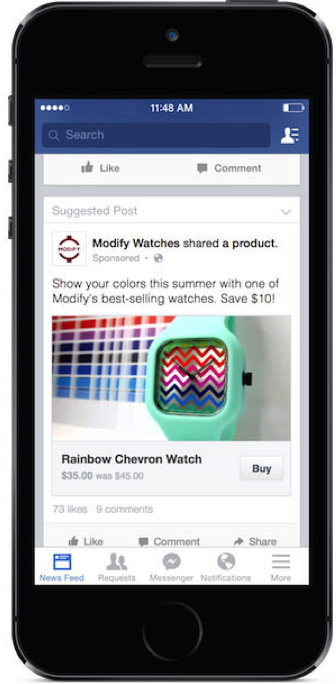
    The social behemoth is testing a new ‘Buy’ button that will let users purchase products without leaving the site. If launched, brands can use this feature to drive sales from News Feed and their Pages.

    Users can now click the ‘Buy’ CTA on ads and Page posts and purchase directly from a brand. Facebook is Testing 'Buy' Button

    Facebook assures users of privacy when using this feature. It says that it will not share with advertisers any of the credit and debit card information users share with Facebook. Users can also select whether they would like to save payment information or not.

    This test is being run with a few small and medium-sized businesses in the US. Facebook says that it will share more information after receiving feedback.

    This feature will allow for more Facebook-driven sales since users don’t have to leave the social network to make purchases. Often, the need to leave the site deters users from purchasing from social networks. If implemented, the ‘Buy’ button can increase sales for brands thereby driving better Facebook ad ROI while making it easier for users to shop on the site.

    Twitter

    The social network is in the news again, this time for the acquisition of payments infrastructure startup, CardSpring.

    This move by Twitter is being seen as an effort to strengthen its e-commerce offerings to increase revenue. CardSpring lets developers build applications for credit cards, discount coupons and other payment systems. Users can collect sales offers, sync them with credit card and collect at stores later.

    CardSpring can help Twitter boost ‘on the spur of the moment’ purchases. As soon as users spot great offers on Tweets, they can immediately purchase with CardSpring’s technology. Along with breathing life into Twitter’s revenue, this technology can also set up Twitter as a name for impulse purchases. This feature will also help users cash in on quick, on the spot deals.

  • Facebook Acquires LiveRail and Twitter Picks up TapCommerce

    Facebook acquires LiveRail

    Facebook

    The latest addition to Facebook is LiveRail, an online video advertising company that provides premium publishers the technology to sell video inventory across all devices. LiveRail connects publishers to major ad networks, Demand-Side Platforms (DSPs), trading desks and exchanges. It uses a combination of real-time bidding and proprietary market data.

    LiveRail will be functioning as a wholly owned subsidiary of Facebook and will be integrating its data with Facebook’s to improve user targeting and display better ads.

    Video ads’ increasing popularity has propelled marketers to take serious note of it. Now, social platforms are catering to marketers’ video ad requirements. Plus, industry trends are leaning towards programmatic ad buying and Facebook’s acquisition of LiveRail underlines the importance of this trend. With LiveRail’s capabilities, marketers will now be able to harness the power of videos ads and will take Facebook’s user reach and user engagement to a different level.

    Twitter

    Treading on the path of boosting its mobile ad offering, Twitter has announced that it will be acquiring TapCommerce, a leading mobile retargeting and re-engagement advertising company.

    After its acquisition of MoPub, Twitter says it has been working on improving its mobile advertising capabilities. Users are increasingly juggling different media and advertisers are spending to gain new customers. However, reviving inactive customers or retaining current customers is equally critical for good ROI.

    Marketers using Twitter can now retarget and re-engage with users using TapCommerce technology. Twitter will be able to provide better capabilities for app re-engagement, tools and managed service solutions for real-time programmatic buying paired with sophisticated measurement capabilities.

    Used with Twitter’s other ad solutions, marketers will now be able to drive ROI with mobile users both on and off Twitter.

    Social media platforms, especially Facebook and Twitter, are constantly innovating and strategically acquiring smaller, niche companies to build up their arsenal. It will be interesting to see whether marketers can keep up with the ever increasing offerings of these two platforms.

    What do you think of these acquisitions?

  • Google My Business Launch and Facebook Plans to Sell Web Browsing Data

    Google My Business launch and Facebook plans to sell web browsing data

    Google

    Based on brands’ feedback that it’s tough to find their loyal customers, Google is making it easier for businesses to connect with the latter.

    Here comes ‘Google My Business’…a free and easy way for brands to connect with customers wherever they are.

    With Google My Business, you can:

    • Update business information on Google Search, Maps and Google+ from one place making it easy for customers to connect with you. This also helps in making sure you provide consistent information to customers across platforms.
    • Add pictures of your business and provide customers with a virtual tour of your business, giving them a glimpse of your company
    • Connect with your customers on Google+ by sharing updates about events and important news
    • Monitor and respond to Google reviews
    • Gain insights and integration with AdWords Express and understand how people find and interact with you
    • Manage your brand’s information even when you are on the move with the Google My Business Android app and the soon-to-be launched iOS app

    Google will be moving brands using Places for Business and the Google+ Dashboard onto Google My Business along with adding new businesses.

    Facebook

    User browsing data and information about the apps they have downloaded will now be provided to advertisers by Facebook.

    Announcing this through a blog post, Facebook said this move was to help users see more personalized ads. The rollout will be limited to US based users initially.

    However, users can opt out of this feature by clicking on this link and selecting the companies they want to opt out from. Users can also opt out from Facebook’s iOS and Android apps.

    Implications

    With Google’s update, brands can now:

    • Connect with customers better and also when they are on the move
    • Manage consistent brand messaging
    • Keep an eye on customer reviews more easily and respond

    Until now, Facebook could target users with ads based on their behavior on the social network only. You can now target users based on their extended web activities. For example, if a user wants to buy a subscription for a PPC service and is searching for it, you can show him/her ads about PPC services using this data. With users choosing to research online increasingly before making purchases, brands can benefit immensely from this data.

  • Facebook Top Performers – News Feed Ads, Custom Audiences and Mobile Ads [Study]


    Facebook

    Facebook news feed ads have shown impressive ROI figures in a recent study by Marin Software.

    The study found that news feed ads in Q3 2013 displayed 44 times higher CTR and 5x increase in conversion rate when compared to the ads that appeared on the Right-Hand Side (RHS) of Facebook. The news feed ads not only outshone RHS ads, they also have a 67% lower CPC.

    Marketers have noticed the high performance levels of news feed ads. Marin Software found that marketers increased their news feed ads spend by 140% in the same quarter.

    News Feed Redesign & Native Advertising

    Facebook’s recent news feed redesign may have had a hand in boosting the performance capabilities of news feed ads.

    As the news feed became more visual-oriented post the redesign, the news feed content requirements for brands also changed; thereby also affecting news feed ad content and probably, their performance. The current emphasis on visuals in digital marketing is also a catalyst here.

    Another factor that probably is in play is that the Facebook newsfeed is a great platform for native advertising.

    Advertisers can subtly slip their messages into the viewers news feed and the better targeted and more attractive these messages are, the greater the chance of them being clicked on.

    Marketers, do take note of this!

    Excellent Performance by Facebook Mobile Ads

    With more and more consumers accessing Facebook through their mobile, marketers are opting for mobile-only campaigns on Facebook. Marketers also seem to recognize that Facebook users behave differently while accessing the site via mobile and computer, and are segregating their Facebook budgets between these two.

    Between Q2 and Q3 2013, 45% more marketers chose mobile-only ads. The reason for this is clear when you see these stats: mobile-only news feed ads outperformed desktop ads with 187% higher CTR and 22% lower CPC.

    This rise in choice of mobile-only ads can also be expected to increase due to the separation of ad buying options by Facebook due to which, marketers can now buy only desktop or mobile ads. Given that marketers may have different objectives while advertising on mobile and desktop, this was a good option that was provided.

    Facebook Custom Audiences Tool Adoption Increases

    Facebook’s Custom Audiences tool, which was launched in March 2013, has seen widespread adoption by brands. It’s not surprising given that it offers marketers better targeting options than the broader options available earlier. Sharper targeting through Custom Audiences should in turn lead to better conversion and lower CPC rates.

    And it has.

    82% more marketers used the Custom Audiences tool in Q3 2013 compared to Q2. This looks like a trend that will continue given the results they have got.

    Ads that used the Custom Audiences tool had conversion rates 3.87 times higher than ads with only demographic or category-based targeting. These ads also showed a 14% lower CPC and 64% lower cost-per-conversion than category or interest-based targeting.

    Facebook advertisers seem to be hitting the gold mine with Facebook’s ad products. What do you think they are doing right? What can Facebook do to make its ads better