Blog

  • Guidelines for App Store Optimization (ASO)


    App store optimization

    Image source: www.searchenginejournal.com

    Over the last few years, the mobile app space has grown into a multi-billion dollar industry. Research estimates 1.2 billion mobile app users in 2012 alone, and that number is expected to grow 29.8% each year. The app industry is broken down by 2 major players (Android and Apple iOS). In terms of OS platform share, comScore (a leading digital research firm) released the following numbers for OS platform market share as of August, 2013:

    • Android: 51.6%
    • Apple: 40.7%
    • Blackberry: 4.8%
    • Microsoft: 3.0%
    • Symbian: 0.4%

    What is ASO?

    App store Optimization (ASO) is the first step to succeed in mobile app marketing.It is the process of improving the visibility of a mobile app (iPhone, Andriod, Windows Phone) in the app store (iTunes or Google Play) and generate extra downloads or sales.

    Why is ASO Important?

    63% of people discover apps via search, according to research firms Nielson and Forrester, so high visibility in app store search results is a key to success.

    Best practices to optimize your app page.
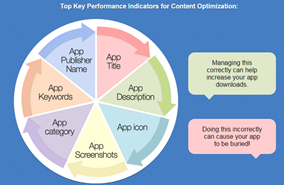
    Content Optimization

    Image source

    App Name/App Title: Tell users about your app.

    Include keywords in your title. Based on the top 25 ranking positions, it was calculated that an app which includes keyword in its title is ranked 10.3% higher than the ones that do not have keywords.

    App Description: Describe everything about your app.

    Focus on convincing the reader and portraying the best picture about the app – here is how it’s done:

    • Get the first 3 lines very right
    • Insert main features and benefits list
    • Include social proof (awards, blog/users reviews)
    • Localize description

    App Icon: Make a first impression.

    Make sure your icon or logo clearly and creatively expresses your app.

    • Don’t include words
    • Don’t standard gloss
    • Simple is good. Simple is clear.
    • Stand out from the crowd
    • Icon/App consistency

    App Screen Shots: Show off your best features.

    Display some eye-catching screenshots of your app in action.

    • Give clear and detailed screenshots of your app and highlight all the best parts of your app with multiple screen shots
    • The App Store allows you to upload five screenshots of your app. Be sure to use every single one!
    • You can add some simple text or additional graphics to your screenshots to drive home the benefits of your app

    App Category: Where does your app fit in?

    Make sure you categorize your app appropriately. A lot of searchers jump straight into specific categories if they are looking for something. Apple also allows a secondary category in the event your app fits into two categories, but always treat the primary app as your most important category.

    App Keywords: What are users looking for?

    The Keyword Field in iOS is a 100 character field which you can use to tell iTunes search for which keywords you should show up

    • Focus on relevancy, search volume, and difficulty
    • Don’t use multiple word phrases; break out to individual words
    • Don’t repeat keywords that are already in your title
    • Separate your keywords by commas but do not use spaces – you should use “keyword1, keyword2? instead of “keyword1, keyword2
    • Use ASO Tools
    • In Google Play, the app description has to be optimized

    App Publisher Name: Who’s making your app?

    The publisher name can also include keywords and you might even want to publish under several subdivisions of your company. “Badabing Financial Apps” and “Badabing Navigation Systems” would help you rank for those respective search terms.

    Off-Page Optimization
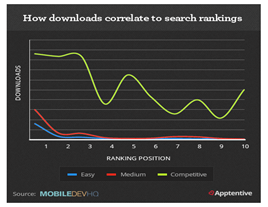
    Off Page Optimization

    Image source

    App Reviews – People always download apps that have positive reviews. Sometimes reviews reveal a great deal of information about the app that may convert into download.

    App Rating – Every app has a rating. People download an app that has a high percentage of ratings. Developing a great app automatically drive great and higher ratings.

    Social/ Articles/Blogs

    Post latest app features on social network to engage with consumers and new users. Keep writing about your app on various blogs. It may cover real life experiences or a basic description of app.

    To reap the rewards of ASO, you need to invest time and effort. If you do, you’ll have a consistent channel driving traffic to your app.

    Contributed by Nitin Revankar, SEO Analyst, Position2 Inc.
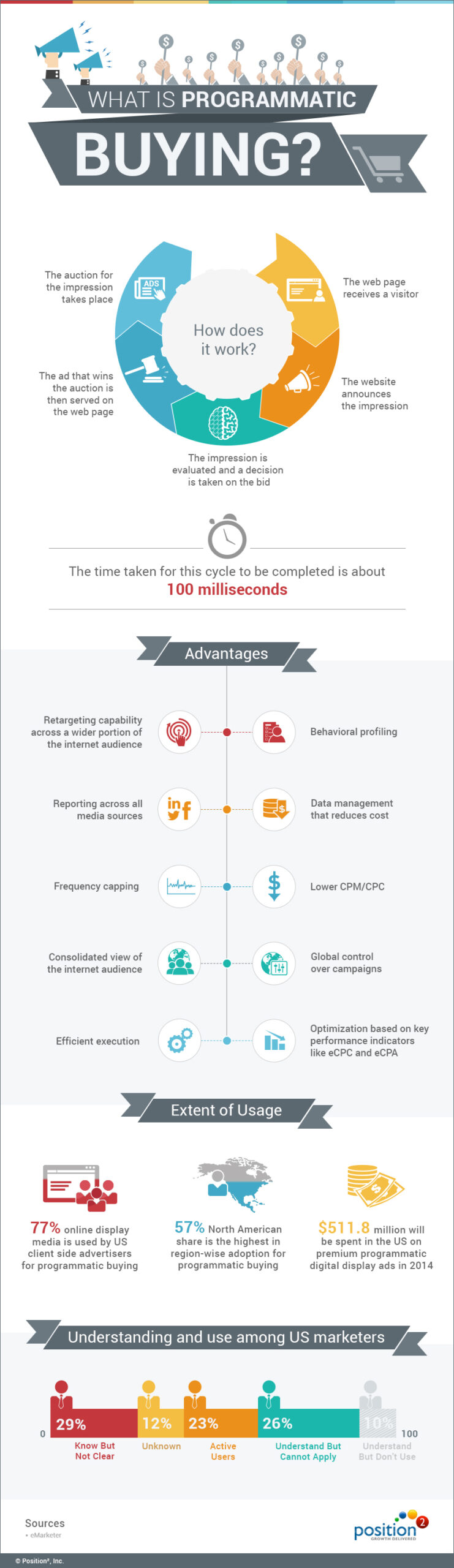
  • What is Programmatic Buying [Infographic]

    Programmatic buying is all the rage today among digital marketers and rightly so. This automation of online display ad inventory has brought in new buzzwords in digital marketing parlance like ‘programmatic reserved’, ‘programmatic premium’, ‘programmatic guaranteed’ and ‘programmatic direct’. All this goes to show the kind of attention programmatic buying is receiving from digital advertisers. It is a heady cocktail of high market value reserved ads that has caught the fancy of premium advertising agencies worldwide and offered directly to them by the respective publishers. All this is done with absolute credibility and efficacy and in real-time through programmatic buying. Check out this visually impactful, data driven infographic to get a better idea.

    Programmatic buying

  • Google Incorporates ‘Structured Snippets’ into Search Results

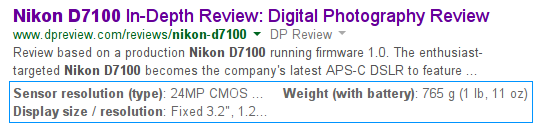
    The Search Engine giant has come up with yet another initiative to offer online searchers a more insightful and hopefully a better experience every time they search via Google. This time it has been named ‘Structured Snippets’ which is kind of self-explanatory. These snippets of information will be displayed for select search terms as facts and data points appearing right below individual search results. To better understand this view the visual example below.

    Structured Snippets

    Fig. shows the search result for Nikon D7100 with the camera core specs tagged as structured snippets.

    Now these structured Snippets that are tagged at the bottom of the original text are not clickable. They merely serve as additional pieces of information helping users to make better decisions without having to follow any links. According to Google, these snippets of information are directly a result of its collaboration with the WebTables research teams. The structured snippets work by extracting information from data tables on a website and then vetting it with an algorithm. This algorithm will test the data for quality, accuracy and relevancy to the search result below which it will be displayed thus authenticating its efficacy. Up to four bits of information can appear under each individual search result, according to an announcement from Google.

    Digital marketers can now take comfort in the fact that their organic search results will have an additional real estate which will cover their pivotal data and facts without any extra effort from their side. Thus, companies purveying goods and services online need to have the key features about their products in their websites so as to assist Google in successfully extracting it. Your readily verifiable objective facts and figures are what will be going into these structured snippets text. All this will give your users a more compelling reason to click your website since now they have a prior knowledge about what you are intending to sell, in terms of hard data.

    So what is your opinion about this new feature from Google, as a digital marketer?


  • Hummingbird Update, B2B Advertising, and much more…| Best of the Week

    This week’s hot news, events and videos from the online marketing and social media world.
    surviving-the-post-hummingbird-era
    From the Position² Blog This Week:
    Surviving the post-Hummingbird era
    The Hummingbird update from Google has taken us one step closer to the ‘Semantic Web’. Read this incisive blog to get a clear understanding of what it means to SEO in particular and digital marketing in general. Makes for a compelling read.
    Top Stories this Week: Social Media
    Top Stories this Week: SEO, PPC and Digital Media
    content-marketin-michael-norton Best of the Week Video
    Daniel Burstein of MECLABS speaks to Michael Norton of Harvard Business School in this Marketing Sherpa video. Michael sheds light on how we might be able to appreciate a thing better when we can visualize the effort that goes into its making.
    White Paper: Increase Visibility for Your Content by 4x
    Today’s traditional SEO is inadequate: Ignite your search results by accelerating visibility in more places than ever before.Download this White Paper and learn:

    • SEO, why the way we know it is not enough
    • Introducing and implementing Enterprise Visibility Accelerator (EVA)
    • Using multi-channel tracking tools for effective monitoring
    • How EVA benefits businesses.

    Download the complimentary EVA White Paper now

    Know more about Enterprise Visibilty Accelerator(EVA)
    If you are reading this blog post via a RSS reader, please click here to subscribe.
  • Surviving the post-Hummingbird era

    Google officially released the Humming bird update almost a year ago on Sep 26, 2013 & we at Position2 had shared our thoughts then. This update was perceived not to be a worrisome algorithm update. But, this can make SEO’s scratch their heads as the approach towards website optimization changes after Humming bird.

    Humming Bird update

    So what does this update mean to Marketers?

    It is estimated that Humming bird affected 90% of search queries & made SEO practices more strict & difficult too. With Humming bird – the underlying layers of the search algorithm have undergone a change and are now more in sync with semantics. This stresses the need to move on from a keyword-focus SEO strategy to landing page level, context based approach while optimizing a site for natural search. Content on site should sound like an answer to relevant search query raised by users.

    Search crawlers are now capable of identifying & listing technical aspects of a website that co-relate with Search rankings. Most important amongst them are Page load time, 302 re-directs, and keyword stuffed metas. Overall on-page factors will remain the most important aspect to focus on while catering to a post-Humming bird era website.

    Although Humming bird may not be as impactful as a Penguin or a Panda; the overall effect lies in the manner in which focus will now shift from keyword-rich content to semantic type of content.

    We see the following impact from Humming Bird:

    Search engines will evolve to be smart engines

    • Paradigm shift in focus : rather than ranking for a query, try to provide the “best” answer for that query
    • Comparison based semantic searches will be served with results from comparison sites: Eg: if the search query goes as “flipkart v/s snapdeal” – Search engines will list review sites, comparison websites & aggregators on top
    • Location based search results will be future – Geo enhancements as part of Search results is already underway – These will also meet Google Pigeon algorithm update guidelines

    Having said about the implications, let us now look at some best-practices & useful considerations for survival in a post-Humming bird era:

    Technical:

    • Ensure that the website in focus is up-to-date with the latest technologies such as responsive web design, hreflang for international landing pages.
    • Define your website architecture and place content in a neat, easy-to-access manner – not only for Search engines but for users too. Remember search engines now cater to consumer behavior
    • Follow best practices of on-page optimization such as on-page Schema Markup, Social Media tags such as Twitter cards, OGP etc.

    Content:

    • Target keywords which are more likely to be used by users (don’t ignore long tail) – as all these contribute in the “semantic” world
    • Have meaningful, grammatical error-free content which resonates to users search intent
    • Create content to answer the 5 W’s of your product/service – Who, What, When, Why, Where?

    Position2’s PoV:

    Our SEO focus has always been on improving the overall health & diagnostics of the site as part of optimization & also delivering the best user-experience on the website. Our thorough audits evaluates close to 40 technical parameters crucial for SEO. In addition, we also provide QC checklists & guidelines for enhancing website architecture.

    In addition to the technical aspect, our detailed, well-researched content calendars are in place catering to primary & long-tail keywords to ensure that there are regular content refreshes happening on the site. We also stress on having an optimized presence on social media to boost organic search presence.

    As Google has aptly named this algorithm to be “precise and fast” like the Humming bird itself, expectations are that sites need to perform to answer precise search queries & of course need to fast!

    Put in your comments and share your thoughts on the Humming Bird experience and how it changed the way you approached SEO.

    Contributed by Chetan Rajasekaraiah, Senior SEO Specialist, SEO Team

    Image source

  • Bing Ads Offers Better Targeting Options

    Bing Ads Offers Better Targeting Options

    The search engine network Bing from Microsoft is bringing in a host of updates in order to help digital marketers to better target their customers with location based targeting. It is also giving you more options in terms of ad scheduling. All this will help marketers to customize their ad campaigns based on their exacting business needs.

    You can advertise to your prospective customers based on their specific geographical location. This kind of hyper-local targeting is most common on mobile devices. Today more and more people are surfing the Internet via mobile devices and this helps to make geo-targeting that much more efficient because of GPS enabling. But there is more to geo-targeting from Bing than meets the eye. Bing allows you to serve a user depending on the location intent of the user as well. If you are selling realty in Los Angeles and a person from New York City is interested in your LA properties then that person will also see your ads even though he is physically in NYC.

    You can even exclude users in a certain geographical area depending on your needs. If you are running a retail chain and you don’t have a store in a certain location then you can exclude that area or if a certain region offers very low conversion rates then you can disable your ads for that location. You can choose the days of the week and the time of the day (in increments of fifteen minutes) during which you want your ads to be served.

    All this is good news to digital marketers who can now better control their ad spends and deliver very narrow targeted campaigns. You can get a detailed report about the location of your users and the impressions that you receive. This can then be mapped back to the device from where it originated for better understanding of user requirements. You can choose the devices on which your ads need to be served like mobile, tablet or PC and even chose the specific OS. You can target an ad group within an ad campaign separately thus overriding the inherited targeting from the ad campaign. All this goes to add that much more punch to your online advertising. Updates like these from Bing will be immensely beneficial to digital marketers going forward.

    So how do you think these new features from Bing will help your ad targeting?

    Image Source

  • Predictive Analytics, B2B Video Marketing, Brand Strategy and much more…| Best of the Week

    This week’s hot news, events and videos from the online marketing and social media world.
    Understanding Predictive Analytics
    From the Position² Blog This Week:
    Understanding Predictive Analytics
    Today marketers need to know about the future of business with a fair degree of accuracy. That is when they turn to predictive analytics which studies current data, detects patterns and predicts possible future trends. Read this interesting blog to know more about this exciting branch of advanced analytics.
    Top Stories this Week: Social Media
    Top Stories this Week: SEO, PPC and Digital Media
    Best Of Week Video Best of the Week Video
    Watch this Webinar moderated by Rick Siegfried that gives you tips on how to optimize your ad campaigns and landing pages using personalized targeting & analytics.
    White Paper: Increase Visibility for Your Content by 4x
    Today’s traditional SEO is inadequate: Ignite your search results by accelerating visibility in more places than ever before.Download this White Paper and learn:


    • SEO, why the way we know it is not enough
    • Introducing and implementing Enterprise Visibility Accelerator (EVA)
    • Using multi-channel tracking tools for effective monitoring
    • How EVA benefits businesses.

    Download the complimentary EVA White Paper now

    Know more about Enterprise Visibilty Accelerator(EVA)
    If you are reading this blog post via a RSS reader, please click here to subscribe.
  • Understanding Predictive Analytics

    Understanding Predictive Analytics

    Everything that happens in the digital world can be recorded and converted into data. Whether you’re visiting a website, buying something online or tweeting about something, it’s all data. Not surprisingly, with the sheer volume of online activity, brands are flooded with data.

    The levels of brand and customer interaction are ever increasing especially with customers active on various communication channels. Brands are building their online presence and interacting with customers on multiple platforms resulting in cross channel marketing.

    In order to keep their eyes and ears open on all relevant platforms, brands are employing social media analytical tools that are also bringing in increasing amounts of customer data. In order to ensure proper utilization of all this data, along with the current need for personalization, you also need to consider implementing a system that will assist in understanding future customer behavior.

    While brands are dealing with incredibly large amounts of data, the good news is that this data can be used to powerfully direct marketing activities with a high degree of effectiveness.

    Enter predictive analytics.

    Predictive analytics is a form of advanced analytics studies current data, detects patterns and predicts possible future trends.

    It helps you make the best use of the behavioral data available by predicting what customers or prospects will do and the best option you can provide them. For example, if data suggests that whenever a particular baseball team loses, sales of beer goes up amongst its fans, the brand can make special offers as soon it knows that the team is doing badly. The brand can make its offer depending on what it wants to achieve – it can ask consumers to try a new variety of beer or try and get consumers to switch brands etc.

    Predictive analytics helps bridge the gap between what you think your customers want and what they actually want. Their current behavior patterns show where they are headed so you can offer your brand when they are primed and ready.

    Predictive analytics points out the instances that are most likely to convert into actual sales in the near future. For example, if data indicates that 1 year after buying a smart phone, customers buy a tablet, then it pays to be ready to be the first brand to offer a tablet a year after the customer has bought a smart phone.

    Instances of Predictive Analytics Application

    Predictive analytics can be used in many ways. If data shows that men increase their investment in life insurance after they turn 30, it’s a good idea to target customers with life insurance as soon as they celebrate their 30th birthday.

    Predictive analytics also helps you predict what products customers would like bundled together. Life insurance and health care for example or even Deep Purple and Pink Floyd albums.

    In online targeting, predictive analytics can help identify which prospect is most likely to react to which ad and which particular offer. An important benefit of predictive analytics is that it helps identify which customers are likely to churn and what’s the best way to stop them.

    If your company is a large corporation with a huge database of customers, it is tough to manually identify opportunities for cross selling and up selling. Predictive analytics can help by tracking customer behavior when they show interest about other products/services, studying their behavior patterns and predicting future conversions.

    However, you need to be mindful of the fact that when you draw data from social media, you will end up with thousands or more mentions. To know the ones that are relevant, you need to build a relevant search terms and keywords database that ensure you focus only on the mentions that are important.

    Have you implemented predictive analytics? What is your opinion about it?

  • eBay Set to Offer New In-app Mobile Advertising

    eBay Set to Offer New In-app Mobile Advertising

    The online marketplace company eBay is all set to launch an in-app advertising network giving digital marketers a new avenue to target customers on the Internet. The amount of time users spend on eBay is much higher than that spent on its competitor sites. This gives digital marketers a very compelling reason to connect with the app’s 4.6 million and burgeoning daily visitors.

    The eBay app is a hot favorite among online shoppers who are either looking for a great bargain or just doing regular shopping. Now a new feature like this from the online marketplace giant is only going to make things more exciting in the ecommerce arena. The digital marketers can at once lay their hands on information regarding the entire shopping journey of eBay users and glean useful data from it.

    eBay will allow placement of advertisements across multiple mobile devices like smartphones and tablets. The kind of customer data that is at eBay’s disposal is really humungous. Since the company’s app requires a customary log-in, all the information about the customer shopping habits are automatically saved and can later be utilized for targeted advertising. Hence, eBay need not rely on cookies but can directly track customers across varied device using first-party data.

    As a digital marketer this is a very attractive avenue for you to create targeted online ad campaigns. You can get data on customer shopping habits, their proclivities and quirky behavior. You know exactly what customers bought in the past, what they are seeking and what they would want to buy. This is an invaluable data for any digital marketer.

    The company is contemplating to launch this new feature in this year’s last quarter. In a video on eBay site, the online marketplace giant says that 40% of its sales occurred on mobile devices that contributed about $20 billion in gross merchandise volume in 2013. So whichever way you look at it the opportunity for digital marketers is too big to be ignored.

    So what do you think the new eBay in-app advertising platform holds in store for you?

  • Creatives in Today’s World, Attraction to Action, and much more…| Best of the Week

    This week’s hot news, events and videos from the online marketing and social media world.
    Creatives in Today’s World
    From the Position² Blog This Week:
    Creatives in Today’s World
    Creatives is one aspect of marketing that is receiving considerable attention today and rightly so. Read this exhaustive interview to know what exactly it entails and the skill sets required to be a part of this highly competitive field. Get an inside view of how a creatives team for B2B digital marketing functions and some idea on where this realm as a whole is headed.
    Top Stories this Week: Social Media
    Top Stories this Week: SEO, PPC and Digital Media
    Best of the Week Video Best of the Week Video
    Rand Fishkin talks on Whiteboard Friday about keyword research and targeting without Exact Match data from Google Adwords, going forward. Watch this video for some very insightful tips on how to make the best of the changing scenario.
    White Paper: Increase Visibility for Your Content by 4x
    Today’s traditional SEO is inadequate: Ignite your search results by accelerating visibility in more places than ever before.Download this White Paper and learn:

    • SEO, why the way we know it is not enough
    • Introducing and implementing Enterprise Visibility Accelerator (EVA)
    • Using multi-channel tracking tools for effective monitoring
    • How EVA benefits businesses.

    Download the complimentary EVA White Paper now

    Know more about Enterprise Visibilty Accelerator(EVA)
    If you are reading this blog post via a RSS reader, please click here to subscribe.