| This week’s hot news, events and videos from the online marketing and social media world. | ||||||||
 |
||||||||
 |
||||||||
|
||||||||
|
||||||||
| If you are reading this blog post via a RSS reader, please click here to subscribe. |
Blog
-
Content Marketing, ROI of PPC Advertising and much more…| Best of the Week
-
The Google Tag Manager gets an Update
The Google Tag Manager is a very useful tool not only for the IT fraternity but also for the digital marketers. You can make the whole process of tag management more predictable and tailor-made for your specific needs. Some of the features associated with the just released Google Tag Manager update are as follows:
- Customizing the Tag Manager to your unique needs using new APIs
- A user friendly interface that can launch and edit your tags quicker and more efficiently.
- A host of other third party templates that makes tagging easier than before.
A tag is an HTML code that executes on a web page or a mobile app. Without an integrated tag management solution you have to manually add the individual tags to the source code of your site. The Google Tag Manager Update (GTM for brevity) helps you manage how tags are deployed on your website or mobile app making the whole process hassle-free. You just have to specify the tags you want to use and the GTM will do all the hard work. You get a powerful set of tools to control how these tags are fired and how your tag data is handled using triggers, variables and a data layer.
GTM for the web is deployed using a single container code snippet that you can place on all your web pages. For the purpose of mobile apps you can use the Tag Manager SDK. These container snippets will handle the deployment and execution of various entities like Google AdWords, Google Analytics, Floodlight ( A Floodlight tag is an HTML tag that you place on your website to track conversions, such as a consumer making a purchase or completing an online form), and other tags that you might be using.
The GTM platform is intuitive and structured making it easy even for first time users to take control. The Google Tag Manager API helps you better manage your web interface. You can easily manage bulk users and set up role-based permissions and the API will provide the right level of access to the right users. You can use the API to generate master container templates to make variations with respect to domain and campaign ids.
Tags could be used for a variety of purposes but most of the tags in GTM are used to send data from your site to a third party site. GTM uses triggers and variables to decide how and when your tags are fired. Tags are deployed based on events and are executed when a page loads or when there is some kind of an interaction with your web page.
You can decide when exactly to execute a tag depending on a specific customer interaction on your website, example, somebody clicking on a download form or a submit button. Thus, you can get specific data regarding the customer behavior on your website which helps you analyze how your digital marketing campaigns are performing. Based on these insights you can tweak your campaigns to improve your digital marketing strategy.
Will you be utilizing the Google Tag Manager update for your websites and mobile apps?
-
Effective Ways of Measuring Your Content Marketing Efforts
Did you know that 92% of companies that blogged multiple times a day acquired customers via their blogs this year? It is time to take full advantage of this content marketing craze by reaching out to your customers with the right content.
The Rise of Content Marketing
All Google updates have led to one conclusion by SEO experts: Content is King. It all started in 2011, when the search query “content marketing” began its rising trend, and has now grown to be extremely common. Creating quality content for your business has major benefits for your search engine optimization, social media marketing, and your company’s overall branding.
What is Content Marketing?
Content Marketing is the new way to get higher search rankings and increased sales by creating useful, informative content that is appealing both to your target group and also to Google and other search engines. The motive is to attract, obtain and engage a clearly defined target audience in order to drive profitable customer interactions.
By answering the most frequently asked questions with respect to your content, your company can become the most credible resource for your domain and gain new leads that convert to customers in the long term.

Image Source: Iciweb
What types of content should you create?
If you are looking for opportunities to generate more results from your marketing efforts, you need to look at establishing a content marketing strategy. This Pyramid highlights a variety of different types of content that need to be taken into consideration:
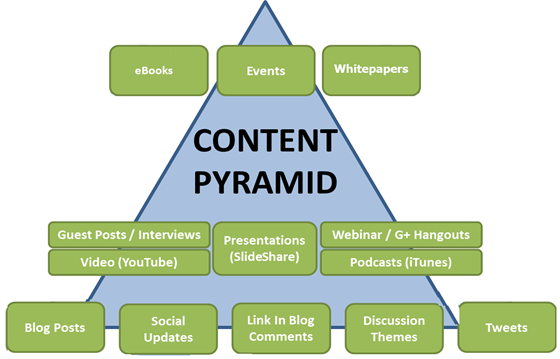
Content Marketing: Parts as a whole
- Creating Valuable Content: Content needs to be created for your audience with the objective of informing and educating them, by simultaneously boosting your credibility and connections with consumers. This can be done in the form of articles, eBooks, press releases, white papers, blogs, webinars, posts, infographics, etc.
- Distributing that Content: This unique content needs to be then shared with users through social networking websites, blogs, through e-mail marketing and other platforms where your viewers are active, provided your content is suitable for that particular platform. Once your content strategy has been recognized, metrics need to be defined in order to accurately measure and monitor your success.
Take a look at metrics to effectively measure the content marketing efforts:
- Brand Lift: “Brand lift” is the blanket term for a brand’s increase in customer or audience perception. This is a concept that has its roots in online advertising (brand advertising, to be more specific) and refers to an increased awareness of the brand (product, or contribution), attitude (view on quality, value and appeal), recall (ability to evoke), favorability (likelihood to recommend), and intent (likelihood to purchase)-all of which can be a challenge to measure.One way to measure the rise or fall in the sentiment of your brand in the long run is through social media. Once we have a plan in place, we create content that promotes your brand and conveys your expertise, distributing it over the right channels to ensure effective placement. When highly consumable content gets published in front of your target audience, you can begin to gain authority and thought leadership in your industry. Increased authority in your space not only helps to retain customers, but also generate awareness and trust in your brand. This creates an organic sales funnel that can dramatically increase conversions.Ultimately, this increased inbound traffic improves your overall branding.
- Social Media Success: This is a metric that allows you to better understand where the social traffic is coming from. By observing the gross amount of social media success, your business will be able to understand what type of content was well received, on what platforms and by which users. It also helps explain how these social actions are affecting your other marketing channels too.The “social media content” widget looks at how many “social actions” were taken while viewing your content. These can include:Interactions – Likes, Comments, Shares, Replies, Retweets, and so on.Reach – The percentage of fans that have seen your post from your page.Engagement Rates –A formula for quantifying a brand’s success.This is a valuable performance measure, as it displays that visitors didn’t just passively leave the web page open for an extent of time, or click through to other web pages because they were bored. It shows that they actually appreciated your content enough to share it within their network.
- Onsite Engagement and content effectiveness: Once traffic is driven to your website from the variety of content that has been distributed to your audiences, the hope is that this effort will drive repeat traffic to your web site. The metrics in Google Analytics helps measure whether the content you’re creating is engaging enough to draw traffic to your website from the search engines. This allows you to make two conclusions about those pieces of content that are attracting a lot of readers and giving you a lot of their time.Firstly, that content is building relationships by compelling readers to return. Secondly, that valuable content is creating an increase by facilitating repeat exposures.This is a valuable way of determining if your content marketing efforts are driving real value to your business. If your content efforts are often the most viewed part of your website, it might be safe to say that your audience is finding value and that you are educating them on a particular expertise.
- Google Analytics audience Widget: Google Analytics is a collection of widgets that allows you to quickly visualize your data. The audience related widgets on the Google Analytics dashboard provide information about viewers. The visitor’s pie chart gives an idea of the number of visitors that revisited the website because they found well optimized content in search engines.Some of these are:“Content behavior metrics” Helps to determine the number of new/revisiting users. Also helps to check whether the content you are creating is engaging enough to draw traffic to your website or not.“Site Content metrics effects” Shows the website’s ALL/ landing pages performance metrics which helps in determining which page content played an important role to get the visitors on the website.Lastly, “GEO metrics effects on content strategy” shows you where in the world your visitors are from. You can use this data to improve your content in all kinds of ways, such as:‘Visitor Language use’ helps in optimizing multi-language websites.‘Location area’: helps to determine the place / nearby places of the visitor, hence it can be helpful in optimization / filtering the content related to location.By using Google Analytics we can measure the content effectiveness using real data. It is always helpful to see what is effective and to avoid what is not.
- Lead Generation: One of the most valuable metrics to monitor when it comes to your content marketing efforts is if lead generation efforts have increased. Lead generation is important because leads are the most likely people to convert and make your business revenue grow. This is where we start determining whether the content marketing efforts are making financial sense.When a visitor signs up on a website, he/she enters his/her contact information to have access to exclusive content created by the company about business. This visitor is a new lead who can eventually become a paying customer. It is important to measure the rate at which leads are being generated from the website content to see what type of content is working to get more traction from your web visitors.Successful content solicits a certain response from your target audience. For instance, taking advantage of a special gift or promo being offered and filling up information sheets that converts visits into leads.
- Conversions: Consumption is the most basic and most measurable type of metric you can use to measure content marketing success. It is straightforward and deals with real figures and statistics. It states how many people actually consumed your content. Google Analytics, Website platforms and social media insights already have these tools available for you to use and the only thing left for you to do is use them and gain better insights about your content consumption. Content marketers and conversion optimization professionals have a glorious collaboration ahead.
- Thought Leadership: Content marketing can describe a business as being an expert or a thought leader in an industry which can lead to many invaluable benefits. Becoming a thought leader and a trusted source of information will gradually gain more traffic, follows, and subscriptions, leads, and conversions over time. Social signals get a boost when website owners refer your work and when social media followers share the content. Take a step back and observe the media mentions of your content, if other thought leaders refer to your content, if the media is requesting for your contribution on certain topics or requests the leaders to speak at business events.Look at how your content is performing and helping you to position your company as a thought leader. By becoming an industry known expert, your content could continue to gain more traffic, follows, subscriptions, leads, and conversions over time. Overall, there are several ways to measure the performance of content marketing strategies.What metrics does your organization use to measure your content marketing? How often are you analyzing the results of your content strategy? I’d love to hear about your experience with your content marketing strategy. Share your thoughts in the comments below!
Blog contributed by Anu Gupta, SEO Analyst, Position2
-
Salesforce Makes a Big Splash with Wave
Salesforce, the global cloud computing company best known for its Customer Relationship Management (CRM) tool- Salesforce.com is getting
 into the big data arena with the launch of its new product ‘Wave‘. This Analytics Cloud platform Wave creates sales, service and marketing analytics that can be read on desktops and mobile devices alike. It can be used to derive more insights from data within Salesforce products or it can also be deployed to extract value from imported third-party data residing on various platforms including machine-generated data.
Wave is a pioneering cloud analytics platform designed to meet the needs of all business users regardless of their size. It makes extracting useful data and discovering new insights easier, thus, assisting in taking actionable decisions faster.
According to IBM business intelligence, 90% of all data today has been generated in the last two years; no wonder we live in an era of constant information overload! When there is some much data around we need proper visualization of patterns and situations as much as we need number-crunching. The Salesforce Wave is a platform that attempts to give us a 360 degree view and access to data assimilation, going forward.
According to Alex Dayon, the President of Products at Salesforce, “Analytics is a $42 billion industry, and people need a new cloud-based platform for it.” Wave is filling that digital void between enterprises and their customers giving them a single platform by which they can communicate and coordinate. This will help Salesforce to go beyond traditional sales and marketing customers to deliver mobile first visualizations of data beyond that which exists on the global CRM giant’s platform.
Digital Marketers will Benefit Immensely
Today all the information that goes into social networking sites, search engines, net banking, and digital communication can all be aggregated and analyzed to take actionable decisions using Wave. This will help businesses understand their customers better and create personalized marketing campaigns with the upshot of boosting sales. The real benefit of this platform is that it is going to democratize data in hitherto unheard ways. Even smaller business entities can immensely benefit from this new Salesforce Wave launch at Dreamforce 2014, San Francisco. It could be used as an analytics front-end to human resources, supply chain and manufacturing data. Digital marketers could build custom mobile analytics apps by making use of any data source available. Hence Wave is a great leveler, bridging the divide between the big and the small at least in the digital data forum. The potential is immense and we are only beginning to scratch the surface of things that are going to manifest in the not so distant future.
Are you as excited as we are about this new Wave launch from Salesforce? Please do let us know.
-
Google Authorship, Native Advertising for B2B and much more…| Best of the Week
-
Facebook Raises the Ante in Mobile Ad Space
Facebook has officially launched its mobile ad platform called “Audience Network” which lets digital advertisers to serve ads on third party apps. Now this is just an extension of the Facebook advertising program and it even involves the same ad inventory that serves ads on Facebook’s own site and its apps. For long Facebook has been struggling to monetize its database of over a billion users without much impact. Now this launch of its mobile ad platform will give a fresh boost to Facebook’s advertising capabilities. It is a simple way to augment its advertising reach across the burgeoning mobile apps category to improve targeted advertising. This will no doubt be beneficial to advertisers but at the same time it offers value to the users and the app publishers as well.
This Facebook platform immediately serves two purposes. Firstly, it helps Facebook to leverage its treasure trove of user information without putting more pressure on its already existing ad programs. Secondly, it gives advertisers an opportunity to display their ads to more people based on specific demographic needs. With the launch of Audience Network, Facebook will now be able to compete directly with Google AdMob, Yahoo Flurry and Twitter MoPub in the mobile advertising space. A major chunk of Facebook’s revenue today is coming from the mobile space and hence the social media giant wants to bolster its position in this arena lest the search engine giant Google permanently renders it to a distant second place.
What it Means for Digital Marketers
The mobile app space is growing at a torrid pace but unfortunately there aren’t many organized advertising networks that cater exclusively to this space. Facebook now is trying to bridge that gap. It will no doubt bring its deep expertise of using targeted advertising to create better campaigns in the mobile app space too. Digital marketers like you can take comfort in the fact that Facebook can now use the same targeting options that it uses to push ads on the social networking site such as age, gender, social contacts, buying habits, et al in the mobile arena too. You can now make your ads resonate with the right customer group and command more qualified leads giving you better return on investment.
Facebook is linking its Audience Network to its existing ad network which means you cannot buy ads on Audience Network without buying ads on Facebook as well. For those of you digital marketers already running News Feed ads on Facebook using this new mobile offering from Facebook is just a click away!
You can better meet your business objectives using Audience Network like increasing app installation and engagement. The platform supports ads in three creative formats namely banner, interstitial and native. Early tests have shown that the ads on Audience Network offer great value for money and this has got the digital marketers quite excited.
So, will you be using Facebook Audience Network to get more digital bang for your buck?
-
Google Authorship Axed but Author Rank Endures
It was heralded as a radical idea that was going to change online content marketing forever. Google patented Agent Ranking/Author Ranking way back in 2007. At that time, the idea was to give due credit to writers/authors for the content that they generated by tagging their identities to their content when it showed up in the results page. The goal was simple and if it had been successfully accomplished, online content would have had an added layer of credibility.
Google’s enthusiasm is understandable. After all, its mission is to organize the world’s information and make it universally accessible and useful.
But for Google things did not pan out the way they had expected. Surprisingly it offered a rather cumbersome option for authors to add their identities to their content. Latest statistics reveal that a majority of the authors made no effort to attach their names to their content. Thus, the very purpose of Author Ranking was defeated due to authors’ aversion to ‘publicity’. Ironically, while real authors didn’t use this feature, there was a proliferation of fake ‘authors’ attaching their names to content they never wrote.
This setback did not faze Google. It’s a research based organization at heart and views failures as stepping stones to success. The company tests and evaluates every product, innovation or change. After rigorous testing anything that does not meet the company’s expectation or does not provide enough user value is ruthlessly terminated. It’s this very discipline that keeps Google at the top of its game even after so many years.
In keeping with the company norms, Google finally had to pull the plug on Author Ranking and call it a day. But that does not mean the search engine giant will not be researching talented authors and make this a leading factor in deciding Page Ranking going forward. It has more than one ways to do it. Google Knowledge Vault is a good case in point and so is the schema markup. It keeps a tab on authors and sees to it that content from tried and tested authors is always valued better than greenhorn writers who are yet to earn their stripes.
What it Means for Content Marketing
Where once the content was followed by the name of the author and a picture in search engine results, the page will now look more lackluster. This doesn’t have to deter content writers and marketers since according to latest research from Google the Authorship snippets in any case offered very little value to searchers and there was no radical change in ‘click behavior’ on results page.
The search engine will rely on Author Rank nonetheless to reward quality content. There is schema.org which is a collaboration of major players in the field of online search. Schema is a microdata that helps search engines to better parse and interpret content on the web in order to better rank it in the results page.
Quality content deserves recognition and reward. Google Author Ranking was a wonderful initiative and something that deserved to do much better. Position2 engaged with a financial services company and recommended Author Ranking that helped them get their content a far higher ranking in the search engine results page.
We believe that the current avatar of Author Rank will continue to help in ranking authors as per their credibility though it will remain inconspicuous to the lay user. Having recognized the need to provide search engine rankings based on author credibility, Google is unlikely to give up on this. While Google has officially pulled back this offering, it’s probably a strategic retreat for them to work on it away from the public eye.
Giving up on a juicy research problem is just not the Google way!
-
Take Your Mobile App Marketing Campaigns to the Next Level with Deep Linking
What separates a successful mobile app from an unsuccessful one? Design, ease of use, demand, effectiveness, etc. all play their part.
The truth is, however, that effective marketing can make a huge difference between an app that is a commercial success and one that gets lost amongst the ever burgeoning crowd of daily released apps.
In addition to putting some marketing effort behind you app’s promotion, it’s incredible how many app developers and marketers aren’t aware of capabilities of mobile app such as what mobile deep linking is, never mind how to use it to benefit their marketing campaigns.
Let’s take a quick look at a few steps you can take to significantly enhance the success of your app through smarter marketing with deep links.
What is Mobile App Deep Linking?
Mobile app deep links in search results allows users to click links to view specific content within your app, or download your app, depending on if they have your app installed. If a person doesn’t have your app installed and clicks on a deep link, they will automatically be directed to your app’s page in the App Store so they can download your app before proceeding to your deep link landing page within an app.
If a person doesn’t have the app installed and clicks on a deep link, they will automatically be directed to the app’s page in the App Store so the user can download the app before proceeding to the deep link destination. Deep linking helps simplify the conversion friction by shortening the users’ flow to the piece of content, product or promo they are interested in which convince user to a buyer.

How deep link works?
Allowing your mobile app to be launched via a link is a necessary first step to making it accessible from the web. This enables promotional efforts (email, social posts, ads, etc.) to lead users directly into your mobile app which is typically a better and more seamless experience for your customers.
If your mobile app is already set up to handle a URI, you are ready to create optimized links that detect if the app is present on a user’s device and then takes them to the mobile app content they are looking for!
What is URI?
In short, a URI is really just a link. The most common kind is a web link (http://www.google.com) which when clicked instructs the browser to render a web page. A mobile app URI is another type of link that allows a user to launch an app—not just a browser—when clicked; for example, youtube:dQw4w9WgXcQ will bring up a video in the YouTube app if it is installed. On both iOS and Android, any mobile app can indicate that it handles URIs, and for this reason, URIs are an ideal mechanism by which mobile apps can be launched from the web.
Benefit from deep linking?
For apps such as shopping, travel, hotel booking, music and news the ability to send users to a specific product, offer or promo page can have tremendous effect over conversion rates and ultimately revenues. For example, if deep linking is enabled, the user can be navigated directly to a certain hotel booking page for which he has seen an advertisement instead of the app’s home page.
Does deep linking works only for users that have the app already installed? Not true.
Deep linking benefits both pre-installed and new users. There are programs that can carry forward the saved request. If the user doesn’t have the app installed, he/she is sent to the App store and, upon opening the app after the installation, is directly taken to the deep linked page for the user requested content.
Even though deep linking is only used as a re-engagement mechanism to bring users back inside the app, it has an enormous potential to drive conversions and ROI.
Why Mobile Deep Linking Important?
Deep linking helps every mobile app which has multiple screens, products or sections to offer for the interested customer. This means that instead of making every user open your app’s main screen and then manually navigate, deep links can take them directly to the desired page.
There are a number of reasons why mobile deep linking is incredibly important.
Deep linking:
- Allows you to highlight areas of your app which do not get lot traffic. With deep links you can easily point to specific areas of you app that you want to highlight and “refresh.”
- Allows you to enhance the flow of your app, encouraging users to engage and view specific content. This could be anything from media content to new subsequent products offered by yourself or affiliates.
- It also allows you to exponentially increase the revenue. By encouraging visitors to engage with, and view other sections within your app, you will be able to align ads with the most relevant content, significantly increasing the conversion rate.
- Allows your app to be more discoverable. Since Google now indexes deep links within apps, more of your content can be found from user queries with the search engine.
- Helps drive re-engagement. For example, a retail company can notify existing customers about the current promotion and drive interested users directly to the product page. It’s time to think beyond the install and start driving value post download!
- Improves the experience of your cross channel marketing campaigns. You can use a deep link for the destination of your promotions across email, social, third parties and your website.
- Removes several layers in the conversion funnel. When users don’t have to navigate through your app to get to the offer or intended destination, you’ll likely lose fewer users through the conversion funnel.
- Helps you understand cross-channel measurement. With the ability to track and measure user experience with deep links, marketers will have a better understanding of how mobile fits into the buying path and the gain insight into the full impact of mobile in their marketing strategy.
Effective Way of Optimizing Mobile App Deep Linking
Google also provided a list of best practices to consider when adding deep links to your app:
- Identify the URI of the section to be linked is most critical – Publishers must specify app deep links for their homepages, or else the links won’t show up.
- App deep links should only be included for canonical web URLs.
- Not all website URLs in a Sitemap need to have a corresponding app deep link. Do not include app deep links that aren’t supported by your app.
- If you are a news site and use News Sitemaps, be sure to include your deep link annotations in the News Sitemaps, as well as your general Sitemaps.
- Don’t provide annotations for deep links that execute native ARM code. This enables app indexing to work for all platforms.
- Make sure the back button behavior of your app leads directly back to the search results page.
Mobile deep linking the future
Mobile web use has been declining, while mobile app use continues to spike, now occupying 86% of the average US mobile consumer’s time. If deep links weren’t a part of your mobile engagement strategy before, it’s time to consider adding them. As mobile app use rises, deep links gain traction. Right now, they make for better app discovery, engagement and conversion with richer opportunities. In the future, when deep links are adopted at scale, they will make navigating between apps similar to how we navigate between web browsers, with more fluid pathways.
Blog contributed by Rajkumar Raju, Assistant Manager-SEO, Position2 Inc.
-
Facebook “Like” Button goes Mobile
Facebook has come up with yet another update wherein the ubiquitous “Like” button will now be available for Android and iOS mobile apps too. This has got the digital marketers quite excited since now they can analyze user engagement via mobile apps. The mobile users can directly “Like” the app’s Facebook page or any other object within the app and share it on the social networking site.
Today more and more people are using mobile gadgets like smart phones, tablets and phablets (phone + tablet) as their primary device for browsing the Internet. In the world of mobile devices the apps rule supreme. So any marketing strategy that does not take into consideration this vital factor is doomed to fail. The Facebook “Like” button going mobile in order to garner the attention of the growing clan of app users is a well-timed update from the social media giant.
The “Like” button works flawlessly with the user’s Facebook account no matter what device he/she is using to log into the account. This makes liking any piece of content in the native app effortless. Facebook has issued some guidelines for digital marketers in order to make the most of the Like button on mobile apps. They are as follows:
- Research when exactly to show the Like button.
- Position it strategically to get the best outcome.
- Have a riveting Facebook page.
As a digital market you have data of a whole new segment of consumers using mobile apps, at your disposal. Using the “Like” button you can find out which is the form factor that your customers are most comfortable with and how it converts into more marketing leads. This can give you an accurate picture about which platform is the most profitable. Thus you can pursue a digital marketing strategy taking cue from this new found knowledge.
Mobile marketing will upend the digital marketing world for good. So you have to be always nimble and on the lookout for new opportunities and threats alike. You need to have a team of technologists with an intuition of future technology, business executives with an eye on the revenues working together seamlessly. Their efforts can then come to fruition using market intelligence apprising you about imminent business prospects.
It was but imperative on the part of Facebook to bring an update like this since the majority of Facebook users are youngsters. So keeping in sync with the mobile centric demographics that Facebook has, it had to bring its desktop features and capabilities on to the mobile bandwagon thus benefiting publishers and developers on this burgeoning platform.
So how do you think this new update from Facebook, is going to augment your digital marketing campaign going forward?
-
Facebook Launches Atlas
Facebook has officially launched the Atlas advertising platform which is purportedly going to give the giants of the industry like Google a run for their money. Facebook calls this “people-based marketing” since the social media giant will not be utilizing cookies to track people and to learn more about their browsing habits. It will be using the login credentials of its over 1.3 billion users, the biggest database of any Internet company in the world! Hence, Facebook can track a user on mobile devices too since they are not relying on cookies here (cookies don’t work on mobile devices). It is going to be a paradigm shift as far as advertising is concerned and this has got the digital advertising agencies quite frenzied.
Facebook can even track its users offline. If a Facebook user goes about shopping in a mall and enters an email id in the shop registry and that shop is on Facebook, then the social networking giant can map that id to the actual user. It can then easily find out whether that person saw a particular ad or not! This helps marketers to reach real people across devices, platforms and publishers. So the cross-device impediment that they used to face until now has been removed. They can now target, serve and measure the performance of their ads across devices.
All this leads to better optimized ads that can help the digital marketers get better ROI on their media budget. When a company like Facebook has so much user information the natural proclivity is to tie that data to analytics and an ad server and start targeting users in hitherto unheard ways. “That’s Marketing Nirvana”, said one digital advertising CEO; how true! Marketers will now be able to successfully serve ads to people based on their demographic data like age, gender, socio-economic status, et al. They can even measure how effective their ad campaigns have been at targeting the right customer group. Instagram, as a publisher is already plugging into the Atlas ad server in order to examine and authenticate ad impressions, according to a Facebook Atlas Update. Looks like there is a lot to come in the days ahead.
So, is this the start of a new era of holistic advertising?
What do you think?