| This week’s hot news, events and videos from the online marketing and social media world. | ||||||||
|
||||||||
 |
||||||||
 |
||||||||
|
||||||||
|
||||||||
| If you are reading this blog post via a RSS reader, please click here to subscribe. |
Blog
-
Best of the Week | How to list your events on Google Knowledge Graph and much more…
-
How to List Your Events on Google’s Knowledge Graph?
More and more entities like videos, travel reservations, events, concerts, conferences are being included to the Knowledge Graph on an ongoing basis for an enhanced search experience. This has got the marketers scrambling to provide the most relevant information in order to get listed in the knowledge graph. Google will pick the structured data markup for events from website into the Knowledge graph and would use it for display on Google search

We describe in detail how event sites should mark up their events in order to be eligible for Google’s event features.
Markup the Site using JSON-LD syntax
Google recommends JSON-LD over other markup formats since JSON-LD doesn’t require the marketer/developer to interweave the structured data with the HTML displayed content unlike schema markup.
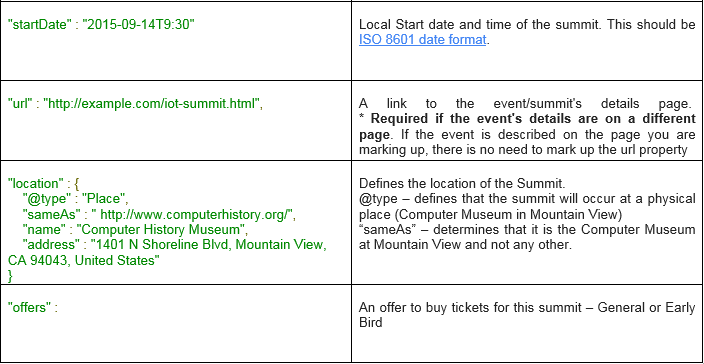
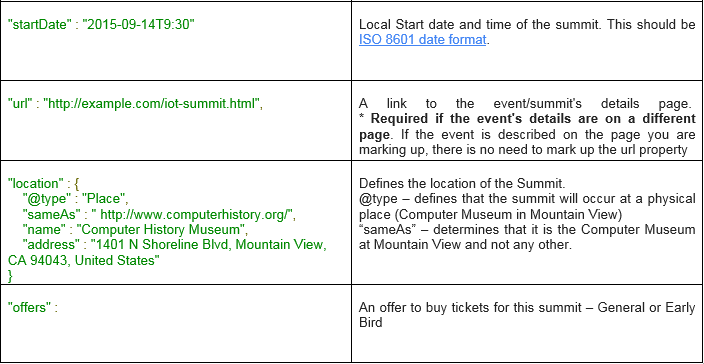
The following example describes some basic information about an IoT (Internet of Things) Summit, including the name, date and time, location, tickets and URL for more information

What the above code means?
Check if the markup is correct using Google Structured Data Tester
Event Markup – Must Know:
- Events from the past will not be shown as a rich snippet on Google Search. Leaving them marked up is still recommended
- Event rich snippets are not meant for advertising purposes. Event name should not contain promotional elements such as the price of the event, a call to purchase, or an indication of a sale or temporary discount, etc.
-
What’s trending? – A New Twitter Trends Experience!
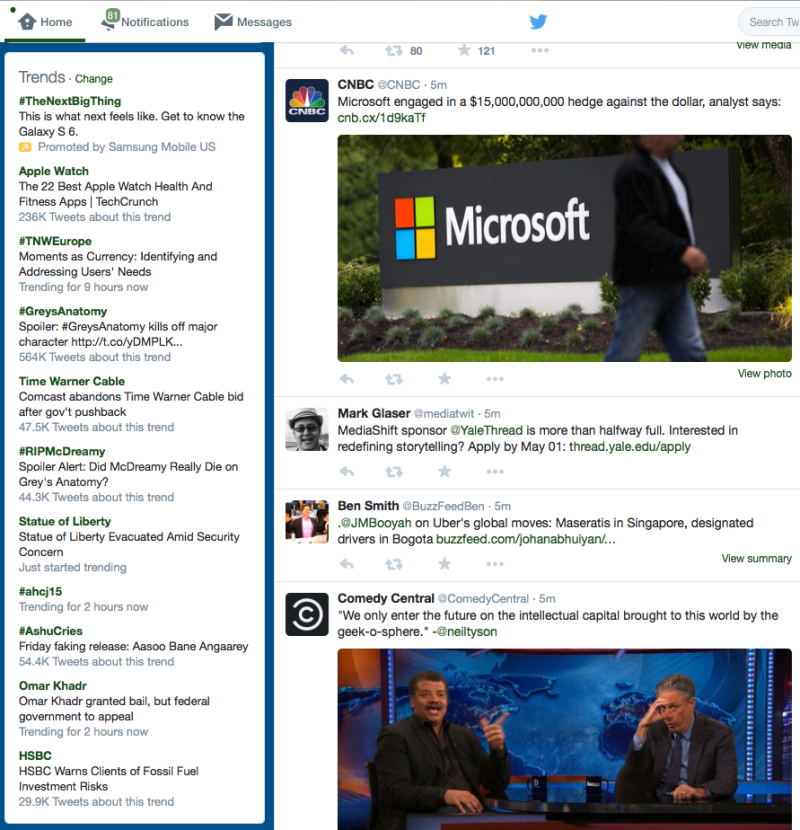
In a bid to give its users a more immersive and enriching experience Twitter introduced a new trends experience for web to run with the similar mobile changes it introduced a few days back. It is, according to the company, “the largest engineering undertaking of the trends system since 2008”. Twitter users will be able to see additional context with their trends — short descriptions, sometimes an image.
Twitter can get so crowded it can be difficult to stay on top of things. With this release trending topics are prioritized and enriched, making them easily spotted and utilized. Trending topics, URLs, users, images, videos — any such application-specific online content – gets ranked hierarchically.
Making trending topics stand out
These new additions will make trending topics pop:
- Description – a short text description about the trending topic
- Image – accompanying the text wherever it adds value
- Data – total volume of Tweets and Re-tweets, the time trending started, etc.
‘Discover’ – the tab that was meant to improve content discovery on Twitter is slowly fading away. The new feature, ‘While You Were Away‘, recaps top Tweets any user may have missed.
-
Mobilegeddon? You Almost Missed the Facebook Update!
While Google busied itself distracting the world on April 21 with “Mobilegeddon“, its mobile-friendly update, Facebook quietly released an update all its own. Did you notice?
Facebook insists that the News Feed exists for one purpose only – to give you the content that matters to you. This latest News Feed update is specifically designed to improve the Facebook users’ experience, aiming at a better balance of content from friends versus content from businesses, publishers, public figures, and local organizations.
The update comes in three layers.
#1: More Content for Content-starved Users
The rule that hitherto prevented you from seeing multiple posts from the same source has now been scrapped. When you run out of recent content and scroll through the News Feed, you’ll now see multiple posts from the same sources.
#2: Updates from Friends Given a Thumbs Up
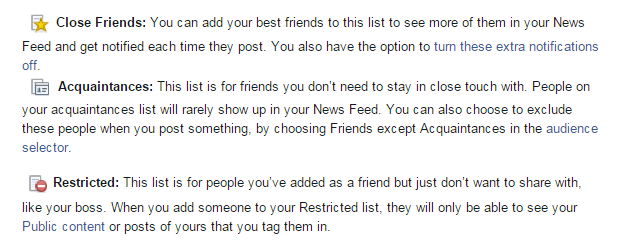
Going forward, content from friends will be placed higher in the News Feed. The Menlo Park social media giant had been getting a lot of negative feedback from users who were missing out on important updates from close friends — photos, videos, status changes, links.
#3: Friends’ Likes & Comments on Posts is a No-show
Likes and comments made by your friends on a Post have been relegated to the bottom of the News Feed so you can focus on what your friends are really saying.

Advertisers Be Warned!
Advertisers will have to make adjustments. Higher grade content posted with consistency will get noticed. Anything else is likely to sink from sight.
-
Best of the Week | Mobilegeddon – The biggest thing since Y2K, and much more…
This week’s hot news, events and videos from the online marketing and social media world. 
Best of the Week Video
Watch this Marketo Summit 2015 Highlights video on YouTube for top takeaways and trends in marketing automation.Persona Based Lead Scoring: The Mystery and the Method Download this White Paper and learn: - Classify leads based on behavior and demographic details
- Develop a consistent methodology to proffer quality leads to sales
- Employ data integrity and tracking
- Deploy marketing automation to improve efficiency and cut costs.?
Download the complimentary persona Based Lead Scoring White Paper now

If you are reading this blog post via a RSS reader, please click here to subscribe. -
Mobilegeddon – The biggest thing since Y2K?
Google rolled out a mobile-friendly update of its search service and search rankings this week and the 24-hour media beast immediately labeled it “mobilegeddon“. Is there need for panic in the streets? Not if you have paid attention to the impact of mobile over the last few years, and adjusted your website accordingly. ComScore research confirms that 56% of digital content is now consumed via smartphones, and that makes mobile optimization a necessity.
Despite the warnings of digital apocalypse Google’s roll out only affects search rankings on smartphones (tablets not included), and only individual pages, not entire websites. But it should encourage a cultural change. Importing websites to mobile just won’t wash going forward. Building a mobile strategy from the ground up is now the order of the day.
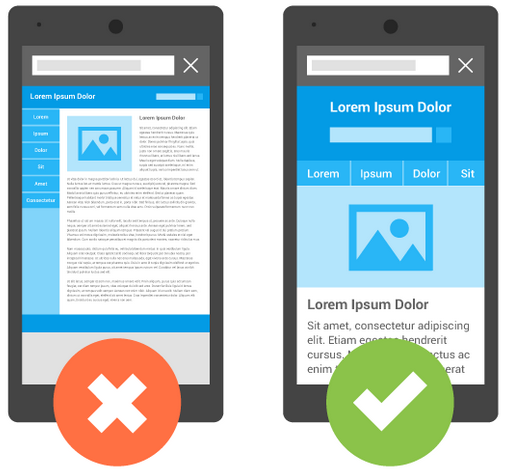
But in the here and now, if you are a webmaster, test your website for mobile compatibility here. To diagnose your website and get a complete mobile usability issues report across your website pages, click here. If mobile users are a big part of your core target group do this sooner rather than later.
Google Analytics will tell you what percentage of your traffic comes from mobile search.
First you need to Sign Up. Then navigate to Audience>Mobile>Overview and review the desktop/mobile/tablet breakdown. What you see is the overview of how seriously you need to make the transition to a mobile-friendly website. Now.
How to “Mobilegeddon-proof” your website
To make certain your web content stays relevant in a “mobile-first” world, check these do’s and don’ts:
- Text has to be readable without tapping and zooming
- Avoid unplayable video content
- Eliminate horizontal scrolling for better rendering
- Do not place your links so close that tapping on one is impossible
- Avoid app download interstitials that block users from completing tasks
- Allow Googlebot access to your JavaScript, CSS and image files
- If you have separate mobile URLs, have immaculate redirects for all mobile users
- Do not have irrelevant cross-links when deploying separate mobile URLs
- Use HTML5 standard tags for animations and videos for a seamless experience
- Steer clear of mobile-only 404s
- Recognize and accommodate the mobile users’ need for speed for. It’s paramount.
Position² will keep you posted on more about how the Google ‘Mobilegeddon’ update pans out in the days and weeks ahead.
Stay tuned!!! -
Bing Adds Close Variants for All Ad Campaigns
Adiós, Exact Match. That’s the official word from search giant Bing. A true exact match will soon be relegated to oblivion. Bing will add Close Variants to all its advertising campaigns beginning May 21st. There are other imminent changes as well and they will impact negative keywords. So advertisers using Bing beware: check out these new changes.
Close variants – keywords with misspellings, grammatical variations, abbreviations, plurals, spacing, and other such close iterations of existing keywords in a campaign – will save time for advertisers while giving them a bigger net to successfully reach out to users inputting keywords in their search queries.
Example:
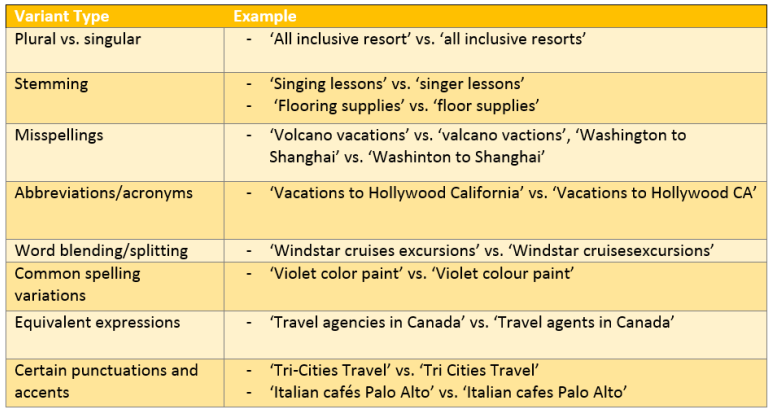
While zeroing in on close variants, Bing will adhere at all times to high relevancy thresholds – this, according to a company statement. By mining close variants from a large pool of qualified sourcing, Bing adds more credibility to search results. Based on metrics from select accounts in the United States where the changes had been implemented last fall, Bing claims that close variants will help drive highly qualified click volumes to campaigns. The select accounts saw an impressive 2-3% rise in click volumes.
New advertisers on Bing will not have to come up with long lists of exact match terms, a true benefit. But advertisers accustomed to laser-targeted spending and reporting metrics may feel some pain from the changes.
Also on board, negatives will no longer supersede targeted keywords. There will no longer be “true blocking” for across the board negative terms.
Example:
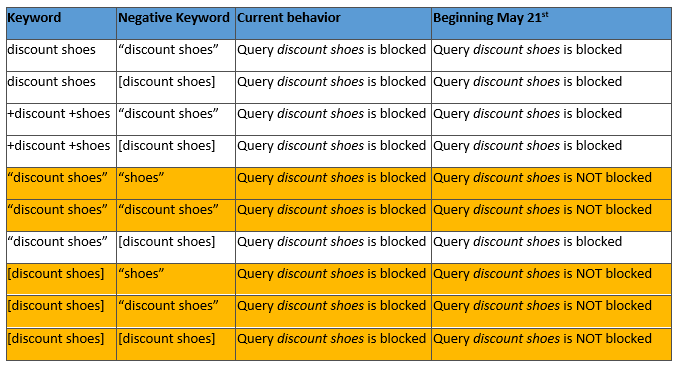
Advertisers will have to remove all terms at the keyword level for which they do not wish ads to be triggered. But Bing shall provide a negative keyword conflict report to discover troublesome keywords and then either pause or remove them.
-
Foursquare Debuts Location-based Ad Targeting
Location check-in app Foursquare just introduced Pinpoint. It’s an ad platform that targets consumers based on where they actually go and builds user profiles with the data it gathers. Foursquare co-founder and CEO Dennis Crowley said, “We want to help solve the problem of how to connect users from the digital to the physical store.”
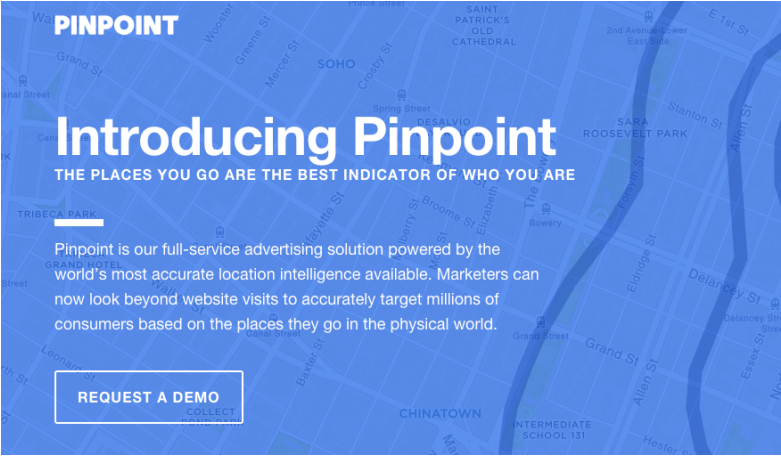
The Pinpoint website describes the newly launched platform as a “full-service advertising solution powered by the world’s most accurate location intelligence available.” Pinpoint utilizes Foursquare’s first-party location intelligence as well as third-party GPS information from other apps and publishers. By slicing and dicing raw data Pinpoint identifies consumer behaviors. This adds context and clarity to the mass of data.
No holds barred digital advertising, anyone?
“Foursquare helps you find places you’ll love, anywhere in the world,” as the tagline goes. Forty-five million registered users seem to agree and swear by this check-in app. Foursquare also helps digital advertisers zero in on (or, pinpoint) location, the Holy Grail of mobile advertising. Using the Pinpoint platform advertisers target Foursquare and non-Foursquare users based on where they have been. The service is not limited to Foursquare apps alone, an important point.
Foursquare should soon be able to sell ads across “a verified ecosystem of apps, exchanges and publishers”, according to a company statement. This means that in all likelihood the local search app will partner with third parties, augmenting what is already an enviable location database.
What ad-men need to know about Pinpoint?
- Your Data – Foursquare’s six years of first party location intelligence made fully available
- Your Ambit – precisely target consumers based on where they go in the real world
- Your Canvas – reach consumers worldwide using an accredited ecosystem
- Your Edge – create custom audience segmentation and targeting using Foursquare’s developed data
- Your Competitors – High profile launch partners like AT&T, FedEx, Samsung have already on-boarded
Advertisers go to Foursquare for decision-grade data based on real-time user check-ins and movement. This is bound to add more impact to online advertising and drive more in-store sales. Advertisers can identify the best neighborhoods that have the best customers for specific products or services and accurately target digital advertising in those particular neighborhoods to drive higher demand, conversions and a better return on advertising spends.
At Position2 we call this business intelligence powered by decision-grade marketing and sales data.
-
Best of the Week | Enterprise SEO Platforms in 2015, and much more…
This week’s hot news, events and videos from the online marketing and social media world. 
From the Position² Blog This Week: Enterprise SEO Platforms in 2015
Your enterprise website needs SEO on a whole new level as compared to a regular website. That is where Enterprise SEO saves the day for search marketers and agencies with SEO paraphernalia, full-service platforms & sundry other techniques. Learn more now.
Best of the Week Video
Be ahead in a personalized digital world. Watch this Whiteboard Friday video hosted by Rand Fishkin for answers!White Paper: The Rapidly Changing World of SEO Get a head start in your quest for search engine optimization by going through this insightful white paper. Download this White Paper to know: - How important SEO is & why it should concern you?
- Various ways in which you can deploy SEO
- How to combine Social Media with SEO?
- SEO best practices and a road map to getting there

If you are reading this blog post via a RSS reader, please click here to subscribe. -
Enterprise SEO Platforms in 2015
Google plays no small part in SEO becoming an ever increasingly complex marketing discipline. Just look at their parade of near-constant algorithmic updates –– Hummingbird, Panda, Penguin. The impact on SEO practices is nothing short of demanding. To succeed in this rapidly changing SEO landscape, search marketers and agencies have turned to automated tools to manage campaigns across search engines, geographies and devices.
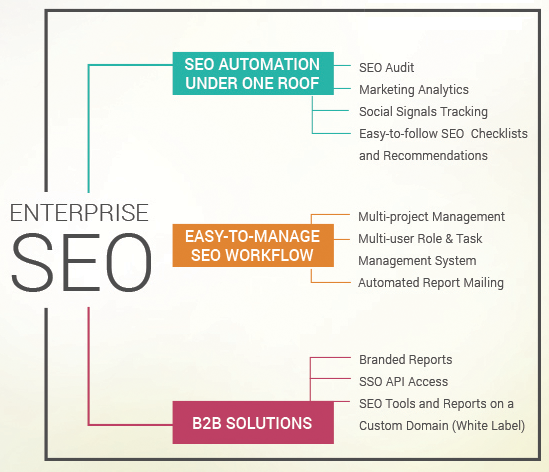
Image Source: WebCEO Blog
Enterprise SEO refers to SEO campaigns implemented and maintained by a business enterprise. At the enterprise level multilingual websites with 1000+ landing pages organized in a thoughtful URL hierarchy are the norm. So too are frequent content creation, focused digital marketing strategy, content management, strong reputation management, all serving a dynamic online community. Marketers and agencies looking for automated tools face an array of choices in an SEO tools market that, while fairly mature, is also highly fragmented.
SEO Platforms Market Trends
Trends driving the Enterprise SEO platforms market include:
- Integration between SEO and content marketing impacts SEO tools, and the enterprises using them.
- SEO strategies adapt to search engine algorithmic changes; the focus on hyper local optimization increases.
- SEO reaches across the enterprise to engage both marketing and technical professionals.
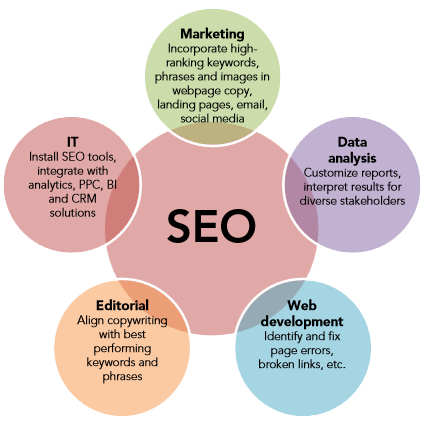
Image Source: Third Door Media
Enterprise SEO Platform Capabilities
SEO software ranges from rank-checking tools and keyword research toolsets up to full-service platforms managing keywords, rankings, backlinks, competitive intelligence, social integration and workflow.
Most SEO solutions offer the following core capabilities:
- Website audit and recommendations
- Keyword research and rankings
- Backlink analysis
- Social signal analysis
Enterprise-level platforms may also provide more extensive link and site analytics that include predictive scoring systems to identify opportunities for improving page performance or link authority.
Other advanced capabilities and key considerations to consider in choosing an Enterprise SEO platform are:
- Content marketing
- Competitor analysis
- Predictive analytics
- Third party data integration
Benefits of Using an Enterprise SEO Platform
Enterprise SEO has become increasingly complicated and time consuming. It involves the management and optimization of hundreds, thousands, even millions of pages, no small feat. Using an Enterprise SEO platform increases efficiency and productivity while reducing the time and likely errors involved in managing organic search campaigns.
Managing SEO through an enterprise toolset provides the following benefits:
- Performing multiple tasks with a single interface
- Efficient management of global operations
- Staying on top of search engine algorithm updates
- Automated & customized reporting