Author: Team Position Squared

  • The Benefits Of Facebook’s Custom Audience Remarketing

    Using Facebook’s Custom Audiences from your website, you can create an audience representing any group of customers or prospective customers that express interest in your product on your website. Later, you can reach these people with targeted Facebook Ads. For example, you could run a campaign to reach out to those who visited your site and viewed a product page, but have not made a purchase.

    Now you can deliver highly relevant ads based on the interest that visitors had in your products. This allows you to target current customers who have viewed a particular product or service page, potential customers who have not yet registered, or re-engage with recent website visitors by delivering highly relevant messages to them.

    Custom Audience from your website can be used to:

    • Remarket to people using your website
    • Make your existing ads more efficient by excluding audiences of people who have already converted
    • Create lookalike audiences of people who look like the people browsing your website

    Why should you track your customers?

    By tracking how each potential customer progresses along the buyer’s journey (e.g., which checkpoints a customer has completed), advertisers can more effectively influence people who have expressed interest in their products. For example, using the Facebook pixel, an advertiser could capture intent based on the activity of people who are viewing pages about a loyalty program, browsing a particular product page, or filling out a preferences form. Later, the advertiser could serve relevant ads to these people to encourage them to convert.

    How to set up Custom Audiences

    Custom Audiences from your website requires use of the Facebook pixel, which is a small piece of JavaScript code placed on every page of your website. The Facebook pixel is used to capture intent information about how people are using your website, and it sends back reports containing general information about the browsing session, a hashed version of the Facebook ID, and the URL being viewed.

    Advertisers can also send Custom Data back to Facebook that contains additional information about the browsing session. For example, when a viewer adds a product into her wish list, an advertiser can optionally send Custom Data to Facebook about this event, including information about the product. This product information then becomes available for use in Audience rules via the Facebook API.

    Now that you have those tracking pixels on your website, you’ll begin capturing your visitors so that you’re able to remarket to them at your leisure. This means that your ads will appear in their Facebook News Feed after they’ve visited your site.

    Using Custom Audience can lead to heightened brand recall, greater engagement, and a higher conversion rate.

  • An Introduction to the Position² Demand Acceleration Framework

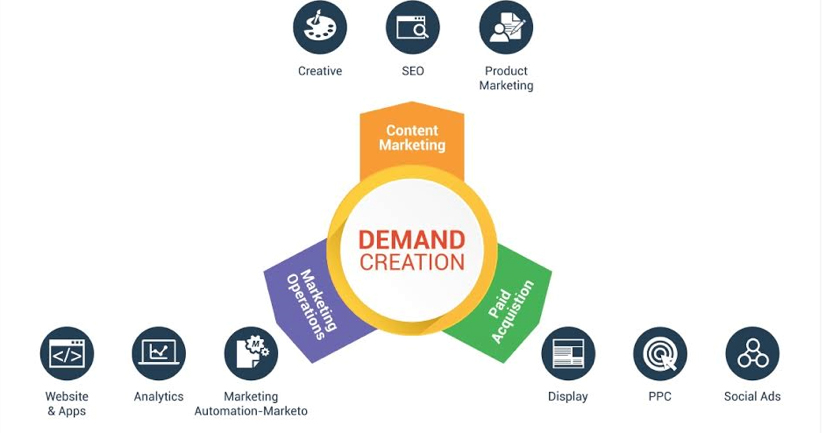
    Position2 is a full service digital marketing agency that has been working with top brands in the B2B space for over a decade. Our Demand Acceleration (DA) framework is the result of years of experience in serving a diverse range of clients of every size and type. It is an integrated approach that combines the key enablers—Content Marketing, Paid Acquisition, and Marketing Technology—to deliver significant results across the Awareness, Engagement, and Purchase stages in B2B sales.

    Over the past two years, Position2 has been engaged with SiriusDecisions, the thought leaders in B2B marketing frameworks—to adopt best practices in our services and processes.

    THE DEMAND CREATION ECOSYSTEM

    Demand Creation is a concept laid out by Sirius Decisions that provides a highly detailed model to plan, manage, and optimize the B2B marketing process.The DC ecosystem revolves around the interactions that buyers have with the marketer. B2B buying behaviour is different from B2C, the key differences being longer sales cycles and multiple buyers. Let’s look at some of the key players and concepts in this ecosystem.

    Demand Waterfall

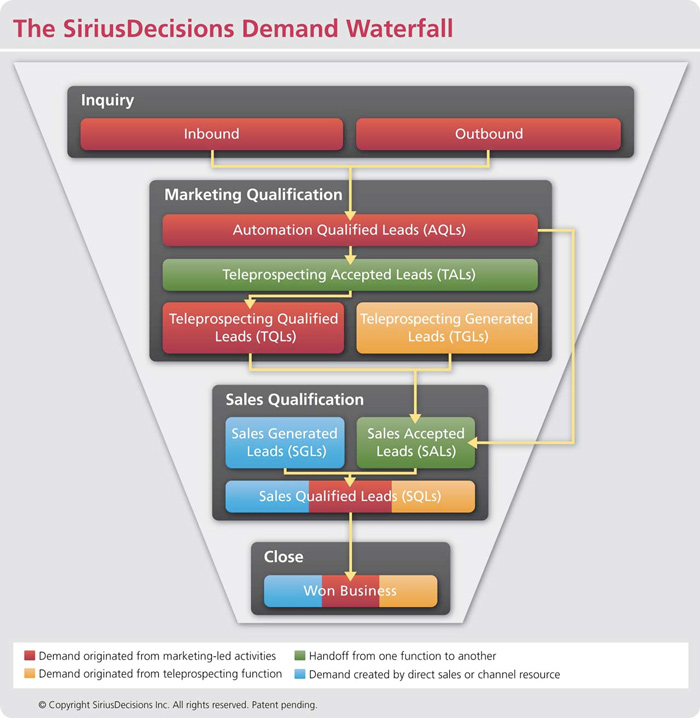
    The Demand Waterfall, originated by Sirius Decisions, illustrates the flow of buyers across different stages of the B2B buying process. The key elements in the waterfall are the different stages that leads pass through before they convert to a sale or become a customer.
     

    demand-waterfallBuyer

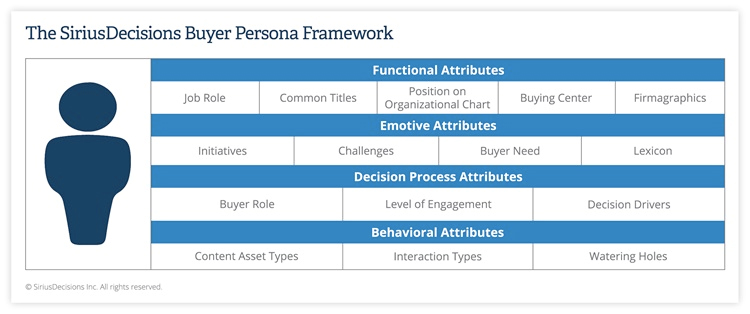
    The buyer is defined as the entity that consumes the product or service. Buyers are further classified based on their role in the buying process, as well as in the consumption of the product and service. Important concepts that are considered in relation to the buyer are personas, buying types and lead lifecycles.
    Buyer Framework

    Product/ Service

    The product or service that is being sold forms the other element in the Demand Creation process. The key concept related to the product or service is Demand Type.
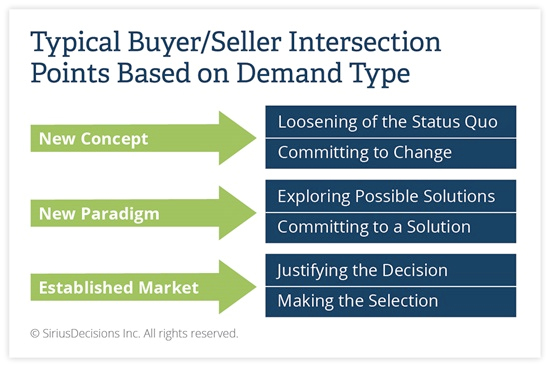
    demand-type-points

    This helps marketers design programs that are best suited to their product or service.

    The Buyer’s Journey

    Position2’s Demand Acceleration framework looks at the buyer as being at the core of the process. The aim is to move the buyer from an initial stage of non-awareness to the final desired stage of purchase. The DA framework leverages the key enablers—Content, Technology, and Campaigns to accelerate the buyer’s journey, thus providing more and faster sales for the company.
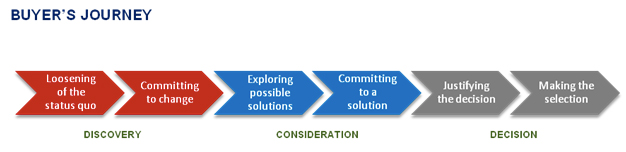
    buyers-journey

    THE ENABLERS

    enablers

    Content Marketing

    Content Marketing covers all the activities and planning required to develop content that drives interactions between marketer and buyer. Various types of content need to be developed based on buyer persona and stage in the buyer’s journey. These could be in the form of short video clips, whitepapers, case studies and infographics, to name a few. The Position2 DA framework incorporates a detailed template-driven process across four key stages—Audit, Creation, Curation, and Measurement.

    Marketing Technology

    Marketing Technology functions both independently, as a channel (e.g., Marketing Automation, Website and Email) as well as an enabler for Content Marketing and Paid Acquisition. Given the rapid pace of development, this is the area that draws a lot of attention and effort. In the DA framework, we clearly distinguish between technology as an enabler and technology as a channel by focusing on the core functionality of the process, rather than the process itself. This allows our framework to adapt and evolve with the latest technologies.

    Paid Acquisition

    While the other two enablers are primarily infrastructure-related, Paid Acquisition is more outward and tactical. It essentially operates as a feeder to the other two enablers. This is also the area which sees the most amount of optimization and scalability, and has the potential to help significantly scale up growth for our clients. Paid acquisition covers all the key channels—Search, Social, Display, as well as newer strategies such as content syndication and sponsorships.

    Position2’s Demand Acceleration framework brings together a calibrated combination of Content Marketing, Marketing Technology, and Paid Acquisition services to produce the best results for our clients in today’s competitive digital marketing arena.

    Contact us if you would like to learn more.

  • Mobile Marketing Trends in 2016

    Mobile marketing has evolved to become an integral part of our digital lifestyle. Smartphones are now used by two-thirds of the US population, and they are increasingly being used for email and social media, photos, navigation, financial transactions, ordering meals, entertainment, and more.

    Mobile’s growth over the past few years has been well documented, and it continues to cross major milestones that illustrate its immense popularity. In 2015, app usage surpassed desktop usage to account for half of all US digital media consumption. In March 2016, the number of mobile-only adult internet users exceeded the number of desktop-only internet users for the first time. This milestone shows just how far mobile has come in overtaking desktop’s longstanding dominance as the primary gateway to the internet.

    Just a year ago, desktop-only internet users accounted for 19.1 percent of all users, while mobile-only users comprised 10.8 percent of the total. This year, the share of mobile-only users has climbed to 11.3 percent, while the desktop-only population has drastically declined to just 10.6 percent. Of course, these numbers also tell us that the vast majority of the digital population is multi-platform and goes online using desktop as well as mobile platforms. Even then, this mobile-only milestone is meaningful because it signifies how smartphones and tablets (particularly the former) are becoming—or rather, have already become—our primary access point to the internet.

    There’s no doubt that desktop computers are highly practical and efficient when it comes to accomplishing complex and information-heavy tasks, which makes them crucial for workforce productivity. They still play an important role in our digital lives, and won’t be phased out anytime soon. Let’s not overlook the fact that consumers still prefer desktops when shopping online, with 87 percent of total digital commerce coming from the platform, despite mobile accounting for 60 percent of total time spent shopping online.

    All signs indicate that the desktop computer is here to stay for the foreseeable future, and that mobile usage will continue to grow. With more mobile-only internet users than desktop-only users today, it’s safe to assume that digital marketing will continue to evolve towards a “mobile first” approach.

  • How To Improve Your Google AdWords Quality Scores

    Quality Score (QS) is easily the most mysterious metric in Google AdWords. PPC gurus have passionately spoken about its importance. As digital marketers, we’re constantly working towards improving the QS of our keywords. Let’s take a look at how we worked on improving QS for a client who we’ve been servicing for three years.

    The client’s selected keywords were of medium priority in terms of conversions, but had relatively low QS. The only way to get the best possible results from them was to improve their QS and lower CPCs.

    How did we achieve this? The effort was twofold. The first and most important step was to ensure relevance between our ad copies, keywords, and LPs. We tested using the keyword in headlines and display URLs, and tailored landing pages to include the keywords.

    The second step was to ensure that we were giving the keywords a chance to see a good CTR through a better average position. This was done by increasing bids for a few days.

    One of our key phrases was “quick business funds.” The ad copy running at that time looked like this:

     Business Funding

    Get The Capital You Need Now.

    Fast & Easy. Sign Up Online!

    Xyz.com

     As you can see, the messaging was generic. We then introduced ad copy that included the key phrase:

    Quick business funds

    Get The Capital You Need Now.

    Fast & Easy. Sign Up Online!

    Xyz.com

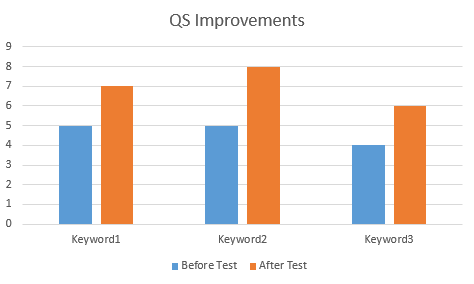
    Did we notice an instant change in QS? No, but our patience and investments in CPC paid off. After a couple of months, we found that 11 out of 23 keywords had score improvements. The table below highlights the improvements in three of the tested keywords:

    QSThe improvements in QS had a positive impact on Average Positions, CTR, and Average CPC as you can see below. It’s important to mention that the bid prices for these keywords remained the same.

    QS 2

    A combination of ad copy testing and bids brought about the improvements we were chasing. In due course of time, we found our average CPC dropping, marginally at first, but significantly in the case of expensive keywords.

    The basis for such a strategy was to insert the keyword into the ad copy in a clever way. You’re often confronted by keywords that don’t directly speak to your product or service. But if these keywords can be highlighted with a unique perspective, there is a lot you can gain as a pay per click advertiser. For example, you’re offering just headphones for sale. Though you don’t offer earphones, keywords around that theme could be crucial for you. If you were to target a user with messaging such as “Why go for Earphones? Get more with Headphones”, you could possibly strike gold on Google. Your Quality Score is bound to increase for such keywords, provided your landing page offers the right experience.

    In addition to this strategy, never underestimate the importance of Ad Extensions catered to the keyword. Google offers advertisers an array of ways to connect with a user, given that there is only so much one can do with 130 characters worth of ad copy. Using Sitelinks, Callouts, Snippets, and other extensions, there are many ways to achieve improved  performance. Tailoring your extensions to a particular campaign, ad group, or even a keyword can help you boost Quality Score in unimaginable ways. The more relevance you earn, the more value you can obtain.

  • Facebook’s New Detailed Ad Targeting Options

    Without much fanfare, Facebook has quietly introduced a new ad targeting option—detailed targeting—which combines demographics, interests, behaviors and categories. Marketers can now create extremely sophisticated, multi-layered target groups that will give them the ultimate in targeting precision.

    In essence, Facebook is bringing four different targeting options—Demographics, Behaviors, Interests and Categories—into one place. With these different targeting options, marketers can build composite targets, such as reaching parents, working in the banking industry, celebrating their wedding anniversary in the next month, for example.This will produce better results, and of course, more money spent on Facebook. It’s a win-win for everyone. It will also be especially helpful to beginner advertisers.

    Now, advertisers on Facebook will see all the targeting options in one place, without needing to explore multiple drop-downs. By making audience targeting more precise, marketers can make their ads significantly more attractive and effective.

    More precision means a smaller audience and more competition. If there are too many advertisers competing for the same niche audience, we may see greatly increased CPM and average cost per click for that audience.

    OR vs. AND Targeting

    For those using third-party tools that work with the Facebook API, you’ve probably already witnessed the power of AND targeting.

    Up until now, Facebook has been operating with OR targeting. This means that if you attempt to get your message in front of two audiences, you would hit either of them, and not the intersection of the two audiences.

    An example of this would be if you wanted to reach people interested in Soccer and Rugby in the same campaign. Facebook would show your ad to either Soccer fans OR Rugby fans. Now with AND targeting, you can reach people interested in both sports.

    You may notice that some targeting options appear to have been removed from the general Facebook ad options page—Demographics (Relationship, Education, Work, Life Events, and more) and Behaviors.

    These options can now be found in the “Detailed Targeting” section, which actually makes sense, because these were already partially using AND targeting when combined with Interests and other targeting factors.

    How Can You Get Access to Detailed Targeting?

    According to Facebook, these new targeting options are slowly being rolled out to advertisers. If you have an account manager at Facebook, ask if these new options can be enabled for you.

    The new detailed targeting options are going to make advertising on Facebook a lot easier. If you can get your message in front of the ideal audience, you have a better chance of converting. This will make advertisers happier than targeting messages at those that might only be slightly interested, and are not likely to convert. Hopefully, this should decrease CPM for narrowly targeted audiences, but only time will tell.

  • The Role of Content Curation in Content Marketing

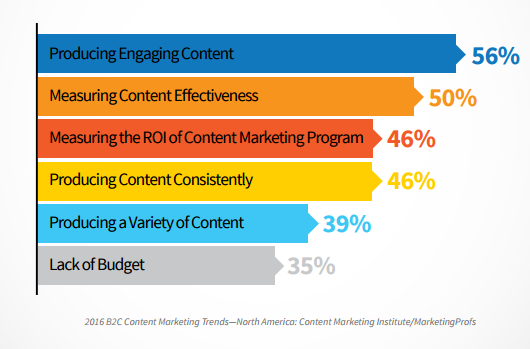
    The Content Marketing Institute (CMI) recently published its report on Content Marketing trends for 2016. It lays out some of the key challenges that marketers face today. As the graph below shows, the major hurdle for marketers lies in producing engaging content itself, according to over 55% of those polled.

    Top Challenges For B-to-C Content Marketers

    Content 1

    The poll also tells us that consistently producing a variety of content—and having the budget required to do so—are significant challenges to many marketers. Content Curation is one solution to these challenges. So what exactly is it, and how does it help marketers achieve the desired ROI? Content Curation can be defined as the process of gathering information relevant to a particular topic or area of interest.

    Key Steps In The Content Curation Process

    • Find interesting content from other people and sources
    • Use curation platforms to add descriptions and make the content more engaging
    • Add more visuals to the article
    • Elaborate on the content in about 200 words; ensure that the article is SEO-friendly
    • Publish it (but don’t forget to cite the original article or credit the author)

    Distributing Curated Content

    The task of a content marketer doesn’t end with curation. It is equally important to distribute curated content to get results. So let’s look at key aspects of how to optimize and distribute curated content.

    • Convert curated blog posts into informational e-books
    • Create emailers and newsletters with curated content
    • Use paid channels such as Medium.com for better performance
    • Create rich-media versions of curated content and syndicate on Slideshare
    • Publish on LinkedIn and other popular social channels

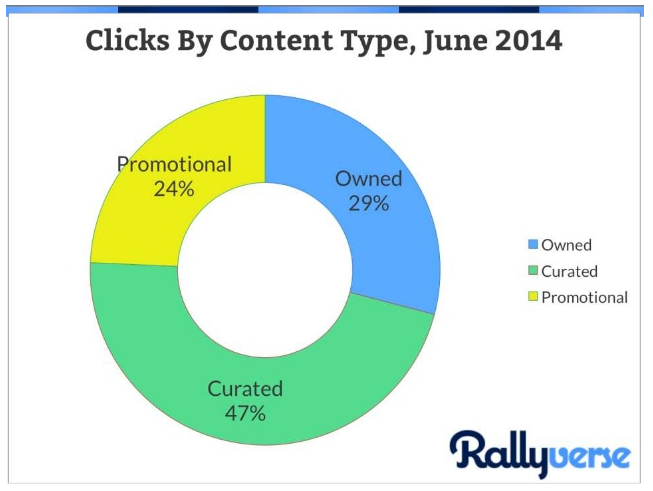
    How effective can content curation be? Here’s an example:

    Content 3Image Source 

    Position2 recommends that content marketers leverage the power of curation to meet marketing goals. We offer specialized content marketing services for businesses to accelerate demand. Get in touch with us for more information.

  • What We Learned at HIMMS 2016 in Las Vegas

    Position2 attended this year’s HIMSS Annual Conference and Exhibition, which was held in Las Vegas in early March. The conference attracts more than 40,000 people each year, with 1,300 vendors exhibiting. Through the course of the event, attendees have the chance to take in keynote speeches from thought leaders in healthcare IT, and take part in discussions, webinars and workshops to drive innovation in this space.

    HIMMS is an important event, and it showcases myriad products and solutions in cutting edge healthcare markets. It also provides a snapshot of the market as it is today, and showcases new opportunities that IT providers can exploit. Our team came away with fresh insights into the opportunities this unique market presents, as well as a new understanding of the importance of our work in delivering engaging content to patients and businesses.

    Key Takeaways from HIMMS 2016

    At Position2, we came away from the event with four valuable takeaways that describe the state of healthcare IT right now. Across all of the products that were exhibited, these principles stood out.

    1. A Need for Efficiency

    Users engaged with healthcare IT are increasingly looking for efficiency in the solutions they select. And it’s not just the healthcare providers that are seeking cost and resource savings. Increasingly, we’re seeing consumers looking for healthcare IT solutions, and they are also likely to be interested in cost-effective answers to their questions. We’re seeing both B2B and B2C products growing in parallel, which presents an interesting evolution of the market compared with traditional medical companies.

    2. Patients Are the Focus

    As the market has evolved, we’re seeing more service users engaging with the IT solutions that provide healthcare information. This is particularly prevalent in the US, where it’s the patient that engages directly with the care provider in many cases. Patients are the focus of the work we do at Position2, and it’s important to maintain this focus.

    3. Mobile is a Growth Area

    Right now, figures suggest that 70 per cent of patients are using mobile devices to log on to service portals. This is an increase on last year, and it ties in with the opportunities of mobile retargeting, which can be used to reengage consumers on their journey. At HIMMS 2016, we saw a strong interest in video ads that are clear, digestible and engaging.

    4. Position2 is excited to be part of this industry

    Position2 had a prominent spot in one of the key vendor’s booth at HIMMS 2016, both on the posters and the video screens displayed to delegates. We continue to support and inspire healthcare companies in delivering effective solutions, contributing to their ongoing growth. As the market continues to boom, Position2 will continue to deliver value to the most important people: a community of patients worldwide.

    The Future of Healthcare IT

    Again and again, IT proves itself as a transformational force. Healthcare is no different. As patients become more in tune with their own care, they will be more interested in using mobile technology to quickly access the services they need. Position2 is at the forefront of this rapidly evolving market. Get in touch to find out more.

  • Position² Introduces Campaign Hub! Also, What To Look For In A B2B Marketing Agency

    This week’s hot news, events and videos from the online marketing and social media world.

    From the Position2 Blog This Week:

    Top Stories of the week

    Join Position2 at the Marketo Summit 2016 at the MGM Grand in Las Vegas

    The Summit theme is “Tomorrow’s Marketer”, and will feature over 100 sessions including Keynotes, Educational Sessions and interactions with industry leaders. Team Position2 will be there to share our insights on how to get the best results out of your Marketo suite.

    Lets Connect

    Lets Connect

    If you are reading this blog post via a RSS reader, please click here to subscribe.

  • Campaign Hub – Position²’s Solution for Effective B2B Marketing

    Content is King, but what good is a king without his queen, advisors and officials?

    Creating great content is just the start. There are several additional things that we have to do right to stand out in today’s crowded marketplace. While we employ time-tested strategies to ensure that the content is reaching its intended audience, it is also critical to experiment and try new things, so that the audience spends more time on your site.

    Much has already been written about the importance of marketing effectively to ensure that the right audiences are targeted at the right time to ensure a successful lead gen campaign. Today, we will focus on the presentation and the technological aspects of a campaign, and their importance in the scheme of things.

    Once you have the right content in place, you want to implement the most effective marketing strategies to ensure that the most relevant audience has been targeted. Once you have the user exactly where you want him to be, the layout, presentation and arrangement of the content are of utmost importance. It is absolutely essential that we do not lose the user after all the effort that has gone in thus far.

    Enter Campaign Hub

    This is where a technology solution like Campaign Hub can prove to be a valuable asset by helping you create the vibrant, unique, and engaging landing page experience that you require to enhance the effectiveness of your content—and ensure that more visitors enter your company’s marketing funnel.

    Position²’s Campaign Hub seamlessly integrates with your company’s existing Marketing Automation software to ensure that all the information entered by your visitors directly reaches your marketing database. You also have the option of personalized targeting where, depending on the profile of the visitor, the type of content being served changes to best suit what they are looking for, and also creates value for your target audience.

    To maximize the effectiveness of your landing page, you can choose from a wide range of theater/ social conversation/ banner modules, form fills, or have custom modules developed to suit your requirements. The Hub’s A/B testing feature helps you test multiple designs and freeze on the one that works best and gives you the most visibility.

    Campaign Hub also has a Content Management System (CMS) option that allows you to launch campaigns with User Generated Content. This feature improves the quality of engagement with the target audience, and allows you to easily moderate the submitted content.

    In conclusion, there is certainly no substitute for good content. However, merely creating good content does not ensure success and visibility in today’s digital marketplace. A solid marketing strategy, as well as the right technology, go a long way in ensuring the success of an online campaign.

  • B2B Marketing Requires the Right Agency Expertise

    For B2B marketers, digital has evolved to become a major driver of success. One-third of businesses are planning to introduce a digital transformation program, while thirty per cent of businesses have already taken that route.

    There are huge opportunities in organic search, and a growing need to focus on paid ads. According to Webbiquity, 71 percent of companies plan to increase their digital marketing spend this year. This is good news, given the number of platforms putting the spotlight on sponsored content. There’s also a more pressing need to invest in high-quality content, particularly in increasingly competitive B2B markets.

    Digital marketing services are essential

    There are two key reasons why businesses must have digital marketing support.

    First, digital marketing gives you the insight you need to customize your content and deliver a meaningful message. We’ve always known that understanding your customers is the most important aspect of marketing to them, and tailoring content is one of the best ways to speak to a customer in a timely and relevant way. You need support to track customers’ journeys and step in at the appropriate time.

    The second reason is equally important. When it comes to any form of marketing, businesses need to see ROI. And with digital marketing, we can provide proof. We can set goals, measure results, and drill down to figure out where more work is needed. We can look at each channel in turn and figure out how it’s contributing to the success of the overall strategy.

    Key components you need to consider

    When you’re looking ahead to digital transformation, or consulting a digital marketing provider, an integrated approach is very important. Selecting the right elements is critical, but so is meshing them together effectively.

    • For time-pressed businesses, automation is an obvious route to consider. Marketing automation has moved away from being heavy-handed and potentially spammy, and is now very good at targeting customers based on trigger actions, supporting near-instant delivery of focused content.
    • Keeping the brand top of mind is still very important, and this is where content supports lead generation and drives increased sales. Digital marketing is ideal for increasing brand awareness and developing tests that can be used for continual content optimization.
    • Finally, don’t forget social media. It’s evolving, but it’s still essential. Likes and shares may be less important, but it’s still critical in developing a dialog with customers and nurturing a relationship over time. According to Social Media Today, just 20 percent of social media content should be geared towards brand awareness. The other 80 percent should generate the conversations and shares you need to connect personally with an audience.

    Choosing the right digital marketing partner

    Now, you understand the need for digital marketing. You can see the components you’ll have to implement. The last piece in the puzzle is choosing the right partner to deliver results.

    We have three specific recommendations.

    • A good marketing agency should understand your goals for growth and provide a unique strategy. You may want to increase sales; equally, you may want to raise brand image. Each set of priorities requires a different approach to achieve that upwards trend, and your agency needs to be fully on board with it.
    • You’re also going to need an agency that can show you the ROI we mentioned earlier. It’s great to get verbal feedback, but hard figures are the only way to measure success. That means getting data about the cost of digital marketing across your chosen channels, data about how activities are converting, and data that clearly shows where your money is best spent. Can your agency produce these reports, and provide evidence to back up its claims?
    • Finally, your agency needs to be honest with you. They need to be a true partner, provide feedback and make suggestions. A really good agency will stop you in your tracks if they have a better suggestion. Remember: this might mean you have to flex your ideas about what digital marketing entails, or be prepared to tweak your budget allocations to support the ways of working the agency suggests.

    Position² Can Deliver

    Position² is a trustworthy digital marketing agency with a proven track record of results across its entire service catalog. If it’s time to implement your digital transformation project, or re-launch your digital marketing strategy, Position² is ideally placed to provide the results your business expects.