Author: Team Position Squared

  • Identifying Personas to Drive Messaging That Works

    Over the years one of the major aspects of businesses – small or big, has been understanding who their customers are and how to appeal to their target audiences. Today, every successful business model has various ways of tapping customers – new and existing. We see a paradigm shift with most organizations leveraging similar strategies to identify the right persona, and address their needs with relevant messaging.

    Which brings us to the question, what is persona? Persona is the representation of your ideal potential customers based on the existing data and research of your current customers.

    Your next question would be, why is identifying personas important for your business? To drive content creation, product development, sales and everything else in-between that relates to successful customer acquisition campaigns.

    Here’s how to identify personas:

    • Start with identifying the demographics to which your product/ service is relevant
    • Understand your prospects’ needs, pain points, and buying process. Based on that, you can easily address their requirements and engage with them through each step of the purchase funnel
    • Segment the demographics based on the aspects of the product they are most likely interested in
    • Focus on persona targeting as it works for any of the marketing goals: Brand Awareness, Engagement, Customer Acquisition

    Targeting in real-time:

    Use various targeting settings of the marketing channels to create the right audience pool.

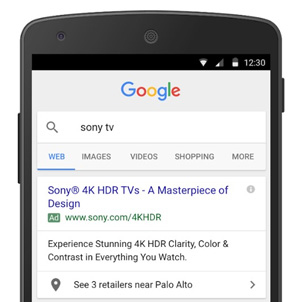
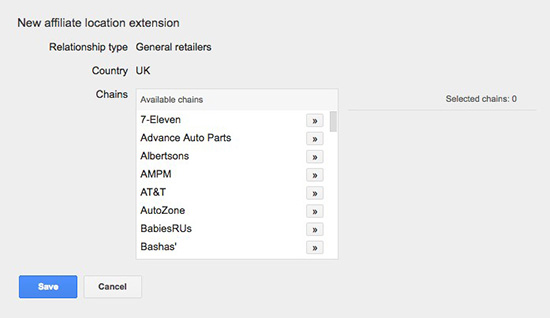
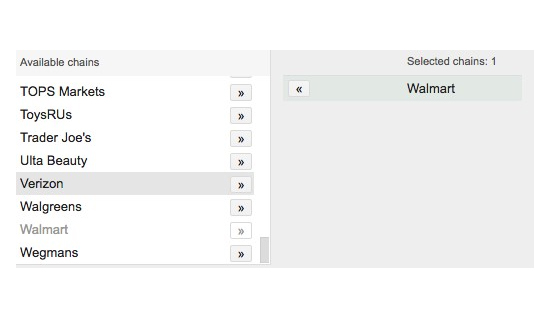
    Mentioned below is a sample list of settings available in various channels

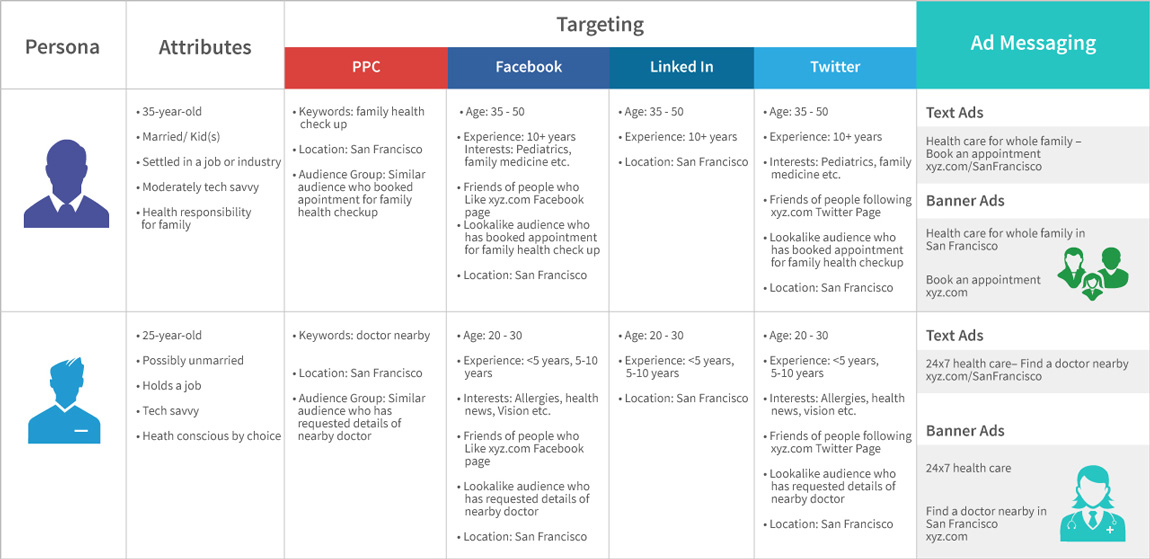
    An Example of Persona Targeting and Messaging Matrix

    Persona features matrix for an online medical care scheduling service provider

    Persona Targeting and Messaging Matrix

    Sample Results:

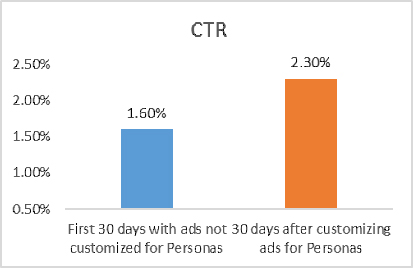
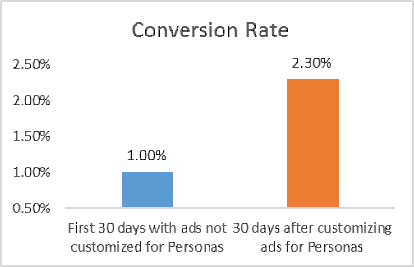
    Results for one of the accounts where we have identified personas and changed the messaging accordingly – observed lift in both CTR & Conversion Rate.

    Date range Impressions Clicks CTR CPC Cost Conversions Conversion
    rate
    Cost/
    Conversion
    First 30 days with ads not customized for personas 26,014 418 1.6% $2.8 $1,174 4 1.0% $294
    30 days after customizing ads for personas 29,478 688 2.3% $2.2 $1,541 16 2.3% $96

    Conclusion:

    Personalized and customized messaging built on personas yields 2X the average sales pipeline1.

    All you need to do as a marketer is to equip yourself with a strategic toolkit to identify personas & address their needs with a relevant messaging, and monitor the impact.

    Source1: www.siriusdecisions.com

  • Key Steps for Improving Your Brand

    According to businessdictionary.com, brand is defined as “Unique design, sign, symbol, words, or a combination of these, employed in creating an image that identifies a product and differentiates it from its competitors. Over time, this image becomes associated with a level of credibility, quality, and satisfaction in the consumer’s mind. Thus, brands help harried consumers in crowded and complex marketplace, by standing for certain benefits and value.”

    Having a good brand is at the heart of having a successful business. So, how do you create and protect your brand? Here are four steps to help you do that.

    1. Have a Recognizable, Compelling Look and Feel

    For the last 30 or so years, when you see a swirl, you know Nike is nearby. When you read the words “Just Do It,” you also know Nike is involved. Nike has one of the most recognizable, compelling brands around. While they’ve changed some of their messaging to align with changing times, they’ve stayed true to their singular look and feel.

    Beyond the look and feel, key messaging should be honored in a similar fashion. For example, if you want your storage solution to be known for “working equally well in data centers and branch offices,” you always need to say those exact words.

    2. Know Your Customers

    Personas are the name of the game these days. You want to use market research and data to create personas for your different customers, and you want to include as much detail as possible. Why? When you are able to talk to people in a personal way, addressing some of heir hottest issues, you build a lot of trust in your brand.

    3. Don’t Keep Yourself a Secret

    People like to get their information in different ways and from different sources. So make sure you are easily found and accessible. Get your word out everywhere – web, social media, YouTube, emails, webinars and more – and then track where you’re having the most success.

    4. Be Authentic

    Your business is made up of wonderful people like you. Be sure to capture this in your voice. Sound like real people who care deeply about their customers’ success. Engage in conversations with your customers. Recognize that your engagement with them helps them move more speedily through the buyer’s journey.

    Now, that you know what to do; know your Brand and be seen!

  • Easily Measure and Optimize Impact of LinkedIn Ads

    LinkedIn conversion tracking, long a privilege for the chosen few, was rolled out to advertisers this August. Pixel-based conversion tracking has been the staple for AdWords, Facebook, Twitter and other third party analytics apps. LinkedIn has been late catching up to this. Now, with the roll out of the conversion tracking for all advertisers, LinkedIn is letting users/advertisers understand the full impact of their campaigns right from the dashboard.

    What can you do with LinkedIn conversion tracking?

    • See how many leads you’re getting from your campaigns
    • Understand your advertising ROI
    • Optimize for the results that matter

    With the implementation of the LinkedIn Insight tag, you can record website conversions tied to your Sponsored Content or Text Ads campaigns, including content downloads, sign-ups, purchases, and more. You can track how many times members converted after clicking (post-click) or viewing (post-view) your ads. You can also measure the true value you’re getting from your LinkedIn advertising on desktop and mobile, including return on ad spend, cost per conversion, and conversion rate — all using analytics from LinkedIn Campaign Manager.

    LinkedIn utilizes a “last touch” attribution model with a 30-day look back period. It credits one unique conversion per individual (the earliest one) within the window and only credits a campaign or ad if that conversion is associated with the campaign.

    Ready to measure conversions from your campaigns?

    1. Choose where you want to track conversions. You’ll be able to track conversions on any part of your site, including subdomains.
    2. Add the LinkedIn Insight Tag to your website. This is a lightweight piece of JavaScript code that lets you track website conversions from your campaigns.
    3. Create a conversion action. An action is a rule that tells LinkedIn which events you want to count as a conversion, like when someone fills out a form on your website. You can create events for Key Page View, Add to Cart, Download, Install, Lead, Purchase, Sign up and Other.
    4. Add your conversion action to a campaign to start recording conversions from that campaign. You can add as many actions as you like to each campaign.
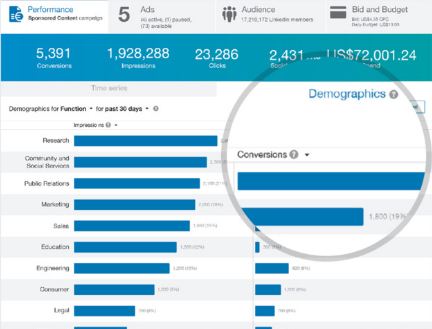
    5. Measure your conversion performance with built-in analytics. As your campaign runs, you can monitor your conversion results in Campaign Manager under the “Demographics” tab.

    See exactly which target audiences are driving conversions

    • Discover the business demographics of your website visitors and customers, such as their job function, industry, company size, seniority, and more.
    • Measure the performance and ROI of your LinkedIn campaigns including clicks and conversions.
    • Access the New Visitors report to see how many new visitors your paid LinkedIn campaigns are driving to your website and at what cost.

    LinkedIn Conversion Tracking Dashboard

    Digital world has a lot to offer and for any advertiser this feature of LinkedIn is not to be ignored. It’s a feature that can ease the tracking of conversions and help optimize ads accordingly. In conclusion, LinkedIn’s Conversion tracking helps you analyze completely. Stay tuned for latest updates from this space!

  • Social Media Content Marketing 101

    Social Media Content Marketing (SMCM) is the intersection where content marketing and social media converge. Social media has dramatically changed the relationship between brands and consumers, it has put the consumer in the driving seat. This connected world has empowered consumers to influence the branding and marketing strategies of multi-billion dollar companies. A connected consumer base is a blessing for those who realize its importance and a curse for those who don’t. Consumers are now aware of the impact they can have on large corporations by simply writing reviews and feedback. Similarly, organizations have also realized the impact that a single tweet or comment can have on their brand image. Consumer feedback and reviews have become major contributing factors while planning a marketing strategy, thanks to social media.

    Source: crazyegg.com

    Word of Mouth: People trust the word of their peers more than a statement made by a brand, no matter how powerful that statement is. Therefore, keeping current customers satisfied and happy, is more valuable than acquiring new ones. Reviews by satisfied customers can have more impact than a million-dollar advertising campaign. Word of mouth in terms of social media is the feedback and reviews which can make or break a brand. A recent study has revealed that an average person spends more than half an hour per day on social media platforms. Therefore it has become imperative that social media strategies be a part of overall marketing goals.

    Content Marketing and Social Media: Content is king, no doubt about that, but in a fast paced world people don’t really have the time to consume content the way it is intended to. Social media compliments content marketing through the use of images, shared content and reviews. Images grab more attention than text; shared content is trustworthy, and reviews are an instant insight into a product or service. Marketing endeavors can be amplified to a large extent by social signals. A share on any social media platform is a clear reflection of trust. People don’t share posts they are skeptical about, as it is a reflection of their personalities. Social media users have the power to promote a brand by sharing, writing reviews and providing feedback. This, in turn, creates awareness about the brand, which eventually results in more conversions.

    Social media marketing cannot function well without content and content will not have the intended impact if it does not reach the target audience.

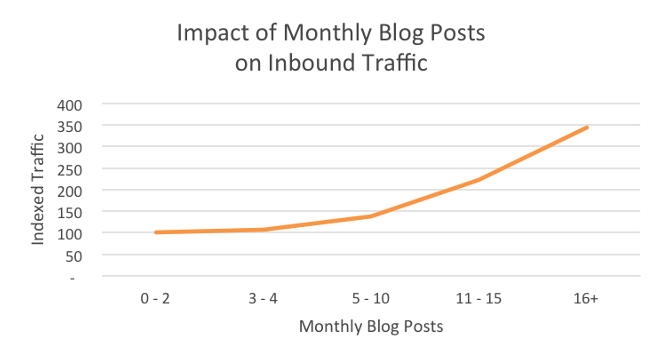
    Blogs: A part of Social Media

    Source: Hubspot

    A few years ago, blogs and social media were considered two different mediums of information where one had no impact on the other. The simple truth is both these are forms of promoting content, and they complement each other. Blogs are social media. The trick is to use a blog to enrich your social media with long-form posts, and to use social media to promote your blog.

    Social media content marketing (SMCM) plays a paramount role in brand health. It is the medium for consumers to access information about brands. Social media platforms engage consumers and build active interaction among them. Hence, it is crucial for companies to have valuable content and to have a precise social media campaign to increase traffic to their pages, provide customers with information they are looking for, convert visitors into customers and to make sure customers become their brand ambassadors.

  • Why Live Video Streaming – The Next Big Thing In Marketing

    Digital marketing has spent much of the past decade looking to social media for the latest trends in cool content. So, it should come as no surprise that the popularity of live video streaming has grabbed the attention and imagination of marketers worldwide.Live video streaming or livestreaming involves broadcasting video content on the internet in real time. The idea of streaming video on the web for promotional purposes is not entirely new; businesses have been using webcasting to share key events with wider audiences online for a number of years.

    Reaching Millions

    But the game changer has been the recent explosion in dedicated live streaming app such as Facebook Live, Youtube Live, Periscope, Meerkat, Younow, Twitch and many more are giving millions of users worldwide opportunity to broadcast live to the world at the touch of a button. And millions are watching.

    It is this level of popularity which has grabbed the attention of the marketing industry, speeding up the on-going shift in advertising spend away from television towards digital video. A recent poll of US marketers found 41% are keen to trial live video streaming as a content platform. One-fifth of US media decision-makers have already allocated budget to advertise around livestream content in the next 6 months.

    So why the buzz?

    Livestreaming is proving a hit on social media because it is immediate, it is personal and it feels authentic. In a world where people expect much video content to be heavily staged and layered with CGI effects, livestreaming feels stripped back and more real. The popularity can be compared to the viewing figure peaks seen for a big live sporting event or a major live news broadcast. People love watching live content.

    That buzz has created a rush of demand to advertise around livestream content, hiking prices way up above comparable online display rates. On the other side of the coin, the close association with livestream has helped social media overtake dedicated video services as the preferred platform for digital video campaigns – according to Trusted Media Brands, 65% of US marketers would rather use Facebook and Twitter than Youtube. With that kind of pulling power, you cannot afford not to be in on livestream.

    Brand Benefits

    The power of livestream is not just about the size of the audience. According to research from Brandlive, a specialist livestream SaaS consultancy, 79% of US-based retail executives feel that live video streaming helps to create more authentic interactions than other forms of digital media, adding a ‘human’ element. Not only does the sense of immediacy and authenticity attract large audiences, it helps to establish trust in a brand and positive interaction.

    In the same survey, just under a third of respondents cited the fact that livestream offers real-time feedback from customers. The ‘live’ aspect creates the conditions for a genuine conversation with an audience of thousands, as everyone can log their thoughts and reactions there and then. And while the ‘live’ element carries much of the power of the format, and content produced can of course be recorded to be reused again, helping to drive traffic to websites where archives are hosted.

    If you are looking to keep up with the latest trends with your digital marketing campaigns, Position2 has the expertise and industry insights to provide the support you need!

  • The Latest On AdWords Is What You Need To Know!

    ‘Change is the name of the game’ and who can advocate this more than Google? They have played a major role in the rapidly evolving world of online marketing and advertising with their regular innovations and strategic thought leadership.

    Google has earned the majority of the global market share [72.48%] by constantly updating and innovating their solutions and services.

    As a continuation of this process of constant evolution, Google rolled out new AdWords updates that are likely to impact your advertising ROI in a positive manner:

    1. Expanded Ad Format
    2. Bidding Metrics – Conversions and Converted Clicks

    1. Expanded Ad Format

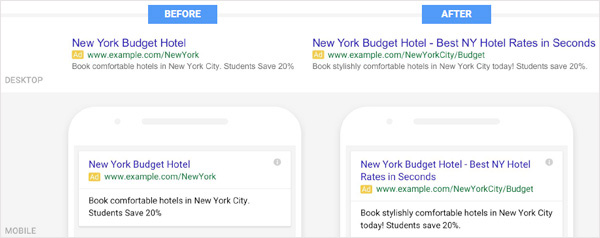
    This next generation text ad is devised to help advertisers reach out to the current mobile-savvy users in an efficient and effective manner. Two times bigger than the standard ad, this new format provides advertisers with a bigger headline and longer description, giving them an opportunity to improve their ad performance and presence across devices.

    The best part of this new format is that these ads will wrap automatically based on the device size. Additionally, the expanded text ads are available on Google Search Network as well as Google Display Network.

    This is one of the biggest changes in the ad format since AdWords was launched. Here are some of the significant features:

    • Two fields for headline with a character count of 30 characters each
    • Description field is expanded up to 80 characters
    • Ability to use final URL’s domain in the display URL
    • Display URL of the ad can use two optional path fields of 15 characters each

    Google Adwords Expanded Text Ads

    Make the changes now as you’ll no longer be able to create or edit standard text ads after October 26th, 2016

    2. Conversions and Converted Clicks

    Google AdWords uses the basic bidding metrics to measure your ad conversions. Converted clicks is a metric that counts the number of clicks leading to one or more conversions. For example, if one customer clicks on your ad and then completes two conversions, converted clicks will consider it as one click.

    On the other hand, conversions are the recommended metric for bidding and reporting, as this gives you a clearer picture of how many conversions you have from AdWords. With this bid metric, you have the option to include cross-device conversions and factor them into your automated bid strategy.

    Starting in September, Google will remove converted clicks as a conversion bid metric and later will remove this from reporting as well. So, all accounts need to change their bid metrics to conversions and if you have not done it yet, you will find it automatically migrated to conversions.

    Here’s a comparison of the metrics that will give you more clarity on the impending change.

    Features Conversions Converted Clicks
    Select which conversion actions to include Yes No
    Segment by conversion name or conversion category Yes No
    Count multiple conversions generated from a click Yes No
    Select an attribution model Yes No
    Specify a value for conversions Yes No

    With so many swift changes in the online advertising world, you need to be updated to beat the competition and win the game. Stay tuned to get the latest from the digital marketing world!

    References:

    1. https://support.google.com/adwords/answer/6372468?hl=en&authuser=0
    2. https://support.google.com/adwords/answer/7048854?hl=en
    3. https://adwords.googleblog.com/2016/07/adwords-editor-expanded-text-ads-mobile-app-engagement.html
  • Glocalization Helps Small Businesses Compete

    Often, smaller businesses are wary of competing with a reputed brand, assuming that the bigger enterprises are more resourceful with an added advantage of an established brand value and reputation in the market. However, that’s not always how it works in the ‘www’ world. In fact, as a local business, you know more about your customers and their requirements than a bigger brand. So, you should always leverage this knowledge to become a local expert on the industry. This brings me to the concept of glocalization, the practice of conducting business according to both local and global considerations.

    Glocalization is the adaptation of globally marketed products and services to local markets. “Think globally, act locally,” is one of the most effective “mantras” for small and medium-sized business who are ‘all set’ to compete with a big brand in your domain.

    With the current digital-growth explosion, where people are connected online 24×7, you can thrive in the market with a well optimized website and an effective content marketing strategy. In fact, “content” is a key buzzword in the online space. According to WordStream, while the catchphrase “content is king” has been used plenty in the past couple of years, we shouldn’t expect it to go away any time soon. “Content is key, having a content strategy is essential, you need quality content if you want to succeed in today’s digital marketing landscape.”

    In addition to having strong content, we recommend following these simple glocalization steps:

    • Get listed on Google Places to gain visibility in the local market. People tend to trust someone from their own area, so this is a great opportunity to build on that trust factor.
    • Add images, videos, and customer testimonials on your website to make your business appear more genuine and trustworthy to potential customers.
    • Use tools to add “review ratings” that show up on the organic search results.
    • Add some resource links on your website to provide good content to your customers. After all, Google appreciates sites with authentic, useful information.
    • Provide local and relevant content on your website that your potential customers can easily relate to.
    • Know your customers’ likes and interests and provide content that they will feel compelled to share with others.
    • Connect well with your customers and get “personal,” making them feel that you are speaking with them. It is widely accepted that people connect with and trust other people more than they connect with trusted brands. Become the face of your business to forge a tie with your customers, foster a lasting relationship, and eventually turn them into loyal advocates of your business.

    Yahoo! is an example of a company that practices glocalization. It markets a portal that is viewed worldwide and offers different versions of its website (and related services) for different users.

    Therefore, the biggest weapons to win the online game are “Local-focused” content and personalization. Make sure you follow glocalization guidelines on an ongoing basis to stall a competitor from becoming a threat!

    Sources:

    1. https://en.wikipedia.org/wiki/Glocalization
    2. http://www.wordstream.com/blog/ws/2015/02/23/marketing-buzzwords
    3. http://www.investopedia.com/terms/g/glocalization.asp