Author: Team Position Squared

  • Twitter Opens Analytics to All Users and Facebook Allows Advertisers to Target Mobile Users by Bandwidth

    Twitter

    The micro-blogging site has given all users access to its analytics feature. This was initially limited to advertisers, Twitter Card publishers and verified users only.

    Twitter Analytics provides real time insights into how your tweet is performing by showing you the impressions, clicks, retweets and replies for each tweet. You can also get a report on monthly engagement and engagement rates for your account and download Tweet metrics.

    This has been an eye-opener for many users since they realized that their organic reach and engagement rates are not at par with their expectations. But, in the future, this could be a very useful tool to measure your Twitter campaigns.

    The Analytics feature is available to people who tweet primarily in English, French, Japanese and Spanish and who have had an account for at least two weeks. Twitter is looking out to extend this service to the rest of the users, though the company did not specify a time frame.

    Twitter has become very popular in recent times, for news dissemination, joining forces for a crucial cause and the like. The analytics dashboard will help you gauge the reach and engagement of every tweet. This insight is helpful in making sense of your tweet and its effectiveness amidst all the clutter.

    Better campaign measurement means better planned Twitter campaigns with an increase in ROI. The analytics dashboard can also encourage more marketers to run Twitter campaigns. Real time insight into tweet engagement rates allows you to know how your campaign is running at the moment. If you are running a campaign for a long time and you have periodic milestones during that time, you can check if users are engaging with your tweets the way you expected at those milestones.

    Have you used Twitter’s analytics? What do you think about this update?

    Facebook

    Facebook is now allowing you to target mobile users in the developing world with ads depending on their bandwidth. This way you don’t waste your company’s resources in showing a video ad to somebody who is on a 2G mobile network.

    This has huge implications for digital marketers who want to target mobile internet users. Mobile penetration today around the globe is truly phenomenal. But, this is not backed by robust mobile data network, particularly in the developing countries. Until now, advertisers had no choice but to target all mobile internet users with one strategy irrespective of their data speeds.

    For instance, with this new feature from Facebook, you can target your video ads to only those consumers who have sufficient bandwidth to support live streaming. For other customers with slower connections, you can resort to image or link ads.

    Being able to target users based on their data speeds will help you be more confident that users would have access to technology to support your ad format. Knowledge of user data speeds will also help you plan your ad campaigns better resulting in more ROI since you wouldn’t be wasting valuable creatives and money on advertising to users who will not be able to even view your ad.

    Facebook is a quick learner on leveraging its one billion+ user database to its advantage. First, it gave advertisers the ability to target devices and operating systems. With this new addition, Facebook is all set to give you powers that will help you run better performing, cost effective campaigns.

    Will this new Facebook feature help your brand?

  • Pinterest Provides Businesses with New Analytics Dashboard

    Businesses actively using Pinterest have one more reason to rejoice. Those that were not have one more reason to join it.

    Pinterest is offering an Analytics Dashboard to business users, through which you can find out how your content are faring on the platform. You can gauge your content reach and access information on the number of impressions and views received.Pinterest launches new analytics dashboard

    The tool also provides insights into how each user interacts with your content. It keeps a record of the impressions, clicks, repins, likes, which enables detailed analysis. The dashboard also has the ability to record the traffic your website receives when you add the ‘Pin It’ button.

    All this helps you understand what works and what doesn’t for your business, thus allowing you to make informed decisions like optimizing click through rates by sharing a particular Pin that is doing well or scaling impressions using Promoted Pins. You can now get a detailed idea about what your fans like and can adapt likewise.

    Whenever a social networking site reaches a critical mass, as a brand, you would want to leverage it to your advantage. Pinterest’s Analytics Dashboard will go a long way in helping you understand your performance on the platform. This insight can help you formulate more effective Pinterest strategies for better user engagement.

    Pinterest is steadily becoming ambitious in the paid ad market. After the launch of Promoted Pins, the visuals-focused network is bolstering its ad offerings with an Analytics Dashboard that will help you measure the performance of your Pinterest campaigns. Despite the existence of numerous third party tools to analyze brand performance on Pinterest, an in-house tool like this could make a lot of difference in the insights that can be gained.

    What do you think about Pinterest’s new analytics?

  • Personalization Strategy, B2B Sales Strategies and much more…| Best of the Week

    This week’s hot news, events and videos from the online marketing and social media world.
    6 Important ‘Must Haves’ for a Successful Personalization Strategy
    From the Position² Blog This Week:
    6 Important ‘Must Haves’ for a Successful Personalization Strategy
    Gone are the days of ‘one size fits all’. Today, your customers need personalized attention, which makes a personalized strategy imperative. Read this blog to learn about 6 important pointers necessary for a successful personalization strategy.
    Top Stories this Week: Social Media
    Top Stories this Week: SEO, PPC and Digital Media
    Best of the Week Video Best of the Week Video
    John Rampton of Search Engine Journal talks to John Gagnon from Bing Ads about Advanced Metrics and how you can use them to improve performance.
    White Paper: Increase Visibility for Your Content by 4x
    Today’s traditional SEO is inadequate: Ignite your search results by accelerating visibility in more places than ever before.Download this White Paper and learn:

    • SEO, why the way we know it is not enough
    • Introducing and implementing Enterprise Visibility Accelerator (EVA)
    • Using multi-channel tracking tools for effective monitoring
    • How EVA benefits businesses.

    Download the complimentary EVA White Paper now

    Know more about Enterprise Visibilty Accelerator(EVA)
    If you are reading this blog post via a RSS reader, please click here to subscribe.
  • 6 Important ‘Must Haves’ for a Successful Personalization Strategy

    Personalization strategy

    Personalization is a major focus area for digital marketers with mobile, cross channel marketing and marketing automation. According to a recent study, one-third of marketers said that personalization will be a key component in the future.

    Customers have a lot of information on products with less time to focus and decide. So, it makes sense for marketers to deliver a marketing experience that’s personalized and relevant. This means personalized messages, offers, products, communication and more.

    We have already written about the importance of personalization, not just in generic marketing, but also in cross channel marketing. Cross channel marketing is closely tied to personalization because of the changes in the way users are doing product research today (read on for more on this).

    Now, for the ‘must have’s’…

    • Audience Segments

    The way you have segmented your target audience plays a vital role in formulating your personalization strategy.

    Your target audience comprises of several different aspects, each of which plays a role in determining marketing effectiveness. Identifying each of these aspects and tailoring them to suit your audience is at the heart of personalized marketing. The more granular your understanding and the more personalized your approach, the more effective your marketing will be.

    For example, your customers may come from different regions – the US, Canada, France etc. and personalizing your marketing to cater to different languages and cultures can increase ROI. From within the same market, different individuals may have different information needs. Knowing what each individual in your audience wants enables successful personalization.

    • Prospect/Customer Data

    Data is central to understanding an audience. A robust and comprehensive database of prospects/ customers is extremely important while preparing a personalization strategy. Marketers recognize this – recent eMarketer research shows that marketers are increasing their efforts to gather customer data. Marketers also are broadening the boundaries of their data collection. Working without data makes marketing ineffective.

    Every bit of data can help fine tune personalization further. So, it’s important to meticulously gather information on a variety of aspects such as:

    • Demographics and zip codes
    • Loyalty membership
    • Device/s used
    • Referral sources such as websites, social network sites, ads, email campaigns etc.
    • Keyword referral data
    • Site search data
    • Past browsing and purchase history
    • Email campaign responses

    For example, using techniques like geo-targeting, you will be able to target prospects with offers personalized to their location. Add tracking codes on your website that allow you to follow prospect trails through your website and gather information about prospects’ likes and habits.

    Prospects have a plethora of channels at their disposal today and they use all of them for product research. Tracking prospects can help you follow the digital footprints they leave through channels they use. In the hands of a savvy marketer, these footprints are like gold nuggets!

    If you analyze your business’s data, you will spot many opportunities for personalization. The more relevant data you get, the greater the likelihood of fine tuning your personalization.

    • Prospect/Customer Journeys

    The customer journey offers many important cues for personalization especially in terms of personalizing information and offers.

    You want the customer journey to be smooth and quick but that doesn’t happen often. Understanding who gets stuck and where and for what reasons – this forms the basis for developing an appropriate personalization strategy. You may need to repurpose your content or develop fresh content to help the prospect get over his information road blocks or even reconfigure your offers to make him get over his inertia.

    • Personalization Technologies

    Before implementing your personalization strategy, you need to check if your technological capabilities match your strategy requirements. If you aim to collect prospect/customer data such as those mentioned above, you need to ensure that your website and marketing campaigns use technology and tools that enable collection and unification of such data. Infrastructure normally follows ambition. So, once you know your destination, you can acquire the appropriate technologies in a phased manner corresponding with your marketing readiness.

    • Strategy Cost

    Keep a close eye on the cost of building and implementing your personalization strategy. Some tools and technologies required can cost a lot. Build a basic personalization strategy that fits your budget and then make changes or retain the same depending on the availability of funds. As mentioned in the earlier point – set a high ambition in terms of where you want to reach in personalization, but get there based on what’s possible.

    • Product Suite/Service Offerings

    Your product/service spread determines your brand’s relevance to your audience. There will be people with diverse tastes and preferences in your target audience. While it’s not possible to have products for each one of them, the more relevant products you have, the more relevant you will be to individuals in your audience. This helps a lot of customers migrate across products as their requirements evolve or prospects to try out an entry level model. It’s this relevance that can lead to higher effectiveness.

    Personalization is an integrated process of constant fine tuning. You can keep adding dimensions and improve on what you are doing, but these 6 pointers should set you firmly down the road to success.

    Are there any other important pointers to consider while putting together a personalization strategy? Let us know through your comments below!

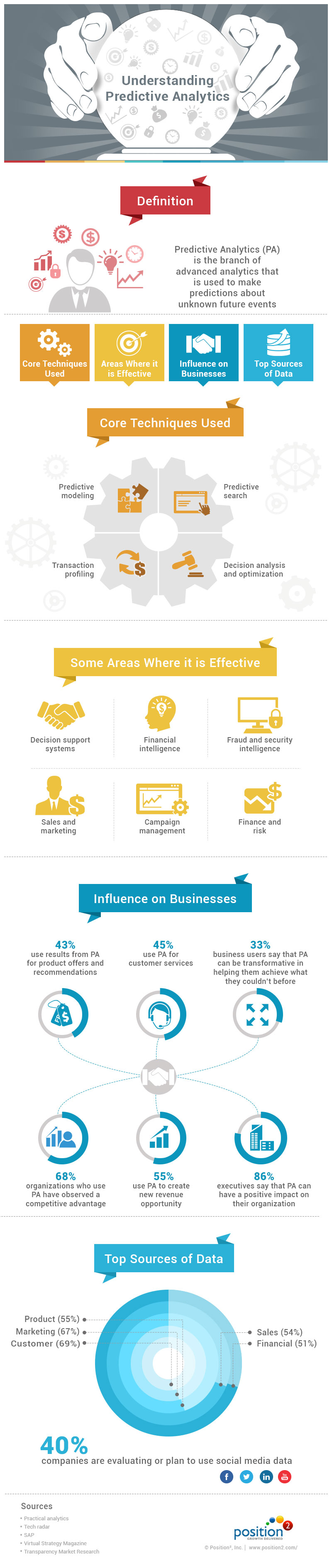
  • Understanding Predictive Analytics- [Infographic]

    Predictive analytics has been gaining momentum as a tool that supports business objectives with respect to sales, marketing, customer support and finance. Check out this infographic to know more about the field of predictive analytics and its role in businesses.

    Understanding Predictive Analytics

  • Conversion rate optimization, ROI in B2B and much more…| Best of the Week

    This week’s hot news, events and videos from the online marketing and social media world.
    6 Tips for Conversion Rate Optimization
    From the Position² Blog This Week:
    6 Tips for Conversion Rate Optimization
    Good SEO needs the support of good percentage of conversions. Along with ongoing SEO efforts, you also need to run conversion rate optimization campaigns. Read this blog to know more.
    Top Stories this Week: Social Media
    Top Stories this Week: SEO, PPC and Digital Media
    Best of the Week Video Best of the Week Video
    Watch this video to know how you can find the best time to send your target audience an email.
    White Paper: Increase Visibility for Your Content by 4x
    Today’s traditional SEO is inadequate: Ignite your search results by accelerating visibility in more places than ever before.Download this White Paper and learn:

    • SEO, why the way we know it is not enough
    • Introducing and implementing Enterprise Visibility Accelerator (EVA)
    • Using multi-channel tracking tools for effective monitoring
    • How EVA benefits businesses.

    Download the complimentary EVA White Paper now

    Know more about Enterprise Visibilty Accelerator(EVA)
    If you are reading this blog post via a RSS reader, please click here to subscribe.
  • Instagram Increases Emphasis on Ads with Debut of New Business Tools

    In order to help brands evolve more creatively, Instagram is providing a host of new tools that will give you more insight into user engagement and sentiment about your Instagram content. Instagram Increases Emphasis on Ads with Debut of New Business Tools

    In a rollout spread over the next few weeks and months, Instagram will be making these tools available to all Instagram advertisers and their feedback will be incorporated into the product before it’s released to other brands later this year. These tools for businesses will help you understand the performance of your organic and paid Instagram content better.

    According to Instagram, the tools will add value in the following areas:

    Account insights – allow you to study the way you are raising awareness using impressions, reach and engagement on Instagram

  • 6 Tips for Conversion Rate Optimization

    SEO is an important component of most companies’ online marketing investment. But good SEO is a job half done, because it only brings in prospects. To support your SEO, you need to run Conversion Rate Optimization (CRO) initiatives to see that the prospects you have brought in actually end up doing what you want them to do – buy from you, subscribe to your email newsletter, recommend friends to buy your product, share your content, etc.

    Your website SEO will get you traffic. But that’s just the beginning. There is a lot to consider after that. For example:

    • How relevant is that traffic?
    • What are your conversion rates and how can they be improved?
    • Is enough of your audience converting? If not, what can you do about it?

    Here is a 6 step checklist that will help you in your CRO efforts:

    1. Setting your objectives

    It’s important to define your objectives. This is the basis for building your website to make your audience take actions that will help you achieve your objectives. Want them to buy? Set up an ecom store. Want them to leave their contact details? Provide a form for them to fill in. Align your website with your objectives.

    2. Research

    Effective CRO requires thorough research. Understanding your audience and their online behavior is crucial for conversions. If you know what they are looking for, what the drivers of their behavior are, then you know what you need to do to get conversions. It’s important to remember that research is a continuous process and its inputs help you fine tune your initiatives to keep conversions improving.

    3. Understand your website and its effectiveness

    This understanding will help build your web pages so that they contribute to more conversions. A conversion is the end result you want out of every site visit. It’s important that you determine what constitutes a conversion for you: product subscriptions, service sign-ups, collateral downloads/ subscriptions, enquiry calls etc.

    The advantage is that everything that happens on your site can be tracked. This creates a wealth of data for you to analyze and see what’s working and what isn’t.

    Record current statistics on number of site visits, bounce rates, conversion rates and amount of time spent on site. Mark up the landing pages that were visited the most. Nailing these details will give you a clear view of conversion goals for your website. Focus on strengthening those pages that are falling behind in contributing to conversions. The clearer the conversion goals are, the easier it is to turn traffic into conversions.

    Outline your sales funnel by combining analytics, research and landing page optimization. You can visualize your sales pipeline better by knowing the landing pages that are performing the best.

    4. Website design and layout

    Designing your website and planning the layout is crucial in the plan to lead website visitors on the path towards conversions. Your website should guide the visitor’s journey to conversion. Interlink pages so that it is easier for visitors to move from one page to another. Your CRO strategy should include a plan for developing necessary collateral that will move website visitors from being a browser, to making a choice and finally to a buyer. Your CRO and landing page optimization practices should support improvement of conversion rates.

    5. Testing

    It’s important to test your pages and see which are working best. Testing has to be continuous because what works tends to change with time and the audience. You don’t want to be in a position where your pages are not working any longer and you don’t know it. There are two important kinds of tests you can run:

    • A/B testing
      Build multiple designs for entire web pages in need of conversion optimization and test them out. Monitor and note behavior on all designs you are testing.
    • Multivariate testing
      Develop multiple new designs for selected elements on the web pages you are optimizing while considering the elements that interact with each other. Your website traffic will come across combinations of the elements you have targeted and you can record their actions.

    6. Integrate social efforts

    Your CRO strategy can start early – even before visitors come to your site. When you integrate social efforts with CRO, you know why your audience is visiting your site and your chances of conversion are much higher than otherwise. Your social media campaigns can prime your audience and bring them to your site, ready for conversion.

    What do you think helps improve conversion rates? Have you worked on your CRO? Let us know.

  • Facebook Eliminates Like Gating and Twitter Launches Promoted Video

    Facebook eliminates like gating

    Facebook ‘Like’ Gating

    In a blog post on their Developers’ page, Facebook recently announced that from November 5, 2014, they will be eliminating ‘like gating’ for Facebook pages. In the near future, this might be a setback for brands that relied on fan gating to grow their fan base. However, in the long run, brands can focus on gaining relevant fans who also engage with the brand.

    Brands can run Facebook campaigns that don’t require fans to like their Page in order to participate in the campaign. You may lose out a few likes by doing this, but you will gaining relevant fans who will engage much more with your content. What’s more, when you don’t insist on Page likes, you might gain other valuable information such as email addresses.

    Twitter Promoted Video

    Twitter has launched the Promoted Video feature in beta.

    The Promoted Video feature draws on the Twitter Amplify program and provides quality content producers a set of new video tools. According to Twitter, Promoted videos will help brands upload and share videos on the Twitter platform while also measuring reach and effectiveness better.

    Twitter has also started offering the ability to run ads with a new Cost Per View (CPV) ad buying model. This means that you are charged only when a user starts playing your video. You also have access to robust video analytics including competition percentage and a breakout of organic vs. paid video views.

    Coupled with the traction tweets gain, you can now also garner user attention and engage with them through Twitter videos. Promoted video can be a cost effective tool where you pay only if a user clicks on the video to play it.

    What’s your take on these developments? Let us know…

  • Google Pigeon update, SMB B2B marketers and much more…| Best of the Week

    This week’s hot news, events and videos from the online marketing and social media world.
    Pigeon - Local Search Algorithm update from Google
    From the Position² Blog This Week:
    Pigeon – Local Search Algorithm update from Google
    Google’s Pigeon algorithm update will have considerable effect on local search results. Read this blog post to know more about the update and understand its effects. Position2 clients – check this out to know what we’re doing to ensure you’re covered for the Pigeon update.
    Top Stories this Week: Social Media
    Top Stories this Week: SEO, PPC and Digital Media
    Best of the Week Video Best of the Week Video
    Check out this Google AdWords video that educates you step-by-step in the process of setting up location targeting for your campaign.
    White Paper: Increase Visibility for Your Content by 4x
    Today’s traditional SEO is inadequate: Ignite your search results by accelerating visibility in more places than ever before.Download this White Paper and learn:

    • SEO, why the way we know it is not enough
    • Introducing and implementing Enterprise Visibility Accelerator (EVA)
    • Using multi-channel tracking tools for effective monitoring
    • How EVA benefits businesses.

    Download the complimentary EVA White Paper now

    Know more about Enterprise Visibilty Accelerator(EVA)
    If you are reading this blog post via a RSS reader, please click here to subscribe.