Author: Team Position Squared

  • SEO 2021: Winning Strategies and Trends You Need to Know!

    Every marketer working with SEO keeps a diligent eye on Google’s algorithm changes and the new features and opportunities they introduce. Optimization techniques that worked two years ago don’t work anymore. For example, Citations used to be a significant ranking factor for local SEO, but recent studies show that this is no longer the case. In this blog, we walk through how you can leverage SEO to make it more impactful in 2021 and beyond.

    Google Now Ranks Web Pages Based on Passages

    Google addressed all their latest updates in a blog post published in October 2020. In a bid to enhance search results, Google is expanding natural language processing to “passage indexing,” ranking individual sentences or phrases within a page. This is one more reason why content should be optimized for long-tail searches, articles, how-to guides, and long-form content, which are all likely to benefit from this enhancement.

    Until now, an FAQ page with 15 frequently asked questions might have trouble hitting the top spot in Google as bots have a hard time understanding the page’s intent. With passage indexing, Google can match a page’s specific section to users’ search queries and rank it.

    E-A-T Principle: Should You Consider It or Not?

    Are we giving too much importance to E-A-T as it is coming straight from Google’s Quality Rater Guidelines? While Google confirmed that E-A-T (Expertise, Authority, Trust) doesn’t directly influence ranking, YMYL ( “your money or your life”) websites can’t rank without some level of expertise, authority and trust.

    In a nutshell, E-A-T is not something that every site owner needs to focus heavily on. However, if your websites fall under finance, health, law, or e-commerce, concentrating on E-A-T will add value and yield results.

    The benefits of increasing E-A-T extend beyond just SEO. E-A-T updates can enhance user experience as users feel more convinced that they can trust your website, authors, and brand.

    User Experience Is a Ranking Factor

    User experience (UX) is vital for any site’s success and has traditionally been a subjective measure. To quantify UX, Google introduced Core Web Vitals, a program to give integrated guidance for quality signals specific to user experience. Since user experience will be a ranking factor in 2021, it is important for SEOs to integrate UX as a part of their strategy.

    The Core Web Vitals report will show you three metrics we briefly discussed under “Focus on Mobile.” You can assess your site’s performance and derive a page-by-page breakdown of issues using the Core Web Vitals report in Google Search Console. This report shows you how your page performs based on real-world usage data or field data. Here are some of the key metrics you’ll find:

    • Largest Contentful Paint (LCP) – How fast a page loads
    • First Input Delay (FID) – How quickly a page interacts
    • Cumulative Layout Shifts (CLS) – How fast a page gets visually stable

    You can easily use this number to benchmark and work towards a better UX experience.

    Focus on Mobile Should Be Your Priority

    Mobile-first indexing will be enabled for all websites starting July 2021. Core Web Vitals are going to be the ranking factor for mobile search queries in May 2021.

    Mobile-first indexing will become the default for all websites, beginning in July 2021. Ensuring all content you serve is also available on mobile is critical.

    Page experience will be another ranking factor from May 2021, where mobile-friendliness and core web vitals are part of this. Safe-browsing, HTTPS-security, and intrusive interstitial are other signals that determine the “Page Experience.” Core web vital factors (LCP, FID, CLS) will be considered for mobile devices when they become an inclusive ranking factor in the algorithm.

    Search Intent More Critical than Keywords

    Google is excellent at isolating relevant content based on a person’s search intent. From an SEO perspective, this means concentrating on top-of-the-funnel, and short-tail keywords alone will no longer work.

    As Google points out, search intent is redefining the marketing funnel and content creation altogether. Here’s an excerpt from Think With Google: “Stop marketing to the average: Be useful. People respond to brands that understand their needs. So, it’s important to optimize your media for both relevance to the consumer and lifetime value for the brand.”

    Content creation should start with a clear understanding of the audience’s intent and how it might satisfy that need. Exploring top keywords you want to rank for as a brand or that your target audience tends to use isn’t good enough. Instead, dig deeper into the needs of your audience. Do people want to buy from you? Find your contact information? Get pricing information or a quote? Is there a particular question that people think you can answer? Start with a close examination of those typical customer journeys to understand that no two journeys are the same.

    From there, we recommend that you:

    • Create content that supports your target audience’s intent
    • Write content around natural search queries (question-based)
    • Examine the types of content (Q&A, guides, how-tos) your users want

    Brand Optimization: Knowledge Panels, Entities and Beyond

    Optimizing your brand’s entire digital presence will be critical in 2021. Brands with a higher presence organically get greater visibility. Claiming your knowledge panel and creating/optimizing entities will be vital in 2021. The Google Knowledge Graph is one way Google tries to recognize searcher intent and the connection between real-world entities and this process revolutionized search forever—for searchers, brands, and businesses.

    Trust also plays a key role in brand optimization. It is becoming one of the most essential and underlying optimization factors for SEO.

    We predict that entities might replace backlinks when Google collects enough data around them. We also see entities as a more real-world model than backlinks to connect a business/person. This model will tell Google which companies are trustworthy, which authors are experts, and what content truly deserves to be ranked higher.

    You can start by:

    • Implementing a complete and accurate organizational schema markup
    • Creating a presence in relevant knowledge bases such as Wikidata/Wikipedia
    • Claiming your knowledge panel to use posts by Google features
    • Setting up your Google My Business profile for physical businesses

    Don’t ignore opportunities like Video SEO (YouTube SEO), Image SEO, Amazon SEO, and like avenues to organically reach a wider audience.

    Conclusion

    Search algorithms are evolving, and users’ search adoption is changing. SEO is not as simple as it used to be. Start with great content first and then employ SEO to make sure that Google takes notice. As we advance, SEO will grow increasingly complex, particularly since rich elements are becoming more common in SERP (Search Engine Results Pages), and it becomes more about being featured than being ranked.

    Are you ready for 2021? At Position2, we can help you understand SEO trends and techniques to meet complex SEO requirements. Contact us today to learn how we can help you take your SEO strategy to the next level.

  • Marketing Dashboard Essentials Is Your Campaign Data Truly Integrated

    This is the first in a series of blog articles called Marketing Dashboard Essentials. This series is designed to help you quickly and effectively assess KPIs from a range of marketing activities and prove the value of your strategies to stakeholders.

    In our engagements with clients, we see that the majority of them had “data” issues. It seems funny that in a world of cloud-based analytics products and APIs, companies would face an issue here. A recent study by Gartner highlights the challenges still faced by digital marketers when it comes to marketing analytics and says that a large proportion of senior marketers “are unimpressed by the results they receive from their marketing data and analytics investments.” (Read more)

    What Does Integrated Data Really Mean, and Why Is It Important?

    While it’s easy to connect data sources and get data in from your Google Ads, Google Analytics, Linkedin, Facebook, CRM, and marketing automation platforms into a single database, it’s hard to integrate the data. Since each platform has its own way of storing data and analytics, you need to build a foundation based on your marketing funnel and then fit in data from each platform in the right slot. We call this joining data at the hip 🙂

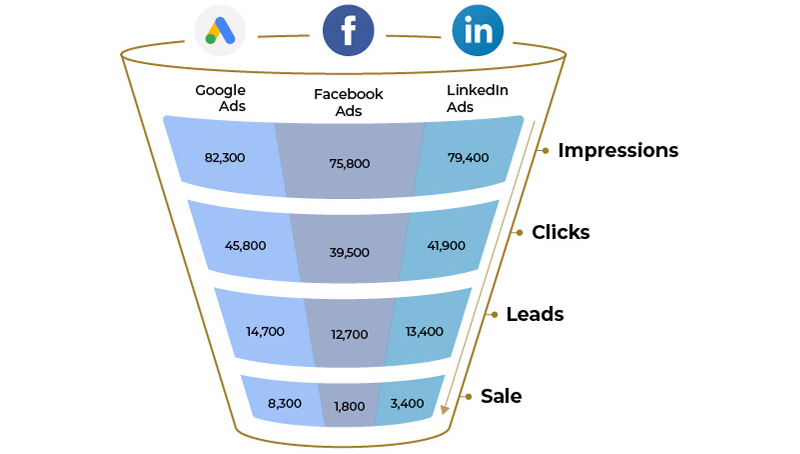
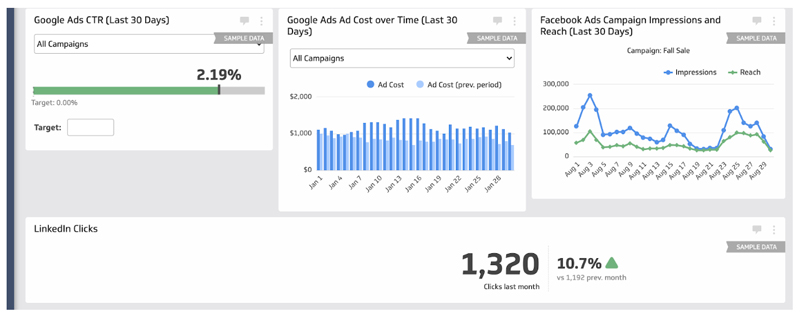
    For example, while one can get Impressions, Clicks, Lead, and Sale data for say Google Ads and Facebook Ads separately – what we really need to make a meaningful comparison is seeing this data in the same chart. Eg. Impressions from Google, Facebook, LinkedIn in one chart. As a campaign manager, you are most likely – working on excel to copy/paste these – or if you have an excel expert you use macros. Google Data studio too can be used. But these need to be set up by an expert and that means when things break – you need to go back to the expert.

    Data Across the full funnel

    Data Across the full funnel

    Is My Dashboard Truly Integrated?

    The simplest way to assess this is to see if you have data from multiple sources in one chart or in separate charts.

    (a) Integrated data dashboard: Data from multiple sources are in each chart for easy comparison. In this, you have the ability to see each parameter across different channels and you also have an option to drill down further into the data.

    Integrated data dashboard

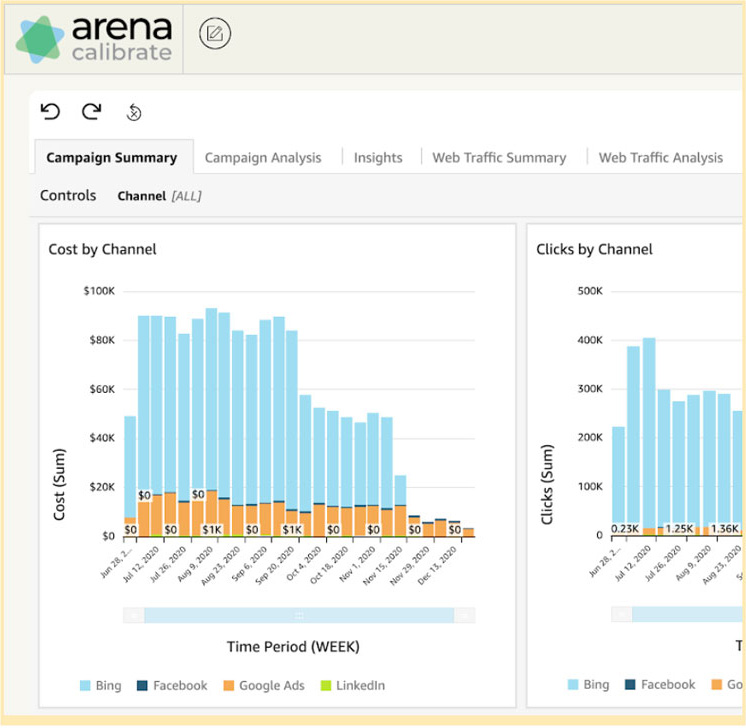
    (b) Non-integrated data dashboard: Data from multiple sources are in separate charts, making comparisons difficult

    Non-integrated data dashboard

    To get a truly integrated marketing dashboard, please test Arena Calibrate, a free dashboard from Position2 that integrates your campaign data from Google Analytics, Google Ads, LinkedIn and Facebook.

  • What Is Personalized Content, and How Can You Use It to Drive Sales?

    When you’re on Amazon’s site, aren’t you amazed (impressed, frightened, in awe) when you see them serving up products that you did a Google search on earlier in the day? Their ability to serve up customized shopping experiences is what personalized content, or dynamic content, is all about.

    Personalized content is online content that dynamically appears based on a visitor’s past and in-session behavior and data known about the visitor.

    Personalized Content and Your CRM System

    Personalized content relies heavily on your CRM system, which might be SalesForce, Hubspot or Pardot. Using data from your CRM system, you can customize your site pages, emails and other communiques for each particular visitor. You can segment your pages to provide a different experience for leads vs. customers, for people from the United States vs. other countries, for people who appear to be further along the sales funnel, for people interested in certain product lines, and so on.

    If you’d like to use your CRM system to personalize content, you’ll first want to make sure your CRM system is collecting a mass amount of data about your customers and prospects. You’ll then define a set of rules and set up priorities for those rules to help ensure that the most important content reaches the right customers. Hubspot provides many more details on how to use your CRM system to add personalization to your content.

    Why Is Personalized Content Important?

    B2B companies spend a ton of money on content – sometimes as much as 25% of their total budget. If that content isn’t consumed, the money goes to waste. Everybody understands that SEO plays a huge role in helping your content be seen. But even if your content is seen, is it consumed, and is it compelling? All too often, it isn’t. All too often, consumers feel like the site they’re visiting is talking generically to a million people. Not a fun experience.

    Personalized content goes a long way in helping engage readers, which of course drives conversions.

    Here is a chart from Evergage’s 2018 Trends in Personalization report.

    What are the main benefits you see from personalization for your organization?

    The good news is that all of these user-experience benefits point to higher-quality content, which improves Google organic rankings and SEO.

    When Creating Personalized Content, What Are the First Steps?

    To create content that delights customers and drives sales, start by identifying who you’re creating your dynamic content for. The more detail, the better. Long gone are the days when you could successfully convert customers by using a one-size-fits-all approach to marketing. A key goal from this step is to identify your segmentation criteria and the smart rules your system will use to adapt your dynamic content to your intended audience.

    Once you identify your audience, do some research on customer intent:

    • Use Google Trends to explore search trends in your category.
    • Conduct keyword research to better understand the words that are more likely to result in conversions.

    Next, determine your default content, which is the content that will be served up to people for whom you have no information. If you manage an ecommerce website, your default content will be the website, perhaps including a “Customers also bought” section. The dynamic element would be a “You may also like” section. This would look different depending on the visitor’s age, their interests and their past buying history. For every dynamic asset on your site, you’ll need a default version for the people for whom you have no information.

    What Should Be Done Next?

    You’ll want to use dynamic content recommendations. The most widely used and most advanced general recommendation method is called ‘collaborative filtering’, which, at its core is an algorithmic approach to capture preference or taste information on many users by collecting and analyzing behavioral information on them.

    Any Other Recommendations?

    • Be Sure to Use Automatic Optimization: Dynamic content should be automatically optimized over time when search engines introduce changes to their algorithms, standards and formats that would otherwise require retroactive and sometimes work-intensive optimization.
    • Adopt a Progressively-Dynamic-Content Approach: If you have a visitor who comes in with no cookies, and you can’t figure out where they live, your system will serve up default content. If your visitor doesn’t have a cookie, but your system can figure out that they live in Texas, that visitor will be served up default content for Texas. If your visitor has a cookie, your system will look up their search and visit history and serve up the most relevant content for them.
    • Choose What You Will Personalize: Because personalization adds layers of complexity, most companies start by personalizing one or two elements per page. Keep in mind that some of your pages won’t be suitable for personalization.
    • Remember All of Your Options: It’s important to remember that, in addition to personalizing web pages, you can personalize social media, emails, landing pages and ecommerce sites.

    How Do You Measure Performance?

    Why do you personalize your content? To increase conversions? The good news is that, according to SurveyAnyplace, 91% of B2B buyers prefer to consume dynamic content over static content.

    But how do you measure the impact of using dynamic content?

    It can be difficult to track which versions of your dynamic content receive more engagement. Using a different link or a unique query string for each asset will make things easier. For your website, you’ll want to track before and after statistics to see if your dynamic site gets more visitors and if the visitors stay longer.

    If they don’t, you will need to rethink your personalization strategy and make modifications to boost your performance.

  • Your Ultimate Guide to Webinar Promotion

    Webinars and online events are increasing at an exponential rate, thanks to the new normal. According to this Forbes article, virtual events are up 1,000% since the start of the COVID-19 pandemic. But not all of them are getting the visibility they deserve. Even after spending so much time and money preparing for the event, most webinars don’t get enough attendees or the right audience.

    No need to worry anymore! Here is a simple and effective nine-step guide to make your event or webinar promotion a success!

    1. Start with a Catchy Title

    The title plays a major role for your webinar promotion. You need a memorable and catchy title that grabs attention and gets people to sign up. Make sure it connects with your target audience and relates to current issues in the sector. Don’t get too technical; keep it simple!

    2. Plan the Promotion Interval

    • Send an email to your target email list from your database three weeks before the webinar, and send reminder emails one week, two days, and one hour before the event.
    • Start yourLinkedIn Inmail (now called Message Ads) three weeks prior to the event.
    • Linkedin sends Inmail only once a month, so you can’t reach your entire audience use this service every week.
    • Make sure that the sender of the Inmail is an influential person in the company (e.g., C-level and directors).

    3. Take Advantage of a Known Audience

    • If you have target-audience details, you can custom match campaigns on LinkedIn, Facebook, and Google to boost registration.
    • If you have conducted a similar webinar or event earlier, promote the new one to your existing users. If they registered earlier, there is a good chance they will do so again.
    • Retarget all of your website visitors. They know your brand and are more likely to register.

    4. Target Your New Relevant Audience

    • Get intent data for your industry from intent providers like Bombora, DiscoverOrg, etc, and target them through LinkedIn and Facebook.
    • Third-party content syndication platforms like Netline can help get leads within a given budget. Such platforms also have a ‘pay-per-registration model.’
    • Target using ‘Job Titles,’ ‘Industry,’ and ‘Skills’ on LinkedIn for better results.

    5. Build Urgency and Leverage Scarcity

    • How many registrations are you planning for the webinar? Mention the seats that are still available.
    • One week before the webinar, start to rotate ads on all platforms with messaging that is clear and creates urgency. For example: ‘Hurry! Only two days left to register.’ ‘Five days to register’

    6. Let the Creatives Speak for You

    Creatives play a huge role in promoting your webinar. Based on our extensive experience, here are some of the best practices:

    • State the date and time of the event clearly on all the banners.
    • Use professional photographs of the speakers and avoid promoting your webinar without photographs. It’s a waste of time, money, and effort!
    • What’s the credibility of the speakers? State the company, designation, and achievements clearly.
    • Mention the partnering company if they are big in the industry.
    • Keep separate creatives for each speaker and promote them separately to appeal to different members of the audience.
    • Rotate the ads for a while and, if required, allocate more budget to the speakers that get more registrations.

    7. Landing Page

    Once you have awesome creatives, a catchy title, and a clear target audience, what’s next?

    You create your landing page highlighting all the details of your webinar and creating some excitement around registration. Follow these guidelines to help ensure better registrations:

    • Make sure the LP is clean and simple. Don’t overdo it.
    • No more big forms! Make sure the registration is a simple process. Don’t ask for too many details. If your webinar is good, they’ll get to know about you and will reach out to you if they need you. If you ask for more details, fewer people will sign up.
    • Call out the speakers with their proper professional picture, their role and experience.
    • Make sure the agenda is clearly laid out.
    • Clearly label the content of the webinar and let the users know what will be the key takeaways.
    • Call out the duration and topic that each speaker will cover.
    • If you already did a webinar on a similar topic, have a one-minute highlight video of it below the registration to give a glimpse of how impactful the topic is..

    8. Extend your Reach with Employee Advocacy

    People!

    Don’t take this for granted. When a trusted friend shares an event or blog that is even slightly related to you, it’s likely that you will register and attend the event.

    Ask all your employees, friends, and trusted connections to share the information on their social media platforms. But get them excited about it, so they don’t just share it but they add their own views and expectations while making their post. This makes the sharing more authentic.

    Social Media Channels

    Share the webinar details on all your social media handles, including Facebook, LinkedIn, Twitter, Instagram, and Youtube. Your followers are your loyal fans, and they won’t disappoint you!

    Signatures

    Update the signature of all your company’s outgoing messages with the webinar details and a link to the blog or registration page. By doing this, more people will learn about the webinar.

    Tools like Signature Satori can help you customize your signature. They offer many templates, allowing you to personalize based on your style.

    9. There Is Always Room for Improvement!

    Even if your webinar was great, it can always be better. Here are some tips to help you for your next webinar:

    • Keep a feedback session or poll at the end of the webinar. Be open to feedback and respond to the feedback providers.
    • Remember one thing: anyone who gives feedback is more likely to attend your next webinar. So, acknowledge their query on the webinar openly and take their feedback positively. After a good experience, they are likely to become your ambassador in the future.
    • Make sure to address all the feedback in your next webinar.

    10. Webinars don’t end; they evolve!

    Don’t forget to record the webinar! The best part of webinars is that they aren’t just one-time content. Recorded webinars can be consumed by more audiences after the live event.

    Add the webinar to your asset list and use it for the following promotions:

    • Add the link to your nurture leads, designed to move people down the funnel.
    • Send the recorded version to all the registrants without fail and add a thank-you note.
    • Promote the recorded version through paid channels for higher audience engagement.
    • As you’re getting ready for your next webinar, promote this one ungated to your audience one month earlier to give them a glimpse of what they can expect. This will encourage the users to join your new webinar.

    The above checklist will help you take your webinar promotion to the next level. Remember that any business is successful with repeat customers. Having a strong webinar series will result in repeat participants, which is likely to result in repeat customers. Remember that content Is King. You need to have the best content ever. Once you do, you need to intelligently promote your event.

    All the best for your next webinar promotions! Please do leave your thoughts and experiences on implementing the above ideas in the comments and share any tested and verified methods that worked for you!

  • The Myth of Perfect Marketing Dashboards

    With marketing going digital, it’s becoming increasingly important to measure results. There are 5000+ data sources, and the challenge of tracking and making sense of all this data is getting harder.

    So what metrics should a marketer’s dashboard contain? If your answer includes only activity-based metrics such as impressions, clicks, and form fills, please read further.

    We recommend looking at the data across two dimensions: depth and breadth.

    On the depth side, the data can be organized into four layers:

    1. Assets – The most granular level is assets, which are typically landing pages (LPs) and email templates. The objective here is to determine which landing pages have high conversion rates and which emails have better open rates or click-through rates.

    2. Programs and Campaigns – Programs and campaigns are groups of ads, emails, and LPs that have a specific objective. The objective could be lead generation or conversion of leads from the top of the funnel to further down the funnel.

    3. Leads – At the lead level, the analytics you’ll be most interested in are the volume of new leads generated and the funnel view of the leads.

    4. Pipeline – The dollar value of the pipeline generated or influenced by marketing and the value of revenue closed are the most important data points. Setting up well-integrated marketing systems will enable you to determine the economic contribution of channels and campaigns.

    On the breadth side, the measurement spans across these areas:

    1. Lead Acquisition – Web traffic, campaigns, and events that offer top-of-funnel metrics

    2. Lead Management and Nurturing – The volume of the marketable database, the volume of leads, the movement of leads from one stage to another (conversion rate), email campaign performance metrics such as open rates, and click-to-open rates

    3. CRM – To arrive at the pipeline and ROI metrics, it’s important to map the leads that came in via multiple sources to their end journey, either opportunity generated or deal closed.

    While you’ll start with basic cuts of the data (by time, industry/vertical, and acquisition channel), over time you’ll likely want to add more customized dimensions, including BUs, geos, products, and services.

    Also, you’ll want to convert the measurements into key performance indicators (KPIs), which are typically ratios, to determine efficiencies. Best practices include comparing against goals or past performance to determine corrective actions.

    Perfect marketing dashboards are not the ones that contain real-time data on siloed metrics but the ones that can give you a comprehensive view of marketing performance across the breadth and depth of marketing activities. We are confident that Arena Calibrate provides an easy to set up and use dashboard. Give it a try and see how it can make your life easier. Once you start using it, we would love to hear your ideas on how we can make it better and more useful for marketers.

  • Optimizing advertising spend across multiple locations

    Optimizing paid acquisition efforts for a company that has many locations is difficult. Nailing multi-location marketing is important for many businesses, including franchises, manufacturing firms with dealer locations, and chains of service providers. In this post, we examine some best practices for multi-location advertising for an illustrative Doggie Daycare company. You will learn the shortcomings of traditional approaches and be introduced to the DOCS framework for optimizing spend across locations.

    Meet Mary, the Director of Marketing at a regional Doggie Daycare brand with 50 locations. Paid acquisition efforts — like search engine marketing and paid social ads — are an important source of lead acquisition for her company. In this post, we consider how Mary should optimize her paid acquisition budget across 50 Doggie Daycare locations. How much budget should she assign to each location? What local marketing factors should she consider when creating the per location budget? How often should that budget split be revisited?

    ‘Even Stevens’: Why an equal marketing budget split across locations is probably not the right answer

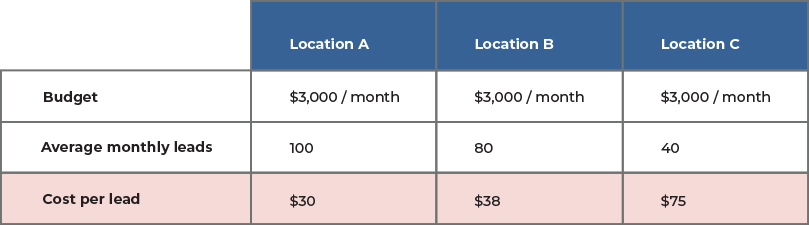
    Mary wants to be fair, so her first instinct is to split the budget equally across all locations. After a couple of months of doing this, however, she notices that some locations are driving far more leads. To investigate why, she takes a look at the leads per location (See Table 1), and notices that the cost per lead is significantly better in Location A ($30), than Location B ($38) and especially Location C ($75). Location A & B are both in locations with relatively less competition, whereas Location C is in downtown — where there are a lot of possible customers but a lot of competitors too.

    (Note: When doing this in real life, you also may notice certain locations would struggle to meet their monthly spending targets because there aren’t enough people searching for relevant keywords in those areas.)

    Table 1: Search Engine Marketing (SEM) Budget & Leads per Location

    SEM Budget & Leads per Location

    Does that mean she should assign all her budget to Location A to get the most customers at the lowest price? Probably not. To keep staff happy at each location, she likely needs some level of minimum spend. She also has to consider the fact that as you try to spend more at each location, the cost per lead will go up.

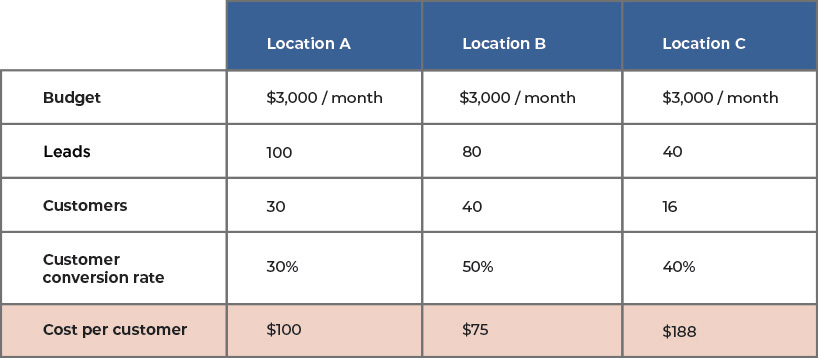
    But the cost per lead is only half the story — what Mary really wants to know is the cost per new customer. Because she has worked with a marketing agency to set up proper call tracking and marketing analytics, Mary is able to calculate cost per customer (See Table 2).

    Table 2: Digital Marketing Cost Per Customer

    Digital Marketing Cost Per Customer

    What factors to consider: Demographics, Operational efficiency, Capacity, and Service mix

    After working with dozens of multi-location companies and franchisor/franchisees, Position2 has developed a framework called “DOCS” to consider when optimizing advertising spend across locations:

    • Demographics: Consider the demographics of the neighborhood. Some locations will be in more prosperous areas, near areas with a concentration of a particular type of customer (e.g., College towns) or areas with more or less foot traffic. All of these factors should be considered along with the company’s product or service to arrive at a hypothesis of how many leads that location could bring in.
    • Operational Efficiency: Some locations — especially in service businesses — will be more or less efficient at converting leads to customers. This could be because of the quality of the reception staff, the hours of operation, or the quality of the service provider (e.g., an established service provider with a great reputation).
    • Capacity: In the service sector, a company’s capacity to serve demand will vary on a weekly or even daily basis. In this example, Mary would want to develop a system to collect prospective information on how many open spots she has in each doggie daycare pack on a regular basis. She would want to spend less money on those locations that have fewer slots open. This dynamic also exists, albeit to a lesser extent, in retail stores, as the amount of product the store has on a shelf will vary.
    • Service Mix: All the stores may not offer the same services. Mary may have some locations that offer training, grooming, or boarding, whereas others only offer doggie daycare. Mary should only spend on relevant keywords for each location, or have a good system for cross-referrals.

    From Theory to Practice: Putting a dynamic optimization system in place

    Putting the DOCS framework into place requires the proper setup. Here are some things to consider:

    • Don’t do this just once: Once you decide how much budget to allocate to each location, ensure you have a system in place to revisit this regularly. Each location’s operational efficiency and capacity will fluctuate regularly, and over time even the demographics and service may shift over time. With many of our clients, we revisit these budget allocations on a monthly or quarterly basis.
    • Use prospective information: Using historical data to predict the future is a necessary input. Where possible, however, try to augment historical data with prospective information (i.e., things you know about the future). For example, a location’s capacity may be low when you look at the past month, but you may be hiring an extra staff member or two in the next two months. You should change your budget allocation in advance to make the most of your location’s budget.
    • Create tiers: It may be difficult to report and digest information on each location. To facilitate ease of reporting to executives, and to ensure the system is easy to sanity check, we often set up “tiers of performance” with our clients. The top tier usually consists of those locations deserving of the most budget based on a balance of DOCS framework considerations. The next tier has the next highest average budget, and so on and so forth. With a tiered system, it is easier to report to executives about how each tier is doing.

    Optimizing budget allocation across multiple locations is tricky, but if you do it well, you will have a big jump on your competitors — and well on your way to getting the most bang for your buck out of your Google, Bing, and Facebook ad dollars. Consider demographics, operational efficiency, capacity, and service mix, and you will be well on your way to a sophisticated approach that gets the most out of each dollar of your marketing budget.

  • Adopting Local Store Marketing in your multi-location marketing strategy| Position2

    Managing local marketing strategies for multiple-location companies can be challenging, even for experienced marketers. Let’s say you’re running a 30-location grocery store on the West Coast of the United States. Your store managers are begging you to do a better job of marketing to their local audiences. Here are just a sampling of their complaints:

    • A manager of the flower department at one store feels like she can’t compete with the truly local florist who gets intimately involved with the high school at prom time and works with the local card store for Mother’s Day.
    • A manager of the produce department at another store doesn’t like the fact that their Asian produce isn’t getting promoted to their substantial Asian population.
    • A manager of the pharmacy department at a senior-rich store feels like he’s not effectively promoting senior-friendly products to his local market.

    How do you solve these problems? By adopting local store marketing (LSM).

    Local store marketing (LSM) is all of the marketing activities you do to help your business be locally relevant to customers within a 1- to 5-mile radius. LSM requires a lot of effort, but the payoff can be great. It’s all about building relationships, giving back to the community and serving the needs of local customers.

    Nine Steps to Take for Local Store Marketing

    1) Develop Location-based Buyer Personas

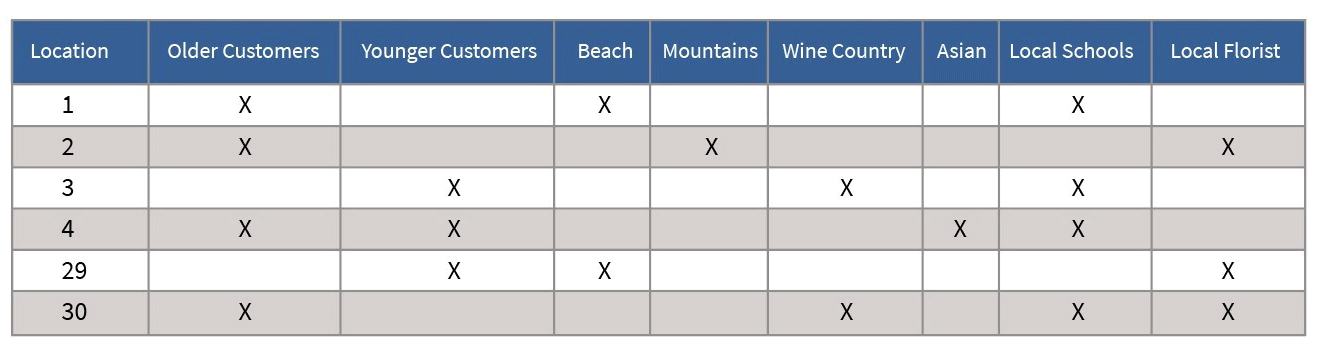
    Think about the unique characteristics of each of your locations. Essentially you want to come up with a location-based buyer persona (or multiple) for each of your stores. Here is an example to help you get started.

    Adopting Local Store Marketing in your multi-location marketing strategy| Position2

    2) Create a Location-specific Database

    Having a location-specific database and good engagement platform will make LSM much easier and more efficient. If you have a store-wide database, you can’t promote Asian produce selectively to your Asian audience.

    3) Leverage Google My Business (GMB) for Each Location

    Assuming you’ve set up Google My Business (GMB) for all of your locations1:

    • Create posts that are particular to each location-based buyer persona. For example, promote sunscreen products for the beach stores, meal kits and other senior-friendly products for the elderly stores, Asian fare for the Asian stores, and to-die-for flower offerings for the stores with local florists.
    • Highlight a local employee each month, letting people know that if they come to the store that month and find the promoted employee, they will receive a special gift. This is all about making your local store feel like a living, breathing entity who cares for them and is worthy of being cared for. Think about how you feel about most corporations. They’re big. They’re unfeeling. They only care about their bottom line. Creating relationships locally goes a long way in building loyalty and trust.
    • Promote a local school and/or a local vendor. Again, the local relationship is huge. A big corporation isn’t going to take the time to care about a local school. But your local store cares deeply.
    • Sponsor a local activity, ideally with other local companies. Perhaps you will support a Little League team or a concert at one of the local wineries. And of course, as part of the sponsorship, include some of your favorite products that you are eager to sell more heavily.

    4) Further Localize Your Digital Marketing Presence Across Multiple Locations

    Create location-specific web pages (company name/location) and social media personas to further help connect local customers with a specific site.

    5) Use Customized Emails

    Use email marketing to reach out to each location-based persona. Ideally, have the local emails signed by the local store manager.

    6) Text Messages Are Even Better

    With smart phones all the rage, text messages are even more effective than emails for connecting with local community members, especially if you’re encouraging people to visit the store. Consider using an automated system to make texting even easier. Invite your customers back, thank them for coming in, send birthday messages and much more. Offer your customers a treat and give them 7 days to come in to redeem it.

    7) Personalize Assets with Location Information

    At a minimum, replace the corporate address information with the local address information. You can do this for online assets as well as for physical assets.

    8) Practice Geotargeting for Multi-Location Marketing

    When you use geotargeting in your online communications, not only do you make local customers feel warm and fuzzy by highlighting favorite watering holes (e.g., popular restaurants, bars, companies and shops), but you also influence the owners of those favorite places to think about partnering with you. This gives you the opportunity down the road to do some joint marketing, which can be very powerful.

    9) Manage Reviews Locally

    We all love great reviews. But we know that with great reviews come some not-so-great reviews. Truth be told, the bad reviews aren’t the end of the world. People trust companies much more when they don’t look absolutely perfect. For example, let’s say you’re looking for an area rug on Overstock, and you see that they have some bad reviews. But when you dig deeper, you notice that most of the bad reviews were due to the wrong product being sent, and the reviewers said that the company handled the mistakes smoothly.

    Whether the reviews are bad or good, it’s important for the store manager to respond to all of them (the local person is key here). Corporate should write up positive and negative templates that they use on behalf of their store managers (making sure their store managers see everything) or their store managers use.

    We hope this article has given you good ideas for how to adopt LSM if you are marketing for a company or franchise with multiple locations.

    Happy Local Store Marketing!

    1Please visit to learn how to do bulk verification in GMB.

  • Post Event Video Marketing for Virtual Events

    This article is a quick snapshot of how to re-use virtual event videos produced in your post-event marketing efforts. Take me to the template.

    Today virtual events are experiencing a corona virus-related boom. It’s accessibility, flexibility, a time-saving benefit for the audience, cost-effectiveness, and most important of all – the social distancing compliance element of it all, is making them the new marketing normal! The very obvious channel of presenting a virtual event is through live streaming or on-demand video through the various tools/resources available today. What’s a less known fact is that videos created at these virtual events have great content that can also be rehashed and used again as an intriguing video asset to continue the conversation with your clients, prospects, or even new logos! While ‘video marketing’ is a trend that is considered essential to the marketing mix, effective re-application of the videos has been an effort that’s yet to be deployed effectively. So, how do we go about it?

    The typical challenges that we commonly hear are;

    1. Is there any content that was produced during the event which can be used again?

    2. We are out of assets. It was all used during the event… Now we need more for post-event promotions

    3. Can we create some snackable assets from the content used at the event?

    Solution:

    Below is a 6 step process on how this can be done.

    STEP 1: AVOID THE PLAN THAT STARTS 2 WEEKS BEFORE THE EVENT

    Start well-in-advance. Based on the event agenda, understand the kind of videos that can be captured. Make a listicle of type of videos. A sample set of videos could be:

    1. Testimonial videos

    2. 2-way interview videos

    3. Break out room session videos

    4. Recap videos (quick recap of the event with or without a moderator talking into the camera), otherwise called Sizzle Reel videos

    While we understand that filming and editing such videos well-in-advance could be an uphill battle, there are easier ways around it. Take a look.!

    STEP 2: BE CLEAR ON THE FORMAT OF THE VIDEOS

    A) Pen down the description of each of the video types so that we (advertiser/marketer) and our clients are on the same page as to what each one of them means. Some examples:

    Demo Video – Product/offering/service showcase video

    Recap Videos – Host talking into the camera on the recap or it could be:

    a. Host and a prominent speaker/guest together summarizing the video

    b. Collage of snapshots from the event – with a VO (will need to be edited)

    B) Be clear on the length of the video. This will be important while planning the usage of the same.

    STEP 3: PIN DOWN THE AUDIENCE ITS MEANT FOR

    It’s important to be clear on the audience it’s meant for. This will help further plan out the possible channels we will use it in, to reach a specific audience. It may also impact the format of the video.

    For example:
    Demo Videos – IT Architects, Developers, Data Scientists

    STEP 4: SLOT THE STAGE OF THE JOURNEY WHERE THE VIDEO FITS INTO

    Split the videos into the different stages of the customer journey. Basically slotting it into stages of the journey where you believe the content would work best. It could go right across from Discover, Early Learn, Late Learn, Try, Buy and so on…

    For example:
    Fireside chat video – where a moderator having a discussion with an expert / Senior leader could be something used in the Discover or Early Learn stage.

    STEP 5: DECIDE THE INTENT

    Now it’s time to decide the ‘intent’ that can be met with the video. Basically, what is the intended action expected from the audience you are targeting when they see this video? Answering this question will also drive a stronger orientation of the content planned for the same.

    For example:
    A Demo – could be used to encourage a trial

    STEP 6: DECIDING THE MARKETING CONDUIT

    Last, but not least, we are to decide which channels would work best for the video we intent to produce.

    For example:
    POV video on existing trends of technology – could be used in:

    • Within articles/blogs written on publisher channels
    • Landing Pages
    • Within Webinars
    • LinkedIn
    Deciding the Marketing Conduit

    Some pre-requisites are essential during this process:

    1. Sign off on the ‘video chart (see template)’ planned from client

    2. Sign off on the plan for future use of the video from the client (which is part of the template)

    3. Assignment of spocs from the client’s end to aid – in video usage post-event56t
    a. Get talent/rights forms signed off- so that they can be used across channels

    4. Detailed list at least a week before the event – of possible clients who would be attending the virtual event and whom we intend to have audience/video interviews.
    a. Get the questions in place for the interviews with approvals from the client’s internal marketing teams and if required client’s client and legal teams
    b. Get as many of videos pre-recorded

    5. Specify the need for a distinguished moderator during the interview if required

    6. Sign off on editing time (If required for uploads in real-time).

    7. Buying and testing with tools to make the videos interactive

    8. Good audio equipment in place for effective audio/videos recordings to be done

    9. Sign off on budgets for appropriate PO releases to be done

    While shifting lead gen from traditional to digital, why don’t you take a look at how Position2 can you put your marketing to work.

    Happy Video-ing! And plan ahead in time. To get you started off, here is a template you can download.

  • Protecting Data Privacy During the Turbulent 2020 COVID-19 Pandemic

    With the invasion of the coronavirus pandemic, the world has changed. Businesses across the globe while practicing social distancing are dependent on the internet more than ever before. Almost all trade shows, conferences, and offline marketing initiatives are canceled. This has dramatically increased the demand for digital marketing. While it is important to stay at home and stay safe to fight the COVID virus, it is also equally important to keep businesses running and help the economy grow during these dire times. Digital usage will be the deciding factor for business continuity and profitability. While companies use new digital strategies, it is important that they adhere to the general data protection laws that have been put in place.

    Governments across different countries are coming up with different data protection regulations and guidelines to safeguard user data. Thus it becomes increasingly important for digital marketers to follow these regulations or face huge penalties. All of the current reforms like GDPR and CCPA aim at helping the customers gain better control over their data by offering more transparency through data collection and usage processes. This doesn’t put an end to how digital marketers can market their products. They just have to modify their ways of collecting and using the data of consumers.

    Here are some tips that a digital marketing agency or any firm involved in digital marketing can use to adhere to data protection laws prevailing across the globe.

    1. Standardize the Policy for All Regions

    It is advisable to maintain a standard all-encompassing policy across all target market regions. Slowly and steadily, all countries are aiming for the protection of their consumer data. These privacy laws which are applicable in one region will soon be implemented in other regions. Most countries follow their predecessors, creating policies that are quite similar to the ones already in place. This means that you don’t have to worry about your campaigns when a new policy takes effect in a different region, because ultimately most of the privacy and cybersecurity laws are more or less similar and you have already accommodated those in your standardized approach.

    2. Risk Management

    Organizations should create new risk management policies that are to be strictly followed by each division of the company. Here are some of the steps that should be included:

    • Catalog your organization’s assets, including server, computers, data, routers, software and email.
    • Determine what threats each asset may face from humans (hackers, competitors, human error), technical (crashes, overloads) and environment (floods, earthquakes).
    • Consider the loss of confidentiality, breach of trust and lawsuit issues that may occur in case of occurrence of a threat.
    • Identify ways to mitigate the risk and protect privacy and data. For example, risks associated with unauthorized access and modification of data can be prevented by an appropriate firewall and updated antivirus.
    • After implementation, educate all stakeholders on new controls, policies, and procedures to follow in order to mitigate the risk.

    3. Website Audit

    Your business is still liable and can face heavy penalties for the collection and improper use of data by third-party platforms. It’s essential for your business to audit its website in order to understand the platforms loading across different pages of your site. This may include tags and pixels that you may not be implementing directly but are piggybacked on your platforms. You need to put checks and balances in place to identify others collecting data from your website.

    This data can be obtained using a tag audit and tag inspector. Follow these steps:

    1) Identify the platforms loading on your website.

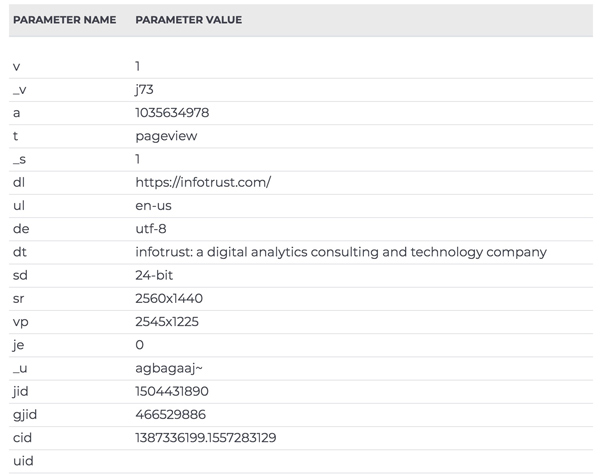
    2) Understand the data collected by them by looking at the network requests they are sending from your business site to the respective server of each platform. The type of data collected by these third-party platforms should be identified. This can be done by looking at the network requests they are sending from your website to their own respective servers.

    3) By using Tag Inspector, you can collect these at scale across all pages of your site and get simpler outputs to aggregate and understand the same data.

    website-audit-image-1-parameter-name-and-parameter-value

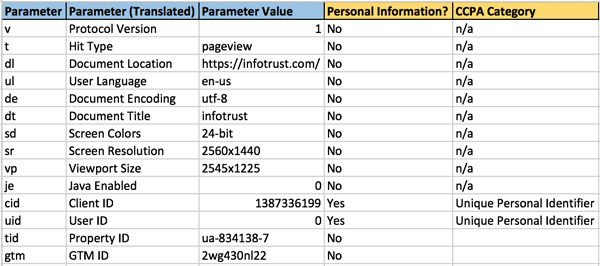
    4) After identifying the data points of each platform, analyze if any data is considered personal information. Mapping of data can be done in this format for ease of understanding.

    Emojis in Advertising: Do’s and Don’ts

    In case personal information is collected/shared/sold, you need to include this in your privacy notice and disclosures to consumers.

    4. Obtaining User Consent

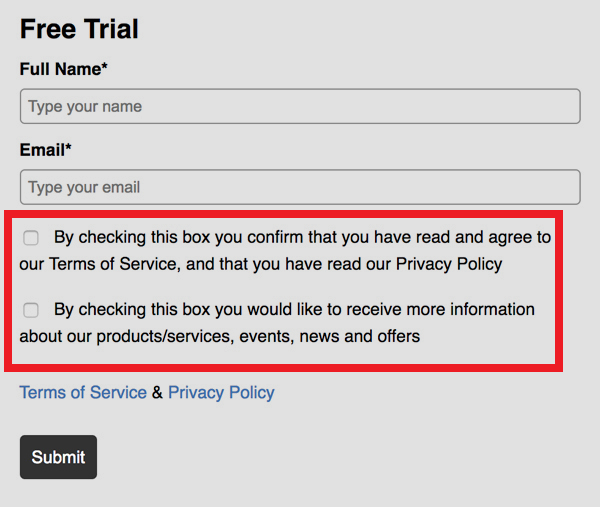
    Terms and consent on your emails, campaigns and websites should be clear and not stuffed with complex language that can confuse users. The user consent should be obtained to collect information as well as to send future information.

    Emojis in Advertising: Do’s and Don’ts

    5. Ownership in Case of Data Breach

    Data breaches are not a matter of “if they happen” but rather “when they happen”. In spite of having a very secure system, always be prepared for the worst. In case of a data breach, Marketing and IT will work together as the first line of defense in complying with legal notification requirements. The appropriate point of contact should be in place in case an unthinkable data breach situation arises.

    6. Immediate Breach Notification

    If a security breach occurs, you should report the data breach to both your customers and data controllers. Failure to report would lead to fines and strict action against the company by data protection authorities.

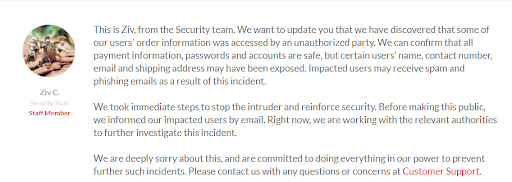
    Every individual in the company is entitled to report a data security breach as soon as they discover it. Recently, Oneplus informed its customers that an unauthorized party was able to access order information from the online store of Oneplus. They also pointed out what information was accessed. Here is the screenshot for the actual notice by Oneplus.

    Emojis in Advertising: Do’s and Don’ts

    7. Providing Data Access Rights to Users

    Under certain legal basis, users have the privilege to access their data that has been collected. The company should be able to provide the user with a free detailed electronic copy of the data that was collected about them. It would be good practice to share a report that includes various ways in which the user data is intended to be used.

    8. Right to Be Forgotten

    Customers have the right to ask for data deletion. They can make a request verbally or in writing. Additionally, companies can erase customer data after it has been used for the purpose per their consent. Every company has the right to refuse data deletion if collected for the following purposes:

    • For providing services or goods requested by the consumer
    • Data pertaining to detection of security incidents and prevention against malicious, fraudulent or illegal activity
    • For engaging in scientific, historical or statistical research in the public interest
    • Used only for internal purposes that are reasonably aligned with the expectations of the consumer
    • Data that is required to comply with a legal obligation or lawful basis

    9. Data Portability

    Data portability laws give the users rights to their own data. This information should be in a usable format that allows easy transmission without hindrance. Companies like Google and Facebook now allow users to download their own data, generally in a machine-readable format that can be used to transmit their data to another service.

    Conclusion

    It’s essential that you only collect relevant data. Collecting unnecessary data just because you think that it would be useful in the future can make your present data processing and management difficult. Ultimately you need to really think whether you require the data you are collecting or not, because the older way of collecting as much data as possible will make things more difficult for you. Data minimization and relevancy should be the goal while storing the data While it may seem that CCPA and GDPR principles will terminate digital marketing, that is far from the truth. These eprivacy directives will, in fact, help companies come out ahead, especially those companies that embrace it. They will help build a good relationship with customers by fostering trust and being open about what data is being collected from customers and why. Giving consumers a choice will help create a mutual benefit — and exchange of data for more personalized and relevant experience.

    This is a smart marketing strategy in the long run. It will help in business continuity in the current COVID-19 times when traditional marketing strategies cannot be implemented due to social distancing and restrictions to fight the global pandemic. As businesses embark on their new digital journey, it is important to adhere to data protection laws. This will benefit both your business and your customers. Stay safe, and keep others safe.

  • Top digital marketing trends for 2020

    2020 is here – the start of a new year and a new decade. Over the course of the last decade, digital marketing grew from sea level to the mountains and emerged as an essential part of any business. With the beginning of a new decade, several marketing experts have predicted how the innovations in digital media, platforms, and technology will shape marketing in 2020.

    In this article, let’s take a look at the digital marketing trends that the experts believe will be the most beneficial to your business.

    Treat personalized marketing as the key to success

    This is undoubtedly the most exciting digital marketing trend. Studies have shown that customers feel more attracted to a certain brand when they get personalized marketing messages from them. Brands should look for ways to make every customer feel special, and this should be more than just typing the first name into an email greeting. They should dig deep into the customer’s mind and find out about their liking and what they look for when buying online. Getting personalized messages,offers and alerts on a certain product that your customer may have been looking for can make them buy it instantly. But keep in mind that users do not want to be bombarded with content, especially if it isn’t relevant, so keep your content concise and easily understandable.

    Use interactive emails to engage your customers

    No matter how much we move forward with technology, the undeniable fact is that Content is still King. Several reports from 2019 suggest that most B2B content is educational, with the intent of fostering leads and building audience trust, two things that are essential for inbound marketing. The latest digital marketing trends show a downfall in text emails and newsletters, and digital marketers are looking to replace these with emails that look and function like web pages, designed with clickable buttons and other interactions. These gleaming designs are doing much more than just creating impressions. They are improving conversions.

    Utilize creatives as a serious performance driver

    Platforms like Google and Facebook are now capable of understanding which ad images and ad copies will drive the best traction and the best click-through and conversion rates. Given these new capabilities, you should make your creative emerge as a performance driver,carrying equal weight to other key drivers such as audience targeting and placement selection.

    Implement product tags to increase eCommerce sales

    A few years back, businesses were struggling to direct their social media traffic to their e-commerce stores. But thankfully, they have found an answer to this issue. With social commerce, buying a product directly from social media posts and ads is now possible, and this can be done without even leaving the app or the site. The shoppable posts may not be exactly new but, since the launch of Instagram’s checkout option, this digital marketing trend has become very popular. By giving customers a hassle-free shopping experience directly on social media, you can increase the chances of successful sales conversion.

    Update your old content with new keywords

    Your site may have old articles that have previously ranked well and have attracted backlinks, but search traffic for those old write-ups may presently not be high. So to maintain your SEO rank, you need to update your old content with new keywords, which will help you to hold your rank. This is one of the most inexpensive and effective digital marketing trends that you should consider.

    Invest in a video blog (vlog) and influencers

    With the growing success of YouTube, Instagram and Snapchat, the popularity of video blogs has skyrocketed. Findingmicro-influencers who have a targeted group of followers and are popular enough to be influential can be very beneficial.They will promote your product with video blogs and help you easily reach more potential customers within your vicinity. Small- and medium-sized businesses are opting to work with small- and medium-sized influencers instead of competing with globally-leading organizations for the top-tier influencers.

    We can see that the upcoming trends in digital marketing ask for both more of a human touch and better utilization of technologies. The emphasis is on giving a more personal relationship with extra targeted niches and making better connections using new technologies. The objective still remains the same – getting people everything they want at the same place – with technology making it easier to reach there.