Author: Team Position Squared

  • How Marketo Ad Bridge Enables To Target The Right Audience


    Marketo Ad Bridge enables you to target the right audience with personalized marketing content across advertising platforms including Google, Facebook, LinkedIn, and other widely visited sites. By specifically targeting the right demographic with personalized content that’s based on their interests, businesses can more effectively reach prospects and get better results out of their marketing expenditure.

    How does it work?

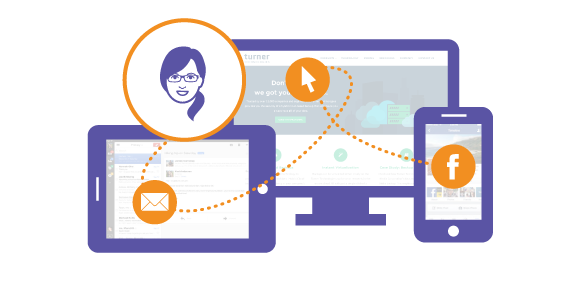
    Ad Bridge leverages Marketo’s behavioral database to show relevant content by analyzing how existing and potential customers interact with your business via email, your website, and social media channels. Personalized ads based on those interactions are then displayed on Google, Facebook, LinkedIn, and other channels.

    Existing as well as new prospects who click on your ad will be taken directly to your business’s website or Facebook page. Ad Bridge allows you to stay in touch with your target market with promotions, useful content, and other information. Focusing on targeted users (rather than on indiscriminately widespread ad placements) helps place ads and useful content in front of those who are more likely to respond to them.

    Let’s delve a bit deeper

    LinkedIn’s partnership with Marketo Ad Bridge helps businesses take lead nurturing to the next level by leveraging the vast amount of information that LinkedIn has on its users via their interactions with connections. For B2B campaigns, Ad Bridge makes it easy to find new users looking for exactly what your business offers, while respecting the privacy of LinkedIn users.

    Marketo’s Ad Bridge partnership with Facebook now offers Lead Ads that make it easy for prospects to interact with a business page in Facebook. For example, clicking such an ad in the mobile version of a company’s Facebook page can bring up a form that is automatically populated with data from the user’s phone (which the user can edit for privacy). This allows the user to easily get in touch with the business for more information or offers. This data is then viewable on the business’s Marketo instance, and can be extremely useful for its lead nurturing program and bring new prospects into the sales funnel.

    It’s easy to see how Ad Bridge offers businesses unprecedented ease and targeting across major social media and professional networking sites. Smarter, more focused ad spending provides greater ROI to businesses using the system. Instead of scattershot ad placements that usually do not produce great results, Ad Bridge provides marketers with the tools to focus on prospects that are more likely to become customers.

    Stay tuned to the Position2 blog for more updates.

  • Best of the Week | Making The Most Of Marketing Databases, and much more…

    This week’s hot news, events and videos from the online marketing and social media world.

    From the Position2 Blog This Week:

    Top Stories this Week: Social Media

    Top Stories this Week: SEO, PPC and Digital Media

    White Paper: The Rapidly Changing World of SEO

    Get a head start in your quest for search engine optimization by going through this insightful white paper. Download this White Paper to know:

    • How important SEO is & why it should concern you?
    • Various ways in which you can deploy SEO
    • How to combine Social Media with SEO?
    • SEO best practices and a road map to getting there

    Download the complimentary SEO White Paper now

    Search-Engine-Optimization-White-Paper-position2

    If you are reading this blog post via a RSS reader, please click here to subscribe.

  • Google+ Offers A New Design In A Relaunch


    It’s no secret that Google+ has been struggling as it tries to connect with users. It has been a difficult few years as Google tried to compete with other social media platforms like Facebook and Reddit. With its recent redesign and the addition of a few new features, Google hopes to boost the platform’s user base in several different ways. Here are some changes you might see the next time you log into your Google+ account.

    Communities

    Many users had asked Google to add a “Communities” feature, to allows users to connect with others based on their interests and hobbies. Whatever your interests may be, the new design makes it much easier to meet people who share those interests. Over 1.2 million users have started using the new Communities feature every day since its introduction—a major change from the somewhat isolating feel of Google+’s “Circles.” The overall Google+ community has always been its strongest point, and this new feature allows a greater sense of connection.

    Collections

    Also geared toward users’ interests and ways to connect with others, the Collections feature of Google+’s new design allows users to find content based on topics that they might be interested in. This is a great feature that social platforms like Facebook and Twitter do not offer—users are solely reliant on what their friends and connections post rather than what they might be inclined to read. The Collections feature is supposed to resemble Pinterest in the way that groups of users can post on a specific topic and share it with the public or with just friends. It’s an easy way to group content and to make it easier to find while providing a social experience.

    Google hopes to create a different kind of social platform unlike what users might currently be using. While over 2.2 billion people have a Google+ account, fewer than ten percent of users have ever posted anything on the site. Many Android phone users (or those with YouTube accounts) were required to sign up to continue using the services, though the platform was rarely used for what it was actually built for. A new homepage design now allows you to not only see what your friends have posted, but also some posts that you might be interested in.

    With a new design, Google executives hope to start over with a clean slate. Wrobleski writes, “While this is an exciting new beginning for us, we’re definitely not done yet.”

    By not trying to do the same things as Facebook and Twitter, but rather by adding community-oriented features similar to Pinterest and Reddit, users are more likely to appreciate the benefits of Google+’s design and what it has to offer. This makes the Google+ relaunch one that may offer more of what users are looking for, in a different kind of social platform.

  • Making The Most Of Marketing Databases


    Among B2B marketers some will call Big Data the “next hype” while others will simply revere it for being a demigod of the digital world. One thing is for sure: before too long terms like ‘predictive analysis’ will litter casual conversation around the office water cooler.

    Organizations have caught on and are bolstering their Big Data spending in a bid to gain better insights into trends and to make informed decisions within the passing moment.

    We’ve already noticed some growing pains, the downside of “data excess”. With so much consumer intelligence at our disposal why is it that companies fail to tap the potential of data collected in real time, and act on it?

    Put simply, their databases are hold them back. Companies far too often focus across all information and fail to make the most of relevant information. Effective data analysis promises priceless insight into customer behavior, patterns and product sets. Understanding the patterns helps you eliminate potential failures while creating unparalleled consumer experience. Combine that with real-time marketing data and the doors to targeted consumer engagement swing wide open.

    Imagine running like a well-oiled machine the data-driven digital marketing for a leading fitness equipment company. You have collected data on consumers’ exercise patterns and timings. By analyzing the data, it becomes clear that the targeted consumer begins his day at 5 am, checking his mail first thing. So you now have the opportunity to send personalized offers at the most personalized time dialed in to his fitness levels and delivered via his preferred device. Bingo!

    While this strategy may seem like the holy grail of digital marketing, rest assured that none of it is possible without an effective database.  Choose an area where data can help you make a difference rather than get lost in the sea of data. There is always time to re-evaluate and decide on collecting more or less data. Hoping Big Data fades away like a fad of the day is a business strategy you want to avoid.

  • Building A Cohesive Brand


    From the get go, the biggest challenge facing digital marketers has been defining the target market. Who is the customer? That’s the big question. Figure that out and you can build Brand recognition that permeates their every touch point.

    Brands need to have a strategic digital content engine in place that seamlessly penetrates the customer’s lifestyle. Without that, all the talk of methodologies and best practices for gaining more business and ROI from your Digital Marketing efforts is of little use.

    It’s not about new methods of digital intervention into people’s lives.It’s about Cohesive Branding.This means appropriately aligning your digital marketing efforts to meet your customer on common ground.

    Here are some of the rules of the road we follow at Position2 to create an engaging Brand presence for our partners and clients:

    Create brands that connect with your audience

    These are real people with real lives. Listen, talk to, share with and help out your customers wherever and whenever they need you.

    Collaborate with your customers

    Solving a customer’s problem polishes the Brand. Leverage that to open the way with new possibilities for potential customers. You are, in effect, creating a bond with the Brand that may last a lifetime.

    Define a Brand’s Culture and Values

    Then make that the center of your marketing efforts. This is how you define a Brand identity likely to connect with targeted customers. There’s a backstory to tell your customers. It’s the underlying effort behind the products you sell them.

  • Best of the Week | Building A Cohesive Brand, and much more…

    This week’s hot news, events and videos from the online marketing and social media world.
    SEO And ROI Go Hand In Hand
    From the Position² Blog This Week:
    Building A Cohesive Brand
    Defining the target market, identifying who the customer is, has been the biggest challenge digital marketers’ face. Read here to find how digital marketers can find success by defining their customers, then meeting them on common ground with targeted solutions.
    Top Stories this Week: Social Media
    Top Stories this Week: SEO, PPC and Digital Media
    SEO And ROI Go Hand In Hand Best of the Week Video
    Some smaller companies find it difficult to connect with consumers and market their products, especially in rural communities. In this video, Daniel Burstein, Director of Editorial Content, MarketingSherpa and Dr. Lauri Baker, Assistant Professor in Agricultural Communications talks about how authentic conversation can help to market to customers via social media platforms.
    White Paper: Increase Visibility for Your Content by 4x
    Today’s traditional SEO is inadequate: Ignite your search results by accelerating visibility in more places than ever before.Download this White Paper and learn:


    • SEO, why the way we know it is not enough
    • Introducing and implementing Enterprise Visibility Accelerator (EVA)
    • Using multi-channel tracking tools for effective monitoring
    • How EVA benefits businesses.

    Download the complimentary EVA White Paper now

    Know more about Enterprise Visibilty Accelerator(EVA)
    If you are reading this blog post via a RSS reader, please click here to subscribe.
  • Content Marketing – The Personalization Game


    The Content Marketing Institute’s 2016 Benchmarks, Budgets and Trends – North America is out now and making waves.  This detailed document covers the content marketing aspects and trends to watch out for in 2016.

    top priorities for b2b content creators

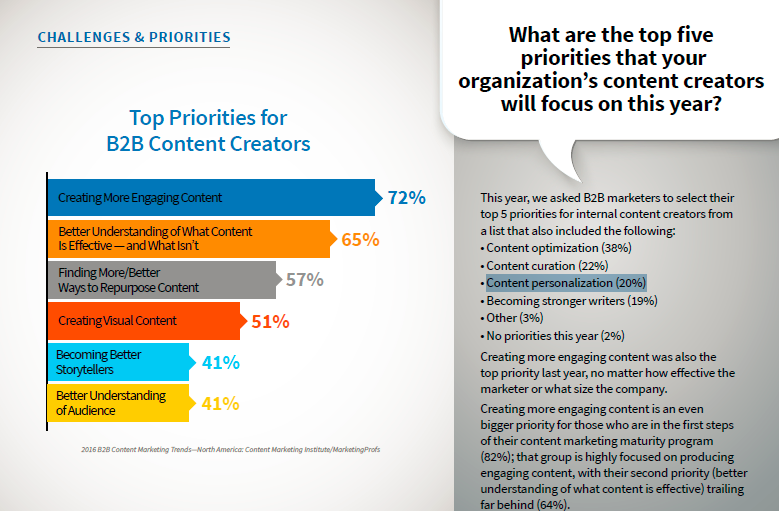
    One of the surveys lists the top 5 priorities for internal content creators:

    • Content optimization (38%)
    • Content curation (22%)
    • Content personalization (20%)
    • Becoming strong writers (19%)
    • Other (3%)
    • No priorities this year (2%)

    While content optimization and curation continue to hold the top position on the priority list, content personalization has obviously caught the attention of content marketers.

    content-personalization

    Image Source

    Content personalization enhances the customer experience across the entire sales lifecycle. Personalizing content results in increased conversion and sales. Leveraging the targeted buyer persona is key to successful content personalization. With that in mind, content creation should result in marketing collateral that can be channelized to the distinct stages of the buyer journey.

    Here are some quick tips on creating personalized content:

    1. Keep historic website data fresh

    Keep your website user’s data updated. Maintain an archive of relevant details. You’ll be able to showcase the right set of digital assets based on the targeted user’s demography.

    2. Quick surveys

    Conducting quick surveys will help you understand your user’s wants and needs. The surveys also serve as a feedback loop revealing what visitors think of the website and digital assets.

    3. Email campaigns

    By regularly leveraging targeted email blasts you build an effective information gathering system and keep your users up to date.

    4. Freebies and Discounts

    Who doesn’t like free? By offering discounts and freebies for repeat visitors you reward users and enhance brand loyalty, something that increases your competitive edge.

    5. Blogs and Newsletters

    An active blog keeps your audience up to date. Share the blog across social platforms. Newsletters are an effective way to update information and spread news across the online world.

    Position2 PoV:

    Content strategists at Position2 keep a close tab on industry standards, on trending keywords, on effective content creation. Our SEO copywriters advise clients about their existing content and placement, and the content we create is optimized for Search. We use content calendars to serve as placeholders for periodic content updates. All digital assets are well researched and segmented into different stages of the buyer’s journey (Awareness, Consideration and Purchase). Each asset is placed correctly to cater to the user persona.

    With 2016 round the corner think about how you will address content personalization in the coming year. Let us know your thoughts and best practices in the comment section.

  • Instagram Chases Snapchat Success With Explore Tab


    When Instagram was acquired by Facebook, users rightfully feared that the app was doomed to become a dumping ground of ads and sponsorships. But so far the Instagram ads have been included in a mindful way, and the user experience has remained consistent to its origins.

    Then came the threat of looping video. Even though Instagram’s core user base embraces the app primarily as a way to share snapshots, video is here to stay. Instagram sees it as a way to enhance a more interactive, social experience. And, more to the point, it’s the way to take a clear swipe at two of its biggest channel competitors, Snapchat and Twitter.

    Explore Instagram With Video

    Instagram has just upgraded Explore, its video channel.  There’s now a stream of hashtag-triggered continually updated and curated content. We saw the first of it with Explore’s one-off event for the recent Halloween weekend.

    The new Explore parallels Twitter’s Moments feature. In the case of the Halloween event, videos were hand-picked for their quality, much like the tweets shown in Moments, which are contributed by selected users. The curated feature ran for 24-hours, a current events window specific to the Halloween weekend. Users who wanted to contribute to the theme used a topical hashtag to be considered for inclusion.

    The experiment is over, but the videos can still be viewed.

    Why Experiment With Explore?

    Snapchat managed to reinvent itself over the last couple of years. Its Live Stories video feed is an obvious inspiration for Instagram’s Explore. The primary difference between the two is timeliness. Snapchat comes and goes. Instagram’s video content potential will have greater appeal to people serious about the timeline of unfolding events. Imagine Instagram Explore in use in Cairo at Tahir Square back in 2011, or on the streets in the US during the Occupy events.

    Instagram also tweaked the best features of Twitter’s Moments, most notably using curated content. They are able to filter much of the “noise” that could otherwise clog the channel. All three apps share a common goal of giving people greater opportunities to contribute personal points of view.

    Explore didn’t display any advertising on its Halloween experiment. But given Instagram’s need to monetize, it’s likely we’ll see sponsored videos soon enough. With 400 million active users every month, Instagram’s user base is now significantly higher than Twitter’s. The potential for a brand to reach a broad and targeted audience is overwhelming.

    Watch Out, Snapchat

    The curated Halloween content in Explore only displayed for US users. But it suggests that Explore could change the way we look for “news” online. Social news has been rightfully criticized for a lack of accuracy.  Instagram’s decision to curate Explore content may prevent such abuses. It also puts the company in a position to censor and shape unfolding events according to its own interests, a slippery slope.

    The more Instagram can maintain user enthusiasm for its app, the more potential it has to make money. The tough part will be financing 24/7/365 curation on a global scale. The Halloween videos were fun, but the real test will be Instagram’s ability to respond quickly to a breaking story and capture the zeitgeist of a trending event. And that’s only if the company decides to roll out the feature long term. We’re still waiting for Instagram to make the announcement.

  • Best of the Week | Plugging the Leaky Funnel: Preventing Lost Marketing Leads, and much more…

    This week’s hot news, events and videos from the online marketing and social media world.
    Plugging the Leaky Funnel: Preventing Lost Marketing Leads | Position2 Blog
    From the Position² Blog This Week:
    Plugging the Leaky Funnel: Preventing Lost Marketing Leads
    Sales success can be achieved when businesses map their pipeline, identify hotspots for fallout, plug the leaks and quickly “recycle” and nurture prospects who don’t initially convert. This is easier said than done. Read this blog on how ‘Plugging the Leaky Funnel: Preventing Lost Marketing Leads’ to off the charts revenue numbers.
    Top Stories this Week: Social Media
    Top Stories this Week: SEO, PPC and Digital Media
    Lead Nurturing: Content-focused strategy leads to 74% lift in leads for Precor Best of the Week Video
    How do you get a 70+% increase in leads for your company? During his presentation at MarketingSherpa Email Summit 2015, Stephen Bruner, Marketing Manager, Vertical Markets, Precor, presented on how tool consolidation, email automation and content were utilized to better Precor’s lead nurturing efforts. Watch this video to get the inside story.
    White Paper: Increase Visibility for Your Content by 4x
    Today’s traditional SEO is inadequate: Ignite your search results by accelerating visibility in more places than ever before.Download this White Paper and learn:


    • SEO, why the way we know it is not enough
    • Introducing and implementing Enterprise Visibility Accelerator (EVA)
    • Using multi-channel tracking tools for effective monitoring
    • How EVA benefits businesses.

    Download the complimentary EVA White Paper now

    Know more about Enterprise Visibilty Accelerator(EVA)
    If you are reading this blog post via a RSS reader, please click here to subscribe.
  • RankBrain: AI Comes To Google Search


    “If you say ‘Google’, people think of search,” Greg Corrado said. He’s a senior research scientist at Google working in artificial intelligence, computational neuroscience, and scalable machine learning. “Search is the cornerstone.” Corrado met with the press to highlight, for the first time, the important place of Artificial Intelligtence (AI) in search. At Google they call their AI system RankBrain.

    Making use of AI, RankBrain embeds vast amounts of written language into mathematical entities — called vectors — that the computer can understand. When RankBrain sees words or phrases for the first time it guesses what words or phrases it already knows that might have a similar meaning, and filters the result accordingly. This makes RankBrain extremely effective at handling never-seen- before search queries, of which there are more than a few.

    Google handles millions of search queries a second, 24/7/365. Let that sink in. Of that total number of daily queries, about 15% of them are completely new to Google.

    The hundreds of signals that contribute to Google’s regular search algorithm all kick in for any query, to be sure. And RankBrain is only one signal out of all those hundreds determining what results appear on a Google search page and where they are ranked. But in the months it has been deployed, according to Corrado, RankBrain has become the third-most important signal contributing to the result of a search query.

    “The other signals, they’re all based on discoveries and insights that people in information retrieval have had,” Corrado said, “but there’s no learning,”.

    And that’s the thing. RankBrain isn’t just precise in matching sites to queries. It also learns and improves its performance over time. Corrado says Google has used RankBrain to handle a massive search load over the past few months and has discovered that RankBrain is better at predicting top search results than Google’s own search engineers.

    The Google engineers who spend their days developing the algorithms that power Google Search were asked to review selected pages and guess which ones Google’s search engine technology would rank on top. They were correct a stunning 70% of the time. Rank Brain had an 80% success rate.

    RankBrain rolled out across all of Google search starting in early 2015 with the green light from Amit Singhal, Google’s senior vice president of search. The yearlong effort started with a team of about five Google engineers, including search specialist Yonghui Wu, and deep-learning expert Thomas Strohmann, before expanding to dozens of people. It took a long time to be certain the system was ranking things correctly.

    “It’s very carefully monitored,” Corrado explained. Google periodically updates the system by feeding it new data to help it better reason with new concepts.