Tag: SEO

  • Google Maps, Yelp & Local SEO Insights

    Start the New Year with a new search engine marketing strategy that looks beyond your business website. If you think local SEO, Google Maps and directory sites like Yelp can push you to the top of search engine listings then go for it.

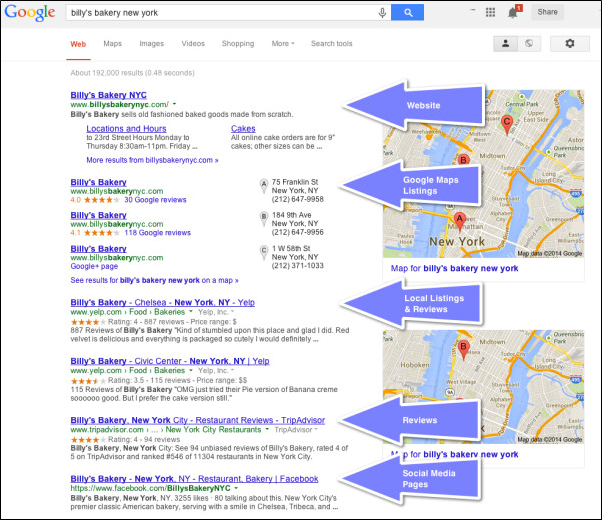
    The July 2014 Google Penguin algorithm update, provides greater relevance to local maps and directory services like Yelp. This way you get useful, relevant and accurate local search results that are tied more closely to traditional web search ranking signals. That means in many cases Local Maps and Yelp listings now rank above the regular business website listing.

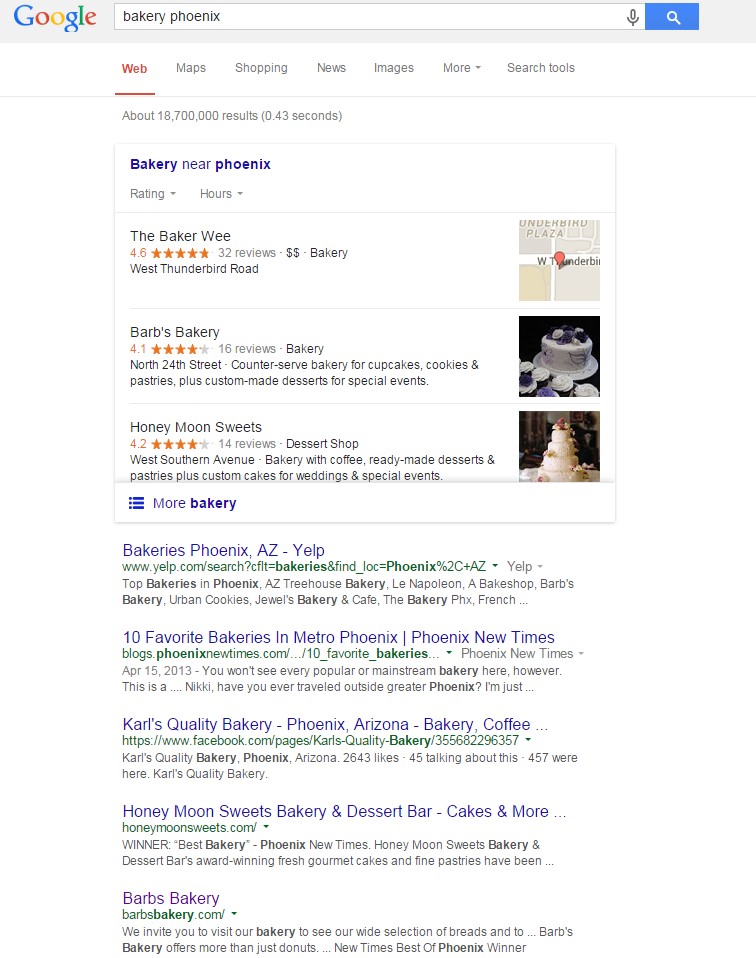
    Check out this Google screenshot, the top results for the search query ‘bakery phoenix’.
    serach_engine_optimization_2015

    As you can see the top three results are Google map listings. And there are three more organic listings before you see the actual local business website. Thus, it is imperative that you pay attention to these listings on a regular basis and optimize your presence on Google Maps and directory sites.

    These are the steps you need to follow to optimize your business website:

    • Set up a Google My Business account

    By creating and verifying your local business with Google My Business, you get your business listed on Google for free. All your business information will be shown on Google Maps, on the search engine results page, and in Google+. Your customers will be able to post reviews. And, as a Google My Business account holder, you will be able to reply to reviews posted on Google+ directly from your dashboard.

    You’ll find that under Yelp for Business Owners. And if there are no matches, simply add your business to Yelp. You can get your Yelp business pages to rank on search engines just like your website. Google’s Pigeon algorithm is now paying close attention to local SEO. So users searching for facts on local businesses can now easily find Yelp reviews.

    • Optimize Your Listings

    Once your business is listed and your contact information verified, optimize your business information. Adding photos, contact business information, website URL, and such other information goes a long way to optimize. Your business can also offer good deals and you can respond to reviews more often.

    • Online Customer engagement

    When reviews appear, responding to them shows all your customers that you care. It’s how you build trust. Yelp allows businesses to respond to user reviews either publically or privately. But Yelp frowns on soliciting reviews. Also, not all reviews will be good. But if you respond and work toward a solution in an amicable way, 40% of negative reviews turn positive. Whether good or bad, be upbeat when you engage and reply.

    Making Google My Business part of your SEO strategy for 2015 and getting your business listed on Google Maps and Yelp and the like will align you with prospective customers and keep you ahead of competition on the digital playing field. But keep in mind that this is not a onetime effort. It’s more of a continuing process that you need to build in to your search engine marketing strategy for 2015 and beyond.

    Contact us to deploy Local SEO for your business website now!

  • Top 5 SEO Trends for 2015 and much more…| Best of the Week

    This week’s hot news, events and videos from the online marketing and social media world.
    Content marketing efforts
    From the Position² Blog This Week:
    Top 5 SEO Trends for 2015
    What do you think are the SEO trends that will attract huge attention from digital marketers in 2015? Well, we have short-listed at least 5 that we think will make it big in the New Year.
    Top Stories this Week: Social Media
    Top Stories this Week: SEO, PPC and Digital Media
    Google tab manager Best of the Week Video
    Watch this video from PPC University to avoid common ad copy pitfalls. It helps you streamline your advertising strategy for better conversions.
    White Paper: Increase Visibility for Your Content by 4x
    Today’s traditional SEO is inadequate: Ignite your search results by accelerating visibility in more places than ever before.Download this White Paper and learn:


    • SEO, why the way we know it is not enough
    • Introducing and implementing Enterprise Visibility Accelerator (EVA)
    • Using multi-channel tracking tools for effective monitoring
    • How EVA benefits businesses.

    Download the complimentary EVA White Paper now

    Know more about Enterprise Visibilty Accelerator(EVA)
    If you are reading this blog post via a RSS reader, please click here to subscribe.
  • Add E-commerce Analytics for Better Business and much more…| Best of the Week

    This week’s hot news, events and videos from the online marketing and social media world.
    Content marketing efforts
    From the Position² Blog This Week:
    Add E-commerce Analytics for Better Business
    It’s great to have an ecommerce portal. But are you tracking how your online business is faring? Well, it’s a vital part of the business process. Learn how to track your ecommerce venture now for a better return on investment.
    Top Stories this Week: Social Media
    Top Stories this Week: SEO, PPC and Digital Media
    Google tab manager Best of the Week Video
    Watch this video on Whiteboard Friday anchored by Josh Bachynski who talks about Google Panda 4.1 – do’s and don’ts. It makes for a compelling watch.
    White Paper: Increase Visibility for Your Content by 4x
    Today’s traditional SEO is inadequate: Ignite your search results by accelerating visibility in more places than ever before.Download this White Paper and learn:

    • SEO, why the way we know it is not enough
    • Introducing and implementing Enterprise Visibility Accelerator (EVA)
    • Using multi-channel tracking tools for effective monitoring
    • How EVA benefits businesses.

    Download the complimentary EVA White Paper now

    Know more about Enterprise Visibilty Accelerator(EVA)
    If you are reading this blog post via a RSS reader, please click here to subscribe.
  • Ten Ways to Optimize Website Speed

    After quality content, page speed is the most important website feature. But all too often people think that optimizing website speed at the time they create a website or blog is wasted effort. They couldn’t be any more wrong. As the popularity of your website expands, testing for page speed becomes absolutely imperative.

    WHY WEBSITE SPEED?

    In a word, search engine rankings.While optimized website speed is important from a user’s perspective, search engines reward it with higher rankings because speed is critical for robots scanning a website. If a competitor’s website loads faster than yours it will take a better position ahead of you on the  search engine results page. The performance of a website is important, but so too is increasing website load time speed. Regularly monitor your website load time and take necessary measures to increase the site speed.

    Website_Speed

    BEST SEO TIPS TO OPTIMIZE THE WEBSITE SPEED


    1. Minimize HTTP Requests

    According to Yahoo, 85% of web page load time is spent downloading the different components of the page (e.g. images, style sheets, and scripts). An HTTP request is multiplied when there are duplicate scripts in the code. Identify and remove these duplicate scripts.

    The quickest way to improve site speed is to simplify your design.

    • Use CSS scripts to combine multiple images
    • Combine background images into a single image
    • Combine multiple style sheets into one
    • Use Script tag on your HTML page
    • Reduce scripts
    1. Optimize Image Size

    Images often contain additional comments and use unnecessary colors. Make images as small as possible so that the browser does not have to resize them.

    Use image editing tools to:

    • Crop your images to the correct size
    • Save in JPEG format
    • Reduce color depth to the lowest acceptable level
    • Remove image comments
    • Specify image dimensions
    1. Minify Resources

    Minification, the process of removing all unnecessary characters from source code without changing its functionality, helps to reduce its size and improve load time.

    Eliminate extra spaces, line breaks, and indentation in your code to keep your pages as lean as possible.

    Minification tools available online include:

    • To minify HTML, PageSpeed Insights Chrome Extension (generates an optimized version of your HTML code)
    • To minify CSS, YUI Compressor
    • To minify JavaScript, JSMin , YUI Compressor
    1. Add CSS at the top and JS at the bottom

    Your pages load faster with style sheet references added to the head of your HTML document because it allows the pages to gradually render the styles. Style sheets also improve page load time.

    Browsers can only download two components per hostname at any given time. Adding your scripts towards the top blocks everything below during the initial page load, and gives the impression of the page loading slower.

    To avoid this situation, place your style sheet at the beginning or <Head>of the HTML document and scripts references at the end, right before closing the <Body> tag.

    1. Caching your web pages

    When you visit a web page for the first time, your browser requests all the web page image files, CSS Scripts and Java files to load from the website’s server, taking up precious page load time.  Caching your website saves these file resources to the browser, and the files can be retrieved from the cached files rather than downloading them again from the network.

    1. Install a cache plugin

    Caching plugins permit you to publish static rather than dynamic HTML files, reducing the time a page takes to load. Additional caching features include minification, caching of feeds, Gzipping, and Content Delivery Network (CDN) support.

    1. Compress and optimize your content

    Compressing your website content will have a huge impact on reducing load times. Large pages with recurring high-quality content are slow to download. The best way to speed up the load time is to zip the pages, called compression. This saves bandwidth as well as the download time it takes to  view your website. It’s biggest impact is on web page load time. Be sure to configure the server to return zipped content.

    You can also compress and optimize your CSS and JavaScript files by combining them and minifying the source code.

    1. Reduce 301 redirects

    Avoiding redirects increases serving speed. Every time a 301 redirect is used, it forces the browser to a new URL which increases page-loading time. The solution? Check for broken links and fix them immediately.

    1. Reduce the number of unnecessary plugins

    A site that needs plugins may slow your web page loading speed.  Too many plugins create safety issues, and often cause crashes.

    Try to measure server performance after disabling the plugins. This way you can identify any plugins that hamper your site speed.

    Web page speed is a metric that should not be ignored if you are concerned about providing  the best user  experience. You can examine and check website speed through free services like Google Site Speed Test and Pingdom.

    1. Avoid text graphics

    Some sites may need formal text to make the web page look attractive. However, text in the form of an image takes up a lot of the web page size and is of no SEO benefit. Don’t use text styles in CSS and keep everything in text format in its place.

    Take Away

    Optimizing your website loading speed is an essential task because search engines reward fast loading websites. Hopefully, these best practices will be of some help. What has or hasn’t worked for you? We would love to know. Contact us now to optimize your website!

  • Is Your Website Worth Clicking and much more…| Best of the Week

    This week’s hot news, events and videos from the online marketing and social media world.
    Your Website is Your Digital Persona. Is Yours Worth Clicking?
    From the Position² Blog This Week:
    Your Website is Your Digital Persona. Is Yours Worth Clicking?
    Designing, developing, maintaining, migrating and optimizing your website is no mean feat. In today’s hypercompetitive digital world you need to be a step ahead of your competition at all times. Read this riveting blog to find out how.
    Top Stories this Week: Social Media
    Top Stories this Week: SEO, PPC and Digital Media
    effective email marketing for the holidays Best of the Week Video
    Watch this webinar moderated by Jessica Langensand, Marketing Programs Manager at Marketo to get great tips on how to go about creating an effective email marketing campaign for the holiday season.
    White Paper: Increase Visibility for Your Content by 4x
    Today’s traditional SEO is inadequate: Ignite your search results by accelerating visibility in more places than ever before.Download this White Paper and learn:

    • SEO, why the way we know it is not enough
    • Introducing and implementing Enterprise Visibility Accelerator (EVA)
    • Using multi-channel tracking tools for effective monitoring
    • How EVA benefits businesses.

    Download the complimentary EVA White Paper now

    Know more about Enterprise Visibilty Accelerator(EVA)
    If you are reading this blog post via a RSS reader, please click here to subscribe.
  • How to Write a Killer Ad Copy That Actually Sells

    We live in a world full of enticing propositions. As a digital marketer garnering the undivided attention of your customers is a challenge. The online arena is a complete world within itself where attention spans are shrinking and novel ideas come in all shapes and sizes.

    What the digital world lacks in attention spans, it makes up for with more focused advertising. Pay Per Click (PPC) advertising is a very targeted form of advertising. Your audience is already primed to buy or wants to know more about the product that you are selling for purchase at a future date. This makes PPC advertising more predictable and you pay the search engine only when somebody clicks on your ad copy. So as a digital marketer you need to make the best of this chance to win over your customers.

    Writing ad copy within the character limits set by the search engine giants however needs practice. The online market is very lucrative and everybody is vying for the same target audience. Then how do you differentiate yourself from the competitor? It’s a tall order but is achievable if you stick to some fundamentals of writing a ‘killer ad copy’.

    • Understand the Audience
    • Use a Psychological Trigger
    • Use Keywords
    • Use Prices & Promotions
    • Use a Strong CTA
    • Differentiate
    • Make it Relevant to Landing Page.
    • Filter Clicks
    • Make it a Continual Process of Testing & Refining.

    Pointers for a Great Ad Copy

    You need to make the most of the character limit that is standardized by search engines. Using the keywords wherever possible makes a crucial difference. Keywords are easily identifiable and are tagged by the search engines. Keywords that are highlighted in the ad copy give you better visibility and improve click through rates.

    Use of trigger words like ‘you’, ‘free’, ‘cheap’ are bound to garner your ad copy more attention. Every purchase is innately perceived with risks but more so in the online world where there is no touch-and-feel factor that we are so used to in the brick and mortar world. Hence, use reassuring words that can soothe your customers and assuage their anxieties.

    Use qualifiers wherever possible in order to give people a better idea of what you are selling and in the process discouraging people who don’t qualify from clicking your ads. Differentiate yourself from the competition by highlighting your unique value proposition. It could be some great offer or something that can add value to your ad copy in a way that can give you the edge over your competitors. Your ad should be in consonance with the landing page that you are going to use to convert your impressions to sales.

    Ask questions in your ad copy wherever possible. This gets the audience more involved. A question with the word ‘you’ is bound to earn your ad copy more attention. People feel you are directly addressing them and that it is not just a phony attempt of enticing people. It makes an emotional connect and people are more likely to buy from you if they are emotionally driven to want your product.

    A Process of Constant Evolution & Improvement:

    Remember ad writing is not a onetime process. You need to continually monitor the status and tweak the ad copy depending on what works and what doesn’t. Hence, you need to have more than one ad copies so that you can always split test and improve your chances of getting better leads. Track your performance using analytics tools available online, the chief being Google Analytics, and incorporate the feedback to get better click through rates.

    Now you might think that the character constraint set by the search engines is stymieing your creativity, but the fact is that people might not even read your entire ad copy. They might just be scanning for some trigger words and your ad copy better have it if you want to convert to sales. You cannot escape the fact that people today are always in a hurry and do not have the luxury of time to look at your ads at leisure. You need to constantly improvise, adapt and overcome in this new era of digital marketing.

    It’s a brave new world out there with ever-changing rules. But you can still conquer it with a killer ad copy.

  • Google Panda 4.1 – Implications & Learnings

    It’s now official, the new update to Panda is here. This follows Pierre Far’s post on Google+.

    Google Panda 4.1 – Position2 Blog

    This has been named Google Panda 4.1 as it comes close to about 4 months from when Google announced Panda 4.0. We at Position2 had shared our thoughts on Google Panda’s implications for SEO & we are now back to shed light on the implications & learnings from 4.1

    Implications of Panda 4.1

    As SearchMetrics’ SEO Visibility tool points out, this is a slow roll-out and will continue over the next few weeks. Google Panda 4.1 is expected to affect about 3-5% of search queries depending on geography.

    Taking a sneak preview at sites listed below, one thing is for sure – Panda 4.1 is in line with the previous updates and is intended at sites which have poor or plagiarized content. Typically, websites which do not produce their own content & re-publish content tops the list of losers.

    Domain-Losers   Before    After 

    Change(%)

    Yellow.com 16383   3413 -79%
    similarities.com 118771  25197 -79%
    free-coloring-pages.com 12268 296 -76%
    dwyer-inst.com 13225 3229 -76%
    issitedowwnrightnow.com 69354  18376 -74%
    updatestar.com 13232 3766 -71%
    office365.com 29365 8781 -70%
    findthebest.com 30848 93937 -70%
    homewyse.com 14161 441 -69%
    adlaide.edu.au 20351 6537 -68%

    Domain-Winners

    Before After Change(%)
    comdotgame.com 2632 38231 1353%
    hogkiat.com 132 68372 406%
    rd.com 8963 42916 379%
    babble.com 17209 71434 315%
    mediagames.net 6839 27876 308%
    hotelguides.com 8563 32957 285%
    yourtango.com 30624 109148 256%
    moreofit.com 6431 22864 256%
    celebritygossip.net 10727 38068 255%
    spoonful.com 2813 89573 218%


    Source:Forbes.com

    This is a classic case of how adherence to Google’s Guidelines is recognized & rewarded w.r.t. quality, original content. Other sites like simplyrecipes.com & Glamour.com have reaped benefits from this algorithm update.Whereas,sites with original quality content stand out to gain from these updates. Noteworthy to mention is Babble.com, which was one of the top losers with Panda 4.0, is now on the winner’s list.

    The overall conclusion here is that News, Content Sites & Portals which offer downloads emerge as clear-cut winners – thanks to original content again. On the other hand, websites which have lyrics, games & aggregator sites need to pay the penalty owing to re-published content which Google terms as “thin-content” sites.

    Learnings from Panda 4.1

    • Have a unique content strategy for your site. Make it as friendly to users.
    • Always have original, quality content on your site; forget content duplication.
    • Content updates should be periodic and should cater to latest happenings in the industry. Efforts should be to evolve as an industry “thought-leader”.
    • Be very careful when re-publishing content, always cite sources whenever required to share content.
    • Avoid guest-blogging, Google considers this as a spam technique.
    • Stick to social channels for content-syndication. Create content useful for your visitors e.g.: infographics, Quick facts, etc. Make your social platforms more engaging and audience friendly.

    Are you seeing any differences in your website performance over the past few weeks or if you are a target of content duplicity, check out for the same on your Webmaster Tool dashboard. Do let us know your comments in the section below.

    Make way for Panda 4.1 – Enjoy spam-free, superior content online!

  • Google Updates Technical Webmaster Guidelines

    The Googlebot that crawls all the web pages could until now only understand textual content and not image based content, CSS or JavaScript. But all that is going to change now, thanks to a recent Update to Google Webmaster Guidelines. Now you will have to optimize your site not just with respect to the textual content but also with respect to the images and the JavaScript too. You will have to do extensive optimization for your CSS (Cascading Style Sheets) too because the Google Spiders will now recognize them.

    If your website settings are such that your robots.txt file is preventing the Googlebot from accessing your Java files then you are at a loss and Google advises you to render access to the bots.  The Google Panda algorithm will negatively view your content if it is not up to the mark with respect to JavaScript or CSS file.

    If in case you are not sure JavaScript and CSS is getting indexed or not, then you can do a manual check by the following process.

    Google fetch

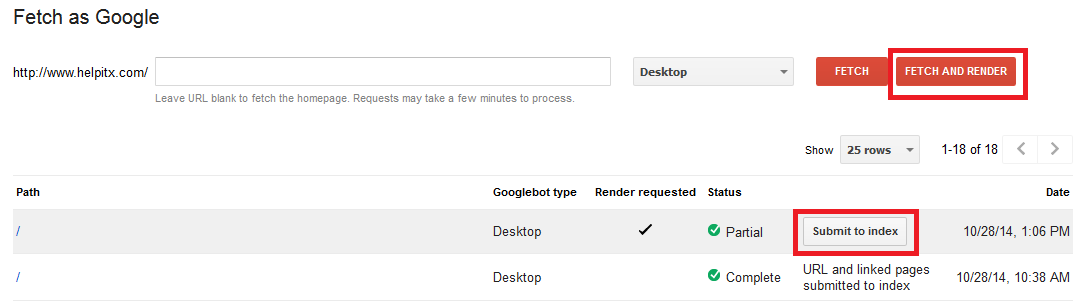
    You need to first select Fetch option under the Crawl tools and then you need to enter the URL of the site that you want to check. If you want to test the homepage then you need to leave the field blank. Press Fetch and Render button so that the Googlebot will begin to crawl your website. Once the crawling is complete you can press the Submit to index button to see the detailed results of the indexing.

    Previously Google used to advise webmasters to check their content on text only browsers like Lynx but now with this new update you will have to check the content on regular browsers to see to it that the site is optimized keeping the new Google update in mind.

    Google offers the following advice for optimal indexing of your website.

    • Be sure to use only the most popular technologies on your website that support the maximum number of browsers.
    • Speed is an important factor for the Google indexing hence avoid all roadblocks to swift indexing like large downloads, et al.
    • Club your various CSS and JavaScript files together and also compress them for better and easier indexing.
    • Handling of full JavaScript and CSS can be tough at times due to various issues and hence optimize your website so that all these additional formatting styles are easily indexed at all times.

    Let us know how this new Update from Google will affect your SEO efforts, going forward.

  • Effective Ways of Improving Your Business Using Local SEO

    Local SEO is becoming one of the most essential components of every business or brand that wants long-term success across search engines. Location-specific searches and the results that go along with them suggests that local business owners need to step up their game in terms of local SEO.

    At present, Google alone has to manage more than 100 billion searches per month from around the world. Among them:

    • 4 billion queries generated from desktops per month in the United States alone have local intent.
    • 50% of all the mobile queries have local intent.

    Local SEO is a great way to target customers by allowing the local businesses to get featured before their customers are looking for them. Higher a business ranks in this local search result, greater are its chances of being noticed by a potential customer.

    What is Local SEO?

    Local SEO has grown significantly over the last few years, particularly due to the rise of smart phone usage and better connectivity all around. Although it has lot of similarities with organic SEO, it is ultimately very different.

    Local SEO is focused on providing results that are relevant to a searcher based on his/her  current location.

    Why Local SEO Matters?

    The number of search queries with local relevance is increasing due to the growth of mobile search. More and more local customers use mobile phones and mobile ‘apps’ to find best local business while they’re walking around.

    In order for Google and other search engines to serve users with the most relevant information using the vast amount of data they have about us, local based results will become more and more prevalent. So the search engines rely on information including local content, social profile pages, links, and citations to provide the most relevant local results to the user.

    The rise of location-specific search of late makes it incumbent on local business owners to seriously start considering ways to scale their local SEO efforts. With the recent Google Pigeon update, local businesses are scrambling in a frenzied manner reacting to the changes.

    Position2- Effective Ways of improving the business using Local SEO

    How to Optimize Your Business for Local Search?

    1. Create Google+ Local Entry and Optimize

    Claim your listing on Google+ Local. If you have already claimed your Google Places page, then it can automatically be moved to Google+ Local, and hence you can manage your Google+ Local page from your original Google Places dashboard. When you appear on Google, you make it easier for the customers to find information regarding your business online. They can see the contact information, hours of operation, direction, as well as the reviews and the ratings.

    2. Encourage Reviews To Add Credibility To Your Business

    Online reviews are playing an increasingly critical role in driving consumers’ purchasing decisions. The quantity and quality of reviews also strongly influences how your business appears in local business listing results. Note that having a more positive score (quality) is more important than quantity of reviews.

    3. Build and Optimize Citations

    NAP (name, address, phone number) citations are a key ranking factor in local SEO. Local citations from quality directories and other locally relevant sites are still very important to gain higher local SEO ranking on Google search. Google crawls them and compares them with the address data on the company’s website. Citations increase the trustworthiness of the company.

    4. Local SEO Website Optimization

    Optimize the website for local search; include some geo-specific information so that the search engines understand the locations you are trying to target.

    • Use your City and State names in your Title tags, Meta descriptions, and in the content of your site  appropriately.
    • Make sure you website provider is making use of the Schema Local Markup, specifically for the Place and the Organization tags.

    5. Ensure Your Business Website is Mobile Friendly

    Google has also recently indicated that one in three US mobile queries is now ‘local’ and 87% of people use their phone when on the go. Google also found that 95% of mobile users look up local information on their phones and the primary functions are calling or visiting a business place. When you are on top of your local SEO, you have a better chance of ranking higher for mobile SEO too.

    Conclusion

    Local search engine optimization is becoming increasingly important, especially because of the rising number of searches via mobile devices. Google is using a combination of proximity, reviews, citations, and other factors to prioritize Local SEO results. Local SEO trends are rising  as of now and they are only going to get better and more significant in the future. Now is the time for you to take advantage of local search engine optimization and boost your business before your competitors gain an edge over you.

    Image Source: SearchEngineLand