Following in the footsteps of Twitter and Facebook, LinkedIn is testing advertising outside its platform.
LinkedIn has kicked off a pilot project that lets marketers to post ads over the web using its data repository. The participants of this pilot program include GroupM’s programmatic focused agency Xaxis and marketing technology and data specialist company Dstillery.
LinkedIn is also opening up its own ad inventory through programmatic channels. Marketers can now target specific audience groups on LinkedIn through a ‘private exchange’.
LinkedIn’s entry into the programmatic ad buying market is new and will take some time to strengthen its hold in the domain.
The digital marketing industry is leaning heavily towards programmatic buying lately. Being a social platform better suited for business professionals, if launched as a full time capability, LinkedIn’s expanding ad network can prove to be a blessing for marketers, B2B in particular. When targeting business professionals, LinkedIn is a top platform and if this pilot project is launched, targeting will become more precise and effective.
Will this move help LinkedIn gain reputation as a top targeting platform and lead to increased revenues?
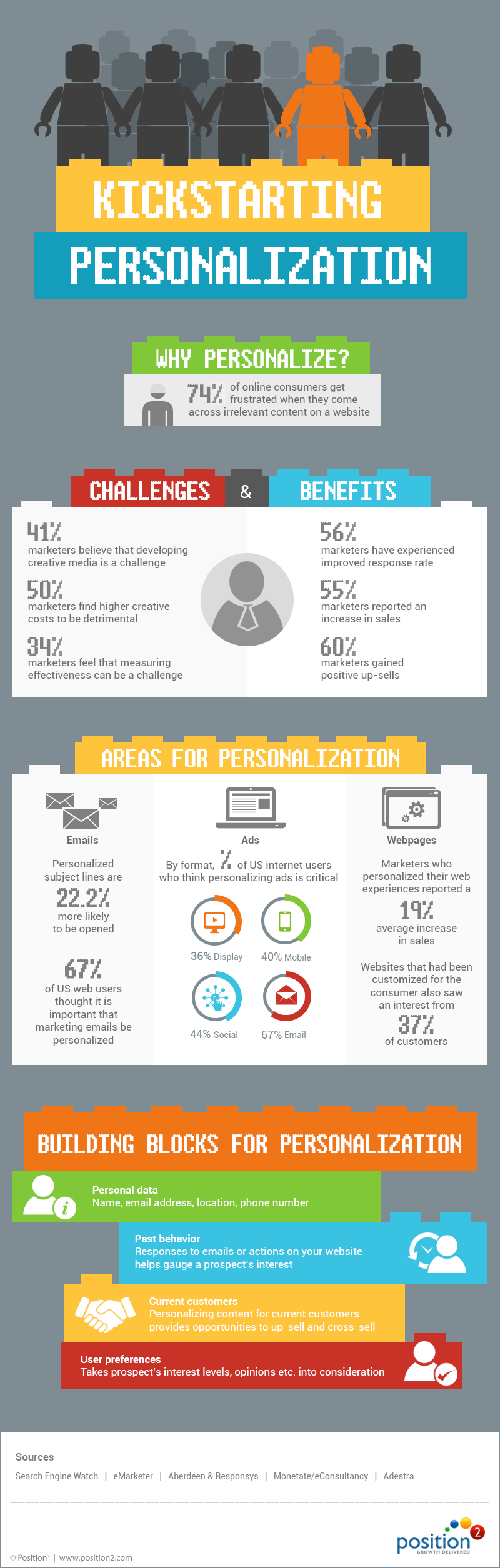
Personalization. This word is being heard, rather a lot, in the industry. A lot of content is available on the same. This is why we came out with this infographic that talks about why you need personalization, its challenges and benefits, areas you can implement it and what you need to apply personalization. Check it out!
Being committed to providing advertisers their investments’ worth in display ads, Yahoo is introducing Yahoo Prime View.
This new vCPM product will allow brands to run display ad campaigns at a 100% viewability rate. vCPM ensures that you pay only for viewable impressions enabling better campaign performance.
Currently, Yahoo Prime View has been introduced for display ads on Yahoo, only in the US. However, the company has plans for a global rollout, with no certain time frame.
You can now increase ad exposure without modifying your workflow – reporting or creative. Yahoo Prime View employs IAB’s SafeFrame, which is a managed API-enabled iframe that opens up a line of communication between the publisher’s page content and iframe contained external content such as ads.
For marketers who opt for CPM campaigns for branding and visibility purposes, Yahoo Prime View will help in increasing marketer confidence in CPM campaigns and thereby, brand investment.
Whether it’s for your email campaigns or your website, personalization is an essential ingredient. Now that cross-channel campaigns are gaining popularity, it’s logical that one applies personalization across channels.
Revisiting cross-channel marketing
Cross-channel marketing refers to the practice of integrating marketing campaigns that are being run across different channels. This means making sure your website, email and social campaigns are talking to the same person in the same way.
Getting down to business…
The Need for Personalization in Cross-channel Marketing
As you would have noticed in our blog posts, we’ve been talking about how consumer attention today is getting divided between multiple media. This is necessitating marketing communication to be sent through different platforms. Every channel has unique characteristics and lends itself to a specific style of messaging. This often leads to inconsistent messaging in terms of tone and manner and occasionally messaging that seems irrelevant.
It is not easy to tailor your messages to suit each platform’s conditions and still capture audience attention. This is where personalization can come to your rescue. By personalizing cross-channel marketing, you tend to catch your prospects attention because the message is developed keeping in mind his interests, habits and other data you have picked up about him. It’s more relevant and therefore, more likely to strike home. Also, when you personalize your marketing, you stay with the prospect all through the communication cycle, otherwise the same brand may sound inconsistent or disconnected while talking to the same person at different stages of communication.
Important Factors for Implementation of Cross-channel Personalization
Identify available data
Personalization is dependent on data. Brands have different types of data about customers stored in different sections of the company. Create a culture of company-wide appreciation of the importance of data. Collate all data into a single database, which can help build an integrated view of the customer and enable creation of personalization strategies. You will be well prepared for more possible scenarios and can build a robust analytics strategy for your cross-channel personalization efforts.
Unify data sets
Brands typically have different data sets about the same customer. There is often disconnect between offline and online data sets. Consolidating all the data against one customer ID helps get an integrated image of the customer. As the database gets richer in terms of data, different user personalities emerge, each with a set of homogenous customers. This enables segregation of customers into different segments from your core audience to less prominent yet important segments.
Develop a connected profile across the customer journey
Customer touch points are many: onsite behavior, email campaign offers & responses, display ads, search terms used, customer support conversations and social media interactions. You will also have data from on-site customer behavior, the transactions they conduct and data from references:
Device related factors – IP address, device type, browser details etc.
Onsite behavioral factors – Time spent on site, site paths followed, product interests etc.
Offline factors – CRM system used, brand loyalty, data from third parties etc.
Time related factors – Time of day during site visit/engagement, day of the week, frequency of visits etc.
Reference related factors – PPC ads, natural search, referring domain etc.
All the above touch points are a part of the customer’s journey. Joining these dots will give you the big picture about the customer segment and specific cues about individuals’ profile.
Stay consistent across channels
Share the available profile data across all the channels that are a part of your cross channel personalization strategy. All your channels should carry the same message since they would be talking to the same customer depending on the channel the customer has chosen. If customers approach you through two different channels and see different offers, it will lead to confusion and indecision.
Build engagement rules
Establish rules that define engagement. Decide how you are going to engage customer profiles on different platforms. Have a plan in place that outlines your strategy after each customer engagement action on every platform. Base these campaign tactics on unique customer profiles.
Implement personalization across touch points
Provide personalized experiences for customers across various touch points. Coordinate these experiences by leveraging customer profiles and recommendations.
Reporting and Analysis
Generating reports and analyzing data will enable you to meet customer requirements better by optimizing your cross channel experiences. However, reporting and analysis can get complex due to the involvement of multiple channels. Knowing the end requirement from every channel can help you channelize the sub-points under every channel to drive towards that end need.
Do you run cross-channel campaigns? What have you learned?
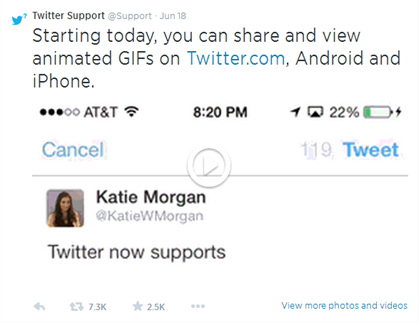
The social media platform recently announced that users will now be able to share and view animated GIFs on the Twitter desktop site and on its Android and iOS apps.
This move saves users from the round trip they had to take until now, uploading the image on third-party sites like Imgur and then sharing the link on Twitter. Users can now share GIFs directly on the site.
However, GIFs will not automatically play on Twitter. Each GIF will have a white play button on it, which the user has to click to play the GIF.
Changes for Marketers
Enabling of animated GIFs provides content marketers with more creative avenues for their content marketing efforts.
GIFs capture attention and engage users more easily. They also help deliver brand messages to customers better through animated visuals. With a 140 character tweet limit, it sometimes would be tough for marketers to convey emotions behind messages. Adding a GIF now makes it easier.
Recently Matt Cutts announced on Twitter that Google had released its Google Panda 4.0 algorithm. This is a major algorithm update and not just a data refresh, which means that Google has probably made significant changes to how Panda identifies websites from now on.
Google Panda History
Google Panda had been designed to prevent sites with poor quality content from showing up on Google’s top search results and provide searchers with the best results possible.
The last confirmed Panda update was on January 22, 2013 and had affected about 1.2% of English queries. This time it is affecting approximately 7.5% of English queries and different languages to varying extents.
Panda 4.0 is considered to be a softer, gentler algorithm change that worked well for only some sites. Google plans to lay the groundwork for future changes in this direction.
Sites that have been affected by this update
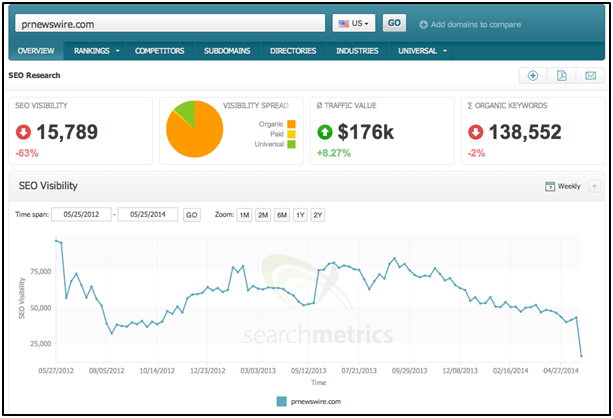
A study of this list by Search metrics reveals that one of the biggest casualties was eBay, which lost a huge amount of traffic from Google. Another was Ask.com.
In a recent blog, Barry Schwartz said that even press release sites like PRweb, Newswire, Business Wire and PRLog seem to have lost significant ranking through Google.
From the above image, we see that PRweb had a significant drop in traffic: 71%.
The winners’ list shows that small business sites have found favor with Google after the Panda update, and many of them have seen an incredible increase in traffic to their websites. Sites that had lost their footing in rankings despite having good quality content because of the Panda 3.0 update benefitted from Panda 4.0.
How does this affect SEO?
Until now, we have observed evident changes like:
Rank difference: There would be a considerable difference in the rankings on Google.
Loss/gain of traffic to the site: Some of the sites lost almost 50%-75% traffic overnight while some gained substantially.
How to overcome the Google Panda 4.0 effect
Listed below are some solutions to counter the impact of Google Panda 4.0:
Have unique and fresh content on your website. Keep in mind that content needs to be generated for users and not search engines.
Exclude keyword hoarding. Do not target all the keywords to one page. Use a combination of long tail/conversational and generic keywords.
Remove duplicate content.
Do not use keyword stuffed title tags. Keep it natural.
Do not overuse keyword rich internal links and keyword rich footer links.
Removing doorway pages and cloaking.
Avoid risky affiliate marketing setups
Please remember recovery can take awhile if you have been hit.
Google Payday Loan Algorithm 2.0
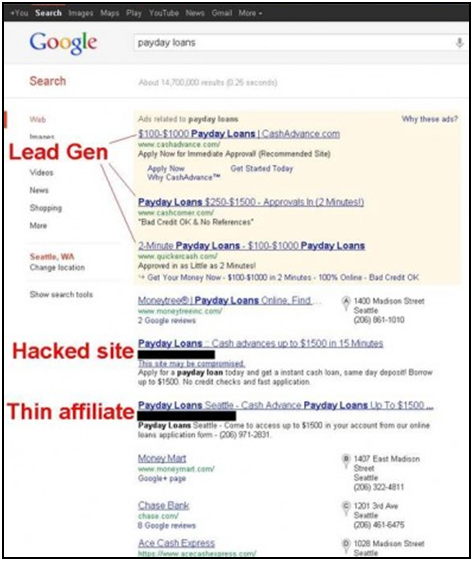
Along with the Panda update, Google rolled out its Payday Loan algorithm 2.0 that targets ‘very spammy queries’. This is the second version of the Payday Loan algorithm, which is used to combat specific search queries like payday loans that tend to have a high number of extremely spammy results. This algorithm is not related to the Google Panda or Penguin updates.
Payday Loan algorithm 2.0 is a continuation of Google’s quest to clean up search queries. The algorithm was rolled out worldwide, affecting different languages to different degrees. It has affected 0.2% of English queries. An advantage is that general queries are likely to receive better search results while preventing the appearance of low quality sites.
Recently, spam results started to reappear in payday loans’ Google SERP’s:
Google Payday Loan Algorithm 3.0
Google Payday Loan algorithm 3.0 was released on June 12, 2014. At SMX Advanced Matt Cutts announced that this would target terms like [payday loans], [casinos] and other forms of highly spammy queries. Payday Loan algorithm 2.0, had been rolled out a week earlier targeted spammy sites.
However, Matt did not shed much light on the difference between spammy sites and spammy queries.
Payday Loan History
The search engine’s original Payday Loan algorithm was first released on June 11, 2013. It impacted roughly 0.3% of US queries and around 4% of Turkish queries, where the volume of webspam is said to be higher.
Last year, it was noticed that for the search term ‘Payday loans’, a completely different set of results were appearing on the SERPs each day. The Payday loan companies were using domains that consisted of slightly outdated specific search queries. These queries were likely to have a high number of extremely spammy results. In order to keep the best Payday loan companies on top of the SERPs, Google released the Payday Loan algorithm.
How does this affect SEO?
Removal of the sites from Google SERPs that have spammy content on their site
Loss of rankings on Google SERPs
Decrease in traffic to the website
How to overcome the Payday Loan effect
Avoid optimizing for any terms that would be considered ‘spammy queries’
Do not use spammy methods – like cloaking, hacked sites/hacked content, leveraging Google+ accounts and leveraging expired domains – to promote your website
Have original, quality content on the website
Do not stuff keywords during optimization. Target 2-3 Keywords for a page. You can use conversational or long tail keywords.
Keep the title and description as natural as possible.
Have anything to add to this? Post your comments below.
Contributed by Susanna Varghese, Junior SEO Analyst
Today’s traditional SEO is inadequate: Ignite your search results by accelerating visibility in more places than ever before.Download this White Paper and learn:
SEO, why the way we know it is not enough
Introducing and implementing Enterprise Visibility Accelerator (EVA)
Using multi-channel tracking tools for effective monitoring
What is the best ROI that you can get through SEO campaigns? How do you know the end results that can be derived from SEO?
Is it engagement, traffic, brand building and reputation management? Or is it simply lead generation?
You need to keep some best practices in mind while generating higher ROI vs. KPIs with SEO.
Search engines are vital in fulfilling the ‘intent’ of finding information. SEO efforts cannot be directly tied to the final purchase of products and services like paid media/advertising. Constant and dynamic updates are made every day by search engines, making it more difficult for marketers to understand it.
The basic rules are simple and straight: stick to the ‘intent of doing good for users’.
Users come first and then the search engines. In fact, the very foundation of success of search engines is users. Search engines want to serve the best information to their audience. The concept of optimizing content for a visitor plays a very vital role for the marketers.
Boost Organic CTR
Here are few tips on how you can boost organic CTR for your website and also within the internal web pages:
1. Focus on people and consider the latest technology as support
People are our ultimate target audience. Users/searchers use technology to attain their goals.
Online marketers should not forget that technology is user-driven.
Tips:
We need to think and adapt to what the users want and need and not the search engines.
Get to know your audience – conduct offline and online market research. Their feedback will be useful for your success.
Develop strategies around human beings (target audience) and deploy them to balance both target audience and search engines. Image source
2. Keyword Research and Mapping
Let’s start with the basics. It is important that we have all the right keywords mapped to the right content.
In other words, keywords should develop out of content and not otherwise. Combine long tail keywords and conversational keywords for balanced conversions. This increases conversions on the website with better targeted content.
Tips:
With the keyword level data vanishing from Google Analytics (‘not provided’), you need to benchmark page level metrics such as KPIs for your success (page level: traffic, engagement, bounce rate, new visits, etc.).
With unique keywords mapped to each page, track performance of the page level traffic to mark success.
Have a content strategy around conversational keyword targeting (with natural language understanding) that includes blogs, forums, etc.
3. Search Engine Results Page (SERP) Ranking
Your SERP Ranking is an indicator of a certain level of success of your SEO efforts. But it is not the complete picture.
We need to remember that organic rankings on Page 1 are just indicators of doing the right optimization. You need an SEO strategy that is defined better to consider these as success parameters.
However, when your audience is finding information on search engines, it is important that you hit the sweet spot on the first page of Google. In short, ranking between 1st and 10th on Google Page 1 does matter. However, rankings above the fold (the part of the screen visible without scroll; usually rankings 1-4) have more visibility; have higher CTR and direct more traffic to the website.
In other words, higher the rankings on search engines, higher the probability of directing relevant traffic to the website and hence conversions. Image source
Tips:
Make sure your basic SEO and technical parameters are in place.
Move inch by inch. Have a detailed plan to test out your SEO strategies, both short and long-term. Create content accordingly.
Remember to create content for your target audience and not search engines. Analyze your audience’s wants and needs.
4. Title Tag
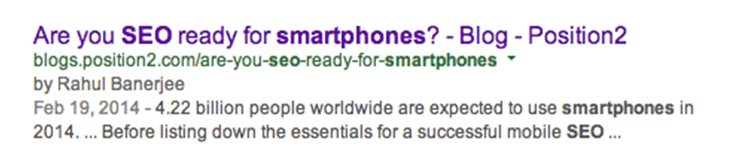
The title tag describes the theme page in short and appears as a blue link on SERPs. These appear when a searcher types in a query to find information on search engines.
A page title catches attention and influences the searchers to click on the link to your page. A well-defined page title has higher CTR on SERPs.
Tips:
Make your page title as natural, relevant and attractive as possible so that the target audience is compelled to click.
Include your target keywords to impact organic rankings.
Keep the title within 65 characters.
Make it simple, short, interesting and natural to increase search inquest.
5. Meta Description
While the meta title gives an idea about the page users see on SERPs, meta descriptions help the audience understand what the web page content is about before they actually reach it. While search engines consider meta descriptions as ranking factors, when constructed well, they also influence searchers to click. You need to briefly describe what the page is offering.
Tips:
Use it tactically. Have an objective for defining your webpage.
Keep it natural and understandable for your target audience. Include keywords that snag users’ attention and lead to chances of higher CTR.
Maintain the optimal character limits for the descriptions. It should be around 150-160 characters with spaces. Write what markets the unique content of the page. Include USPs, value adds, discounts and offers.
Meta descriptions are indicative of the page theme and may not show in the SERPs. Google also uses other publicly available sources of authority like Wikipedia to show relevant results. So, have a content marketing plan along with website optimization.
6. URL Optimization
The best approach is to frame URLs for people that are crisp, easy to read and remember.
Clear and concise URLs on SERPs reassure readers that a page will deliver on their search and enable better CTRs.
7. Rich Snippets (Structured Data Markup)
a) On-page markup using Schema
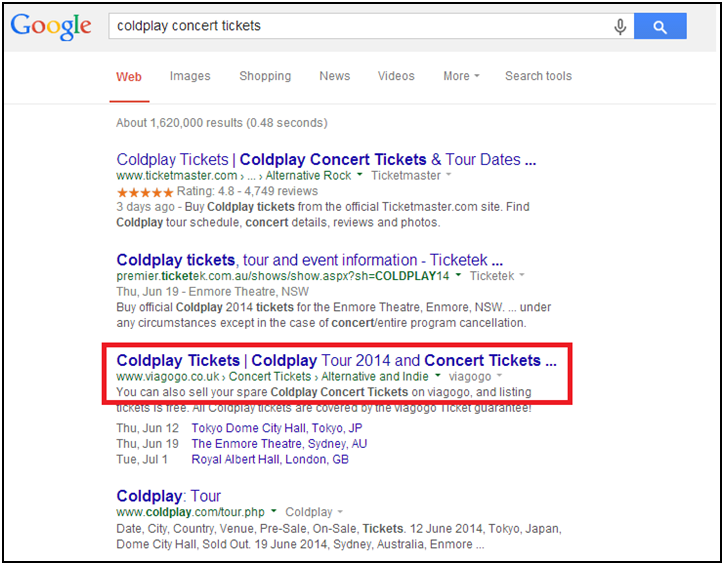
Inclusion of Schema markup enables search engines to understand and categorize unstructured data on web pages. This helps provide richer search results and makes it easier for users to find relevant information on the SERPs thereby driving better CTRs.
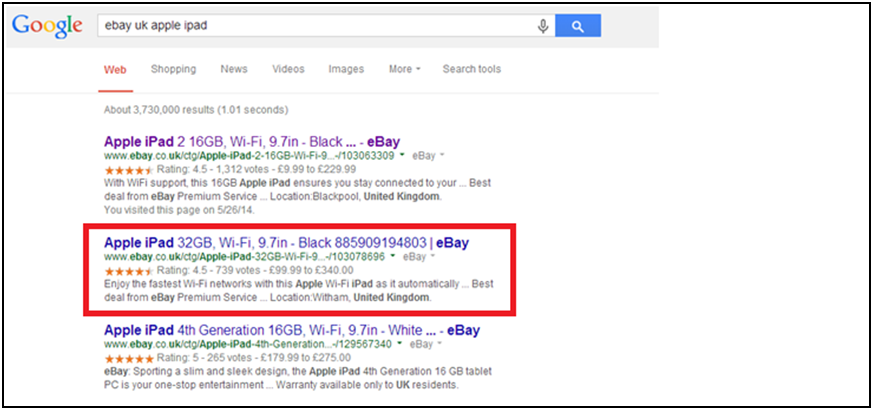
Customer rating markup on a product page: Improves credibility of the product leading to better CTRs.
b) Google Authorship markup
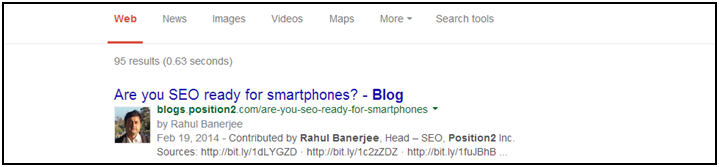
Linking the content of the author with his/her Google+ profile enables a headshot of the author to appear next to the search listing. This leads to better CTRs for blog posts and articles from SERPs.
8. Call-to-Action (CTA) – Visibility
Apart from techniques to increase CTR through search, the final touch should be well-judged placements of CTAs on the website. This would increase the probability of CTRs and hence, conversions on the website.
As mentioned earlier, it is necessary to rank above to fold in search engines and have CTAs (buttons, forms, etc.) above the fold.
Tips:
Test the important pages of the website, the home page, products and solutions pages with Heat Map. Monitor your audience’s movements on your website pages. Then place the CTAs accordingly.
Competitive analysis tells you how your competition is doing. Draw inputs through the comparison.
Work on your website design based on your budget and look to improve user experience.
The Bangalore chapter of Digital Now conference, in association with Google, concluded on June 12. The event was a great success, both for the participants and speakers.
If you could not attend the event or if you want a second look at the insights shared, here are the key takeaways:
Reach of Digital in India by Google’s Akshay Sonthalia
Google’s Strategic Partnership Manager, Akshay Sonthalia, delivered the keynote address on the reach of digital in India. Akshay shared several popular videos with the audience, that highlighted one key factor – digital marketing is capable of touching the hearts of millions. It Connects.
Check out the key takeaways from his session:
Think digital, with Google – Engage with people’s emotions, logic and sense of awe. Digital helps move people when it matters the most
Video views are exploding in India with YouTube having 60 million unique users. If you have not completely embraced video marketing, you need to start now to stay ahead of your competitors
Timeliness, reach and impact can act as cost effective ways to reach out to millions of people
Increase reach by embracing personalization. In fact, digital ads have more scope to get creative as compared to traditional media, where you are bound by a set of guidelines
Indians are transacting online more. Here is what we found – Digital buyers in India are expected to reach 41.8 million by 2016 (eMarketer)
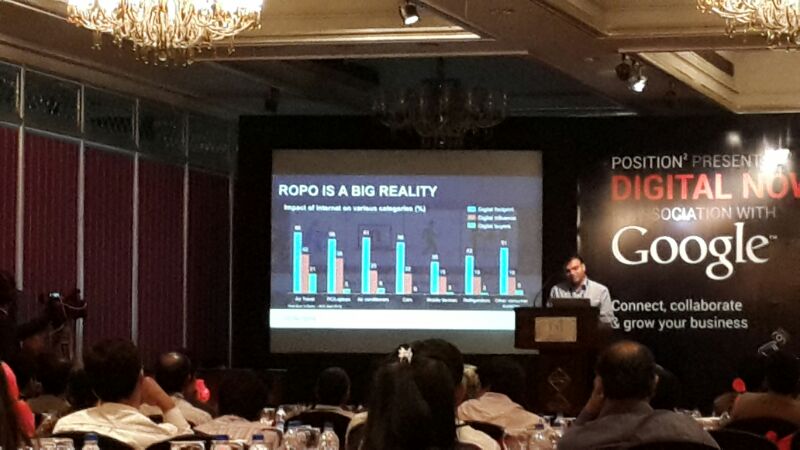
Research Online Purchase Offline (ROPO) is today’s reality – consideration happens in digital even if purchase doesn’t. Leverage it.
3 pillars of capturing demand: Personalize, build for mobile and data usage
Good customers are great to have, they say awesome things about you. However, you should not ignore disgruntled customers. In fact, you should be wary of them, since they can ruin your credibility with even a single bad experience, thanks to digital media. Invest in reputation management systems.
Consumers can create and consume content. Keep consumers engaged to make them your brand advocates
Infrastructure for going digital, by Position2’s CEO Rajiv Parikh and MD 74 Nambiar
After watching some wonderful, moving videos, it was time for the audience to tighten their seat belts. Next up were our CEO Rajiv Parikh and MD 74 Nambiar for the session on ‘What you need to go digital’. Here are the key insights from this session:
Customer journey varies in B2C and B2B sectors. Position2 took the audience through the journey of a consumer, until she/he reaches a purchase decision.
Content in multiple formats is in demand
Mobile is big, so you have to make your landing pages mobile-friendly
You need a three layered framework to go digital:
Content layer
Interaction layer (for instance, blogs, social channels, landing pages etc.)
Marketing layer (paid search, media, email etc.)
We also emphasized on the need for user centric SEO, as compared to search engine centric. The consumer is king and while creating an SEO strategy, companies need to focus on conversational keywords, user experience and content authority. If you are still focusing on keywords, content quantity and frequency, its time to realign your marketing priorities.
Insights from the panel discussion
The following are the important points that cropped up during the panel discussion that followed:
Move from traditional to digital marketing
Monitor the journey of a customer through digital
Consumer behavior drive social media marketing
Hope this was a good refresher!
To the 100+ people who attended the event, thank you! If you did not get to the event, we hope you see you next time.
Best of the Week VideoMobile devices and apps are hot areas for marketers. Check out this video to know how you can use both platforms to engage with customers and also generate brand value and revenue.
Today’s traditional SEO is inadequate: Ignite your search results by accelerating visibility in more places than ever before.Download this White Paper and learn:
SEO, why the way we know it is not enough
Introducing and implementing Enterprise Visibility Accelerator (EVA)
Using multi-channel tracking tools for effective monitoring
















 Tips:
Tips: