Blog

  • Google’s Data Platform Changes Imminent

    Google is the market leader as far as online advertising is concerned. But of late there are a few other competitors that are threatening Google’s hegemony in this space. This has obviously got the search engine giant quite perturbed and it is no mood to give away its share of the lucrative online ad business without a fight. The Facebook Atlas platform seems to be one of the toughest competitors that the Google ad network had to face since a very long time.

    Google intends to respond to such threats by restricting its ad network to data management platforms. This has naturally got digital marketers quite concerned. This move could curtail the freedom that ad tech firms enjoyed till now. But there is definitely more to this move from Google than meets the eye.

    Going forward, Google will restrict ad technology partners from gathering data while running campaigns on the Google Display Network. Now this move seems to have been timed with the launch of Facebook’s ad server and data platform, Atlas. But there are people on the other end of the spectrum who say that Google has been working on this for quite some time now.

    Whatever be the spur, Google will not allow ad networks to fire pixels on certain ads. Pixels help advertisers to keep track of user views and interactions so that the ads can be better managed. Standalone entities who do not have a hybrid model of deploying ads will be the most affected. Beginning March 2015, Google will implement its policy to restrain certain data management platforms from firing tracking pixels on the Google Display Network. The DMPs that will get the short end of the stick are the ones that do not own a demand-side platform or DSP to execute the transaction.

    But ad tech companies are afraid that in due course, Google might bring sweeping changes to the ads served on its various platforms including its DoubleClick Ad Exchange. Now that calls for a detailed discussion which we shall be covering as and when it happens. Watch this space for more.

    What is your take away from this new move from Google? Contact us now for 360° online advertising!

  • CES 2015 – What’s in it for Digital Marketers?

    Contact us for integrated digital marketing for a new interconnected world.

    Consumer electronic brands from far corners of the globe came and set shop and people arrived in hordes to see what the tech Gods had in store for them. Now that the show is over, it’s time to reminisce about this Consumer Electronic Show, 2015 held in ‘Sin City’ Las Vegas, Nevada!

    There was a lot of new technology on display and more ways to make our lives simpler and enjoying the finer things in life. But amidst all the hullaballoo of near impossible tech gadget specifications and next generation of bleeding-edge products, we are more interested in the digital marketing aspect of it.

    Digital marketing, all the way…

    It’s a digital world and our lives are getting more interconnected with each passing day. ‘No man is an island’ said a wise man, maybe he was referring to our digital existence, after all! Two of the important themes that stood out in this year’s CES were – Internet of Things and Wearable Technology. Today every device in your house or otherwise does have an electronic chip embedded within it. With due reverence to IBM, it seems that it’s truly the dawn of the ‘Smarter Planet’, and we are all a part of it.

    Wearable technology has got a real shot in the arm with latest watches and health trackers that were launched by the tech giants. The technology is so smart that if you are passing by a McDonalds and you still have time for that important meeting with the boss, then your watch will automatically signal to you that you can afford to have a break and indulge in your favorite Big Mac!

    Now this is of particular interest to digital marketers. A whole new frontier has opened up as far targeted digital marketing is concerned. Your client could be a fast food chain and some person passes by your client’s outlet, then you can afford to flash a discount coupon or two via his connected smart watch. This gives a much better chance of conversions too.

    Tech biggies like Apple and Google are coming up with their own version of the smart, connected home. Your refrigerator could directly order the milk from your grocer when it senses that milk needs to be replenished. Until now digital marketers could only peek into the web browsing habits of their consumers. Going forward, digital marketers will be able to make sense of people’s eating habits, favorite television shows, music genres liked, et al.

    All things will be a part of a grand scheme of network called the Internet of Things and we are just getting a first glimpse of the shape of things to come. This opens the floodgates for more targeted advertising, remarketing and such other stuff. The future is bright and it is quite an exciting time to be a digital marketer. It’s an electrifying world and we all call it home!

    It goes without saying that we are elated about the just concluded CES, 2015.

    Contact us and share your opinion about digital marketing for this new interconnected world.

  • Hreflang Spoken Here

    While there is no place quite like home, there comes a time in a successful website’s life when significant amounts of traffic from foreign-based search engines really start to matter. You are going to want to optimize your website to serve international audiences. Otherwise, people dialing in from abroad won’t find your content either relevant or useful.

    hreflang

    Google uses the rel=”alternate” hreflang=”x” attributes to serve the correct language or regional URL in Search results. Introduced in 2011, the tag signals search engines that users querying in language “x” should be shown a different version of similar content than is shown to someone querying in language “y”. It is particularly useful for content specifically created to serve a local audience.

    Hreflang and Canonicalization

    When web content has more than one possible URLs, canonicalization comes to the search engine’s rescue to avoid  content duplication . Hreflang, on the other hand, shows a search engine a different version of a similar page based on languages or regions shown in the search results.Hreflang helps Google crawlers understand that certain pages, sections, subdomains or country code level domains (cctlds) are targeted for a specific country.

    When and where the tag needs to be implemented

    Google recommends using hreflang when:

    • You keep the main content in a single languageand translate only the template, such as the navigation and footer. Pages that feature user-generated content like a forum that typically does this.
    • Your content has small regional variationswith similar content in a single language. For example, you might have English-language content targeted to the US, GB, and Ireland.
    • Your site content is fully translated. For example, you have both German and English versions of each page.

    The hreflang tag can be placed on hreflang page level, the HTTP header, or the sitemap.

    HTML Link Element

    <link rel=”alternate” hreflang=”es” href=”http://es.mywebiste.com/” />

    HTTP Header

    If you have non-HTML content on your web pages such as a PDF file, you can use rel=”canonical” HTTP headers to indicate the canonical URL for HTML documents.

    Link: <http://es.mywebiste.com/>; rel=”alternate”; hreflang=”es”

    Sitemap

    Instead of using markup, you can submit a language specific version via a sitemap.

    <?xml version=”1.0″ encoding=”UTF-8″?>

    <urlset xmlns=”http://www.sitemaps.org/schemas/sitemap/0.9″

    xmlns:xhtml=”http://www.w3.org/1999/xhtml”>

    <url>

    <loc>http://www.mywebiste.com/english/</loc>

    <xhtml:link

    rel=”alternate”

    hreflang=”de”

    href=”http://www.mywebiste.com/deutsch/”

    />

    <xhtml:link

    rel=”alternate”

    hreflang=”de-ch”

    href=”http://www.mywebiste.com/schweiz-deutsch/”

    />

    Each page includes a reference to itself as well as to all the pages that serve as alternates for it.

    Meta Language Tag for Bing and other Search Engines

    Google is the main search engine that uses HREFLANG to set up country targeting. Bing and many other search engines employ the Meta Language Tag. There are two ways to set up the syntax on this tag:

    <meta http-equiv=”content-language” content=”en-us”>

    Or the alternative syntax would be:

    <meta name=”language” content=”English”>

    The first option would be ideal if the website is targeted for both language and country. If you use Hreflang for your website’s overseas targeting, please let us know how it’s working for you.

    Contact us to get your website optimized for international locations now!

  • Twitter Goes All Out to Expand its Ads Program

    The micro-blogging site has been trailing behind the numero uno social networking site, when it comes to number of users as well as earning precious ad revenue. But 2015 seems to the right time for Twitter to close that gap and leapfrog its way to become a leading destination for advertisers to showcase their latest digital promotions.

    Going forward, Twitter will be showing ads on third party sites and apps for all those people who see Tweets all over the web without actually using Twitter. This way Twitter can start making money from non-users as well. At the Consumer Electronics Show in Las Vegas, the micro-blogging giant made its intent clear about selling ads within streams of Tweets within other publisher’s websites and apps. Initially Twitter is going to have advertisers like ESPN’s SportsCenter app and Flipboard.

    Twitter has just announced that it is going to expand its ads mainly in the following two ways –

    • The ability to showcase tweets on a site or app that has the option to enable ads
    • Auto-play feature for video that helps Twitter to have ads like Facebook

    Now this is a revolutionary step for the micro-blogging site which is the equivalent of AdSense for social ads. The proposition of ads placed within streams is going to benefit both the publishers and Twitter. The micro-blogging site has made rapid progress with hashtags, Graph Search and video. But this new feature with the ability to profit from showcasing Tweets is something that has got the advertising fraternity quite excited.

    Soon Twitter users would be able to see videos being auto-played in their feeds. These videos will initially only play for 6 seconds with the options of playing the full video upon a click. Users, advertisers and media companies will have the option of uploading video directly on Twitter for user consumption. Every time you view a video you will get a list of videos that are related so that you can consume more than one video at a time.

    The revenue sharing model with the publishers looks quite promising and advertising with Twitter will never be the same again. The video ads on the other hand will help Twitter to gain back precious views from competing services like Facebook and YouTube.

    What do you think of this new ad initiative from Twitter? Contact us now for 360 advertising on social networking sites!

  • Google to Roll Out Viewability Reporting

    At the Consumer Electronics Show (CES) in Las Vegas, Google announced the roll out of viewability reporting across its ad platforms. They’ve also added over 30 broadcasters, premium publishers, and major brands to Google Partner Select, the premium video service they launched last year. This move will help marketing professionals understand whether consumers are actually watching their online video ads.

    Google will report the percentage of an advertiser’s or publishers’ video ads which were at least 50% in view for at least two seconds in keeping with the Media Ratings Council’s standard. Statistics will be available for campaigns powered via Google’s DoubleClick ad-technology, including the ad exchange. These viewability reports will be available to advertisers and publishers using Google’s DoubleClick reporting tools.

    Allstate, BMW and Netflix are a few of Google Partner Select’s early adopters. During the marketplace’s tests, the video ads had 74 percent completion rates. In the coming months, Google plans to offer its marketers the ability to target viewable impressions in DoubleClick and buy viewable video impressions across the Google Display Network, as well as reports on audibility and the total time their video ads were viewable.

    Video promotion is 6 times more effective than print or online, 67.3% marketers plan on increasing their video budget, and adding videos to landing pages increases conversions by 90%. Interesting video content, appropriate distribution channels and real-time analytics are key to a successful video centric campaign. Talk to our Visibility Accelerators on how to take your video viral.

  • New from Google: ‘Mobile-Friendly’ Labels in Mobile Search Results

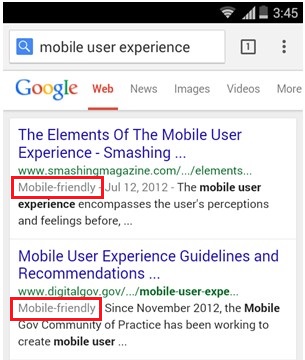
    To help mobile users improve their search experience, Google officially launched the mobile friendly label on its search snippet. It lets users know whether or not a website is mobile friendly. Not only will this feature enhance user experience on mobile devices, it suggests that Google may soon include mobile friendliness as one of the criteria for ranking sites.

    Is Google Experimenting with Mobile Friendly Ranking Factors

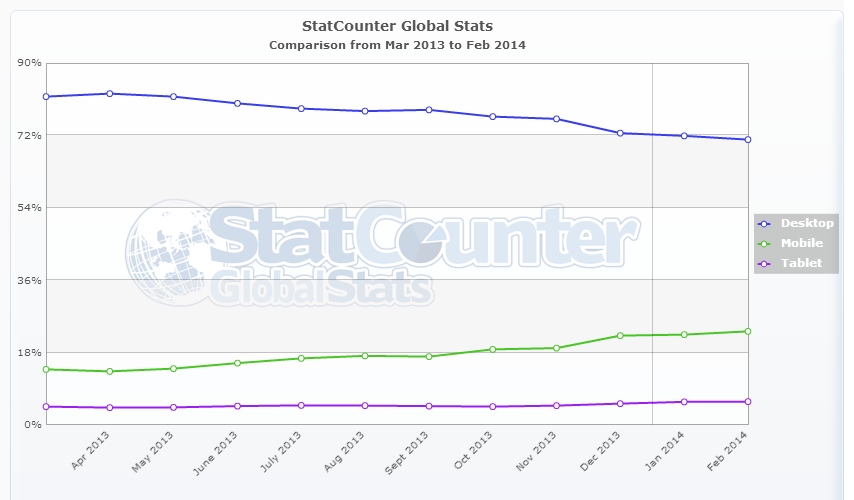
    We keep track of changes in Google’s approach on various metrics for mobile experience and it shows that Google is testing mobile friendly ranking factors to give a better search result for mobile users. In a recent survey conducted by Google, mobile search queries have found to grow faster whereas desktop search queries have begun to slowly decrease. So mobile adaptability is now highly relevant for optimal search results.

    platform-usage-mobile

    Image Source

    Why Mobile-friendly Labels?mobile-friendly-label

    The Google mobile friendly label tells users whether the website they click on is mobile friendly or not.  The mobile-friendly label is right there on the search snippet in the mobile SERP and it signals whether or not the website they are looking for is responsive to their mobile device. This saves time and eliminates the annoyance factor when a user discovers a web page isn’t mobile friendly.

    How does Google decide to add mobile-friendly labels on the search snippet on mobile SERP? There are guidelines to help websites conform in order to get the mobile friendly label. It is  highly likely that this new feature shows Google’s intent to make ease of usability on mobile devices, a major factor in deciding search engine rankings for websites.

     Contact us now to create mobile friendly websites to optimize your mobile prospects!


  • Digital Marketing in 2015 – Concentrate on Data Quality

    As digital marketers we are in the midst of a data deluge that seems to overwhelm us if we are not accustomed to efficiently dealing with it. This makes the quality of data that we collate all the more important. A recent survey by Google has shown that over 56% of its online ads are never seen. Unfortunately digital marketers were never too concerned about data quality. 2015 might just be the right time to delve deeper into data mining.

    Big data has been getting all the right attention but there is an overabundance of it (of course that is where it gets its name from!).  Getting intimidated by big data is clearly not going to help you in any way.  Concentrate on only that portion of big data that makes sense to you. Create personas of your customers using the newfound knowledge. But there are a lot of impediments when it comes to making sense of the data that you collate from various sources.

    Consumers are cagey about their social and mobile data falling into the wrong hands. Digital marketers need to provide compelling reasons for users to part with their valuable data. Providing quality content to your users is one sure shot way of achieving this. While soliciting user information do ensure that you have a mandatory email field and the rest of the fields can be kept to only the bare essentials so that users don’t type in bogus information.

    High quality data today is any digital marketers’ dream come true. It can be used to create highly sophisticated and accurate customer profiles within marketing software that you deploy. Thus, it is imperative that you ensure the databases are built around reliable data as the first step towards creating better marketing campaigns. This is highly useful in executing targeted and personalized messages to customers.

    Remarketing – The Holy Grail

    2015 will see a lot of action on this front. All the tools needed to deploy highly effective digital remarketing already exist. For the uninitiated, remarketing lets you show your ads to people who have previously visited your website or used your mobile app. Dynamic remarketing takes it one notch higher by helping you to advertise only those products or services that users have previously viewed on your website or app. But all this needs the underpinning of quintessential data on consumer browsing habits.

    Some of the obvious benefits of remarketing are –

    • Targeting consumers when they are most likely to buy
    • Catering to a tailored list of consumers like ‘shopping cart abandoners’ that provides you insights on what exactly to advertise and to whom
    • It is possible to create a greater impact with your advertising the second time around

    Now to satiate your quest for remarketing or targeted advertising, you have a range of marketing automation software at your disposal. Take this quiz to find out how effective is you digital marketing strategy and if marketing automation software can actually help you.

    Hope you corral, cull and corroborate high quality data to deploy highly effective digital marketing campaigns in 2015!

    Contact us now for Integrated Digital Marketing campaigns to get the best ROI for your marketing spends!