Blog
-
Content Marketing – The Personalization Game
The Content Marketing Institute’s 2016 Benchmarks, Budgets and Trends – North America is out now and making waves. This detailed document covers the content marketing aspects and trends to watch out for in 2016.
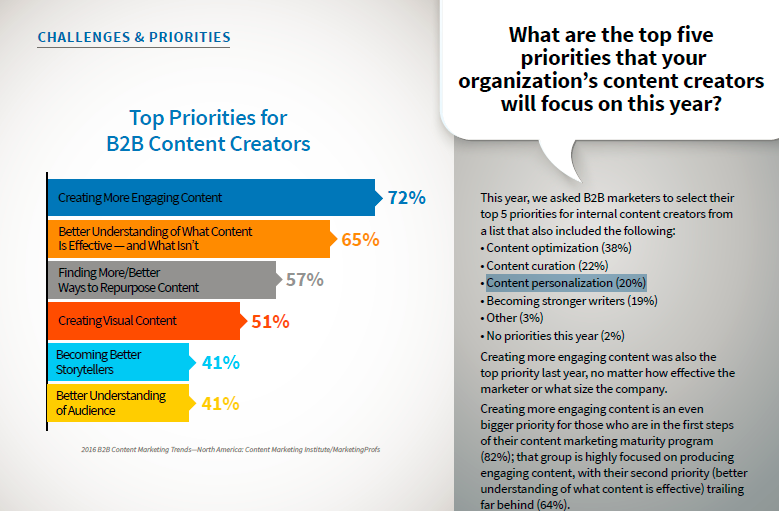
One of the surveys lists the top 5 priorities for internal content creators:
- Content optimization (38%)
- Content curation (22%)
- Content personalization (20%)
- Becoming strong writers (19%)
- Other (3%)
- No priorities this year (2%)
While content optimization and curation continue to hold the top position on the priority list, content personalization has obviously caught the attention of content marketers.

Content personalization enhances the customer experience across the entire sales lifecycle. Personalizing content results in increased conversion and sales. Leveraging the targeted buyer persona is key to successful content personalization. With that in mind, content creation should result in marketing collateral that can be channelized to the distinct stages of the buyer journey.
Here are some quick tips on creating personalized content:
1. Keep historic website data fresh
Keep your website user’s data updated. Maintain an archive of relevant details. You’ll be able to showcase the right set of digital assets based on the targeted user’s demography.
2. Quick surveys
Conducting quick surveys will help you understand your user’s wants and needs. The surveys also serve as a feedback loop revealing what visitors think of the website and digital assets.
3. Email campaigns
By regularly leveraging targeted email blasts you build an effective information gathering system and keep your users up to date.
4. Freebies and Discounts
Who doesn’t like free? By offering discounts and freebies for repeat visitors you reward users and enhance brand loyalty, something that increases your competitive edge.
5. Blogs and Newsletters
An active blog keeps your audience up to date. Share the blog across social platforms. Newsletters are an effective way to update information and spread news across the online world.
Position2 PoV:
Content strategists at Position2 keep a close tab on industry standards, on trending keywords, on effective content creation. Our SEO copywriters advise clients about their existing content and placement, and the content we create is optimized for Search. We use content calendars to serve as placeholders for periodic content updates. All digital assets are well researched and segmented into different stages of the buyer’s journey (Awareness, Consideration and Purchase). Each asset is placed correctly to cater to the user persona.
With 2016 round the corner think about how you will address content personalization in the coming year. Let us know your thoughts and best practices in the comment section.
-
Best of the Week | Plugging the Leaky Funnel: Preventing Lost Marketing Leads, and much more…
-
RankBrain: AI Comes To Google Search
“If you say ‘Google’, people think of search,” Greg Corrado said. He’s a senior research scientist at Google working in artificial intelligence, computational neuroscience, and scalable machine learning. “Search is the cornerstone.” Corrado met with the press to highlight, for the first time, the important place of Artificial Intelligtence (AI) in search. At Google they call their AI system RankBrain.
Making use of AI, RankBrain embeds vast amounts of written language into mathematical entities — called vectors — that the computer can understand. When RankBrain sees words or phrases for the first time it guesses what words or phrases it already knows that might have a similar meaning, and filters the result accordingly. This makes RankBrain extremely effective at handling never-seen- before search queries, of which there are more than a few.
Google handles millions of search queries a second, 24/7/365. Let that sink in. Of that total number of daily queries, about 15% of them are completely new to Google.
The hundreds of signals that contribute to Google’s regular search algorithm all kick in for any query, to be sure. And RankBrain is only one signal out of all those hundreds determining what results appear on a Google search page and where they are ranked. But in the months it has been deployed, according to Corrado, RankBrain has become the third-most important signal contributing to the result of a search query.
“The other signals, they’re all based on discoveries and insights that people in information retrieval have had,” Corrado said, “but there’s no learning,”.
And that’s the thing. RankBrain isn’t just precise in matching sites to queries. It also learns and improves its performance over time. Corrado says Google has used RankBrain to handle a massive search load over the past few months and has discovered that RankBrain is better at predicting top search results than Google’s own search engineers.
The Google engineers who spend their days developing the algorithms that power Google Search were asked to review selected pages and guess which ones Google’s search engine technology would rank on top. They were correct a stunning 70% of the time. Rank Brain had an 80% success rate.
RankBrain rolled out across all of Google search starting in early 2015 with the green light from Amit Singhal, Google’s senior vice president of search. The yearlong effort started with a team of about five Google engineers, including search specialist Yonghui Wu, and deep-learning expert Thomas Strohmann, before expanding to dozens of people. It took a long time to be certain the system was ranking things correctly.
“It’s very carefully monitored,” Corrado explained. Google periodically updates the system by feeding it new data to help it better reason with new concepts.
-
Plugging the Leaky Funnel: Preventing Lost Marketing Leads
In most businesses, data is passed from marketing to sales in one direction. While this makes for a neat, tidy process, it isn’t necessarily the best way to close leads.
Many strategists argue that sales and marketing should be considered one team, so that data can flow in and out of both of them. Before we look closely at this idea, let’s examine the reasons why uni-directional flow can be so problematic for your funnel.
How Leads are Lost
The word ‘funnel’ can be a misleading term, because it promises a neat flow in one direction. Often, the marketing process is not that straightforward. This is why so many leads lose their way.
There are five key reasons why your business is losing leads. Essentially, all five leaks point to a mismatch between customer behaviour and business process:
- Leads get lost, ignored or discarded
- They are not scored, or have been scored incorrectly. MarketingSherpa found that 79 per cent of B2B marketers had not established any form of scoring
- They are not qualified, and not yet ready to spend
- There is a lack of communication, which may make it difficult to understand their position and whether they should be passed to the sales team
- They are not re-engaged after a sale. According to MarketingSherpa, 73 per cent have no process for nurturing leads after a sale has taken place
Calling these ‘leaks’ makes the situation sound minor; a small margin of error, perhaps. But according to SiriusDecisions, 70 per cent of the qualified leads that are passed to sales end up being lost.
DemandGen Report predicts that 80 per cent will go on to buy within 24 months – but they may not necessarily buy from you.
Plugging the Leak
Handling the constant flow of consumer enquiries is challenging for any business. But while data is still flowing one way, there will always be missed opportunities. Manual labor only makes control more difficult, because a CRM can only go so far to lighten the load.
Marketing automation helps to prioritise leads that are ready to be passed to the sales team, using algorithms and scoring to automatically trigger the process. This includes automatic scoring, the critical piece of the puzzle that is missing in so many businesses. It factors in the realization that leads enter and exit the funnel in different places.
Automation also lets you track real time developments in the buying cycle. If someone purchases a product, then comes back to make a second purchase, your sales team can respond with relevant information. Sure, they have the CRM already. But they’ll have the customer’s last time of visit, details of the pages they viewed, and the segment they have been assigned.
Armed with all of this new data, they can engage in personal discussion, deliver the right information, and nurture that second sale.
The Next Step
This continuous monitoring, scoring and qualification automation transforms the marketing and sales process. From a fixed, linear and leaky funnel, it becomes a cycle; a way to re-engage, re-market and re-assess from minute to minute.
If you haven’t implemented marketing automation, you might be amazed at the effect it will have on your ROI. Talk to us today about aligning your sales and marketing teams more effectively, using automation to drive efficiency and profit.
-
Best of the Week | Quality Assurance In The Digital Marketing World, and much more…
This week’s hot news, events and videos from the online marketing and social media world. 
From the Position² Blog This Week: Quality Assurance In The Digital Marketing World
Long gone are the marketing days of batch and blast email campaigns. The new age digital marketing champions must cater across channels, devices and content. Tight rope walking is a neat trick, but all it takes is one slip. One drop in quality. Read this blog and create a safety net in your digital marketing operation.


Best of the Week Video
Digital marketing has come a long way. Tactics that seemingly worked marketing magic just a few years ago may fall flat today. Watch this video for tips to up-level your digital advertising strategy.White Paper: Increase Visibility for Your Content by 4x Today’s traditional SEO is inadequate: Ignite your search results by accelerating visibility in more places than ever before.Download this White Paper and learn: - SEO, why the way we know it is not enough
- Introducing and implementing Enterprise Visibility Accelerator (EVA)
- Using multi-channel tracking tools for effective monitoring
- How EVA benefits businesses.

If you are reading this blog post via a RSS reader, please click here to subscribe. -
Quality Assurance In The Digital Marketing World
Long gone are the marketing days of batch and blast email campaigns. Throw some copy and graphics together with a collateral taste treat. The new age digital marketing champions must cater across channels, devices and content formats to the specialized needs and wants of their audience. They also need to respond effectively to a sales team clamouring for qualified leads. Tight rope walking is a neat trick, but all it takes is one slip. One drop in quality.
It could be spelling errors, grammar, language localization, skewed images, bad stock pictures, incorrect design elements, deviation from corporate brand guidelines, non-responsive email. Those are a few things that can go wrong in a single email. And digital marketing now includes email marketing, marketing automation, web development, analytics, and paid acquisition including social, media, PPC/SEM, SEO and content marketing.
A drop in quality can mean:
- unrepairable damage to the brand
- losing out on business in real time
- giving your competitors an edge over you
Quality Assurance Processes are your best protection in the face of the accelerating velocity of digital technology adoption. Quality Assurance Processes help you stay out ahead of the rapid pace of digital transformation of business models. Here are three basic examples.
Quality Drop #1: Poor Strategy and Planning
Lack of planning results in a poor strategy, and the execution that follows results in a #marketingblooper. Understand your market. Understand your target audience and your channels. Fine-tune your messaging and positioning. Beware of cultural and language nuances.
Quality Check
Planning must involve all stakeholders. The planning review must pass through multiple layers of people before it is executed. A robust review process is usually all that is needed to avoid a #marketingblooper.

“Few things hurt a brand more than an accusation of racism. So even though it’s impossible to tell if this tweet from Home Depot was indeed racist or simply stupid, the fact that the Twittersphere was up in arms over it made corporate delete the tweet, apologize for two days, and fire the social media agency responsible.” Business Insider
Quality Drop #2: Lack of Policy and Processes
Without basic marketing policy and processes the marketing team may as well be blind-folded when it comes to day-to-day execution of tasks.
Quality Check
Put a few basic policies in place for all marketing teams:
- Brand guidelines, colour palette and corporate style guide
- Social media, public relations and external communication policy
- A process to handle all external communication with various stakeholders like Public Relation firms, Analyst Relation firms, media, social influencers, industry experts, etc.

Image Source
Quality Drop #3: Implementation and Execution
“Every marketer makes a mistake.” – All Marketers
Mistakes can range from a simple typo or grammatical error to sending out an email for a new mobile app download which is not mobile-responsive.
Quality Check
For content:
- spelling, grammar, sentence construction, language (e.g. UK and US English is very different)
- all critical information is present and accurate
- titles, headers, and call to action buttons all labelled correctly
For collateral:
- design consistency – check the graphics and layout
- image quality – use appropriate images
- alignment of all design elements
- brand compliance for colour accuracy, typography, etc.
Responsive design:
- check on different browsers (Chrome, Firefox, Safari, IE)
- check on different versions of the browsers
- check on different devices (form factors – smartphones, tablets, laptops, etc.)
This is just the first pass at a very deep, very important issue.
Watch this space for more on quality assurance in the digital marketing world. We will come back with a deep dive into the rigorous Quality Assurance Processes we follow at Position2 to ensure there is no compromise on the quality of deliverables for our client partners.
Use the comment box below to share your best practices or a #marketingblooper.
-
Best of the Week | SEO And ROI Go Hand In Hand, and much more…
This week’s hot news, events and videos from the online marketing and social media world. 
From the Position² Blog This Week: SEO And ROI Go Hand In Hand
The moment a customer has the intent to search for relevant information, that’s where SEO comes in. It’s one of the best investments you can make for your online presence. SEO helps the consumer with decision making, and your ROI increases. It scales over time. Read this blog and find out how.
Best of the Week Video
#AdWordsTips – Negative keywords help your ads reach the most interested customers, which can lead to reduced costs and an increased return on investment. Learn more by watching this video.White Paper: Increase Visibility for Your Content by 4x Today’s traditional SEO is inadequate: Ignite your search results by accelerating visibility in more places than ever before.Download this White Paper and learn: - SEO, why the way we know it is not enough
- Introducing and implementing Enterprise Visibility Accelerator (EVA)
- Using multi-channel tracking tools for effective monitoring
- How EVA benefits businesses.
If you are reading this blog post via a RSS reader, please click here to subscribe. -
SEO And ROI Go Hand In Hand
The moment a customer has the intent to search for relevant information, that’s where SEO (Search Engine Optimization) comes in. It’s one of the best investments you can make for your online presence. It’s pretty simple. SEO helps the consumer with decision making, and your ROI increases. It scales over time.
Be Local, Everywhere
Give customers an accurate geographic location and relevant information about your products and services. Build a location-friendly website. A fair piece of your online sales strategy should focus on local search results that drive relevant traffic to your website. This is the benefit of meticulous keyword research. Do not stint. It’s a necessary piece of effective SEO. It’s how successful online businesses increase traffic.
SEO Keep-in-Minds
- Use an integrated method that blends content creation, traditional SEO principles, social media, conversion optimization and e-mail marketing.
- Use effective keyword selection to drive targeted (i.e. those with the intent to buy) traffic to the website.
- Indexed pages help build awareness about the website across the internet.
- Referral quality (External links) is important. It affects improvement in ranking of the website while increasing website credibility.
- By targeting the traffic you bring to the site (know your buyer persona) you improve the quality of leads and the conversion rate. Targeted consumers are more likely to fill out a form, send email and call for information.
Benefits of SEO
A good site needs to appeal with personalized search results to the online audience as well as its core and niche market segments. The aim of SEO is to optimize overall site quality and increase ranking for relevant queries catering to both online, niche, and core audiences. If users can match the importance of the site to their own needs while feeling comfortable on the site, conversions roll in. SEO is a long-term winner and deserves a place in your overall marketing strategy. You and the consumer both win. It’s how you increase ROI, by employing effective SEO.