The numbers are in. The verdict has been delivered. The paradigm shift is official. According to new research from Standard Media Index, digital media siphoned off more than $1 billion in advertising revenue from the US TV market, with 87% of those dollars drained out of the Big Four networks – NBC, ABC, CBS and Fox. SMI tracked agency investments over a nine-month period spanning October 2014 to June 2015, an interval that corresponds with the broadcast calendar.
New segments like the digital video market are growing at a blistering rate. With spend on pace, it is poised to hit $7.77 billion by year’s end which is a little over 10% of the $70.6 billion TV market.
Not Convinced? Let Facebook Be Your Guide…
Three years after Facebook started running ads on its mobile properties, mobile advertising accounted for 76% of Facebook’s $3.8 billion in second-quarter advertising revenue, which was up 43% year-over-year.
Facebook’s mobile user base saw even steeper growth, with mobile monthly active users up 22% and mobile daily active users up 29%
In the second quarter, the average price of an ad on Facebook rose by 220% while the number of ad impressions Facebook served dropped by 55%.
Is your business strategy in line with the digital and mobility revolution? Use the comment box to share your thoughts.
The nature of digital marketing will not stand still, not with Google constantly creating new ripples for marketers all over the world. Here’s a look at what’s in the pipeline:
Purchases On Google
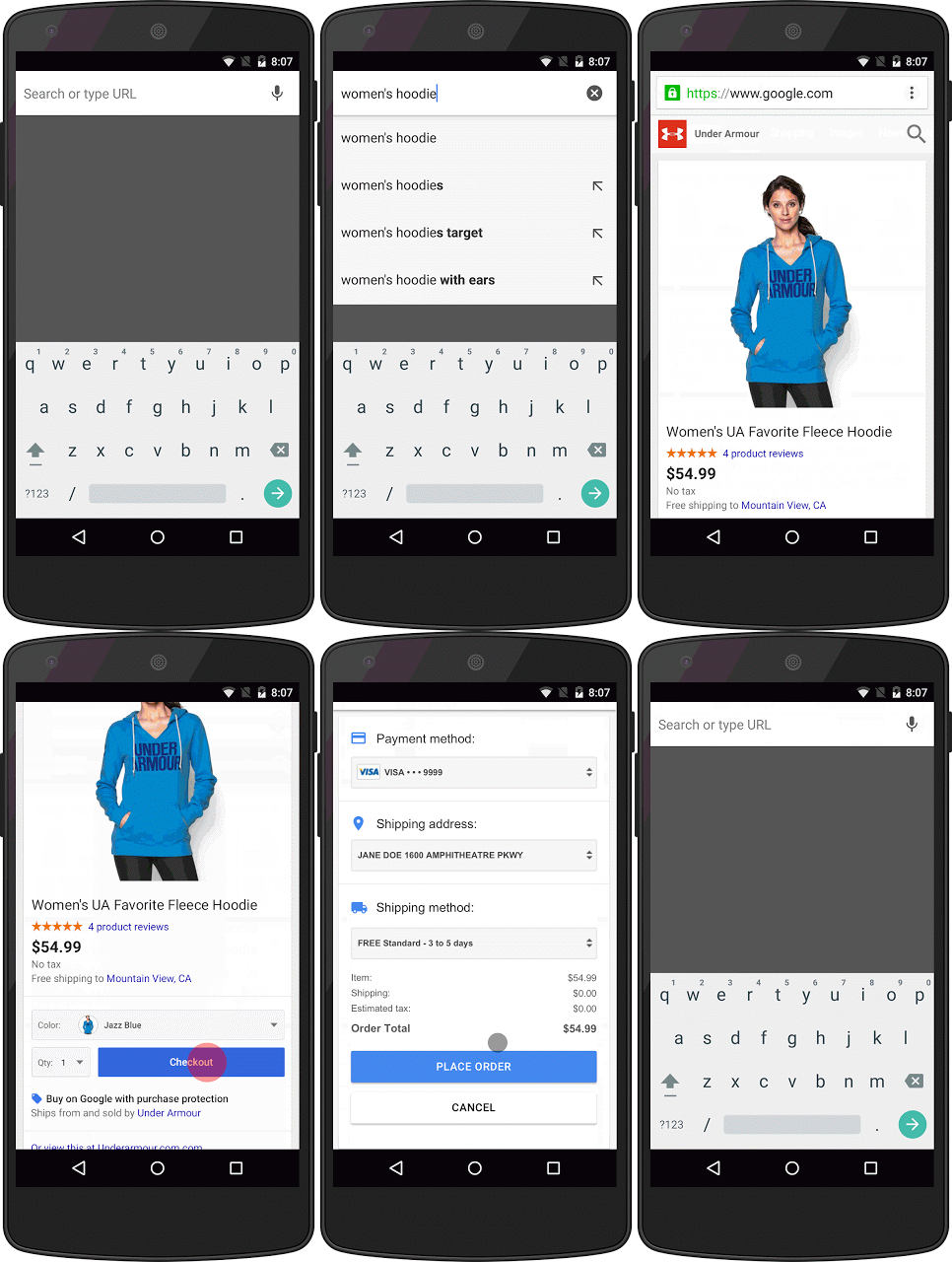
The much-anticipated “buy button” in Google search ads is here but it’s not really a button. Called ‘Purchases On Google’ mobile users will be able to click on search ad results and go directly to the dozen or so retailers currently participating in the test. Response thus far has been enthusiastic and positive.
“Purchases on Google will simplify our customers’ ability to search for items on Google and then buy with Staples.” said Faisal Masud, Executive Vice President of Global E-Commerce, Staples, Inc.
“Customers increasingly want to shop on their own terms. Purchases on Google facilitates that flexibility while maintaining the merchant’s ability to own the customer relationship.” says, Peter Cobb, eBags Marketing EVP and Shop.org Chairman.
By clicking anywhere on the ad the user is taken to a merchant-branded gateway landing page hosted by Google. The consumer can buy the product immediately using his mobile device.
New Mobile Shopping Ad Formats For Voice Search
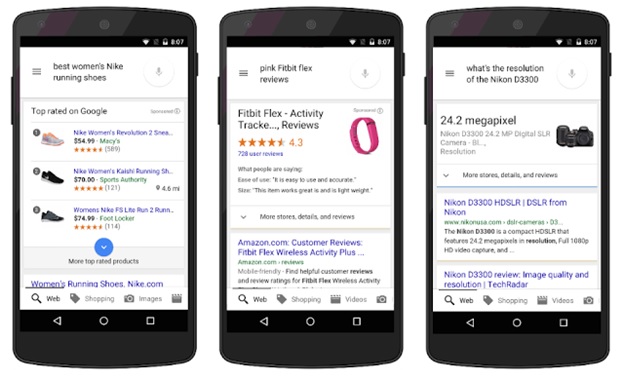
Google has started to show new ad formats that include rankings and ratings when consumers search using voice. In this example rankings 1 to 3 have been displayed in the search results for the image on the left after making as voice search.
Expanded Product Listing Ads (PLAs) When Viewing The Carousel On Mobile
When users swipe to see more in the PLAs on their smartphones, Google will now expand the ads to show the full product title as well as extensions like product ratings and nearby availability. This functionality will roll out to Chrome for Android this month, and iOS in the coming months.
Google Now In-store Cards
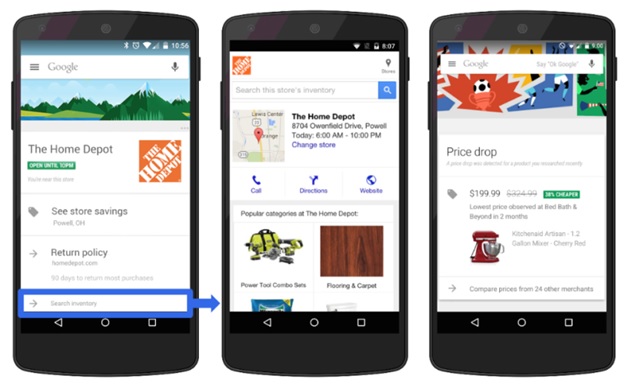
Local Inventory Ads have been performing well so a lot more of them will begin showing up in mobile search results. Also coming online, the Google Now in-store card that appears when a user is near a store. It will show sales, closing hours, loyalty card information and more. Also, look for the Google Now price drop card. It will showcase significant price decreases on products the user has previously browsed.
PLA Deep Linking To Shopping Apps
Google is running a pilot test with a small group of global retailers including eBay, Flipkart and Zalando to deep link their product listing ads to product pages in their apps rather than their websites. More retailers will participate in the test in the coming months.
Flipkart, India’s answer to Amazon, bid adieu to its mobile website with the Big App Shopping Sale in March, 2015. From here on out, Flipkart shopping is all about the mobile app. Myntra, India’s foremost e-commerce fashion site, has shut down its mobile website, and may ditch browser-based shopping altogether. Such is the rising power of mobile.
With e-commerce firms actively pushing consumers to their apps and leveraging attractive discounts and deals to encourage consumers to buy through the apps, having a mobile app in place is now all but essential. From Amazon’s Happiness Day sale in November 2014 to Myntra’s Binge Weekend Sale and Snapdeal’s App Fest in February 2015, the offers on mobile apps just keep on coming.
“There is a business reason behind promoting apps,” says Mr. Rajiv Srivastsa, founder and chief operating officer of Urban Ladder. “It leads to higher conversion and engagement. If you build only an app platform, it is cheaper as you don’t have to invest in two-sets of codes – both mobile website and app. However, in the long run, one has to engage the user enough, so she doesn’t uninstall the app.”
Experience is the Key
Though apps offer an attractive way for e-commerce players to interact with their consumers, it is neither easy nor advisable to force apps on customers. According to a study conducted by ICM Research in UK, a majority of customers prefer to interact with retailers through their mobile websites and only download an app if they are incentivized to do so, or if they are regular shoppers. And yet the same consumers are far more likely to complete transactions through the retailer’s mobile app than through the mobile website.
“Going app-only makes sense if you can provide an experience not otherwise possible on the mobile web platform,” says Shamik Sharma, chief product and technology officer at Myntra.
Merits / Demerits of Mobile App
There are crucial differences in the ways mobile websites and mobile apps help customers navigate and experience their shopping journeys. Mobile apps function a lot like mobile websites. They have certain operational and functional benefits and they have downsides as well. Customers can interact with the app 24/7 no matter where they may be. The IT advantage for business is having their own corner on a customer’s device. Mobile apps promote a customized experience because they work in the background, allowing e-retailers to collect user-specific data such as recurring purchases, duration of browsing, preferred platform to share information, geo-location and so on. The downside involves convincing customers it’s in their interest to install the app and give up permissions.
Some businesses simply prefer both mobile websites and mobile apps. For example, India’s MakeMyTrip mobile site is an acquisition platform while the app is a loyalty and retention platform complementing its desktop presence. According to Pranav Basin, head of online products for Makemytrip.com, “The desktop plus mobile app is a great combo. They complement each other perfectly”. Ankit Khanna, Senior VP for product development at Snapdeal cautions, “We do not want to force consumers to download our app. If they want to browse first and buy later, we enable them to do that”.
While an app install “cost” is high, once you get the consumer on board the marketing cost could shrink.
While mobile apps enable better targeting of customers, the major draw back is the extra step introduced into the shopping journey – at least the first time around. As one e-marketer pointed out, with e-commerce you click and buy. With an app, you click, you download and install, and then you buy.
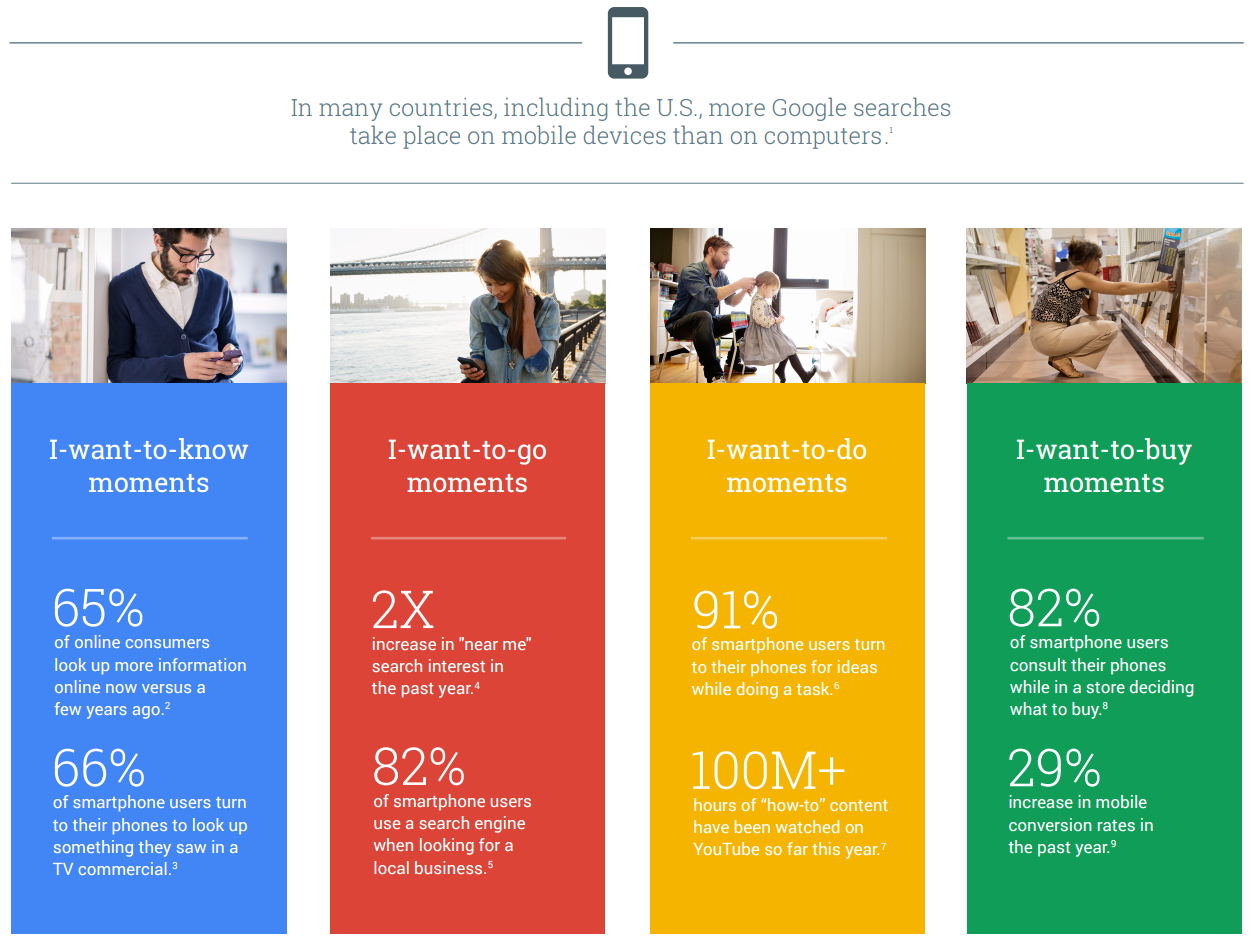
Mobile has changed consumer behavior forever more. It’s now the primary channel used by people to interact with media. What were once predictable, daily online sessions seated before desktop or laptop PCs have been superseded by frequent, unpredictable, instantaneous, on the run, need-based interactions with smartphones – palm up, face down. “We’ve hit an inflection point,” says Jerry Dischler, Vice President of Product Management for AdWords, “where more Google searches are taking place in mobile than desktop in 10 countries, including US and Japan. We think it’s a real turning point in digital adverting and we have been investing in mobile-focused initiatives,”.
What were once conventional “moments of truth” in a consumer journey have since fragmented into hundreds of micro-moments, those intent-driven moments of decision-making and preference-shaping, where today’s battle is waged for a share of the hearts, minds, and wallets of consumers.
It’s a micro-moments when you turn to your smartphone to fulfill a need or answer an “I want…” question, such as:
I want to learn…
I want to buy…
I want to know…
I want to go…
I want to do…
I want to make…
Recent Google research shows how micro-moments have changed the Rules of the Game:
Of leisure travelers using smartphone, 69% search for travel ideas during spare moments, like standing in line or waiting for the subway. Nearly half go on to book their choices through an entirely separate channel.
Of smartphone users, 91% look up information on their smartphones in the middle of a task.
Of smartphone users, 82% consult their phones while they’re in a store deciding which product to buy. One in 10 of those consumers ends up buying a different product than planned.
Of online consumers, 69% agree that the quality, timing, or relevance of a company’s message influences their perception of a brand. (This is a critical finding.)
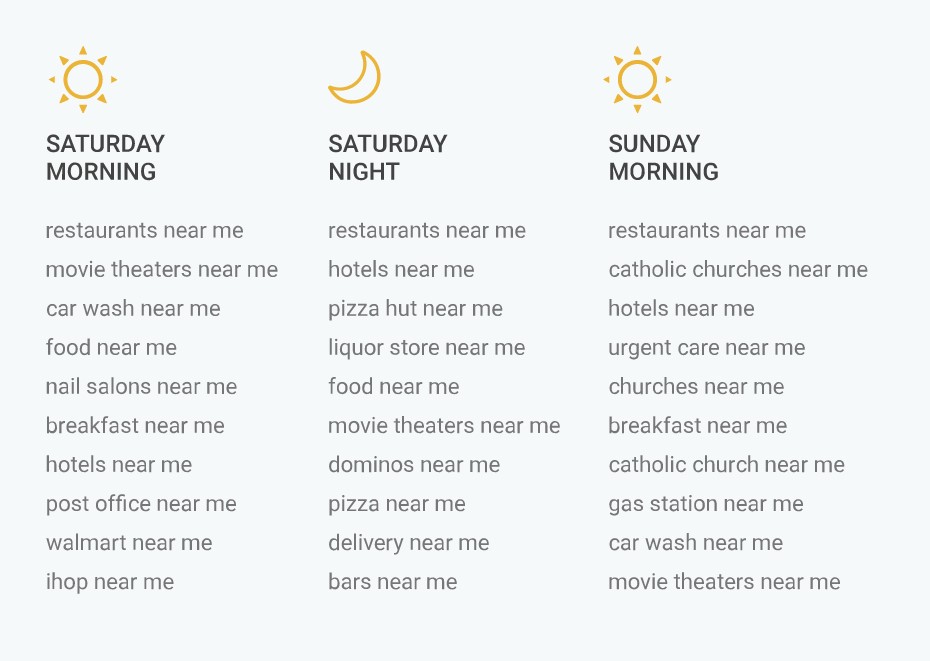
FACT: “Near me” searches are sky-rocketing: Google search interest in “near me” has increased 34X since 2011* and nearly doubled since last year. The vast majority come from mobile—80% in Q4 2014. **
Source: *Google Trends, Data pulled March 30, 2015. **Google Data, Q4 2014
Identify your target audiences’ micro-moments: Engage with your consumers at points of sale, forums, social media, through surveys and focus groups to understand when and how they research and make purchase decisions. Understand the why, the where and the how of a consumer’s search for information. And don’t overlook the why not.
Deliver the right product or service at the right moment: Research and identify unique patterns of intent. Use search insights to uncover new trends. Then, incorporate search, social, video and display in your marketing strategy to reach consumers at home, in stores, in offices and anywhere in between – any time of day — based on your research.
Deliver context appropriate messaging: This cannot be overstated. Create ads and content that provide custom solutions and answers for the questions people ask. Personalized ads have 10x higher CTR compared to traditional display ads. No one wants to look at or hear conventional, generic advertising on their smartphones. Or, put another way, don’t make smartphones dumb.
Make purchasing easy: Make seamless the transition from research to purchase. Give the consumer multiple ways to buy. Examples: Facebook CTA buttons on ads, Twitter or Pinterest buy buttons or link to a local store “Near You”.
Measure every moment that matters: It’s no longer enough to simply measure the online conversion. With the mobile fragmented path to purchase advertisers need to measure results online, across devices, in apps, and even in stores. Audit your current efforts then test and iterate using new approaches, KPIs and methodologies.