Category: Marketing Automation

  • Sales and Marketing – The Evolving Relationship

    Sales and marketing are different sides of the same coin. While marketing team’s job is to generate qualified, purchase-ready leads for the sales team, it is the sales team’s job to turn those leads into sales. Although it may seem that both departments have different objectives, in the end, the goal remains the same: marketing to drive sales and generate revenue.

    According to research by Marketo and ReachForce, half of sales’ time is spent on unproductive prospecting, with sales ignoring as much as 80% of marketing leads. It’s important to empower the sales team with the right information by the marketing team, and that both teams know exactly when to handover the qualified leads from marketing to sales. Marketers have to prepare the sales team with necessary information and content to add value to existing relationships with leads.

    Marketing and sales alignment basically means the process of getting the two teams to work together toward a common goal efficiently.

    The Situation:

    The sales and marketing departments are different bodies, which causes differences in the following ways:

    • No Common Objectives
    • Misunderstood Goals

    Set Common Objectives

    Marketing and sales teams work toward the same goals: converting new leads to revenue closure. However, because of the perceived handoff from marketing to sales, this process can seem like two separate stages.

    Marketing goals are mostly long-term – which is generating potential sales leads by building a foundation with strong branding and content. It focuses more on scoring and nurturing leads for the long term.

    Sales goals, on the other hand, are short term – it’s mostly monthly or quarterly targets to achieve.

    Incorporating marketing into sales activities and working closely with the sales team allows marketers to see how they contribute towards the success of the sales team. Marketers can get a better understanding of the impact of lead quality, and sales teams can understand the need to follow up quickly.

    Misunderstood Goals

    Creating the right goals between marketing and sales is imperative for proper alignment. Defining roles for marketing and sales helps move leads through the funnel more effectively. Defining specific roles ensures that every part of the lead’s journey is accounted for.

    Marketing supports revenue goals by generating more qualified leads to pass on to the sales team. It helps to focus on many things, including full-funnel marketing programs, lead nurturing, and analytics. Marketing supports sales enablement through content creation, understanding the sales process, and product and data sheet creation. This team creates valuable and instructive content to help the sales reps and provide materials for lead gen and nurturing.

    The Solution:

    Create Service-level Agreements

    SLAs contribute to another critical part of sales and marketing alignment: making sure no qualified lead is left behind. The SLAs prioritize and assign a time stamp to leads. When marketing passes on a lead, sales teams have a certain window of time before making the first call. Once a given amount of time has elapsed, reps receive a reminder email.

    Replace the Sales Funnel with a Revenue Cycle

    The traditional sales funnel modeled a process whereby a large audience was sorted down to leads, then prospects, and then finally sales.

    Marketo’s Revenue Cycle Is an Evolution of the Traditional Sales Funnel:

    • At the top of the Marketing Funnel (TOFU), your prospects are aware of the brand. This designates when a name has officially entered the database. People move onto the next stage after meaningful engagement.
    • And in the middle of the funnel (MOFU) is where the traditional sales begin. Leads have displayed buying behavior and have engaged with content, making them a potential sales lead. We use lead scoring to determine whether it’s time to reach out. If leads aren’t ready to convert, we start the lead nurturing process. If leads are sales-ready, they are passed on to an account executive.
    • At the bottom of the funnel (BOFU), once leads have reached the bottom of the funnel, they are close to becoming a customer. Leads in this stage are sales-accepted and actively being worked on by the sales team.

    Define the Common Terms and Goals

    • Lead Scoring
    • Lead Generation Metrics – MQL, SAL, SQL

    Sales Development Representatives

    Sales Development Representatives can further help you streamline the sales qualification process and ensure the best results in the handover from marketing to sales. More consistent the follow up on leads better the conversion of leads into opportunities.

    Sources:

  • Key Takeaways From Marketo Marketing Nation Summit 2016

    Marketo Marketing Nation 2016 was enthralling to say the least. The plethora of speakers was something marketers only dream of. The sessions were just amazing with meaningful insights. Exciting is just one way of describing the experience.

    As proud sponsors of Marketo Marketing Nation Summit for the past three years, we not only attended the event this year, but also had an engaging exhibitor booth!

    Marketo Marketing Nation Summit 2016

    Here are some of the key takeaways we captured at the summit:

    • Keynote speaker Will Smith emphasized the power of being authentic, “In today’s world – we are out in the open, so the best bet to succeed is be true.”
    • Jon Miller of Engagio highlighted that, “75% of marketing executives read unsolicited content if it’s relevant.”
    • Jeriad Zoghby of Accenture explained that, “Personalization is making it easier for consumers to buy and consume what they want, how/when they want.”
    • Strategy trumps creative in email marketing campaigns. Most successful campaigns spend more time on strategy.
    • Gen Z form 30% of the global population, are age 18 and younger, digital dependent and control $200B in spending annually. So your long term marketing plans need to influence this group who will soon (if not already) be your primary target audience.
    • The Facebook community – with 1.65B people on Facebook, 400M on Instagram, 1B on WhatsApp and 900M on Messenger – is turning out to be the world’s largest ecosystem. Facebook should be part of every Marketer’s digital plan.

    With stimulating sessions and inspiring keynotes, Marketo Marketing Nation Summit was abuzz with activity. A great opportunity to showcase our proprietary approach, Demand Acceleration. A three-pronged approach that leverages content marketing, paid acquisition and marketing technology to give your digital marketing endeavour a big boost. As a certified Marketo partner and the preferred agency for many high-tech B2B and B2C companies, we believe that Demand Acceleration can help resolve your immediate as well as long term revenue challenges.

    To learn more, reach out to us or better yet, come see us at our office in the heart of Silicon Valley, California.

  • Why You Can’t Afford to Ignore Marketing Automation in 2016

    For too long, marketers have been overly dependent on IT to assist with their campaigns. Often, this is a slow process; requests for data dumps can be slow to appear. For many years, data has been locked down so tightly that there was no other option for marketers.

    But the task of compiling and using data is becoming increasingly devolved. This is part of a wider shift in the way we think about data, bringing it out of the server room and funneling it through tools that every department can access.

    Increased sharing of data requires high quality data that is free from errors and out of date information.

    Data in a database decays at a rate of 2 per cent per month. Up to 96 per cent of your database is currently out of date. Clearly, action needs to be taken on a consistent and long-term basis. The 2016 MarTech Data Report found that data quality is a problem for 49 per cent of its 400 respondents. Simultaneously, 51 per cent of respondents said missing information was a problem.

    Marketing automation offers great opportunities, but we all have groundwork to do first.

    Why does marketing automation matter?

    Automation assists businesses in having real time conversations with the people most likely to spend. In an era of increased social engagement, two-way dialogue is a critical part of positioning your brand as being open and willing to engage. It certainly helps if those conversations can take place instantly, without being a crippling burden on your resources.

    Customers are also using increasingly diverse channels, and automation helps businesses claim those channels and have conversations that span more than one. Thanks to better tracking and analytics, marketers can know where their efforts would achieve best results, without waiting for the IT department to turn around reports on KPIs.

    By 2020, Gartner says that customers will manage 85 per cent of their relationships with suppliers without ever talking to a person. Where there is less human effort, there are also lower costs, and a better use of data that the business already holds.

    Lead scoring, nurturing and segmentation also help boost efficiencies, passing these considerable resource savings to both marketing and sales departments. Marketing automation lets us see more granular segments and clearer signposts to engaging with prospects.

    Choosing the right platform

    In 2016, it’s not a question of whether you’ll adopt marketing automation, but which platform you should choose, and why. There are two key elements that a marketing automation platform must support:

    1. Your marketing funnel. Knowing your customer personas is key to marketing success, and when you’ve automated your processes, personas become absolutely critical. Too many companies choose solutions that don’t allow enough definition and measurement. That means content is less effective, and success is difficult to quantify.
    2. Your wider business. The marketing team does not exist in isolation. The data it uses should be the same data used by everyone else. What can marketing learn from other areas of the business? Integration is critical, because sales and customer support is part of the customer journey, and every cog is a part of the larger machine. Your automation platform needs to involved with the conversation, and needs to bring in all these different inputs.

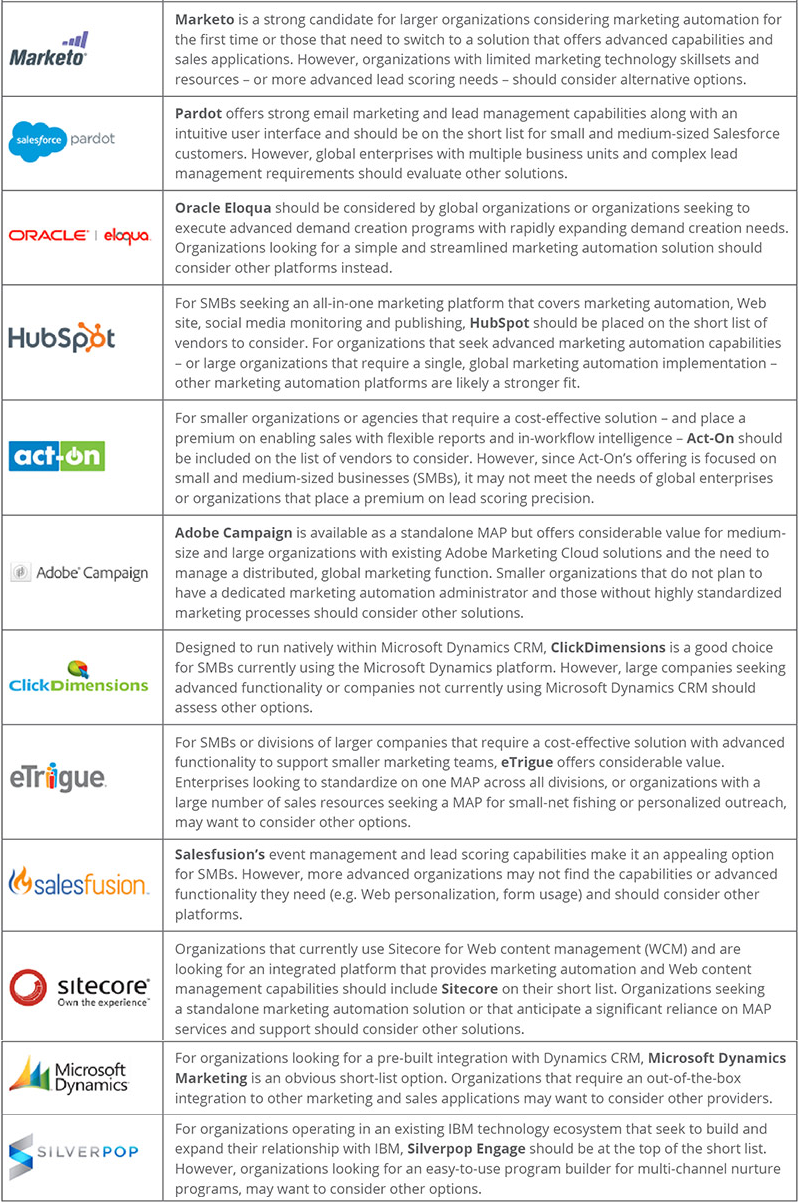
    There are dozens of options on the market, and not all of them are comparable. Some serve enterprise well, but others are SME focused. Examine the solutions you already have, and the ecosystem that will best work for your business.

    marketing_automation_vendorsImage Source

    Moving towards an automated world

    Marketing automation is pushing new boundaries in a new digital landscape. Software is delivering new features, opening up data that was previously difficult to access. Automation lets you respond quickly, adapt instantly, and tailor your approach depending on response.

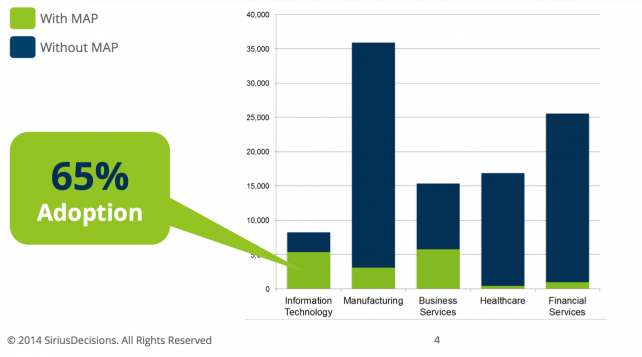
    One thing is for certain: automation drives an increase in marketing qualified leads (MQLs). This is proven in several studies. 80 per cent of marketing automation system users saw an increase in leads, and 65 per cent say leads increased by at least 10 per cent. According to SiriusDecisions, marketing automation adoption is increasing at a rate of 22 per cent; given the opportunities, it’s hardly surprising.

    marketing-automation-adoption-at-22-siriusdecision

    Your first step

    Position² is a Marketo Certified Partner, and our team already has over 4 years’ experience in the platform. Contact us for more information about our Marketo consultancy services. We have a booth at the forthcoming Marketo Marketing Summit 2016; stay tuned for more details about the event.

  • How Marketo Ad Bridge Enables To Target The Right Audience


    Marketo Ad Bridge enables you to target the right audience with personalized marketing content across advertising platforms including Google, Facebook, LinkedIn, and other widely visited sites. By specifically targeting the right demographic with personalized content that’s based on their interests, businesses can more effectively reach prospects and get better results out of their marketing expenditure.

    How does it work?

    Ad Bridge leverages Marketo’s behavioral database to show relevant content by analyzing how existing and potential customers interact with your business via email, your website, and social media channels. Personalized ads based on those interactions are then displayed on Google, Facebook, LinkedIn, and other channels.

    Existing as well as new prospects who click on your ad will be taken directly to your business’s website or Facebook page. Ad Bridge allows you to stay in touch with your target market with promotions, useful content, and other information. Focusing on targeted users (rather than on indiscriminately widespread ad placements) helps place ads and useful content in front of those who are more likely to respond to them.

    Let’s delve a bit deeper

    LinkedIn’s partnership with Marketo Ad Bridge helps businesses take lead nurturing to the next level by leveraging the vast amount of information that LinkedIn has on its users via their interactions with connections. For B2B campaigns, Ad Bridge makes it easy to find new users looking for exactly what your business offers, while respecting the privacy of LinkedIn users.

    Marketo’s Ad Bridge partnership with Facebook now offers Lead Ads that make it easy for prospects to interact with a business page in Facebook. For example, clicking such an ad in the mobile version of a company’s Facebook page can bring up a form that is automatically populated with data from the user’s phone (which the user can edit for privacy). This allows the user to easily get in touch with the business for more information or offers. This data is then viewable on the business’s Marketo instance, and can be extremely useful for its lead nurturing program and bring new prospects into the sales funnel.

    It’s easy to see how Ad Bridge offers businesses unprecedented ease and targeting across major social media and professional networking sites. Smarter, more focused ad spending provides greater ROI to businesses using the system. Instead of scattershot ad placements that usually do not produce great results, Ad Bridge provides marketers with the tools to focus on prospects that are more likely to become customers.

    Stay tuned to the Position2 blog for more updates.

  • Plugging the Leaky Funnel: Preventing Lost Marketing Leads


    In most businesses, data is passed from marketing to sales in one direction. While this makes for a neat, tidy process, it isn’t necessarily the best way to close leads.

    Many strategists argue that sales and marketing should be considered one team, so that data can flow in and out of both of them. Before we look closely at this idea, let’s examine the reasons why uni-directional flow can be so problematic for your funnel.

    How Leads are Lost

    The word ‘funnel’ can be a misleading term, because it promises a neat flow in one direction. Often, the marketing process is not that straightforward. This is why so many leads lose their way.

    There are five key reasons why your business is losing leads. Essentially, all five leaks point to a mismatch between customer behaviour and business process:

    1. Leads get lost, ignored or discarded
    2. They are not scored, or have been scored incorrectly. MarketingSherpa found that 79 per cent of B2B marketers had not established any form of scoring
    3. They are not qualified, and not yet ready to spend
    4. There is a lack of communication, which may make it difficult to understand their position and whether they should be passed to the sales team
    5. They are not re-engaged after a sale. According to MarketingSherpa, 73 per cent have no process for nurturing leads after a sale has taken place

    Calling these ‘leaks’ makes the situation sound minor; a small margin of error, perhaps. But according to SiriusDecisions, 70 per cent of the qualified leads that are passed to sales end up being lost.

    DemandGen Report predicts that 80 per cent will go on to buy within 24 months – but they may not necessarily buy from you.

    Plugging the Leak

    Handling the constant flow of consumer enquiries is challenging for any business. But while data is still flowing one way, there will always be missed opportunities. Manual labor only makes control more difficult, because a CRM can only go so far to lighten the load.

    Marketing automation helps to prioritise leads that are ready to be passed to the sales team, using algorithms and scoring to automatically trigger the process. This includes automatic scoring, the critical piece of the puzzle that is missing in so many businesses. It factors in the realization that leads enter and exit the funnel in different places.

    Automation also lets you track real time developments in the buying cycle. If someone purchases a product, then comes back to make a second purchase, your sales team can respond with relevant information. Sure, they have the CRM already. But they’ll have the customer’s last time of visit, details of the pages they viewed, and the segment they have been assigned.

    Armed with all of this new data, they can engage in personal discussion, deliver the right information, and nurture that second sale.

    The Next Step

    This continuous monitoring, scoring and qualification automation transforms the marketing and sales process. From a fixed, linear and leaky funnel, it becomes a cycle; a way to re-engage, re-market and re-assess from minute to minute.

    If you haven’t implemented marketing automation, you might be amazed at the effect it will have on your ROI. Talk to us today about aligning your sales and marketing teams more effectively, using automation to drive efficiency and profit.

  • How Marketing Automation Can Transform Your Business


    If you haven’t looked at marketing automation technology recently, you may not recognize the place. There are now over 215 marketing automation solutions on the market and the rate of marketing automation solution and innovation adoption shows no sign of slackening. The question for marketers isn’t so much will marketing automation technology have an impact on your business as it is which trend is the best fit?

    Consider these statistics:

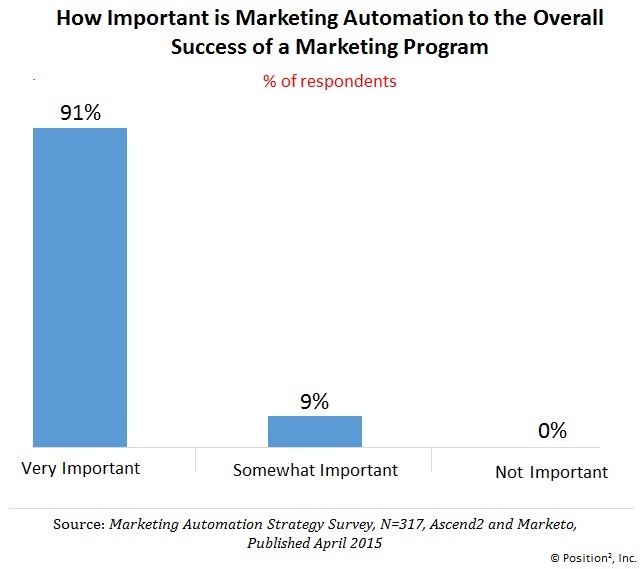
    • 91% of users believe that marketing automation is “very important” to the overall success of their marketing across channels. Marketo

    Importance of Marketing Automation to the Overall Success of a Marketing Program


    • 41% of marketers say that marketing automation is “Very effective/effective” at creating a cohesive customer journey. Salesforce
    • 85% of B2B marketers felt they were not using their marketing automation software to their full potential last year. SiriusDecisions
    • Nurtured leads make 47% larger purchases than those who were not nurtured. HubSpot
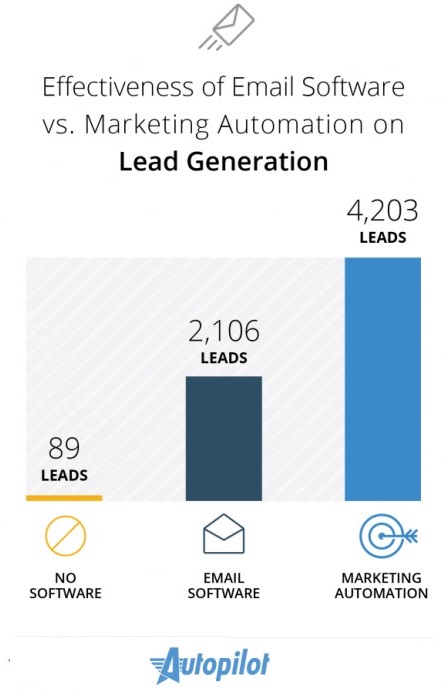
    • Companies using marketing automation generate twice as many leads as those using just email software. AutoPilot

    effectiveness of email software -vs-marketing-automation-on-lead-generation

    Not all solutions are the same. Learn the basics of marketing automation, then choose your route.

    Predictive Analytics

    In “The Hype Cycle for Business Intelligence and Analytics, 2013” Gartner reported that predictive analytics was poised to reach mainstream adoption in 0-2 years, or about right now. Here in 2015 we believe that insight-oriented diagnostic analytics and foresight-oriented predictive analytics will ensure marketer success.

    Robust, predictive models help marketers eliminate guess work based on trends they identified using data. Eliminate guess work by answering questions like these:

    • What is the optimum frequency of sending emails in a lead nurturing sequence?
    • Which content (blogs, infographic, whitepapers, videos, etc.) should you send to a certain lead persona?
    • Do you need to revisit your personas? Lead scoring?
    • How should you score a lead from a particular marketing channel?

    Data driven decisions help marketers launch and execute winning campaigns.

    Let us know the best practices you follow when using data driven decisions.

    Multi-channel Marketing

    Multi-channel Marketing is the ability to interact and engage potential consumers across platforms in real-time — website, Facebook, etc. Marketing automation tools make it possible to personalize this interaction, the ultimate expression of “reach out and touch someone”.

    Here’s an example. A company sells laptop computers for home and office use and Karen, a prospect, visits their website, adds a mainstream laptop with a high end graphics card to her cart, gets as far as billing and shipping details, but does not complete the order.

    In a situation like this multi-channel marketing could:

    1. Send Karen a personalized email urging her to complete her order. The email would show the details of Karen’s cart, her shipping and billing details and a link she can click to complete her order
    2. Leverage Facebook so Karen sees an ad — “Karen, are you looking for a new laptop?” — when she logs on. This comes from an integration of the marketing automation platform with Facebook for retargeting.
    3. Send, after a day of Karen not responding, a personalized email from Sales Support Executive Brian asking if he can help with any questions Karen may have?
    4. Automatically activate after a few days a separate email nurture or Facebook retargeting campaign

    This sequence of events can be customized based on the persona “Karen” is associated with in the marketing automation platform.

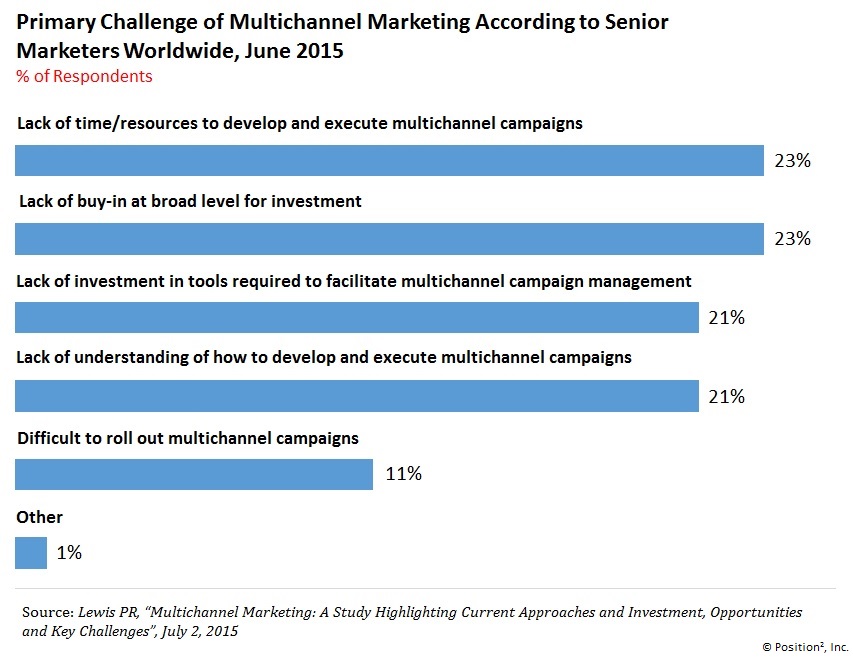
    While highly effective, multi – channel nurturing is woefully underutilized. Here are some of the challenges marketers face when it comes to developing and executing these campaigns.

    primary-challenge-of-multichannel-marketing-how-marketing-automation-can-transform-your-business

    Multichannel marketing makes it virtually impossible to lose a customer due to their distraction or a technical glitch just before a purchase. This is a powerful concept that helps marketers target the right personas with personalized content at every step of their buyer’s journey.

    Do you think this trend will help you improve conversions and target your prospects better?

    Marketing Qualified Leads

    Lead Quality. It’s typically where sales and marketing have their falling out.

    • What is the rate of acceptance of your Marketing Qualified Leads into Sales Accepted Leads?
    • Are sales and marketing on the same page when it comes to defining a “Qualified Lead”?

    When implemented correctly marketing automation platforms change the ways sales and marketing teams perceive each other. Well-structured, well-documented lead scoring for various personas, channels, etc. help bring marketing and sales to the same conversation.

    A constructive dialogue between the teams ensures “qualified” leads are converted, there is no leakage and leads that are not “sales ready” go back for a tailor made nurture andr future qualification.

    Are you plagued with disconnect between your sales and marketing teams when it comes to lead qualification?

    All our data points in one direction – marketing automation is becoming smarter, more personalized, and more accessible. It’s going way beyond the basic batch-and-blast email tool of yore.

    Use the comment box below and let us know your thoughts on how marketing automation can transform business.

  • Drip Marketing vs. Lead Nurturing

    Old marketing aphorism

    He who confuses drip marketing for lead nurturing will see no results from either.

    Use drip marketing to nurture leads. But use lead nurturing to push those leads all the way through the buyer’s journey to its successful (for you) conclusion.

    While both campaigns benefit by automating and maintaining sustained engagement with prospects with direct email and social media — Facebook, Google+, Twitter, LinkedIn, etc. drip marketing engages a prospect and lead nurturing takes it from there by understanding the behavior of the prospect, their associated needs and other interests, all in service of developing a better, more qualified sales opportunity.

    By understanding the basic difference between these two you will improve your marketing programs, and your bottom line will swell. Organizations drive prospects and renewals by nurturing prospects in all stages of the lead life cycle. What’s important is a continuous process of education and engagement at every stage of a buyer’s journey, be it event communications, free trials, employee communication programs, etc.

    Drip Marketing

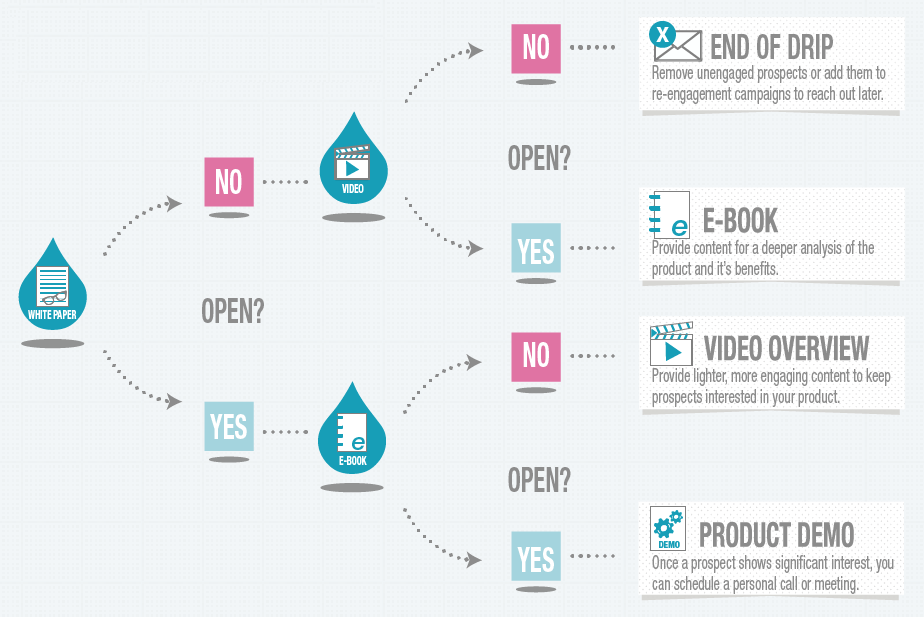
    Drip campaigns begin when people engage in common activities like signing up for an account or simply visiting your site. The people become a self-defined group and the drip campaign enables you to stay in touch. These campaigns typically consist of batches or triggers that change the nature of communication depending on the engagement or lead response. Every email originates from an archive of pre-written emails that are blasted using an automated process that allows for personalization of the name of the lead, the name of the organization, and much more.

    Drip Marketing Process

    Image Source

    Drip marketing is an effective way to push leads in a sales-ready direction. You educate the prospects about the product, build interest, and once ready, automatically move them to sales. Drip marketing is simpler and less customizable than a lead nurturing program but with continuous engagement it helps to keep your organization visible.

    Lead Nurturing

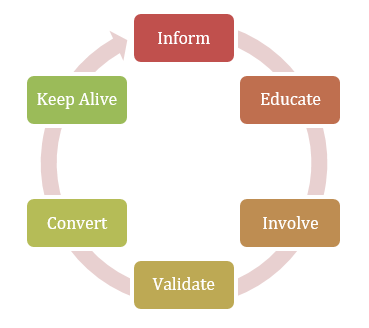
    Lead nurturing is about consistent communication with buyers throughout the lead life cycle, addressing key issues right from when interaction with the lead begins to when the lead is ready to purchase. Customers won’t appear overnight. It requires strategic marketing over time for potential customers to educate themselves and begin to build trust with the company. Lead nurturing successfully delivers valuable enough content that your leads remain engaged. Done right, lead nurturing develops strong brand and solution preferences in your prospects long before they’re actively engaged in the buying process.

    The successful lead nurturing program must be: lead nurture funnel

    • Able to maintain contact with the prospect
    • Use appropriate content
    • Target and Segment
    • Survey progress throughout the buying cycle

    To reduce the unsubscribe rate, keep all your communications simple and engaging. All of the content marketing rules for designing and sending effective emails apply to drip marketing and lead nurture. Begin with basic lead nurturing, going through the content on your website and blog to break it down into pieces that leads can easily and quickly consume. You need to map the content according to where your prospects land in the lead life cycle. A lead in the early-stages will have content requirements totally different than a lead in the late-stages. Your content has to be informative. It has to educate. And, to generate meaningful customer engagement, it has to be targeted. .

    Lead nurturing is a powerful way to automatically stay engaged with future buyers. Use targeting and segmentation to leverage prospects and ensure that communications remain relevant. By successfully implementing the nurturing process you gain valuable insights into buyer preferences and gain knowledge of the buyer’s timing and path. None of this is possible, of course, if your lead nurturing program delivers content of insufficient value or interest to your prospects.

  • The State of Marketing Technology

    Today technology is used in every facet of marketing. Marketing as a discipline is changing and marketers need to adapt to the changing technology landscape. IDC predicts, spends on marketing technology will reach $32.3 billion by 2018. According to credible sources, 65% of senior marketing executives plan to increase marketing technology spends.

    With so much marketing technology around, marketers at times can get overwhelmed. There are so many companies selling marketing technology that there is too much gratuitous stuff out there. Due to this most marketers till now have steered clear of marketing technology and this is the reason why its adoption and implementation is abysmally low.

    Now this is clearly a wasted opportunity since most marketers who have adopted marketing technology have reported rapid and significant improvements in ROI. In order to help marketers make the most of this technology we provide a set of programs that every company needs to give a serious thought, in an effort to scale leads, opportunities and ultimately revenues.

    Search Engine Marketing

    Search engine is one of the most important avenues through which users arrive at your website. Search engine marketing helps you to get more qualified leads through both search engine optimization and pay per click advertising. Your landing page becomes all the more crucial if you have to convert your leads to conversions. You have to give your users what they are seeking in a simple yet effective manner. There might be a need to test different landing pages depending on who you are targeting. Technology can help you do this in a dynamic and cost effective way. There are specialized tools for programmatic buying, attribution systems, tracking systems, consumer insights, conversion optimizers, campaign management, reporting and dashboards.

    search marketing

    Remarketing

    Remarketing is a very effective use of technology in order to follow your website visitors to other resources on the internet. You can target people with specific offers who have shown interest in particular product or service of your company. The conversion rate is high in this type of targeting since you already know what people are looking for. You can easily set up the technology needed to implement this in your digital marketing campaigns.

    remarketing

    Conversion Optimization

    When a visitor finally lands on your website it is expected that you convert the users into what you want them to do. This could be filling out a form or at least collecting their email addresses. But for that you need to have the right strategy in place like an outstanding offer or a marketing app that can do the trick for you. Conversion optimization technology can help you do this with minimum human intervention.

    conversion optimization

     Analytics

    Analytics helps you understand where your marketing dollars are going and how effective it is in improving your company’s revenue. There are many tools available today that can measure the performance of your ads, offers, digital channels and technologies. This way you can only pursue the campaigns that makes sense to you and scale down or end those campaigns that don’t.

    Google Analytics is the most widely used analytics tool. You can analyze your return on marketing investment or ROMI, using the marketing intelligence platform MiDash.

    analytics

    Marketing Automation

    Marketing automation is a class of software that automates, streamlines and measures marketing tasks and workflows. All this helps companies to increase operational efficiencies and scale revenues faster. Marketing automation can be thought of as the technology that brings it all together. It includes among other things, analytics, tracking, and online forms.  You get a clear picture of what people are doing once they land on your website. This way you can personalize your website content, create better email campaigns and bridge the gap between sales and marketing. You can send automated alerts to customers, nurture lead scoring using information from your CRM tools and third party sources.

    marketing_automation

    This is the state of marketing technology today and things can only get better! Let us have your views on marketing technology and its various benefits!

    Contact us to deploy marketing technology for your business now!

  • State of Marketing Automation 2015 [Infographic]

    Today with the explosion of digital channels and technologies you are spoilt for choice as a digital marketer. Marketing automation can effectively help put things into perspective so that you stay on top of things. Go through this insightful infographic in order to gain an inside view of the world of marketing automation now.

    position2_infographics_January_2015

  • 6 Important ‘Must Haves’ for a Successful Personalization Strategy

    Personalization strategy

    Personalization is a major focus area for digital marketers with mobile, cross channel marketing and marketing automation. According to a recent study, one-third of marketers said that personalization will be a key component in the future.

    Customers have a lot of information on products with less time to focus and decide. So, it makes sense for marketers to deliver a marketing experience that’s personalized and relevant. This means personalized messages, offers, products, communication and more.

    We have already written about the importance of personalization, not just in generic marketing, but also in cross channel marketing. Cross channel marketing is closely tied to personalization because of the changes in the way users are doing product research today (read on for more on this).

    Now, for the ‘must have’s’…

    • Audience Segments

    The way you have segmented your target audience plays a vital role in formulating your personalization strategy.

    Your target audience comprises of several different aspects, each of which plays a role in determining marketing effectiveness. Identifying each of these aspects and tailoring them to suit your audience is at the heart of personalized marketing. The more granular your understanding and the more personalized your approach, the more effective your marketing will be.

    For example, your customers may come from different regions – the US, Canada, France etc. and personalizing your marketing to cater to different languages and cultures can increase ROI. From within the same market, different individuals may have different information needs. Knowing what each individual in your audience wants enables successful personalization.

    • Prospect/Customer Data

    Data is central to understanding an audience. A robust and comprehensive database of prospects/ customers is extremely important while preparing a personalization strategy. Marketers recognize this – recent eMarketer research shows that marketers are increasing their efforts to gather customer data. Marketers also are broadening the boundaries of their data collection. Working without data makes marketing ineffective.

    Every bit of data can help fine tune personalization further. So, it’s important to meticulously gather information on a variety of aspects such as:

    • Demographics and zip codes
    • Loyalty membership
    • Device/s used
    • Referral sources such as websites, social network sites, ads, email campaigns etc.
    • Keyword referral data
    • Site search data
    • Past browsing and purchase history
    • Email campaign responses

    For example, using techniques like geo-targeting, you will be able to target prospects with offers personalized to their location. Add tracking codes on your website that allow you to follow prospect trails through your website and gather information about prospects’ likes and habits.

    Prospects have a plethora of channels at their disposal today and they use all of them for product research. Tracking prospects can help you follow the digital footprints they leave through channels they use. In the hands of a savvy marketer, these footprints are like gold nuggets!

    If you analyze your business’s data, you will spot many opportunities for personalization. The more relevant data you get, the greater the likelihood of fine tuning your personalization.

    • Prospect/Customer Journeys

    The customer journey offers many important cues for personalization especially in terms of personalizing information and offers.

    You want the customer journey to be smooth and quick but that doesn’t happen often. Understanding who gets stuck and where and for what reasons – this forms the basis for developing an appropriate personalization strategy. You may need to repurpose your content or develop fresh content to help the prospect get over his information road blocks or even reconfigure your offers to make him get over his inertia.

    • Personalization Technologies

    Before implementing your personalization strategy, you need to check if your technological capabilities match your strategy requirements. If you aim to collect prospect/customer data such as those mentioned above, you need to ensure that your website and marketing campaigns use technology and tools that enable collection and unification of such data. Infrastructure normally follows ambition. So, once you know your destination, you can acquire the appropriate technologies in a phased manner corresponding with your marketing readiness.

    • Strategy Cost

    Keep a close eye on the cost of building and implementing your personalization strategy. Some tools and technologies required can cost a lot. Build a basic personalization strategy that fits your budget and then make changes or retain the same depending on the availability of funds. As mentioned in the earlier point – set a high ambition in terms of where you want to reach in personalization, but get there based on what’s possible.

    • Product Suite/Service Offerings

    Your product/service spread determines your brand’s relevance to your audience. There will be people with diverse tastes and preferences in your target audience. While it’s not possible to have products for each one of them, the more relevant products you have, the more relevant you will be to individuals in your audience. This helps a lot of customers migrate across products as their requirements evolve or prospects to try out an entry level model. It’s this relevance that can lead to higher effectiveness.

    Personalization is an integrated process of constant fine tuning. You can keep adding dimensions and improve on what you are doing, but these 6 pointers should set you firmly down the road to success.

    Are there any other important pointers to consider while putting together a personalization strategy? Let us know through your comments below!