Author: Todd Mintz

  • Top 10 PPC Lessons I Learned from Bruce Springsteen

    I’m a huge Springsteen fan who has seen him in concert 10 times since 1992 (and I’ve spent countless hours listening to his albums and bootlegs online). Bruce has shared extraordinary personal insights through his music, but few know that Bruce’s insights could be applied to Paid Search (even though Paid Search didn’t exist until around the time he released “The Rising” album). So, without further ado, here’s what Bruce has taught me.

    You Can Look But You Better Not Touch”:
    Never discount the value of impression based marketing. Through the GDN or YouTube, a client can get large number of valuable views of their ad or their video for very low CPM rates. In a funnel-based marketing system, views can sew the seeds of future clicks and conversions.

    Jungleland”:
    Paid Search is a very skilled undertaking, especially in the B2B space. So many large companies waste quite a bit of money with suboptimal strategies and tactics. Partnering with a trusted agency with relevant experience will generate an excellent ROI.

    Does This Bus Stop At 82nd Street”:
    Many paid search efforts will benefit significantly from localization. Looking at the data, one will likely find significant performance differences between different geos, and bidding can and should be adjusted to take advantage of this performance delta.

    Growin’ Up”:
    We work with many businesses that are in early growth stage. They have big dreams for the future but have a long path to travel in order to fulfill what they wish to accomplish. We create a paid search strategy for them that will help their current situation but is also scalable for their future growth.

    Highway Patrolman”:
    Having positive relationships with Google is a solid value ad for our clients. Google has offered many of our clients invaluable assistance in growing their business or helping them solve problems. However, advice given by Google needs to be taken with a very critical eye, for not all of it will be of benefit. We can separate the Google Wheat from the Google Chaff.

    Top 10 PPC Lessons

    Roll Of The Dice”:
    Part of our job is to caution clients against making costly mistakes. For example, many clients want to bid aggressively on competitor brands. However, 99.9% of the time, this is a failed strategy with terrible ROI, so we caution our clients to stay away.

    Open All Night”:
    Paid search is a 24/7 enterprise. The concept of “Business Hours” doesn’t exist, and people will be doing research and making business decisions while you’re fast asleep. Make sure you have enough budget for all 24 hours of the day.

    57 Channels (And Nothing On)”:
    Google quietly started to show a low volume of ads on “Connected” TV devices. As more and more people “cut the cord”, this segment will increase exponentially in size, and the forward-thinking agencies and clients will begin to strategize specifically for this segment.

    Human Touch”:
    Over the years, Google’s automation has become significantly better. Today, it’s not a question of whether to use it…it’s how best to use it. Experienced paid search marketers are extremely valuable for guiding clients through choosing, implementing, and monitoring Google’s automated strategies.

    Mansion On The Hill”:
    What can be purchased with the revenue earned from a professionally managed AdWords campaign.

    Hopefully, my little reminiscence will cause you to both examine your current PPC Strategy…and listen to your favorite Springsteen.
  • B2B Facebook Event Targeting

    Are you a B2B company that’s exhibiting at a convention/conference? Facebook Event Targeting, coupled with Facebook ads, is a tactic that will go a long way towards helping your company increase the ROI at your trade show—and will only add a very small sum to your exhibition budget.

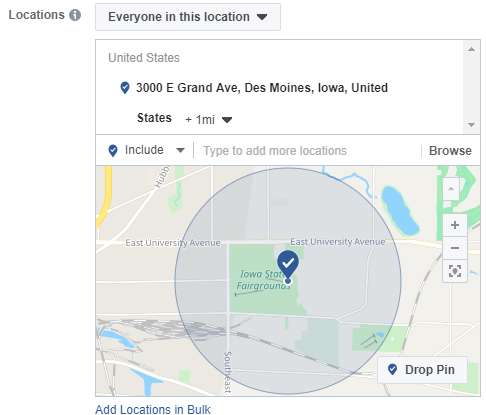
    The most important aspect of the ad setup is the definition of the geographical radius. Facebook allows “radius targeting” by address in mile increments. In all likelihood, a one-mile radius using the conference site address as the target will allow you to target the entire conference site plus a small surrounding area (since people will go offsite to transact business), which is completely adequate for the purposes of this exercise.

    Here’s a screenshot from a campaign I set up recently targeting the Iowa State Fairgrounds:

    B2B Facebook Event Targeting

    If your convention site is located in a dense urban area, this tactic will be somewhat less effective, since your mile radius will include plenty of people not involved in the targeted conference. This will require you to be more careful with managing your spend.

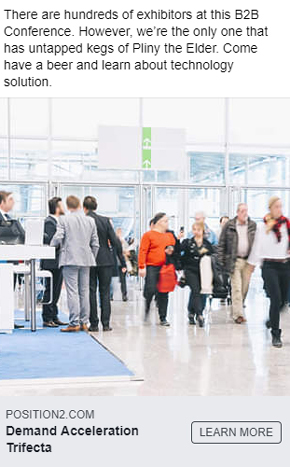
    Now, we need to hook people with the ad. Don’t run your “normal” Facebook ads for conference attendees (for someone quickly scrolling through Facebook on their phone isn’t going to connect your regular ad with your conference exhibit). Instead, do something creative that’s only going to be meaningful to conference attendees:

    We are going to get a fair number of clicks to the website from this ad, which is good (and generate some incidental leads). However, our objective is to directly call out people at the convention site to stop by the booth. We’ve given them an incentive to stop by (good beer). Such a tactic will generate more conversations at the booth, bringing more leads into the top of the funnel and helping to validate the tradeshow exhibition tactic.

    A logical question that I’ve been asked is whether you should layer additional interest targeting on top of the geographical targeting. I don’t recommend it as when I’ve tested it, I’ve made the audience reach too small. By virtue of being at the conference, people have self-selected as a relevant audience no matter what their previous Facebook behavior says about their interests and likes, and any restriction to this audience would be a mistake.

    How much does this cost? I’ve targeted Dreamforce at Moscone Center, San Francisco for $100 a day…and while I could have likely spent more than this, I couldn’t spend too much more while geographically restricting the campaign to just the conference site. You might not think that people would be on Facebook while attending a B2B conference, but I have plenty of data that says otherwise. This tactic has provided amazing results for my clients and no matter how much I talk about it, I feel confident that it will remain effective and inexpensive for the foreseeable future.

    B2B Facebook Event Targeting

  • How Does Quality Score Play into B2B AdWords Optimization

    A frequent question that I’ve been asked: How do you optimize an AdWords Account? My answer (to quote an oft-used phrase): I begin with the end in mind. If I’m working with a B2B Account, I am solely focused on the Cost Per Lead Metrics, so I optimize all the elements higher up in the funnel that I have control over in order to get a most favorable CPL.

    What elements do I have control over?

    Bids. Bid Strategy. Ad Text. Keyword Targeting. Landing Pages (sometimes). If I’m being the best steward of my client’s money, I’m making the most relevant choices for the account…examining the account data…and tweaking my choices, all the while chasing optimum performance.

    AdWords Optimization

    What element do I not have control over?

    Quality Score.

    You might point out to me that you’ve seen all these blog posts talking about quality score elements and what you might do to get your score higher. I would tell you that most of that advice is quite valid.

    You might also point out to me that you’ve read studies showing that higher quality scores lead to lower CPCs and better performance. I would acknowledge that those studies (as well as reports I’ve run on client accounts) validate this theory.

    So why don’t you have control over your Quality Score?

    Technically, you do have some control over it. However, it plays very little into how you would optimize an account.

    If I’m doing the best possible job for my client, I’ve chosen the right list of keywords; I’ve written extremely pertinent ads; I’m making the best bidding choices, and my landing pages are topically on point and contain all the right elements to convert relevant traffic.

    I let my performance against client goals dictate how I manage the account…not what the quality score is telling me.

    Would you ever manage an account based on Quality Score?

    If for some reason I’m not hitting client goals and I’m looking for an easy way to optimize the account, I would look at the Quality Score of the non-branded keywords. What I might do is create a CPA Matrix by Quality Score (QS) with an eye towards pausing all non-branded keywords tied to a Quality Score with a substandard CPA (generally QS 1-3), investing the savings into higher QS keywords. Implementation of this tactic should improve account performance.

    I have to say that I rarely resort to Quality Score-based tactics, because I’m solidly dialed in for campaign management. Were Google to take away Quality Score, it would have very little impact on my process and my results (which would still be awesome).