One-liner: Effective agentic AI governance frameworks are essential for securely deploying autonomous AI agents across enterprises while ensuring compliance and reducing risks.
The Rise of Agentic AI and a New Kind of Risk
Agentic AI is not a brand-new concept. Early AI agents began appearing in the early 2000s alongside advances in machine learning. Fast forward two decades, and the pace has changed dramatically. By 2023, agent-based systems were driving measurable productivity gains and cost savings across enterprises.
By 2024, the global Agentic AI market reached $5.4 billion and is projected to grow to $50.31 billion by 2030, reflecting a 45.8% CAGR. (1)
Growth at this scale brings opportunity, but it also introduces a new category of enterprise risk.
A Moment of Realization: When Optimism Meets Fear
While listening to an eye-opening keynote at the AI Realized Summit, Fall 2024, I felt equal parts optimism and concern. The fear was not about AI itself, but about scale. An expanding ecosystem of autonomous agents accessing sensitive systems, interacting with critical data, and operating with limited oversight, governance, or security.
If that sounds familiar, it should.
Later that summer, while listening to the Spark of Ages podcast, a conversation with Chandar Pattabhiram, Chief GTM Officer at Workato, crystallized the issue. He described what he called agentic sprawl and the lack of visibility and governance surrounding rapidly deployed agents.
That was the moment the light bulb went on.
Why Agentic AI Sprawl Is a Growing Enterprise Risk
Agentic AI sprawl occurs when autonomous AI agents are deployed across teams and departments without centralized governance, oversight, or security protocols. As adoption of these agents increases, enterprises risk losing control over how AI systems interact with sensitive systems, data, and decision-making processes.
This risk is not hypothetical; it mirrors earlier challenges experienced during the growth of IT sprawl and SaaS sprawl. However, the stakes are higher with agentic AI, which has more autonomy and decision-making power.
Lessons From IT and SaaS Sprawl
In highly regulated industries, similar challenges have occurred before. Teams often created tools rapidly to improve performance tracking and streamline data access. However, leadership had little visibility into:
Who created these tools
What data did they access
Who had access to them
Whether they were still needed
To address this, organizations adopted centralized governance frameworks and lifecycle management processes to track, manage, and decommission these tools. A similar approach is needed for managing agentic AI governance frameworks effectively, ensuring accountability and minimizing risks.
Common Problems Caused by Agentic AI Sprawl
Redundancy and Duplication of Effort
Multiple teams may build AI agents that perform overlapping functions, leading to redundant efforts and wasted resources.
Fragmented Workflows
Rather than cohesive systems, enterprises may end up with disconnected AI agents that manage different stages of the same workflow.
Lack of Visibility and Accountability
Without centralized oversight, organizations cannot assess:
Data access risks
Compliance exposure
Security vulnerabilities
Model behavior and decision logic
Establishing an Agent Registry as the Foundation
The first step toward effective AI governance is visibility.
An enterprise AI agent registry should track:
Active and retired agents
Ownership and purpose
Data access and permissions
Deployment status
This registry helps enterprises manage AI agent sprawl, reduce overprovisioning, and ensure compliance with internal and external governance standards.
Core Components of an Enterprise AI Governance Framework
Algorithmic Accountability
Every decision made by an AI agent must be traceable. Organizations should maintain an audit trail that tracks:
Input data
Decision logic
Model outputs
Final outcomes
This algorithmic accountability is critical, especially for regulated industries like financial services and healthcare, where transparency is paramount.
Real-Time Guardrails and Monitoring
Static governance policies are not enough. Enterprises need real-time guardrails to detect:
Model drift
Hallucinations
Safety threshold violations
When these issues occur, systems should automatically pause or restrict agent actions until reviewed.
Human-in-the-Loop Oversight
Modern Human-in-the-Loop (HITL) systems focus more on oversight than approval. Agents should provide:
Clear reasoning
Explainable outputs
Human-readable decision summaries
This allows effective AI governance while maintaining operational efficiency.
Leadership and Cross-Functional Governance
Successful AI governance frameworks require leadership buy-in. Enterprises should form a cross-functional governance group responsible for:
AI products
AI services
Autonomous agents embedded within business processes
This approach ensures informed decision-making and promotes effective risk management.
Why Governance Builds Trust in Enterprise AI
Strong AI governance frameworks not only reduce risks but also help build trust with:
Regulators
Customers
Internal stakeholders
By prioritizing auditability, accountability, and transparency, organizations can scale their AI agents responsibly and ensure long-term trust with all stakeholders.
Final Thoughts on Managing Agentic AI Sprawl
As agentic AI adoption continues to accelerate, enterprises must treat autonomous agents not just as software but as digital colleagues with real-world impacts. Effective AI agent governance frameworks are essential for taming agentic AI sprawl and ensuring its responsible growth.
This article provides the foundational elements needed to manage AI agent sprawl, reduce risks, and build trust in agentic AI systems.
Agentic AI sprawl refers to the uncontrolled deployment of autonomous AI agents across multiple departments or teams without centralized governance or oversight.
2. Why is governance important for AI agents?
Governance frameworks ensure that AI agents are deployed with clear accountability, security, and compliance, preventing sprawl and minimizing risks.
3. How is agentic AI different from traditional software?
Agentic AI operates autonomously, adapts over time, and influences decision-making processes, requiring stronger governance and oversight compared to traditional software.
4. What industries need agentic AI governance most?
Industries like financial services, healthcare, and insurance face the highest requirements for agentic AI governance due to regulatory concerns.
Before we discuss Vector Search Engine and when to consider using them, let’s start with a simple question.
What is a vector?
In terms of data representation, a vector is a sequence of numbers (or scalars) that can represent data points in a multidimensional space.
It’s not a new concept – its use in mathematics was first introduced by polymath Hermann Grassmann in the mid-19th century. In this article, we will discuss how the vector representation of data works with machine learning, natural language processing (NLP), and image processing. Using vectors to represent data has been around since the 1980s (through Spatial databases). You’ve probably used a spatial database more than once – Google Maps? Two billion users a month rely on that database, which uses vectors to deliver accurate results efficiently to get where they need to go.
So, let’s discuss the difference between a traditional database and a Vector Search Engine. A traditional database is organized on structured data (think rows and columns) and can be paired with a relational database. Traditional databases can be queried with exact match (or range) queries and filtered based on specific criteria, relying on structured query languages (like SQL).
Vector Search Engine represent and store data as vectors, numerical representations of those data points in high-dimensional spaces. High-dimensional spaces are datasets that contain many variables (columns) compared to the number of data points (rows). Vectors capture the underlying meaning of data, enabling similarity searches.
Understanding Vectors
To understand vectors, it starts with embedding.
Embedding is the numerical representation (vector) that captures the meaning and relationships of text, image, and audio files. Each embedding or vector has a high-dimensional aspect. That means that each vector can have hundreds or thousands of dimensions—each dimension captures a different feature or aspect.
When creating those vectors, the goal is to keep data with similar meanings close to each other in the vector space to allow for an optimized similarity search.
Word embedding
Here’s an example of word embedding (provided by Google Gemini):
We have two sentences:
Sentence 1: “The cat is on the mat.”
Sentence 2: “A feline rested on the rug.”
An embedding model (like those used in NLP) would convert these sentences into vectors. These vectors might look something like:
Because the sentences have similar meanings, their vectors would be relatively close to each other in the high-dimensional space.
Image embedding
It is common to use a convolutional neural network (CNN) to extract features of an image and generate image embeddings.1
Here’s an example of image embedding (provided by Google Gemini):
An image of a dog might be represented by a vector like:
[0.78, 0.12, -0.45, …, 0.91]
A similar vector would be used for another image of a dog. Conversely, a significantly different vector would be used for a picture of a cat.
Digging into convolutional neural networks a little more, they excel at learning hierarchical features from images. Their layers can detect patterns like edges, textures, and more complex object parts.
Image embeddings from convolutional neural networks can be used for:
Similarity search: Finding images that may be visually similar (think two images with two different dog breeds, both are sitting)
Image retrieval: Searching for images based on their content
Image classification: Using the embeddings as features for classification tasks
Facial recognition: Representing faces as embeddings for comparison
An important aspect of Vector Search Engine is their capacity to store, index, and manage high-dimensional data. This concept is not easy to understand, so I asked Gemini to give me an easy way to describe it.
Imagine you want to describe a simple object, like a color. You might use just one number: its position on a rainbow scale (e.g., 0 for red, 100 for violet). That’s a one-dimensional space.
Now, let’s describe a point on a map.
You need two numbers: its latitude and its longitude. That’s a two-dimensional space.
If you want to describe a cube, use its length, width, and height. That’s a three-dimensional space, and we can easily visualize all of these.
Core concepts of Vector Search Engine
A Vector Search Engine is designed for efficiently storing, indexing, and querying high-dimensional vector embeddings. These embeddings are numerical representations of data, capturing the semantic meaning (or features) of various forms of unstructured data. We covered one of the core concepts above – embeddings, and we’ll dig deeper into a few more core concepts.
High-Dimensional Vectors
Vector embeddings typically have a large number of dimensions.
Each dimension captures a nuanced aspect of the data, allowing for a rich and detailed representation.
An embedding with many dimensions requires specialized indexing (and querying) techniques.
Similarity Search:
Unlike a traditional database (which focuses on exact matches), Vector Search Engine excel at finding data points similar to a query vector.
Similarity is determined by measuring the distance between vectors in the high-dimensional space.2
Standard distance metrics include:
Cosine Similarity: measures the angle between two vectors, which are useful for text and high-dimensional data, as it’s insensitive to magnitude. Magnitude in this reference is a calculation that allows for the normalization of vectors, enabling the metric to measure the similarity based on the orientation or direction of the vectors rather than their size.
Euclidean Distance: The straight-line distance between two points in the vector space. This is the fundamental distance metric in various fields, including mathematics, physics, computer science, and particularly in machine learning algorithms.
Dot Product: Another measure of vector similarity. It’s used in geometry, physics, and computer science.
Indexing:
Vector Search Engine employ specialized indexing techniques to perform similarity searches across large datasets of high-dimensional vectors efficiently.
Traditional indexing methods used in relational databases are not efficient for high-dimensional data.
Standard vector indexing algorithms include:
Hierarchical Navigable Small Worlds (HNSW): builds a multi-layer graph structure for an efficient approximate nearest neighbor (ANN) search.
Inverted File Index (IVF): Divides the vector space into partitions and searches within the most relevant partitions.
Product Quantization (PQ): Compresses vectors to reduce memory usage and speed up distance calculations.
Approximate Nearest Neighbor (ANN) Search:
Due to the computational cost of finding the exact nearest neighbors in high-dimensional space, Vector Search Engine often use ANN algorithms.
ANN algorithms sacrifice some accuracy to achieve significantly faster search speeds, which is acceptable for many similarity search applications.
These core concepts revolve around representing complex data as high-dimensional vectors, indexing these vectors for efficient similarity search using specialized algorithms and distance metrics, and performing approximate nearest-neighbor searches to retrieve semantically related information quickly.
Use cases for a Vector Search Engine
By now, you’ve got a good understanding of the concepts around Vector Search Engine and their differences.
1. Semantic Search and Information Retrieval: Imagine searching for “pictures of cute fluffy animals” and getting back images that look like cute fluffy animals, even if the captions don’t explicitly use those words. Vector Search Engine excel at understanding the meaning behind text and images. By embedding queries and documents (text, images, audio, video) into a shared vector space, the database can find the most semantically similar items, going beyond simple keyword matching. It powers more intelligent search engines and recommendation systems.
2. Personalized Recommendations: Imagine your favorite streaming service suggesting movies or shows you might like. Vector Search Engine can store user preferences (represented as vectors based on their viewing history, ratings, etc.) and content characteristics (also as vectors). By finding the closest content vectors to a user’s preference vector, the system can deliver highly personalized and relevant recommendations for movies, music, products, articles, and more.
3. Fraud Detection: In the financial world, Vector Search Engine can help teams identify unusual patterns that indicate fraudulent activity. By representing user transactions, account details, and other relevant information as vectors, the system can detect anomalies – data points far away from typical behavior in the vector space. This process can identify potentially fraudulent activities that a rule-based system might miss.
4. Chatbots and Conversational AI: When you interact with a chatbot, it needs to understand the nuances of your questions. Vector Search Engine store embeddings of previous conversations, user queries, and knowledge base articles. The chatbot can retrieve relevant information and generate more contextually appropriate and helpful responses by embedding a new user query and finding the most similar existing vectors.
5. Image and Video Similarity Search: Beyond just text, Vector Search Engine are powerful for finding similar images or videos. By extracting features from visual content and embedding them as vectors, you can perform searches like “find me other dresses that look like this one” or “show me all video clips with a similar scene.” It has applications in e-commerce, media management, and content moderation.
6. Drug Discovery: In pharmaceutical research, Vector Search Engine can help accelerate discovery. On average, it takes 10 years to bring a drug from initial discovery to market approval. Utilizing a Vector Search Engine, in drug discovery, molecules can be represented as vectors based on their properties. Researchers can then search the database for molecules similar to known drugs or target compounds, potentially identifying new drug candidates faster – potentially improving the time to clinical trials (and eventually to market).
While Vector Search Engine offer exciting possibilities, there are some common challenges and important considerations to keep in mind when working with them:
Challenges:
1. The Curse of Dimensionality: Vector embeddings can have hundreds (or thousands) of dimensions to capture the richness of the data completely. This high dimensionality can lead to the “curse of dimensionality,” where distance metrics become less meaningful, and overall search performance degrades. Finding the right balance between information richness and dimensionality is critical.3
2. Scalability and Performance: Maintaining efficient search performance can become challenging as the data volume and vectors’ dimensionality increase. Indexing high-dimensional data for fast similarity search is a complex problem. Indexing techniques (like HNSW, Annoy, etc.) have trade-offs regarding build time, query speed, and memory usage. Scaling the database horizontally to handle large datasets while preserving query latency requires careful architectural design.
3. Choosing the Right Embedding Model: The quality of the vector embeddings is paramount. The choice of embedding model (e.g., different transformer models for text, CNN architectures for images) significantly impacts the effectiveness of the Vector Search Engine. Understanding the specific data type and the desired semantic understanding is critical; selecting the right model that is appropriate can have an impact on your success.
4. Indexing and Query Optimization: Efficiently indexing and querying high-dimensional vector data requires specialized techniques. Understanding the characteristics of different indexing algorithms and how they perform under various workloads is essential for optimizing query latency and throughput. Choosing the right distance metric (e.g., cosine similarity, Euclidean distance) for the specific use case also impacts performance and relevance.
5. Data Updates and Maintenance: Real-world data is dynamic. Updating vectors in an extensive database while maintaining index integrity can be challenging. You need to develop strategies for handling inserts, deletes, and updates to avoid performance degradation.
Monitoring and Observability: Monitoring the performance and health of a Vector Search Engine is crucial. Effective monitoring and alerting systems are important for identifying and addressing potential issues.
Considerations:
1. Defining the Use Case and Data: The first step is to clearly understand the specific problem you are trying to solve with a Vector Search Engine and the nature of your data. This will guide the choice of embedding model, indexing strategy, and distance metric.
2. Embedding Strategy: How will you generate the vector embeddings? Will you use pre-trained models or train your own? What are the trade-offs regarding accuracy, computational cost, and customization?
3. Indexing Technique Selection: Which indexing algorithm best suits your data volume, dimensionality, query patterns, and performance requirements? Understanding the trade-offs between approximate nearest neighbor (ANN) search algorithms (speed vs. accuracy) is essential.
4. Distance Metric: Which distance metric aligns best with the notion of similarity for your data? Cosine similarity is often used for text embeddings, while Euclidean distance might be more appropriate for other data types.
5. Accuracy vs. Speed Trade-off: Many ANN search algorithms offer a trade-off between search speed and accuracy (recall). You need to determine the acceptable level of approximation for your application.
6. Integration with Existing Systems: How will a Vector Search Engine integrate with your existing data pipeline and infrastructure? Considerations should include ingestion, query execution, and synchronization.
7. Cost and Infrastructure: Vector Search Engine can have specific infrastructure requirements – especially for large-scale deployments. You need to fully understand the costs associated with storage, compute resources, and managed service offerings.
8. Security and Privacy: If your Vector Search Engine contains sensitive information, your team needs to ensure that the appropriate security measures are in place to protect the data. Standard security tactics like encryption and access control are necessary to ensure that you’re meeting compliance requirements.
Whether your focus is on developing a Retrieval-Augmented Generation (RAG) for an LLM or a semantic search feature, keeping these challenges and considerations in mind – you’ll be able to tap into the full power of Vector Search Engine.
Successfully integrating a Vector Search Engine into your product or feature hinges on a clear understanding of its capabilities and a planned approach to implementation. You will need to clearly define your use case and have a solid understanding of your data. Those two steps will inform your decisions regarding the following:
1. Embedding Strategy: Which embedding model (pre-trained or custom-trained) will best represent your data’s semantic meaning for your specific problem?
2. Indexing Technique: Given your data volume, dimensionality, and query speed requirements, select the most appropriate approximate nearest neighbor (ANN) indexing algorithm (e.g., HNSW for balanced performance, PQ for memory efficiency).
3. Distance Metric: Choose the distance metric (e.g., Cosine Similarity for semantic text search, Euclidean for more general feature comparisons) that accurately reflects ‘similarity’ for your application.
Outside of the initial setup, you will have ongoing operational considerations that need to be addressed.
From planning for data updates to establishing monitoring and observability to track performance (and resource utilization) and ensure your chosen solution aligns with your scalability, cost, security, and privacy requirements, you can harness the full power of Vector Search Engine for intelligent data retrieval and advanced applications by addressing these factors proactively.
Some analysts predict that the Global LLM and Agentic AI markets could reach $36 billion and $47 billion in revenue by 2030, respectively. Understanding the infrastructure and underlying technology that will support that growth is important. Making the right decisions now will ensure scalability and future growth.
This article was a collaborative effort between Qdrant and Position2.
Qdrant is a leading open-source, high-performance Vector Search Engine and vector search engine. Built to power semantic search, recommendation engines, Agentic AI memory and AI-driven retrieval. Qdrant offers both a managed service (Qdrant Cloud) or the option to run it on-premise.
Position2 is an AI-first Growth Marketing firm that drives growth for innovative brands. We understand your needs, and that understanding drives us to develop the right marketing mix for your company. Our unique process of mapping content to each customer journey stage and deep knowledge of AdTech & Martech platforms deliver exceptional results for your ABM programs. We power our integrated marketing campaigns with the most advanced tactics in Paid Acquisition, Marketing Automation, CRM, Analytics, and cutting-edge Content Creation, Design, and Web Development.
1. Clainche, S. L., Ferrer, E., Gibson, S., Cross, E., Parente, A., & Vinuesa, R. (2022). Improving aircraft performance using machine learning: A review. https://doi.org/10.1016/j.ast.2023.108354
In today’s marketing landscape, marketing automation has become indispensable for businesses seeking to optimize their marketing efforts and boost efficiency. As your company’s needs evolve, you may need to migrate to a more advanced platform. This guide will walk you through the critical steps to ensure a successful migration, maximize your investment, and minimize any disruptions.
Why Migration Matters
Platform migrations are not for the faint of heart. They usually start with an assessment of your needs. As you assess those needs, you understand what capabilities, and processes need to be maintained and what functionality needs to be added to your tech stack.
What are your areas of focus in the assessment? There will probably be more than one—it could be improvements in productivity, analytics, targeting, integrations, cost-savings, or modernization.
Once the assessment is complete, the next step is an RFP for vendors that meet your changing needs.
So, how do you set your team up for success?
Get the basics done first. Depending on your company’s size and the complexity of your marketing operations, you may have to engage finance, procurement, and IT infrastructure before any work starts.
It starts with the team. Identify the team members and stakeholders that will be integral to the entire process – including those that would lead any migration effort. After the team is identified – define their roles and responsibilities for the entire process. As your team starts the assessment and the RFP:
Know what you have. Understand your tech stack (including data sources). If you are looking for another solution, make sure you understand the current setup you have and how your team uses it. What are the pros and cons of your current solution?
What are the connections, dependencies, and processes tied to the current solution?
Define clear objectives. It all starts with identifying your objectives and goals and making sure the platform that you are reviewing aligns with your overall strategy.
What enhanced features does your team need?
Is scalability important for a new solution?
Are you focused on cost reduction, efficiency gains or both?
Buy for the future. As you develop your RFP, you start from what you know of your current tool and setup (strengths and opportunities). What functionality do you need to maintain? What capabilities need to be added? Are there any upcoming tech stack changes that need to be factored in?
Scrutinize potential new platforms for:
Feature set and functionality
Vendor support and ecosystem
Integration capabilities
Data management
User experience and interface
Scalability and future-proofing
When is the right time to discuss migration?
When meeting with prospective vendors, ask what they offer in migration support and what their timelines for migration are—that is critical, their answers will influence your team’s decision.
Timing
There’s a lot of pre-work to be done before you submit an RFP to a select group of vendors. Identifying your team, and laying out clear roles and responsibilities is the first step. Followed by knowing your existing setup and data sources – as well as identifying the functionality you need to maintain and the new capabilities your strategy will need.
It’s likely you’ll have already collected a shortlist of vendors/solutions that you’re interested in evaluating. If you don’t, that’s fine too. We recommend using sites like G2 to compare various solutions and get access to customer reviews.
That’s already a sizable book of work that could take several weeks to complete — there are still critical tasks that will demand your team’s attention.
Next steps
Your team should develop a comprehensive migration plan in parallel with other activities. They know your infrastructure and systems better than anyone, and you want to use that knowledge to create a preliminary plan before signing with a new vendor. That migration plan can be finalized after vendor selection. Here’s a short list of things to consider.
Timelines: Establish a realistic timeline for data, asset, and workflow migration. You’ll also need to have a launch date in mind.
Alignment: Your migration plans need to align with your broader business strategy.
Identify your resources: Since you’ve already identified the team members and stakeholders for vendor selection, that could be your starting point for selecting the team for migration.
Plan for training: In your vendor conversations, identify what they offer to train your team on the new system.
Integration plans: You’ll need to plan for integration with your existing systems (CRM, CMS, DAM, etc.). Your internal resources can also be members of those teams. They can help with recommendations on other team members to include and serve as a central point for internal communications.
Data and Data Security: Ensuring data protection during the transfer process or at rest, as well as factoring in compliance with data protection and privacy regulations (e.g., GDPR).
Processes: A successful migration depends on identifying every internal process you have in place to manage your operations. If you haven’t documented them already, now is the time to start.
Testing is critical: As your team migrates solutions – you need to test every aspect of the migration, so start working on test plans early on.
Depending on who and what your team is evaluating, it could take weeks or a couple of months to get to a final selection. Once a vendor/solution is selected, the work begins. You will need to manage the vendor engagement and migration like you handled the RFP and selection process – with the right stakeholders and plan. After conferring with your broader team – have a date in mind for the completion of the migration activities and plan accordingly. Once the plan is set – you need to realize any delay – or failure pushes that date out.
Are you overwhelmed yet? This entire process can be daunting – your team needs to anticipate and plan for these challenges. The right planning, project management, communication, and leadership – can make the difference in vendor selection and migration.
The buzz over the last year and a half around AI has raised awareness of Generative AI systems (Gen AI) and large language models (LLMs) and shone a spotlight on the issues and gaps in these systems, specifically regarding bias and discriminatory practices.
Here are some definitions (courtesy of Google’s Gemini) so we’re all on the same page.
Gen AI: It is a system that uses machine learning, algorithms, and training data to generate content based on user inputs or prompts. Content can include text, images, music, video, code, and more. Gen AI models are bidirectional, taking cues from human inputs and prompts to shape their content production.
LLMs: Are programs that use deep learning to analyze large amounts of data to understand human language and perform natural language processing (NLP) tasks. LLMs can recognize, generate, summarize, translate, and predict text and other content. They can also understand how words, sentences, and characters work together and recognize distinctions between different pieces of content.
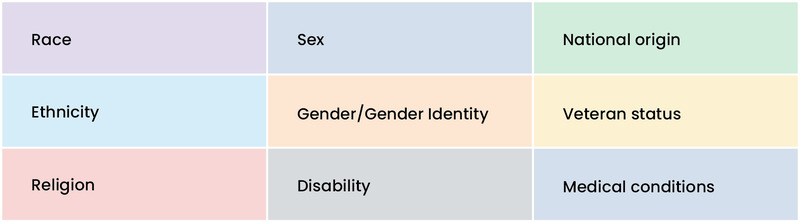
The list of potential biases is long, to say the least. They can include:
According to the CompTIA 2024 AI Outlook, 22% of companies are pursuing the integration of AI across a wide variety of products and workflows, and another 33% are engaging in limited implementation of AI.
With so many companies and government entities considering adoption or having already implemented AI and LLMs into their products, processes, and workflows concerns about potential bias and discriminatory practices grow.
The table above clearly illustrates that biases and discrimination have a direct impact on all people, whether they are part of a historically marginalized community or not.
Sources of bias
Where do biases in our AI systems come from? It’d be easy to declare this a technology issue, but it stems from human, systemic, and institutionalized biases resident in our digitized world. When systems use web data and information for training, they reflect the biases present in that training data and it becomes part of any output from that system.
As for systemic or institutional bias – that bias can come directly from that institution’s data and inadvertently exclude people. An example of this is a hiring tool that learned the features of a company’s employees (predominantly men) rejected women applicants for spurious and discriminatory reasons; resumes with the word “women’s,” such as “women’s chess club captain,” were penalized in the candidate ranking.1
The impact of bias
Real-world examples show that these ingrained biases can impact a person’s financial well-being, the ability to get hired, medical treatment, mental health, and an overall potential loss of opportunity.
What considerations can prevent unconscious AI bias?
To ensure fairer AI systems – it’s universally understood that data privacy, transparency, and accountability have to be at the forefront of all internal use policies.
These policies must be coupled with the ability to detect existing biases in those systems and accompanied by mitigation plans.
So what does implementation look like?
Data Privacy
Eliminating bias in AI begins with data anonymization. Data anonymization is nothing new; industries like Healthcare, Financial Services, and Telecommunications have been doing it effectively for years. Government organizations also use it to protect Personally Identifiable Information (PII).
One component of data anonymization that can preserve privacy while preserving data utility for AI applications is pseudonymization. Pseudonymization anonymizes data by replacing any identifying information with a pseudonymous identifier. Across industries, Pseudonymization protects personal information like first and last names, addresses, and Social Security Numbers.
Additional techniques that can help preserve privacy are federated learning and differential privacy, which enable data analysis without compromising privacy.
Data anonymization has pros and cons. Teams must decide how they utilize PII data to ensure they pursue the right approach.
Transparency
Transparency is key to reducing bias and discrimination in AI systems. It’s a pretty broad term – what it means in terms of AI systems is there is an openness and clarity of AI systems, this applies to their algorithms, decision-making processes, and data sources. Areas to focus on for data transparency include:
Data collection and processing – What data sources are you using? How is the data collected and processed?
Assessments – Conduct assessments of these systems for bias and discrimination, including any remediation efforts. Publicly publish any assessments of the system (and maintain records of these).
Privacy policy – Develop and publish your privacy policy for system users.
Evidence compliance with all applicable regulations in the regions you operate.
Transparency is a critical component of responsible AI, as it helps ensure that decisions are made fairly, ethically, and without bias—most importantly, that these efforts are shared with system users.
Accountability
Accountability involves establishing processes and frameworks to create an oversight and monitoring function over these systems to ensure that they operate as intended and do not cause unintended consequences.
Creating a governance framework supports both accountability and transparency. It establishes an oversight body that reviews the development, deployment, and day-to-day performance of AI systems.
Define ethical guidelines for staff who build and update these systems.
The common elements between transparency and accountability are that both of these functions require active monitoring and reporting on the adherence to stated policies, guidance, and compliance with all applicable regulations. As with most technology solutions, these need to be audited and tested to ensure the controls are working as intended, not causing new issues, and any subsequent bias is identified.
In closing
Bias and discrimination exist in these systems, and the solutions that can help reduce them in AI systems are nothing ‘new.’ They are tried-and-true approaches that multiple industries have used for years to protect sensitive data and create and maintain the confidence of consumers, regulators, and investors. As these systems are being developed, companies need to consider whether speed to market is more important than developing systems that have enshrined fairness and are not actively reinforcing societal bias.
Although LLMs have been around since the 1950s, let’s start by defining what they are. A Large Language Model is a type of AI program that uses deep learning and machine learning to perform natural language processing (NLP) tasks. LLMs are trained on large amounts of data to understand and generate human language.
LLMs are built on transformer models (because of the massive datasets they are trained on), which are neural networks that use self-attention to learn context and detect relationships between elements in a sequence.
What is a Marketing LLM?
Marketing-focused LLMs are specifically trained on your data. The data you use to train can be your marketing content, campaigns, analytics, and customer data. These LLMs can ingest and train on large amounts of data.
The clear advantage of leveraging AI in your Marketing Strategies
LLMs and Generative AI aren’t going anywhere, these tools have been around for a while, and they will continue to make an impact on multiple industries. Across those industries and companies, Gen AI is being utilized to create content (like social posts, ad copy, and blogs), creative assets, templates, product descriptions, and metadata to create efficiencies in their marketing and creative teams as well as improve speed to market for test iterations.
Over half of marketers (55%) in an eMarketer study use AI for content ideation, indicating the technology’s value in generating new creative concepts and strategies. Let’s look at some examples of how a Marketing LLM can impact your campaign creative:
Personalization at scale: Marketing LLMs can quickly tailor content to specific audiences, ensuring that the right message gets to the right target.
Scalable content: You can quickly develop and version existing content for use in omnichannel campaigns.
Optimizing existing content: With speed and efficiency you can quickly optimize content to improve your engagement and conversion rates on existing campaigns.
Data-Driven Insights and Analysis
In the same eMarketer study from earlier this year, almost half (45%) of the respondents use AI to gather consumer insights, showcasing AI’s role in understanding market trends and customer behaviors. Marketing LLMs can deliver value with:
Processing customer data with NLP: You can utilize an LLM to clean and correct customer data or personalize responses tied to customer interactions.
Analyzing customer sentiment: Review and analyze sentiment based on classifying inbound communication.
Identifying trends and opportunities: With so many touchpoints to process, it’s difficult for teams to identify trends. An LLM can process unstructured data like customer feedback, social media posts, and online reviews – identifying trends and opportunities your team might miss.
Chatbots and Conversational AI
There are clear differences between chatbots and conversational AI. Chatbots use predefined conversation flows that are limited. Think about the last chatbot you used—there are clear limits to what it can answer based on your input. Simply put, Conversational AI uses machine learning and NLP to provide a more robust, personalized experience. There are use cases for both – broadly they can be used for:
Enhancing customer experience
Being an always-on, 24/7 support function
Being a key component in Sales or Business Development flows
Optimization and Testing
Testing your marketing is critical to increasing its effectiveness, reducing waste on strategies that don’t work, and increasing the ROI of your campaigns – Marketing LLMs are a great tool to help you with all of that.
Creative copy and content optimization
A/B testing and experimentation strategies
Integration with Marketing Automation
Marketing LLMs can have an impact on Marketing automation – from identifying prospects that can convert to finding the best time to market to them to get that conversion. They can also assist in:
Streamlining workflows and processes
Personalized nurturing campaigns
Enhancing marketing efficiency
Challenges and Considerations
In 2017, The Economist declared that data was the most valuable resource. Although the article focused on US tech companies and their use and storage of massive amounts of data – it’s a very relevant topic for AI and Marketing LLMs.
Data quality and privacy concerns are top considerations when using a Marketing LLM – the data the system is trained has a direct impact on the results. Poor data quality can quickly cause issues with an LLM. These issues can be mitigated before they even start by:
Data cleaning: Identify, correct, and remove inconsistencies, errors, and missing values from your data set.
Data collection: Establishing strong controls (process and procedures) on the collection of data.
In addition to the above, creating rules and procedures for data validation, integration, and monitoring.
Privacy concerns: You need to ensure that training data does not contain personally identifiable information (PII)—if it does, it increases the risk of being exposed by hackers and is subject to multiple laws worldwide. The best policy regarding privacy concerns with PII is to ensure that data is anonymized and that consent is obtained where necessary.
Ethical and responsible AI implementation: We’ve all seen the news stories about bias and discrimination in LLMs, and it’s clear that improved data quality and human oversight are critical to preventing bias, discrimination, and misleading information that can hurt historically marginalized communities.
Future Outlook
As LLMs continue to evolve, we can count on a future with them making an impact on both consumers and businesses. Advancements in LLMs will include a deeper level of personalization, advanced conversational capability, and an industry-level focus on specific industries.
Today, LLMs can provide businesses with a clear advantage by enhancing productivity by optimizing operations, reducing costs, and improving delivery. LLMs can process and analyze vast amounts of data faster and more efficiently than people, driving quicker, more accurate decision-making.
Conclusion
When it comes to Marketing LLMs, there are so many practical applications that can uplevel your marketing and customer experience for your customers—and these capabilities will only grow as new LLMs enter the marketplace.
Although there are some clear concerns about data quality, potential biases, and privacy, these can all be mitigated by strong controls (process and procedure) combined with actual human oversight.
We believe there’s a clear competitive advantage to using Marketing LLMs and that the benefits clearly outweigh the concerns.
The marketplace is crowded, and the traditional approach of batch and blast is no longer effective. Instead, businesses need to pivot and focus on personalization, partnerships, and community building to reach their target audience more effectively and build a loyal customer base. We’ll break down how each of these verticals can improve your marketing efforts.
The traditional approach to marketing
Traditionally, marketing has been based on a mass marketing approach. We liken this to businesses creating one-size-fits-all broad-based marketing messages and campaigns designed to reach as many people as possible.
However, it’s an approach that is no longer effective in the crowded marketplace of today’s digital age. There is so much noise and competition – standing out from the crowd is difficult and challenging for you to get your organization’s message seen.
A new approach to marketing
The new approach to marketing is based on three vital segments: personalization, partnerships, and community building. This means that you need to become more intentional in creating marketing messages and campaigns tailored to your target audience’s specific needs and interests. You also need to build relationships with other businesses and organizations that can help you reach your target audience.
Personalization at Scale
Personalization is the key to reaching your target audience more effectively because you meet your customers where they are. In fact, 91% of consumers are more likely to purchase from brands that provide relevant offers and recommendations.
By understanding your customers’ needs and interests, you can create marketing messages and campaigns that are more likely to resonate with them. No need to be disingenuous; there are a number of ways to personalize your marketing, including:
Using customer data to create targeted email campaigns
Creating personalized landing pages
Offering personalized discounts and promotions
Sending personalized recommendations
Partnerships
Because the market is crowded, consider aligning your interests with companies that share your goals. Partnerships are an effective method of reaching your target audience.
By partnering with other businesses and organizations, you can get your message in front of a wider audience. There are a number of ways to partner with other businesses, including:
Co-marketing campaigns and events
Joint ventures
Referral programs
Affiliate marketing
Community Building
One of the most underutilized tactics is community building, another important and new approach to marketing. By building a community around your brand, you can create a loyal following of customers who are more likely to do business with you. There are a number of ways to build a community through organically crafted content, including:
Creating a blog
Hosting webinars and events
Running contests and giveaways
Engaging with customers on social media
Advocacy and Loyalty
Advocacy and loyalty are essential for any business that wants to succeed. By creating advocates for your brand, you can get your message spread by word-of-mouth. There are a number of ways to create advocates, including:
Providing excellent customer service
Offering rewards and incentives
Giving back to the community
Meeting your customers where they are
Finally, it’s important to meet your customers where they are. Be authentic, using the channels they use and speaking to them in a way that they understand.
For example, if your target audience is on social media, then you need to be active on social media. If your target audience is reading blogs, then you need to be writing blogs. The proof is in the pudding.
The Bottom Line
Taking a different approach to marketing is essential for businesses that want to succeed in today’s crowded marketplace. By focusing on personalization, partnerships, community building, advocacy and loyalty, and meeting your customers where they are, you can reach your target audience more effectively and build a loyal customer base.
To learn more about how to take a different approach to marketing, check out our blog series or contact us for a consultation.
SaaS marketers need to understand whether their strategies are effective, but many don’t know how to. Some may be running the wrong tests, or they may not be reading the results correctly—others might not even be testing.
As a result, they may be wasting time and money on marketing that just isn’t effective. Organizations rely on their marketing strategies to attract and convert potential customers. But how can you be sure that your strategy is actually working? The quick answer is test, test, test… but there’s a little more to it.
It’s not just testing – it’s using the right method, understanding the result, and knowing what success or growth looks like. By testing different elements of your marketing strategy, you can see what’s working and what’s not. This will help you to improve your strategy and attract more of your ideal customers (ICPs).
In this article, we will discuss some of the key elements of SaaS marketing that you can test. We will also provide tips on how to run effective tests and interpret the results.
First, let’s talk about the common mistakes SaaS marketers make when testing their marketing campaigns:
What are you testing for? Not having clear goals for your marketing test makes it difficult to measure success. Be intentional in the planning. Ask yourself this question … “What do you want to achieve with this test?” Are you testing messaging, cadence, or creative elements?
It’s important to clearly identify what you are testing and what success looks like. Have a specific goal in mind before you start testing – it’s the foundation of any test and the first step in the process.
Not testing enough variables. There are many angles and parameters when it comes to crafting marketing content. When you’re testing a marketing message or landing page, it’s important to test more than one variable at a time. This will help you to isolate the factors that are most affecting your results.
Not running your tests for long enough. It takes time to collect enough data to get accurate results from a marketing test. If you don’t run your test for long enough, you may not get the full picture. Be realistic with your testing timetables so that your efforts will yield effective results.
Not analyzing your results properly. Once you’ve run your test, it’s important to analyze the results carefully. This includes looking at the click-through rate, conversion rate, and other metrics. When you analyze your results thoroughly, you can glean insights from your marketing campaigns, getting you closer to targeting your ICPs.
Set your strategy on the right path by ensuring that your SaaS marketing strategy is attracting your ICPs You can achieve this by testing your marketing regularly. Let’s discuss some of the different types of marketing tests that you can run:
A/B testing: In A/B testing, you compare two different versions of a marketing message, landing page, or email to see which one performs optimally. For example, you could test various aspects, including different headlines, images, or calls to action.
Split testing: In split testing, you send different versions of a marketing message to different segments of your audience to see which one performs better. For example, you could test different email subject lines or landing pages for different types of customers.
User testing: In user testing or user experience (UX), you observe real users interacting with your website or landing page to see how they use it and what they find confusing or difficult. This type of testing can be very helpful for identifying usability issues that are preventing people from converting.
In addition to running these types of tests, you can also attract your ICPs with your marketing tests by:
Targeting the right audience: Make sure your marketing tests target the right audience for your product or service. This means understanding your ICPs’ needs and pain points and creating content that is relevant to them.
Using relevant keywords: Use relevant keywords in your marketing tests to attract the right people to your website or landing page. This will help you to rank higher in search results and attract more organic traffic.
Creating compelling content: It will engage your target audience and encourage them to take action. This could include blog posts, infographics, videos, or ebooks.
By testing your marketing regularly and using the right tactics, you can ensure that your SaaS marketing strategy is attracting your ICPs and helping you to achieve your business goals.
The key ingredient to habitual growth in SaaS marketing
The SaaS market is competitive, and with its compound annual growth rate forecasted at 18%, it’s only heating up. It’s more important than ever to have a growth-oriented marketing strategy, and performance-based marketing is a key ingredient to achieving this goal – so, let’s get into it.
What is Performance-Based Marketing?
Simply put, it’s a type of digital marketing in which a Brand only pays when its marketing agency meets its business objectives/goals. You’re not paying for impressions; you’re paying for a desired action (outcome), such as a click, a purchase, or a lead.
The benefits of Performance-Based Marketing
For SaaS businesses looking to make a mark in a saturated market – here are a few benefits:
Scalability: It can be scaled up or down as needed, making it a cost-effective way to reach a large audience.
Transparency: It offers transparency – so you know exactly what you’re paying for – making it easier to manage marketing spend more effectively.
Measurability: Being able to easily measure and track your results to see what’s working provides the insights you need to optimize your marketing campaigns, allowing you to iterate and yield better results.
Measuring Performance
The first step to measuring marketing performance is to set clear goals and objectives. Ask yourself: What do you want to achieve with your marketing campaigns?
Once you know your goals, you can start to track the metrics that matter most to your organization. So, what are some metrics that you can track?
The common performance metrics that your organization can track include:
Cost per acquisition (CPA): measures the total cost of a customer completing a specific action.
Cost per conversion (CPC): measures the total cost of converting a lead or prospect into a customer.
Conversion rate: The percentage of visitors who take a desired action, such as signing up for your email list or purchasing a product or service.
Return on investment (ROI): net profit (or loss) divided by the total investment.
Make growth habitual
Growth is the key to long-term success in marketing, and marketing SaaS is no different. This means that, as a marketer, consistently generating new leads and customers over time has to be the cornerstone of your strategy. Performance-based marketing can help you to achieve consistent growth by:
Helping you to target the right audience with the right message.
Delivering measurable results that you can track and optimize.
Providing you with the flexibility to scale your marketing campaigns as needed.
Creating a Culture of Consistent Growth
Maintaining consistent growth in your organization requires fostering a culture around it. It needs to be embedded into the marketing DNA of your company. To create a habit of growth in your SaaS marketing, you need to:
Set realistic goals: Start with small, achievable goals and gradually increase them as you get better at performance-based marketing.
Track your results: So you can see what’s working and what’s not.
Make adjustments: Based on performance optimize your marketing strategy as needed.
The Bottom Line
Performance marketing is a powerful tool for achieving growth goals. By setting clear goals, tracking your results, and making adjustments as needed, you can create a habit of growth that will help you succeed in the long run.
To learn more about what Position2 can offer, visit our website and follow us on LinkedIn.
We’ve all heard the adage, “change is the only constant”. In the world of B2B marketing, there’s a lot of truth to that. We adapt to meet customer needs, internal organizational needs, and evolving economic factors. More to the point, as new technologies advance, organizations must develop and transform to remain competitive in the market.
We know that customers are more adept and discerning when it comes to making purchases. And in this ever-changing marketing landscape, businesses that rely on legacy thinking are at a major disadvantage.
Legacy thinking is the tendency to stick with old tactics and strategies– the tried and true methods of yesteryear– even when they are no longer effective. We get it; change is jarring. However, this type of thinking can lead to you and your organization missing out on new opportunities – failing to connect with your target audience.
3 ways Legacy Thinking Kills Businesses
It can be challenging to discern whether or not you’re using legacy thinking in your marketing efforts. We’ve identified a few behaviors that can torpedo your organization’s growth and future success.
Old school methodology – Businesses using outdated marketing tactics are no longer effective. For example, relying on traditional advertising methods, such as TV and print ads, you may find that your ads are not reaching their target audience as effectively as they used to. This is because people are increasingly consuming media online, rendering traditional advertising methods a less than viable option for reaching this audience.
Not embracing new strategies – Legacy thinking can prevent businesses from embracing new marketing tactics and strategies. New marketing tactics, which include social media marketing and content marketing, can be very effective at reaching target audiences. Still, businesses that rely on legacy thinking may be reluctant to adopt these new tactics. This can put them at a major disadvantage in the competitive marketplace because their audience reach is significantly hampered by not occupying the same channels as their competitors and their target audience, respectively.
Mixed messaging – When you rely on legacy thinking, you will inevitably create marketing messages that do not resonate with your target audience. When businesses do not understand their target audience, they’re more likely to create disjointed marketing messages that are not relevant or useful to their needs or interests. This causes low engagement and poor results, ultimately stagnating your organization’s growth and potentially putting you in the red.
Embrace the future
Change and innovation are hard; that’s a reality. In today’s market, successful businesses are those that are willing to get uncomfortable and embrace new marketing tactics and strategies. They understand that the old ways of marketing are no longer effective, and they are willing to experiment with new approaches.
If you want to succeed in our current landscape, you must move on from legacy thinking and take up new marketing tactics and strategies. By doing these things, you can create marketing messages that resonate with your target audience and achieve your marketing goals.
In this series, we will discuss the tactics and strategies that will help break you away from legacy thinking and get the right message at the right time – in front of the right audience.
In the SaaS world, marketing is critical to growth and success. However, many marketers in SaaS organizations continue to make common mistakes that can lead to ineffective marketing tactics and wasted budgets. Long gone are the days where sizeable marketing budgets can easily cover up marketing mistakes.
Those spammy email nurture campaigns – yeah, they don’t actually work. More to the point, as the workforce continues to evolve and contract, rookie marketers can no longer afford to continue throwing money into ineffective marketing funnels.
According to Zipdo, The average SaaS company spends 75% of its revenue on sales and marketing for the first three years. In this blog post, we’ll discuss the most common mistakes that SaaS marketers make, and how you can avoid them to create marketing funnels that convert.
Top 3 mistakes in SaaS marketing:
Chasing vanity metrics. Vanity metrics are metrics that look good on paper but don’t actually measure the success of your marketing campaigns (it’s a broad challenge for Marketing across industries as well). For example, leads generated is a vanity metric because it doesn’t take into account the quality of leads. A lead is only valuable if it’s a qualified lead that’s likely to convert into a customer. Sure, you could garner thousands of leads, but if they aren’t interested in your products or services, you’re setting up your sales team for disaster.
Choosing the right marketing channel. Not all marketing channels are created equal. Some channels are more effective for certain types of businesses than others. For example, if you’re selling a B2B SaaS product, you’re probably not going to get a lot of traction on Instagram or Pinterest. So even if you have a ton of followers, those followers don’t necessarily translate into customers or sales.
Not understanding terminology. There are a lot of technical terms that are used in marketing and marketing SaaS is no different. If you don’t understand these terms, you’re going to have a hard time tracking your results and making informed decisions about your marketing campaigns. A study by Demand Gen Report found that 40% of SaaS marketers don’t understand the difference between lead generation and lead nurturing. This lack of understanding can lead to ineffective marketing campaigns. Don’t get caught up in the jargon and make sure you understand exactly what your strategy entails.
By correcting these mistakes, you can refocus your marketing to achieve your goals. Let’s talk about what you can do to improve your current marketing initiatives.
Focus your marketing efforts in these areas to achieve your goals:
Focus on the customer journey. We talk about the customer journey a lot, and there’s a reason for that. It’s the process that a potential customer goes through from the moment they first become aware of your product or service to the moment they make a purchase. When you understand the customer journey, you can tailor your marketing efforts to each stage of the journey. This is where you start planning your marketing strategy.
Use data-driven insights. In order to know if your strategy is resonating with your customers, you need to measure your results. Data-driven insights and analytics are your friend. Track your results so you can see what’s working and what’s not. This will help you make informed decisions about your campaigns. And, as an added bonus it’ll also help you celebrate your wins with your team.
Test and iterate. Put your problem-solving cap on and don’t be afraid to experiment with different marketing channels and strategies. The best way to find what works for your business is to test different things and see what gives you the best results.
Look, we get it. Marketing is hard and SaaS Marketing has its own unique set of challenges, but it’s essential for businesses to thrive. In this blog series, we’re going to tackle the common challenges and best practices, giving you the tactical tools and insights to be the best marketer you can be. Stay tuned for the next post in this 5-part series and bolster your marketing strategy while being kind to your budget – get ready to learn how to create a winning SaaS marketing strategy.