Author: Team Position Squared

  • Digital Marketing & Behavioral Targeting

    You can’t be limiting your marketing strategies to one or two channels today, not with digital media on board. If the difficulty of marketing to potential customers on this labyrinthine playing field tweaks your pain threshold, then you need to focus on behavioral targeting.

    It is nothing new. Marketers have used behavioral targeting since analog times to get better ROI. But not necessarily in the digital age. Only 24% of digital marketers actively utilize behavioral targeting techniques, no matter how straight forward those techniques might be.

    So let’s look at some ways to implement behavioral targeting in the digital world. In its simplest form, behavioral targeting means gathering information from a user’s browsing history then using it to tailor a marketing strategy. Consumers leave behind a digital footprint when they visit a website. Customer profiles can be created from page visits, time spent, links visited, search history, etc., and can then be used to deploy behavioral targeting, like pushing highly relevant (“targeted”) advertising. Statistics demonstrate that the chances are high that a targeted advertisement will convert a user into a customer.

    When Amazon seems to follow you to any website you visit and then throws up highly relevant ads, that’s behavioral targeting used by an online ecommerce behemoth. The days of one size fits all are long gone. The Internet of the future will be an even more personalized affair. Behavioral targeting might be costly to deploy but the returns more than compensate.

    The Right Approach

    It is an interconnected world all the way around and the idea of remaining incognito while on the Internet is, well, quaint. Digital marketers can turn this quality to their advantage. With each passing day the prices of ads rise and the cost of customer acquisition follows suit. This has given rise to technology firms masquerading as ad networks that partner with tens of hundreds of websites simply to obtain information on user behavior. In other words, a whole new digital industry. These ad networks use sophisticated software tools and advanced analytics to slice and dice the raw data they gather and produce readily deployable digital marketing information..

    It is not how much information you have but what you do with that information that matters. You can target your users via “cookies”, small bits of code deposited on your users’ hard drive. From this their browsing behavior can be tracked, the websites they visit, their social networking interests. If they send a tweet or publish a post on Facebook, you can keep a tab on it, too. All this information pertaining to your users can then be organized, aggregated and distributed so you can make sense of it and target them with ads that, hopefully, make sense to them. When someone shops on an ecommerce site their shopping behavior reveals itself, in detail. And so user personas are built and targeted ads are delivered. But here’s the trick for digital marketers: whenever they tracking users, they should make sure the users have a knowledge of it. In other words, the users have to buy in. Otherwise, it’s spying. It’s invading privacy.

    If done the right way your users won’t complain about behavioral targeting. It can be a win-win situation, but not if it  becomes intrusive, a perceived breach of trust. That’s when it becomes an issue with your users. You simply cannot intrude on your users’ privacy. Everybody appreciates their needs being met, actions being anticipated before they are manifested. But no one likes their privacy hacked by advertisers. The opportunity you have is to build trust. Then you not only convert a customer, you retain a customer for life.

    What do you think of behavioral targeting and its vast benefits? Contact us to deliver personalized advertising to your target group now!

  • Yahoo Market Share Rises after Mozilla Deal!

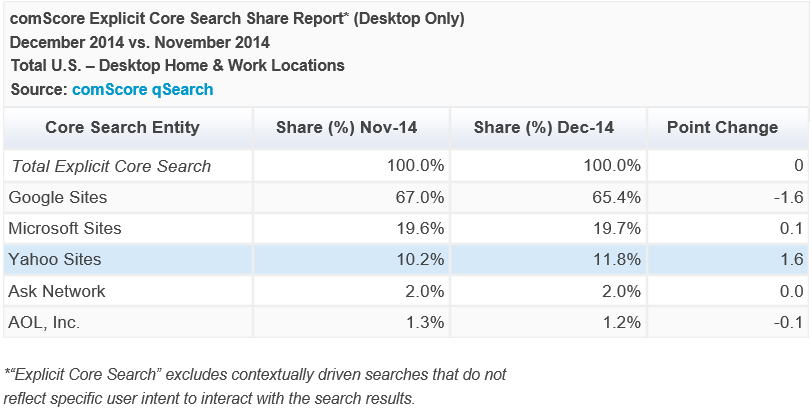
    Yahoo had got into an exclusive agreement with Mozilla in November 2014. As per this deal, Yahoo became the default search engine for Mozilla PC and mobile browsers. This was a “strategic five-year partnership” and as part of the deal, Yahoo started offering enhanced search experiences. Yahoo featured a clear, modern and immersive design with inputs from the Mozilla team.

    yahoo_market_share_rise

    Source

    This deal seems to have paid Yahoo rich dividends. This is clearly evident in the latest comScore released for US desktop search engine rankings. As per this data, Yahoo has seen an increase of 1.6% in US desktop search market for the month of December. This is the first month since the five year partnership with Mozilla came into effect. Unsurprisingly this comes at the cost of Google which saw a decline of 1.6% of its market share. Any rise of more than 1% is significant for Yahoo, considering the vice-like grip that the numero uno search engine Google has on the US online search market. This is Yahoo’s highest market share since 2009 for the United States.

    How do you view Yahoo’s ascent in the online search market share!

    Contact us for enhanced search engine optimization of your website now!

  • WhatsApp Gets a Desktop Avatar

    It is the sign of the changing times. Convergence is the way to go in the digital world. Less than a year ago, the social media giant Facebook had bought the mobile messaging service WhatsApp for around $19 billion! Now Facebook is going for a major makeover for the app. Going forward you can access WhatsApp on your desktop or laptop PCs.

    This would basically be a mirror of the app on your phone and you would still need an Internet-connected phone. All your message though will reside on your phone and the desktop would just be an interface for you to send and receive messages. This is presently available for the Google Chrome browser and there are plans to include the Apple iOS platform too.

    To get your WhatsApp messages on your desktop all you need to do is

    • Open the website https://web.whatsapp.com in your chrome browser
    • You will see a QR code which you need to scan inside of WhatsApp
    • WhatsApp web client will now be paired with WhatsApp on your phone

    Your phone always needs to be connected to the Internet for the web client to work. Make sure you have the latest version of WhatsApp installed on your phone. This latest development shows the growing influence of the mobile messaging services in the grand scheme of digital communication.

    Let us know what you think of WhatsApp on Desktop!

    Contact us to deploy your marketing messages effectively across the digital space!

  • Responsive Web Design (RWD) – What you should know?

    The use of mobile devices with differing display sizes to browse the web has all but erupted overnight, and most websites haven’t been optimized to handle the variety of screens. Enter Responsive Web Design (RWD), a technique capable of rendering the same content without disruption across devices with varying screen sizes.

    What is Responsive Web Design?

    Responsive web design is a web development approach that enables dynamic changes to the appearance of a web page, depending on the screen size and orientation of the device used. It’s a technique for building websites that works on mobile phones, tablets, TVs, game consoles and wearables as well as laptops and PCs. RWD is the best way for websites to eloquently adapt to different kinds of screens.

    How does Responsive Design work?

    With RWD web pages automatically adapt to the layout of the viewing environment using Fluid, proportions-based grids, Flexible or responsive images and Media queries.

    Fluid Grid:

    Website design initially followed in the tradition of the print media industry where a magazine or newspaper was the same fixed size, though in the case of websites the size was defined in terms of pixels. But the problem arises when website content is no longer viewed using only one fixed display size. A magazine is a magazine and the content is universally viewed in a specific fixed size. Websites can be viewed using a bigger format like a television or a smaller format like a smartphone, or a tablet or an even smaller smart watch. So, responsive web design builds websites with relative, not fixed units. The fluid grid concept calls for page element sizing to be in relative units like percentages, rather than absolute units like pixels or points.

    Flexible or Responsive Images:

    The idea of responsive images, in a nutshell: images shrink and adjust themselves within the confines of a fluid grid.
    Responsive_website_device_view

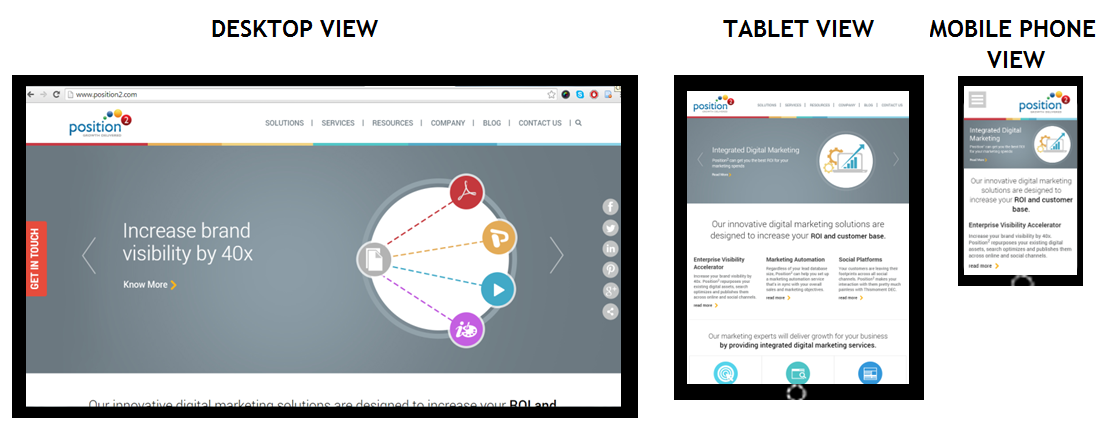
    Home page of www.position2.com viewed on various devices

    Desktop View gives maximum image size, but in the Tablet View the same image shrinks to display with full details while text content colonizes the remaining area of the screen. In Mobile Phone View, the image shrinks to display full details and text content occupies the remaining area of the screen. So, depending on the screen size, responsive images shrink or extend to display images in full details.

    RWD developers define the maximum and minimum dimensions to establish the limit of image pixilation in the CSS.

    img { max-width: 100%; }

    Media Queries:

    Websites are usually built for viewing on desktops and laptops in landscape mode. It’s challenging to take such a website and try to shrink it down to a mobile phone because mobile phones are used in portrait mode where the screen is longer than it is wide. With the website scrolling vertically, layouts several columns wide don’t work. This is where media queries come in. Media queries are a CSS technology, a core component of responsive design. Media queries allow CSS to be applied only when specific conditions are met (like when a webpage is viewed in portrait mode). When a design is too large or too small, a media query detects the site width and serves CSS that appropriately rearranges or adjusts the site’s content.

    Media queries code differs depending on the target device. Below is an example of media queries code for a smart phone in portrait mode:

    <style  type=”text/css”>

    @media (max-width: 320px) {
    #banner { width:275px; }
    #banner img { max-width:275px; max-height:83px; }
    #main { width:250px; }
    #main-content { width:250px;padding:0px;}
    #widget-container { width:250px; padding:0px; }
    .widget-content { width:250px; margin:5px;}
    .widget-text { display:none; }
    }
    </style>

    The challenge in responsive web design is to reorganize elements on larger pages to fit smaller, longer pages or vice versa. To make sure responsive design is successful, the design must be usable across an array of screen sizes (SEO experts will help the developer to define this limit based on the various devices used to access the website from Google Analytics).

    Advantages of Responsive Web Design

    A website with responsive web design gives a better user experience and the users are more likely to engage with the content.

    Cost efficient: When a website is developed using responsive web design, it basically means one website for all screen sizes and devices. You won’t have to build a separate mobile website.

    Smarter and better user experience: RWD gives users a better experience by offering the same content on a smaller device. It can be accessed from anywhere on any device at the sole discretion of the user.

    Future preparation: If you have a website built with responsive web design, then you are well prepared for the mobile future.

    Increase in conversion rate: A well-optimized website gives better user experience, encourages them to remain engaged with the site, and eventually leads them to customer conversion.

    One URL for one website: One website with a common URL can be used for different devices.

    Better user experience: Responsive websites are available to users anytime anywhere on any device.

    Bounce rate improvement: Do not underestimate the fickle nature of tablet and mobile users. They want their (same) desktop content and they want it now, otherwise they will bounce. And those bounce rates can get high. RWD enables delivery of the same content both in mobile and desktop view thus improving mobile traffic.

    Responsive web design delivers great user experience. It’s simply the best way to optimize a website for mobile devices. Visitors accustomed to viewing websites on larger screens expect the same experience on their smaller devices. If a website is not well optimized, then it annoys the user and bounce rates escalate. The solution is a responsive website with well optimized content ensuring that users see what they really want to see at first glance.

    Contact us now to deploy responsive web design & never miss another opportunity!

  • Google’s Data Platform Changes Imminent

    Google is the market leader as far as online advertising is concerned. But of late there are a few other competitors that are threatening Google’s hegemony in this space. This has obviously got the search engine giant quite perturbed and it is no mood to give away its share of the lucrative online ad business without a fight. The Facebook Atlas platform seems to be one of the toughest competitors that the Google ad network had to face since a very long time.

    Google intends to respond to such threats by restricting its ad network to data management platforms. This has naturally got digital marketers quite concerned. This move could curtail the freedom that ad tech firms enjoyed till now. But there is definitely more to this move from Google than meets the eye.

    Going forward, Google will restrict ad technology partners from gathering data while running campaigns on the Google Display Network. Now this move seems to have been timed with the launch of Facebook’s ad server and data platform, Atlas. But there are people on the other end of the spectrum who say that Google has been working on this for quite some time now.

    Whatever be the spur, Google will not allow ad networks to fire pixels on certain ads. Pixels help advertisers to keep track of user views and interactions so that the ads can be better managed. Standalone entities who do not have a hybrid model of deploying ads will be the most affected. Beginning March 2015, Google will implement its policy to restrain certain data management platforms from firing tracking pixels on the Google Display Network. The DMPs that will get the short end of the stick are the ones that do not own a demand-side platform or DSP to execute the transaction.

    But ad tech companies are afraid that in due course, Google might bring sweeping changes to the ads served on its various platforms including its DoubleClick Ad Exchange. Now that calls for a detailed discussion which we shall be covering as and when it happens. Watch this space for more.

    What is your take away from this new move from Google? Contact us now for 360° online advertising!

  • CES 2015 – What’s in it for Digital Marketers?

    Contact us for integrated digital marketing for a new interconnected world.

    Consumer electronic brands from far corners of the globe came and set shop and people arrived in hordes to see what the tech Gods had in store for them. Now that the show is over, it’s time to reminisce about this Consumer Electronic Show, 2015 held in ‘Sin City’ Las Vegas, Nevada!

    There was a lot of new technology on display and more ways to make our lives simpler and enjoying the finer things in life. But amidst all the hullaballoo of near impossible tech gadget specifications and next generation of bleeding-edge products, we are more interested in the digital marketing aspect of it.

    Digital marketing, all the way…

    It’s a digital world and our lives are getting more interconnected with each passing day. ‘No man is an island’ said a wise man, maybe he was referring to our digital existence, after all! Two of the important themes that stood out in this year’s CES were – Internet of Things and Wearable Technology. Today every device in your house or otherwise does have an electronic chip embedded within it. With due reverence to IBM, it seems that it’s truly the dawn of the ‘Smarter Planet’, and we are all a part of it.

    Wearable technology has got a real shot in the arm with latest watches and health trackers that were launched by the tech giants. The technology is so smart that if you are passing by a McDonalds and you still have time for that important meeting with the boss, then your watch will automatically signal to you that you can afford to have a break and indulge in your favorite Big Mac!

    Now this is of particular interest to digital marketers. A whole new frontier has opened up as far targeted digital marketing is concerned. Your client could be a fast food chain and some person passes by your client’s outlet, then you can afford to flash a discount coupon or two via his connected smart watch. This gives a much better chance of conversions too.

    Tech biggies like Apple and Google are coming up with their own version of the smart, connected home. Your refrigerator could directly order the milk from your grocer when it senses that milk needs to be replenished. Until now digital marketers could only peek into the web browsing habits of their consumers. Going forward, digital marketers will be able to make sense of people’s eating habits, favorite television shows, music genres liked, et al.

    All things will be a part of a grand scheme of network called the Internet of Things and we are just getting a first glimpse of the shape of things to come. This opens the floodgates for more targeted advertising, remarketing and such other stuff. The future is bright and it is quite an exciting time to be a digital marketer. It’s an electrifying world and we all call it home!

    It goes without saying that we are elated about the just concluded CES, 2015.

    Contact us and share your opinion about digital marketing for this new interconnected world.

  • Hreflang Spoken Here

    While there is no place quite like home, there comes a time in a successful website’s life when significant amounts of traffic from foreign-based search engines really start to matter. You are going to want to optimize your website to serve international audiences. Otherwise, people dialing in from abroad won’t find your content either relevant or useful.

    hreflang

    Google uses the rel=”alternate” hreflang=”x” attributes to serve the correct language or regional URL in Search results. Introduced in 2011, the tag signals search engines that users querying in language “x” should be shown a different version of similar content than is shown to someone querying in language “y”. It is particularly useful for content specifically created to serve a local audience.

    Hreflang and Canonicalization

    When web content has more than one possible URLs, canonicalization comes to the search engine’s rescue to avoid  content duplication . Hreflang, on the other hand, shows a search engine a different version of a similar page based on languages or regions shown in the search results.Hreflang helps Google crawlers understand that certain pages, sections, subdomains or country code level domains (cctlds) are targeted for a specific country.

    When and where the tag needs to be implemented

    Google recommends using hreflang when:

    • You keep the main content in a single languageand translate only the template, such as the navigation and footer. Pages that feature user-generated content like a forum that typically does this.
    • Your content has small regional variationswith similar content in a single language. For example, you might have English-language content targeted to the US, GB, and Ireland.
    • Your site content is fully translated. For example, you have both German and English versions of each page.

    The hreflang tag can be placed on hreflang page level, the HTTP header, or the sitemap.

    HTML Link Element

    <link rel=”alternate” hreflang=”es” href=”http://es.mywebiste.com/” />

    HTTP Header

    If you have non-HTML content on your web pages such as a PDF file, you can use rel=”canonical” HTTP headers to indicate the canonical URL for HTML documents.

    Link: <http://es.mywebiste.com/>; rel=”alternate”; hreflang=”es”

    Sitemap

    Instead of using markup, you can submit a language specific version via a sitemap.

    <?xml version=”1.0″ encoding=”UTF-8″?>

    <urlset xmlns=”http://www.sitemaps.org/schemas/sitemap/0.9″

    xmlns:xhtml=”http://www.w3.org/1999/xhtml”>

    <url>

    <loc>http://www.mywebiste.com/english/</loc>

    <xhtml:link

    rel=”alternate”

    hreflang=”de”

    href=”http://www.mywebiste.com/deutsch/”

    />

    <xhtml:link

    rel=”alternate”

    hreflang=”de-ch”

    href=”http://www.mywebiste.com/schweiz-deutsch/”

    />

    Each page includes a reference to itself as well as to all the pages that serve as alternates for it.

    Meta Language Tag for Bing and other Search Engines

    Google is the main search engine that uses HREFLANG to set up country targeting. Bing and many other search engines employ the Meta Language Tag. There are two ways to set up the syntax on this tag:

    <meta http-equiv=”content-language” content=”en-us”>

    Or the alternative syntax would be:

    <meta name=”language” content=”English”>

    The first option would be ideal if the website is targeted for both language and country. If you use Hreflang for your website’s overseas targeting, please let us know how it’s working for you.

    Contact us to get your website optimized for international locations now!

  • Twitter Goes All Out to Expand its Ads Program

    The micro-blogging site has been trailing behind the numero uno social networking site, when it comes to number of users as well as earning precious ad revenue. But 2015 seems to the right time for Twitter to close that gap and leapfrog its way to become a leading destination for advertisers to showcase their latest digital promotions.

    Going forward, Twitter will be showing ads on third party sites and apps for all those people who see Tweets all over the web without actually using Twitter. This way Twitter can start making money from non-users as well. At the Consumer Electronics Show in Las Vegas, the micro-blogging giant made its intent clear about selling ads within streams of Tweets within other publisher’s websites and apps. Initially Twitter is going to have advertisers like ESPN’s SportsCenter app and Flipboard.

    Twitter has just announced that it is going to expand its ads mainly in the following two ways –

    • The ability to showcase tweets on a site or app that has the option to enable ads
    • Auto-play feature for video that helps Twitter to have ads like Facebook

    Now this is a revolutionary step for the micro-blogging site which is the equivalent of AdSense for social ads. The proposition of ads placed within streams is going to benefit both the publishers and Twitter. The micro-blogging site has made rapid progress with hashtags, Graph Search and video. But this new feature with the ability to profit from showcasing Tweets is something that has got the advertising fraternity quite excited.

    Soon Twitter users would be able to see videos being auto-played in their feeds. These videos will initially only play for 6 seconds with the options of playing the full video upon a click. Users, advertisers and media companies will have the option of uploading video directly on Twitter for user consumption. Every time you view a video you will get a list of videos that are related so that you can consume more than one video at a time.

    The revenue sharing model with the publishers looks quite promising and advertising with Twitter will never be the same again. The video ads on the other hand will help Twitter to gain back precious views from competing services like Facebook and YouTube.

    What do you think of this new ad initiative from Twitter? Contact us now for 360 advertising on social networking sites!