| This week’s hot news, events and videos from the online marketing and social media world. | ||||||||
 |
||||||||
 |
||||||||
|
||||||||
|
||||||||
| If you are reading this blog post via a RSS reader, please click here to subscribe. |
Author: Team Position Squared
-
Best of the Week | UI and UX Trends in 2015, and much more…
-
UI and UX Trends in 2015
Digital marketing has been trending for a couple of years, and now it’s in constant flux. In 2014, we saw changes in mobile, HTML 5, scrolling, micro UX, flat UI and all time design principles.

What’s likely in 2015?
Responsive Design:
According to comScore Report, smartphones and tablets account for 60% of all online transactions. Mobile devices and mobile apps currently drive 50% of traffic, and Cisco Systems forecasts that by 2018 the number will rise to more than 75% of traffic.
In recent months, there has been an increase in the number of sites designed with mobile app-like navigation, this as opposed to the traditional desktop navigation bars with several drop-down menus that are toggled when rendered on small screen devices.
Today there is a need to design for the mobile form factor and your desktop version should be mobile friendly as well. Mobile ubiquity is the new mantra, not mobile-first. Designing for the mobile platform forces designers to streamline their web content according to user needs. Mobile was the platform that made digital marketers first listen to the users, and now the market has responded with “give me that for the desktop, too!”
In 2015 and beyond, the mobile ubiquitous trend will continue to grow. Navigation will continue to simplify with fixed headers and minimalist design reducing clicks and clutter. Visitors are attracted to easy-to-use sites that allow them to quickly find what they’re looking. But don’t give up on visual appeal! Users still want to be dazzled by stunning visual elements.
Long Scroll
Scrolling is still predicted to dominate clicking in the future – simply because it works best in the mobile environment. It is easy and intuitive to use. It improves user experience. It limits the load time of the page with more interactive kinds of experience that users can have with the website.
Flat Design
No more patterns, shadows, gradients or bubbles. Now’s the time to embrace the simplicity of the flat design. It channels the key trend in recent web design – invincible minimalism. Perfect for all kinds of hand held devices, flat user interfaces provide a smooth and uncluttered page structure. Google engineered their future on mobile with a flat design or material design based on metaphors, bold graphics and meaningful motion. This could easily become a new trend in the already prominent flat design.
Videos
Users are looking to be entertained and large blocks of text are not the best way to do that. Video is easier, cost effective to produce and a great way to quickly deliver a message. There’s a science behind it. Our brain processes visuals more rapidly than other forms of information. By using video, even as a background element, you can highlight your core strengths and services to make an impact in a matter of seconds.
Personalization of UX
Showing users relevant content will improve their overall experience with your website. That’s why we all use cookies. But the ways in which we do it will change in 2015 to create a sense of continuity. Brands will use the recently read or visited functionality to render their websites more familiar and relevant. Knowing the user’s activity on your website, you can also try to propose some new content for his or her consideration, and cookies can help you do it.
These are some of the trends that can be expected in 2015 — that render to UI & UX.
Get in touch with us to get your website optimized based on UI & UX now!
-
The State of Marketing Technology
Today technology is used in every facet of marketing. Marketing as a discipline is changing and marketers need to adapt to the changing technology landscape. IDC predicts, spends on marketing technology will reach $32.3 billion by 2018. According to credible sources, 65% of senior marketing executives plan to increase marketing technology spends.
With so much marketing technology around, marketers at times can get overwhelmed. There are so many companies selling marketing technology that there is too much gratuitous stuff out there. Due to this most marketers till now have steered clear of marketing technology and this is the reason why its adoption and implementation is abysmally low.
Now this is clearly a wasted opportunity since most marketers who have adopted marketing technology have reported rapid and significant improvements in ROI. In order to help marketers make the most of this technology we provide a set of programs that every company needs to give a serious thought, in an effort to scale leads, opportunities and ultimately revenues.
Search Engine Marketing
Search engine is one of the most important avenues through which users arrive at your website. Search engine marketing helps you to get more qualified leads through both search engine optimization and pay per click advertising. Your landing page becomes all the more crucial if you have to convert your leads to conversions. You have to give your users what they are seeking in a simple yet effective manner. There might be a need to test different landing pages depending on who you are targeting. Technology can help you do this in a dynamic and cost effective way. There are specialized tools for programmatic buying, attribution systems, tracking systems, consumer insights, conversion optimizers, campaign management, reporting and dashboards.

Remarketing
Remarketing is a very effective use of technology in order to follow your website visitors to other resources on the internet. You can target people with specific offers who have shown interest in particular product or service of your company. The conversion rate is high in this type of targeting since you already know what people are looking for. You can easily set up the technology needed to implement this in your digital marketing campaigns.

Conversion Optimization
When a visitor finally lands on your website it is expected that you convert the users into what you want them to do. This could be filling out a form or at least collecting their email addresses. But for that you need to have the right strategy in place like an outstanding offer or a marketing app that can do the trick for you. Conversion optimization technology can help you do this with minimum human intervention.

Analytics
Analytics helps you understand where your marketing dollars are going and how effective it is in improving your company’s revenue. There are many tools available today that can measure the performance of your ads, offers, digital channels and technologies. This way you can only pursue the campaigns that makes sense to you and scale down or end those campaigns that don’t.
Google Analytics is the most widely used analytics tool. You can analyze your return on marketing investment or ROMI, using the marketing intelligence platform MiDash.

Marketing Automation
Marketing automation is a class of software that automates, streamlines and measures marketing tasks and workflows. All this helps companies to increase operational efficiencies and scale revenues faster. Marketing automation can be thought of as the technology that brings it all together. It includes among other things, analytics, tracking, and online forms. You get a clear picture of what people are doing once they land on your website. This way you can personalize your website content, create better email campaigns and bridge the gap between sales and marketing. You can send automated alerts to customers, nurture lead scoring using information from your CRM tools and third party sources.

This is the state of marketing technology today and things can only get better! Let us have your views on marketing technology and its various benefits!
Contact us to deploy marketing technology for your business now!
-
Best of the Week | Personalized search, and much more…
This week’s hot news, events and videos from the online marketing and social media world. 
Best of the Week Video
Watch this Whiteboard Friday video hosted by Rand Fishkin where he talks about the five things we should be looking into when formulating an SEO strategy.Persona-based Lead Scoring: The Mystery and the Method Download this White Paper and learn: - Classify leads based on behavior and demographic details
- Develop a consistent methodology to proffer quality leads to sales
- Employ data integrity and tracking
- Deploy marketing automation to improve efficiency and cut costs

If you are reading this blog post via a RSS reader, please click here to subscribe. -
Personalized Search
A personalized search reaches beyond the user’s initial query by incorporating information gleaned from his digital history of interests. There are at least two ways in which personalized search can be delivered: modifying the search query, and re-ranking the search results.
The search engines of yore catered to all users in the same way. Not so today. The search engine learns about the user profile from the individual’s search history. This profile is then mapped to a set of categories that the search engine accesses to make sense of the query. In effect, the search engine disambiguates keywords in order to serve up what the searcher is actually looking for. With this level of personalization, search engines provide different results for different searchers.
Google first introduced personalized search in 2004 and began actively implementing it in 2005 in the Google search results. Various factors come into play when personalizing a user’s search results, like the location of the user, the search language and the user web history.
Search engines today want to reach beyond what you type in the search box. They seek to understand what your intent might be in order to give you exactly what you want. Or, what they think you want. To do this they use information you have provided, either wittingly or unwittingly, to create user profiles, or personas. The search engine then utilizes the persona to target information in a way that best serves your perceived interest.
The more often you visit a certain web page, the more Google believes that you like that page. Your behavior is duly noted and used to optimize future search results. The next time you search, a page which you have been previously visiting with regularity is likely to be shown more prominently. Herein lays both advantages and disadvantages of just such a likelihood.
Finding new information becomes a major disadvantage of personalized search. You will be repeatedly shown the same results because that is what you always click on. It’s in your history. This naturally narrows your information exploration on the web. The problem is called ‘filter bubble’ and it means that people are letting search engines decide what the users want to see and what they don’t want to see. In the extreme case the user becomes confined to his own ‘filter bubble’ and is cordoned off from the rest of the information out there on the Internet.
Extrapolate this to a community level, and the consequences become troubling. As certain search results are bumped up and more and more people view them, the favored results become more prominent, and the ones not so favored are removed from the listed search results. When this happens collectively the society as a whole will likely have a skewed perspective of a particular topic. It gets Orwellian without much effort. He who controls the search engine controls information.
Google uses Google News to personalize your search. The first few results for a specific news query would likely be the same to all viewers. But as you scroll down, the results begin to differ. Google takes your past searches into account and your location and gives you local news that may matter more to you. This could be useful. But the potential disadvantage is missing what may be important news from farther afield.
The average person’s attention span is 8 seconds, so personalized search helps to quickly sift through the blocks of data that search engines throw up. Personalization saves time and significantly improves the quality of the search. It can also help search engines display highly targeted (“personalized”) advertising — the best deals, offers and discounts, depending on an individual’s interests – the idea being that the consumer finds what he is looking for faster and with all the relevant information displayed more prominently.
Contact us to deploy personalized advertising campaigns!
-
Google ‘Other Interests’ Closure Imminent
The numero uno search engine will be retiring its ‘other interests’ category in the interest of serving the advertisers more effectively. This was a service that was introduced by Google in 2009 in the interest market category connecting advertisers with people across the display network based on customer interests. Using this advertisers could get a better inkling about their core target group. ‘Other interests’ was basically built on topics. But now it seems that it is limited in addressing advertisers’ extensive targeting needs and there is a lack of specificity too here.
‘Other interests’ was deployed by Google in order to target people based on implicit interests. This was done on the basis of types of web pages that these people visited on the Google Display Network. It was but natural that Google would pull the plug on ‘other interests’ since there was an overlap with the advanced audience solutions. But you can still access historical performance data from ‘other interest’ targeting, going forward.
With each passing day, Google has been launching new and powerful interest-based capability tools like ‘affinity’, ‘custom affinity’ and ‘in-market audiences’. These tools offer much more flexibility and control as compared to the ‘other interests’ tool. If you have a ‘other interests’ campaign account then it will run for some time and then it will be automatically upgraded to one of the three tools viz.
- Affinity audiences – To create brand awareness
- Custom affinity audiences – For niche audience targeting
- In-market audience – targeting prepped shoppers on the verge of buying
All these above tools use very sophisticated audience signals to attract and retain very specific group of customers. It makes segregation on the basis of customers wanting to buy particular products or services and such other criteria. So when you upgrade to the new services, if the need be, Google can help you out with campaign type recommendations based on your current performance goals and bidding preferences.
Let us have your inputs on this imminent changes in advertising with Google! Contact us to advertise across the extensive Google Network and beyond!
-
State of Marketing Automation 2015 [Infographic]
Today with the explosion of digital channels and technologies you are spoilt for choice as a digital marketer. Marketing automation can effectively help put things into perspective so that you stay on top of things. Go through this insightful infographic in order to gain an inside view of the world of marketing automation now.

-
View-through Conversions
You are as likely to click on a website immediately on seeing a banner ad as much as you would walk immediately into a store on seeing an attractive out-of-home display ad. We are less inclined to stop what we are doing in order to respond to ads, be it online or when we are out in the city.
In the world of search marketing, click-through conversion is all that matters. Search, by its very nature, has a pre-qualified audience based on their intent to seek out information. Clicks reign supreme because ‘Clicks’ from search ads connect your brand with a sought after need.
On the other hand view-through conversions – VTCs (a.k.a post-impression conversions) happen when a person is exposed to a display advertisement, does not click, but goes on later to visit the website or search for the brand on search engines and converts. The driving force behind display advertisement is to create an influence. As a marketer we must endeavor to reach the right type of person, at the right time, at the right location and with an offer /service they simply cannot refuse. Even when all these factors are present in a precise way, a person might be inclined to click only when an impression is served and is compelled by what he sees in order to take some action. In display advertising, the ‘Impression’ still reigns supreme.
So that brings us to some interesting questions:
Q – Are VTCs just duplicates of the other conversions in the interface?
View-through conversions are not able to get the rightful credit mainly due to the way people view it in DSP buying. Many DSPs will group the VTCs along with the Click-through conversions while filling leads form thus giving a distorted figure. These DSPs will then promise a CPA model to the client which can only be fulfilled with the help of duplicated view-through conversions.
You can be on top of all such things by checking the validity of this metric:
- You have to run a split or A/B test campaign. For one group you need to show the banner ad and for the other show a PSA ad. You then have to find out the incremental conversions for the group that viewed the banner ads.
A/B Testing vs a Blank Ad

- You have to demand that the view-through conversions be shown separately from last click conversions. That way you can have the actual break down of the conversions.
- Based on the industry conversion duration norms, set a custom backtrack durations for view-through look ups. Do not take view-through conversions that are registered beyond the set conversion duration.
Q – What is the view-through conversion window?
A view-through conversion window reckons a conversion after an ad is viewed depending on the number of days that you allow for the conversion to happen. You can customize it as per your needs to only record a VTC if it happens within the window of time frame post ad view that you have selected. The shorter the ad window the more accurate is the result. A 24-hour window is very reliable since the stickiness factor will definitely influence the customer’s decision to click the ad. A 30 days ad window may or may not be so accurate which is again wholly dependent on the type of product or service that you are selling, sales cycle, industry, and other factors.
Q – Even if I believe that VTCs are valuable, how should I value them?
We have to get used to the fact that impressions are indeed influential. This needs a radical change in the mindset of marketers that strictly value ROI and CPA goals. Studies have shown that lift and influence are very real and give a fair amount of conversion rate improvement. If you look at the following table you will see that VTC does help.
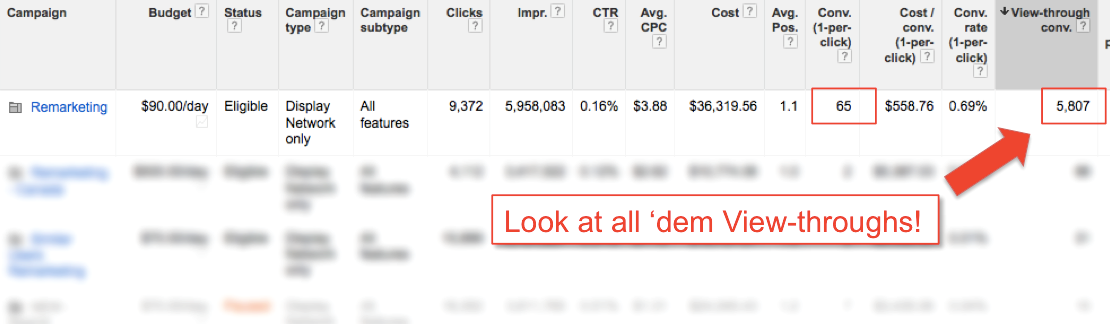
Influence of View-through conversion
Even if it is just a 10% improvement it still can make a difference. It could mean ratcheting up a good ROI to a great ROI. If you closely look at users clicking on your ads or otherwise you will surely see that they might not convert immediately. They can come back to your website later and convert. This is the overwhelming underpinning validation of view-through conversions. You can now measure the success of your display ad campaigns via the view-through conversion paradigm. Search engines like Google have taken cognizance of this and provide you insights into it so you get a holistic value of your display campaigns.
View-through conversions is a tracking metrics available in the AdWords account that can give you a clear understanding of your campaigns as it can measure assisted conversions. This happens when a user views your ad but comes back to it later, may be through another channel and converts into a customer.
Display advertising plays an important role in improving your digital marketing returns. Taking into account view-through conversions (VTC) can get you a comprehensive understanding of your efforts. It offers you a lifting effect of display advertising which hitherto you had no idea about. VTC helps to drive conversions even though it might not produce direct clicks. A visitor might return to your site via a bookmark, an organic listing or a regular URL and convert. You can then conclude that the original display ad did make a difference.
Now, we have a formula in order to find the efficacy of VTC that can help you reckon your digital ROI.
Actionable items
- Segregate you target group into two parts, 90% for brand and 10% as control group with no room for overlap.
- Use your Branded ads in the first campaign and PSA control ads for the second
- Run the ads for a conveniently long period to collate good amount of data
Compare results after normalizing the data

An Example
Impressions VTC Brand Ads 1,000,000 1000 PSA 800,000 720 We need to multiply the PSA campaign results by a factor of 1.25, to normalize the data
Impressions VTC Brand Ads 1,000,000 1000 PSA 1,000,000 900 Weighted VTC = (1000 – 900)/1000 = 10%
Result: One in ten VTC has indeed influenced someone to take action.
This is a holistic view of your digital return on investment. Most digital marketers might not be initially convinced of the benefits of VTC. In today’s world, people more often than not, are multitasking. So somebody might see your display ad while visiting some website at work. Now that somebody might not click immediately on that ad or even take any action at that point of time. Your ad might not even get due appreciation by the person. But the brain can register more than the eyes can see. So you might not get an immediate conversion for your display ads but that does not mean that your ad spend is completely wasted. It does create an impression and next time that person sees your ad he can immediately relate to it. There are more chances of conversion on that pay per click ad that you are going to serve him for his specific query. But then if you give 100% of the credit to the PPC ad, then it is not completely accurate. The initial display ad did have its own impact and all we say is that we now have a robust method to measure that impression leading to conversion called as view-through conversion.
This is a new frontier in a digital marketing world addicted to clicks and quick results. VTC is an avenue that you need to explore further in your quest for improved results for digital marketing dollars spent.
Let us know your views on View Through Conversions!
Contact us now to make your display ads go the extra mile for you!
-
Digital Marketing & Behavioral Targeting and much more…| Best of the Week
This week’s hot news, events and videos from the online marketing and social media world. 
From the Position² Blog This Week: Digital Marketing & Behavioral Targeting
Behavioral targeting is a new frontier that digital marketers are testing and with positive upshot. Customers are delighted when they are given tailored offers. Your advertising spends are more accountable too. Read this blog to find out more.
Best of the Week Video
Watch this video on White Board Friday hosted by Rand Fishkin where he talks about ways to find what your audience wants before deploying content marketing.White Paper: Increase Visibility for Your Content by 4x Today’s traditional SEO is inadequate: Ignite your search results by accelerating visibility in more places than ever before.Download this White Paper and learn: - SEO, why the way we know it is not enough
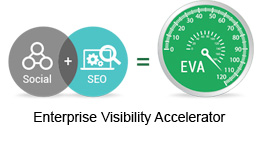
- Introducing and implementing Enterprise Visibility Accelerator (EVA)
- Using multi-channel tracking tools for effective monitoring
- How EVA benefits businesses.

If you are reading this blog post via a RSS reader, please click here to subscribe.