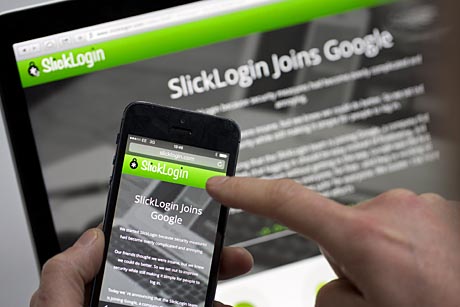
Five month old start-up SlickLogin has been acquired by Google for their work on sound-based verification capabilities. Post its debut at TechCrunch Disrupt, September 2013, Israel-based SlickLogin released its product in closed Beta.
How it works
Users need to have the SlickLogin app installed on their smart phone. Adding five lines of code to an existing app will enable the app. When users want to login to a website enabled by SlickLogin, they need to click the login button and hold their phone in front of the computer.
SlickLogin will then verify the phone’s position using technology such as, Wi-Fi, Bluetooth, Near Field Communication (NFC) or Global Positioning System (GPS). The website would then play a unique sound generated, through the computer’s speakers, which is picked up and analyzed by the phone’s app. A signal is then sent to the site’s server confirming the user’s identity.
User Security Concerns
SlickLogin seems to have its finger on the pulse. Each uniquely generated sound is tied to that moment. No one can record a signal and play it later to hack into an account. The phone would not have the required login credentials and these details are not embedded into the sound also. If anyone tries any of this, they may only be logging that user into their own account!
This acquisition will help Google strengthen its login security beyond the current two-step process.
The social network has opened its publishing platform, LinkedIn Influencer to more members.
Now, the posts published by LinkedIn users will be made a part of their professional profile, shared with their professional network and can spread out to a large group of professionals. Users can now not only follow other members who are not in their network, but can also build their own follower group.
The opening up of LinkedIn Influencer gives professionals a great chance to:
- Share their experiences with others (whether they are experienced or new)
- Expand their brand influence
- Add to their reputation as thought leaders in their respective industries
LinkedIn has added more influencers to the existing list and will also be monitoring them to maintain high quality levels and engagement. The capability has been extended to 25,000 LinkedIn members currently and will be expanded to include all members in multiple languages in time.
There will be more of user-generated content on LinkedIn henceforth, which can draw more people to consume content on the site. LinkedIn can soon be a major hub for quality content by professionals. Brands can now begin to turn to LinkedIn with more focus for their content marketing strategy due to a surge in high quality content generated. If your brand’s executive is a LinkedIn Influencer, it means better brand reputation and more exposure.
Yahoo!
In case you had read about it, we recently wrote about Yahoo!’s ambitions for developing better ‘contextual search’.
Appears to be true, seeing the $10 million given to Carnegie Mellon University.
Yahoo! does not mention the term ‘contextual search’ explicitly. But, a read of the company statement gives a sure signal of an improved version of contextual search being built.
Though Google is already a player in the game, the possibility and consequences of a better contextual search by Yahoo! is an interesting development for the search world.
What is your take on these updates?
Images Courtesy: The Sydney Morning Herald, LinkedIn, Mashable
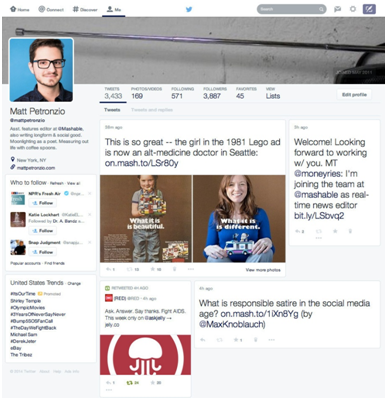 Looks like the micro-blogging site has been busy sculpting its new profile design…
 Is the company looking at implementing contextual search?