Tag: user experience

  • Why UI and UX are crucial for SEO?

    UI (User Interface) and UX (User Experience) play crucial roles in SEO (Search Engine Optimization) because they directly impact user engagement, website performance, and overall user satisfaction. A website with a well-designed UI is visually appealing, easy to navigate, and provides a seamless browsing experience. This encourages visitors to stay longer on the site, explore its content, and engage with it, which signals to search engines that the website is valuable and relevant.

    Beyond Content & Links

    Search Marketers are right when they say content is ‘King’ regarding Search Engine Optimization (SEO). While we are busy generating quality content for our target audience, there is another aspect that we tend to overlook completely.

    You must have guessed it by now. It is the aspect of how content is presented to the readers. We are referring to UI/UX (User Interface/User Experience), an integral aspect of promoting content on the web.

    With the inclusion of recent updates like Hummingbird, Panda, Penguin, Pigeon, and hundreds of other Google algorithms that are being tweaked regularly, it becomes critical to know how users react to the website User Interface. The experience that the visitors go through definitely counts regarding how we perform on Search Engines, with special emphasis on Google!

    As a webmaster/marketer, it is essential to understand how users react to your website. Are visitors spending ample time on the website? Are they finding relevant information with minimal clicks? Are they taking desirable actions? Why are they bouncing off the website? Can the website drive visitors to the right content/sections and encourage them to take action after that? – While there are many questions to ponder, the simplicity behind having a great website is to have helpful content and enhanced UX with a well-laid-out UI.

    SEO

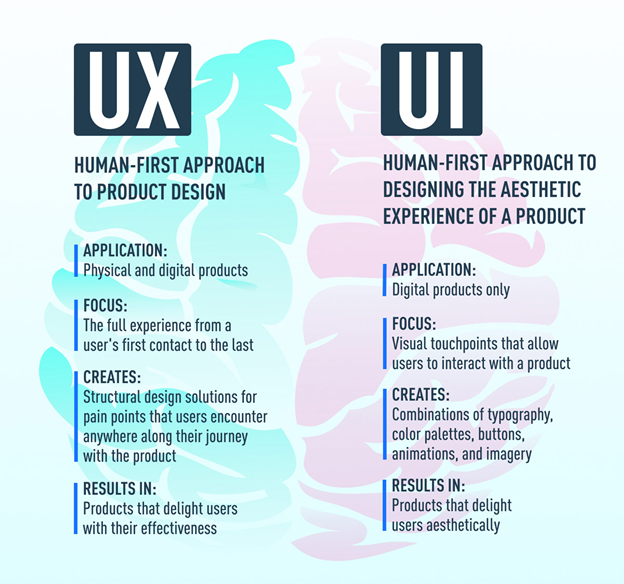
    What are UI and UX

    What are UI and UX

    User Interface (UI)

    UI refers to a website’s visual and interactive elements, including buttons, menus, and other graphical elements that users interact with. The UI creates an intuitive and user-friendly interface that allows users to navigate and interact with a website easily.

    User Experience (UX)

    UX, on the other hand, refers to a user’s overall experience when interacting with a website. This includes factors such as site speed, ease of navigation, and the quality and relevance of the content. A good UX design aims to create a positive and engaging user experience, which can lead to longer session durations, lower bounce rates, and higher conversion rates.

    In short, UI and UX are important aspects of web design that create a positive user experience.

    Impact of UI UX on SEO
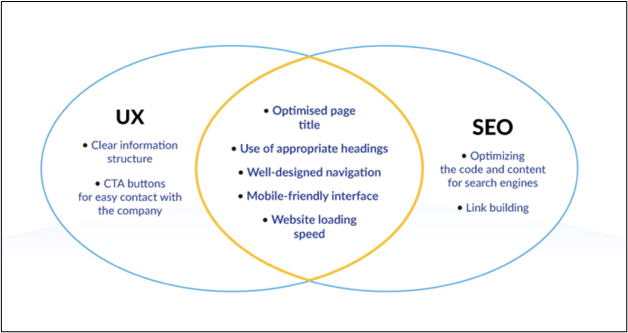
    Impact of UI UX on SEO

    UI UX both have a significant impact on SEO. A website with good UI and UX design can increase SEO rankings, traffic, and user engagement.

    A good UI design can improve a website’s SEO by making it more user-friendly and easy to navigate. This can lead to longer session durations, lower bounce rates, and higher click-through rates, all important factors that search engines consider when determining rankings.

    Similarly, a good UX design can improve a website’s SEO by creating a positive and engaging user experience. This can lead to more social shares, backlinks, and other signals that search engines use to determine the relevance and authority of a website.

    1. Teamwork: SEO + UI/UX

    SEO is the medium to drive traffic, while UX/UI creates the first impression. Both work in tandem to ultimately serve the user’s intent and hence conversions on the website. It is that bit of Creative effort which aids in boosting conversions.

    matts cutts

    “…If you don’t have search engine optimization, it’s harder to be found. If you don’t have end-user optimization, you don’t get conversions… you need to have both…Try to see them in tandem (i.e., Search Engines and End Users) …Your users’ interests and the search engine’s interests are always aligned….Hence you need to view them as one unit. .”

    SEO and UI/UX play a significant role in where the path (SEO) leads to the destination (UI/UX). What happens on the web page is our real goal or concern (conversions).

    We should know that SEO exists due to dynamic Search Engine algorithms, and hence fundamentally, it plays the role of a latent follower when optimizing a website for search.

    Google Hummingbird, Panda, and Penguin updates are now meticulously weeding out sites that don’t meet the basic content standards, design (UI/UX), utility, relevance, and speed.

    SEO and UI/UX are more like unified partners that marketers/businesses must respect since one cannot work without the other.

    2. Graphics makes your website more Attractive

    While most marketers are concerned with the content that drives traffic to the website, the other aspect that we miss is the aesthetics part. This concerns how the content is more impressive and informative to visitors.

    The image and graphics support and content make visitors interact more on the website and react positively to the information provided.

    Using the right mix of graphics, images, and text is a simple and effective idea. Using image alt tags, Meta information, and SEO-friendly URLs further helps to attain more SEO benefits.

    3. Visibility: Above and below the fold

    Don’t make your website a newspaper. The above-the-fold actions came from newspapers and were later adopted as a norm for websites. You need to evaluate the website’s objective to serve the target audience.

    With the changes in user behavior and assimilation of information available on the websites, visitors have learned to scan and scroll the webpages below the fold too. The folding concept remains important, but the judgment of how to attract visitors with content, images, and graphics that make visitors look for more cannot be ignored.

    4. Responsive Website: Facilitate improved User Experience

    As more people choose to use mobiles, smartphones, and tablets, having a responsive website that allows users to search for required information on any device becomes all the more imperative.

    In 2014, 4.22 billion people worldwide are expected to use smartphones. 49% of mobile users will go online via mobile browsers or apps. By 2015, the global mobile phone Internet audience is anticipated to cross well over the 50% mark. Hence, the importance of focusing on the responsiveness of a website that provides users with what they want, i.e., uninterrupted and high-quality User Experience (UX) on any device used for search. Read more on the importance of mobile SEO optimization.
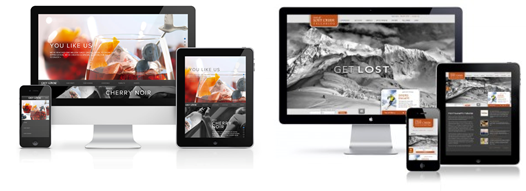
    Responsive Website

    5. Call-to-Actions on your website pages

    The call-to-action (CTA) emphasizes what a user is expected or anticipated to do. Additionally, the Call to Action helps visitors find what they need. CTAs open the website and assist users in consuming the content they are searching for by making it easy to access, increasing engagement, and improving the probability of conversions.

    call to action

    6. Blog post-level Social Sharing

    While social signals are not a direct ranking factor, they can indirectly impact a website’s search ranking in several ways. For example, if a website’s content is widely shared on social media, it can lead to more backlinks to the site, which is a direct ranking factor. In addition, social signals can also increase the visibility and reach of a website’s content, which can lead to more organic traffic and engagement on the site. This can lead to longer session durations, lower bounce rates, and higher click-through rates, all of which are important factors that search engines consider when determining search rankings.

    Social sharing

    Furthermore, areas where UI and UX impact SEO

    1. Site Speed

    Site speed (page speed) is important for SEO. Search engines like Google prioritize providing users with the best possible search results; a fast-loading website is key. Websites that load quickly are more likely to rank higher in search results

    In addition, site speed is also important for mobile SEO. With more and more users accessing the internet on mobile devices, search engines like Google prioritize mobile-friendly websites.

    2. Bounce Rate

    Bounce rate refers to the percentage of users who visit a website and leave without interacting with the site beyond the first page they land on. A high bounce rate can indicate to search engines that the website does not provide a good user experience, which can negatively impact search rankings.

    3. Linkability

    It refers to how easily other websites can link to a website. Having a high number of high-quality external links pointing to a website is a key factor in improving its search ranking.

    Example of UI and UX elements that impact SEO

    • Instagram has become extremely popular. Users can easily move through the never-ending stream of visual content for lengthy periods of time without feeling overburdened because of its layout. There is something genuinely great about Instagram’s visual harmony and order, even though most users couldn’t quite put their finger on it.
    • Uber is a prime example of a product with a nearly evenly split UX design.
    • Disney+ has generated a lot of buzz since it first entered the streaming media. The user experience has been enhanced even if the UX design had a rocky beginning.
    • Telegram is less well-known than Whatsapp, its main competitor. Its UX design does, however, offer a thoughtful, attention-to-detail experience, which is a feature of a strong UX design example.
    • Nike’s website recognizes that proximity and visual cues significantly impact the user experience. This is a lesson that every design team should remember: proximity and hierarchy can promote sales. Nike’s various product pages are excellent examples of effective UX design.
    • Without mentioning Pinterest’s recognizable user interface, what kind of blog post about UI design inspiration would it be? As true innovators in card design, Pinterest combines card design with a waterfall flow to provide users with an extremely seamless and user-friendly interface.

    Conclusion

    User intent should be measured as a probable treasure trove for content marketers. Great content, amplified attention to SEO aspects of your website, and equal prominence to the User interface (including Call-to-Actions) are all critical for making a website add value to your business.

    UI and UX is a critical part of the online purchase cycle of a product or service, and having an optimal balance of all the aspects puts you ahead of the competition.

    Frequently Asked Questions

    How can I measure the impact of UI/UX on SEO?

    You can measure the impact of UI/UX on SEO by tracking metrics such as bounce rate, session duration, and click-through rate using tools like Google Analytics. Additionally, conducting user surveys and analyzing user behavior can provide insights into how UI/UX impacts search rankings.

    Is UX/UI part of SEO?

    UX (User Experience) and UI (User Interface) are not directly part of SEO (Search Engine Optimization). However, they can indirectly impact SEO by affecting user behavior on a website. A website with a good UX/UI design is likelier to have lower bounce rates, longer session durations, and higher click-through rates, all factors that Google considers when determining search engine rankings.

    Why is user experience the most important factor for SEO in 2023?

    User experience (UX) is one of the most important factors for SEO (Search Engine Optimization) because it directly affects user behavior on a website. Search engines like Google prioritize providing their users with the best search results; a positive user experience is key. Websites that provide a good user experience, with fast loading times, mobile experience, easy navigation, and engaging content, are more likely to rank higher in search engine results.

    How do poor UI and UX affect a website’s SEO?

    A poor UI (User Interface) and UX (User Experience) can have negative impacts on a website’s SEO (Search Engine Optimization). A website’s poor UI/UX design can lead to high bounce rates, low session durations, and low click-through rates. These factors can signal to search engines that the website is not providing a good user experience, resulting in lower search rankings.

    How is SEO connected to UI and UX?

    SEO (Search Engine Optimization) and UI/UX (User Interface/User Experience) are connected because a good UI/UX design can positively impact a website’s SEO. Search engines like Google prioritize providing their users with the best search results; a positive user experience is key.

  • GIFs For Pages On Facebook


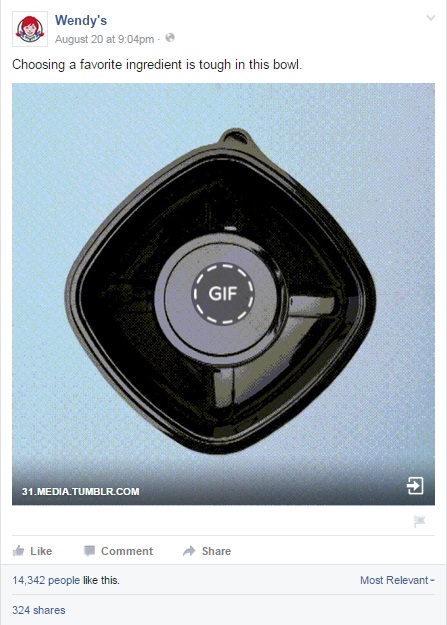
    You have been seeing animated GIFs in Facebook personal profiles since spring, but not in Facebook Pages. Until now. Sticking its toe in the water, the Social Media Giant announced today that it has relaxed its NO-GIF policy. The experiment begins with a few selected brand pages to evaluate the use of GIFs and the users’ experience. Wendy’s and Coca-Cola’s Brazilian brand Kuat posted GIFs today.

    The Original Post

    wendys facebook post using GIF

    And The GIF

    coco cola kuat


    You’ll see these new GIFs in “Boosted” Page posts — which make up most of the ads you see in your feed — not in those tiny sidebar ads. Facebook is phasing those puppies out.

    “GIFs can be a fun and compelling way to communicate,” a company spokesperson wrote in an email. “We’ve started testing GIF support in posts and boosted posts for a small percentage of Facebook Pages… and will evaluate whether it drives a great experience for people before rolling it out to more Pages.”

    Based on the performance of the advertisements, GIFs will be rolled out to all brand pages. But Facebook is cautious. The water temperature needs to be just right. It does not want to disrupt its users’ experience with annoying animations.

  • Strategies For Optimizing Your Website


    A website can be the ideal platform for businesses to make their services and products available online at their customer’s and potential customer’s convenience. In other words, a website is your best bet for being available to customers everywhere, all the time.

    Websites vary according to business goals. The B2B website isn’t going to function like the B2C, C2C or even C2B websites. Website optimization begins with a clear business strategy.

    What actions do you want people to take?

    What do you want your website to accomplish? Which business goals must it fulfill? What actions do you want website visitor’s to take? Answer these questions then determine which of three website optimization strategies leads to success.

    1. Search engine ranking
    2. User experience
    3. Lead conversions

      1. Search engine ranking

    The goal here is to occupy the highest rank on search engine result pages for selected target keywords. High ranking search results are more likely to be clicked by customers.

    To optimize your website for search engine ranking, research your close competitors’ content. You’ll be able to figure out which relevant keywords should be optimized for content updates on the website. Relevant keywords are the ‘base’ of the web content that users will be looking at. This content should be relevant to the user’s search query intent — relevant to the topic of the search query — and should provide value to the searcher.

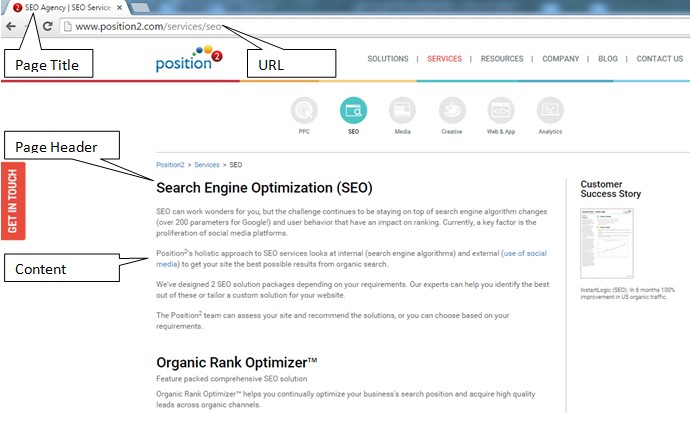
    Optimize by inserting defined keywords at Page Titles, URLs, Page Headers, into the main body content, meta descriptions and on the meta keywords. These sections of the page are crawled by search engine bots looking for keywords and using them as a ranking factor. You maintain rank position by continually monitoring and refreshing web content.

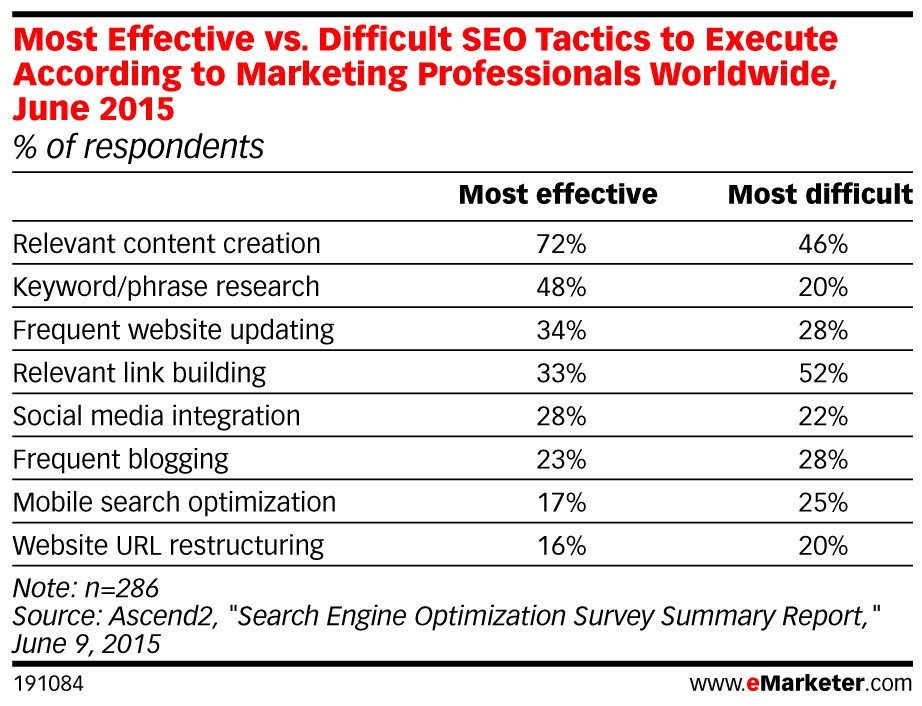
    Most effective vs difficult SEO tactics

    Double check this list for search engine ranking optimization:

    • Right keywords or content topic
    • Content relevance
    • Page title
    • URL restructuring
    • Page headers
    • Social media integration
    • Meta Description and meta keywords

    SEO Optimization to improve rankings

    2. User experience

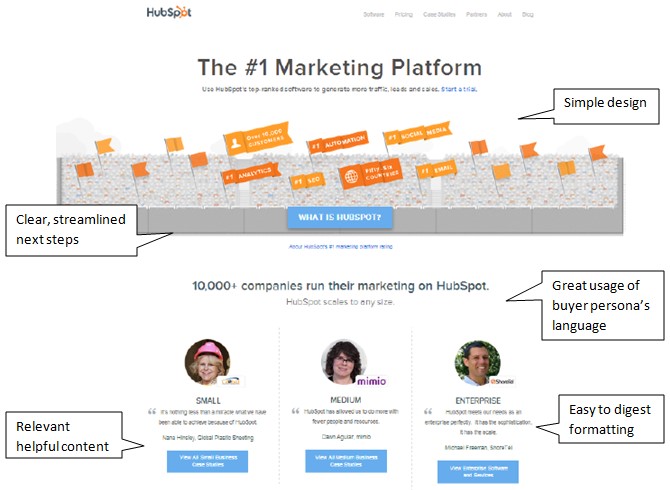
    Optimize your website by focusing on design. Where some websites are too simple and lack appropriate content others are visually complex to the point of distraction. Users make these kinds of quick judgments on their first interactions. Consider these statistics:

    • 40% of people will abandon a web page if it takes more than three seconds to load (Source:Econsultancy)
    • 6% of mobile users report having difficulty interacting with a web page, and 44% complain that navigation was difficult (Source: Keynote)
    • When a page takes 4 seconds or more to load the change in a website bounce rate spikes 100%. At 8 seconds or more to load it jumps to 150%. (Source: Mobile Joomla)
    • 95% of those queried agree with the statement: “good user experience just makes sense” (Econsultancy)

    Websites should not be static. They should continually evolve over time. Keep these points in mind to make a website attractive and appealing for quality user experience:

    1. Maintain font hierarchy
    2. Include pictures
    3. Use short sentences and paragraphs written in an active voice
    4. Use bullets appropriately
    5. Leverage bolding, italics and hyperlinked content

    Web content should be easy to understand for visitors, and easy to crawl for major search engines.

    Brief relevant content on the website should not be sacrificed for the sake of simplicity. Coordinate between the various components like title, URL, body content, descriptions and keywords. For example, if the page topic is fitness equipment, the same message should be conveyed in the URL, title of the page, brief content, meta description and meta keywords. This is like a welcome mat for users, making them feel that they have landed on the page with the answers they are looking for.

    Website User Experience (UX/UI)

    Source: Hubspot 

    3. Lead conversions

    For some businesses, acquiring quality leads may the primary purpose of their online presence. In that case, optimize your website to acquire lead information from visitors.

    Oddly enough, a lot of businesses don’t bother:

    • 56% of B2B small business websites don’t use meta descriptions that show up in search results and could help draw visitors into the website
    • 87% don’t do anything to make their “Contact Us” option stand out
    • 82% don’t bother to even list their social media profiles
    • 68% do not show an email address on the home page
    • 70% of business B2B websites lack a Call to Action

    So if you just do that much, you are way ahead of the game. Your design should be based on click-through action buttons that are visually engaging. Here are some basic click-through rules of the road:

    • Base your design on click-through action
    • Place CTA buttons above the fold of the page
    • Use visually prominent colors for CTA buttons
    • Landing pages from CTA buttons should be simple form fills

    Once users have clicked through to a landing page, don’t befuddle them with complexities.  Simple design is good design. Complex form fills requiring too much information don’t get completed, and the viable lead bounces away. See image below for lead gen form:

    Lead Conversion Tactics

    Source: Landing Page Course

    Your business needs will determine the best optimization strategy. Websites should be easy to understand and to crawl. They should satisfy search engines and searchers alike. Website optimization is more than just search engine optimization. With quality content that answers your users’ search questions you will always rank at the top of search engines and attract, convert, acquire and delight customers.

  • Google Phantom 2 Algorithm Update

     ‘What does it mean to the businesses and search marketers?’

    Google’s on a roll. From the “Mobilegeddon” update last month to its recent secretive “Phantom 2” algorithm update, it’s delivering the best possible search results to users. And then going back for more. Google silently tweaks its algorithm much frequently than most marketers imagine.

    While the Mobilegeddon algorithm update was designed to boost the rankings of mobile friendly sites on mobile devices, Google’s Phantom 2 update will penalize sites with low quality content, specifically impacting “how-to” style content. Additionally, the impact will be felt by the entire domain not just standalone low quality website pages.

    What “Phantom” should mean for Search marketer?

    It’s a swift silent punisher of sites with thin content. They will lose the bulk of their rankings, traffic and conversions overnight.

     google phantom 2 update

    Image Source

    What does Phantom do to the actual business?

    • Your entire website is punished or sand-boxed
    • You rapidly lose a lot of traffic
    • You can’t see your high traffic ranking keywords on Google search results pages (SERPs)
    • Traffic conversions drop faster than you think
    • Your Return on Investment (ROI) disintegrates

    Essentially, you lose almost everything online you were working on the site (whether intentional or unintentional).

    It sounds scary, right?

    Reasons why a website is hit by Google Phantom 2 algorithm

    1. Sites with Low Quality Content

    Google has been cautioning everyone for quite some time now with Panda algorithm updates. Sites that add very little or no value to the audience are hit with the Phantom 2 algorithm update. This includes poor representation and lack of uniqueness in the content to the users.

    2. Engagement

    If your website content is not able to provide value to the audience, the engagement level is bound to be low on the website. The Phantom update emphasizes this fact. And the current Phantom 2 updates are a lot more strict than Panda updates

    3. User Experience (UX)

    • While content is one major aspect, others include the website load time, 404 errors, user flow, page architecture (design), color combinations, user navigation all of which should be taken very seriously by the webmasters. Make sure the website functions perfectly without distracting your audience and the search engines
    • Supplement, template content or using auto generate content tools slanders the uniqueness and the usefulness of the content for users. Marketers should be very careful and should maintain the relevance of the content for the users
    • Use of distractive and/or sponsored ads: Ads are meant to help users make the right decisions or provide information they intend to use during the buying process. Many businesses overdo by forcing users to click on these ads
    • Affiliate networks, which keep on bombarding and showcasing users with irrelevant ads
    • Sometimes ad links and content are in the same flow & color and users can’t determine the difference. Applying these tactics hurts the sites rather than helping. Remember, Google has already included human bots in deciphering these tactics
    • Pop-up’s annoy the audience if not used judiciously. Google algorithm has been optimized to identify these
    • Pages only containing images and videos without considering the theme of the webpage or over exposing the aspect of rich media are a negative impact
    • Pages with just links that point to subdomains or other websites with less/no content, are of little help. No more old school link farm techniques

    4. No Corrective Action Taken

    If your website has been hit by Google Panda or had elements hit by the update earlier, and you have done nothing to make content more appealing, fresh, and unique to the users, Phantom 2 will definitely have an impact.

    5. Duplicate Content and Canonical issues

    Happens frequently but often ignored by webmasters. Make sure you remove duplicate pages/content. Just remove them or block duplicate content from search engine indexing. Use proper canonical tags to make sure that one version of pages exist.

    6. Doorway Pages

    Doorway pages–Don’t try to deceive Search Engines and create similar pages to gain multiple rankings on SERPs. Google is smart enough to identify these and punish websites accordingly. Read here

    7. User Generated (spam content)

    Make sure user-generated conversations are relevant and checked for spam. Lots of low quality and thin ineffective user generated content raises an alarm and will be hit by the Phantom update. Ensure that community/forums are not used as junkyards for link and ad promotions. Have guidelines for the users to comment. Do periodic checks and edit/remove comments, which have negative user experiences.

    More to consider

    • Understand Your Target Audience/Personas before you write content. Attribute content across the funnel of the buyer’s journey
    • Have in place a content marketing strategy and plan. Make sure you generate genuine and unique content for the users, not for search engines
    • Try to develop a mix of content/asset types to keep users engaged. Distribute your content to relevant channels where your target audience generally visits. Content is King, but Distribution is ‘Queen’
    • Start with small. If you have constraints generating content, take small steps. Use Social Media to interact with your audience
    • Optimize your online channels Facebook, Google+, LinkedIn, etc., and reach out to your audience
    • Generate small content pieces. The traditional rule for audience engagement is 80/20. Eighty percent of your content should be for your audience, and 20% should be for your business (sales, marketing, self-promotion, etc.)
    • Have a social calendar in place to communicate with your audience
    • Regular Website Health Check up – Make sure all the technical aspects of the website are taken care of like page load time, design, navigation, etc. Regular checks on website hygiene ensures removing any major issues and creates better user and search engine experience
    • Make sure you track your content performance using analytical tools
    • Conduct regular analytics audits to make sure you are on top of your user engagement metrics. Understand what your audience needs and generate content accordingly

    At Position2 we utilize an Integrated Digital Marketing Approach to make sure our clients achieve premium results. Our proprietary Website Calibrator™ technology, a 41-point technical SEO audit, keeps our client websites equipped for any Search Engine algorithm updates.

  • Mobilegeddon? You Almost Missed the Facebook Update!

    While Google busied itself distracting the world on April 21 with “Mobilegeddon“, its mobile-friendly update, Facebook quietly released an update all its own. Did you notice?

    Facebook insists that the News Feed exists for one purpose only – to give you the content that matters to you. This latest News Feed update is specifically designed to improve the Facebook users’ experience, aiming at a better balance of content from friends versus content from businesses, publishers, public figures, and local organizations.

    The update comes in three layers.

    #1: More Content for Content-starved Users

    The rule that hitherto prevented you from seeing multiple posts from the same source has now been scrapped. When you run out of recent content and scroll through the News Feed, you’ll now see multiple posts from the same sources.

    #2: Updates from Friends Given a Thumbs Up

    Going forward, content from friends will be placed higher in the News Feed. The Menlo Park social media giant had been getting a lot of negative feedback from users who were missing out on important updates from close friends — photos, videos, status changes, links.

    facebook friends

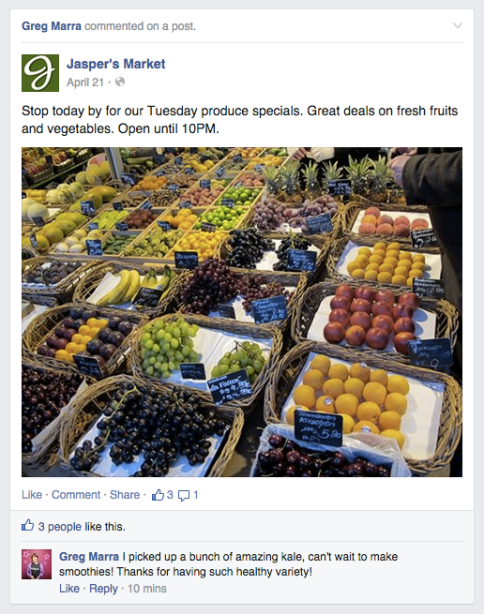
    #3: Friends’ Likes & Comments on Posts is a No-show

    Likes and comments made by your friends on a Post have been relegated to the bottom of the News Feed so you can focus on what your friends are really saying.

     Latest Facebook mobile-friendly updates

    Advertisers Be Warned!

    Advertisers will have to make adjustments. Higher grade content posted with consistency will get noticed. Anything else is likely to sink from sight.

  • Best of the Week | UI and UX Trends in 2015, and much more…

  • Your Website is Your Digital Persona. Is Yours Worth Clicking?

    Today having a website is more than just a business imperative. You need to differentiate your website from that of your competitors. Your interface should be user friendly and at the same time it should be easy to maintain and upgrade. Having a robust site is very important since web security is of critical importance if you are really serious about scaling your business. You cannot take risks when it comes to web development. The world is going the digital way and you need to take cognizance of that.

    The first impression that your website gives is critical. It can make or break a deal for your website. So put your best foot forward. Have a website that is visually appealing and informative at the same time. According to statistics most visitors to your site will have decided in the first few seconds whether your website is worth spending time on or they ought to give it a pass.

    We can’t stress enough on how much content rules even in this day and age of gimmicks and smoke and mirrors. You cannot have mediocre content and expect first class results. Give your users first class content and sooner than later you will see how it benefits your website.

    Functionality is a big issue with a lot of websites as webmasters do not think twice about the user experience. A website is a platform where people navigate depending on what they are seeking and if your website has broken links, insufficient information, lack of guidance then people will immediately move away from your site and that does not bode well for you.

    As far as usability is concerned keep your website simple. Have a good layout with links clearly marked with where they are supposed to lead you. See to it that your pages load fast and efficiently. That way navigation is not an issue for your users and you can rest assured that rich dividends will surely follow.

    You cannot have any quick fix solutions just because they are cheaper. When you are in for the long haul it will cost you dearly and we are not talking about the monetary cost here. How much are you willing to pay for a lost client? So you need to be discerning and have a studied approach.

    The recent hacking of the BBC website is a case in point. This shows how serious you need to be when it comes to online security. A website endeavor is not a one-time approach but a continuous process of finding out what works and what does not. You will have some new technology coming up and you need to incorporate that in your site. Only then will you be able to compete in this cut throat world.

    Mobile friendly_website

    Image Source

    Today the Internet is going mobile. Due to faster wireless connectivity and cheaper smart phones and tablets, a revolution is underway in the mobile domain. But not all companies have a website that is optimized for the mobile platform. There is a whole generation of young men and women who have accessed the Internet for the first time on a mobile device. Now that is the generation which is of particular interest to the digital marketers. They drive the bulk of sales for products and services in the cyber space. Google has just come up with an exclusive set of tools to help you make your site mobile-friendly. Your site’s mobile compatibility might even become a deciding factor in ranking your website in the Google search engine results page.

    Position² POV

    Different websites have different requirements and you cannot have a cookie-cutter approach. It is better to build your website from scratch since that way all the things will be personalized to your particular needs. Wherever possible do not make use of plug-ins and such other technologies. Now this might seem costly but then it is worth it when it comes to scaling your business and offering a better experience for your users.

    We have worked extensively with a gamut of industry verticals with respect to Web and Application Services. One of our recent works that is worth mentioning is a complete revamp of the website of a leading global information technology and outsourcing company headquartered in Bangalore. After we extensively worked on their website they got an exceptionally high rating in a record period of time from Acquia’s external scanning system. The site was evaluated with tests created by Drupal experts.

    Another recent example is our work on the website of an emerging enterprise cloud storage solutions provider. Here we helped transform their marketing infrastructure with a transition to Drupal for the website, an upgrade to the WordPress blog. This and a lot of other improvements gave the company a renewed capability to reach new customers and partners.

    You need to design, develop, maintain, migrate and optimize your website. Thus, having the backing of a firm which has extensive experience in all these is half the battle won. But still there is no room for complacency. The world of web technologies is changing at a very fast pace and you need to keep abreast of it at all times.

    Contact us to learn how we can transform your business now!