Tag: Snapchat

  • Snapchat Story Explorer Offers New Perspectives on Events


    Snapchat continues to gain ground in the social space, taking on its more established rivals and becoming more than just a photo sharing app. Its newest feature, Story Explorer, is a small but significant new feature that the company hopes will become popular with its relatively young user base.

    Story Explorer builds on Stories, Snapchat’s collective news story tool. When a user uploads a snap of a live Story, all other snaps related to that Story taken by other users are linked with it. Story Explorer allows a user to swipe up to see different perspectives on the same event, so they can get all the information they need with just a few taps.

    Making the switch

    Snapchat has one considerable advantage over Twitter: it relies on big, beautiful pictures and videos, rather than reams of text, hashtags and links. That makes Story Explorer a compelling prospect, particularly when you consider the demographics of its target market and they way they tend to consume news.

    The Story Explorer tool is obviously targeted at people who like to use Snapchat to share photos of public events such as sports fixtures and concerts. This lets everyone build a hive of information around a theme in real time. It could also be used to find out more about a breaking news story by linking uploads from multiple Snapchat users, the kind of thing that made Twitter popular with news junkies.

    It looks like the Story Explorer feature can’t be entirely automated yet; human curators need to select stories that genuinely overlap, while weeding out the inevitable sub-par content. Over time, Snapchat may find a way to use location and image scanning techniques to automatically link Stories together without as much reliance on curators. This will help Snapchat compete with Instagram and Twitter to become a social source of breaking news.

    The changing audience

    It’s strange to think that Snapchat had something of a seedy reputation only a few years ago. Content sent between users disappeared 10 seconds after being opened, which made Snapchat the ideal platform for sharing content you probably wouldn’t want your mom to see.

    At the height of the controversy, the FBI warned that Snapchat was being used by pedophiles, which only served to reinforce its unsavory reputation.

    Now, with Story Explorer, the app is trying to shed its reputation for ‘sexting’ and become a source for serious news.

    Story Explorer is live now in New York and Los Angeles, and will be rolled out to other cities in due course. It’s a small step in the right direction for the fast growing platform, and signals the beginning of a new era of improved and easier to find public content.
  • Instagram Chases Snapchat Success With Explore Tab


    When Instagram was acquired by Facebook, users rightfully feared that the app was doomed to become a dumping ground of ads and sponsorships. But so far the Instagram ads have been included in a mindful way, and the user experience has remained consistent to its origins.

    Then came the threat of looping video. Even though Instagram’s core user base embraces the app primarily as a way to share snapshots, video is here to stay. Instagram sees it as a way to enhance a more interactive, social experience. And, more to the point, it’s the way to take a clear swipe at two of its biggest channel competitors, Snapchat and Twitter.

    Explore Instagram With Video

    Instagram has just upgraded Explore, its video channel.  There’s now a stream of hashtag-triggered continually updated and curated content. We saw the first of it with Explore’s one-off event for the recent Halloween weekend.

    The new Explore parallels Twitter’s Moments feature. In the case of the Halloween event, videos were hand-picked for their quality, much like the tweets shown in Moments, which are contributed by selected users. The curated feature ran for 24-hours, a current events window specific to the Halloween weekend. Users who wanted to contribute to the theme used a topical hashtag to be considered for inclusion.

    The experiment is over, but the videos can still be viewed.

    Why Experiment With Explore?

    Snapchat managed to reinvent itself over the last couple of years. Its Live Stories video feed is an obvious inspiration for Instagram’s Explore. The primary difference between the two is timeliness. Snapchat comes and goes. Instagram’s video content potential will have greater appeal to people serious about the timeline of unfolding events. Imagine Instagram Explore in use in Cairo at Tahir Square back in 2011, or on the streets in the US during the Occupy events.

    Instagram also tweaked the best features of Twitter’s Moments, most notably using curated content. They are able to filter much of the “noise” that could otherwise clog the channel. All three apps share a common goal of giving people greater opportunities to contribute personal points of view.

    Explore didn’t display any advertising on its Halloween experiment. But given Instagram’s need to monetize, it’s likely we’ll see sponsored videos soon enough. With 400 million active users every month, Instagram’s user base is now significantly higher than Twitter’s. The potential for a brand to reach a broad and targeted audience is overwhelming.

    Watch Out, Snapchat

    The curated Halloween content in Explore only displayed for US users. But it suggests that Explore could change the way we look for “news” online. Social news has been rightfully criticized for a lack of accuracy.  Instagram’s decision to curate Explore content may prevent such abuses. It also puts the company in a position to censor and shape unfolding events according to its own interests, a slippery slope.

    The more Instagram can maintain user enthusiasm for its app, the more potential it has to make money. The tough part will be financing 24/7/365 curation on a global scale. The Halloween videos were fun, but the real test will be Instagram’s ability to respond quickly to a breaking story and capture the zeitgeist of a trending event. And that’s only if the company decides to roll out the feature long term. We’re still waiting for Instagram to make the announcement.

  • Facebook: Where There Is No Outside

    Facebook wants its 1.44 billion active users to stay put. It sees each link out as a potential loss that undermines Facebook’s business model. To keep its users inside Facebook identifies all the likely content and experiences that users seek or pay for, those digital opportunities that take users out of its sphere of influence, and then recreates them inside the blue walled Facebook ecosystem.

    Consider Pages

    Facebook introduced Pages in 2007 with the intention of replacing business websites which were seen as inconsistent silos trumpeting incomplete information. In time Pages overwhelmed websites with cover photos, Timeline, maps, reviews, business hours, messaging channels, and many more rich features. Pages created a wealth of content for Facebook. Thousands of digital marketing professionals jumped in to build strategies, create content, media and links to maximize utility and engagement value. Facebook became a destination, a one stop shop for information on any brand. Nike.com might provide information about the latest shoes, but by visiting the Nike Page in Facebook a user got that information and, with News Feed amassing user targeted information in one endless scroll, exposure to much more — a band’s tour dates, the latest movie in a nearby theater, etc.

    Plugging the Leak

    When a users click on a News Feed preview, the link takes them outside the gates of Facebook. And they may not come back. Facebook responded by moving down the stack, from subsuming the authors to subsuming their content.

    Clicking on a YouTube video in Facebook took the user out to You Tube where upon completion of the video the user was encouraged to watch more non-Facebook content. Adding injury to insult, these videos would also display Google Ads. No revenue there. Facebook responded in December 2013 with Auto-play Videos. You could upload clips directly to Facebook and users could watch them without pre-roll ads or pop-overs. Six months later, between May and July 2014, auto-play video views grew 50%. By September, Facebook hit 1 billion video views per day. By January, it was 3 billion. And it’s over 4 billion today. Who’s to notice video ads appearing among all those organic clips?

    facebook

    Image Source

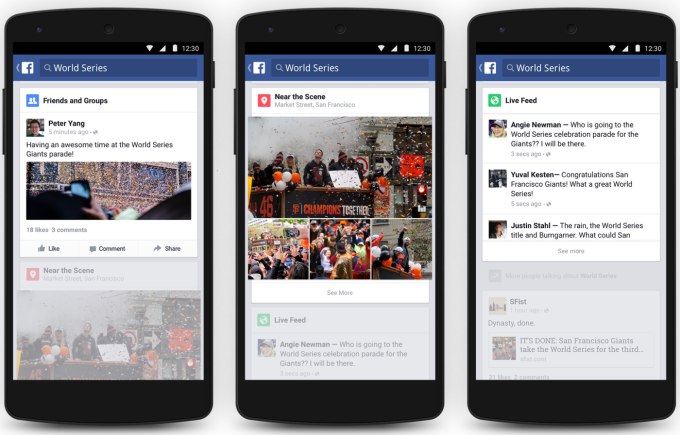
    Reader reactions and posts by the people involved on the latest news: Facebook’s Trends pages

    Got the message?

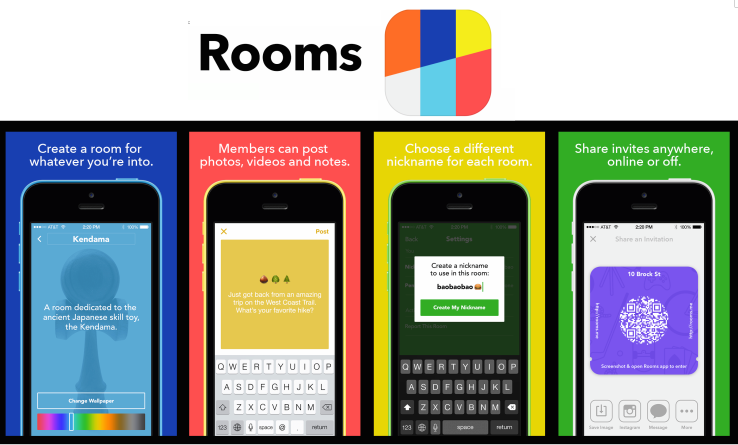
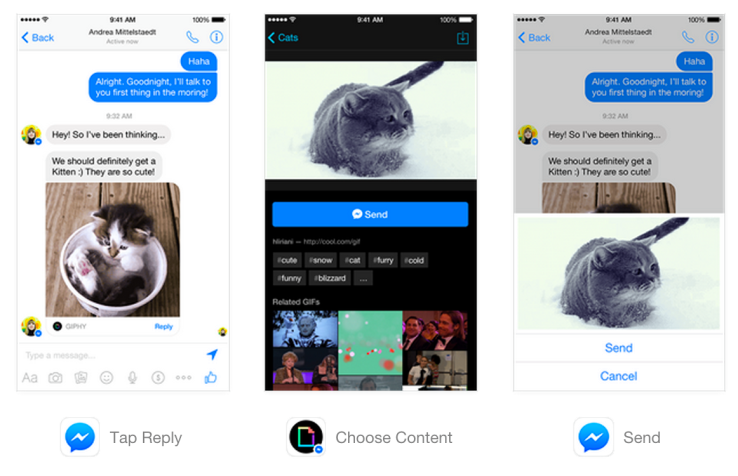
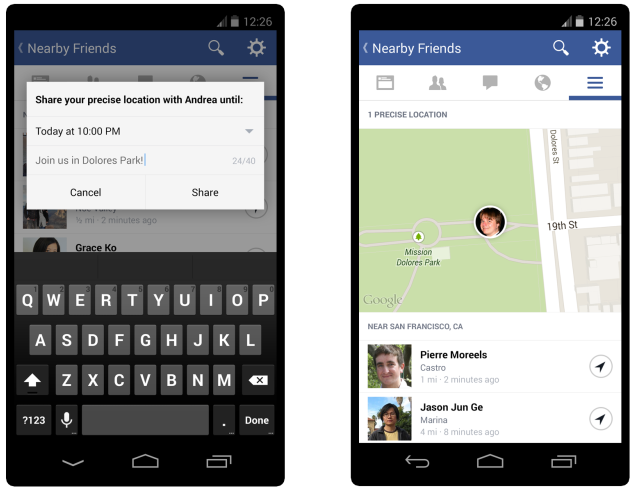
    Who needs email when there’s Facebook Message? At the March 2015 F8 conference, Facebook announced its new Messenger Platform. Users will be able to create and share content with third-party tools, and communicate directly with businesses rather than calling or emailing them.

    Facebook targets other popular apps:

    facebook

    Image Source

    facebook rooms

    Image Source

    facebook messenger

    Image Source

    One Click Instant Purchase

    To counter being whisked off by ecommerce ads to an outside website where a user keys in payment and delivery details Facebook provided the Buy Button, a particular boon to anyone using a mobile device (which is pretty much everyone). Rather than clicking away to a merchant’s site, the Buy button lets the user complete the entire purchase flow within Facebook, which could boost conversion rates and further endear retailers to the social network.

    facebook

    Image Source

    App install ads, Facebook’s cash cow, accounted for a major part of the $2.4 billion it made on mobile ads last quarter. Here, Facebook has tried pop-up App Store windows in-hopes of letting users download without moving out of the realm of Facebook.

    Facebook’s Instant Articles

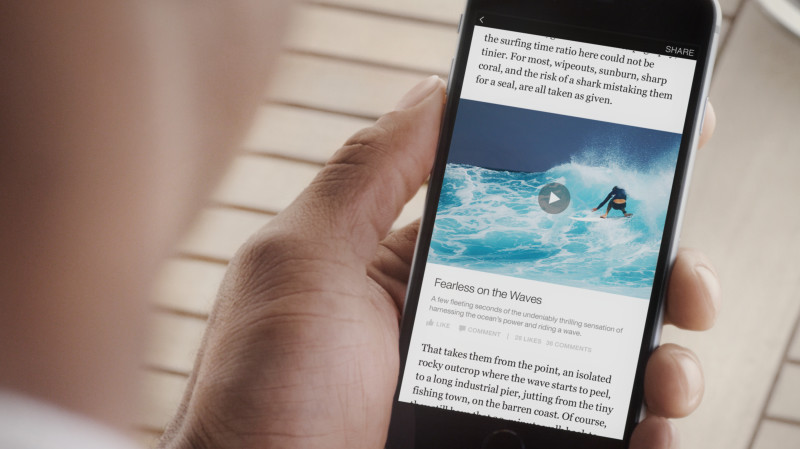
    Why wait for eight seconds for an external page to load when you can read the article with a single tap within the comfort of Facebook? Rich media tools within Instant Articles allow marketers to add audio captions and zoomable videos to their copy. Publishers keep 100% of the revenue if they sell the ads that appear within Instant Articles, while Facebook keeps 30% if it sells the ads.

    fb-instant-articles

    Image Source

    Best to Keep Facebook in Mind

    While these features appear to make life easier for Facebook users, they also keep them inside the blue zone. Which is the point, after all. Some features have been controversial, but controversy comes and goes. Commerce is forever. If one out of 1.44 billion Facebook users buys something, or books a room somewhere, or the flight to get there, best they do that business within Facebook than somewhere, well, outside. With Messenger and Group products remaining totally free for over 500 million users, advertisers have begun to rethink their global strategies, presumably with Facebook in mind.

  • Digital Advertising is the Elephant in the Room for Media Companies

    The rise of the World Wide Web that began at the fag end of the twentieth century has since then been dominating people’s attention spans and garnering eye balls unlike anything else the world has ever seen. 2015 will be the year that will see big wars being fought by media behemoths to conquer this space, the last frontier!

    People are getting comfortable with the online media and this has got the advertisers excited. Today brands are devising video advertisements tailor made for the online world rather than taking the ads running on the television and serving it to digital users. The advertisers’ switching to the digital arena is not a question of if but more about when, and 2015 seems to be the right time!

    The total US TV advertising spends rose a mere 2.6% to $11.4 billion for the third quarter. But the US online advertising spends for the same period rose by a staggering 22% to $8.7 billion! Now you don’t need a rocket scientist to see the writing on the wall, for the TV broadcasters!

    If the offline media companies are unable to adapt to the changing dynamics of people’s penchant to view digital content, then they might come up against some harsh realities in the not so distant future.

    The Digital Stomping Ground

    Hulu, the ad-supported online video service offering TV shows and movies and video clips is doing a roaring business. Though initially Hulu did not find much luck with advertisers, it is now a hot favorite among online advertisers! The owners of Hulu – Walt Disney Co., 21st Century Fox Inc., and Comcast Corp. are some of the biggest media companies on earth. Together they agreed to invest at least $750 million into the business venture in 2013, seeing the potential of online video consumption.

    But the billion dollar question to ask here is ‘will that be enough?’. Today it is not a labor intensive or a capital intensive economy but it is a knowledge intensive economy, all the way. All you need to look at, is a three year old photo messaging application developed by guys in their twenties, that is worth a staggering $10 billion dollars today! Yes, we are talking about Snapchat. That is the beauty of the online arena. Start-ups of today can become multi-billion dollar enterprises of tomorrow.

    This has got the media behemoths quite worried. What guarantees do they have that tomorrow some wunderkind will not come up with something that rivals Hulu. Now this would thoroughly challenge the old media barons in this new digital stomping ground that is the World Wide Web. Who knows tomorrow a dark horse from Silicon Valley might just challenge the 800-pound gorilla of the media landscape!

    Do share your thoughts on this issue!

    Contact us now to deploy integrated online advertising campaigns!