Tag: SERP

  • Google To Stop Showing Ads On Right Side Of Desktop Search Results

    Position² Point of View

    This new Google policy will result in many advertisers seeing a big drop in traffic, as their ads will appear at the 14th position on search result pages instead of at the fourth position.

    This will also have an impact on Cost Per Click, as more advertisers will compete for the top three slots—similar to Google display ads that appear above organic results on mobile devices. In our experience, the top three positions produce the best results on mobile, and it looks like this will now apply to desktop searches as well. Advertisements in fourth position will now have reduced impact, as they will appear at the bottom of the page, which may result in low CTR and low traffic.

    QS is King

    Quality Score is going to play a key role with this change, as only high quality ads can appear on top of the page, irrespective of bid price. So keywords with low quality scores will see a huge drop in traffic. This means that we will be seeing fewer high quality ads on Google.

    Long Tail Keywords

    Traditionally, most advertisers largely ignored long tail keywords, or didn’t focus as strongly on improving their QS. These keywords will play a key role now—if we can establish good quality scores for them with relevant ads and landing pages.

    Product Listing Ads

    PLAs will get more visibility now, as the number of text ads will be reduced, and PLA advertisers will see an increase in CTR. Advertisers who run PLAs must review their results as a consequence of Google’s new policy.

    How Will This Impact Your Advertising?

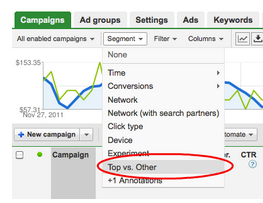
    If you’re a marketer, you need to run a simple Adwords report comparing “Top vs. Other” segments and see what kind of traffic you’re getting. If your maximum traffic is for “Top” you will see an increase in CPC, so you will want to increase your budget outlay. If you’re getting most of your traffic from “Others” you must work on improving positions and QS for your keywords to avoid large drops in your traffic.
    google

    Positives

    Companies that can afford to advertise in top positions will see an increase in competition, so we can expect higher quality results. In general, the quality of ads goes down in the lower positions, as they are dominated by affiliates and often feature lower production values.

    Fewer premium advertisers will result in less complexity, and this will probably reduce the importance of bid management platforms. If we find out that low ranking keywords are not performing, we can eliminate them as they will not get much traffic in the future. This will result in a smaller number of keywords to use in campaigns, and further simplify account management.

    Negatives

    So far, Google advertising has been the most affordable and easy to test channel for small advertisers with limited budgets. Such advertisers will now need to increase their spending to get good results from the Adwords platform.

    Watch this space for more updates!

    By Sudheer Dayanand@Team Position2
  • Evolution of Mobile: The Future of Mobile SEO


    Expanding the theme, Evolution of Mobile SEO : Is Your Website Mobile Friendly?, we ask: Are You Ready for What’s Coming?

    Google is never likely to sit still. The company wants to enhance their competitiveness while giving users the best solutions. Here are a few tips on how you can gear up for the ever unfolding future:

    1. Getting the ‘Mobile Friendly’ Designation in Mobile SERPs has affected search rankings on smartphones. Unblocking CSS and JavaScript plays a vital part in nailing the Mobile Friendly designation, according to Google Webmaster. Googlebot needs to see your site like an average user. By always allowing Googlebot access to the JavaScript, CSS, and image files used by your website you achieve optimal rendering and indexing,
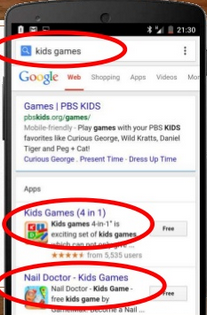
    2. Deep linking has become one of the key signals for positive web rankings and to drive traffic to the Apps. They appear in the Google SERP individually or as part of a mobile App Pack. An “App Pack” is a group of related apps that rank together for a given query. It’s shown together in a box separated from the inline organic search results.

    Mobile Search Results with App Packs

    Screenshot from Cindy Krum and Linkdex webinar

    1. Demystifying ASO: Keep your App Store Optimization title tags short and descriptive. It’s to your benefit to have exact match keywords in the title and description tag. There are advantages as well as disadvantages to having a mobile app rather than a web page. For queries that are almost similar to the app name, mobile websites get pushed down below the fold.
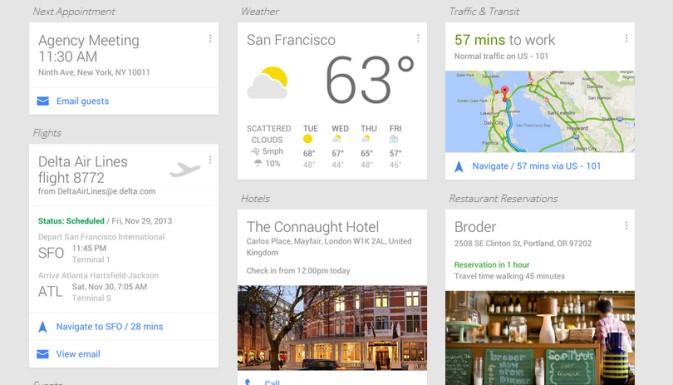
    2. Google NOW has evolved into the user’s personal knowledge graph. Users are adding data and increasing content to their big data mix with info cards as the most ideal and personalized result format for users. Google gives the right information at just the right time assisting you around the clock with relevant suggestions.

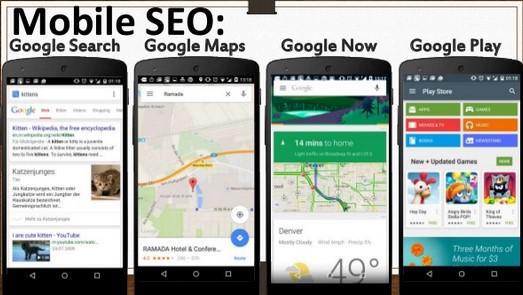
    Personalized Info Cards - Google NOW Google Products that affects Mobile SEO

    Image source

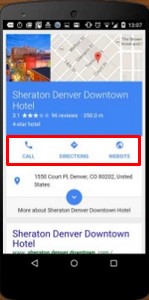
    1. Mobile Results going full screen on Page #1:Music info cards, hotel booking search, flight booking search, TV info cards, map queries, restaurants and menus, etc. take up the top fold of the search results.

    In this example, for a search query “hotels”, Sheraton Denver Downtown Hotel  takes up the first fold.

    Full Screen Mobile Search Results – Position2 Blog

    Image source

    1. Google avoids blue links or websites from showing above the fold on Mobile. Results that are likely to come up for search are Info cards, Answer boxes, Knowledge Graph results and other cards.

    Your task:  Optimize for mobile search and Google Now.  Apps, Images, Videos and Google+ for business need to be optimized for placement at the top of the Mobile search results.

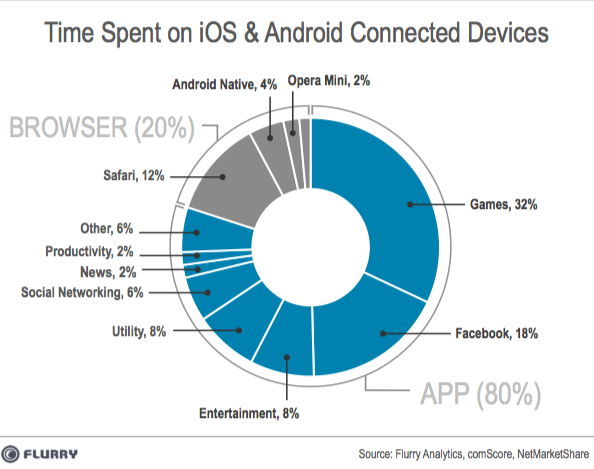
    1. App like sites, instead of mobile websites: The numbers speak. Users spent 80% of their time on Apps and 20% of their time on Website. Mobile App visits Vs. Website visits
    2. Personalized Info Cards are generated by different Apps: Google integrates with different Apps to generate info cards, for example adding transcripts and lyrics to videos and music, displaying them in answer boxes. Google makes these changes to deliver the best mobile experience for searchers, giving them exactly what they want at the right time.
  • Search is Changing – Real-time Updates in SERPs

    SERPsThe world around us is moving at a swift pace today, so much so that often information absorption has to be literally (read, virtually) instantaneous. Web platforms have made it so easy to share information that people use these channels to announce important events and updates rather than wait for the slow dissemination of information by traditional media.
    Speed of Information Diffusion

    According to the now obsolete Hypodermic Needle Model theory, traditional media has an “immediate” effect on the masses. The theory stated that people were passive receivers of information and that they were immediately influenced by it.

    This theory was developed in the days when only traditional media existed and its meaning of the word ‘immediate’ is vastly different from today’s adrenaline driven, turbo charged world of social media and online communities.

    Immediate today means ‘immediate’!

    Earlier, it took at least a few hours for news to be updated through traditional media (as it does sometimes even today). But today, by that time, crucial updates would have already broken out on forums and social channels.

    In today’s highly interconnected world, it’s very important today to know about key events as soon as possible. This necessity invariably prompts people to look towards information sources that are more real-time oriented.

    For instance, the ongoing crisis in Syria captured headlines world over, especially on the web. People took to online communities and social sites like Twitter and Instagram to protest and express their anguish. A brand crisis like defective brakes in a new car model too can prompt widespread searches. Tyson’s chicken scare recently triggered a few frantic searches.

    Real-time Updates in Search Engines

    Search EnginesSearch engines are mostly regarded as a treasure trove of data by netizens. Innumerable people gravitate towards search engines when they are looking to learn about the latest events. However, a developing trend is where web users are turning to online forums and social sites like Twitter, Pinterest, Instagram and the like for real-time updates.

    Let’s do a quick inspection of the most popular multi-lingual search engines and understand their current position in terms of availability of real-time updates:

    Google

    Arguably the most popular search engine, Google has not missed this trick. They have been covering Twitter and FriendFeed updates to which they added Google+ updates also recently.

    Bing

    Microsoft’s search engine is also up-to-date offering Twitter and Facebook updates on its SERPs.

    Yahoo!

    They entered the game a little late after both Google and Bing but Yahoo! also started offering real time information on the search categories available at search.yahoo.com.

    There are also unmistakable signs of search engines opening up to search result components of different natures when compared to results that appeared on SERPs traditionally. For example, Google has begun integrating Google+ updates and it recently allowed more in-depth articles in its search results. According to Google, many users’ requests for information were for broader topics, to cater to which, the search giant incorporated more detailed posts in SERPs.

    YouTube videos have also been included in search results from a long time.

    Effect on Businesses

    All of this asks the question, ‘Can brands take advantage of people’s interest in real-time information?’ One way of doing this is in the manner mentioned above; of quickly reaching out to consumers at a time of a product crisis.

    Another way to positively leverage this opportunity is by aligning promotions with significant events. Tweeting congratulations to Golden Globe winners as the awards are announced or building a quick info newsbyte around significant events will help the brand get featured in the search results.

    How else can brands leverage people’s search for real-time information? Tell us!

    Image Sources: Bizness Quest, Real Traffic Productions