Tag: search marketing

  • Smart Money is in Digital Ads, Where is Yours?

    When consumers embark on their journey, we know that they use multiple channels to get information. Of all the touch points in a typical journey, display ads are a major contributor to conversion. As spend increases, and customers’ behavior changes, we’re seeing digital ads pushing better and better results.

    The real magic here is that digital ads boost results across the board. As an example, take a look at the BrandScience and Microsoft econometrics study. They wanted to figure out how online advertising influences behavior. The study found that digital ads perform very well when taken as a sole channel. Combined with other media spend, they can lift ROI by up to 70 per cent.

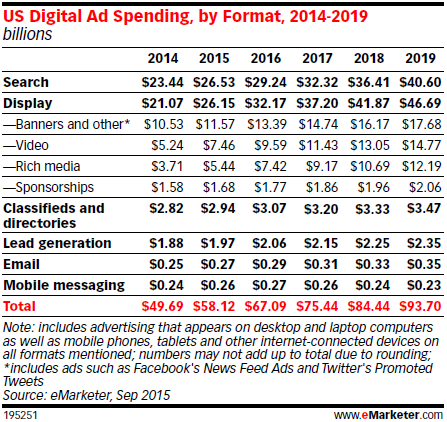
    US digital ad spend

    Image Source

    Now is the Time

    In 2016, US digital ad spend will surpass spend on search advertising. This is a big deal for marketers, because it’s the first time that digital ads will come out on top, with the estimated spend being more than $32 billion total. This huge figure is set to increase to over $46 billion by 2019.

    We already know that paid media and digital ads are a major factor in the buyer’s journey. They support brand discovery, encourage repeat visitors from partner websites, and reinforce the brand message you’re cultivating. Now that we also know that digital ads boost results holistically, we can look more closely at the proof.

    Digital Advertising: Facts and Figures

    Display advertising is a very effective way to drive traffic. Display ads across all formats result in an average 0.6 per cent CTRGlobally, we’re going to see increasing shifts towards campaigns that focus on digital. Multinational companies like Procter & Gamble invest huge amounts of money in this space. Investment of 30-40 per cent of a marketing budget is fairly typical, and reflects the overall interest of bigger brands in boosting overall results in a campaign.

    In fact, 57 per cent of CMOs expect budgets to increase over the next two to three years.

    Looking specifically at mobile, spend on mobile search is expected to increase from $13.6 billion in 2015 to $18.5 billion in 2016. And if we look at US spend on banners, rich media, sponsorships and other display formats, a massive 77.5 per cent – $17.5 billion – will target individuals on mobiles and tablets.

    The proof is there, and it’s compelling. But there’s one more piece in this puzzle.

    Honing Digital Ads

    When it comes to digital ads, the amount you invest is going to dictate your results. But focus is just as important, and 2016 is the year we’re going to see an uplift in ROI via more targeted advertising strategies.

    Coming up with effective ad strategies is not easy, and there’s an ongoing question mark around ad blockers and other tools that can disrupt planned trajectory. Brands are struggling to leverage the market on their own. But with the right support from a capable agency, any business can navigate this complex terrain.

    Position2 is well placed to deliver the strategy you need to make the most of your digital ad spend. We have our finger on the pulse, and we know which metrics to measure. We know how, and when, to target your audience.

    Seeking an integrated digital media strategy? You found your perfect partner. Contact us for advice today, and subscribe to our blog for more updates.

  • View-through Conversions

    You are as likely to click on a website immediately on seeing a banner ad as much as you would walk immediately into a store on seeing an attractive out-of-home display ad. We are less inclined to stop what we are doing in order to respond to ads, be it online or when we are out in the city.

    In the world of search marketing, click-through conversion is all that matters. Search, by its very nature, has a pre-qualified audience based on their intent to seek out information. Clicks reign supreme because ‘Clicks’ from search ads connect your brand with a sought after need.

    On the other hand view-through conversions – VTCs (a.k.a post-impression conversions) happen when a person is exposed to a display advertisement, does not click, but goes on later to visit the website or search for the brand on search engines and converts. The driving force behind display advertisement is to create an influence. As a marketer we must endeavor to reach the right type of person, at the right time, at the right location and with an offer /service they simply cannot refuse. Even when all these factors are present in a precise way, a person might be inclined to click only when an impression is served and is compelled by what he sees in order to take some action. In display advertising, the ‘Impression’ still reigns supreme.

    So that brings us to some interesting questions:

    Q – Are VTCs just duplicates of the other conversions in the interface?

    View-through conversions are not able to get the rightful credit mainly due to the way people view it in DSP buying. Many DSPs will group the VTCs along with the Click-through conversions while filling leads form thus giving a distorted figure. These DSPs will then promise a CPA model to the client which can only be fulfilled with the help of duplicated view-through conversions.

    You can be on top of all such things by checking the validity of this metric:

    1. You have to run a split or A/B test campaign. For one group you need to show the banner ad and for the other show a PSA ad. You then have to find out the incremental conversions for the group that viewed the banner ads.

    A/B Testing vs a Blank Ad

    a_b testing_view-through-conversion

    Source

    1. You have to demand that the view-through conversions be shown separately from last click conversions. That way you can have the actual break down of the conversions.
    2. Based on the industry conversion duration norms, set a custom backtrack durations for view-through look ups. Do not take view-through conversions that are registered beyond the set conversion duration.

    Q – What is the view-through conversion window?

    A view-through conversion window reckons a conversion after an ad is viewed depending on the number of days that you allow for the conversion to happen. You can customize it as per your needs to only record a VTC if it happens within the window of time frame post ad view that you have selected. The shorter the ad window the more accurate is the result. A 24-hour window is very reliable since the stickiness factor will definitely influence the customer’s decision to click the ad. A 30 days ad window may or may not be so accurate which is again wholly dependent on the type of product or service that you are selling, sales cycle, industry, and other factors.

    Q – Even if I believe that VTCs are valuable, how should I value them?

    We have to get used to the fact that impressions are indeed influential. This needs a radical change in the mindset of marketers that strictly value ROI and CPA goals. Studies have shown that lift and influence are very real and give a fair amount of conversion rate improvement. If you look at the following table you will see that VTC does help.
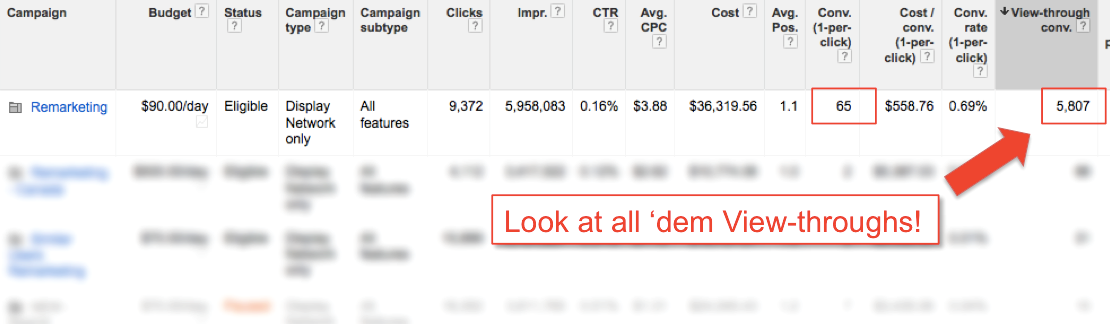
    Influence of View-through conversion

    Influence of View-through conversion

    Even if it is just a 10% improvement it still can make a difference. It could mean ratcheting up a good ROI to a great ROI. If you closely look at users clicking on your ads or otherwise you will surely see that they might not convert immediately. They can come back to your website later and convert. This is the overwhelming underpinning validation of view-through conversions. You can now measure the success of your display ad campaigns via the view-through conversion paradigm. Search engines like Google have taken cognizance of this and provide you insights into it so you get a holistic value of your display campaigns.

    View-through conversions is a tracking metrics available in the AdWords account that can give you a clear understanding of your campaigns as it can measure assisted conversions. This happens when a user views your ad but comes back to it later, may be through another channel and converts into a customer.

    Display advertising plays an important role in improving your digital marketing returns. Taking into account view-through conversions (VTC) can get you a comprehensive understanding of your efforts. It offers you a lifting effect of display advertising which hitherto you had no idea about. VTC helps to drive conversions even though it might not produce direct clicks. A visitor might return to your site via a bookmark, an organic listing or a regular URL and convert. You can then conclude that the original display ad did make a difference.

    Now, we have a formula in order to find the efficacy of VTC that can help you reckon your digital ROI.

    Actionable items

    • Segregate you target group into two parts, 90% for brand and 10% as control group with no room for overlap.
    • Use your Branded ads in the first campaign and PSA control ads for the second
    • Run the ads for a conveniently long period to collate good amount of data

    Compare results after normalizing the data

    weighted vtc

    An Example

    Sample Data

    Impressions VTC
    Brand Ads 1,000,000 1000
    PSA 800,000 720

    We need to multiply the PSA campaign results by a factor of 1.25, to normalize the data

      Impressions VTC
    Brand Ads 1,000,000 1000
    PSA 1,000,000 900

    Weighted VTC = (1000 – 900)/1000 = 10%

    Result: One in ten VTC has indeed influenced someone to take action.

    This is a holistic view of your digital return on investment. Most digital marketers might not be initially convinced of the benefits of VTC. In today’s world, people more often than not, are multitasking. So somebody might see your display ad while visiting some website at work. Now that somebody might not click immediately on that ad or even take any action at that point of time. Your ad might not even get due appreciation by the person. But the brain can register more than the eyes can see. So you might not get an immediate conversion for your display ads but that does not mean that your ad spend is completely wasted. It does create an impression and next time that person sees your ad he can immediately relate to it. There are more chances of conversion on that pay per click ad that you are going to serve him for his specific query. But then if you give 100% of the credit to the PPC ad, then it is not completely accurate. The initial display ad did have its own impact and all we say is that we now have a robust method to measure that impression leading to conversion called as view-through conversion.

    This is a new frontier in a digital marketing world addicted to clicks and quick results. VTC is an avenue that you need to explore further in your quest for improved results for digital marketing dollars spent.

    Let us know your views on View Through Conversions!

    Contact us now to make your display ads go the extra mile for you!
  • Position² @ SMX West, San Jose, March 2014

    Position2 was at the SMX West event in San Jose last month represented by our Head of SEO, Rahul Banerjee.

    We think SMX West lived up to its expectations this year, especially from a SEO point of view. A look into the future of SEO was most intriguing. SMX shed light on a few key future trends to watch for:

    If you need additional information, feel free to reach out to us.

    • Conversational Search: Advancement is seen both in complexity and nature because of changing user behavior. Now, there is increased emphasis on conversational and voice search. An example of this is the Hummingbird update which emphasizes semantic search methodology (for example, Google Auto Complete option) and Natural Language Understanding (NLU) by looking at the relevance and meaning behind the query.

    Position2 shares an example of conversational search.

    Our content strategies are aligned with user experience and the optimization of search engines also powers better search results. For example, the use of blogs, forums, the Google authorship program, social media optimization etc. helps reach out to the target more with the natural language parameter of users.

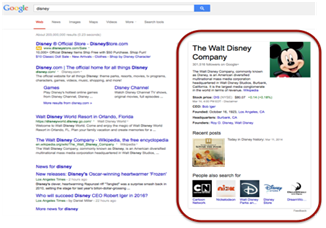
    • Knowledge Graph: It is a system that understands facts about people, places and objects and the interconnectivity between them.With the implementation of the Knowledge Graph, companies will now need to make more efforts to build their brand online. Google will include results about reputed brands of authority who are trusted. Online brand building efforts need to be an ongoing activity.

    Position2 shares an example of knowledge graph.

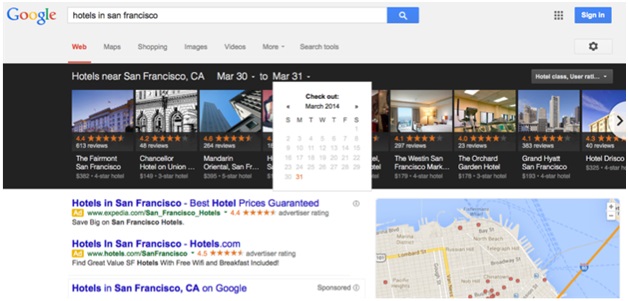
    However, Google is also testing ads on the Knowledge Graph and carousel.

    Position2 shares an example of knowledge graph ads.

    • Structure Data Markup: It helps Google understand the content architecture of a website better and facilitates faster and more relevant results.We recommend our clients implement structure data markup (eg. Schema.org) on their websites.

    Position2 shares an example of schema markup.

    Here are some more key relevant points for organic SEO:

    • High competition: With Google testing out paid ads on search results, organic search results have less shelf space and are needed to compete more to be visible. For example, if you type “Hotels in San Francisco” in Google, the top scroll of the Google SERP includes only paid ads pushing the organic results lower.
    • Mobile will soon dominate: Google mobile queries are set to surpass PC search this year.


    Image Source: Google

    Mobile is another factor that is altering the nature of search. Mobile capabilities differ from device to device, which in turn impacts the content development, communication, engagement and measurement.

    Implementing and embracing personalization will make for better search experience.

    • Apps: There is a global opportunity to develop and market through apps. However, app stores must also be localized.
    • Social presence: Google may not able to read social signals completely from other channels like Facebook and Twitter yet. But, this is going to change soon, which is why we maintain a social presence for our clients and help them build the right influencer network. Google has already said that users who use their Google logins will experience better search results. Google will roll out a full fledged algorithm soon.
    • Natural link building: ‘The best links are not asked for’. Work on natural link building. Do not use shortcuts or indulge in explicit link sales. Let the target audience refer, like, comment and build links for you.

    If you have original content that is useful for people, you can ask for recommendations/references. But your intentions will matter. Google is constantly penalizing websites with vested interest towards link building as an activity.

    • Devalued content: Press releases, articles and guest blogging are now devalued content due to over optimization techniques used by most of the SEO experts. Content that offers value should be created for the target audience and not for search engines.
    • Build recognition, reputation and trust through well-devised content marketing plans. Authority plays a vital role for Google to rank a website. Consumers also look for brand reputation and trust levels before making online purchase decisions.
    • Google Panda updates: It is likely that Panda will be updated more frequently. Expect one soon. Google is constantly testing out search parameters to provide the best results to users.
    • World does not stop at ‘Not Provided’: Post the ‘Not Provided’ update, Google changed the way it harvests data from search to protect users’ privacy. First, all logged-in users were switched to “https” from “http”, where the referral data relating to that search is hidden. But, as already indicated, that refers now to the whole universe.

    Position2 recommends analyzing success with page-level metrics like page-level traffic, bounce rate, percentage of new visitors etc. to have an edge and understand user engagement metrics.

    • Generic Top Level Domains (gTLDs): These do not impact rankings. For example, a domain like www.buymycar.com need not be ranked for car related keywords if it does not have content related to buying cars.

    Share your thoughts on the event insights with us in the comments below.

    More to follow from Position2

    … keep in touch!