Tag: Personalized Marketing

  • Hyper-Personalization—The Inevitable Evolution Of Marketing

    Hyper-personalization or ‘personalized marketing at scale’, is where Big Data and online marketing intersect. This new marketing buzzword denotes more than a passing phase—it’s part of an irreversible evolution in marketing that targets individuals with content that is tailored to them. This is marketing done smarter, and it’s a technique you need to know about.

    This new world of personalized marketing presents both opportunities and risks for marketers. We must seek to engage with our audience without being creepy or overstepping privacy boundaries.

    We all know that blanket TV ads are becoming increasingly less effective. It’s time to look at hyper-personalization to boost engagement and generate demand. Nearly 6 in 10 marketers say that personalizing content is a crucial part of their strategy, and we think that number will only increase in the foreseeable future.

    With so many experts in agreement, it’s time to face the facts. This isn’t a fad; it’s a technique that’s here to stay, and it will permanently and irreversibly change how marketing is done.

    Three ways to deliver personalized marketing at scale

    There are three key techniques we need to focus on. Let’s look at them briefly:

    1. Social listening

    Being represented on social media isn’t enough any more. The number of likes, shares and follows is irrelevant. What matters is the one-to-one connection that is created with a personalized approach. On social media, hyper-personalization means actively listening to individuals and then engaging in a conversation with them.

    2. Data analysis

    Hyper-personalization is married to Big Data. It cannot exist without it. So we need to update our data management strategies and look at ways to enrich what we know. Using a CRM is no longer enough. We need to capture profile information, scan social networks, look for relevant hashtags, and enhance our data with third-party sources. We all need to put more effort into maintaining a high level of data quality.

    3. Content and context

    Content is still king in this new age of marketing, but hyper-personalization implies that content needs to be personal and targeted. This is essentially the Holy Grail of content marketing. We need to track people, tailor our message, and create content for the individual.

    Personalization and ROI

    Hyper-personalization is intrinsically linked with providing exceptional customer service and triggering loyalty that results in increased frequency of purchases.

    Customers increasingly expect a business to know who they are, and what they want, and hyper-personalization allows businesses to make that personal connection. In a report by Infosys, 59 per cent of shoppers who have experienced personalization believe it had a “noticeable influence” on their purchasing decisions. Marketers have many opportunities to leverage this competitive advantage.

    It’s not just about creating loyalty; it’s about increasing spend, and that means giving customers more reasons to purchase, so that they come back and spend more frequently. These could include loyalty rewards, incentives, and coupons that tap into customers’ purchase triggers.

    Customers expect personalization

    At the beginning of this article, we briefly mentioned that personalization has to strike a fine balance. It has to deliver the experience customers expect, without stalking them or invading their privacy.

    Technology is providing the experience that customers are expecting, but it can also be responsible for making them feel like they’re being tracked or monitored by ads. There must be a guaranteed return in exchange for personal information, but marketers need to be cognizant of the issues around privacy and data gathering.

    Consider these figures from an eMarketer survey:

    • 21 per cent of marketers said that the experience needs to be completely unique to be effective
    • 32 per cent were neutral
    • 46 per cent of client site marketers disagreed
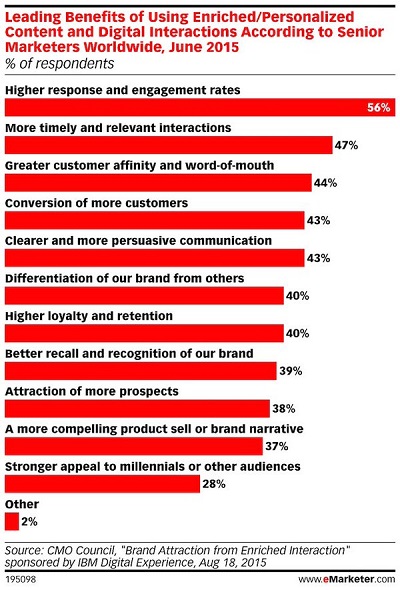
    Benefits of personalized content


    Image Source

    Perhaps the most compelling reason to use hyper-personalized content is the uplift in response and engagement rates. In a study by the CMO Council, 56 per cent of surveyed marketers reported this as an outcome of personalized content and digital interactions.

    Takeaways

    2016 is the year that segmentation will wither and die. With all the data potentially available to them, marketers now have opportunities to develop relationships with customers through engaging personal interactions and thus obtain valuable insights.

    The only way marketing teams can achieve this is to carefully analyze data, drill down to the granular details to figure out what their customers want, and build a picture from data gleaned through multiple channels. This highly focused approach can produce astonishing results.

  • Best of the Week | Let’s Get Personal, and much more…

    This week’s hot news, events and videos from the online marketing and social media world.
    Let's Get Personal
    From the Position² Blog This Week:
    Let’s Get Personal
    Personalization comes down to being interesting. Digital marketing provides marketers new avenues to personalize the buyers’ journey with an adaptive, customized pathway across multiple cross-channel touch points. Read this blog to market to your audience of ONE.
    Top Stories this Week: Social Media
    Top Stories this Week: SEO, PPC and Digital Media
    Engage and Convert: The New Rules for Digital Advertising CIM Best of the Week Video
    Have you made the most of your digital advertising investment? Digital advertising is forecasted to exceed $200 billion in 2016. Despite this investment the skills, knowledge and investment lags behind when it comes to digital advertising. Watch this webinar to help you fine tune your strategy for digital advertising success.
    White Paper: Increase Visibility for Your Content by 4x
    Today’s traditional SEO is inadequate: Ignite your search results by accelerating visibility in more places than ever before.Download this White Paper and learn:


    • SEO, why the way we know it is not enough
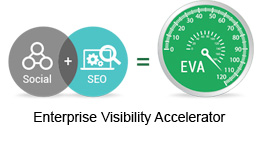
    • Introducing and implementing Enterprise Visibility Accelerator (EVA)
    • Using multi-channel tracking tools for effective monitoring
    • How EVA benefits businesses.

    Download the complimentary EVA White Paper now

    Enterprise Visibility Accelerator-EVA
    If you are reading this blog post via a RSS reader, please click here to subscribe.
  • To A/B Test or To Personalize?

    A/b testing or website personalization?

    To A/B test or to Personalize?These are two separate concepts each geared to deliver more effective marketing.

    Let’s examine a few important aspects of these before we go any further.

    As is true for most things, a/b testing and personalization also have their unique pros and cons.

    A/B Testing

    A/B testing is an approach towards making your website/emailer/online ads more effective by testing each aspect of them individually to see what delivers the greatest effectiveness. It’s a process of identifying which combination of elements, placed in what order can deliver the best results.

    Even if you have been carrying out a/b testing for years and have tested every element on your site, you can convince yourself that you don’t need website personalization only if your company is a single product/service selling entity and you sell to the same people in the same way, every time. This is a highly unlikely scenario.

    With multiple products and services, the task of A/B testing is far more complex, as one can only test one variable at a time. Testing multiple elements, one at a time can be tedious with a high possibility of confusion and errors. However, complexity should not necessarily be a deterrent to effectiveness and the investment of effort is often worth it.

    A/B testing builds effectiveness by focusing on what works with various segments of prospects. It looks at what works with the majority in each segment. What it misses out on are commercially important people who are not represented by the majority but possess significant business potential and this is where personalization comes in.

    Personalization

    Personalized marketing is about marketing to individuals based on their individual preferences and choices. This helps make them feel more predisposed towards the brand and inclined to buy. Personalized marketing includes personalizing website appearance, information, products, offers etc. This is based on data of the individual’s preferences if he is a regular customer.

    But companies can hardly mine lots of data from a first time site visitor and target them with a great personalized experience. It takes time to build that kind of robust, informative database and apply it into your website experience. Sometimes marketers use a combination of individual data and data analytics to predict what the customer will like based on the behavior of other customers who closely resemble the individuals’ profile.

    So, you should be using a/b testing, which will help you have a strong foothold with the best performing elements till your database gathers strength.

    If you have a large website, it may not be likely to gain so much of traffic that you have sufficient data to personalize every page/section. In such a case, a/b testing is useful which helps to optimize specific points on your site.

    Personalizing your website without a/b testing is like being a brand that is very interactive and friendly but does not know what its customers like.

    Website personalization lets you can target every unique individual audience member. If you have your user personas down right, you can easily target almost everyone in your target audience by embedding their personas in your website.

    What we suggest is that you take up both a/b testing and personalization. What do you think about a/b testing vs. personalization?

  • Checklist to Develop User Personas for Your Website

    Personas

    Images Source: Alex Morley

    Everyone knows that it’s important to have a website that is appealing, informative and technically updated. But, an informative and friendly website is not all that it takes to connect with visitors these days.

    Your website needs to be able to talk individually to every visitor and cater to their needs. This requires knowing:

    • Why do users come to your website?
    • What are their needs?
    • Do they have a particular problem that has to be addressed?
    • What approach do they usually take to tackle their business problems online?

    These are just some of the questions that you need to be thinking about while developing your website content. It’s easier to talk to visitors when you know who they are and what they are looking for.

    Prospects visit websites in search of solutions for stated or unstated problems but it’s not enough just to have a solution to their problem. You need to make them want to listen to you and buy from you.

    Online buyer personas define groups as specific individual types and in doing so, help the website speak directly to these individuals. For example, typifying a user type as ‘Deal seeking Donald’ helps you write your content as if you were talking to him directly, answering his questions as they form in his mind. This makes your brand look like it knows him and cares about his problems.

    Also, if you are considering embracing personalized marketing, building buyer personas will be an important step to send out the right information to the right personality type.

    Check out this step-by-step procedure that will help you create user personas for your website:

    Step 1: Define Industries & Roles

    List out the different industries your target audience belongs to: IT, e-commerce, finance etc. The next thing is to identify their role within the organization:

    • What is their designation?
    • Are they the decision makers?
    • Are they executives who actually use the product/service?

    Step 2: Define Demographics

    Gather demographic details about your target audience. Here are some questions you can ask across industries:

    Step 3: Learn their Business Objectives

    Know what makes their business tick:

    • What are the passions that drive them?
    • What business goals are they trying to achieve?
    • What are the business problems they need solutions to?

    Step 4: Your Value Proposition

    Tell users how you can enhance their business:

    • What is it that your company can offer users?
    • How is your company different from the competitors?

    Step 5: Categorize personality types

    Divide your target audience by their overall personality types:

    • Are they problem solvers?
    • Are they early adopters of new technologies?
    • Are they conservative?

    After defining your personas, here are some aspects that you need to understand:

    • What will these users expect from you in terms of products and solutions?
    • What should be your top content communication format?
    • Depending on their needs, which are the pages they are most likely to view and spend time on?
    • How will you structure those pages?
    • What keywords are the users typing in to look for your brand or industry?

    Imbibe the information you gain from user personas into your website building process.

    Can you think of any other important questions you need to answer while building user personas?

  • Google Strengthens GDN Targeting with Bizo Partnership

    Display Ads

    In a bid to improve the targeting capabilities offered on the Google Display Network (GDN), Google has struck a deal with data management and targeting platform Bizo.

    Google is now testing new targeting capabilities in beta through their partnership with Bizo. The latter has access to a database of more than 120 million business professionals throughout the world that can leveraged across different platforms such as, email, display and social.

    Bizo audience targeting capabilities coupled with GDN can make sure that your ads are placed in front of the right audience. A wide choice of audience segments are available to pick from:

    • Technology
    • Beauty
    • Fashion
    • Music and so on

    You can choose Bizo audience segment targeting within Google AdWords for both display and video campaign targeting. You can also optimize and measure campaigns in real-time since all the performance data is stored in Google AdWords.

    However, the cost of CPMs and CPCs for advertising with this kind of audience targeting on the GDN is likely to be high owing to the cost of Bizo and other third-party providers.

    This partnership will add more power in the targeting arsenal of online marketers. With personalized marketing increasing the emphasis on precision audience targeting, such empowered targeting capabilities will help marketers target the right people improving the chances of conversion and ROI. Better conversion and ROI can help in more efficient campaign planning and budgeting ensuring judicious use of your digital marketing budget.

    Do you think such partnerships will help Google become stronger in the online audience targeting space?

  • Personalized Marketing, 5 ways B2B companies can evaluate their on-site SEO program in 2014 and much more…| Best of the Week

    This week’s hot news, events and videos from the online marketing and social media world.
    Personalized Marketing - How personal should you get?
    From the Position2 Blog This Week:
    Personalized Marketing – How personal should you get?
    Consumers are asking for personalized messages. But, is there something like too much personalization? Read our blog to know more about personalized marketing, its benefits and how much personalization is required.
    Top Stories this Week: Social Media
    Top Stories this Week: SEO, PPC and Digital Media
    Best of the Week Video Best of the Week Video
    IBM’s innovation is not just restricted to Watson. Check out IBM’s videos on youtube for some innovative ideas to create B2B videos.
    White Paper: Increase Visibility for Your Content by 4x
    Today’s traditional SEO is inadequate: Ignite your search results by accelerating visibility in more places than ever before.Download this White Paper and learn:

    • SEO, why the way we know it is not enough
    • Introducing and implementing Enterprise Visibility Accelerator (EVA)
    • Using multi-channel tracking tools for effective monitoring
    • How EVA benefits businesses.

    Download the complimentary EVA White Paper now

    Know more about Enterprise Visibilty Accelerator(EVA)
    If you are reading this blog post via a RSS reader, please click here to subscribe.
  • Personalized Marketing – How Personal Should You Get?

    Personalized Marketing

    Personalized marketing.

    Though the name is pretty much self-explanatory, we would still like to define it because it is a significant aspect of modern marketing and deserves a definition. Simply put, personalized marketing is the breaking down of the mass marketing process to directly address the needs and interests of individual prospects.

    Why is personalized marketing so important?

    In the past, it was probably acceptable to a certain extent for marketers to send out generic communications. You would remember that personalized messages weren’t as common some years ago, as they are today. Generic communication to the entire audience suited everyone whether customers or marketing departments for no one knew or even could do any better.

    As consumers and technology changed, there was a need for marketing to become a lot more focused and cost-effective. Consumers began asking for their individual needs to be addressed and marketers had to measure up to the changing expectations.

    Increase in the amount of content

    This situation escalated with the onslaught of online content. The internet is an ocean of content and an average person receives more content today and from more sources than compared to a few years ago.

    Sifting through the entire content one receives, looking for information that is relevant, is not something that anyone looks forward to. In the midst of all this generic (and mostly irrelevant) content, people are on the lookout for communications that talks to them directly and offers to address their needs.

    Marketing is getting more personal

    According to research conducted in 2013, 74% of online customers said that they get frustrated when they encounter content irrelevant to their interests on websites.

    This goes to show that after being literally (or, should we say virtually) bombarded with generic content, consumers don’t want to be bundled with a crowd. They want personalized brand messages that are in line with their interests.

    But if you think that this mindset is restricted to brand messages, you’re wrong. Consumers want the entire marketing process to be personalized, sometimes including personalized products too. And while this is tough, marketers are figuring how to do this because it stands to deliver greater loyalty and higher sales.

    Benefits of Personalized Marketing

    Personalized marketing is also helpful in nurturing leads and retargeting campaigns. Talking to a lead about something that interests them about your brand will naturally capture their attention and result in better lead nurturing.

    With retargeting campaigns, targeting prospects with products/services they have already shown an interest in buying may prod them into actually making the purchase.

    But, but, but…how personal can you get? Doesn’t this personalization need to stop?

    Introducing personalization as early as possible and increasing it as far as possible is a great way to improve loyalty and effectiveness.

    What’s important, however, is that it should be done right.

    Do it right.

    Adopting an overly familiar tone with prospects just because you know their name or presuming that you know their requirements too early in the relationship can put them off. You definitely don’t want to get off the wrong foot like this. Nobody likes a smug presumptuous associate!

    However, as you gain more knowledge about the prospect, using this well to personalize your information, suggestion of products, etc. will help further the relationship. You can even use a marketing automation system to manage this if the volume of prospects is high. Mass personalized marketing as a concept is here to stay.

    We would love to know what your opinion is about personalized marketing. Drop your comments in the box below…